
Ecumenical “Crusaders” and the other, other Notre Dame
In the weeks following, I attended two ecumenical evenings, of quite different character.
The first was with an informal network that has been meeting for decades, the Jerusalem Ecumenical Friends Network (or some variation thereof). Moderated by a kindly White Father (Missionaries of Africa), about 25 of us gathered in the Austrian Hospice (founded 1863) including representatives of the Anglican, Armenian Apostolic, Baptist, Greek Orthodox, Lutheran, and Catholics of Latin, Melkite, and Maronite churches. Focolare and Chemin Neuf were both present. Others are often represented, often including Churches with little or no official dialogue. A pleasant evening and a great way to connect with some of the local ecumenists. From Tantur, the rector, librarian, and myself were present. Simpler in nature, this was the real ecumenists’ meeting; the second was more grand, though a little less on-topic for Christian Unity. The opportunity no less appreciated for that, however.
A few days after returning from meetings in D.C. and at [the University of] Notre Dame, I was privileged again to join an ecumenical group for an evening affair. This time, we started with liturgy at the chapel of the Sisters of Charity of St. Vincent de Paul, followed by a reception and dinner at Notre Dame Centre of Jerusalem, just north of the Damascus Gate. (No affiliation of the former with the latter, to my knowledge, but someone recently told me that the bar serves glasses with the monogram ND on it. Will have to go investigate.)
Having been to the Cathedral of Notre Dame in Paris on my way to the University of Notre Dame, this makes the third Notre Dame I had been to in little more than a week’s time.

The installation liturgy was accompanied by an impressive Polish choir and included clergy representatives from the Latin and Melkite Catholics, the Armenian Apostolic Church, the Greek Orthodox, the Coptic and Syriac Oriental Orthodox, Anglican, Lutheran, and the United Protestant Church of France. Arab Catholic scouts were present as servers and standard bearers.
In a bit of interesting trivia, I only just discovered that the Centre is actually a Territorial Prelature, giving it quasi-diocesan status, distinct from the Latin Patriarchate, with the Apostolic Delegate as Ordinary. Originally built as a pilgrim house for the French by the Assumptionists in 1904, the Yom Kippur War left it in a state of disrepair. It was given over the Holy See in 1972, and Pope John Paul II established it as a territorial prelature barely two months into his papacy. In late November 2004, just four months before his death, a motu proprio was issued giving control of the Centre to the scandalously problematic Legion of Christ. Given the pope’s known health issues at the time as well as the already well known problems in the Legion, this move was, shall we say, controversial.
The occasion this time was an elaborate ceremony and dinner celebrating the installation of a new Grand Master of the Order of St. Lazarus* and the initiation of several new members from around Europe and the Mediterranean, including an Orthodox colleague I have met here.
Prior to this event, all I knew of the Order was that they had some connection to, or inspiration from, the crusader-Hospitaller order of the same name, and their intentional ecumenical inclusion of members, and their support of a keynote at the National Workshop in Christian Unity in the U.S. It is this ecumenical inclusion – if not explicit goal of Christian Unity – that makes this Order more appealing to some ecumenists than some of the more widely known charitable Orders – such as the Sovereign Military Order of Malta, or the Equestrian Order of the Holy Sepulchre. (I am coming to think of all of these organizations as elaborate donor recognition societies, or as the Knights of Columbus on steroids. Which is no bad thing, in itself).
I was impressed with the conversations I had, with both officers and guests, including delightful dinner conversation with the local Finnish Lutheran pastor and her daughter, though we shared the experience as sort of outsiders – coming from cultures where the medieval concepts of royalty and nobility have been excised. Many of those present were from European countries where these ideas are still very much alive, if in a different form than was the case when monarchs were heads of government as much as heads of state. That lead me into further investigation of the Order and of the crusader orders in general which are, or claim to be, extant today.

* Five major military-monastic orders were formed in the Holy Land during the era of the first crusades:
- Equestrian Order of the Holy Sepulchre of Jerusalem (c.1099)
- Order of the Knights of St. John of Jerusalem, Rhodes and Malta (Knights Hospitaller) (c. 1099)
- Poor-Fellow Soldiers of Christ and of the Temple of Solomon (Knights Templar) (c.1118)
- Order of the Brothers of the German House of St. Mary in Jerusalem (Teutonic Knights) (1190)
- Order of St Lazarus of Jerusalem (1123).
Some, like the Templars, were disbanded (giving us Friday the Thirteenth as an unlucky day). Others morphed into elaborate charitable organizations, continuing the work of hospitals or support of the Christians in the Holy Land, but abandoning the militaristic aspects after the conquest of Acre in the late thirteenth century. The Order of St. Lazarus survived in this transformed mode, and various attempts were made by popes to merge it with other Orders (Order of Our Lady of Bethlehem, the Order of Malta, the Order of St Maurice) throughout the fifteenth and sixteenth century. At the beginning of the seventeenth, the Order was effectively transferred from papal oversight to the royal house of France. It effectively ceased following the French Revolution, Royal Protection being withdrawn from the Order in 1830.
Whether it continued then or in what form is apparently a matter of some dispute among historians of chivalrous orders, nobility, and the like.
In 1910, though, the Melkite patriarch and some veterans of the papal army revived the Order as a non-profit charitable association under French law. Its efforts at ecumenical inclusion began in the 1960s, in fidelity to the reforms of the Second Vatican Council and in the interest of expanding into the anglophone world.
Ironically, just as the Order embraced these ecumenical values, tensions between anglophone and francophone leadership lead to a schism in 1969 between what became known as the Malta and Paris obediences, respectively. Attempts at reunion only partially succeeded in 1986, when a significant portion of the anglophone members in the Malta obedience joined the Parisian sector, including the U.S. In 2004, a schism within the Paris obedience resulted in an Orleans obedience, under the spiritual patronage of the Archbishop of Prague. Further confusion is caused when, in 2010, some of the original leadership of the Orleans obedience broke away and formed St. Lazare International, based in Jerusalem. Happily, in 2008, the majority memberships present in the Paris and Malta obediences reunited, leaving three main branches of the Order (indicated with their respective spiritual protectors):
- Order of St. Lazarus – Malta-Paris – Melkite Patriarch Gregory III Laham
- Order of St. Lazarus – Orleans – Archbishop Dominik Duka, OP, of Prague
- Order of St. Lazarus – Jerusalem – Bishop Richard Gerard, emeritus Representative of the Archbishop of Canterbury to the Holy See.
There is also an Italian ‘branch’ that seems to have little to do with the rest:
- Ordine San Lazzaro – “Bishop” Giovanni Ferrando (who appears nowhere in the Italian hierarchy list and whose supposed address is the local renaissance castle…)
If you are interested, more extensive history of the order is provided here by the order itself, and here by a skeptical researcher.
Nevertheless, the charitable work of the Order – mostly hospital and ambulance work – and its ecumenical inclusion are worthy of admiration. All such orders could, perhaps, divest themselves a bit of concerns over nobility and dynastic ties and promote based on merit alone. That being said in principle, my impression of Prince Sixte-Henri and his officers was positive, setting the standard for what one supposes nobility is supposed to represent in the first place.

High Holy Days
A month into my fellowship at Tantur, and though time is flying, it has proved to be just what I needed – an escape from the work and distractions of Rome. Not that the last three weeks have been without concerns, as violence has escalated in and around Jerusalem. Thankfully, Tantur is safely removed from the areas of tension, and spending the day in the library and at my desk is easy to do. There have been some exceptions worth sharing, however.

I arrived in the middle of the High Holy Days, between Rosh Hashanah (Jewish New Year) and Yom Kippur (Day of Atonement), the latter of which coincided this year with the beginning of Eid Al-Adha (Feast of Sacrifice/Time of the Hajj).
Tantur is at the southern end of Jerusalem, about 8km from the Old City, and just under a kilometer north of the checkpoint into Bethlehem. (It is another 3.5km to the Church of the Nativity).
On Yom Kippur a group of us walked into the old city, stopping at St. Clare Monastery on the way. The Poor Clares here arrived from France in 1884. A glimpse into their life can be found online here.
On arrival in the Old City we went first to vespers with the German Benedictine monks at the Abbey of the Dormition, on Mount Zion, just next to the Tomb of King David and the Cenacle (the Upper Room of the Last Supper). Through the construction of the abbey took place from 1900-1910, with the first monks arriving in 1906, the history of the community starts with the 19th century immigration of Germans into Jerusalem, culminating in the 1898 visit of Kaiser Wilhelm II. During his tour, the Kaiser dedicated the Lutheran Church of the Redeemer in the Old City and donated the land for the Abbey to the German Association for the Holy Land.
After vespers we wend our way down to the Kotel (the Western Wall), just in time to get settled before the shofar (ceremonial ram’s horn) sounded, marking the end of the day of fasting and the beginning of a celebration. This was one of the most moving spiritual experiences, watching the joy and celebration. I had not arrived in the Holy Land expecting this to be on my to do list, but now I can cross off something that belongs up there with Midnight Mass at St. Peter’s, as far as lifetime religious experiences go. It has made me realize that any “bucket list” i might keep for myself begins with unique spiritual religious places/times. Appropriate, then, that my time here begins with Yom Kippur at the Wall and will end after Christmas in Bethlehem.
Quickly added to the list was the opportunity to celebrate Sukkot – the Festival of Booths, or Tabernacles – with a friend from Hebrew University. A rooftop Sukkah and a cozy company of guests from both Israel and the U.S. made for a real welcome to this place. I imagine the cultural equivalent to be Thanksgiving – you know you have been welcomed as friend and family when you have this gift!
Three Months at Tantur, Jerusalem
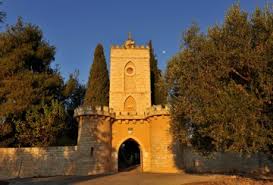
The Ottoman-era gate at Tantur
Summer has come and gone, and I find myself checking off something that has been on my “Bucket List” for nearly two decades: Living and research at Notre Dame’s Tantur Ecumenical Institute in Jerusalem.
I arrived in the Jerusalem late Sunday night, after what felt like a week in transit via Seattle, Vancouver, Minneapolis, Amsterdam and Rome. My first thought, as the Nesher shuttle drove under Montefiore Windmill, is that time flies and I can hardly believe it has already been 5 years since my first visit to the Holy Land. That was a 9-day seminar with the Russell Berrie Fellowship, at the Shalom Hartman Institute.
Today, I embark on a 3-month dissertation writing fellowship at Tantur. It has taken three years of working multiple part time jobs (university teaching, research assistant, study abroad residence manager, spiritual advisor, international program staff) to get to the point I could take a few months ‘off’ and actually work full time on my dissertation. I am looking forward to it, but I confess it takes a couple days to adjust to having so much time to work on the one thing I never seem to have time for!
Thankfully, Tantur has a library of about 60,000-70,000 volumes on hand, with emphasis on ecumenism and patristics. [By comparison, the Centro Pro Unione in Rome has about 24,000; the World Council of Churches library at Bossey has about 100,000.] The library resources suffered some during the Second Intifada (c2000-2005), and is in the midst of updating its collection – a project I have been asked to help with while I am here, as part of my Fellowship.
The roots of the institute go back to the Second Vatican Council and encounters between Paul VI and ecumenical observers, who dreamed of an international theological institute for ecumenical research and life. The famous 1964 meeting of Paul VI and Athenagoras in Jerusalem on the Mount of Olives sparked the notion that this would be the obvious place for such an institute to be established.
Before long, Paul VI entrusted the vision to none other than Notre Dame’s president, Rev. Theodore Hesburgh, CSC. As he looked around Jerusalem, he seemed to find the perfect spot.
Tantur is located on 36 acres of hilltop olive trees, vineyards, and pine. Overlooking Bethlehem, Gilo, and Bayt Jala, a short drive south of Jerusalem and with the mountains of Jordan visible on a clear day, the location has been understandably described as “strategic”. Prior to the 1967 Six Day War, this was Jordanian territory, and is ‘east’ of the Green Line but west of the border fence surrounding Bethlehem.
The property itself belonged to the Sovereign Military Order of Malta, at least since 1869, when it was administered by the Habsburg Austro-Hungarian Empire’s branch of the SMOM. During the Ottoman era, they operated a hospital on this site. Apparently, though, there are ties to this land with the order dating back to their first arrival here – in 1099, with the first crusade.
Fr. Hesburgh convinced Paul VI to purchase the property from the Order in 1966, for $300,000, just a few months shy of the Six Day War. The initial cost of building the center was estimated at $1 million, for which Fr. Ted looked to the generosity of I. A. O’Shaughnessy (known on campus for having donated the funds for the Arts and Letters College). Notre Dame leased the property from the Vatican in 1967, but building had to wait during the conflict, after which Israel now controlled the territory. By the time the center was constructed in 1971, the cost had doubled. The first year of operation was 1972.
Anticipating the renewal of the Vatican lease of Tantur to Notre Dame for another 50 years, starting next year, the University has approved a strategic plan that would propel the Institute to its next phase. The original vision of a resident community of scholars has ebbed and flowed, and most of the people who come through do so either for sabbatical or short term programs, in addition to ND’s study abroad programs in the spring. There are currently three of us considered resident Fellows or Scholars: A Church of England priest, a Jewish biblical scholar, and myself. There is also one seminarian intern/program assistant. There are about twenty people here on a three-month sabbatical/continuing education program, mostly Catholic priests (with two Anglicans). It is easy to envision something like the Lay Centre in Rome as a model for the community life here, with a more explicit focus on ecumenical dialogue.
***
I had finished most of this post at the end of my first full day here; this morning (Yom Kippur/ Eid al-Adha) I heard the news of the shooting death of a 19-year old university freshman at a security checkpoint from a Mennonite peace worker. It is a somber reminder that even as I am here to get away from the distractions of the world to write and research, and as quiet and peaceful as things appear from this hilltop retreat, the complexities of the situation here, and the tragedies, require our prayer for peaceful resolution. And deeper understanding. I am no expert, and I hope the next three months bring me to a deeper understanding and solidarity with my brothers and sisters here – Israeli and Palestinian, Jewish, Muslim, Druze, and Christian.
A Common Date for Easter?
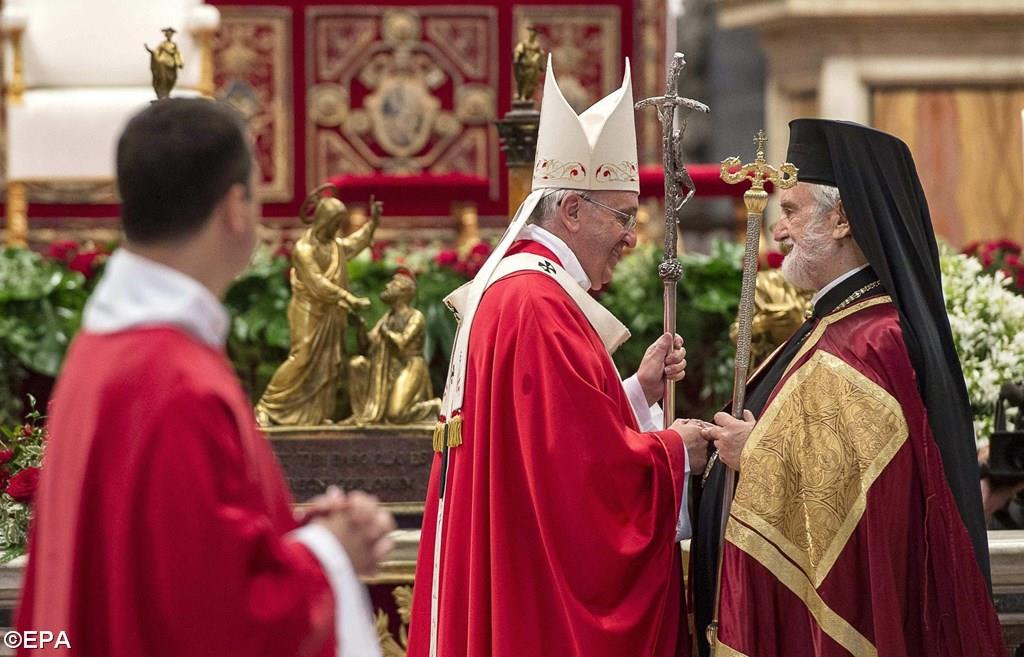
Pope Francis and Metropolitan John
Re-posted from Rev. Ron Roberson, CSP at the USCCB Secretariat for Ecumenical and Interreligious Affairs:
Last month, in his address to a group of priests in Rome from around the world, Pope Francis again raised the question of the date of Easter, which Orthodox and western Christians have usually celebrated on different dates for centuries. In fact, he said that the Catholic Church was “ready to renounce” its method of calculation of the date of Easter in order to reach an agreement with the Orthodox Church, so that all Christian churches can celebrate Easter on the same day. What’s going on here?
In the early church there was considerable confusion regarding the date of Easter and different areas were observing it on different days. Eventually a consensus developed that harkened back to discussions at the First Council of Nicaea in the year 325, that Easter should be celebrated on the Sunday following the first full moon after the spring equinox. This is the classical formulation that has remained in place until the present day.
But as the centuries went by, things grew more complicated. Most importantly, the calculation of the date of Easter on the traditional “Julian” calendar became more and more inaccurate. Eventually there was a reform of the calendar in the West that was promulgated by Pope Gregory XIII in 1582. The reform included skipping ten days in October (October 4 was followed by October 15 that year) and the introduction of leap years. In the West this new and much more accurate “Gregorian” calendar was subsequently used to calculate the date of Easter, but the Eastern Churches continued to use the Julian calendar. Another difference in calculation is that in the East, Easter may never coincide with Jewish Passover but must come after it; in the West the two can coincide.
As a result, for several centuries now the western and eastern churches have had different ways of calculating the date of Easter. Sometimes they still coincide, as they did in 2010, 2011, and 2014, and will again in 2017, but not after that until 2025. Often the two are just a week apart but can be much farther apart, as they were in 2013 (March 31 and May 5), and will be in 2016 (March 27 and May 1), and 2024 (March 31 and May 5). It should be noted, however, that the eastern and western calculations of the date of Easter are not absolutely identified with the western and eastern churches. Catholics in Greece, for example, celebrate Easter on the Orthodox calendar, and the Orthodox in Finland celebrate on the western calendar used by the majority of Christians in that country. Some Eastern Catholics also celebrate Easter on the Julian calendar.
It has often been observed that the inability of Christians to celebrate together the central mystery of their faith is nothing short of a scandal, and it diminishes the credibility of Christian witness to the Gospel in today’s world. With this in mind, the Vatican and the World Council of Churches sponsored a conference in Aleppo, Syria, in March 1997 to examine this question. At the end of the meeting, the conference issued an agreed statement entitled, “Towards a Common Date for Easter.”
The Aleppo document recommended that all the churches reaffirm their acceptance of the formula of the Council of Nicaea, but that the astronomical data (the vernal equinox and the full moon) be re-calculated by the most accurate possible scientific means, using the meridian of Jerusalem, the place of Christ’s death and resurrection, as the basis for reckoning. The result of this re-calculation would produce a calendar different from both the eastern and western calendars as they exist today, although it would be closer to the western one. It would allow all Christians to celebrate the Resurrection together, while also being more faithful to the Council of Nicaea than any of the churches are today. The obvious advantages of this solution were spelled out in an agreed statement of the North American Orthodox-Catholic Theological Consultation in October 1998.
Nevertheless, it has become clear that the Orthodox are not able to support the proposals in the Aleppo document. The reasons for this are not primarily theological but pastoral. After World War I most of the Orthodox Churches (except Jerusalem, Russia, Serbia, and Mount Athos) adopted the Gregorian calendar for fixed feasts, but not for Easter and the movable feasts dependent on it. There was a strong reaction to this among the faithful with a more traditionalist outlook, which led to schisms and the foundation of several “Old Calendar” churches in Greece, Romania and Bulgaria that still exist today. Also, in Russia in the early years of communism the Soviet government supported a “Living Church” movement within the Orthodox Church that advocated the use of the Gregorian calendar. That group was eventually suppressed in 1946, but in the minds of many faithful there was now a connection between the Gregorian calendar and communism. These fairly recent schisms within Orthodoxy explain why the Orthodox are extremely reluctant to tamper with their traditional reckoning of the date of Easter.
In view of this history, it is not easy to imagine an agreement on the date of Easter that all Christians would find acceptable. The Aleppo document proposed an eminently reasonable solution that the Orthodox have been unable to accept. A fixed date for Easter such as the third Sunday of April would be a departure from the tradition that few would find acceptable. It has often been observed that the only way that all Christians could agree on a date for Easter would be a universal adherence to the Orthodox calendar. This solution would have obvious disadvantages, but in the real world it may be the only one possible.
—
Father Ronald Roberson, CSP is associate director of the Secretariat for Ecumenical and Interreligious Affairs of the U.S. Conference of Catholic Bishops. He is also a consultor to the Vatican’s Congregation for the Oriental Churches.
The Church of the East: There can be only one
It has been a big news week. And I already digressed into the area of moral theology and civility to comment on one of the rulings by the U.S. Supreme Court this week, i am not speaking of the rest (though, as a Catholic Christian, i believe universal access health care is a good, and capital punishment is not, so it was a pretty mixed bag all around).
Ecumenically, there have been a few interesting developments.

Metropolitan Hilarion
The General Synod of the United Church of Christ (USA) unanimously approved a full communion agreement with the United Church of Canada yesterday. The UCC and the UCC are both ‘united and uniting’ churches, themselves the products of previous ecumenical reunion efforts. The UCC (USA) already has similar agreements with the Christian Church (Disciples of Christ), the Union of Evangelical (read:Lutheran) Churches in Germany, the Presbyterian Church (USA), the Reformed Church in America, and the Evangelical Lutheran Church in America.
Two days ago, the Corriere della Sera published an interview with Metropolitan Hilarion Alfeyev, the head of external relations for the Moscow Patriarchate. He is quoted as saying that a meeting between Patriarch Kiril and Pope Francis “is getting closer every day”. Though this is his boilerplate response when asked about a meeting between the head of the largest Orthodox church with the bishop of Rome, he alluded that it was actually on the agenda – though no date is set, and it would certainly be in a ‘neutral’ location like the Austro-Hungarian Empire Austria or Hungary. This meeting has been in discussion for 20 years, since the intended meeting between Alexy II and John Paul II was cancelled at the last minute.
And of course there was the annual delegation from the Phanar to the Vatican on the patronal feast of Rome, Sts. Paul and Peter. Leading the delegation this year was Metropolitan John (Zizioulas) of Pergamon, who was also part of the panel presentation of the environmental encyclical Laudato Si. He and Metropolitan Hilarion were both in Rome this week as part of the drafting committee of a statement, “Towards the Understanding of Synodality and Primacy in the Church of the First Millennium” by the International Commission for Theological Dialogue between the Orthodox and Catholic Churches.
Pope Francis and Metropolitan John
Probably the most interesting, and potentially most dramatic, however, was the proposal of Patriarch Raphael I (Louis Sako) of Bablyon, head of the Chaldean Catholic Church, who proposed a plan for a united Church of the East that would entail his own resignation.
The schism between the Church of the East and the rest of the orthodox Christian world is the oldest surviving division in the Church, its origins dating back to the Council of Ephesus in 431 AD. It was the Christian Church in the Persian Empire, and has often (wrongly) been called Nestorian. Acknowledging that there is now brief way to do justice to the history of communion and schism between the Church of the East and the Catholic/Orthodox Church(es) in the last 1600 years, suffice it to say that what remains is a very small community based in Baghdad but effectively existing as a diaspora community, with its leaders often in Exile.
There are three current churches succeeding from that original Church of the East, which was founded, according to tradition, by the apostle Thomas and by Mar Addai (Jude/Thaddeus, maybe, or a disciple of Thomas) and Mari, a disciple of Addai.
The Assyrian Church of the East, whose Catholicos (Patriarch) Mar Dinkha IV died in March, consists of about 250,000 faithful, mostly in the U.S., Europe, and Oceania. The election of his successor has been postponed until September. The patriarchate went into exile to the United States in the 1930s. (The Assyrian Church is, to the best of my knowledge, the only ancient apostolic church where priests and deacons have been allowed to marry even after ordination; in the Orthodox and Catholic Churches, married men could be ordained, but ordained men could not be married).
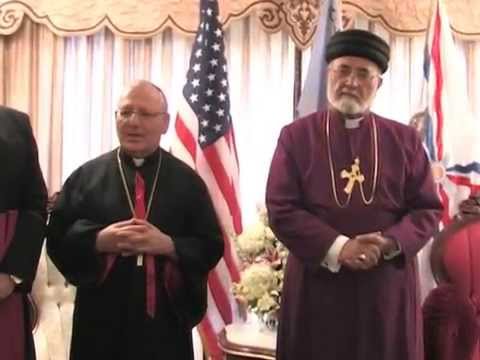
Patriarch Raphael I and Mar Dinkha IV
The Ancient Church of the East, whose Catholicos is Mar Addai II (since 1970!) numbers about 100,000 faithful and the patriarchate remains in Baghdad. From at least 1450 until 1976, the patriarchate of the Assyrian Church of the East had become a hereditary office, passing from uncle to nephew. In 1964, some members of the Assyrian Church used the official adoption of the Gregorian calendar as an opportunity to split from the rest, the underlying reason being objection to this hereditary practice and perhaps wanting to keep the hierarchy based in its ancient homeland.
The Chaldean Catholic Church was initially established in 1553 when a similar break-away faction of the Assyrian hierarchy (also objecting to a hereditary patriarchate) sought full communion with Rome, and over the next three centuries there was a great deal of fluidity back and forth, only stabilized about 1830. The Chaldeans number somewhere between 500,000 and 750,000, also mostly in diaspora. Patriarch Raphael I has been the primate of this church since 2013.
For the last three decades, there have been very successful ecumenical dialogue between the Catholic Church and the Assyrian Church of the East, resulting in a Joint Christological Declaration in 1996, resolving the theological issue that had divided the churches of Rome and Persia back in the 5th century. Ten years later an agreement on sacraments was reached but not promulgated due to some internal issues. The only remaining issue holding back full communion was that of common ecclesiastical governance, and this is what Patriarch Raphael of the Chaldean Catholic Church has proposed to resolve now, if he and Patriarch Addy II both resign, and the bishops of all three churches come together to elect a single Catholicos-Patriarch.
Let us pray that this comes to fruition this year!
I would like to share some personal thoughts with those of others, since they may contribute to achieving the project of “the unity of the Church of the East”.
Unity is the commandment of the Lord Jesus, “so that they may be one” (John 17/11), and the demand of Christians who face significant challenges that threaten their existence in diaspora with assimilation, and in the motherland with extinction
I propose that we adopt a single denomination for the church: The Church of the East as it was for many centuries, and that we not maintain the factional denominations. The single denomination will give it strength and momentum, and it can become a model for other churches.
The communion of faith and unity with the Roman See is a fundamental base of unity. It is an increase of power, not a decrease, especially since there is no difference in doctrine, but only in its formal expression. Therefore, to think of disassembling the link of “the Church of the East” with the See of Rome would be a great loss and cause of weakness. Unity does not mean uniformity, nor the melting of our own church identity into one style, but it maintains unity in diversity and we remain one apostolic universal church, the Oriental Church, that maintains its independence of administration, laws and liturgies, traditions and support through respect for the authority of the Patriarch and the Synod of Bishops.
After deliberation and dialogue between the three branches and the acceptance of this communion with Rome:
1. The current Patriarchs: Louis Raphael Sako, Patriarch of the Chaldean Catholic Church, and Mar Addai II, Patriarch of the ancient Church of the East, would submit their resignations without any conditions, but their desire for unity.
2. The Bishops of the three churches would meet to choose a new Patriarch.
3. The elected Patriarch should have assistants from each branch to enhance the “weft” (the permanent Synod).
4. The Patriarch and the Synod would leave national interests to the laity, because the church should be open to everyone and concerned with the best interests of all.
5. The Patriarch and the Synod would prepare for a General Synod to develop a new road-map for The One Church of the East.
[For the best guide to navigating the byzantine waters of Eastern Christianity, see Ron Roberson, The Eastern Christian Churches, now in its 7th Edition]
SCOTUS: Beautiful Opinion, Brilliant Dissent
I took great delight in reading both of these passages from the recent Supreme Court decision overturning state bans on same-sex marriage.
Justice Kennedy’s opinion:
No union is more profound than marriage, for it embodies the highest ideals of love, fidelity, devotion, sacrifice and family. In forming a marital union, two people become something greater than they once were. As some of the petitioners in these cases demonstrate, marriage embodies a love that may endure even past death. It would misunderstand these men and women to say they disrespect the idea of marriage. Their plea is that they do respect it, respect it so deeply that they seek to find its fulfillment for themselves. Their hope is not to be condemned to live in loneliness, excluded from one of civilization’s oldest institutions. They as for equal dignity in the eyes of the law. The Constitution grants them that right.
Justice Scalia’s dissent:
‘The nature of marriage is that, through its enduring bond, two persons together can find other freedoms, such as expression, intimacy, and spirituality,’ “Really? Who ever thought that intimacy and spirituality [whatever that means] were freedoms? And if intimacy is, one would think Freedom of Intimacy is abridged rather than expanded by marriage. Ask the nearest hippie.
…The Supreme Court of the United States has descended from the disciplined legal reasoning of John Marshall and Joseph Story to the mystical aphorisms of the fortune cookie.
Would any of my hippie friends like to comment on the abridgment of the Freedom of Intimacy? Justice Scalia is one of the most brilliant men i have ever met. I find myself disagreeing with his conclusions as often as not, but his clarity of thought is often undeniable. As is his acerbic wit.
Right and Wrong: Catholic Responses to SCOTUS
For Catholic Christians, there is a right way and a wrong way to disagree with the #SCOTUS ruling against banning same-sex marriage in the U.S.
Let us say for a moment you are a Catholic Christian and you believe that marriage is part of the natural law, a primordial sacrament that has been part of the make-up of human society since the beginning, between one man and one woman, an expression of total love and fidelity, for life.
(And let us assume you are familiar with the Catechism’s section on the sixth commandment, or, better, the tradition of Christian moral thinking it attempts to summarize.)
I imagine that most of the world would not be surprised that this is your belief.
Now in the wake of the latest decision by the Supreme Court of the United States to overturn laws banning same-sex marriage throughout the land, how do you respond?
Based on the entirely unscientific method of scanning my Facebook feed for an hour as I think about this, it seems nearly everyone falls into one of two camps: outright celebration or something ranging from grumpy disgust to hatred.
Of course, there are secularists who lump all religions or religious people in the same basket with the most hateful. There are those who suggest that the only possible reason for opposing this ruling is homophobia. Both sides have extremists and a lack of nuance. These are wrong too, but not the point of my post…
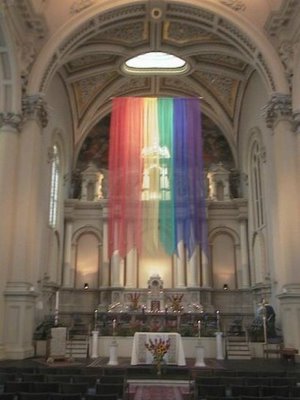 The right way, from a Catholic Christian point of view, has been shared by the likes of Archbishop Wilton Gregory, Archbishop Gregory Aymond. Bishop Gerald Kicanas, James Martin, SJ, Dan Horan, OFM, Elizabeth Scalia, and many others.
You can affirm the Christian position of marriage, affirm the sacramental nature of marriage, speak of the beauty of the primordial sacrament and the integral ecology of human nature – and then proceed to honor the Church’s teaching to love one another, to treat our LGBT sisters and brothers with “respect, sensitivity, and compassion”. You can choose to “light a candle, rather than curse the darkness”. You can choose to celebrate the good present in the decision, aware of its limitations.
The wrong way comes from those who speak of a “war on marriage”, that the judgement “harms the common good”, is “immoral and unjust”, is “anti-Catholic” or “a persecution of Christian freedoms”, to claim that “Love has lost”, or to refer to it as “a wrongly decided decision” (that primarily because of bad prose). To the Texas pastor who threatened self-immolation: get thee to an exorcist. Or a shrink.
The cringe-inducing, fear-mongering, and hate-filled rhetoric of some commentators – sadly, even including a few bishops and religious leaders – do more harm than good. Giving scandal, in this case encouraging homophobic violence or hatred, is a greater sin.
To liken this decision to Roe v. Wade and therefore to liken same-sex marriage to abortion is beyond the pale. One is about love and fidelity – even if, as a Catholic Christian, it is not sacramental marriage, or marriage in the proper sense; the other is about killing innocent children before they are born. There is no comparison.
To speak of same-sex marriage as an attack on heterosexual marriage is nonsensical; certainly it is unhelpful to the cause (as the cartoon below illustrates). No-fault divorce is an attack on marriage. A throw-away culture that encourages people to recycle spouses as readily, or more readily, than their smart phones is an attack on marriage. Pornography and Disney and The Bachelorette and every trashy romance novel ever written are attacks on marriage, with their unrealistic scenarios, false hopes, and impossible standards for success. As a Catholic Christian you might say that same-sex marriage is only a partial good – honoring the unitatve purpose of marriage if not the procreative – but you can celebrate the good that is there. Most Catholics i know would say committed monogamy in any form is better than the alternatives, morally speaking. Why be so afraid of recognizing the steps on the way to perfection that we all must take. Meet people where they are, and walk with them further. There are many kinds of civil marriages that the church does not recognize as sacramental, including a significant number among Catholics. This is no different, at that level.
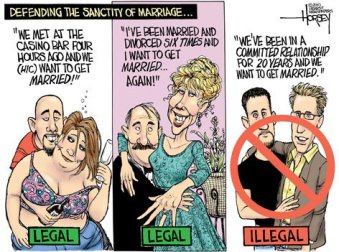 Honestly, I have never understood the hatred that is tolerated in Christian circles when it comes to homosexuality. As a kid, at least from my perspective, the Church was always a place where everyone was welcome. Which is not to say the Church did not teach clearly what it thought was right and good and what it did not. But everyone is imperfect, we are all a pilgrim people: The Church is about field triage, not a social club for the elite, so everyone is welcome. Being Catholic and being homophobic were as mutually exclusive in my early years as being Catholic and being racist. I knew there were some fundamentalist Christians who seemed to preach hate, but I had never encountered it in the Catholic Church.
It was only at university – at Notre Dame – that I first encountered otherwise level-headed, loving, and reasonable Catholics who seemed to abandon reason and charity both when the topic of homosexuality came up. This is unacceptable.
God is love. God calls Christians to love. Not just to love those who vote as you vote, or read the same journals you read, or go to the same form of liturgy you attend, but to love our neighbors, our enemies, everyone. Only with love can you speak truth, and until you have the former, you cannot hope to find the latter.
Theology Jokes 2015
I may not have uploaded last year’s!
Some Pharisees bring an adulteress before Jesus and ask Him what they should do with her, reminding him that the typical penalty is stoning. He calmly replies “let the one among you who is without sin cast the first stone.” A single rock soars up our of the crowd and strikes the adulteress on the head,, knocking her senseless. Jesus’ initial look of bewilderment is quickly replaced with annoyed indignity as he shouts, “Mom!”
A priest had been hearing confessions all day and was really hoping to get out early so he could catch a playoff game with his home team. Ten minutes before game time, it had already been quiet for a while. Assuming there were no more people in line, the priest got up to go, happy that he would be able to catch the game after all. Just as he did so, he heard to door of the confessional creak open.
“Please let it be a little old lady who will only take five minutes” he prayed.
“Bless me Father, for I have sinned.” A low, gruff voice intoned. “It has been 24 years since my last confession.”
To which the priest replied, “Well, come back next year and we’ll celebrate your anniversary!”
Q: What is God’s favorite chord?
A: Gsus
A Franciscan and a Dominican are walking together and encounter a river. Since the Franciscan is barefoot, the Dominican asks him to carry him across the water so he won’t get his shoes wet. Content, the Franciscan agrees. Mid-stream, though, the Franciscan pauses. “Brother,” he asks “Do you have any money on you?” The Dominican answers, “Well, yes, I have a few coins in my pouch”. The Franciscan replies, “What? My vows prevent me from carrying any wealth!”, and immediately throws the Dominican off his shoulders, getting him very, very wet.
Pope John XXIII was asked once, “How many people work in the Vatican, your Holiness?”
“About half,” he answered.
What happened at the first baseball game in the bible?
In the Big Inning, Eve stole first, Adam stole second, and Cain struck Abel out.
God sees Adam without a human companion, so he descends and tells Adam, “I will make for you a great partner. She will praise you, follow you, serve you, never question you or get in your way. She will bring pleasure and help expand the human race, ending your loneliness. It will only cost you an arm and a leg.”
Adam considers the offer and then replies, “What can I get for a rib?”
Q: How do you know the pope has primacy?
A: Easy, he’s a primate.
Q: Why do they wear goggles at the convent?
A: Because they are nunderwater.
A Dominican and a Jesuit die in a car accident. When they get to heaven, the gates swing open and a red carpet rolls out. Mary and Peter come out and embrace the Jesuit. Trumpets are playing and more saints arrive, including Ignatius and Francis Xavier. They usher the Jesuit in with singing. The gates swing shut behind him.
The Dominican is left confused outside. After a few minutes, an unfamiliar Dominican sticks his head out of a side door, saying, “Hey, you. Get in here.”
The Dominican asks, “How come I didn’t get the red carpet treatment?”
The other replies, “We get Dominicans in here every day, but it has been a couple centuries since the last Jesuit came right in!”
“Your Holiness, we have good news and we have bad news. The good news is that Jesus has returned, and he’s on the phone right now wanting to talk to you!”
“That’s wonderful!” Says the pope, “So what could be the bad news?”
“He’s calling from Salt Lake City…”
The Dominican, Jesuit, and Franciscan superiors general decide that it is time once and for all to put aside their differences and squabbling, and just ask God who His favorite Order is. So they dedicate an octave of prayer and fasting in silent retreat together, at the end of which spend a night in vigil at the altar in the chapel, beseeching God for an answer.
At the end of the vigil, in the still quiet hours of the morning, a sudden clap of thunder and a blinding light fill the chapel. When they can see again, the three notice a beautiful golden scroll atop the altar.
“My dear little Children, I love each of you equally and have endowed you each with different charisms for a reason. There are many gifts but only one Spirit – to be united in me does not require uniformity….” It goes on for some time extolling the virtues of each, and their particular place in the infinite design of God.
After moving each to tears, the scroll concludes, “Remember, my children, I have no favorites among you. Please put aside these questions, and go forth in love and service to each other.
Your Loving Father,
God, S.J.
A Franciscan and a Jesuit were standing on a street corner when a man approaches them with a question. “Fathers, is it permissible to pray a novena to get a Maserati?”
“What is a Maserati?” Asks the Franciscan.
“What’s a novena?” Asks the Jesuit.
“The pope is taking suggestions on how to streamline the curia, improve efficiency, and weed out corruption. Any ideas?”
“Move the Vatican out of Italy?”
Papa Francesco: Two Years On
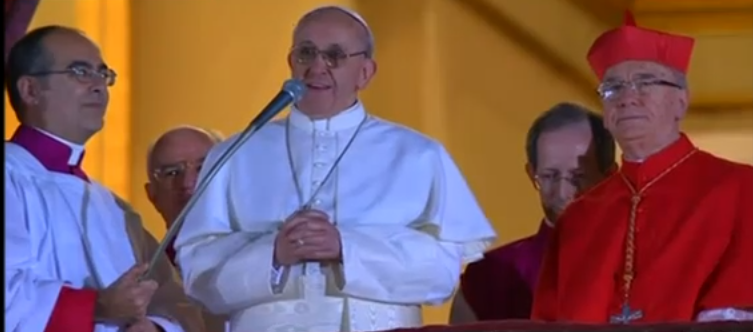 Today marks the second anniversary of the election of Pope Francis as bishop of Rome. They have been, without question, the two most hope-filled years in a lifetime of study and service of the Church. Most people, including most Catholics, have rejoiced in Pope Francis’ style, simplicity, and dedication to reforming the Roman Curia.
It made for a great 35th birthday present, very slightly anticipated!
Sadly, this is not a consensus feeling among the faithful, perhaps particularly among Anglophones in Rome and those in positions of authority in the Roman Curia. A couple weeks ago, on the anniversary of the first papal resignation in six centuries, this pithy post showed up in my newsfeed:
..Two year’s ago today, Pope Benedict XVI announced his resignation.
Thus beginning the craziest two years of our lives.
Papa Bennie, we miss you. …
I respect Pope Benedict, perhaps even more so because of his strength of character, as witnessed by the resignation itself. His ecclesiology and personality were both strong enough not to buy into the false mythology of a papacy that is more monarchy than episcopacy, or that requires clinging to power rather than absenting oneself from service when no longer able to serve well.
We all find resonance with different leaders, whether bosses or politicians, bishops or popes. It is natural that some people will like one more than the other, but I have a hard time understanding those who claim to be “confused” by Pope Francis, or who think that the last two years have been difficult for the Church.
A recent conversation with friends revealed, of course, those not satisfied with Pope Francis: On one side, the traditionalists who were given the keys to the kingdom under Benedict are now back to being treated as a minority in the Church – which is only fair, as they are, but I can commiserate with the feeling. On the other, genuinely liberal Catholics tend to be unhappy with the Holy Father’s language on women, not sure whether referring to (lay and religious) women theologians as “strawberries on the cake” is meant to indicate that they are mere decoration, or something more appreciative.
Neither side is confused: they know clearly what they do not like. Whether I agree with either side, they know where they stand and I respect that. It is the commentators claiming “confusion” who are not to be trusted. There is nothing confusing at all about a gospel message of mercy and humble service.
Nevertheless, for the broad swath in between liberals and traditionalists, the last two years have been like fresh air after decades of sitting on a Roman bus, stifling because the old-school Italians refuse to let the windows open lest we get hit by moving air and therefore damage our livers. Somehow. (What is the ecclesiological equivalent of a colpo d’aria?)
If the Good Pope opened the windows of the Church at Vatican II to let it air out a bit, it seems much of the trajectory of the last decades has been, if not to outright close them again, to pile up so many screens and curtains that the effect is nearly the same. Francis has opened it again to let the light and fresh air in. Sure, the dust gets blown about that way, but blame it on those who let the dust gather, rather than the one who starts the spring cleaning!
To be fair, if not concise, the analogy would extend to Benedict having attempted the same, only to discover that he did not have the strength. (Though, after years of investing in multiple layers of curtain lace, you ought not be surprised at the surfeit of suffocating material you then have to remove to get at the ‘filth’ hiding in the darkness provided thereby. But I digress.)
I have little doubt that Pope Benedict will be a Doctor of the Church someday, and in addition to his massive corpus of theological writings, his act of spiritual humility and demonstration of truly sound ecclesiology by resigning as bishop of Rome will be the reason it happens.
I have lived through two of the greatest papacies in recent centuries, but if there has been a truly good pope in my lifetime, it is Francis. Two years is nowhere near enough, may he live for twenty more, sound of mind and body, and bring to closure the reforms started fifty years ago. It is perhaps our best hope for unity in the Church, which in turn is the best hope for an effective witness to the Good News.
Milestone 100,000
On Sunday, 1 March, somebody in Hungary became the 100,000th visitor to my humble little blog, which I started in October 2009 as I moved to Rome, to communicate with friends and family about travel and visits to the sites of the Eternal City, and to offer musings and commentary on Christian Unity and reform in the Catholic Church.
The more I try to write for my dissertation, though, the less frequently I write for the blog. When I started I averaged three posts a week. Now if I get three a month I am being productive. I noticed I have over 16,000 words of notes and half-written posts in my draft file. Like my dissertation, there is a lot of starter material that just needs time and focus to complete. Also like my dissertation, much of it will never see the light of day.
My first post spoke of the surprises in technology, liturgy, community life, and diet and exercise found upon arriving in Bella Italia.
By far the most read post was about Pope Francis lifting restrictions on married Eastern Catholic priests in the ‘diaspora’ – including the U.S., Australia, Canada, et al. That post alone was viewed 8,000 times. I would like to think the popularity is because of my brilliant prose and that it was an English-language scoop, but I know that the title “Married Catholic Priests coming to a Parish Near You” played a bit on hopes that this would include Latin, or Roman Catholic, priests as well as those serving our Eastern brothers and sisters.
Recent rumors try to suggest that Pope Francis might actually extend it in some way to the Latin Church, but i suspect there are so many people who do not understand the hierarchy of truths well enough that they would think this was an act worth breaking communion over, and as wrong as they are, there is no doubt that a good leader would tread carefully even to do the right thing before allowing the weak of faith to fall further into sin.
The most surprising moments included being introduced to the Archbishop of Canterbury and his ecumenical officer, who greeted me with “Oh, so you’re the one with the blog…!” (I got to see Bishop Jonathan again very briefly during the 50th anniversary celebrations of Unitatis Redintegratio, one of the great ecumenists I have been privileged to meet in these years).
Even after 5 1/2 years, there are still surprises to be found, new adventures in Rome. Just recently with a class walking over the Ponte Fabrico to Isola Tiberna, someone pointed out the marble faces adorning the bridge, which I have crossed dozens of times at least, and never noticed.
Or take the Station Churches, an ancient tradition like so many revived with the Second Vatican Council after being lost for some time before hand. While I have always managed to attend a few of the morning liturgies with the North American College, this is the first year I have been able to attend most of the official Italian liturgies in the afternoons. Photos here.
Now, some personal updating for friends and family:
Officially, the pontifical graduate degrees of License and Doctorate take two and three years respectively. My License took three, including almost a year’s worth of additional classes between the Berrie Fellowship and the extra requirements specific to the ecumenical section at the time (Most people doing an STL are required to take 24 classes in addition to comps and thesis; I took 36, and had credit for 9 more from previous graduate studies and experience). During the doctorate, I have worked two part time jobs and taught 2-3 classes a semester, so while I am still aiming for the three-year mark, I will accept if that just gets me to a good draft.
As I get ever closer to 40, the idea of settling into a permanent position gets more and more appealing. These five years in Rome mark the longest I have lived in one city since I was 16, and even then entails moving at least for every summer, and often not knowing where I will be more than a few months ahead. Recent job searches have revealed potential positions in Edinburgh, Basel, Geneva, Jerusalem, all over the US, and Antarctica. (Admittedly, the last one had nothing to do with theology, but who would not want to spend a few months dodging penguins in -15C weather after the Baroque excess and summer heat of Rome?)
Dear friends and colleagues, faithful readers and strangers who happened by while looking for images, thank you for your visit and your interest. I hope we will be seeing more of each other over the year to come! Happy Lent!
Latest Posts
-

Merry Christmas – and checking in
Merry Christmas to all, wherever you are in the world, and whether you are celebrating today, or waiting until the Julian calendar comes around. I…
-
Russell Berrie Fellows – a decade later
A decade after my arrival in Rome as part of the first internationally recruited cohort of Russell Berrie Fellows in Interreligious Studies, the program was…
-

There should only be five Italian cardinals
The internationalization of the College of Cardinals is neither new nor unique to Pope Francis, despite the grumbling in some circles about his penchant for…
-
The Viganò letter: first read
Viganò must be taken with a large grain of salt – it becomes clear he is ideologically driven and fixated on homosexuality – which is…
 The Ecumenism Blog