
Home » Posts tagged 'Rome' (Page 8)
Tag Archives: Rome
Beatification debriefing in brief

New image of the newly Blessed
This morning I have already begun to hear stories of people’s experience here in Rome for the beatification, from one being interviewed by CNN in the middle of Piazza San Pietro, to others who gave up trying to get within a kilometer of the Vatican, and still others who deliberately skipped town to avoid the chaos and the crowd.
The Beatification Mass began at 10:00am Sunday, with an hour-long rosary and divine mercy chaplet planed ahead of time.
Vatican security had cleared the Piazza at 7:00pm Saturday night, though people had already staked places and laid out sleeping pads on the cobblestones around the square. They were moved back beyond a large perimeter. We saw nearly every law enforcement agency available in the city – Policia Municipale, Guarda di Finanza, Carabinieri, Corpo Forestale, Polizia di Stato, et al.
One friend was at the perimeter by 1:00am Sunday, and she made it no closer to the altar than the obelisk in the centre of the piazza. Others arrived at 4:00am and were never able to get into the square. The gates officially opened at 5:30am, allowing people into Piazza San Pietro and Via della Conciliazione. By 6:15am, people were packed up to Castel Sant’Angelo. We followed a group of bishops into the crowd, only to be turned back on the close side of the castle – even the bishops could not get through.
Even in lateral directions the area around the Vatican was packed – I have not yet seen an aerial photo that was able to capture the whole scene of people-packed streets, I do not know if any of the helicopters were high enough to get that wide a view.
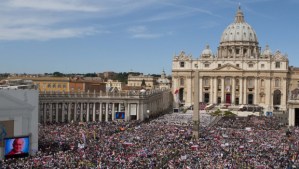
The 5.7 acres of Piazza San Pietro hold only a fraction of the people who came to Rome for the beatification
Some people decided to bail, and go somewhere they could be less crowded and watch it on a jumbotron – the city had a dozen such locations set up, including the Cathedral of San Giovanni in Laterano and the Circo Massimo. Others continued to push in, but never made it close. We found shade and refreshment under the umbrellas of a café’s outdoor seating area, with an oblique view of a jumbotron at Piazza Risorgimento, with no audio but a pilgrims radio tuned to a station translating the whole thing into Polish.
We spent almost two hours in a line to get a cappuccino and cornetto, and then go to the bathroom, once it was decided there was no where better to go unless we wanted to bail and watch at one of the other centers around the city. We got out just in time for mass to start, and stood (thankfully in the shade with tables to put our things on), for the entire 3 hour liturgy and angelus address. Even the English reading was translated into polish on the radio, so I could only relay the parts of the mass as I saw from the partial view of the screen and from the singing in Latin.
I am glad I was here for an historic event, grateful to be in a place with shade and with a friend, but sorry that, given the exhaustion of staying up all night after the vigil that we did not get closer than we did. But, I never thought I would get as close as we did, either. For his canonization, which I expect this time next year, I think the view from San Giovanni in Laterano sounds pretty good – especially for a pope who repeatedly said his role as bishop of Rome, along with Servant of the Servants of God, was the most important responsibility of the pope.
Holy Thursday in Rome
The Paschal Triduum in Rome this year sees even more than its usual number of pilgrims and visitors. In part this is because of the lateness of the season – in two centuries, it will be this late or later only thrice – and in part because of early arrivals for the beatification of John Paul II next Sunday, May 1.
Given a shortage of tickets to papal events, a group of friends – from the Lay Centre, students in Rome and visitors from the States – opted for the neighboring parish basilica of Santa Maria in Domnica, alias the Navicella, for the Mass of the Lord’s Supper after an early dinner.
Our local parish, animated by the Communione e Liberazione movement, the church is beautifully mosaiced, based on an ancient site, and normal Sunday liturgy includes a full choir of young voices, so our expectations were a little high. We did want something shorter than the papal liturgy down the street at the Cathedral, but none of us were quite prepared for what felt more like a daily mass with a couple extra bits added on – the entire liturgy, including a period of adoration at the altar of repose, was finished in 55 minutes.
There was no choir, no psalmist – even the Gloria was merely recited. The washing of the feet (of a dozen teen and preteen boys) barely took five minutes. The only minister of the mass was the presiding priest – even for the procession to the altar of repose the thurifer and crucifer were pulled form the assembly and dressed in ‘civvies’, rather than an alb (or cassock and surplice).
On one hand, there is something nice about not having to wait for three hours to get into a three hour liturgy. On the other hand, the liturgy looses something when, as one visitor said, it seems as if the presider has more important things to do afterwards!
Still, the altar of repose was tastefully prepared, with a simple and elegant wooden tabernacle. The abbreviated liturgy left us four hours to visit and pray at as many churches as desired before midnight; the goal was the traditional seven, culminating at the Pantheon, which was reputed to have one of the most beautiful altars prepared in the city.
(Some friends just reported on their evening at Trinità dei Monti at the top of the Spanish Steps, as one of the most beautiful liturgies ever experienced – something to keep in mind next year!)
Pictures pending – but here’s a schedule of our mini-pilgrimage:
+ Santa Maria in Cosmedin – closed
+ San Giorgio in Valabro – closed
+ San Nicola in Carcere – open
+ Santa Maria in Campitelli – open
+ Santa Maria in Ara Coeli – open
+ San Marco – closed
+ Cappella della Madonnella – open
+ Chiesa del Gesù – closed
+ Santa Maria Sopra Minerva – open
+ Sant’Ignazio – closed
+ Santa Maria ad Martyres (Pantheon) – closed
+ San Luigi dei Francese – open
+ Sant’Agnese in Agone – closed
+ Sant’Andrea della Valle – open
The intended grand finale of the Pantheon was closed, as was the Jesuit headquarters of the Gesù!
The French national church of San Luigi probably was the most evocative – you enter a completely dark church, only a small light in a distant chapel visible. As you stumble your way to its source, you see a single light illuminating a simple altar reserving the Blessed Sacrament under both species, tucked into the Contarelli Chapel, famous as each of sides is adorned with masterpieces of Caravaggio: the Calling of St. Matthew, the Inspiration of St. Matthew, and the Martyrdom of St. Matthew. With an entire church in black, and this small corner in light, it was as if Caravaggio himself had planned the entire experience.
San Nicola’s altar of repose was surrounded by about fifty candles, and attended by a solitary monk. Santa Maria in Compitelli was a church I had never visited before, and beheld there an 11th century icon and one of the rare baroque altars that actually looks good. Santa Maria in Ara Coeli had candles along the stairs leading up the Capitoline hill to the entrance and an altar of repose filled with flowers. Madonella is almost Reformed in its whitewashed and modern simplicity, and Sopra Minerva offered no surprises. At Sant’Andrea some very modern, interpretive paintings of the Stations of the Cross almost distracted before one could get to the altar of repose, but offered a welcome end to our evening’s sojourn in any case.
Syro-Malankara Catholic bishops at the Angelicum
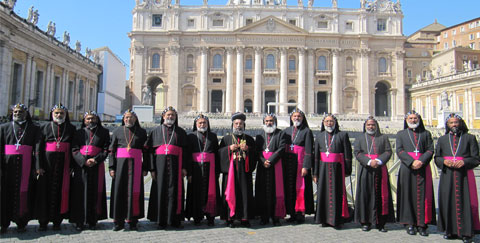
The bishops of the Syro-Malankara Catholic Church were in Rome this week for their ad limina visit “to the threshold” of the shrines of Peter and Paul, and to meet with their successor, Benedict XVI. There are a total of 13 of them, including the Major Archbishop-Catholicos, symbolically representative of Christ and the Twelve. (Also symbolizing Christ and the Twelve are the distinctive headcovering with thirteen stitched crosses, one large and twelve small.)
The Syro-Malankara Catholic Church has about 500,000 members, predominately in Kerala state, India. It follows the west-Syrian Rite and the liturgy of St. James of Jerusalem, and forms part of the Thomas Christians who trace their initial evangelization to the Apostle Thomas in about the year 52 AD. From at least the 8th century, the Metropolitan of the autonomous Thomas Christian Church was a hierarch in the Assyrian Church of the East, their closest ecclesiastical neighbors. The Thomas Christians held that communion was maintained, if communication lost, with the Catholic/Orthodox world until the arrival of Tridentine-era Portuguese missionaries at the end of the 15th century, who began a program of Latinization. Resistance to the imposition of western culture and ecclesiology culminated in 1653, the symbolic date for the breaking of communion and the eventual breaking of the once-unified Christian Church in India into its current situation, divided among those in communion with the Assyrian Church of the East, the Syrian Orthodox Church, Malankara Orthodox Syrian Church, the Malankara Mar Thoma Syrian Church (Anglican), the Syro-Malabar Catholic Church and the Syro-Malankara Catholic Church. The latter traces its origin to the corporate reunion of some Malankara Orthodox Syrian bishops and faithful starting in 1930.
The bishops met with Pope Benedict XVI this morning, and this afternoon were gathered at the Angelicum for a lecture offered by one of their number, Bishop Thomas Mar Anthonios, entitled, “New Evangelization: The Mission and Role of the Syro-Malankara Catholic Church”. The text is basically a synopsis of the lineamenta prepared for the first-ever Major Archiepiscopal Assembly scheduled for later this year. Thiers will be the first episcopal conference or church sui iuris to address the theme of the New Evangelization in plenary.
Before the beginning of the lecture, His Beatitude Major Archbishop Moran Mor Baselios Cleemis greeted the assembled students and guests, and made a special point to recognize his dissertation director, Fr. Fred Bliss, SM, from his days as an Angelicum student. As I sat surrounded almost entirely by Indian Catholics, the chanted prayer that began the seminar was one of the more moving spiritual moments I’ve experienced in recent weeks (I am not even sure if it was Hindi or one of the other languages, such as Tamil or Malayalam, I should ask).
Questions and challenges to be addressed in the new evangelization noted by Bishop Thomas included the relationship of evangelization and interreligious dialogue, individualism and secular culture (referred to as a “darkness”), the success of genuine inculturation, the necessity of Christian unity for effective evangelization, and the obstacles to freedom placed before the church both by the Indian state and the Roman curia (an issue which we were assured Pope Benedict had promised this morning to take under serious consideration). Pastoral lethargy was also noted as a challenge, “Communities should be shaken from their present slumber of maintenance to a renewed consciousness of mission.”
[The text of the Holy Father’s address to the bishops can be found at Vatican Radio here]

Chanted Prayer with Syro-Malankara bishops
Guest response to ‘Liberal’ and ‘Conservative’ in the Church
My blog posts appear on my Facebook wall, and sometimes get comments there. A friend and former parishioner of mine, Colleen Walsh, shared this reply to my quote from Fr. Ladislas Orsy on ‘Liberal’ and ‘Conservative’ in the Church. I would like to see continued conversation on this idea, and will add some of my own thoughts soon, but I asked Colleen if she would allow me to repost her comments here on the blog so a broader audience could take up the theme, and she kindly agreed. [I have made some minor copy and formatting edits, but not edited content]
As always, replies, comments and critiques are welcome, but only respectful contributions will be approved!
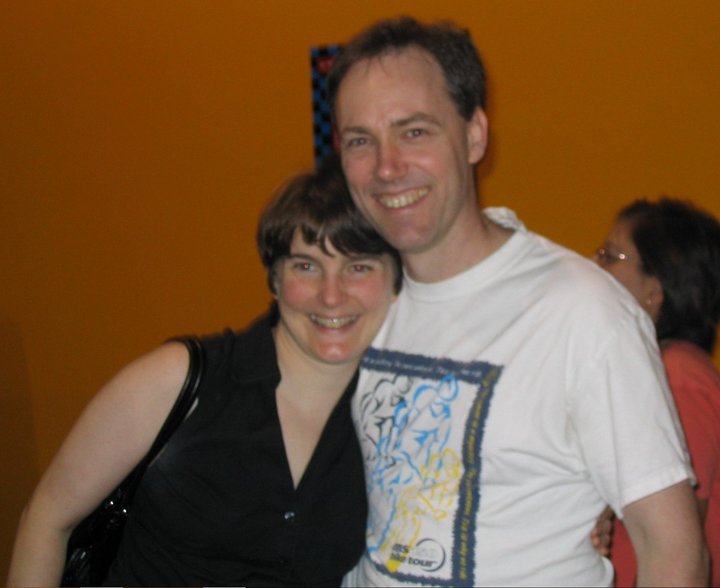
Colleen and her husband, Pat
A.J., I think there is actually a post-Vatican II split, some would call a schism of sorts, that is not being considered in this article.
I would have to ask this: If the people who like the Tridentine Mass would be considered the conservatives, and my group could be considered the faithful liberals, due to being post Vatican II, then what would you call the folks that seem to be more liberal than me? There are many examples of this, but I will only mention two for illustrative purposes. One example would be the people in the church that want women priests. Another group of people would be those who seem to actually embrace integrating eastern religious ideas and rituals into the Catholic church. I have had contact with many people of both these beliefs, neither of which, I would wish to be grouped with, if a line is being drawn.
The latter of these groups baffle me. I mean, If Jesus is the real thing, and our church is the One True Church, then it appears that one who believes in the integration of Eastern religion is implying that God somehow goofed and left something out when He started our church. How can that be if we are the One True Church? Last I checked, God doesn’t make mistakes. He picked males to lead his church from the beginning and He also chose His Son to be our saviour, who could bring us to His Father, God. God didn’t expect us to go through some guru to in order to have a relationship with God. If Jesus is the way and no one can come to His Father but by Him, then why do these people feel all paths lead to God? God is a loving God, so why would He ask His only begotten Son to die for us, a horrible painful death, if there were going to be other paths to Him anyway? God would not do it if He thought there was another way. God, in His infinite wisdom, is way smarter than us, and knows the weight of our sin, and it is very, very, heavy! Just look at abortion, for example.
Many folks think I am conservative because I like taking communion on the tongue and am glad that they put kneelers back the churches around here. I am opposed to the idea of inclusive language, don’t agree with the idea of women priests and am against using female altar servers. (I think female altar servers helped contribute to our dwindling number of vocations to the priesthood) I also really like that Mother Angelica and Fr. Corapi and Priests for Life are not afraid to stand up for the sanctity of life in this culture of death. I believe nuns should be happy to wear the habit, and should not be hiding their light under the bushel basket of street clothing. They shouldn’t be afraid to show their Catholic identity! I also do not like round churches as I believe we should be focused on the miracle of the Mass, the Eucharist, not the people across the room from us. That is a distraction. I believe the tabernacle belongs behind the alter, not in a separate room adjacent to the sanctuary like it’s some sort of a side show in a circus. The Eucharist is central to our faith and should not be kicked to the side of the building somewhere. I think a crucifix belongs inside the sanctuary at all times, not these statues of the risen Christ, because as Catholics, not only is it part of our identity, but it is an important reminder that we should see often. (Jesus loves us THIS MUCH, and suffered for us THIS MUCH) We are only human and need that reminder! The devil wants us to forget this. Seeing Jesus crucified helps to form a good sense of Catholic guilt. Contrary to popular belief, Catholic guilt can be a good thing. 🙂 It should be an integrated part of every conscience. It helps us to make the right choice. It helps us make a good examination of conscience. I think the risen Christ status are beautiful and would be a fine, even welcome addition, to today’s church, as long as they are not being used to replace the crucifix. They could be set up at the end of the stations of the cross to finish the story. 🙂 As for stained glass windows, I think it is a shame my first parish, sold their beautiful building in the 80’s to build a new round, visually plain, modernized church without kneelers. The old building had previously been a seminary and the stained glass and mosaics told stories of Saints and the Bible along with a beautiful stations of the cross. This beauty, along with the presence of the Eucharist in the tabernacle behind the altar, and the crucifix in front of the congregation which was a constant reminder of the ultimate sacrifice, created a beautiful setting for Mass, even with the folky guitar music I so enjoyed at the time. It was the perfect mix of old and new, in my opinion.
On the other hand, I have friends who think I am way too liberal because I do not want to go backwards to a complete Latin Mass. I think it’s important to hear the Word and understand it in ones own native language. (on a side note, I have to say, I dislike the bilingual masses our archdiocese is into doing. It seems there is always something lost for those who don’t speak both languages fluently, since they flip flop between the readings and songs. The only REAL bilingual part is the fact that the homily is said in both languages.) I attended a Latin Easter Vigil Mass once and although we could read along in English with every reading, the only part in a English was the homily. Even though the music was pretty, I wanted to sing along and was frustrated that it was mostly only the schola choir allowed to sing during the Mass. I think the part that got me most is that I felt a need to go back home and read the readings all over again in English because I still felt hungry for the Word! I have heard that I picked an extreme Mass to go to for my first Latin Mass, and that it was not typical to do every reading in Latin during many Masses, but I felt it really was not my worship style.
I very much enjoy Lifeteen Mass music, and am not opposed to clapping during songs in Mass. I have even sung with some of the “modern” music groups at different parishes and was even part of a Catholic handbell choir at a local parish before I moved up north. I listen to the local a Christian music station, and I even let my kids watch some secular TV shows, which would be considered taboo for some of my Tridentine friends, many of which don’t believe in even having a TV in the house at all. I am not opposed to holding hands during the “Our Father” and have been known to cross aisles and even give hugs during the sign of peace. Although, I try to wear my Sunday best, but I have to confess that on some occasions I find myself having to wear jeans to Mass. When this happens, I try to at least wear ones that are not too faded and can be sort of dressed up with a nice shirt and some shoes other than tennis shoes, after all it IS the King we are going to see! (Bishop Eusebio reminded me of that when he was our pastor at St. Elizabeth prior to becoming a bishop. It was kinda funny cuz I was so pregnant my feet wouldn’t fit my dress shoes, so I wore my fake birkenstocks the next week so as not to get reprimanded by Father. LOL) My Tridentine friends are almost never seen without a skirt, even on the playground and would never go to Mass without a veil. I do have to say that I am appalled at the fact that so many altar servers in our diocese that wear jeans and tennis shoes under their albs. I think it is not only tacky and distracting, but disrespectful to serve like this. Waiters at restaurant dress nicer than most of these boys!
I have been to charismatic gatherings over the years and have been baptized in the Holy Spirit and very much see the need to reach out to our protestant brothers and sisters and those of other traditions, though I do not believe we should be hiding our Catholic identity by trying to look like protestant churches. I believe music is a great place to find some common ground, both biblically and culturally in our liturgy without losing our Catholic identity in today’s world.
Believe it or not, there is a very large group that is often stereotyped as ultra-conservative, pre-Vatican II, but to the contrary, actually embraces the liberating aspect of hearing God’s Word spoken in a way that is meaningful to them in their own language. It is a group that appreciates the ability to sing praise to God with all the zeal given to us by the Holy Spirit, even, if it means clapping, and using guitars and drums! Yes, there is actually quite a large group of us conservative, yet modern (or as this article seems to call us, ‘faithful liberals’) post -Vatican II folks who are out there. We enjoy the ability to participate in Mass with a more modern worship style. The problem is that some people would like to throw us all into one category with the pre-Vatican II crowd just because we appreciate some of the beauty the old church had to offer, some of the same beauty you get to experience every day while you are in Rome. While we embrace the changes in liturgy given to us by Vatican II, we cling to whatever beauty and traditions we still have in today’s church, sometimes due to a deep understanding of the meaning behind the tradition and other times due to fear that before too long, the Church will be purged of all that identifies Her: throwing the baby out with the bathwater in an attempt to make Her more inviting to non-believers. It would be a sad day if they renovated Rome, yanked out all the crucifixes and kneelers, stripped the buildings of all the stained glass and mosaics in the name of Vatican II.
International Joint Commission for Theological Dialogue between the Catholic Church and the Oriental Orthodox Churches:
A few weeks ago I mentioned running into Fr. Ron Roberson on the streets of Rome as he was heading into this meeting. This is a repost of the report from Oriental Orthodox Church News and Events posted by Ibrahim Yuhanon, S O C E ( Editor ) at 2/02/2011 07:49:00 PM
 The eighth meeting of the International Joint Commission for Theological Dialogue between the Catholic Church and the Oriental Orthodox Churches took place in Rome from January 25 to 28, 2011. The meeting was hosted by His Eminence Cardinal Kurt Koch, the new President of the Pontifical Council for Promoting Christian Unity. It was chaired jointly by Cardinal Koch and by His Eminence Metropolitan Bishoy of Damiette, General Secretary of the Holy Synod of the Coptic Orthodox Church.
Joining delegates from the Catholic Church were representatives of the following Oriental Orthodox Churches: the Antiochian Syrian Orthodox Church, the Armenian Apostolic Church (Catholicosate of All Armenians), the Armenian Apostolic Church (Holy See of Cilicia), the Coptic Orthodox Church, the Ethiopian Orthodox Tewahido Church, and the Malankara Orthodox Syrian Church. No representative of the Eritrean Orthodox Tewahdo Church was able to attend.
The two delegations met separately on January 25, and held plenary sessions each day from January 26 to January 28. Each day of the plenary sessions began with a common celebration of Morning Prayer. In his remarks at the beginning of the first session, Cardinal Koch welcomed the group to Rome, and said that “I have had an enduring ecumenical interest in the Oriental Orthodox Churches, and in your history, your life of faith, your liturgy and theology. I have always felt very at home in your presence. Despite our longstanding separation, we share a solid basis of faith and ecclesial order.” With great sadness the Cardinal also informed the group of the death of one of the Ethiopian Orthodox representatives, Father Megabe Biluy Seife Selassie. He has been replaced by Archdeacon Daniel Seife Michael, an instructor at Holy Trinity Theological University College in Addis Ababa. The cardinal also offered congratulations to Father John Matthews who, since the last meeting, was ordained a bishop and given the name Metropolitan Dr. Youhanan Mar Demetrios, Assistant Metropolitan of Delhi, and to His Eminence Nareg Alemezian who has been elevated to the rank of Archbishop. Metropolitan Bishoy took the occasion to congratulate Cardinal Koch on his appointment as President of the Pontifical Council, and to express his gratitude to Cardinal Walter Kasper for his co-chairmanship of the commission until his retirement last year. He also stressed that the official name of his family of churches should always be “Oriental Orthodox Churches.”
At this meeting, the members continued their study – in a very friendly atmosphere – of the ways in which the churches expressed their communion with one another until the middle of the fifth century and the role played by monasticism in this. The papers presented included “The Communion and Communication that Existed Between Our Churches Until the Mid-Fifth Century of Christian History As Well As the Role Played by Monasticism: The Tradition of Antioch,” by Archbishop Theophilus George Saliba; “The Petrine Office and the Question, Who Established the Church of Rome?: Coptic Orthodox Perspective,” by Metropolitan Bishoy of Damiette, “Communion and Communication Among the Churches in the Tradition of Alexandria,” by Father Mark Sheridan, OSB; “The Role of Monasticism in the Development and Communion of the Churches,” by Father Columba Stewart, OSB; “Communion and Communication that Existed Between Our Churches Until the Mid-Fifth Century of Christian History and the Role Played by Monasticism: The Ethiopian Experience,” by Archdeacon Daniel Seife Michael Feleke; “The Reception of the Ecumenical Councils in the Armenian Tradition (VIII-XV cc.)” and “Communion and Communication,” by Archbishop Yeznik Petrossian; “Communion and Communication Between the St. Thomas Christians of India and Other Churches till Mid-Fifth Century A.D. – Indian Orthodox Perspective,” by Metropolitan Dr. Gabriel Mar Gregorios; “Communion and Communication Between the St. Thomas Christians of India and Other Churches till Mid-Fifth Century A.D. – A Syrian Orthodox Perspective,” by Metropolitan Dr Kuriakose Theophilose; “Communion and Communication Among the Churches: Rome in the Pre-Constantinian Era,” by Prof. Dietmar W. Winkler.
In these various studies, the members of the commission focused more precisely on the concrete expressions of communion and communication among the churches before the separation. Indeed, communion was expressed primarily through various forms of communication. It was noted that in the pre-Constantinian period, there was an intense communication among the churches, especially in times of crisis. There was a common sense of responsibility towards the other churches that was found most clearly in the exchange of letters and synodal decisions. These provided a means of conveying encouragement and challenge to one another, as well as theological clarifications. This exchange was mutual among the various churches. It exemplified a remarkable degree of communion among local communities in a process that lacked central direction after 250 years of expansion throughout the Roman Empire and beyond, including Armenia, Persia, Ethiopia and India. The universal phenomenon of Christian asceticism, present from the earliest times, found expression in the monastic movements, emerging from the late third century in all parts of the Christian world. There was a fruitful exchange of monastic spiritual writings emanating from the Christian Orient, even across doctrinal divisions.
In the evening of January 25, the members attended a Vespers service in the Basilica of Saint Paul’s Outside the Walls presided over by His Holiness Pope Benedict XVI for the conclusion of the Week of Prayer for Christian Unity. In his homily the Holy Father made reference to the presence of the members of the dialogue, and said, “We entrust the success of your meeting to the Lord, that it may be another step forward towards our longed-for unity”. On Thursday evening January 27, Cardinal Koch hosted a dinner for the dialogue members and staff of the Pontifical Council for Promoting Christian Unity at the Domus Sanctae Marthae in the Vatican.
Pope Benedict XVI received the members of the commission in private audience on Friday morning January 28. Cardinal Koch and Metropolitan Bishoy thanked the Pope for receiving the commission, and Metropolitan Bishoy presented a Coptic icon of Saint Mary the Mother of God to him on behalf of the members of the commission. The Pope then greeted the members, saying “It is with great joy that I welcome you, the members of the Joint International Commission for Theological Dialogue between the Catholic Church and the Oriental Orthodox Churches. Through you I gladly extend fraternal greetings to my venerable Brothers, the Heads of the Oriental Orthodox Churches. I am grateful for the work of the Commission which began in January 2003 as a shared initiative of the ecclesial authorities of the family of the Oriental Orthodox Churches and the Pontifical Council for Promoting Christian Unity. As you know, the first phase of the dialogue, from 2003 to 2009, resulted in the common text entitled Nature, Constitution and Mission of the Church. The document outlined aspects of fundamental ecclesiological principles that we share and identified issues requiring deeper reflection in successive phases of the dialogue. We can only be grateful that after almost fifteen hundred years of separation we still find agreement about the sacramental nature of the Church, about apostolic succession in priestly service and about the impelling need to bear witness to the Gospel of our Lord and Saviour Jesus Christ in the world. In the second phase the Commission has reflected from an historical perspective on the ways in which the Churches expressed their communion down the ages. During the meeting this week you are deepening your study of the communion and communication that existed between the Churches until the mid-fifth century of Christian history, as well as the role played by monasticism in the life of the early Church. We must be confident that your theological reflection will lead our Churches not only to understand each other more deeply, but resolutely to continue our journey decisively towards the full communion to which we are called by the will of Christ. For this intention we have lifted up our common prayer during the Week of Prayer for Christian Unity which has just ended. Many of you come from regions where Christian individuals and communities face trials and difficulties that are a cause of deep concern for us all. All Christians need to work together in mutual acceptance and trust in order to serve the cause of peace and justice. May the intercession and example of the many martyrs and saints, who have given courageous witness to Christ in all our Churches, sustain and strengthen you and your Christian communities. With sentiments of fraternal affection I invoke upon all of you the grace and peace of our Lord Jesus Christ.”
The ninth meeting of the International Joint Commission will take place in Addis Ababa, Ethiopia, at the invitation of His Holiness Abune Paulos I, Patriarch of the Ethiopian Tewahido Orthodox Church. The members will plan to arrive on Monday January 16, 2012, and depart on Monday January 23. The two delegations will meet separately on Tuesday January 17, and in plenary session on Wednesday, Thursday and Saturday, January 18, 19, and 21. They will participate in the celebration of Epiphany (Timkat) on January 20, and in Sunday liturgies on January 22.
The members concluded with joyful thanks to God, the Father Son and Holy Spirit, for what has been accomplished at this meeting.
* * *
The members of the Commission are:
Representatives of the Oriental Orthodox Churches
(in alphabetical order)
Armenian Apostolic Church— Catholicosate of all Armenians: H.E. Khajag Barsamian, Archbishop of the Eastern Diocese of the USA, New York; H.E. Archbishop Yeznik Petrossian, General Secretary of Bible Society of Armenia, Etchmiadzin, Armenia;
Armenian Apostolic Church— Holy See of Cilicia: H.E. Archbishop Oshagan Choloyan, Prelate of the Eastern Prelacy in the USA, New York; H.G. Archbishop Nareg Alemezian, Ecumenical Officer of the Holy See of Cilicia, Antelias, Lebanon;
Coptic Orthodox Church: H.E. Anba Bishoy (co-chair), Metropolitan of Damiette, Egypt, General Secretary of the Holy Synod of the Coptic Orthodox Church; Rev. Fr. Shenouda Maher Ishak, West Henrietta, New York, USA; H.G. Bishop Daniel of the Coptic Orthodox Church in Sydney, Australia (observer);
Eritrean Orthodox Tewahdo Church: Rev. Fr. Kaleab Gebreselassie Gebru, Eritrean Orthodox Tewahdo Patriarchate, Asmara, Eritrea (unable to attend);
Ethiopian Orthodox Tewahido Church: Archdeacon Daniel Seife Michael Feleke of Holy Trinity Theological University College in Addis Ababa; Mr. Lique Hiruyan Getachew Guadie (unable to attend);
Malankara Orthodox Syrian Church: H.E. Metropolitan Dr. Gabriel Mar Gregorios, President of the Department of Ecumenical Relations, Diocese of Trivandrum, India; H. G. Metropolitan Dr. Youhanon Mar Demetrios, Assistant Bishop of Delhi (co-secretary), Delhi, India.
Syrian Orthodox Church of Antioch: H.E. Mor Theophilus George Saliba, Archbishop of Mount Lebanon, Secretary of the Holy Synod of the Syrian Orthodox Church, Beirut, Lebanon; H.E. Kuriakose Theophilose, Metropolitan of the Malankara Syrian Orthodox Theological Seminary and President of the Ecumenical Secretariat of the Malankara Syrian Orthodox Church in India, Ernakulam, India;
Representatives of the Catholic Church
His Eminence Cardinal Kurt Koch (co-chair), President of the Pontifical Council for Promoting Christian Unity;
Most Reverend Paul-Werner Scheele, Bishop Emeritus of Würzburg, Germany;
Most Reverend Youhanna Golta, Patriarchal Auxiliary Bishop of the Coptic Catholic Patriarchate, Cairo, Egypt;
Most Reverend Jules Mikhael Al-Jamil, Procurator of the Syrian Catholic Patriarchate to the Holy See and Apostolic Visitator in Europe, Rome;
Most Reverend Peter Marayati, Armenian Catholic Archbishop of Aleppo, Syria;
Most Reverend Woldetensae Ghebreghiorghis, Apostolic Vicar of Harar, Ethiopia, President of the Ecumenical Commission of the Catholic Church in Ethiopia and Eritrea;
Rev. Fr. Frans Bouwen M.Afr., Consultant to the Pontifical Council for Promoting Christian Unity; Jerusalem;
Rev. Fr. Columba Stewart, OSB, Executive Director, Hill Museum and Manuscript Library, St. John’s Abbey and University, Collegeville, Minnesota, USA;
Rev. Fr. Ronald G. Roberson, CSP, Associate Director of the Secretariat for Ecumenical and Interreligious Affairs, US Conference of Catholic Bishops, Washington, DC, USA;
Rev. Fr. Paul Rouhana, OLM, Université Saint-Esprit, Kaslik, Jounieh, Lebanon (unable to attend);
Rev. Fr. Mark Sheridan, OSB, Pontificio Ateneo S. Anselmo, Rome;
Rev. Fr. Mathew Vellanickal, Vicar General of the Archdiocese of Changanacherry, India;
Rev. Fr. Boghos Levon Zekiyan, Pontifical Oriental Institute, Rome;
Prof. Dietmar W. Winkler, Consultant to the Pontifical Council for Promoting Christian Unity, Salzburg, Austria.
Rev. Fr. Gabriel Quicke, Official of the Pontifical Council for Promoting Christian Unity, Rome (co-secretary).
Rome, January 28, 2011
Spring Studies
For those still keeping track, here are my courses for the coming semester, along with thesis writing and preparing for the lectio coram – comprehensive oral exams.
- Catholicism in the Church: Anglican and Roman Catholic Perspectives
- Does Doctrine Still Divide? (with Geoffrey Wainright)
- Ecumenical Methodology II
- Ecumenism and Canonical Structures
- First-Century Judaism
- From the Chalcedonian Formula of Faith to the Christological Agreements between the Catholic Church and the Pre-Chalcedonian Churches
- The Messianic Idea in the Hebrew Bible and the Dead Sea Scrolls
- Shi’ite Islam and Roman Catholicism
- Seminar: Readings in Schillebeeckx’s Christology
Catholic – Oriental Orthodox Dialogue in Rome
While waiting with some classmates to meet with the German Salesian responsible for staffing the Pontifical Commission for Religious Relations with the Jews, I ran into a friend of my on the Via della Conciliazione. He was in Rome for the week-long meeting of the Catholic-Oriental Orthodox International Commission on Dialogue. The participants, including representatives of the Coptic, Ethiopian, Eritrean, Armenian, Syriac and Malankara churches, participated in the vespers concluding the Week of Prayer for Christian Unity at St. Paul Outside the Walls as their opening activity.
Vatican Radio recorded a thirteen minute interview with the officer responsible for dialogue with the Oriental Orthodox in the PCPCU:
They’re among the most ancient churches in the world, founded according to tradition by the apostles in Egypt, Armenia, Syria, India and Ethiopia in the decades following Christ’s death and Resurrection. Yet they have not been in communion with either the Roman Catholic world or the Eastern Orthodox world since they officially severed ties in the 5th century – hence very little is known about their rich heritage and traditions outside those countries where they are still based.
They are of course the Oriental Orthodox Churches and here in the Vatican on Friday, their representatives concluded a meeting of the mixed commission for theological dialogue with their Catholic counterparts.
To find out more about the meeting and about the impact of the recent attacks on Coptic Christians in Egypt, Philippa Hitchen talked to Fr Gabriel Quicke, who’s in charge of relations with these Churches at the Pontifical Council for Promoting Christian Unity….
Relating Random Roman Reflections and Realities
Over the course of the last three semesters in Rome, I have seen and overheard a few little things – one-liners, Roman witticisms and cynicisms, curious images – that a little taste of the Eternal City beyond the big stuff.
* * *
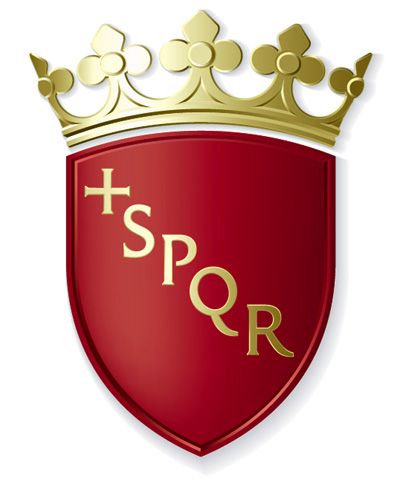 SPQR – ubiquitous, stamped on everything from sewer covers to the city’s coat of arms, it officially stands for Senatus PopulusQue Romanus, “Senate and People of Rome”. Unofficially, I was told by an Italian, it is also Sono Pazzi Questi Romani, “They are Crazy, These Romans!”
From a canon law professor, “In Rome, always does not always mean always, and never never means never.”
I attended a lecture given by a Grand Archdeacon last week. Possibly, THE Grand Archdeacon; I do not know if there is more than one.
To say “good luck” in Italian, you say, In boca del lupo “In the mouth of the wolf!” to which they reply, crepi! “death! [to the wolf!]”
In terms of the question “when does life begin?”, a Vatican official affirmed that the medieval view of the church and its theologians was often that life begins with “ensoulment” – the time when the human soul is infused into the body -, which happened around 40 days after conception. “The exact moment of when life begins has never been clear, though of course now we are very adamant about it.” When someone pointed out this was almost exactly what Nancy Pelosi said that got her into so much trouble a couple years ago, his response was, “Who?”
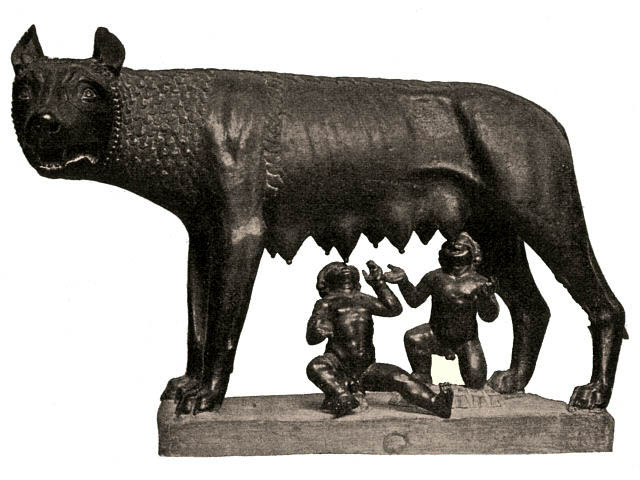
Romulus and Remus, Founders of Rome
Italians do not think right and wrong. They think bella e brutto – “beautiful and ugly”.
After one of the Italian church scandals this year, an Italian paper ran the headline, “The Vatican Denies Everything, No One Believes It”, because the Vatican took nearly three weeks to issue a statement of any kind, which was along the lines of “no comment”.
Romans hate giving change. Where an American might go to the grocery store deliberately to break a $50 bill by buying a piece of gum, one gelateria owner reached over the counter to strangle me, only half-jokingly, when i profered a 20 Euro note to pay for a 2.50 gelato.

St. James Cathedral, Seattle
While in Ancora bookstore, right in front of St. Peters, I spotted a book whose cover was a picture of the font and altar at St. James Cathedral in Seattle.
Speaking of books, I was in the working library of one of the curial dicasteries when I noticed Notre Dame Prof. Richard McBrien’s recent book, The Church. It was sitting on a shelf clearly labeled, “Orthodox”.
Public toilets in Rome usually lack a toilet seat. Apparently, this is seen as a cost-saving measure.
Another canon lawyer, a Roman: “The Law is meant to be beautiful and make people happy. That is why there are exceptions.”
Overheard: “Growing up, i always heard about first-world and third-world – but there never seemed to be a second-world. I think i know now what that is, though: Italy is a second-world country. Something you expect of a first world nation – working internet, easy access to hot water, a generaly operative government and administration, for example – seems to be there, but then sometimes acts like it belongs in the third world. You average it all out, and you get second-world!”
In my neighborhood, a block off of the traditional procession route of popes leading from St. Peters to the Lateran, very near San Clemente, is a small shrine with a very faded fresco that appears to be the Madonna and child, and almost always fresh flowers. Allegedly, this is the monument to Pope Joan, marking the place where she suddenly gave birth to her child in the middle of a Pontifical procession in 855 AD (according to the oft-repeated and equally often debunked legend).
A Roman church-person, commenting on some of the ‘newer’ movements in the church: “The Legion of Christ was founded to make Opus Dei look normal. Then, the Heralds of the Gospel were founded to make the Legion look normal.”
The Europeans understand heaven and hell: Heaven is where the cooks are French, the police are English, the engineers are German, the lovers Italian, and everything is run by the Swiss. Hell is where the cooks are English, the police are German, the engineers are French, the lovers Swiss, and everything is organized by the Italians.
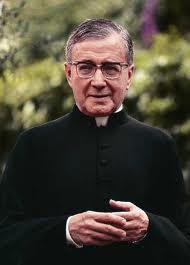
St. Josemaria Escriva, Founder of Opus Dei
.
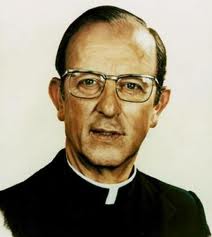
Marciel Maciel, disgraced founder of the Legion of Christ
.
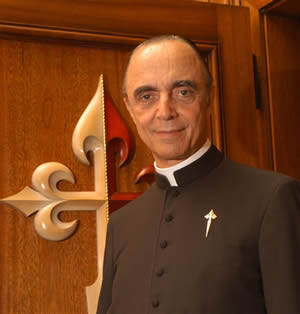
Msgr. Joao Scognamiglio Cla, Founder Heralds of the Gospel
.
Highlights of the Week of Prayer
A few highlights of the week here in Rome I thought I would share. Clearly, there was too much going on for me to even make it to most of the services and events, and even those I did get to would take too long to recount in full.
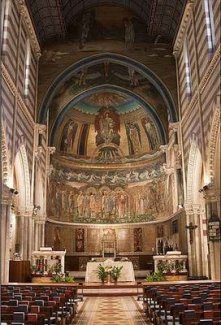
St. Paul Within the Walls, Rome
The pope called ecumenism a moral imperative. That does not leave much wiggle room for the doubtful, dissenting, or disinterested. Definitely a highlight, though already mentioned here.
One of the most beautiful moments was a concert by four Roman choirs at St. Paul Within the Wall, the Episcopal Church of Rome (That is, Anglican Communion, American branch). After an ecumenical evensong that was well-attended, these four choirs provided us with a live, surround-sound rendition of Thomas Tallis’ Spem in Alium. This is a ten minute, 40-part motet from 1570, an English response to the Italian mastery of Renaissance music. Given the timing, I suppose a little ecclesiastical/nationalistic competitiveness was not surprising. In any case, what Tallis produced is moving, and though listening to it on YouTube does not do justice to the experience, the parish has kindly provided a recording of the event here.
On Sunday, I celebrated the Eucharist with the Caravita Community, which I have mentioned before, as they are one of the Anglophone locales for events ecumenical. In addition to three of the Gregorian’s Muslim students there for part of their research into Christian worship (having already been to a mass in Italian), there were some Anglican priests present, including a visiting professor from Virginia Theological Seminary, who was the guest homilist (and whose homily he brought to the ambo on his iPad). It was a good homily, but the most striking part of the liturgy came during the communion rite. As the Anglican priests, including the Archbishop of Canterbury’s Representative to the Holy See, Canon David Richardson, came to the presider to receive communion, they inclined their heads for a blessing. After blessing each, however, the minister inclined his own head and asked for a blessing from them. A fitting sign and ecumenical gesture – we are, painfully, still divided, but equally in need of each others’ prayer and benediction, especially in the sacramental moment that lays bare the imperfect state of our communion.
I should also note that here, as everywhere else during the week, including the papal liturgy, prayers during the general intercessions were offered for the pope, the ecumenical patriarch, and the archbishop of Canterbury, something which has been a decades-old (but often ignored) recommendation of the Holy See to churches around the world – and something which ought to be practiced more often!

Canon David Richardson, Archbishop of Canterbury's Representative to the Holy See and Director of the Anglican Centre in Rome
A couple of days later, I was at the Anglican Centre, located within the Palazzo Doria Pamphilj off the Piazza Collegio Romano. Every Tuesday they offer mass and lunch for residents and visitors, Anglicans and Catholics alike. The small chapel accommodated the 30-35 people present, but snugly. Canon David was presider, and delivered what I think is the best homily of the week. Here, the intimacy, the noble simplicity of the rite, the familiarity and theology of the liturgy all coalesced to provide one of the more literally gut-wrenching moments of being unable to share communion. One of my friends who had not been to many Anglican liturgies asked me afterwards, “So… that was Anglican? But it was almost identical to [the Catholic] mass!”
About the only difference was the location of the sign of peace before the preface to the Eucharistic Prayer, a move which even our current pope has suggests we ought to emulate.
The whole point of being unable to share communion is that we are motivated by the pain of this that we work ever the harder for full unity. But if people are never in the position where they experience this, how can they be so motivated? A thought for a later post there…

Cardinal Kurt Koch
Finally, during the closing liturgy of the week, the papal vespers for the feast of the Conversion of St. Paul Outside the Walls, there was another interesting little thing. In addition to the ecumenical guests offering prayers and readings, which is quite standard, the Latin-chanted Lord’s Prayer included the doxology. There were actually audible responses from the seats around me along the lines of, “huh, that’s interesting!” – at least from the people who know enough Latin to have noticed. One of the choirs even stopped, perhaps out of habit, a line early and had to jump back in to finish the prayer. Reflecting on the addition, it occurred to me that while it could well have been an ecumenical gesture, it was also a more authentically accurate move from a purely Catholic liturgical point of view, as well. More on that below.
Oh, and i got to meet Cardinal Koch, Cardinal Kasper’s successor as President of the Pontifical Council for Promoting Christian Unity.
Lay Centre Online
The Lay Centre is expanding its web-presence, on the occasion of its 25th year. Part of the reason for my relative dearth of posts in the last weeks is that I have been preparing some for publication on the official site, which can be found here: http://www.laycentre.org/blog/ They will be appearing as soon as we upload the relevant pictures!
While I will continue to include some reflections on Lay Centre events here on my own personal blog – along with what I hope to be an increasing share of time on theological, pastoral, and ecumenical entries – this new blog will serve as the official venue for “what’s going on in the life of the Lay Centre” and will be a joint project of various contributors, including Donna, Robert, and myself on a regular basis.
You may note the new look and feel of the Lay Centre website, and other additions, including a new forum for students, alumni, and friends to share messages and information. You will also find links to news and events, even a Vatican Radio feature on the Lay Centre (including a brief interview with yours truly). There is now also a Lay Centre Facebook page. Friends and alumni are invited to join us there, if you are a denizen of the social network.
 The Ecumenism Blog