
21st century tech in a 16th century university
I am actually now online at the Angelicum. Interestingly, the wireless is open and unencrypted, but you have to meet with one Father Stancotti, OP to get him to enter the secret code to allow your connection to the local network actually reach out to the internet. (It seems we are each assigned a specific IP address that he has to activate from his quarters, or some such). I finally tracked him down this afternoon when a seminar i thought about taking was either cancelled or mysteriously moved without notice.
Anyway, i have mentioned to some that as of last tuesday, i was no longer able to download emails to my outlook client (prior to that, at the Lay Centre once the wireless was up, i had no problem). Sending has been no problem, but recieving has been limited to the webclient, which has been very sketchy.
So, it should be no surprise whatsoever, that for the last 30 minutes my computer has been downloading hundreds of emails dating back to 12 October 2008. Coincidence that my last successfully recieved emails were 12 October 2009? I think not! It means something, I just don’t know what. Any Microsofties out there have an idea?
All those emails that i lost when my laptop crashed in January? They’re all coming back. It remains to be seen if i get those sent in the last week and a half, but at the rate things are going (I’m at 1360 emails and counting, only up to December 20, 2008) I’ll find out in about an hour!
Anglican-Catholic Personal Ordinariates
Two days ago, Rome announced a forthcoming Apostolic Constitution establishing Personal Ordinariates for former Anglicans seeking full communion with the Catholic Church.
As the Constitution itself has not been actually published, there’s a great deal more speculation on the blogs and newswires that real information, but a few things were made clear in the news conference.
Unfortunately, my presence on Vatican property and proximity to the halls of power has not really increased my access to information about the decisions made there. We did have dinner tonight with an official from the Pontifical Council for Promoting Christian Unity, however, which probably would not have been possible in Seattle – so there are some advantages!
So, some immediate observations:
The “note” and press conference was delivered by two of the highest ranking Americans in the Holy See, Cardinal William Levada, prefect of the Congregation for the Doctrine of the Faith, and Archbishop Augustin DiNoia, secretary (#2) in the Congregation for Divine Worship and the Discipline of the Sacraments. Why two Americans? Why no Brits? Probably because of the offices they hold, but Romans seem to be skeptical of coincidences. I’m merely curious.
Conspicuous by absence is any representative of the Pontifical Council for Promoting Christian Unity. Indeed, Cardinal Kasper, president of the council, is not even in Rome, but in Cyprus for the 11th meeting of the Joint International Commission for Theological Dialogue between the Catholic Church and the Orthodox Church.
Personal Ordinariates are not exactly like a Personal Prelature (which is what Opus Dei is), but are basically what the Military Ordinariates are – essentially a diocese serving people of a certain characteristic rather than a geographic structure. Instead of members of the armed forces, the membership will be former Anglicans.
Something like this, or the establishment of a new Church sui iuris with its own patriarch or major archbishop, has been discussed as a structural option for the future full communion between the Anglican Communion and the Catholic Church. I think that may still be seen as an eventual option, because the Personal Ordinariates are not fully autonomous churches in that sense, but particular churches like a diocese, still within the context of the Roman church and its national conferences.
Nevertheless, the specter of “uniatism” will no doubt be raised again in the Eastern Orthodox world, and possibly, in the Anglican and Protestant world too. This move could be seen from those corners as proof that Rome really is just interested in co-opting non-Roman liturgical and theological patrimony just for the sake of proselytism. While such an accusation has some historical bases, especially concerning the Latinization of Eastern Catholic Churches, it is clearly not the reality of the current Eastern Catholic Churches, and I do not think it is the reality for these Personal Ordinariates, either. Still, the perception itself could be damaging to the ongoing reception of ecumenical advances with the apostolic chuches in the East.
There is one line that I found particularly interesting, even though it seemed to be made almost off-hand: When explaining that the ordinary of these Ordinariates (read: diocesan bishop) may be either a (celibate) bishop or a (celibate or married) priest, the note states, “Historical and ecumenical reasons preclude the ordination of married men as bishops in both the Catholic and Orthodox Churches.”
Really? that’s new…
Historically, the Latin Church has had married bishops, at least when we also had married presbyters and deacons as a rule (that is, most of the first 1200 years). If we do not have a requirement of celibacy for either deacons or presbyters, as would be the case in these Ordinariates, there is no historical reason for requiring it of bishops (in Western practice).
Ecumenically, as far as I am aware, to restore this discipline would not pose a challenge to the Orthodox, as they see no objection to the Western Church having married bishops even while the Eastern Church does not. The difference in custom is based on the practice of selecting bishops from the diocesan clergy (as in the West) rather than from the monastic clergy (as is most common in the East). So while there is historic precedent for a celibate episcopate in the Eastern Catholic and Orthodox churches, it does not hold for the Western churches, except inasmuch as we currently have a (mostly) celibate presbyterate and have discontinued the ancient practice of selecting bishops from the diaconate.
I would really like to see the ecumenical and historical rationale behind this piece of the note; presumably it is in the forthcoming Apostolic Constitution. Either way, it has got my curiosity piqued; I’ll look into it and follow up!
Hapiness is…
Spending the day reading theology on the terrace, in the warm Roman sun, with a view of the Forum and the dome of St. Peter’s just over the Palatine Hill, in the company of a good friend with a sharp mind and a merry disposition! Oh yeah, tea and “biscuits” help, too!
Shopping for Roman collars
Everyone in Rome has a uniform and a title; and that’s if you are a nobody. If you are important, you also have a stamp, a wax seal, and most likely a signet ring. Perhaps this is why electronic means of communicating, providing identification, registering for classes, paying bills, and the like are so difficult and considered downright foreign here. I’ve gone through i don’t know how many hard-copy pictures of myself, and every correspondence to everyone needs to be an original letter, signed, co-signed and countersigned, then stamped in duplicate or triplicate.
Norbertine Habit
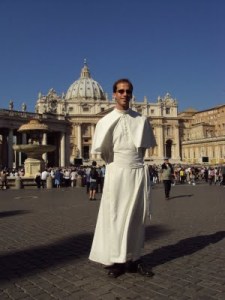
But back to the uniforms: One of the many blessings of being in Rome is seeing the life of the church in all its profound diversity. You cannot maintain the illusion of a monolithic Catholicism very long in this capital of the church. I’ve seen habits for orders i had heard of but never met: Norbertines, for example, dress in a white simar and fascia looking almost identical to the pope. Then there are those i did not even know existed: the Teutonic knights, apparently, are back as a diocesan order, and looking very medieval.
Even most of the lay people around here are in ecclesiastical garb, particularly seminarians and lay religious, even during classes. So, naturally, I am on a mission to discover the appropriate ecclesiastical garb for a lay ecclesial minister. After all, if a student candidate for ministry gets a uniform, so too should someone already in sacred ministry, no?
(The current favored title is “Almost Reverend…”, or “Your Mediocreness”, and the garb is a white or black dress shirt with banded collar, though I am open to suggestions. But, I digress.)
Archbishop Wilton D. Gregory
Allora… I decided to peruse the ecclesiastical shopping district near the Pantheon with Stian, an Anglican seminarian and friend of mine who shares that you can get four clerical shirts in Rome for the price of one in Norway.
We picked up a couple new friends on the way, Matthew, from Australia, and Cosima, from Germany. While Stian was being fitted for his clericals, the rest of us were perusing the mitres, zucchetti, and birettas that seemed to be available over the counter.
Did you know that with an ecclesiastical doctorate one is entitled to wear a biretta with the appropriate color trimming? For theology, it’s scarlet; canon law is green, etc.
As we were about to leave in search of a pizzeria and gellateria, America’s lone representative to the Synod for Africa, Archbishop Wilton Gregory of Atlanta, walked in for some shopping of his own. He was kind enough to stop for a brief chat about the Synod, and exchange a warm greeting before we moved on for pizza and gelato. At least now we know we were in the right shop!
Life Together
My spiritual reading this Sunday was Dietrich Bonhoeffer’s Life Together: A Discussion of Christian Fellowship. It was mentioned by our Augustinian guest last week, Father Bob Guessetto, as the source of the famous quote that “the person who loves his dream of community more than the Christian community itself becomes a destroyer of the latter, even though his personal intentions may be ever so honest and earnest and sacrificial.”
Bonhoeffer, a Lutheran pastor and theologian, was a martyr of the Nazis at Flossenburg in April 1945, only a couple months before Allied victory in Europe. Prior to his capture in 1943, he was active in the Confessing Church and the German resistance, teaching in an underground seminary (like the one Karol Wojtyla attended in Poland) and ministering to the Germans who fought against Hitler’s regime.
His discussion is only about 120 pages, touching on the themes of the community itself, the day with others, the day alone, ministry in the community, confession and communion. Leave it to a Lutheran to give one of the most eloquent descriptions and defenses of confession I have ever read! (Luther, as you probably know, was a devoted participant in the sacrament of Reconciliation, originally keeping it along with Baptism and Eucharist as truly sacraments).
He highlights the aspects/gifts of ministry in community as The Ministry of Holding One’s Tongue, The Ministry of Meekness, The Ministry of Listening, The Ministry of Helpfulness, The Ministry of Bearing, The Ministry of Proclaiming, and the Ministry of Authority.
The book is definitely worth a read, for anyone living in Christian community (including family life!) or serving in ministry. I thought I’d share a few nuggets worth expropriating:
“First, Christian community is not an ideal, but a divine reality. Second, Christian community is a spiritual and not a psychic reality.”
“Life together under the Word will remain sound and healthy only where it does not form itself intoa movement, and order, a society, but rather where it understands itself as being a part of the one, holy, catholic, Christian Church, where it shares actively and passively in the sufferings and struggles and promise of the whole church”
“It is not the experience of Christian community, but solid and certain faith in community that holds us together. … We are bound together by faith, not by experience. … for Jesus Christ alone is our unity”
“Listening can be a greater service than speaking. He who can no longer listen to his brother will soon be no longer listening to God either; he will be doing nothing but prattle in the presence of God too.”
“The day of the Lord’s Supper is an occasion of joy for the Christian community. Reconciled in their hearts with God and the brethren, the congregation receives the gift of the body and blood of Jesus Christ, and receiving that, received forgiveness, new life and salvation. … The fellowship of the Lord’s Supper is the superlative fulfillment of Christian fellowship. … Here the community has reached its goal. Here joy in Christ and his community is complete. The life of Christians together under the Word has reached its perfection in the sacrament.”
Philo of Alexandria
Today, I completed my first course at the Angelicum, exam and all. Granted, it’s only a credit and a half, but not bad for the first week of classes.
It has been 12 years since David Burrell’s survey of Ancient and Medieval Philosophy, so I’m a bit rusty when it comes to middle-Platonist Jewish philosophers. Thankfully, there’s really only one.
Philo of Alexandria is a fascinating person. In attempting to synthesize his Jewish faith with the Greek philosophy in which he was proficient, he had a remarkable influence on the early Church Fathers – and virtually none on Judaism until the late medieval era. He was a Hellenized Jew in Alexandria, of nearly the last generation of Ancient Judaism, before the destruction of the Temple and the birth of both Christianity and Rabbinical Judaism from the ashes.
Twenty-five years older than Jesus, and dying just a few years after Christ, his work probably even influenced some of the Gospels. John’s prologue owes at least a little to the concept of the Word (the Logos) present in Philo. He even has a type of Trinity – though not completely – of God, Logos, and Powers. With Philo, the transcendent, inscrutable God is knowable only through the Son (the Logos), and the dynamies/powers of mercy and justice. “You can only come to the Father through the Son” sound familiar?
He’s also known for his allegorical interpretation of scripture, especially Genesis and the creation story, wherein man=our mental capacity and spiritual self, and woman=our sensory capacity and physical self, so that when man and woman cleave together to become one flesh, it really does mean one person – combining our intellect and sense-perception, our spiritual and our material aspects, to be the human-kind we know.
Probably one of his biggest contributions is in the uniting of the religious side of Platonism with Biblical faith, bringing the idea of a totally transcendent “unmoved mover” into the same conversation as the very personal and immanent God of the Hebrew Scriptures. Totaliter aliter and Emmanuel, all in one divine bundle.
No wonder it feels like all the great ideas have already been thought!
A dialogue of hospitality
We had a few guests for dinner at the Lay Centre tonight.
That would be the “necessary but insufficient” description. Allow me to elaborate.
Ambassador Tony Hall
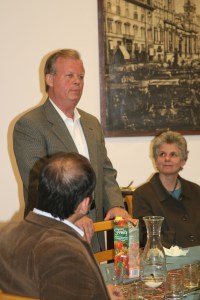
Former U.S. Special Representative to the U.N. agencies in Rome (and former U.S. Representative), Ambassador Tony Hall, his wife Janet, their daughter Jyl and her husband Ryan joined us for dinner. Apparently during their years in Rome, Mrs. Hall was a regular participant of the Centre’s ongoing formation program, the Vincent Pallotti Institute, and she and Ambassador Hall became regular guests and friends of the Lay Centre.
Now back home in the States, they were in Rome for a few days and were able to stop by to see the new location and meet the new members of the community. Ambassador Hall shared with us some reflections on his dedication to eradicate hunger and malnutrition in our world, and gave witness to the fact that it was his faith in Christ, and the conviction of the Gospel, that moved him to spend so much of his life in service to those most in need.
Jyl and Ryan – who, as it turns out, is a native of Bellingham, WA –came across the Adriatic from Macedonia where they are involved in a ministry sponsored by Faith and Learning International. Between sports and art, they are reaching hundreds of youth in the context of a broader outreach in the Balkans. You can read their blog here: http://prayforryanandjyl.blogspot.com/

Daniel Roberts, Dr. Adam Afterman, AJ, Naomi Shank
We were also honored to have Ms. Naomi Shank, director of the Russell Berrie Fellowship program, Mr. Daniel Roberts, director of the Institute for International Education’s Europe Office (IIE), and Dr. Adam Afterman of Hebrew University and the Shalom Hartman Institute in Jerusalem. As you know, my studies at the Angelicum are being funded by one of the Russell Berrie Fellowships, which is coordinated through the IIE, and a part of our fellowship is a seminar in the Holy Land coordinated by Dr. Afterman and the Hartman Institute, so it was a particularly welcome opportunity for me to put faces with the names of those responsible for my grant.
Finally, complete with Caribinieri escort, the newly appointed U.S. Special Representative to the U.N. agencies in Rome, Ambassador Ertharin Cousin, joined us just as Ambassador Hall was beginning his after dinner remarks. Having just arrived to her post the same day I arrived in Rome, not quite two weeks ago, that she was willing to find time to join us was indicative both to the Ambassadors own commitment to interfaith and inter-cultural dialogue and reconciliation, and to the value of the Lay Centre in the life of Rome as a place where the dialogues of life, charity, and hospitality coincide with the dialogue of truth.

Ambassador Ertharin Cousin
For those who do not know – and I certainly did not – the U.S. mission to the U.N. Agencies in Rome is our relationship with the U.N. Agencies for Food and Agriculture, including the Food and Agriculture Organization, the World Food Program and the International Fund for Agricultural Development. It is also responsible for overseeing U.S. participation in the International Development Law Organization, the International Institute for the Unification of Private Law, and the International Center for the Study and Preservation of Cultural Property.
Buongiorno, Princepessa…
Caravaggio's Rest During the Flight to Egypt
The Galleria Doria Pamphilj is housed in one of the palaces of the Doria Pamphilj family, and just a couple short blocks from the Pantheon, on the Via del Corso in the heart of Rome. Not to be confused with their other Palazzo Pamphilj, which takes up half of the western end of the Piazza Navona, and is now the Brazilian Embassy. Nor the giant Villa Doria Pamphilj not far to the south of the Vatican, in Trastevere, which is second only to the Villa Borghese in size. of course, all this gives you a sense of the scope of wealth and power wielded by this Roman aristocratic family in the last millennium and more. The beauty of the art inside is an even grander testament to a family that has included popes and princes of Rome, and which, according to Roman legend, is descended from the poet Virgil, no less.
And what better way to tour such a place than with Princepessa Gesine and her husband Don Massimiliano?
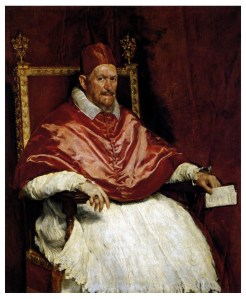
Diego Vasquez' Innocent X
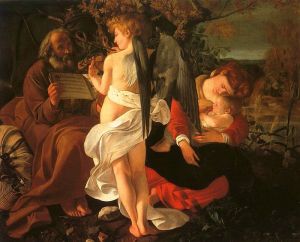
Don Massimiliano, who is a Deacon in one of Rome’s suburbicarian Sees, led the tour of the estate, pointing out several of the more well known artists and pieces. There is, for example, Caravaggio’s last work with any kind of landscape, Rest During the Flight to Egypt, or the famous Portrait of Pope Innocent X by Diego Rodriguez de Silva y Velázquez (upon seeing it, the pope is said to have exclaimed, “It’s too real!”). You can see some of the pieces at the website.
We went through the family chapel, complete with an extensive reliquary and a semi-secret passage to a private observation booth in the adjacent Church where the noble family could observe the elevation of the host without mingling with the masses. Pun intended.
After the tour, the princepessa and her husband provided welcome hospitality in the family room – complete with antique furniture, marble fireplace, and genuine oil-on-canvass portraits of Donna Gesine’s family going back three generations! We have invited them to the Lay Centre to return the favor, and though we have some decent art – including an original sketch of the Council Fathers at Vatican II – ours is a humble abode by comparison!
Biker Rally for il Papa
I do not have any good photos of this, but then any really good ones would have to have been taken from the papal apartments…. besides, it was the sound and sensation that made the moment rather than the visual.
On our first Sunday in Rome, just after the Papal Mass at St. Peter’s Basilica, we decided to wait in the piazza for His Holiness’ weekly Angelus address, which he offers at noon any Sunday he’s in Rome, from the window of the papal apartments. The usual assortment of Romans, a couple groups of pilgrims, and tourists were there. What was a little less usual was that about 1/4 of the piazza was filled with bikers – and not just the little Roman motorini that zip through traffic at 50cc’s or whatever, though there were plenty – but honest-to-goodness motorcycles. After offering greeting and blessings to pilgrims and tourists in about eight languages, Benedict offered a special word of welcome to the bikers. The response was a roar of engines that filled the piazza, and shook the dust off Bernini’s colonnade! Quite an experience! So to all those Harley fans out there (Zandyr, Lana, Chris, et al) remember: the Pope, he loves you too!
Ahhh, Bella Roma!
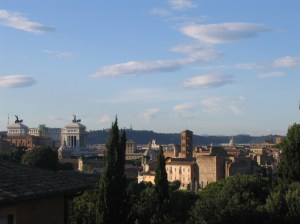
View from my room: Vittorio Emmanuele monument and Roman Forum
I am in Rome. After a flight cancellation, delayed luggage, and a fairly typical (read: nail-biting) taxi ride from Fiumincino airport to my new residence, I arrived at the Lay Centre at Foyer Unitas at about 1700 (5pm for us non-Europeans), just over 24 hours after Nancy dropped me off at SeaTac. Just in time for a brief tour, a moment to admire the view from my room, and a short nap before venturing to the nearby church of Santa Maria in Domenica for Mass and then dinner with the other residents.
With this blog I hope to regularly update family, friends, and insomniac internet wanderers as to my life in the Eternal City, as well as to provide reflections on the courses, research and other theological or ecclesiastical goings on. My intent is to save your inboxes but keep in touch, and to provide either catechesis or opportunity for theological discussion, depending on the reader. Please feel free to respond publicly or privately! I’m looking forward to a view of the church from Rome, though I have a long way to go on my Italian before it becomes unfiltered!
Some initial observations:
Technology: I am seriously considering investing in trans-Atlantic homing pigeons and a stock of quill pens. Our wireless connection at the residence has only worked for a few hours a couple of times over the last week and a half, apparently because of some issue with the electricity – twice the routers have been fried by the electrical system in the monastery! Likewise, the wireless at the Angelicum University has not been connected to the internet any time I have tried it, but I was able to ‘borrow’ a cable from a physics conference on campus last week. Not that it mattered too much, as my laptop crashed literally the first time I turned it on in Rome. Thankfully my files were backed up, but I left some important software backups at home, like my Italian lessons from Rosetta Stone…
Liturgy: My first Sunday Eucharist was the Pontifical Mass at St. Peter’s Basilica for the opening of the Synod of Bishops for Africa. If you’ve been there, you know San Pietro is “in the round”, albeit in a cruciform shape, with the altar in the center – much like St. Brendan’s in Bothell. And, like St Brendan, the presider (in this case the Holy Father) was able to celebrate both ad orientem and versus populum, simultaneously. That is, to face east, one must also face the largest section of the assembly in the long nave adjacent to the piazza. Communion was taken in the hand, along the center aisle, with the Eucharistic ministers moving back and forth between about five or six rows. The cup was not offered, and we stood during the Eucharistic prayer. The mass parts were in Latin, given the international character of the liturgy, but readings in English and Portuguese, with prayers in the languages of Africa, from Ge’ez and Arabic to Swahili and French. Most other liturgy has been in the community; more on that momentarily.
Diet, Exercise, and Environment: The university is just about a 35 minute walk from our residence, and the Centro Pro Unione (Center for Union), which serves as the library for my department, is another 30 minute walk beyond that. Though, as I walk around in my shorts and shirtsleeves sweating enough to flood the colloseo, I no doubt stand out like a sore thumb, as the Romans are all dressed in black, some wearing coats already, all in long pants, and never seem to break a sweat. It must be 75 and its very humid, but apparently it’s a big relief from summer! As for food, I have never eaten so well in my life! After just a few days, I actually feel healthier. Even the cappuccino seems fresher, smaller, and less addictive.
I also really appreciate the pausa – or siesta – the break from about 12:30-3:30pm which is especially necessary on hot days. You just cannot get anything done in the heat, so why not nap, and save your energy for the more active evening time? So classes are held 830-12:30, then 3:30-7:30, and many businesses are on similar hours.
To orient yourself to my daily route, look at a map of Rome (google maps is good), start just south of the Colloseo at the monastery of Sts. John and Paul (on the site of the Temple of Claudius), follow Via Claudia north along the east side of the colloseo, then along the Via dei Fori Imperiali past the Foro Romano and the Foro Augusto to the Monument for Vittorio Emmanuele II. Turn right at Trajan’s Column, up the stairs to the church of Santi Domenico e Sisto – that’s the Angelicum “campus”. From there to the Centro Pro Unione, head back west and somewhat north to the Piazza Navona, passing the Church of the Gesù, Santa Maria sopra Minerva, and the Pantheon if you like. Just behind the Palace Pamphilj, the Society of the Atonement has their headquarters and the Centro. Rest assured, I have already been shown the famous Gellateria La Palma nearby!
Community: I am staying at the Lay Centre at Foyer Unitas, which has an interesting history. Foyer Unitas was originally founded in 1962 by a small Dutch religious order of women known as the Ladies of Bethany as a house of hospitality for any non-Catholic in Rome, just off the Piazza Navona in the same building as the Centro Pro Unione. The Lay Centre is the brainchild of Dr. Donna Orsuto and Riekie van Velzen, who had been connected to the Foyer Unitas, as a college for those of us coming to Rome who did not quite fit in to the ecclesiastical residences. The NAC, for example, houses only seminarians and priests, leaving religious to live with their orders, deacons and lay ecclesial ministers, along with other lay students, to fend for themselves. Founded in 1986, it was housed first at Foyer Unitas (hence the name) and then in the English College, the Irish College, and now at the Passionist Monastery of Sts. John and Paul.
We are 21 residents this year, from Albania, Canada, Germany, Greece, Ghana, Italy, Mexico, the Netherlands, New Zealand, Norway, Serbia, Turkey, and the U.S. Three Muslims, three Eastern Orthodox, an Anglican, and the rest of us are Catholic. We have a medical doctor, a lawyer, and a nurse all studying for new vocations. Breakfast and lunch are self serve during the week, with dinner at 7:45 followed by Compline (night prayer). Wednesdays are our community nights, with mass at 7:00pm followed by dinner and usually a presentation. During our first several days, we’ve had brief presentations during dinner each night, and a day of reflection on Sunday. We’ve already had some orientation to community life from a Jesuit, a Benedictine, an Augustinian, and a Marist, in addition to our director (Donna Orsuto) and assistant (Robert White).
The location is a profound blessing. We are in the historical center or Rome, within the Aurelian walls, but with large enough private gardens that we are removed from the street noise – something unheard of almost anywhere else in the city. We sit on top of one of the famous Seven Hills of Rome, Monte Celio, and my bedroom window looks right down on the Foro Romano, the Colloseum, and the Capitoline Hill with the Monument for Vittorio Emanuele. From our patio ledge, we can see the dome of San Pietro.
 The Ecumenism Blog