
Home » Posts tagged 'Lay Centre at Foyer Unitas' (Page 4)
Tag Archives: Lay Centre at Foyer Unitas
Vatican Radio Feature: Haven of Hospitality
Vatican Radio featured the Lay Centre today, after the celebration dedicating our new site yesterday evening. The twenty-minute interview features co-founder and director Dr. Donna Orsuto, assistant director Robert White, Dr. Aurelie Hagstrom of Providence College, and this humble scribe.
Click here to listen. (You may need RealPlayer)
Address of U.S. Ambassador Miguel Diaz for the Lay Centre Dedication
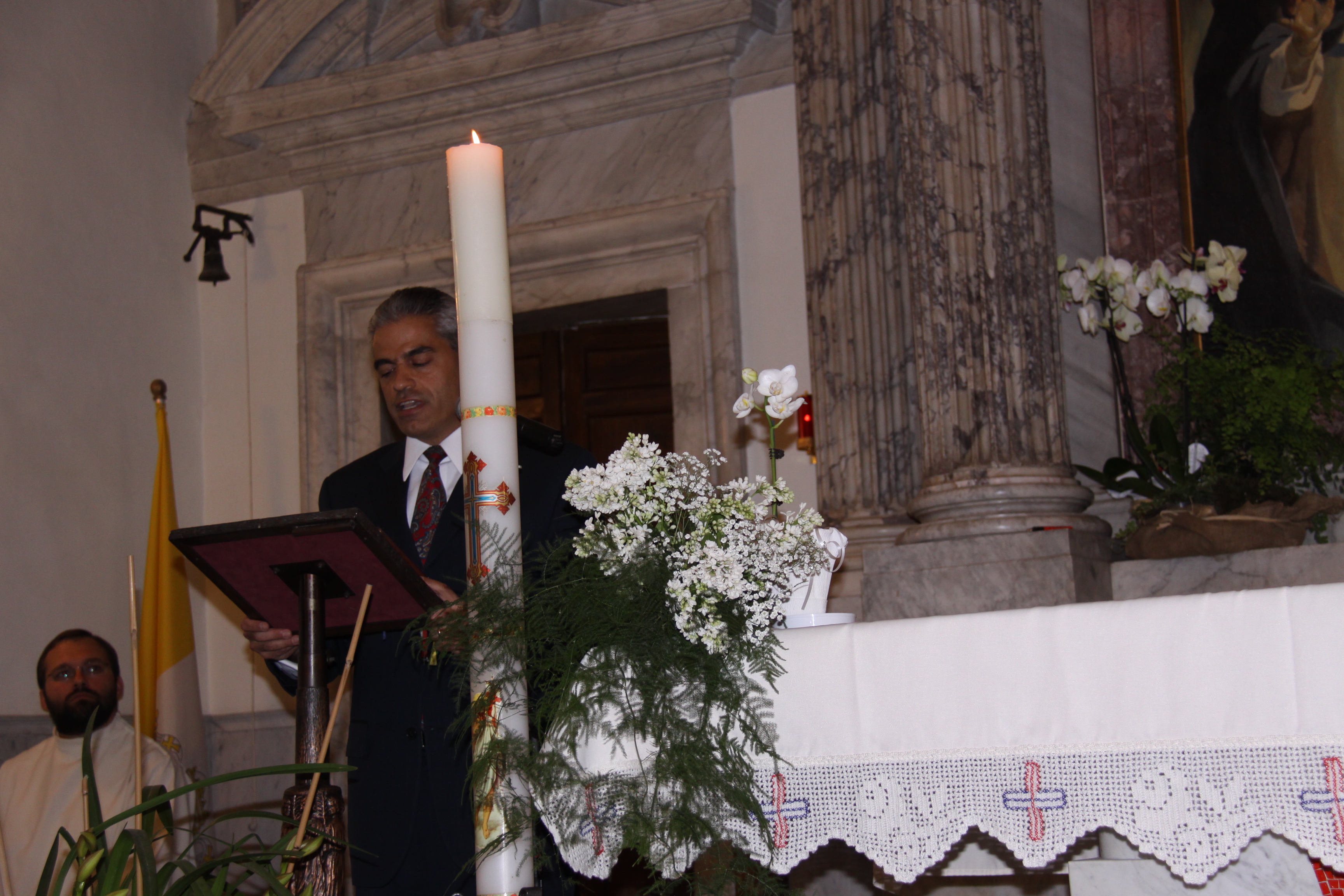
Ambassador Miguel Diaz
The story of the hospitality of Abraham and Sarah in Gen 18 has inspired countless icons, including the Trinitarian icon that appears on the front page of our prayer programs and on the altar tonight. Of course, the most famous of these Trinitarian icons is Andrei Rublev’s fifteenth century icon of the Trinity. I was first introduced to this icon back when I was a doctoral student at the University of Notre Dame by one of my mentors and now deceased Roman Catholic theologian, Catherine M. LaCugna. After making the transatlantic trip all the way from Minnesota, a 4’ by 5’ copy of this icon, which has been hanging in of our family’s dining room for over ten years, now hangs at Villa Richardson. Throughout my life journey, I have drawn much personal inspiration from this icon. In several of my scholarly publications, I have underscored the icon’s ability to suggest the values of familial and communal living, the affirmation of human differences, creaturely interdependence, the sharing of resources, and above all, the practice of hospitality.
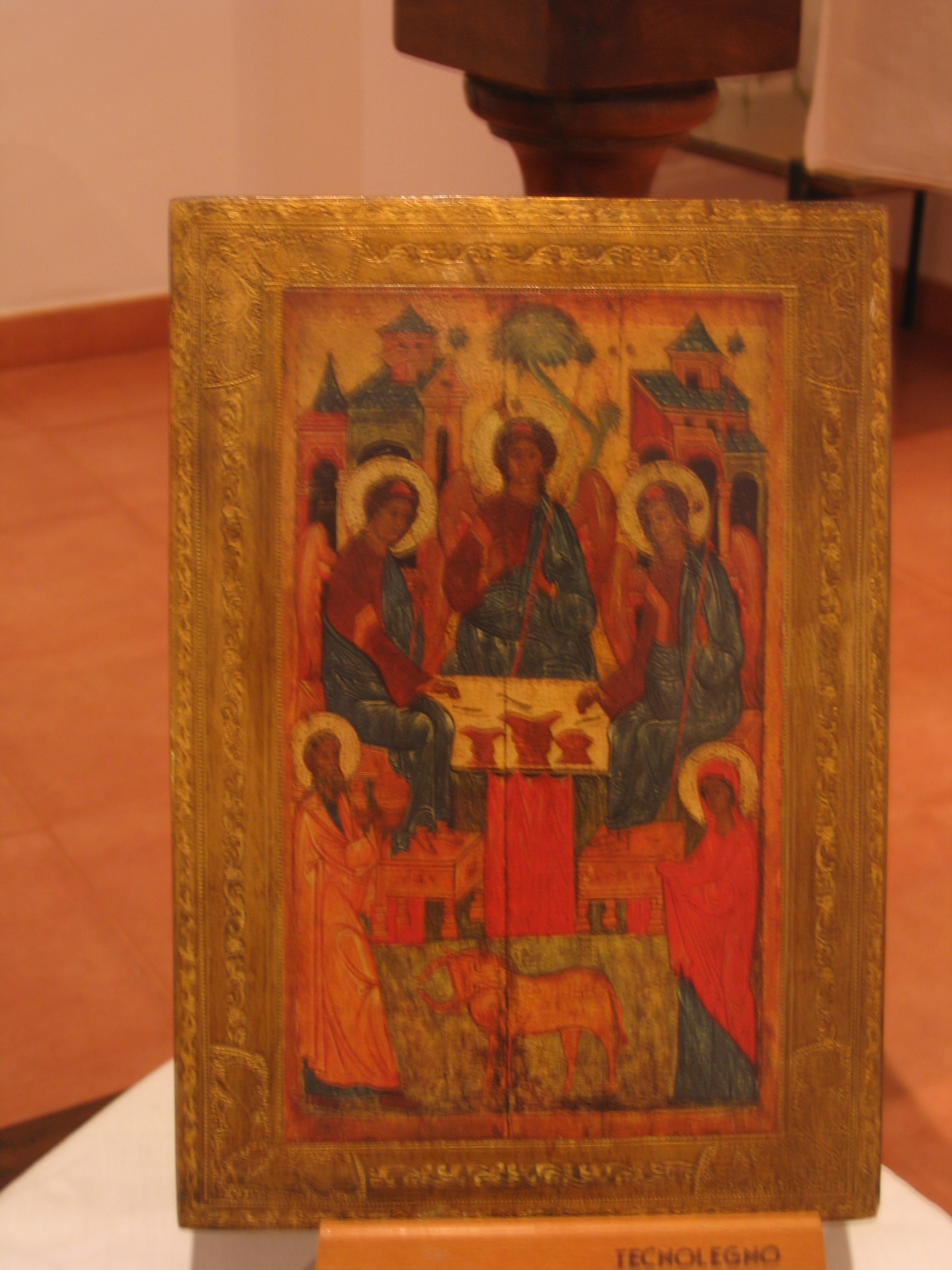
Icon of the Holy Trinity at the Lay Centre
How fitting it is to have this icon remind us of these values as we gather here today to celebrate the official opening of the Lay Centre at its new home on the Caelian Hill! In a world plagued by violence, prejudice, and religious intolerance, this Lay Centre offers an oasis for persons of faith to come together, set aside divisions, and engage in mutual and transformative actions. In giving to and receiving from each other, especially with respect to the exchange of theological ideas that will occur in this centre, human lives will be changed. This is a place where minds will be challenged to advance human understanding and hearts opened to serve one’s neighbor. As persons from very diverse backgrounds come together, cultural and intellectual resources will be shared. And as is often the case in educational settings, this sharing will birth again and again, a vibrant community of learners.
President Obama has invited the human family to build bridges and turn dialogue into interfaith service for the sake of the common good. In this place, interfaith dialogue will lead to and flow from interfaith service, as students who live in community and come here from various religious backgrounds accompany one another, learn from one another, and help each other translate and integrate what they have learned into a life of service.
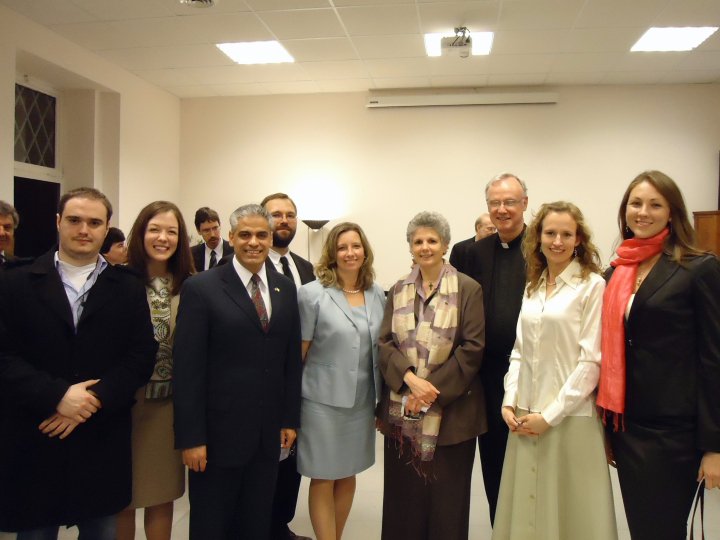
Radmilo, Amanda, Ambassador Diaz, AJ, Dr. Marian Diaz, Dr. Donna Orsuto, Fr. Donald Senior, Natalie, Karina
In its Pastoral Constitution of the Church in the Modern World, Gaudium et Spes, the Second Vatican Council invites women and men of faith to understand the aspirations, the yearnings, and the often dramatic features of the world in which we live” (GS, 4). May this Lay Centre, situated at the heart of the eternal city of Rome, cultivate minds and hearts willing to turn to others and to the world that surrounds us in order to better read and respond to the signs of our time. May this international community yield much fruit relative to new ideas embraced and actions undertaken for the sake of the common good. And may the practice of hospitality in this centre turn hosts into guests and strangers into friends. Perhaps, somewhere in this learning and living community, in simple acts of sharing material and spiritual resources, the words in the letter to the Hebrews will become palpable: “Do not neglect to show hospitality to strangers, for by doing that some have entertained angels without knowing it” (Heb 13:2).
Lay Centre Inaugurates New Home
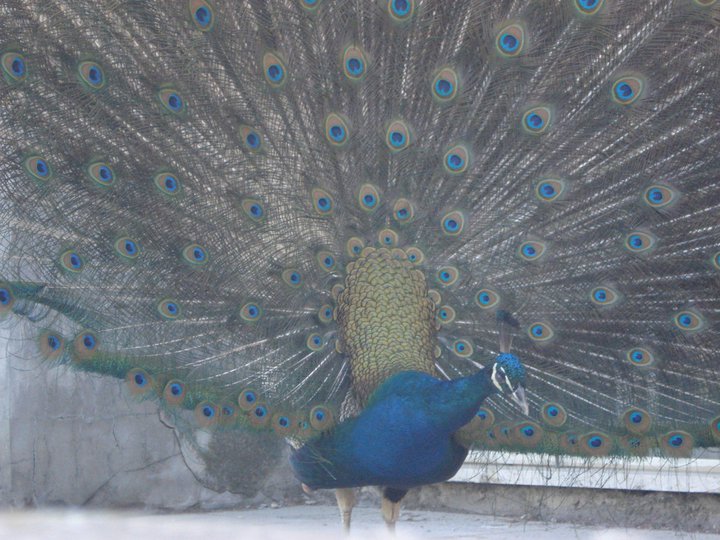
Lay Centre's other Guardian
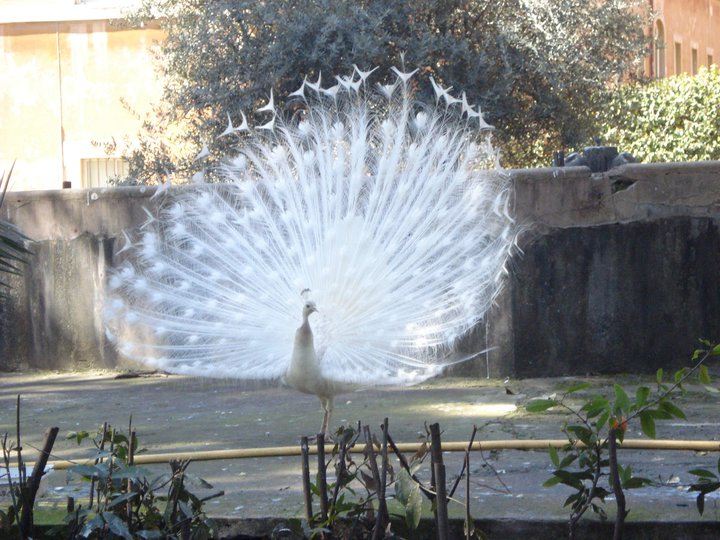
- Lay Centre’s Albino Guardian
Foyer Unitas was a ministry of hospitality operated by the Ladies of Bethany in Rome for nearly 35 years – just above the Centro Pro Unione and overlooking Piazza Navona. Asked by Pope Paul VI to provide lodging for the ecumenical observers at Vatican II, and then for other ecumenical and interfaith pilgrims to Rome, Foyer Unitas saw its share of Council fathers and peritii, from Cardinal Bea to young theologians Walter Kasper and Joseph Ratzinger.
When the decision was made for Foyer Unitas to close its doors in the mid-1980’s, two women who had been student employees assisting the Ladies developed the idea for a lay student residence to meet the obvious need for something like the Roman Colleges for the growing number of non-ordained, non-religious students at the Pontifical Universities. In 1986, co-founders Donna Orsuto and Riekie van Velzen opened the doors to the Lay Centre at Foyer Unitas.
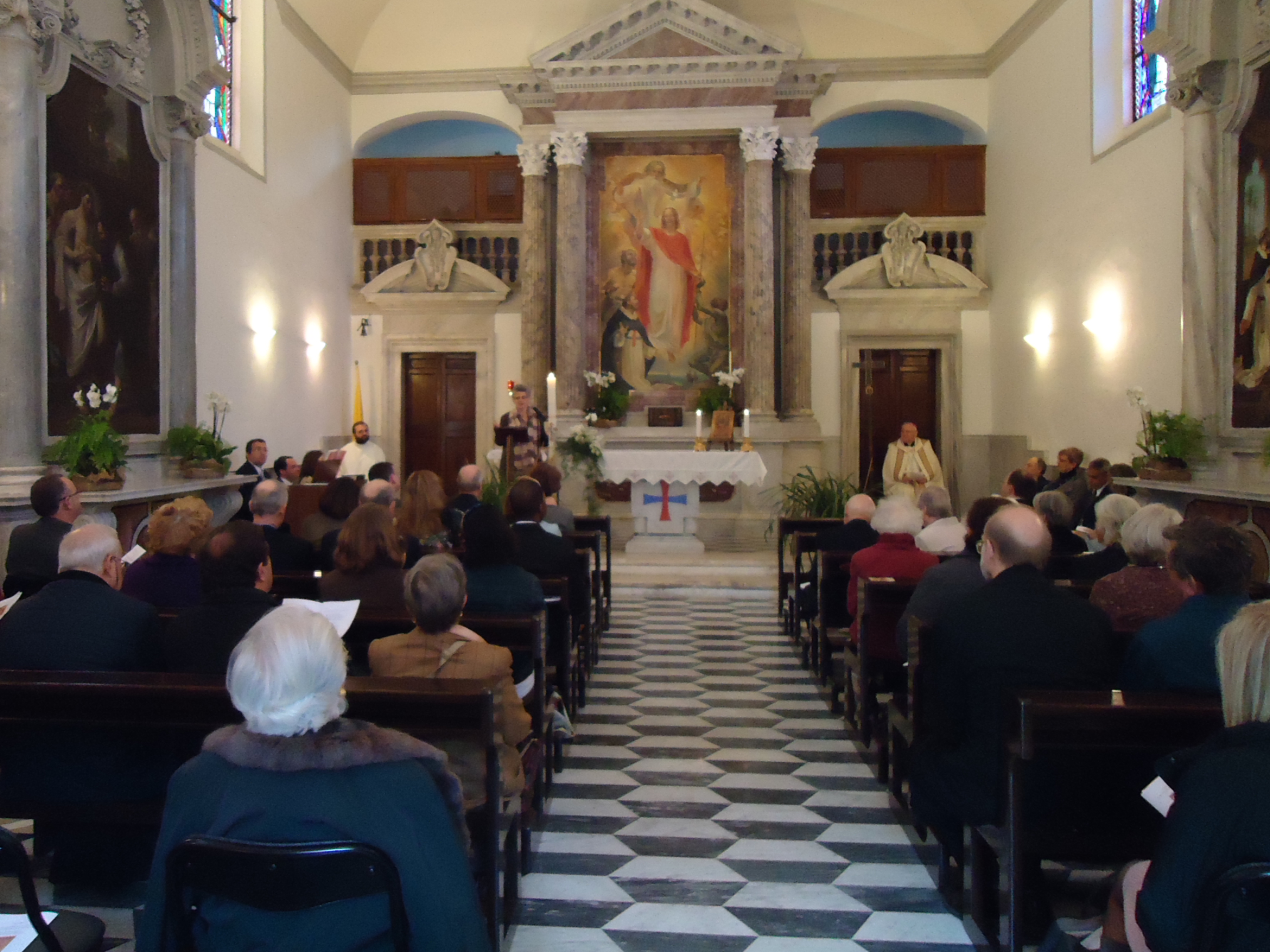
Vespers, with Bishop Farrell and Dr. Donna Orsuto
Tonight we celebrated the dedication and official inauguration of the new site of the Lay Centre, now located within part of the Passionist Retreat of Sts. John and Paul on the Caelian hill. With private gardens overlooking the Coliseum that had once been site to the Temple of Divine Claudius and Nero’s Nymphaeum, the remains of a 1st century aqueduct, and views of the Roman Forum and Palatine Hill, it is hard to imagine a better setting for prayer, study, and life in common.
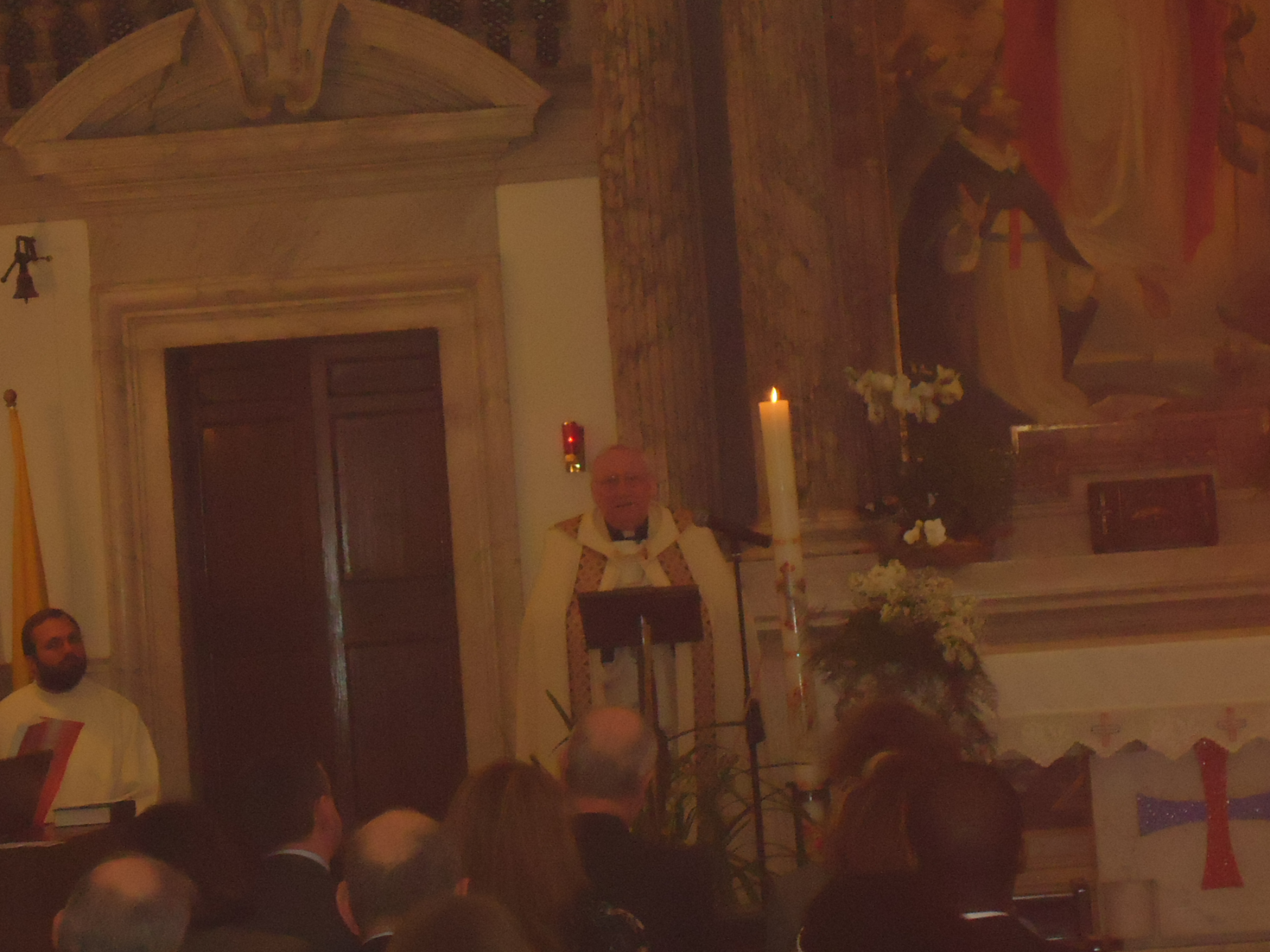
Bishop Brian Farrell delivers the homily
Nestled in the Villa Celimontana next door is a small church San Tommaso in Formis (St. Thomas in Chains), served by the Trinitarian Fathers on the site of what was once a monastery and hospital operated by the order. (The original complex dates back 800 years, but the current church is early 20th century). This was the venue for our vespers, presided by the Most Rev. Brian Farrell, LC, Secretary of the Pontifical Council for Promoting Christian Unity.

Procession begins down Via Santi Giovanni e Paolo
The site was chosen to celebrate the Trinitarian theme. The chapel of Foyer Unitas, dedicated on 7 October 1962, was dedicated to the Holy Trinity, as is the chapel at the new Lay Centre, dedicated on 7 October 2009. The Lay Centre’s Icon of the Holy Trinity, written in imitation of a XVII century icon, was originally blessed by Cardinal Bea along with the Foyer Unitas chapel and was prominent this evening during the celebration of the liturgy.

Procession enters Passionist Retreat grounds
Bishop Farrell’s presence and preaching was particularly significant given the long history and relationship between the Pontifical Council for Promoting Christian Unity and both the Lay Centre and Foyer Unitas. Bishop Farrell himself is a generous and patient man, the kind it is always a delight to serve with, liturgically. He lifelong commitment to ecumenism and support for the lay centre were also evident throughout the evening. Bishop Giorgio Corbellini, of the governorate of the Vatican City State also made a typically low-key entrance. Dressed only in a simple clerical suit (sans pectoral cross), he came back to the sacristy while Bishop Farrell and I were waiting for things to get started and I would not have recognized him without the introductions.
U.S. Ambassador to the Holy See Dr. Miguel Diaz and his wife, Dr. Marian Diaz, were guests of honor, as the former theology professor made a brief address at the end of vespers on hospitality and dialogue (full text to follow). In addition, nine other ambassadors were present, as well as three deputy chiefs of mission, including:
- US Ambassador to the Holy See His Excellency Miguel Diaz & Dr. Marian Diaz
- Canadian Ambassador to the Holy See Her Excellency Anne Leahy
- British Ambassador to the Holy See His Excellency Francis Campbell
- Irish Ambassador to the Holy See His Excellency Noel Fahey
- Egyptian Ambassador to the Holy See Her Excellency Lamia Mekhekar
- Dutch Ambassador to the Holy See Baroness Henriette van Lynden-Leijten
- Australian Ambassador to the Holy See His Excellency Tim Fischer
Several Lay Centre Board members and honorary board members made the trip from the United States and elsewhere. Board Chair Nancy Lindsay, retired senior counsel of the World Bank, had been here in the fall with her nephew, Andrew, and is probably the most faithful reader of this blog! Ralph and Mary Dwan are a lovely couple from the D.C. area, where he is retired as an attorney and she as an educator. Joseph Lynaugh was in from New Jersey where he has served as CEO of a couple of companies.
The honorary board members included the English-speaking world’s most well-known Vaticanist, John Allen, Jr. of the National Catholic Reporter; Sr. Leideke Galema, 90, of the Ladies of Bethany who moved to Rome in 1960 to spend the next forty years of her life here; Retired U.S. Ambassador to the Holy See and former RNC chairman James Nicholson and his wife Suzanne.
Following vespers, the assembly processed from the Church of St. Thomas through the gardens of the Passionist Retreat to the courtyard at the entrance to the Lay Centre where Bishop Farrell concluded the rites with a blessing of the entry and the people. A reception followed, generously provided by Peggy Brennan Hassett and Jack Kehoe and wine donated by a Roman enoteca owned by Claudio and Silvia DiRollo.
The official dedication celebration continues this week with a special two-part Vincent Palotti Institute presentation by Dr. Aurelie Hagstrom, chair of theology at Providence College in Rhode Island, and Robert White, Assistant director of the Lay Centre, on “The Hidden Treasures of the Caelian Hill”. Fr. Donald Senior, CP, President of Catholic Theological Union in Chicago will preside at a liturgy in the rooms of Passionist founder St. Paul of the Cross on Friday evening. Residents and board members will join the Passionist community for Sunday Eucharist in the chapel of St. Paul of the Cross in the Basilica of Sts. John and Paul, followed by our closing lunch.
Whether Mt. Eyjafjallajokull will let anyone leave Rome is another question, however! We may have to continue celebrations into next week!
Vatican Radio: Rome’s Lay Centre Inaugurates New Location
From Vatican Radio, a brief teaser about the dedication of the Lay Centre at its new site. Click here to listen (you will need RealPlayer it seems):
Rome’s Lay Centre or ‘Foyer Unitas’ as it’s also known [sic] is officially inaugurating its new premises close to the Colosseum today.
Founded nearly a quarter of a century ago to provide hospitality with an emphasis on ecumenical and interfaith dialogue, the centre currently hosts students from many different countries and from diverse Christian, Muslim and Jewish traditions.
It also runs a packed programme of lectures and courses on church history, spirituality and dialogue.
The co-founder and director of the Centre is Dr Donna Orsuto, a professor at Rome’s Gregorian University and former consulter with the Pontifical Council for Inter-religious Dialogue.
She spoke with Philippa Hitchen about the centre’s work and its new location…
Paschal Triduum 2010
The first time I participated in the Easter Triduum was also my altar serving debut. I was in third grade, nine years old. My training was held right after school by Sr. Mary Thorne, if I recollect correctly, and a few hours later I was serving my first mass, on Holy Thursday. That was twenty-three years ago and I have never intentionally missed any part of the Triduum.
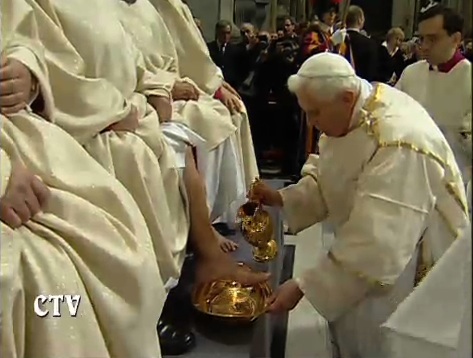
Holy Father washing feet of 12 presbyters at Holy Thursday Mass
In fact, I can only remember missing the whole thing once, because I was sick – but I had already done all the planning and training for the liturgies, and had very reliable volunteer lay liturgical ministers to rely upon in absentia. One other year, I was in the ER during the Easter vigil with a friend. Other than these two, I have worshipped during the high holy days, and usually as a server, lector, or liturgist and master of ceremonies. Even in my last interim parish ministry, where I was not the primary liturgist, I still had a contingent of catechumens to bring through the rites.
That said, it is kind of nice (but also a bit weird) to be absolutely and completely free of responsibility throughout the Triduum, and to be in Rome. There are three places where every Catholic should spend Holy Week at least once, in my opinion: Jerusalem, Rome, and Notre Dame. Though not necessarily in that order.
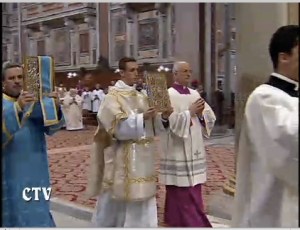
Latin and Greek Deacons in Gospel Procession, Holy Thursday, Archbasilica San Giovanni
Throughout my four years at Notre Dame, I was an altar server in the Basilica of the Sacred Heart, and sometime assistant MC there and sacristan/liturgy coordinator at the Chapel of Our Lady of Guadalupe in Keough Hall. Triduum was always a great deal of work, but always masterfully done, accompanied by beautiful music, and in the words of one visiting curial cardinal (who so enjoyed Holy Week at ND he came back twice while I was there), “This is better than Saint Peter’s!”.
I am inclined to agree, but with qualification. To be clear, I am disappointed in nothing of the Triduum here in Rome, except for the mob (the Romans’ answer to the queue, or line).
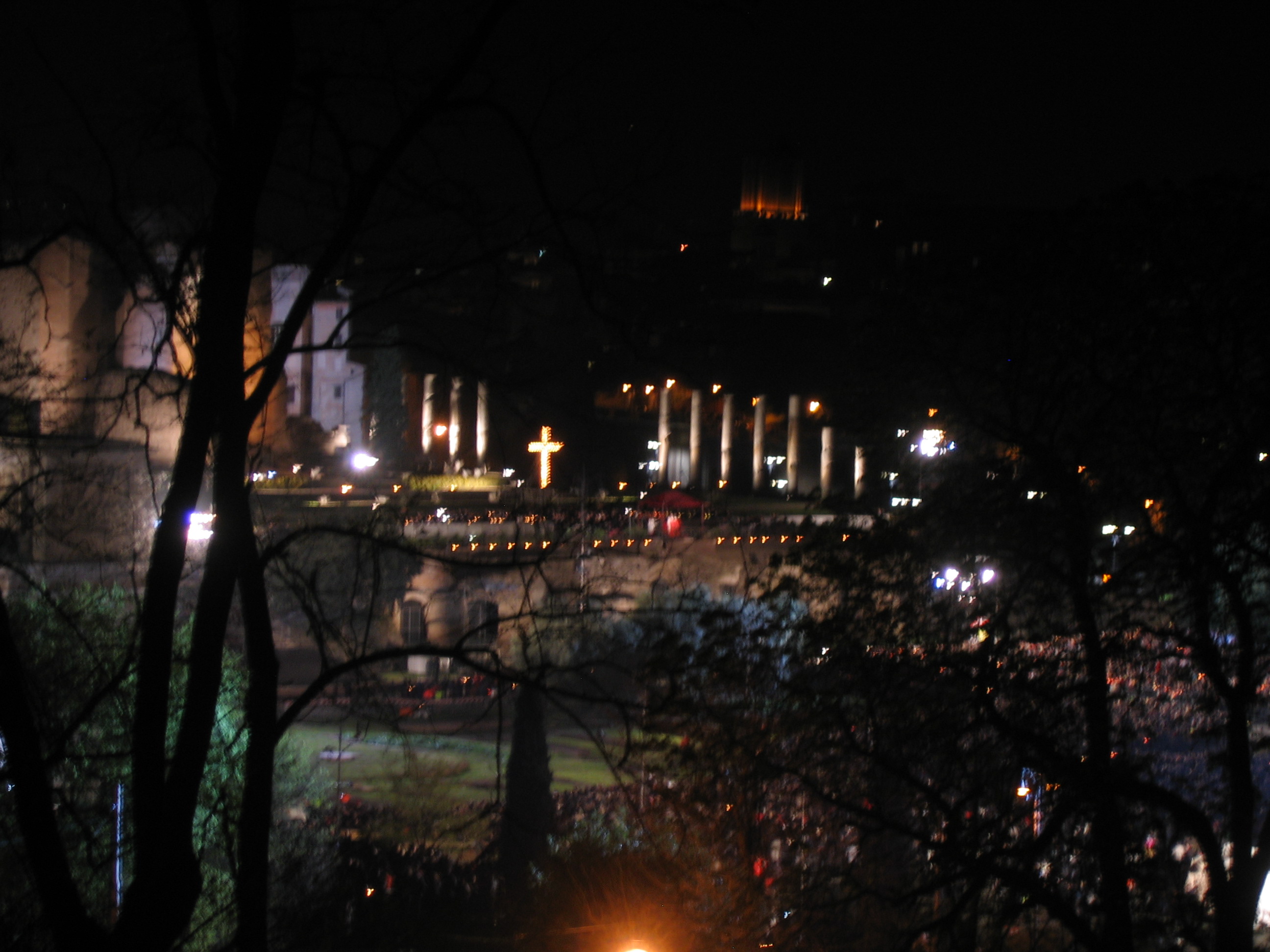
Way of the Cross - my view was not this blurry
This is, after all, the first church (not in chronology, but in order). The Mass of the Lord’s Supper on Holy Thursday was celebrated at the Pope’s Cathedral, the Archbasilica of Saint John Lateran, Mother-Church of Rome. The Service of Our Lord’s Passion on Good Friday and the Great Vigil of Easter were celebrated at the Vatican Basilica of Saint Peter. All were presided by the Bishop of Rome, Benedict XVI, and he was homilist at the first and last (Raniero Cantalamesa, OFM Cap., the preacher of the papal household, had the homily on Good Friday, as you may have heard.) I prayed the Way of the Cross from the edge of our property, a bluff overlooking the Coliseum with clear line-of-sight of the Holy Father about 300 meters away.

Raniero Cantalamessa, OFM Cap., Papal Preacher on Good Friday
The prayer guides are published pocket-sized booklets, illustrated with prints of 15th and 16th century frescoes from Italian churches. The liturgy was celebrated in Latin, the mass parts chanted in Gregorian style, and deacons blessed with angelic voices chanted the gospel – on Thursday it was proclaimed twice, once each in both Latin and Greek! (Presumably in honor of the fact that this year, Passover and Easter on both the Julian and Gregorian calendars all coincide). The prayers of the faithful throughout the three-day liturgy were offered in French, Spanish, English, Polish, German, Portuguese, Russian, Tagalog, Swahili and Arabic. Readings were in Italian, Greek, Latin, French, English, German, and Spanish.
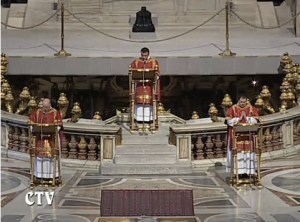
Deacons Proclaiming the Passion
The exultet in Latin is amazing. The Passion on Good Friday in slowly chanted Latin is impressive, but also a little hard on the back. (OK, yes, the very act of complaining about listening to the passion, when it is after all, the passion, is a sin I will publicly confess here and now: Mea culpa, ego sum mereum humanum.)
I found this interesting, though: Over the last few years in liturgical circles we have been encouraged to discourage the reading of the Passion in parts, as it is often printed in the missalletes and music books, and instead just have three deacons or readers proclaim the reading in turn. At the papal liturgy at San Pietro, with the ‘new’ Marini in charge, they had each deacon proclaim different parts (Narrator, Jesus, Peter/others) and the choir as the crowd/assembly.
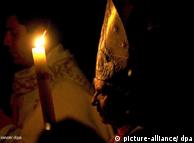
Pope Benedict during the Great Vigil's Service of Light
This touches on one of the great reasons to be in Rome: The liturgical diversity. I do not just mean the fact that there are representatives of all the major rites of the Church here in the city (Alexandrian, Antiochene, Armenian, Byzantine, Chaldean, and Latin), but also that within the Latin rites, within the Roman rite specifically, you have diversity. Just between the Roman Cathedral (San Giovanni) and the Vatican Basilica (San Pietro), with the same pope presiding and the same papal MC, you find different ways of celebrating and different customs.
One small example, during the Eucharistic prayer: At San Giovanni, we do not kneel, and there is no bell during the epiclesis and the two elevations, but there is incense. At San Pietro, we kneel from the epiclesis to the mystery of faith, and there is a bell for the epiclesis and two elevations, but no incense.
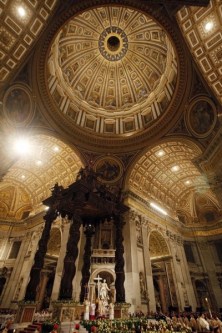
Easter Vigil 2010 San Pietro
Another interesting note, if a little random. While the Mass of the Lord’s Supper traditionally commemorates the institution of the Eucharist in the form of the Last Supper, it has traditionally been called the institution of the priesthood, through the act of the washing of feet. Historically, of course, and theologically, this is not entirely accurate so back home we had long since opted away from this simplistic phrasing lest it require a great deal of explanation. However, in the pre-liturgy announcements at San Giovanni, there it was “The Institution of the Eucharist and of the ministerial priesthood”.
Twelve presbyters were the mandatum at the Holy Thursday Mass of the Lord’s Supper, whose feet the Holy Father washed, though none of this was visible to me. The diplomatic corps were invited to communion with the Holy Father as minister, which they recieveed kneeling and on the tongue, or, they recieved a blessing instead of communion, if appropriate; but everyone else recieved communion along the aisles (standing, and in tongue or hand as the communicant prefered).
After returning to the Lay Centre for dinner, a group of us spent the evening in an adoration pilgrimage of seven churches during the traditional period until midnight: Basilica San Giovanni e Paolo, Basilica Santa Maria in Domnica, the Baptistry of San Giovanni, Archbasilica San Giovanni, Basilica Sant’Antonio di Padova, Basilica Santi Quattri Coronatti, and the Chapel of the Holy Trinity.
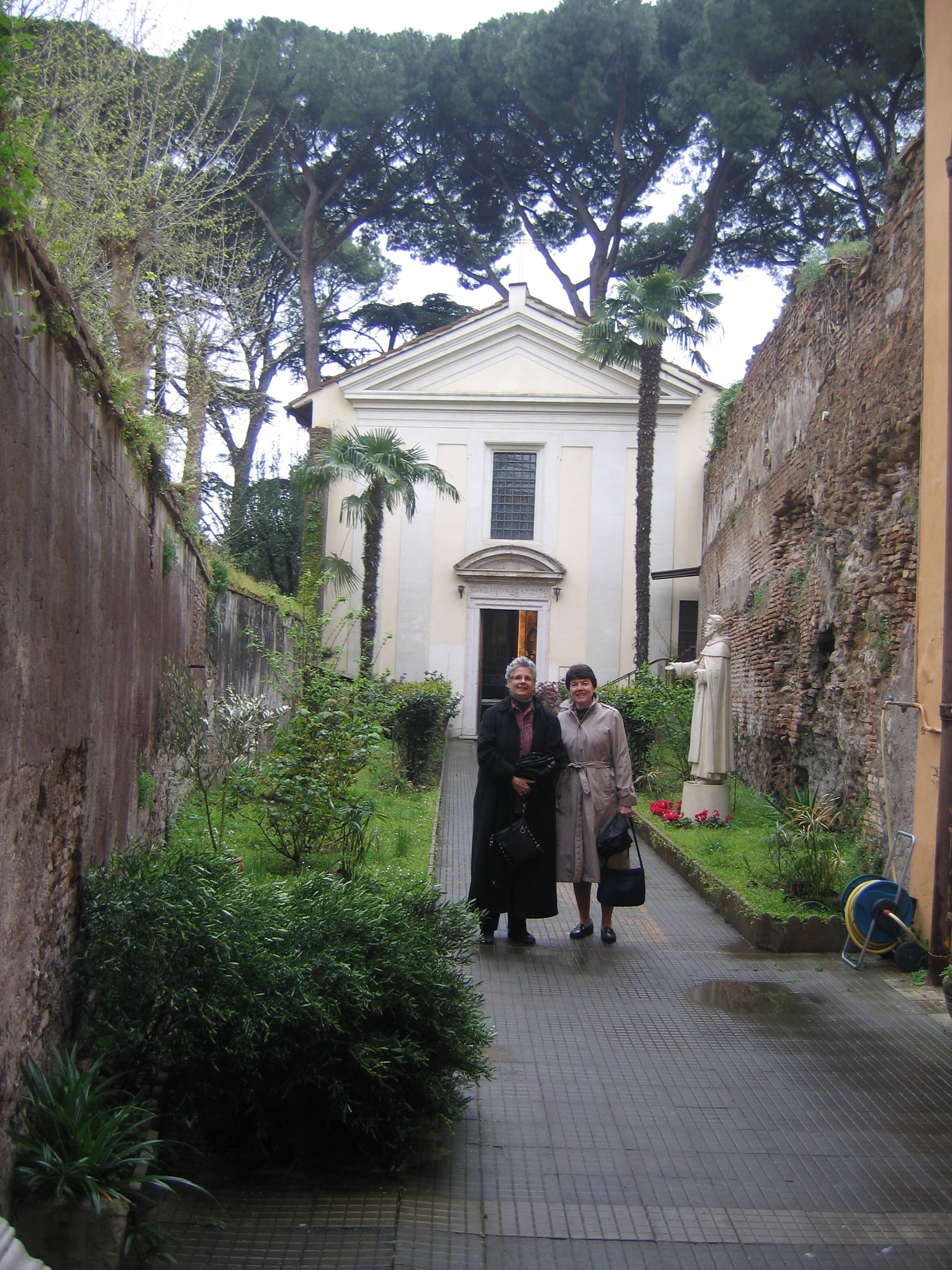
San Tommaso in Formis, with Dr. Orsuto and Dr. Hagstrom
St. Peter’s has a capacity of over 60,000 roughly the same as Notre Dame Stadium before the 1997 expansion. That plus room for another 400,000 in the piazza makes for a somewhat larger assembly than the 2500 or so who can fill the Basilica of Sacred Heart at Notre Dame. For an experience of the Church universal in the heart of the Church, you cannot beat Rome. But for that Church universal manifest in a local church, I do not think even Rome can beat Notre Dame. To a degree, its like apples and oranges. The assembly is different, and the considerations are different. One aims for a liturgy that represents the whole church, which is probably represented pretty well by those present. The other aims for a liturgy of the local church being wholly church in its place. For Latin and the biggest of big liturgy, it is Rome. For best liturgy captured in a particular church, music that is beautiful, reverent and accessible, it is Notre Dame. I am happy to have had my four years at ND, and hope to get a few more here in Rome!
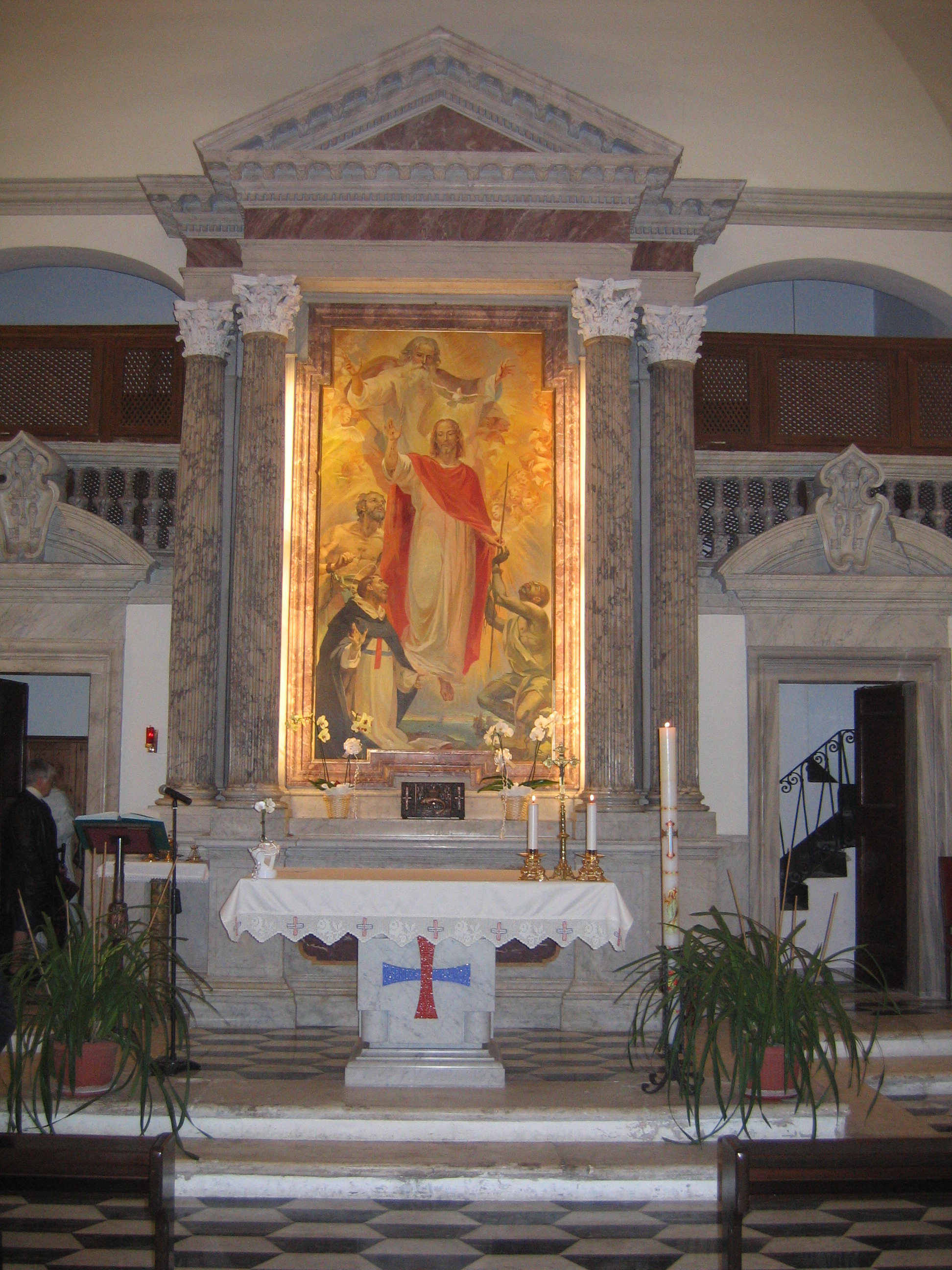
Church of San Tommaso in Formis
For Easter Sunday, between the full papal Triduum experience and the rain, I decided to go to the little church served by the Trinitarian Fathers, Chiesa San Tomasso in Formis (St. Thomas in Chains), literally just outside our front gate and around the corner. About 30 people filled the church, including two priests and two other Lay Centre folk, director Donna Orsuto and visiting scholar Dr. Aurelie Hagstrom, chair of the theology department at Providence College in Rhode Island who is here for a month of Marian research. Such a different experience after the big liturgies to be in a small community! The only space for the after-mass social was the tiny sacristy behind the altar, as long as we entered from one side and exited the other!
After a quick cappuccino and cornetto to celebrate the end of Lenten fasting, we watched the Urbi et Orbi on TV and prepared for a mid-afternoon Easter feast. Only a couple guests joined us, making us about fifteen in all – a perfect way to spend a drizzly Easter afternoon.
Maronite Mass with Fr. John Paul Kimes
Father John Paul Kimes is a Maronite presbyter serving in the Supreme Tribunal of the Congregation for the Doctrine of the Faith, the section which deals with grave delicts, those sins which involve the desecration of the sacraments and, since 2001, the sexual abuse of minors by clergy.
The Maronite Church is one of the 23 “self-governing” churches that make up the Catholic Church, and is the only patriarchal church with no Orthodox counterpart. The short version of the history is that while communion between the church of Rome and the church of Lebanon was never broken, communication was lost for some centuries at a time. However, at any opportunity where communion could be expressed, it was. So, it is common to say that the Maronite church was always a part of the Catholic communion. Born of the Syrian tradition surrounding Antioch and Edessa, this church settled in Lebanon and took its name from a hermit-priest of the late fourth century, St. Maron.
Given the connection to these communities, the liturgical rites are West Syrian, or Antiochene, and the liturgical language is a variation of Aramaic, and also includes Arabic. While most of our celebration was in English, some key prayers and responses were said in Arabic, and only our Egyptian Muslim and our Italian scripture scholar could keep up without the transliteration!
It’s a beautiful liturgy, even in the simple setting of our chapel. Perhaps especially so. After my experience with the Syro-Malabar Divine Liturgy recently, I was stuck by how much more of a role the deacon has in the Maronite rite. Also that neither the Alleluia nor the Gloria are omitted in the Maronite liturgy during Lent. (I found a Maronite liturgy on YouTube you could check out)
After dinner Fr. Kimes engaged questions and shared something of his work in the CDF. One of the questions posed was around the role of lay people in curial offices. There are few offices which are actually required, by law, to be held by a cleric, and the CDF tribunal is one of them. In most dicasteries it is simply a culture that has not been challenged. When he was prefect of the CDF, Cardinal Ratzinger apparently filled as many positions as he could with qualified non-ordained people. Even when, after becoming pope, the Congregation needed the very particular expertise of a lay person in a position reserved in canon law to a cleric, Pope Benedict granted it without question.
So why hasn’t this openness translated into changes across the curia now that he’s pope? He leaves his deputies to do the hiring themselves; rather than micromanage he prefers to lead by example. I’m not sure it’s a clear example, however, to most that are unaware of this. There remains, too, what might be described as a benign clericalism (my term, not his), a belief that the limitations to certain offices to clergy is broader than it actually is. In some cases this is more explicit and less benign. But even in the case of the Supreme Tribunal of the CDF, which is clearly clerical by law, Fr. Kimes expressed the opinion that this was a wisdom – some of what is dealt with is so heinous, the thought is that the judges need all the sacramental graces and spiritual strength that they can have, hence the preference in law for someone ordained.
St. Patrick’s in Roma
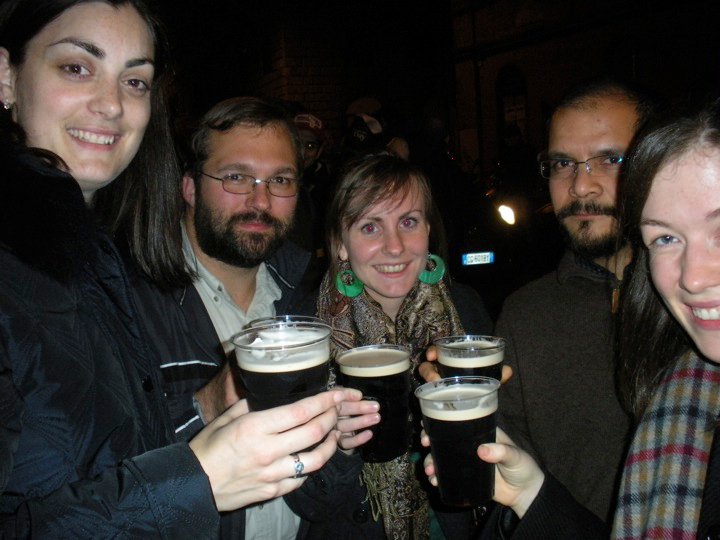 I never knew there would be so many Irish pubs in Rome. The last time I was in Europe, I discovered that almost every city on the continent of any decent size includes three requisite cuisine options beyond the local fare: an Irish pub, a Chinese restaurant, and a McDonald’s. But I read recently that there were nearly 100 Irish pubs in the greater Rome area, and I even encounter a group of American undergrads making their best effort to visit all of them today.
Thankfully, there’s one just across the park from the front gates, complete with Guinness on tap. Less thankfully, everyone in the Celio neighborhood decided it would be a good idea to celebrate St. Patrick’s Day there. So a contingent of us ventured over after our community night for a pint. One pint, only, mind you. Nevertheless, that was enough to induce an impromptu lesson in Irish dancing for some of my companions…
But, back to our community evening: these are, I may have said, one of the greatest aspects of formation in Rome, the opportunity to meet with curial officials and other church leaders on a weekly basis, celebrating the liturgy with them and hearing a little of their thoughts, their stories, and their insights.
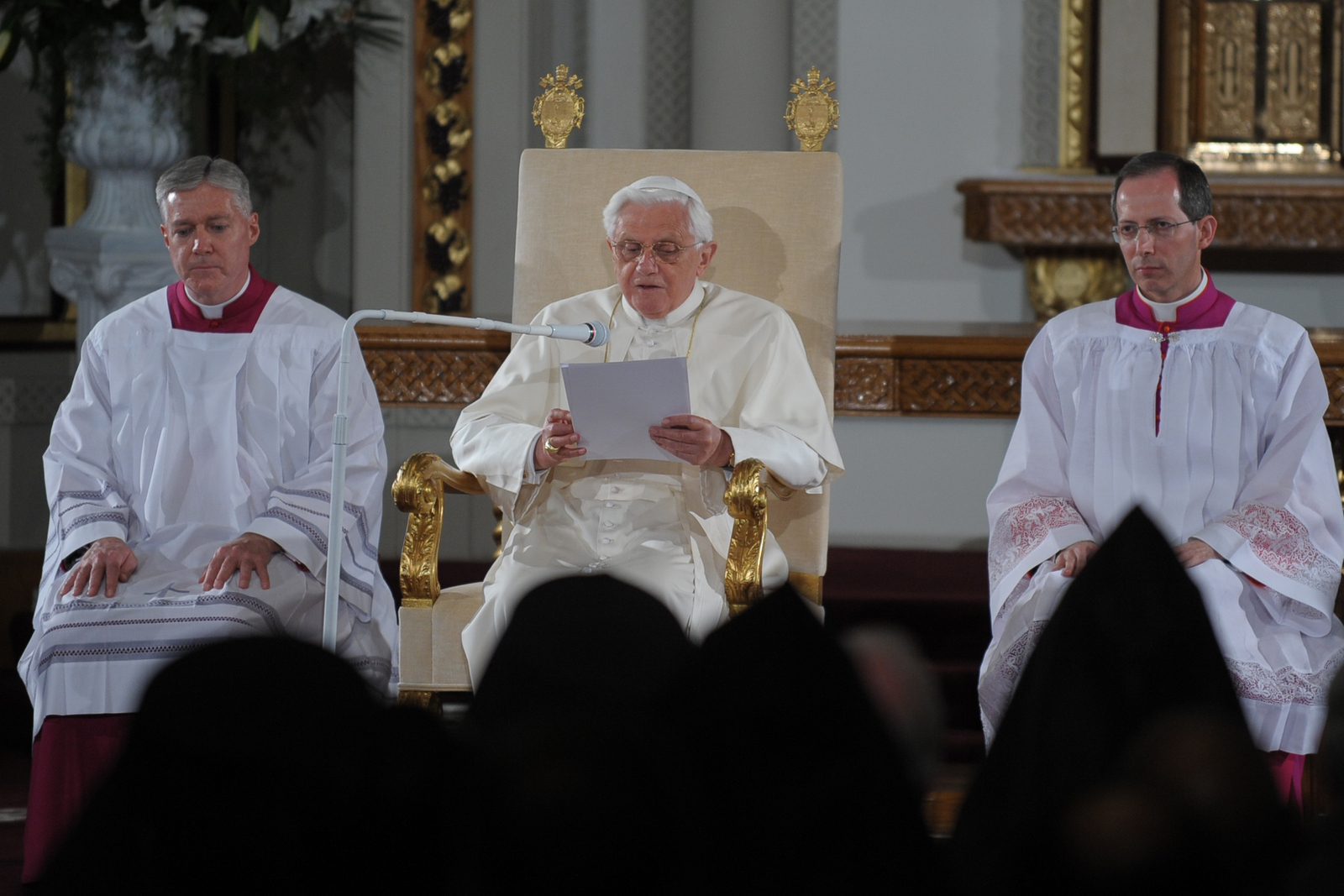
Msgr. Millea, Pope Benedict, Msgr. Marini
Tonight we were pleased to welcome Monsignor William Millea, an American who works in the Secretariat of State, General Affairs Section. This is the section that might parallel white house staff, in the sense that they handle appointments to curial offices, translations and publication of official texts and speeches, etc. An additional duty Father Millea has had is serving as one of the masters of ceremonies for the pope, and can often be seen with the papal master of liturgical celebrations, Monsignor Marini, alongside the Holy Father. This was the case throughout the pope’s pastoral visit to the Unites States a couple years ago. (At which point, as the token American in the Vatican retinue, it was to Millea that Pope Benedict turned after the big Eucharist at Yankee Stadium: “That’s what the liturgy is supposed to be!”)
Like so many we have talked to, he came to Rome for a year, and then came back for more and never left. His love of Latin and things classical certainly helped land him in a position to do much of the translating and interactions with things American and Anglophone for the Secretariat.
The Ides of March

Julius Caesar's Pyre & Temple
I remember being told by some middle school science teacher that each of us probably had two molecules of Caesar’s last breath in our biological makeup. Naturally, given my birth on the anniversary of his assassination, I have always had an interest – I do not think I would go so far as to say a connection – with the Roman Dictator.
I also cannot tell you how many times in my life I have heard the phrase uttered, “Beware the Ides of March” instead of the usual “Happy Birthday!”
With March being full of intensive courses, I was not able to get the full effect of Rome’s celebration honoring its first leader to be officially deified. The site of his funeral pyre, in the heart of the ancient Foro Romano, is modest by comparison to some of the temples around it, but is still adorned with fresh flowers almost daily by Roman devotees. Near the statue of Julius on the Via Forii Imperialli we witnessed a troop of costumed youth re-enacting the story of Caesar and his assassination in 44 B.C.

Julius Caesar statue on Fori Imperiali
While the Roman Senate house is still visible on the Roman forum, it was not in this building where as many as 60 senators participated in his assassination. Instead, meetings were taking place across town, near the Area Sacra at Largo Argentina, in the Theatre of Pompey. There is a restaurant, I’m told, where you can access the basement and eat in part of what was the building in which Caesar was killed. I did not get around to making reservations this year, but maybe next!
Instead, we had a typically great meal at the Lay Centre, and thanks to the intervention of my favorite Dutch theologian-diplomat, Feda baked a delicious flourless chocolate cake popular in Italy known as Torta della Nonna (Grandmother’s Cake).
Lay Centre Featured on Rome Reports
Rome Reports, an English-language news agency that broadcasts to several countries, did a feature about the Lay Centre at Foyer Unitas that aired last week:
Mar Bawai Soro
One of my intensive courses this semester is “The History of Aramaic Christianity”, taught by Mar Bawai Soro, a bishop of the Chaldean Catholic Church whose name is probably familiar to anyone who has been involved in ecumenism the last few years. He was also our guest for dinner at the Lay Centre this evening. (And though he did not share this, he was the person who, during the Jubilee Year 2000, recieved from Pope John Paul II the cross carried at the Stations of the Cross at the Colosseum. The pope carried it to the first two stations, handed off to Bishop Bawai for the second two, who then handed it off again.)
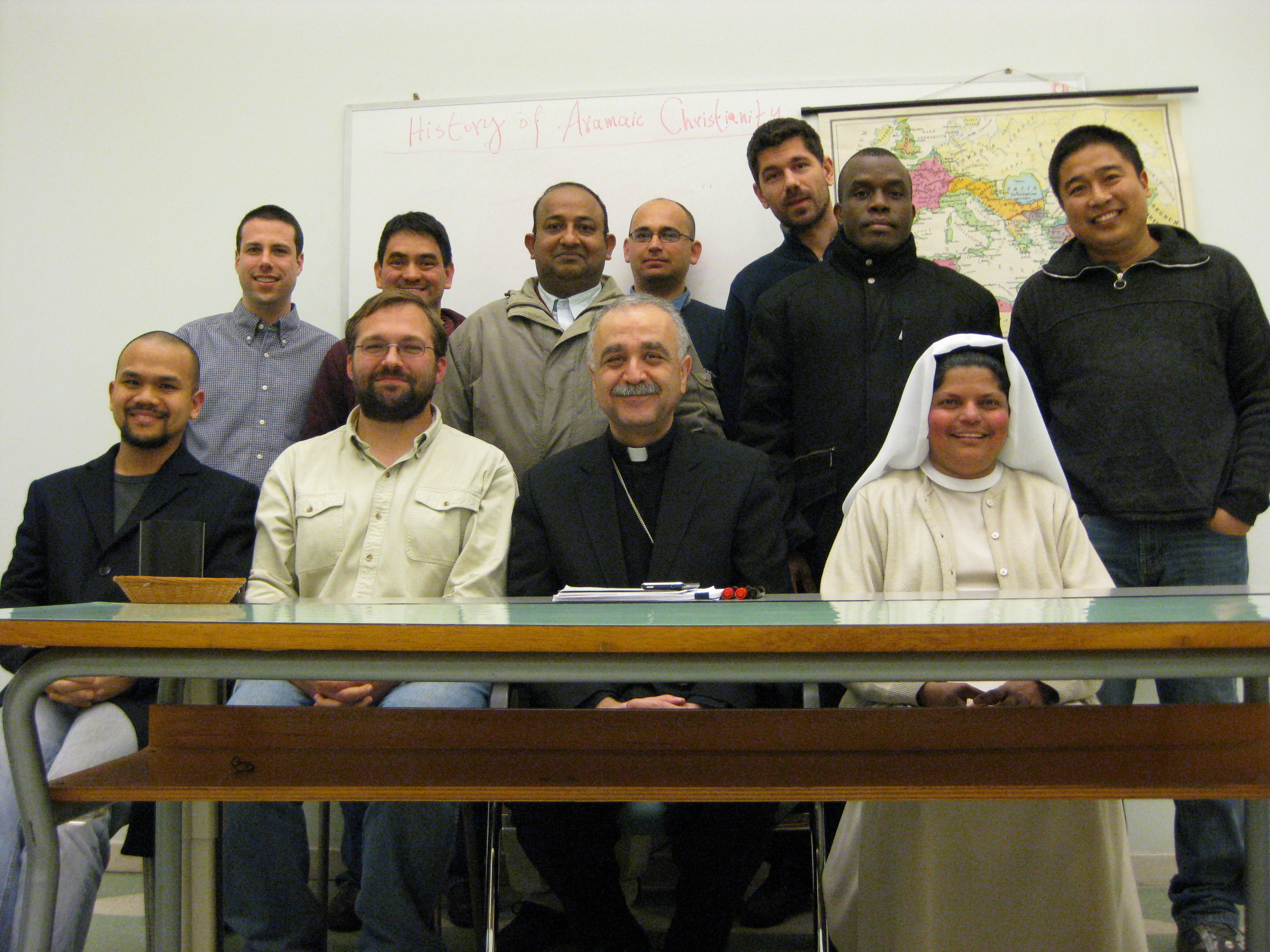
History of Aramaic Christianity, Angelicum, 2010
In most church history classes I have taken or taught, the focus is usually on the history of the Church within the Roman empire, and subsequently the nations were in direct succession from that Empire. Sometimes it gets even more eclipsed if the focus is purely on the Latin Church, the churches directly associated with the ritual and patriarchal patrimony of the church of Rome itself (ie, the Roman Catholic Church). It is sometimes news enough for people to realize there were four other apostolic sees within the Roman empire besides Rome! But we have often forgotten entirely the church in Asia, beyond the borders of the ancient Roman Empire.
The focus of our studies for this course have been on that Church of the East – not the Eastern or Oriental Orthodox Churches, but further east, in Mesopotamia and what was part of the Persian Empire at the time of Constantine. This church never enjoyed the status of being an official religion of the empire, as did the church in the empire of Rome and Constantinople. In fact, persecution only increased after Christianity became associated with the enemy to the west. To this day, being Christian in this area makes you suspect of collaboration with the “West” – whether that is Emperor Constantine or President Bush, and whether the dominant religion is Persian Zoroastrianism or Shi’a Islam.
This was the church of refuge for the Nestorians and the theological School of Antioch, driven across the border in the aftermath of the Council of Ephesus in 431, and a place where the theological battle between Monophysites and Nestorians was waged for centuries. The first stopping point for the missionary activity of the Apostle Thomas, the Mesopotamian church was the mother church of the earliest Christians in India, still known as Mar Thoma (St. Thomas) Christians. Missionaries of this church had reached Mongolia and China by the sixth century, and some scholars have suggested communities as far as Japan.
The current heirs to this tradition include:
- The Assyrian Church of the East, with about 250,000 members, traditionally centered in Iraq
- The Chaldean Catholic Church, with about 750,000 members, centered in Iraq
- The Syro-Malabar Catholic Church, with about 4 million members centered in the state of Kerala, India

Mar Bawai Soro
Much of the Church of the East’s history has been marked by political and ecclesial isolation – first by being the Christians outside the Roman empire, then ecclesially, and throughout by being more or less constantly a persecuted minority in Zoroastrian Persia, or Muslim Arab and Mongol rule. Several times in the last six centuries dioceses and other groups of the faithful would resume full communion with Rome. The first, in 1445 was the archbishop of Cyprus and his diocese, who after a couple generations were unfortunately Latinized and assimilated into the Latin (Roman) Catholic Church. A couple others only lasted for a century or so, eventually leaving communion again. Finally, the Patriarch (one of two rivals, anyway) and his cohort came in to full communion in 1830, giving us the current Chaldean Catholic Church. The rival patriarchal line and those in communion with it remain today as the Assyrian Church of the East, though they were the line which had been in Catholic communion for a century or so during the 16th and 17th centuries.
For 20 years, Bishop Bawai served this church as a bishop and as their top theologian and ecumenical officer (a sort of Ratzinger-Kasper combo, if you will), and participated in the Assyrian-Catholic dialogue from its inception, through the Common Christological Declaration of 1994 and the preparation of the Common Sacramental Declaration that was to follow.
For those who wonder about the products of ecumenism, it only took 8 years of dialogue to resolve the Christological issue that split the church 1500 years ago, and confess together that :
Our Lord Jesus Christ is true God and true man, perfect in his divinity and perfect in his humanity, consubstantial with the Father and consubstantial with us in all things but sin. His divinity and his humanity are united in one person, without confusion or change, without division or separation. In him has been preserved the difference of the natures of divinity and humanity, with all their properties, faculties and operations. But far from constituting “one and another”, the divinity and humanity are united in the person of the same and unique Son of God and Lord Jesus Christ, who is the object of a single adoration.
This is why there is always hope!
 Of course, that hope is always needed. The reality of the impending full communion with the Catholic Church provoked some nervousness. Understandably, I suppose: Comparatively, we are beyond huge (4400 Catholics for every one Assyrian Christian), and the prospect of the Patriarch becoming a mere cardinal, as some bloggers have put it, was uninviting. Their decision was to suspend the dialogue, and to suspend the bishop.
After finding no appeal, Mar Bawai and about 5000 faithful, including 30 deacons and a half dozen priests, came into full communion with the Chaldean Catholic Church in 2008.
 The Ecumenism Blog