The Ecumenism Blog

Home » Posts tagged 'ecumenism' (Page 4)

Tag Archives: ecumenism

Testing the Porvoo Agreement: An Ordination in Norway

Stian Heggedal was an Anglican seminarian when he lived at the Lay Centre for his semester as a student in Rome in 2009. Today he is a priest of the Lutheran Church of Norway, ordained at Nidarosdomen, the Cathedral Church of Trondheim. Yet, he will have the faculties of an Anglican priest as well, and be able to serve in either church. His first pastoral assignment is with the Military Ordinariate of Norway, where he will begin as a chaplain lieutenant stationed near Lillehammer.

The ecumenical achievement that makes this possible is the Porvoo Communion, which was established by the signing of the Porvoo Common Statement, twenty years ago in the very same cathedral where Stian received his presbyteral ordination.

As early as 1938, work began towards a closer union between the established churches of northern Europe, which are variously Anglican or Lutheran. The church of Norway was one of the first handful of signatories in 1992, with the Church of Denmark being the latest to join, in 2010. It includes 14 member churches and some observers, consisting of the Anglican and Lutheran churches in the British Isles, Scandinavia, the Baltic states and the Iberian peninsula.

The churches are all episcopal in structure, rather than congregational or presbyterian, and most are established state churches. An ordained priest or pastor in one can serve in another, and in theory at least, it does not matter anymore which church you are ordained into. An Anglican seminarian can be ordained by a Lutheran bishop, and still be validly Anglican.

Yet in practice, it did not quite work that way. Stian had to officially join the Lutheran Church of Norway about two weeks before his ordination. Finance, personnel, and administration seem to delay what theology and sacramental practice have already allowed to happen!

As for the ordination itself, i am sorry to report that my camera died, which was only discovered at the end of the weekend. However, i will note that i was surprised at how small the attendance was. Family members and friends, and a few church officials, but for two ordinands, there were about 50 people present, including three of us who had studied with Stian in Rome – myself, Eveline from the Netherlands and Cosima from Germany. The presiding bishop of the Church of Norway was present, but served as neither the presider at Eucharist nor the principal minister of ordination. In fact, one ordinand offered the homily and the other offered the Eucharist.

On a personal note, i have to say that i liked Norway for the fact that it was the first time in my life i was up before the crack of dawn every day. Granted, dawn cracked at about 10:00am, and sunset was at 2:00pm, but still… It was a very good trip!


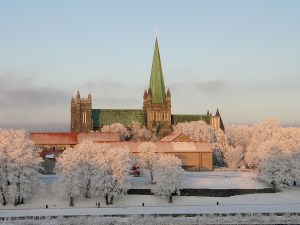
Nidaros Cathedral, Trondheim

In January, i was in Trondheim, Norway for the ordination of a friend of mine as a pastor in the (Lutheran) Church of Norway. More about that in another post, but here’s something about the Cathedral, which was for centuries the northernmost cathedral in the world.

Located at about the same latitude as Fairbanks, Alaska, the city that is now called Trondheim was founded as Nidaros by King Olaf I Tryggvason, in AD 997 – that would be the same King Olaf who received Leif Eriksson and introduced him to Chrstianity, just before the latter made his famous voyage to establish “Vinland” – modern-day Newfoundland, Canada.

The diocese was erected by St. Olav (King Olaf II Haraldsson) in about AD 1030 and elevated to metropolitan see in 1153 with suffragan sees in Norway, Iceland, Greenland, and the Kingdom of Mann and the Isles. The cathedral was constructed during the later part of the 11th century and the entirety of the 12th. In the mid-1530s the Church of Norway came under the influence of the Lutheran reformation, and, like the Church of England, broke communion with Rome, and became an established church. For four centuries there was no official Catholic presence there, until a mission was re-established in the 1930s; now the de-facto Catholic cathedral of the Territorial Prelature of Trondheim sits just across the road from Nidarosdomen, in a squat temporary building. (A capital campaign is underway to build a new Catholic church there.)

Nidaros Cathedral houses the remains of St. Olav, patron of Norway – though the exact whereabouts have been unknown since a 16th century iconoclasm. The only known relic of St. Olav is his arm, which is located in the (Catholic) Cathedral of Oslo.

Next to the Cathedral one can still find the archbishop’s palace, though there is no longer an archbishop. The (Lutheran) Bishop of Nidaros has his offices there, and hosted us for an intimate reception after the ordination. The presiding bishop of the Church of Norway also officially has some offices there, as Nidaros is the primatial see of Norway, though she spends most of her time in Oslo, the national capital.

Year in Review

As the Year of Grace 2011 ended, I reviewed my “to write” file for the blog, and found no less than 22 pages of notes on events and ideas I had not had time to develop into full posts. Here is a list of some highlights from the last year, with links to posts if I have them and as I develop them!

December:

November:

October:

September:

August:

  • Short visit home in the Pacific Northwest
  • Cascade Covenant Church
  • Helping my sister move: 16 hours on the road, 45 minutes unpacking the truck
  • My brother’s new house

July:

  • Netherlands: visiting Eveline, Clare
  • New York/New Jersey: visiting Courtney, Liam, Rob
  • Lay Centre 25th Anniversary Colloquium: My paper on the laity and ecumenism

June:

  • Archbishop Sartain of Seattle in Rome for Pallium
  • EuroPride in Rome – monastic perspectives from the hill

May

  • Notre Dame Chorale Concert at Sant’Ignazio: Michael and Kerri Castorano
  • Eucharistic Procession with Cardinal Marc Ouellet
  • Notre Dame Glee Club and Fr. Michael Driscoll in Rome
  • Lay Centre alumnus Theodosius Kyriakidis debuts his documentary film on Greek Christians in Asia Minor; another alumnus Mustafa Cenap Aydin of Turkey responds
  • Archbishop Michael Fitzgerald and Leijla Demiri present on Interfaith Dialogue of life
  • Beatification of JPII

April:

  • Fr. Michael Casey, O.Cist. visits Lay Centre
  • Assisi and Florence with Courtney and co.
  • David Ford and Stephen Kepnes: The Future of Theology
  • Annual JPII Lecture David Ford on Scriptural Reasoning
  • Paschal Triduum  in Rome
  • Culture Week in Rome
  • Meeting with Fr. Norbert Hofmann

March:

Earlier unwritten posts:

  • Cardinal Levada visits the Lay Centre
  • Springtime of Faith Summit in Rome – local presenters include two cardinals, two professors, and me!

Ideas, ongoing or upcoming:

  • Liberal and Conservative in the Church (see june 26, Feb 2)
  • Nostra Aetate, Dabru Amet, and Common Word
  • ARCIC III and Personal Ordinariates
  • Clericalism and Anti-clericalism
  • Laïcite, laity, secularism, and secularity
  • Vocations: discernment or recruiting office?
  • Catholic Education beyond parochial schools
  • “Catholic” vs. “Roman Catholic”: What’s in a Name?
  • The Bologna Process and Pontifical Universities
  • Papal honors as ecclesiological indicator
  • Liturgy Wars: Episode V – The New Translation
  • Call for a Common Easter
  • The Big Sort
  • Ecumenical Updates: Where have we got with all this dialogue?
  • Wikipedia as Courtyard of the Gentiles: A call for biographical articles on great ecumenists and other theologians
  • A Parable: The Kingdom of God is like the Electromagnetic Spectrum and it is Easier for a Colorblind Man to Pass Through 400-789 Terrahertz than to Enter it…
  • Upcoming article in Koinonia
  • Upcoming article and presentation for Assisi 2012: Ecclesiological Investigations Network conference

And finally: “The Diaconate in the International Ecumenical Dialogues: Toward an Understanding of the Deacon as Minister of Unity.” a tesina to be submitted for the License in Sacred Theology…

Colloquium on Anglican Patrimony in light of the Apostolic Constitution: A Canon Law Perspective

After class on Friday, my professor and I walked down the hill from the Angelicum to the Anglican Centre in Rome to join a group of canon lawyers from the Anglican Communion and the Catholic Church engage in a presentation and a conversation on the nature of Anglican Patrimony in light of the Apostolic Constitution Anglicanorum Coetibus.

In the wake of the 2009 apostolic constitution making provision for the establishment of personal ordinariates, questions have been raised about the exact nature of the “Anglican Patrimony” which is named in the text of the constitution and its appended general norms. Cardinal Levada’s answer to the inquiring Anglicans was, “we are hoping you can tell us!” To begin answering that question, the Anglican Centre in Rome is coordinating a series of meetings this year on the theme Anglican Patrimony in light of Anglicanorum Coetibus.

There were 22 participants in the workshop: Three lay women, four lay men, and fifteen priests – Most of the participants were members of the standing colloquium of Anglican and Catholic canonists, who chose to have their annual meeting in conjunction with this workshop.

Questions raised and observations made included the following:

What exactly is “patrimony”? Canonically the term is used in the Latin code only in reference to the charism of religious orders and the particular customs of local churches in the formation of priests. In the Code of Canons for the Eastern Churches, it more clearly refers to the liturgy, theology, spirituality, and discipline of a particular church (CCEO 28, 39, 405). If the model of religious order charism is an example, it was noted by a Franciscan friar present that it took Clare 40 years to get the rule she wanted approved by Rome, a constant give and take, debate and discussion between the founder’s vision and the hierarchy’s presumptions – and we are only 16 months from the announcement of the Apostolic Constitution and six weeks from the establishment of the first actual Ordinariate. We may not know for some time what this received Anglican Patrimony will actually be.

There was some discussion that the ordinariates are apparently not limited to Anglicans and former Anglicans. [Though, in rereading the text, it does seem to be limited] Indeed, many of the traditionalist Anglicans attracted to it are former Catholics – canonically still considered Catholic by the Latin code. But does this mean that Lutherans, Baptists, et al. can join the Catholic Church as part of the Ordinariate? What/who defines an “Anglican group” that can corporately join the Ordinariate? Four of the provinces of the Anglican Communion are in fact united churches, local ecumenical unions between Anglicans, Reformed, and other denominations. Could a Presbyterian elder of one of these united churches join and become an Anglican Ordinariate priest? Many of these members of united churches are part of the Anglican Communion but do not think of themselves as Anglican.

Why was the model of the pastoral provision not simply adopted more widely? (Where personal parishes would be set up allowing for use of Anglican rites and lead by former Anglican clergy) In this case it was thought that the patrimony would not be sufficiently preserved, and Pope Benedict finds the Anglican patrimony to be worthy of preservation within the Catholics Church, not just by the Anglican Communion. (This observation lead to an entire conversation about the locus and determiners of Anglican patrimony).

What would be the approved liturgical use in the Ordinariate, and would this be up to each Ordinariate individually? Someone had heard the 1928 Book of Common Prayer, which had been approved for use by the Episcopal Church in the US but rejected by Parliament for use by the Church of England, would be the model. This was unconfirmed, and others noted that most Anglo-Catholics, in England especially, are already using the Roman rite anyway and would likely continue to do so.

This lead to the speculation that there could be an Anglican Ordinariate in which no particularly Anglican Eucharistic rite was celebrated, somewhat ironic when one considers that most people probably think of Anglican patrimony in primarily liturgical terms.

Why not establish an Anglican Catholic Church sui iuris, like the Eastern Catholic Churches? The thought here was the mention in the constitution of seeing the Anglican Church as a particular expression of the Latin Church, its rites as variation of the Roman rite – as well as not wanting to do any more to appear to be bringing back uniatism as a form of ecumenism, something which has been rejected by the Catholic Church in its agreements with the Orthodox.

Since the Anglican Communion officially recognizes two sacraments, how will the other five be celebrated in an Anglican Ordinariate, since the Catholics Church accepts seven? This question was ‘corrected’ as someone else noted that the Anglicans do, in fact, recognize all seven sacraments and both churches, as agreed in ARCIC I, recognize a hierarchy of sacraments – the two dominical sacraments of Baptism and Eucharist holding a pride of place among the seven sacramental acts, for both churches, though this is expressed differently in parts of the Anglican Communion than others.

Candidacy for ordination, in the personal ordinariates, will be determined by the Governing Council – but this is neither Catholic nor Anglican, for both communions currently put this decision in the hands of the ordaining bishop, though with appropriate consultation.

Some noted that there had been popular speculation that the exception to celibacy would only be granted pro tempore, however, this would have been made clear in the text if that was the intent. Each will be appealed on a case by case basis, as celibacy remains the ideal for those who were not already ordained in the Anglican church, but it remains a real, practical possibility.  

Married bishops are a part of Anglican Patrimony, based on scripture, yet the Official Commentary on the Apostolic Constitution, written by Jesuit Father Gianfranco Ghirlanda, Rector emeritus of the Gregorian, has “absolutely excluded” the possibility of married bishops “given the entire Catholic Latin tradition and the tradition of the Oriental Catholic Churches, including the Orthodox tradition…” The VIS communiqué on 15 January announcing the erection of the first Personal Ordinariate of Our Lady of Walsingham for England and Wales, went so far as to say, “For doctrinal reasons the Church does not, in any circumstances, allow the ordination of married men as bishops.”

Given all of that, the question was asked, how much a part of the Anglican patrimony are married bishops, and what reasons could there be to exclude them? It was noted that despite the VIS announcement, there are no doctrinal reasons for not ordaining married men to the episcopate, only disciplinary reasons. It is suspected, given the wording of Fr. Ghirlanda’s commentary, that this could be out of ecumenical concern for our relations with the East – but also noted that the traditions of Latin and Eastern and Oriental churches have always differed, and the Orthodox would likely not be concerned whether we had a different discipline in the West vis a vis married bishops or not. Strangest of all, some noted, was that though the married former Anglican bishops would only be ordained to the presbyterate, especially those serving as ordinary are still allowed the use of pontificals, the symbols of episcopal office such as the pectoral cross and ring.

What will the role of priest’s wives be in the Ordinariate, if any? What role do Anglican clergy spouses have now? This varies in the Anglican Communion, depending on the cultural context, and would likely vary as well in the Ordinariates.  In some places the priests wife is treated as the ‘first lady’ of the parish, and the bishops wife even called “mama bishop” and treated as the first among these. In others, they have no role unless they are also a theologian or minister in the church, or volunteer like any other parishioner.

Final comments came from two Anglicans. The first shared that he had initially thought this “pastoral response” was anything but ecumenical, but as he reflected on it, the idea formed that the Anglican patrimony to be received by the Catholic Church in the Ordinariates was the people themselves. In this way, by receiving them, we are receiving some part of Anglicanism, and this may eventually turn out to be one more way in which the ground was prepared for the full-scale reception of each other in full communion down the road.

The other, who also stated considerable concern, shared that he was afraid that this would in fact have some rather negative ecumenical results, again by reason of the people received through the Ordinariate – the Anglicans may be all to happy to see them go, and he fears we Catholics may not be all that happy to receive them, once we get to know them!

On that note, we broke for drinks.

International Joint Commission for Theological Dialogue between the Catholic Church and the Oriental Orthodox Churches:

A few weeks ago I mentioned running into Fr. Ron Roberson on the streets of Rome as he was heading into this meeting. This is a repost of the report from Oriental Orthodox Church News and Events  posted by Ibrahim Yuhanon, S O C E ( Editor ) at 2/02/2011 07:49:00 PM

Eighth Meeting Rome, January 25 to 28, 2011

The eighth meeting of the International Joint Commission for Theological Dialogue between the Catholic Church and the Oriental Orthodox Churches took place in Rome from January 25 to 28, 2011. The meeting was hosted by His Eminence Cardinal Kurt Koch, the new President of the Pontifical Council for Promoting Christian Unity. It was chaired jointly by Cardinal Koch and by His Eminence Metropolitan Bishoy of Damiette, General Secretary of the Holy Synod of the Coptic Orthodox Church.

Joining delegates from the Catholic Church were representatives of the following Oriental Orthodox Churches: the Antiochian Syrian Orthodox Church, the Armenian Apostolic Church (Catholicosate of All Armenians), the Armenian Apostolic Church (Holy See of Cilicia), the Coptic Orthodox Church, the Ethiopian Orthodox Tewahido Church, and the Malankara Orthodox Syrian Church. No representative of the Eritrean Orthodox Tewahdo Church was able to attend.

The two delegations met separately on January 25, and held plenary sessions each day from January 26 to January 28. Each day of the plenary sessions began with a common celebration of Morning Prayer. In his remarks at the beginning of the first session, Cardinal Koch welcomed the group to Rome, and said that “I have had an enduring ecumenical interest in the Oriental Orthodox Churches, and in your history, your life of faith, your liturgy and theology. I have always felt very at home in your presence. Despite our longstanding separation, we share a solid basis of faith and ecclesial order.” With great sadness the Cardinal also informed the group of the death of one of the Ethiopian Orthodox representatives, Father Megabe Biluy Seife Selassie. He has been replaced by Archdeacon Daniel Seife Michael, an instructor at Holy Trinity Theological University College in Addis Ababa. The cardinal also offered congratulations to Father John Matthews who, since the last meeting, was ordained a bishop and given the name Metropolitan Dr. Youhanan Mar Demetrios, Assistant Metropolitan of Delhi, and to His Eminence Nareg Alemezian who has been elevated to the rank of Archbishop. Metropolitan Bishoy took the occasion to congratulate Cardinal Koch on his appointment as President of the Pontifical Council, and to express his gratitude to Cardinal Walter Kasper for his co-chairmanship of the commission until his retirement last year. He also stressed that the official name of his family of churches should always be “Oriental Orthodox Churches.”

At this meeting, the members continued their study – in a very friendly atmosphere – of the ways in which the churches expressed their communion with one another until the middle of the fifth century and the role played by monasticism in this. The papers presented included “The Communion and Communication that Existed Between Our Churches Until the Mid-Fifth Century of Christian History As Well As the Role Played by Monasticism: The Tradition of Antioch,” by Archbishop Theophilus George Saliba; “The Petrine Office and the Question, Who Established the Church of Rome?: Coptic Orthodox Perspective,” by Metropolitan Bishoy of Damiette, “Communion and Communication Among the Churches in the Tradition of Alexandria,” by Father Mark Sheridan, OSB; “The Role of Monasticism in the Development and Communion of the Churches,” by Father Columba Stewart, OSB; “Communion and Communication that Existed Between Our Churches Until the Mid-Fifth Century of Christian History and the Role Played by Monasticism: The Ethiopian Experience,” by Archdeacon Daniel Seife Michael Feleke; “The Reception of the Ecumenical Councils in the Armenian Tradition (VIII-XV cc.)” and “Communion and Communication,” by Archbishop Yeznik Petrossian; “Communion and Communication Between the St. Thomas Christians of India and Other Churches till Mid-Fifth Century A.D. – Indian Orthodox Perspective,” by Metropolitan Dr. Gabriel Mar Gregorios; “Communion and Communication Between the St. Thomas Christians of India and Other Churches till Mid-Fifth Century A.D. – A Syrian Orthodox Perspective,” by Metropolitan Dr Kuriakose Theophilose; “Communion and Communication Among the Churches: Rome in the Pre-Constantinian Era,” by Prof. Dietmar W. Winkler.

In these various studies, the members of the commission focused more precisely on the concrete expressions of communion and communication among the churches before the separation. Indeed, communion was expressed primarily through various forms of communication. It was noted that in the pre-Constantinian period, there was an intense communication among the churches, especially in times of crisis. There was a common sense of responsibility towards the other churches that was found most clearly in the exchange of letters and synodal decisions. These provided a means of conveying encouragement and challenge to one another, as well as theological clarifications. This exchange was mutual among the various churches. It exemplified a remarkable degree of communion among local communities in a process that lacked central direction after 250 years of expansion throughout the Roman Empire and beyond, including Armenia, Persia, Ethiopia and India. The universal phenomenon of Christian asceticism, present from the earliest times, found expression in the monastic movements, emerging from the late third century in all parts of the Christian world. There was a fruitful exchange of monastic spiritual writings emanating from the Christian Orient, even across doctrinal divisions.

In the evening of January 25, the members attended a Vespers service in the Basilica of Saint Paul’s Outside the Walls presided over by His Holiness Pope Benedict XVI for the conclusion of the Week of Prayer for Christian Unity. In his homily the Holy Father made reference to the presence of the members of the dialogue, and said, “We entrust the success of your meeting to the Lord, that it may be another step forward towards our longed-for unity”. On Thursday evening January 27, Cardinal Koch hosted a dinner for the dialogue members and staff of the Pontifical Council for Promoting Christian Unity at the Domus Sanctae Marthae in the Vatican.

Pope Benedict XVI received the members of the commission in private audience on Friday morning January 28. Cardinal Koch and Metropolitan Bishoy thanked the Pope for receiving the commission, and Metropolitan Bishoy presented a Coptic icon of Saint Mary the Mother of God to him on behalf of the members of the commission. The Pope then greeted the members, saying “It is with great joy that I welcome you, the members of the Joint International Commission for Theological Dialogue between the Catholic Church and the Oriental Orthodox Churches. Through you I gladly extend fraternal greetings to my venerable Brothers, the Heads of the Oriental Orthodox Churches. I am grateful for the work of the Commission which began in January 2003 as a shared initiative of the ecclesial authorities of the family of the Oriental Orthodox Churches and the Pontifical Council for Promoting Christian Unity. As you know, the first phase of the dialogue, from 2003 to 2009, resulted in the common text entitled Nature, Constitution and Mission of the Church. The document outlined aspects of fundamental ecclesiological principles that we share and identified issues requiring deeper reflection in successive phases of the dialogue. We can only be grateful that after almost fifteen hundred years of separation we still find agreement about the sacramental nature of the Church, about apostolic succession in priestly service and about the impelling need to bear witness to the Gospel of our Lord and Saviour Jesus Christ in the world. In the second phase the Commission has reflected from an historical perspective on the ways in which the Churches expressed their communion down the ages. During the meeting this week you are deepening your study of the communion and communication that existed between the Churches until the mid-fifth century of Christian history, as well as the role played by monasticism in the life of the early Church. We must be confident that your theological reflection will lead our Churches not only to understand each other more deeply, but resolutely to continue our journey decisively towards the full communion to which we are called by the will of Christ. For this intention we have lifted up our common prayer during the Week of Prayer for Christian Unity which has just ended. Many of you come from regions where Christian individuals and communities face trials and difficulties that are a cause of deep concern for us all. All Christians need to work together in mutual acceptance and trust in order to serve the cause of peace and justice. May the intercession and example of the many martyrs and saints, who have given courageous witness to Christ in all our Churches, sustain and strengthen you and your Christian communities. With sentiments of fraternal affection I invoke upon all of you the grace and peace of our Lord Jesus Christ.”

The ninth meeting of the International Joint Commission will take place in Addis Ababa, Ethiopia, at the invitation of His Holiness Abune Paulos I, Patriarch of the Ethiopian Tewahido Orthodox Church. The members will plan to arrive on Monday January 16, 2012, and depart on Monday January 23. The two delegations will meet separately on Tuesday January 17, and in plenary session on Wednesday, Thursday and Saturday, January 18, 19, and 21. They will participate in the celebration of Epiphany (Timkat) on January 20, and in Sunday liturgies on January 22.

The members concluded with joyful thanks to God, the Father Son and Holy Spirit, for what has been accomplished at this meeting.

* * *

The members of the Commission are:

Representatives of the Oriental Orthodox Churches
(in alphabetical order)

Armenian Apostolic Church— Catholicosate of all Armenians: H.E. Khajag Barsamian, Archbishop of the Eastern Diocese of the USA, New York; H.E. Archbishop Yeznik Petrossian, General Secretary of Bible Society of Armenia, Etchmiadzin, Armenia;

Armenian Apostolic Church— Holy See of Cilicia:
H.E. Archbishop Oshagan Choloyan, Prelate of the Eastern Prelacy in the USA, New York; H.G. Archbishop Nareg Alemezian, Ecumenical Officer of the Holy See of Cilicia, Antelias, Lebanon;

Coptic Orthodox Church: H.E. Anba Bishoy (co-chair), Metropolitan of Damiette, Egypt, General Secretary of the Holy Synod of the Coptic Orthodox Church; Rev. Fr. Shenouda Maher Ishak, West Henrietta, New York, USA; H.G. Bishop Daniel of the Coptic Orthodox Church in Sydney, Australia (observer);

Eritrean Orthodox Tewahdo Church: Rev. Fr. Kaleab Gebreselassie Gebru, Eritrean Orthodox Tewahdo Patriarchate, Asmara, Eritrea (unable to attend);

Ethiopian Orthodox Tewahido Church: Archdeacon Daniel Seife Michael Feleke of Holy Trinity Theological University College in Addis Ababa; Mr. Lique Hiruyan Getachew Guadie (unable to attend);

Malankara Orthodox Syrian Church: H.E. Metropolitan Dr. Gabriel Mar Gregorios, President of the Department of Ecumenical Relations, Diocese of Trivandrum, India; H. G. Metropolitan Dr. Youhanon Mar Demetrios, Assistant Bishop of Delhi (co-secretary), Delhi, India.

Syrian Orthodox Church of Antioch: H.E. Mor Theophilus George Saliba, Archbishop of Mount Lebanon, Secretary of the Holy Synod of the Syrian Orthodox Church, Beirut, Lebanon; H.E. Kuriakose Theophilose, Metropolitan of the Malankara Syrian Orthodox Theological Seminary and President of the Ecumenical Secretariat of the Malankara Syrian Orthodox Church in India, Ernakulam, India;

Representatives of the Catholic Church

His Eminence Cardinal Kurt Koch (co-chair), President of the Pontifical Council for Promoting Christian Unity;

Most Reverend Paul-Werner Scheele, Bishop Emeritus of Würzburg, Germany;

Most Reverend Youhanna Golta, Patriarchal Auxiliary Bishop of the Coptic Catholic Patriarchate, Cairo, Egypt;

Most Reverend Jules Mikhael Al-Jamil, Procurator of the Syrian Catholic Patriarchate to the Holy See and Apostolic Visitator in Europe, Rome;

Most Reverend Peter Marayati, Armenian Catholic Archbishop of Aleppo, Syria;

Most Reverend Woldetensae Ghebreghiorghis, Apostolic Vicar of Harar, Ethiopia, President of the Ecumenical Commission of the Catholic Church in Ethiopia and Eritrea;

Rev. Fr. Frans Bouwen M.Afr., Consultant to the Pontifical Council for Promoting Christian Unity; Jerusalem;

Rev. Fr. Columba Stewart, OSB, Executive Director, Hill Museum and Manuscript Library, St. John’s Abbey and University, Collegeville, Minnesota, USA;

Rev. Fr. Ronald G. Roberson, CSP, Associate Director of the Secretariat for Ecumenical and Interreligious Affairs, US Conference of Catholic Bishops, Washington, DC, USA;

Rev. Fr. Paul Rouhana, OLM, Université Saint-Esprit, Kaslik, Jounieh, Lebanon (unable to attend);

Rev. Fr. Mark Sheridan, OSB, Pontificio Ateneo S. Anselmo, Rome;

Rev. Fr. Mathew Vellanickal, Vicar General of the Archdiocese of Changanacherry, India;

Rev. Fr. Boghos Levon Zekiyan, Pontifical Oriental Institute, Rome;

Prof. Dietmar W. Winkler, Consultant to the Pontifical Council for Promoting Christian Unity, Salzburg, Austria.

Rev. Fr. Gabriel Quicke, Official of the Pontifical Council for Promoting Christian Unity, Rome (co-secretary).

Rome, January 28, 2011

Spring Studies

For those still keeping track, here are my courses for the coming semester, along with thesis writing and preparing for the lectio coram – comprehensive oral exams.

  • Catholicism in the Church: Anglican and Roman Catholic Perspectives
  • Does Doctrine Still Divide? (with Geoffrey Wainright)
  • Ecumenical Methodology II
  • Ecumenism and Canonical Structures
  • First-Century Judaism
  • From the Chalcedonian Formula of Faith to the Christological Agreements between the Catholic Church and the Pre-Chalcedonian Churches
  • The Messianic Idea in the Hebrew Bible and the Dead Sea Scrolls
  • Shi’ite Islam and Roman Catholicism
  • Seminar: Readings in Schillebeeckx’s Christology

Catholic – Oriental Orthodox Dialogue in Rome

While waiting with some classmates to meet with the German Salesian responsible for staffing the Pontifical Commission for Religious Relations with the Jews, I ran into a friend of my on the Via della Conciliazione. He was in Rome for the week-long meeting of the Catholic-Oriental Orthodox International Commission on Dialogue. The participants, including representatives of the Coptic, Ethiopian, Eritrean, Armenian, Syriac and Malankara churches, participated in the vespers concluding the Week of Prayer for Christian Unity at St. Paul Outside the Walls as their opening activity.

Vatican Radio recorded a thirteen minute interview with the officer responsible for dialogue with the Oriental Orthodox in the PCPCU:

They’re among the most ancient churches in the world, founded according to tradition by the apostles in Egypt, Armenia, Syria, India and Ethiopia in the decades following Christ’s death and Resurrection. Yet they have not been in communion with either the Roman Catholic world or the Eastern Orthodox world since they officially severed ties in the 5th century – hence very little is known about their rich heritage and traditions outside those countries where they are still based.

They are of course the Oriental Orthodox Churches and here in the Vatican on Friday, their representatives concluded a meeting of the mixed commission for theological dialogue with their Catholic counterparts.

To find out more about the meeting and about the impact of the recent attacks on Coptic Christians in Egypt, Philippa Hitchen talked to Fr Gabriel Quicke, who’s in charge of relations with these Churches at the Pontifical Council for Promoting Christian Unity….

Listen Here

Lord’s Prayer and Doxology: a suggestion

The doxology is the last line of the Lord’s Prayer, “For thine is the kingdom, the power, and the glory forever and ever. Amen.” It is, to be more precise, an ancient prayer traditionally added on to the Lord’s Prayer (as found in Matthew, normally), and a version of it dates back to the beginning of the 2nd century – meaning some Catholics, at least, were praying it this way more than 1300 years before it became “the Protestant version”. Or one might just say it is one other way in which Catholic tradition has been kept better outside the Catholic communion. In any case…

The reason Catholics have become used to the Our Father without the doxology is liturgical – when we pray the Lord’s Prayer during the Eucharistic liturgy, we pause between the end of the Prayer proper and the doxology to allow the priests’ embolism, “Deliver us Lord, from every evil…” Even though we pray the doxology every Sunday, we are habituated to stopping after “…deliver us from evil”, such that when we are taken out of the Sunday liturgy, we continue to stop.

In fact, however, the embolism is only part of the Eucharist, and is not part of other liturgies, such as the Liturgy of the Hours. In those times, we should pray the entire prayer, with the doxology, even when it is not an ecumenical prayer service. If we do this regularly, it will seem less uncomfortable when we do get to a mixed liturgical setting, and be better hosts to the other Christians who rarely omit this last line of the prayer.

Highlights of the Week of Prayer

A few highlights of the week here in Rome I thought I would share. Clearly, there was too much going on for me to even make it to most of the services and events, and even those I did get to would take too long to recount in full.

St. Paul Within the Walls, Rome

The pope called ecumenism a moral imperative. That does not leave much wiggle room for the doubtful, dissenting, or disinterested. Definitely a highlight, though already mentioned here.

One of the most beautiful moments was a concert by four Roman choirs at St. Paul Within the Wall, the Episcopal Church of Rome (That is, Anglican Communion, American branch). After an ecumenical evensong that was well-attended, these four choirs provided us with a live, surround-sound rendition of Thomas Tallis’ Spem in Alium. This is a ten minute, 40-part motet from 1570, an English response to the Italian mastery of Renaissance music. Given the timing, I suppose a little ecclesiastical/nationalistic competitiveness was not surprising. In any case, what Tallis produced is moving, and though listening to it on YouTube does not do justice to the experience, the parish has kindly provided a recording of the event here.

On Sunday, I celebrated the Eucharist with the Caravita Community, which I have mentioned before, as they are one of the Anglophone locales for events ecumenical. In addition to three of the Gregorian’s Muslim students there for part of their research into Christian worship (having already been to a  mass in Italian), there were some Anglican priests present, including a visiting professor from Virginia Theological Seminary, who was the guest homilist (and whose homily he brought to the ambo on his iPad). It was a good homily, but the most striking part of the liturgy came during the communion rite. As the Anglican priests, including the Archbishop of Canterbury’s Representative to the Holy See, Canon David Richardson, came to the presider to receive communion, they inclined their heads for a blessing. After blessing each, however, the minister inclined his own head and asked for a blessing from them. A fitting sign and ecumenical gesture – we are, painfully, still divided, but equally in need of each others’ prayer and benediction, especially in the sacramental moment that lays bare the imperfect state of our communion.

I should also note that here, as everywhere else during the week, including the papal liturgy, prayers during the general intercessions were offered for the pope, the ecumenical patriarch, and the archbishop of Canterbury, something which has been a decades-old (but often ignored) recommendation of the Holy See to churches around the world – and something which ought to be practiced more often!

Canon David Richardson, Archbishop of Canterbury's Representative to the Holy See and Director of the Anglican Centre in Rome

A couple of days later, I was at the Anglican Centre, located within the Palazzo Doria Pamphilj off the Piazza Collegio Romano. Every Tuesday they offer mass and lunch for residents and visitors, Anglicans and Catholics alike. The small chapel accommodated the 30-35 people present, but snugly. Canon David was presider, and delivered what I think is the best homily of the week. Here, the intimacy, the noble simplicity of the rite, the familiarity and theology of the liturgy all coalesced to provide one of the more literally gut-wrenching moments of being unable to share communion. One of my friends who had not been to many Anglican liturgies asked me afterwards, “So… that was Anglican? But it was almost identical to [the Catholic] mass!”

About the only difference was the location of the sign of peace before the preface to the Eucharistic Prayer, a move which even our current pope has suggests we ought to emulate.

The whole point of being unable to share communion is that we are motivated by the pain of this that we work ever the harder for full unity. But if people are never in the position where they experience this, how can they be so motivated? A thought for a later post there…

Cardinal Kurt Koch

Finally, during the closing liturgy of the week, the papal vespers for the feast of the Conversion of St. Paul Outside the Walls, there was another interesting little thing. In addition to the ecumenical guests offering prayers and readings, which is quite standard, the Latin-chanted Lord’s Prayer included the doxology. There were actually audible responses from the seats around me along the lines of, “huh, that’s interesting!” – at least from the people who know enough Latin to have noticed. One of the choirs even stopped, perhaps out of habit, a line early and had to jump back in to finish the prayer. Reflecting on the addition, it occurred to me that while it could well have been an ecumenical gesture, it was also a more authentically accurate move from a purely Catholic liturgical point of view, as well. More on that below.

Oh, and i got to meet Cardinal Koch, Cardinal Kasper’s successor as President of the Pontifical Council for Promoting Christian Unity.

Papal Homily at Vespers Closing Week of Prayer


Video can be found here: http://vod.vatican.va/vespri25012011.mov 

“The path toward this unity must be seen as a moral imperative, response to a precise call of the Lord.”

ROME, JAN. 25, 2011 (Zenit.org).- Here is a translation of the homily Benedict XVI delivered today at the closing vespers of the Week of Prayer for Christian Unity, held at the Basilica of St. Paul’s Outside the Walls. Today’s feast of the Conversion of St. Paul brought the prayer week to a close. 

* * *

Brothers and Sisters,

Following the example of Jesus, who on the eve of his Passion prayed to the Father for his disciples “that they may all be one” (John 17:21), Christians continue to invoke incessantly from God the gift of this unity. This request is made more intense during the Week of Prayer, which ends today, when the Churches and ecclesial Communities meditate and pray together for the unity of all Christians.

This year the theme offered for our meditation was proposed by the Christian communities of Jerusalem, to which I would like to express by heartfelt gratitude, accompanied by the assurance of affection and prayer either on my part or on that of the whole of the Church. The Christians of the Holy City invite us to renew and reinforce our commitment for the re-establishment of full unity meditating on the model of life of the first disciples of Christ gathered in Jerusalem: “They — we read in the Acts of the Apostles (and we heard it now) — devoted themselves to the Apostles’ teaching and fellowship, to the breaking of bread and the prayers” (Acts 2:42). This is the portrait of the early community, born in Jerusalem the same day of Pentecost, aroused by the preaching of the Apostle Peter, full of the Holy Spirit, addressed to all those who had arrived in the Holy City for the feast. A community not shut-in on itself, but, from its birth, catholic, universal, capable of embracing people of different languages and cultures, as the book of the Acts of the Apostles itself testifies. A community not founded on a pact among its members, or the simple sharing of a project or an ideal, but from profound communion with God, who revealed himself in his Son, from the encounter with Christ dead and resurrected.

In a brief summary, which ends the chapter that began with the account of the descent of the Holy Spirit on the day of Pentecost, the Evangelist Luke presents synthetically the life of this first community: how many had heard the word preached by Peter and were baptized, listened to the Word of God, transmitted by the Apostles; were happily together, taking charge of the necessary services and sharing freely and generously their material goods; celebrated the sacrifice of Christ on the Cross, his mystery of Death and Resurrection, in the Eucharist, repeating the gesture of the breaking of the bread; they continually praised and thanked the Lord, invoking his help in their difficulties. This description, however, is not simply a memory of the past, and even less the presentation of an example to imitate or of an ideal goal to reach. It is rather the affirmation of the presence and action of the Holy Spirit, uniting all in Christ, who is the principle of the unity of the Church and makes believers one.

The teaching of the Apostles, fraternal communion, the breaking of the bread and prayer are the concrete ways of life of the first Christian community of Jerusalem gathered by the action of the Holy Spirit but at the same time they constitute the essential features of all Christian communities, of all times and all places. In other words, we can also say that they represent the essential dimensions of the unity of the visible Body of the Church.

We must be grateful because, in the course of the last decades, the ecumenical movement, “arising from the impulse of the grace of the Holy Spirit” (“Unitatis Redintegratio,” No. 1), has taken significant steps forward, which have made it possible to attain encouraging convergence and consent on varied points, developing between the Churches and the ecclesial communities relations of mutual esteem and respect, as well as of concrete collaboration in face of the challenges of the contemporary world. We are well aware, however, that we are still far from that unity for which Christ prayed and which we find reflected in the portrait of the first community of Jerusalem. The unity to which Christ, through his Spirit, calls the Church is not realized only on the plane of organizational structures, but is configured, at a much more profound level, as expressed “in the confession of only one faith, in the common celebration of divine worship and in the fraternal concord of the family of God” (ibid., No. 2). 

The search for the re-establishment of unity among divided Christians cannot therefore be reduced to a recognition of the reciprocal differences and to the obtaining of a peaceful coexistence: What we long for is that unity for which Christ himself prayed and which by its nature is manifested in the communion of the faith, of the sacraments, of the ministry. The path toward this unity must be seen as a moral imperative, response to a precise call of the Lord. Because of this, the temptation must be overcome to resignation and pessimism, which is lack of trust in the power of the Holy Spirit. Our duty is to continue passionately on the path towards this goal with a serious and rigorous dialogue to deepen the common theological, liturgical and spiritual patrimony; with reciprocal knowledge, with the ecumenical formation of the new generations and, above all, with conversion of heart and prayer. In fact, as Vatican Council II declared, the “holy intention to reconcile all Christians in the unity of the one Church of Christ, surpasses human forces and talents” and, because of this, our hope is placed first of all “in the prayer of Christ for the Church, in the Father’s love for us and in the power of the Holy Spirit” (ibid., No. 24).

On this path for the search of full visible unity among all Christians we are accompanied and sustained by the Apostle Paul, of whom today we celebrate solemnly the feast of his conversion. He, before the Risen One appeared to him on the road to Damascus saying to him: “I am Jesus whom you are persecuting!” (Acts 9:5), was one of the most ferocious adversaries of the early Christian communities. The evangelist Luke describes Saul among those who approved the killing of Stephen, in the days when a violent persecution broke out against Christians of Jerusalem (cf. Acts 8:1). He left from the Holy City to extend the persecution of Christians to Syria and, after his conversion, he returned to be introduced to the Apostles of Barnabas, who made himself guarantor of the authenticity of his encounter with the Lord. From then on Paul was admitted not only as a member of the Church but also as preacher of the Gospel together with the other Apostles, having received, as them, the manifestation of the Risen Lord and the special call to be “chosen instrument” to carry his name before the Gentiles (cf. Acts 9:15).

In his long missionary journeys, Paul, journeying through different cities and regions, never forgot the bond of communion with the Church of Jerusalem. The collection in favor of Christians of that community, who, very soon, had need of being helped (cf. 1 Corinthians 16:1), occupied an important place in Paul’s concerns, which he considered not only a work of charity, but the sign and the guarantee of the unity and the communion between the Churches founded by him and the early community of the Holy City, as sign of the one Church of Christ.

In this climate of intense prayer, I wish to address my cordial greeting to all those present: to Cardinal Francesco Monterisi, archpriest of this Basilica, to Cardinal Kurt Koch, president of the Pontifical Council for Promoting Christian Unity, to the other cardinals and brothers in the episcopate and priesthood, to the abbot and to the Benedictine monks of this ancient community, to men and women religious, to the laity that represent the entire diocesan community of Rome. In a special way, I would like to greet the brothers and sisters of the other Churches and ecclesial communities represented here this evening. Among them, it is particularly gratifying to me to address my greeting to the members of the International Mixed Commission for Theological Dialogue between the Catholic Church and the Ancient Eastern Churches, whose meeting will take place here in Rome in the next few days. Let us entrust to the Lord the good outcome of your meeting, so that it can represent a step forward toward the much hoped for unity.

[…]

Dear brothers and sisters, trusting in the intercession of the Virgin Mary, Mother of Christ and Mother of the Church, we invoke, therefore, the gift of unity. United to Mary, who on the day of Pentecost was present in the Cenacle together with the Apostles, we turn to God source of every gift to have renewed for us today the miracle of Pentecost and, guided by the Holy Spirit, may all Christians re-establish full unity in Christ. Amen.