
Home » Posts tagged 'Catholic Church' (Page 9)
Tag Archives: Catholic Church
John Paul II Center for Interreligious Dialogue

In the midst of last week’s events surrounding the Fifth Annual John Paul II Lecture on Interreligious Understanding, delivered at the Angelicum by Cardinal Kurt Koch, i was asked to stay on another year as the graduate assistant at the John Paul II Center for Interreligious Dialogue at the Angelicum. So, another year in Rome, at least!
Coincident with the big event – that being the lecture not my assistantship renewal – the Center rolled out a new website, that will continue to expand its content: http://jp2center.org/
While my academic focus has remained ecumenical, the interreligious piece, especially with the Abrahamic faiths, has grown ever entwined in every aspect of my life. It is hard to believe how much time has passed in Rome already, but there is always more to see and do. Please check out the website, and also the Center’s Facebook page.
Building on Nostra Aetate: 50 Years of Christian-Jewish Dialogue, with Cardinal Koch
 The John Paul II Center for Interreligious Dialogue hosted its fifth annual John Paul II Lecture on Interreligious Understanding, featuring Cardinal Kurt Koch, president of the pontifical council for promoting Christian Unity and the commission for religious relations with the Jews. His topic was “Building on Nostra Aetate: 50 Years of Christian-Jewish Dialogue.” (full text)
The lecture was the highlight of a busy week for the Center, with a series of meetings and receptions around the Russell Berrie Fellowship and the relationship of the Angelicum University and the Russell Berrie Foundation, which is made manifest in the John Paul II Center. About 150 people attended, including the president emeritus of Ireland, Mary MacAleese, ambassadors to the Holy See from several countries, the U.S. Special Envoy for combating anti-Semitism, the new rector of the Angelicum Fr. Miroslav Adam, and Cardinal Walter Kasper.
His Eminence addressed the topic in seven sections. Nostra Aetate itself, he summed up with “YES to our Jewish roots, NO to anti-Semitism”, and as the ‘magna charta’ of Jewish-Catholic dialogue. That Nostra Aetate took up this question and set an unambiguous position that “in the Catholic Church, [Jews] have a reliable ally in the struggle against anti-Semitism.” It affirms, as Pope John Paul II said during his 1986 visit to the Roman synagogue, that
“The Jewish religion is not something ‘extrinsic’ to us, but in a certain way is ‘intrinsic’ to our own religion. With Judaism we therefore have a relationship we do not have with any other religion. You are our dearly beloved brothers and in a certain way it could be said, our elder brothers.”
With regard to the reception history of Vatican II, he says that “one can without doubt dare to assert that Nostra Aetate is to be reckoned among those Council texts which have in a convincing manner been able to effect a fundamental reorientation of the Catholic Church following the Council”. This statement, incidentally, points to a hermeneutic that clearly holds that the purpose of the Council was a reorientation of the Catholic Church.
He outlined the historical and theological reasons for including the dialogue with Jews in the Council for Christian Unity rather than the one for Interreligious Dialogue:
“The separation of Church and Synagogue can be considered the first schism in the history of the church, or as the Catholic theologian Erich Przywara has called it, the ‘primal rift’, from which he derives later progressive loss of wholeness in the Catholica.”
This was followed by a survey of post-conciliar documents building on Nostra Aetate, the most recent from the Commission being the 1998 We Remember: A Reflection on the Shoah, and then a similar treatment of global international dialogues and their development, the result of which is that,
“Confrontation has turned into successful collaboration, the previous conflict potential has become positive conflict management, and the coexistence of the past has been replaced by a load-bearing friendship.”
While he acknowledges that the real papal impetus for dialogue began with Paul VI, he points out that this engagement by the leadership of the universal Catholic Church was only really apprehended by the wider public in the form of Pope John Paul II, who “had a refined sense for grand gestures and strong images” as compared to, for example, Pope Benedict XVI, who “relies above all on the power of the word and humble encounter.”
Of Ratzinger, Koch highlighted the theologian Ratzinger’s understanding of the bible as one single book, with the old testament inseparable from the new. He likewise highlights the German Shepherd’s book, Jesus of Nazareth, in which he clearly reiterates Church teaching that the biblical report of the trial of Jesus cannot serve as the basis for any assertion of collective Jewish guilt: “Jesus’ blood raises no call for retaliation, but calls all to reconciliation. It has become as the letter ot the Hebrews shows, itself the permanent Day of Atonement of God.”
He concludes by engaging open theological questions and prospects. The question of the role of Christ in the salvation of the Jews, given the enduring covenant of God: What is the mission to the Jews, if there is one? How do we reconcile these two truths without offering a parallel path of extra-Christological salvation?
Cardinal Koch sees anti-semitism, anti-Judaism, and Marcionism as still-present challenges which the Catholic Church must and does denounce as a betrayal of Christian faith. An expression of this question is found in the recently revised Good Friday prayers for use in the ‘extraordinary form’ of the Latin liturgy, which itself raises questions about “lex orandi, lex credendi”, when we have seen four versions in forty years. Liturgically, he also critiqued both preachers who omit the old testament readings from their reflections, and presiders who “change the mass” omit the original Hebrew meanings of the prayers.
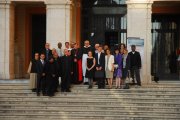
Cardinal Koch with Berrie Fellows
Assisi 2012 – Where we Dwell in Common.
So, I have had a bit of a break from blogging, mostly to focus on other writing, and owing to other distractions. Rome can do that.
However, I find myself now with about 30 pages of back-notes for blogs, and sitting in Assisi for a conference of the Ecclesiological Investigations Network, so it seemed opportune to begin again with some observations from the first day. The theme is Assisi 2012: Where we Dwell in Common – Pathway sofr Dialogue in the 21st Century. The three thematic tracks are intra/inter ecclesial issues (ecumenism/ecclesiology), interfaith/interreligious issues, and Faith and World/Culture.
We arrived yesterday and started with an opening plenary prayer in the Basilica of Santa Maria degli Angeli, home of the Porzincula, and greeted by Assisi Archbishop Domenic Sorrentino and Friar Fabrizio Migliasso, Custodian of the basilica.
There are a few familiar faces (Peter Phan, Rick Gillardetz, Dennis Doyle, Michael Kinnamon), and a few names I finally get to put faces to (Paul Murray from Durham, the other Viggo Mortensen). But I confess I am a little surprised how few I knew or knew of – one more reminder of how insulated pontifical academia can get.
Participants number over 200, from 55 countries, and several different churches and faiths. The opening panel offered insights into the theological situation in Italy for the participants, and the opening keynote was offered by Paul Arthur of North Ireland, offering lessons from the peace process there for dialogue initiatives. Peter Phan offered a humorous evening toast, and Dennis Doyle delivered a deadpan response. This morning began with a plenary panel composed of Brad Hinze (US), Mary Getui (Kenya), and Eleni Kasselour Hatzivassiliadi (Greece) and a response from Deivit Montealegre (Argentina).
The late morning, we had parallel plenaries, with mine focused on interchurch issues, such as:
- The Burdens of History: Must Tribalism Always Prevail?
- Hierarchy or Network of Truths? Hermenutical Principles and Challenges of Dialogue about Doctrinal Issues
- Does a Doctrinal Teaching Office have an Ecumenical Future? (Which focused on a recent report of the Group des Dombes)
The afternoon held smaller breakout sessions with panels of smaller papers, and more direct discussion. I chose one with a Chilean and Tanzanian students from Louven, and Michael Walsh, the British church historian. He offered a look into an as-yet unpublished encyclical of Pius XI, Ecclesia Christi – On the True Church of Christ. It is one of two released in the archives of his pontificate.
It is so healthy, and people are so approachable. It is like a retreat, except that daily life in Rome is like a retreat, so I guess having a packed schedule is the retreat from the retreat. Having the daily intellectual stimulation with world class scholars is a nice break though. It is such a culture clash from the daily pontifical experience though, nobody is here speaking in official capacity, and everyone is quite open. No holds barred in critiquing the narrowing hermeneutic of the Council, calling to task shoddy scholarship, or directly challenging other churches for inconsistencies or unusual doctrinal stances.
I present on Friday, offering some observations on non-priestly ministries as opportunities for ecumenical convergence. Diaconate and lay ecclesial ministry anyone?
Ecumenical witness in the life of Camaldoli
This is not all that has been going on, and not all we were celebrating, however, for this Benedictine offshoot congregation on the Caelian hill. Several weeks ago, they elected a new prior: Dom Peter John Hughes. Dom Peter has been an Anglican priest for a number of years, and a Camaldolese monk for fifteen. How fitting, that on the eve of their millennial anniversary, the community living in the house that was that of the pope who sent the Apostle of England would choose as their Roman prior a priest of the Communion born from the Church of England?
After fifteen years of ecumenical witness as an Anglican priest active in a Catholic order, the election presented a crossroads. Clearly, the prior must be in full communion with the Catholic Church – and there is no personal Ordinariate established in Italy. Therefore, Dom Peter was brought into full communion and welcomed into the Catholic presbyterate at a quiet liturgy presided by Archbishop Bruno Forte of Chieti-Vasto, “Italy’s most famous theologian”. Forte has been rumored as a possible successor to Cardinal Levada in the CDF, and was one of the first appointees to the Council on the New Evangelization.
Below is a selection of his homily:
My dear Peter! In order to become a monk in the community at Camaldoli, you were required first to become a member of the Catholic Church. While you understood and accepted this, you felt it paradoxical that, in order to embrace monasticism as a sign of an ecclesial mystery larger than that of each single tradition and of the unity which lies beyond all divisions, a decision was required which seemed to point in the opposite direction. Despite the consequences of disunion, we can nevertheless recognise and celebrate gifts of grace and continuity. Where there was discontinuity because of the non-recognition of your Anglican Orders, the continuity was maintained in your decision to live the monastic life, in the light of the understanding of Camaldoli, as an ecumenical witness, with its goal of full visible unity in faith and sacraments. When you were recently appointed to lead the Camaldoli monastic community in Rome, you were also invited to consider receiving Holy Orders in the Catholic Church.
After much thought and prayer, you have come to see this as a response to a call, an invitation to exercise to the full the service of leadership now asked of you, and an opportunity to offer a fuller witness within the Catholic Church. By giving such a response, you do not deny your origins or identity or the value of your long and fruitful ministry in the Anglican communion, and you do not intend to break this communion. On the contrary, your ordination to-day opens the way for you to continue your service to the unity for which Jesus prayed, liberating it for a fuller realisation within the Catholic Church that has received you as a member and has called you to exercise this ministry. Our sincere wish is that this act today might also be celebrated as expression of this deeper Christian fellowship we already share in Christ, and linked as it is with the monastic witness, may be welcomed as a positive and constructive contribution to the ecumenical journey.
By all accounts of those present, every effort was made to recognize the value of Peter’s entire ministry and his dedication to the community, and there was not a drop of Roman triumphalism, much to the credit of Archbishop Forte and the curial offices involved. One can be received into Catholic orders in a way that does not invalidate the ongoing participation in the priesthood of Christ, that someone such as Dom Peter so clearly exemplifies. We must continue to pray for the day when such steps are no longer necessary.
Catholic or Roman Catholic? – Kasper on Ratzinger
“It is the Catholic Church, not the Roman Catholic Church. I know Pope Benedict is strongly against using ‘Roman Catholic’ [to describe the whole Catholic Church] because like me he lived through the Nazis. The Nazis called us römisch-katholisch to emphasize the Roman and downplay the Catholic. No German Catholic theologian would use ‘Roman Catholic’ in that way.”
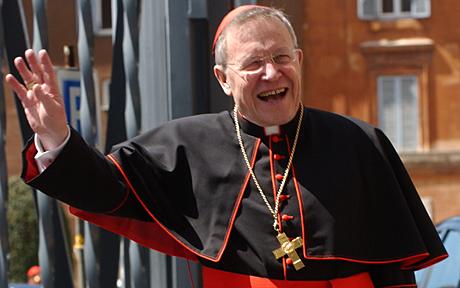 Cardinal Walter Kasper, during a lecture in a course offered at the Angelicum this semester, “Ecclesiological Themes in Ecumenical Dialogue: Catholicity, Apostolicity, Unity”
Prayer for Christian Unity?
One of the most well advertised annual events during the Week of Prayer for Christian Unity in Rome has nothing to do with ecumenism.
At least, not explicitly.
Every night at 8:00pm during the WPCU, there is a liturgy at Santa Maria in Via Lata, just off the Via del Corso. Instead of inviting in the Orthodox, Anglican, and Protestant communities in Rome to lead worship in rotation, every one of these liturgies is Catholic. The unique aspect of the series, however, is that each is celebrated according to a different liturgical rite, sponsored by different of the Churches sui iuris that make up the Catholic communion.
It is a great idea, but the question is whether it is appropriate for the week of prayer that is meant to focus on the restoration of unity with other Christians. Is it a celebration of the unity-in-diversity that already exists in a real but imperfect way in the Catholic Church? Does it smack of uniatism, or of Catholic imperialism? Is it enough to remind Roman Catholics that not all Catholics are Roman, that we do not all do things the same way, and therefore demonstrate a fundamental principle of ecumenism – that unity does not mean uniformity?
This year’s schedule includes most of the major liturgical traditions – though the East Syrian, or Assyrian/Chaldean rite is notably absent for some reason:
- January 18: Byzantine Rite, Greek Catholic Church
(organized by the Pontifical Greek College) - January 19: Byzantine Rite, Ukrainian Catholic Church
(organized by the Basilian Fathers of St. Giosafat) - January 20: Byzantine Rite, Romanian Catholic Church
(organized by the Pontifical Romanian College) - January 21: Maronite Rite, Maronite Catholic Church
(organized by the Maronite Order of the Blessed Virgin Mary) - January 22: Latin Rite, Roman Catholic Church
(presided by Archbishop Piero Marini) - January 23: West-Syrian Rite, Syro-Malankara Catholic Church
(organized by the Pontifical Damascene College) - January 24: Armenian Rite, Armenian Catholic Church
(organized by the Pontifical Armenian College) - January 25: Ge’ez Rite, Ethiopian Catholic Church
(organized by the Pontifical Ethiopian College)
First, I have to say it is a great opportunity to celebrate the liturgical diversity of the Catholic Church. In a way it recalls Bl. John XXIII’s decision to open Vatican II in the Ambrosian Rite rather than in the Roman – a reminder that there is always more than one way to be Catholic.
It is also helpful for us Latins to remember that the Catholic Church is actually catholic, and not simply an extension of Latin-Roman/Western culture. All Roman Catholics are Catholic, but not all Catholics are Roman Catholic.
(It should go without saying the ecumenically obvious statement that not all catholics are Catholic, either, but that does not merit calling all Catholics ‘Roman Catholic’. Capisce?)
One caveat is that it can reduce the respective churches of the Catholic communion merely to their liturgical patrimony, as if the Catholic Church simply enjoys liturgical diversity in a single monolithic ecclesial entity, rather than in fact being a communion of churches.
Another is that such a celebration during the Week of Prayer for Christian Unity could communicate an unintended model of unity, some kind of liturgical uniatism – or, as one my first ecumenical dialogue partners, an avid Trekkie, would put it, this model makes the Catholic Church out to be the Borg, with a simple message: “Your patrimony will be absorbed and added to our own. Resistance is futile.”
Certainly, that is not ecumenism according to the Catholic Church. (Though there is at least a hint of receptivity!)
Nevertheless, it is a celebration of Christian Unity – to be precise, of Catholic unity – to be able to celebrate the same Eucharistic mystery in such varied and ancient liturgical traditions, all of which are found within the Catholic Church. It just is not the kind of Christian Unity, or not the whole scope of the kind of unity, envisioned by the Week of Prayer.
It might be more fitting, however, if the week included Anglican, Protestant, and Orthodox Eucharistic liturgies, in which it is precisely our inability to share communion that compels us to strive for the unity for which Christ himself prays. Or let us celebrate the rich diversity of the Catholic communion in the same manner, but in a different week: perhaps the Pentecost octave. Then at least we would have time to participate in both!
Dear Father Facebook: You are not married
 Dear Father Facebook,
We have been friends for a while, possibly in real life, but certainly on this social networking site, which is far more important at the moment.
You are a priest of the Catholic Church. I am pretty good at ecclesiology, and having studied and discerned ordained and non-ordained ecclesial ministry my whole life, and I am quite sure that the norm of celibacy is still in force for the Latin Church. I have a deep respect and love of Eastern Catholic Churches, which generally allow their diocesan clergy to wed, but I happen to know that you are thoroughly Latin.
That being the case, unless you are an Anglican priest or Lutheran pastor who has come into full communion since your ordination, you are not married.
Please change your relationship status.
Yes, I know you are not alone, and it is not a clear cut choice. There is no “celibate” option on the relationship status list, last time I checked, so you and your brother presbyters have to choose between “single”, “in a relationship”, or “it’s complicated”, etc. Several of you have opted to present yourself as “married”, but I suggest this is not a good idea. Primarily because, well, you are not married.
You could say you are single, which is the most obvious true choice. The problem is that it might imply that you are available, and if you are chaste in your celibacy, as I am sure you are, then you are not available and I can understand that you do not want to give that impression.
You could say you are in a relationship, or that it is complicated, indicating you are not available, but neither are you engaged or married. These might be better, because, again, they are honest descriptions, though hopefully your commitment to your orders is not really that complicated. And it never says what kind of relationship you are in, so this could work.
But the one thing you are not is “married” (nor “engaged”, for you seminarians reading this). These very clearly indicate a vowed, committed lifelong relationship between two people that is a sign of love and union, and open to children. If you are religious you are in a vowed relationship as well, but it is not marriage. If you are diocesan (secular, for you old-school types), you are not even in vows, but an oath of fealty to your bishop.
Sure, back in the day when local churches elected their own bishops for life, it was spoken of as “being married to the church” – but when princes and popes took the power of placement away from the people, and when bishops began to move from see to shining see with impunity, the analogy began to break down.
And, sure, we can joke about people being “married to the job” because of their commitment and dedication, but these parallels and analogies are not the real thing. As Catholic Christians we view holy marriage as a sacrament – Pope John Paul II called it the “primordial sacrament” – and we should not treat it lightly.
For that reason too, as well as respecting the human person, it is probably not a good idea to refer to your breviary, your calendar, or your bishop even jokingly as your “wife”.
While we are on the topic of mixed messages – please do not wear a wedding band. You are not married.
Symbols are powerful. Consider if all the baptized and confirmed began wearing a stole as a symbol of their priesthood. Even though based on a true doctrinal reality – that by Christian Initiation all share in the priesthood of Christ – we reserve that particular symbol for a particular participation in His priesthood: that of the ordained bishop, presbyter or deacon. Similarly, the wedding band is reserved for those who actually participate in the sacrament of marriage, not a parallel image, no matter how sincere the intent or worthy the service.
If you want to begin a petition for Facebook to offer a “celibate” or “vowed religious” or even “consecrated virgin” relationship status, I will “like” it. I hope you can post an honest descriptor on your page, showing to the socially networked world the sacrifice you have made “for the sake of the kingdom”.
Until that time, however, please help me in supporting the traditional definition of marriage… by removing it from your profile.
Sincerely,
your (unmarried) brother in Christ.
Liberalism (and Conservativism) Today
My friend and colleague, Dr. Matthew Tan, has his own blog, the Divine Wedgie, which lately has been more active than mine. Probably because he has finished his license and i am still procrastinating toiling away.
Recently, he posted this little bit about “Liberalism today” and prompted my thoughts, below. This continues a thread loosely connected on the topic of partisan labeling, in the Church especially, started with a quote from the famous canonist Ladislas Orsy, and followed by a former parishioner’s response.
First, Matthew’s remarks:
The American radical social activist Saul Alinsky has been dubbed as one of the “great American leaders of the non-socialist left”. He once said that a Liberal was someone that left the room before an argument began.
That was the 20th century, now that Liberalism has established itself as the dominant institutional paradigm in the 21st century (even when articulated through some ostensibly postmodern voices), we find the Liberal being the only one in the room and who bars entry into it before an argument begins.
One should not be surprised, since Liberalism, in its attempt to provide a space for all to behave however they want regardless of communal telos, paradoxically enjoins a particular pattern of behaviour that seeks to undercut and displace any pattern of virtue it claims it wants to include. To the extent it seeks to do this, Liberalism becomes not the opposite to but equates to a form of totalitarianism.
[Warning, liberal use of dry wit below. Or is it conservative use?]
My immediate response:
This sounds rather like late 20th century liberalism, not the contemporary kind. At least in the States, the 80s and 90s were the days of overly uptight political correctness, and you could be sued for sexual harassment for opening a door for a woman. Only the intolerant could not be tolerated. Totalitarian and liberal, in the contemporary sense, are anything but synonymous. Today’s “liberals” really do just want to listen, and be welcoming, which is what gets them labeled as such….
Unless you really do mean Liberalism with a capital L. Because we do not call them Liberals anymore, in the classical sense, probably because they would get confused with the liberals, so they are now called neo-conservatives for some reason. And your description fits well, since they do not care much for dialogue. Or people.
Thankfully in the Church things are much clearer.
Church liberals are the people who are trying to maintain the status quo, or at least the status quo of the last generation or two. They may find themselves fighting fiercely to maintain the serenity and balance of the way things are, lest they be destroyed by these young radicals. Their concern is with tradition as they received it, and protecting the Church from the damage done by irresponsible change.
Church conservatives are radical change agents, dissatisfied with the current state and confused as to why everyone else does not see the obvious need for “reform” (or the abandonment of all that is good and holy, if you are on the other side). They are trying to look back beyond the last couple generations to a previous period, and bring back a ‘purer age’ unencumbered by the historical accretions that are represented in the ‘golden age’ that the reactionaries (above) idealize.
… Does anyone else miss the good old days? You know, back when men were men, roses were red, conservatives were sticks-in-the-mud, and liberals were singing kumbayah?
*sigh*
Syro-Malankara Catholic bishops at the Angelicum
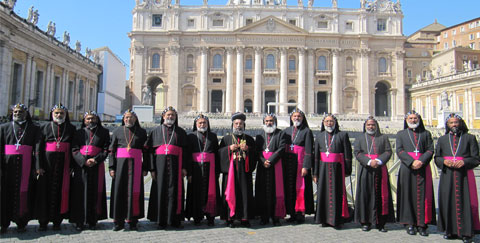
The bishops of the Syro-Malankara Catholic Church were in Rome this week for their ad limina visit “to the threshold” of the shrines of Peter and Paul, and to meet with their successor, Benedict XVI. There are a total of 13 of them, including the Major Archbishop-Catholicos, symbolically representative of Christ and the Twelve. (Also symbolizing Christ and the Twelve are the distinctive headcovering with thirteen stitched crosses, one large and twelve small.)
The Syro-Malankara Catholic Church has about 500,000 members, predominately in Kerala state, India. It follows the west-Syrian Rite and the liturgy of St. James of Jerusalem, and forms part of the Thomas Christians who trace their initial evangelization to the Apostle Thomas in about the year 52 AD. From at least the 8th century, the Metropolitan of the autonomous Thomas Christian Church was a hierarch in the Assyrian Church of the East, their closest ecclesiastical neighbors. The Thomas Christians held that communion was maintained, if communication lost, with the Catholic/Orthodox world until the arrival of Tridentine-era Portuguese missionaries at the end of the 15th century, who began a program of Latinization. Resistance to the imposition of western culture and ecclesiology culminated in 1653, the symbolic date for the breaking of communion and the eventual breaking of the once-unified Christian Church in India into its current situation, divided among those in communion with the Assyrian Church of the East, the Syrian Orthodox Church, Malankara Orthodox Syrian Church, the Malankara Mar Thoma Syrian Church (Anglican), the Syro-Malabar Catholic Church and the Syro-Malankara Catholic Church. The latter traces its origin to the corporate reunion of some Malankara Orthodox Syrian bishops and faithful starting in 1930.
The bishops met with Pope Benedict XVI this morning, and this afternoon were gathered at the Angelicum for a lecture offered by one of their number, Bishop Thomas Mar Anthonios, entitled, “New Evangelization: The Mission and Role of the Syro-Malankara Catholic Church”. The text is basically a synopsis of the lineamenta prepared for the first-ever Major Archiepiscopal Assembly scheduled for later this year. Thiers will be the first episcopal conference or church sui iuris to address the theme of the New Evangelization in plenary.
Before the beginning of the lecture, His Beatitude Major Archbishop Moran Mor Baselios Cleemis greeted the assembled students and guests, and made a special point to recognize his dissertation director, Fr. Fred Bliss, SM, from his days as an Angelicum student. As I sat surrounded almost entirely by Indian Catholics, the chanted prayer that began the seminar was one of the more moving spiritual moments I’ve experienced in recent weeks (I am not even sure if it was Hindi or one of the other languages, such as Tamil or Malayalam, I should ask).
Questions and challenges to be addressed in the new evangelization noted by Bishop Thomas included the relationship of evangelization and interreligious dialogue, individualism and secular culture (referred to as a “darkness”), the success of genuine inculturation, the necessity of Christian unity for effective evangelization, and the obstacles to freedom placed before the church both by the Indian state and the Roman curia (an issue which we were assured Pope Benedict had promised this morning to take under serious consideration). Pastoral lethargy was also noted as a challenge, “Communities should be shaken from their present slumber of maintenance to a renewed consciousness of mission.”
[The text of the Holy Father’s address to the bishops can be found at Vatican Radio here]

Chanted Prayer with Syro-Malankara bishops
Colloquium on Anglican Patrimony in light of the Apostolic Constitution: A Canon Law Perspective
After class on Friday, my professor and I walked down the hill from the Angelicum to the Anglican Centre in Rome to join a group of canon lawyers from the Anglican Communion and the Catholic Church engage in a presentation and a conversation on the nature of Anglican Patrimony in light of the Apostolic Constitution Anglicanorum Coetibus.
In the wake of the 2009 apostolic constitution making provision for the establishment of personal ordinariates, questions have been raised about the exact nature of the “Anglican Patrimony” which is named in the text of the constitution and its appended general norms. Cardinal Levada’s answer to the inquiring Anglicans was, “we are hoping you can tell us!” To begin answering that question, the Anglican Centre in Rome is coordinating a series of meetings this year on the theme Anglican Patrimony in light of Anglicanorum Coetibus.
There were 22 participants in the workshop: Three lay women, four lay men, and fifteen priests – Most of the participants were members of the standing colloquium of Anglican and Catholic canonists, who chose to have their annual meeting in conjunction with this workshop.
Questions raised and observations made included the following:
What exactly is “patrimony”? Canonically the term is used in the Latin code only in reference to the charism of religious orders and the particular customs of local churches in the formation of priests. In the Code of Canons for the Eastern Churches, it more clearly refers to the liturgy, theology, spirituality, and discipline of a particular church (CCEO 28, 39, 405). If the model of religious order charism is an example, it was noted by a Franciscan friar present that it took Clare 40 years to get the rule she wanted approved by Rome, a constant give and take, debate and discussion between the founder’s vision and the hierarchy’s presumptions – and we are only 16 months from the announcement of the Apostolic Constitution and six weeks from the establishment of the first actual Ordinariate. We may not know for some time what this received Anglican Patrimony will actually be.
There was some discussion that the ordinariates are apparently not limited to Anglicans and former Anglicans. [Though, in rereading the text, it does seem to be limited] Indeed, many of the traditionalist Anglicans attracted to it are former Catholics – canonically still considered Catholic by the Latin code. But does this mean that Lutherans, Baptists, et al. can join the Catholic Church as part of the Ordinariate? What/who defines an “Anglican group” that can corporately join the Ordinariate? Four of the provinces of the Anglican Communion are in fact united churches, local ecumenical unions between Anglicans, Reformed, and other denominations. Could a Presbyterian elder of one of these united churches join and become an Anglican Ordinariate priest? Many of these members of united churches are part of the Anglican Communion but do not think of themselves as Anglican.
Why was the model of the pastoral provision not simply adopted more widely? (Where personal parishes would be set up allowing for use of Anglican rites and lead by former Anglican clergy) In this case it was thought that the patrimony would not be sufficiently preserved, and Pope Benedict finds the Anglican patrimony to be worthy of preservation within the Catholics Church, not just by the Anglican Communion. (This observation lead to an entire conversation about the locus and determiners of Anglican patrimony).
What would be the approved liturgical use in the Ordinariate, and would this be up to each Ordinariate individually? Someone had heard the 1928 Book of Common Prayer, which had been approved for use by the Episcopal Church in the US but rejected by Parliament for use by the Church of England, would be the model. This was unconfirmed, and others noted that most Anglo-Catholics, in England especially, are already using the Roman rite anyway and would likely continue to do so.
This lead to the speculation that there could be an Anglican Ordinariate in which no particularly Anglican Eucharistic rite was celebrated, somewhat ironic when one considers that most people probably think of Anglican patrimony in primarily liturgical terms.
Why not establish an Anglican Catholic Church sui iuris, like the Eastern Catholic Churches? The thought here was the mention in the constitution of seeing the Anglican Church as a particular expression of the Latin Church, its rites as variation of the Roman rite – as well as not wanting to do any more to appear to be bringing back uniatism as a form of ecumenism, something which has been rejected by the Catholic Church in its agreements with the Orthodox.
Since the Anglican Communion officially recognizes two sacraments, how will the other five be celebrated in an Anglican Ordinariate, since the Catholics Church accepts seven? This question was ‘corrected’ as someone else noted that the Anglicans do, in fact, recognize all seven sacraments and both churches, as agreed in ARCIC I, recognize a hierarchy of sacraments – the two dominical sacraments of Baptism and Eucharist holding a pride of place among the seven sacramental acts, for both churches, though this is expressed differently in parts of the Anglican Communion than others.
Candidacy for ordination, in the personal ordinariates, will be determined by the Governing Council – but this is neither Catholic nor Anglican, for both communions currently put this decision in the hands of the ordaining bishop, though with appropriate consultation.
Some noted that there had been popular speculation that the exception to celibacy would only be granted pro tempore, however, this would have been made clear in the text if that was the intent. Each will be appealed on a case by case basis, as celibacy remains the ideal for those who were not already ordained in the Anglican church, but it remains a real, practical possibility.
Married bishops are a part of Anglican Patrimony, based on scripture, yet the Official Commentary on the Apostolic Constitution, written by Jesuit Father Gianfranco Ghirlanda, Rector emeritus of the Gregorian, has “absolutely excluded” the possibility of married bishops “given the entire Catholic Latin tradition and the tradition of the Oriental Catholic Churches, including the Orthodox tradition…” The VIS communiqué on 15 January announcing the erection of the first Personal Ordinariate of Our Lady of Walsingham for England and Wales, went so far as to say, “For doctrinal reasons the Church does not, in any circumstances, allow the ordination of married men as bishops.”
Given all of that, the question was asked, how much a part of the Anglican patrimony are married bishops, and what reasons could there be to exclude them? It was noted that despite the VIS announcement, there are no doctrinal reasons for not ordaining married men to the episcopate, only disciplinary reasons. It is suspected, given the wording of Fr. Ghirlanda’s commentary, that this could be out of ecumenical concern for our relations with the East – but also noted that the traditions of Latin and Eastern and Oriental churches have always differed, and the Orthodox would likely not be concerned whether we had a different discipline in the West vis a vis married bishops or not. Strangest of all, some noted, was that though the married former Anglican bishops would only be ordained to the presbyterate, especially those serving as ordinary are still allowed the use of pontificals, the symbols of episcopal office such as the pectoral cross and ring.
What will the role of priest’s wives be in the Ordinariate, if any? What role do Anglican clergy spouses have now? This varies in the Anglican Communion, depending on the cultural context, and would likely vary as well in the Ordinariates. In some places the priests wife is treated as the ‘first lady’ of the parish, and the bishops wife even called “mama bishop” and treated as the first among these. In others, they have no role unless they are also a theologian or minister in the church, or volunteer like any other parishioner.
Final comments came from two Anglicans. The first shared that he had initially thought this “pastoral response” was anything but ecumenical, but as he reflected on it, the idea formed that the Anglican patrimony to be received by the Catholic Church in the Ordinariates was the people themselves. In this way, by receiving them, we are receiving some part of Anglicanism, and this may eventually turn out to be one more way in which the ground was prepared for the full-scale reception of each other in full communion down the road.
The other, who also stated considerable concern, shared that he was afraid that this would in fact have some rather negative ecumenical results, again by reason of the people received through the Ordinariate – the Anglicans may be all to happy to see them go, and he fears we Catholics may not be all that happy to receive them, once we get to know them!
On that note, we broke for drinks.
 The Ecumenism Blog