
Home » La vita Roma (Page 6)
Category Archives: La vita Roma
Lectio Coram or bust
 Friends, my lectio coram – my comprehensive exams – have been scheduled for this Friday at 16.50 Rome time.
The thesis was submitted two weeks ago and is being evaluated, though as soon as i got the printed version back i even noticed a spelling error on the front page. The first word, no less. Still, after this weekend, i hope to have my License in hand and be on the final stage of the doctorate: all research and writing, all the time.
The thesis title was “The Diaconate in Ecumenical Context” and my major presentation for the lectio coram is on “Ecumenical Development on the theme of Apostolicity” followed by questions covering the whole range of my studies here. Prayers are appreciated!
Then, i hope, i will be back to my normal volume of posts: this is going to be an exciting year!
A president, an archbishop, and an ambassador sit down for dinner…
After a summer attempting to survive the Roman heat on my own, with the generosity of friends and colleagues allowing me to housesit in lieu of rent, I moved back into the Lay Centre in early September. Our first guest dinner was a typical Lay Centre affair, in that guests included the following:
- Mary McAleese, Former President of Ireland, and former Lay Centre resident
- Archbishop Michael Fitzgerald, recently retired Apostolic Nuncio to Egypt, and one of the Church’s leading experts on Islam and Interreligious Dialogue
- Lithuanian Ambassador to the Holy See Irina Vaišvilaitė, another former resident of the Lay Centre.
Archbishop Fitzgerald updated us on the process for the election of the Coptic pope, which was still ongoing. Involving laity, clergy, and religious, the original field of nominations was 17, bishops and monks, which was whittled down to 5, and then three whose names were submitted to be selected by a blindfolded altar boy. A great deal of consultation and lay involvement went into the decision making fo who those names would be, yet room was left in the process for divine guidance, in the form of the blind innocence of a child.
Ambassador Vaišvilaitė shared her experience of presenting her credentials to the Holy Father at Castel Gandolfo, in an unusual individual meeting and conversation at the summer retreat.
President McAleese is returning to Rome to finish her doctorate in canon law, and now at the Irish College, which is practically bereft of new Irish seminarians after the much contested Dolan Report earlier this year.
In other words, just another evening at the Lay Centre at Foyer Unitas!
Breaking Bad Liturgical Habits
George Weigel wrote this column in January for ‘the other’ NCR that recently piqued my liturgical antennae.
He has good points and bad, mixed together in an acerbic style that is by now pretty well known. It got me thinking about my own version, offered in contraposition and in complementarity, based especially on some of the “liturgical abuses” I have witnessed in Rome, as well as some of the “best practices”.
It has happened on occasion, even here in Rome, that I have been accused of being a true liturgist – in the sense of the old joke about the difference between terrorists and liturgists. I offer these as suggestions merely, humbly, and invite, as always, critique and commentary.
Some of the basic points I agree with Weigel are these:
“there is no “reform of the reform” to be found in lace surplices, narrow fiddleback chasubles and massive candles.”
Another great sage of liturgical aesthetic, the clock from Disney’s Beauty and the Beast, put it this way: “If it ain’t Baroque, don’t fix it!” We are as done with Baroque as we are with orange shag carpeting and felt banners, thank God. Let us not idealize one period of the past at the expense of the entirety of Tradition, and the need for ongoing aggiornamento. Ecclesia semper purificanda, after all.
“Catholics who embrace the truth of Catholic faith do not enjoy clericalism.”
Clericalism is a systemic and personal sin that ought to be rigorously avoided and rooted out of ecclesial structures like the cancer that it is… but, that is a topic for another post.
“Music directors and pastors: As a general rule, sing all the verses of a processional or recessional hymn.”
Weigel seems to conflate his personal musical taste with some objective sense of quality, and goes on to express this rather rudely and without perspective – Compared to the angelic chorus, even the best of Palestrina, Bach, and Mozart, would sound like a ‘treacly confection’. That aside, this is one way we can remember we have left chronos and entered kairos.
I would just add that songs should be singable, for the most part, though there is room for a reflection or meditative hymn, it would be a tragedy if the entire liturgy were converted into a concert given by professional choirs in polyphonic chant that is impossible to follow without expert training. It is not without reason, and this is one of them, that more than one cardinal expressed to us while visiting Notre Dame that the Triduum liturgy there was done better than in Rome!
“Sacred space [sanctuary] is different from other space; the inside of the church is different from the narthex.”
True… but how many churches do not have adequate narthex space? Most I would say. At St. Brendan the Navigator in Bothell, WA, there is an excellent example of good use of narthex and sanctuary/nave in the same building.
He also offers a few points that I disagree, or would attenuate
“Celebrants (not ‘presiders’)”
Weigel channels Ratzinger when he insists that presider be called celebrant. The problem is simple, though. The entire assembly celebrates the Eucharist, but only the bishop (or presbyter-delegate) presides. This language goes back much further than that of “celebrant”, and we can see the title in Justin Martyr, before presbyters are even allowed to take on the role.
“Extraordinary ministers of the Eucharist are vastly overused in U.S. parishes, a practice that risks of signaling that the Mass is a matter of the self-worshipping community celebrating and feeding itself.”
There may be some parishes where extraordinary ministers of communion are overused, but when I see hundreds upon hundreds of communion ministers at St. Peter’s here in Rome, whether priests, deacons, or extraordinary, it is hard to say that anywhere else overuses them. Most use what they need. And there is no connection between having too many communion ministers and making the mass a self-worshipping act. This is a nonsensical and unsupported assertion.
“no one outside of those in holy orders should “bless” in a liturgical context”
This is a matter under the authority of the local bishop, as legislator and liturgist of his diocese. Offering a blessing at communion, especially to those not in full communion, but who desire it, is a significant practice that should not be lost.
“And while we’re on the subject of the congregation, might we all reconsider our vesture at Sunday Mass?”
Absolutely. The entire assembly, at least those fully initiated with Baptism, Confirmation, and admission to the Eucharist, should be vested in albs, the white baptismal garment. Can you imagine the effect, if all the initiated were actually vested?
Bad habits in Rome
When in Rome, do as I want to do.
The cynical observer, or the realist, will tell you that the Romans do pretty much whatever they want. But when you come to Rome, observe the official practice, and the actual practices, and try not to impose your practice from Milan, Seattle, or London upon the community here. Observe and adapt.
At the same time, just because (some) Romans do it does not make it right. Here are a few observed practices of which I am wary:
Communion from the tabernacle during the liturgy.
The ideal situation is that each Eucharist should consecrate enough bread and wine for all those present, and maybe just enough for the sick and homebound. Ideal is not always pastorally possible. However, here, you can frequently see only one host consecrated, for the presider, and then everyone else served from the tabernacle.
Communion under one kind only.
While minimally sufficient, it should normally be under both species, or it lacks the fullness of the sacramental sign. Further, it is the choice of the communicant to receive on the tongue or in the hand. The latter is more ancient, the former is canonically the norm here in Italy. I have addressed these points here and here.
Confessions during the liturgy.
It is one thing in a giant basilica where you have mass in some side chapel, and confessions going on a football field away in another part of the building. Quite another when the 18th century wooden confessional is cozied up so close to the pews in the parish church that you can hear the penitent while you are sitting in reflective silence after the homily. When the liturgy begins, no other sacrament or devotion should be happening in the sanctuary, unless it is a part of the liturgy.
Many altars, many breads, no body.
One of the beautiful tragedies, or tragically beautiful moments, is if you go to St. Peter’s early in the morning (this happens rarely for me), and you see dozens of priests at dozens of altars all offering the Mass, separately, and with at most one assistant. It is easy to think of all the places in the world where people go days, weeks, or months without access to the Eucharistic liturgy. But it also begs the question, why not concelebrate? Why not have one mass, so that the few morning pilgrims could all join as well? Is a liturgy without the presence of the Church even a liturgy, or a private devotion of the presbyter?
Excessive Concelebrating.
I never thought I would agree with the Lefebvrists on much beyond the basic dogmas of the faith. But they have a certain point here, though for different reasons. Imagine a liturgy with twenty people. Fifteen are vested and concelebrating, and five are in ‘plainclothes’ and simply celebrating. Is it really necessary to have so many concelebrants? A priest may feel obligated to celebrate the Eucharist every day, and this is a worthy thing, but he need not do so vested every time, especially in such a scenario. There could be the presider, a deacon, and as many concelebrants as needed for communion, or for a preacher, etc. With occasional exceptions, less is more.
We stand for prayer, not for announcements.
The most elegant remedy to this I have seen is that the Prayer after Communion be offered at the end of the Communion procession, rather than at the beginning fo the concluding rites. That is, remain standing (or kneeling, or sitting, as the local case may be) for the entire communion procession, and as soon as everyone has received, the presider offers the communion prayer. Only then do we sit in silence (or with meditative hymn) for the post-communion reflection. Then, while still seated, any announcements can be made.
Christmas and Easter.
Midnight Mass is at Midnight. Not 10pm. Even if the pope does it. Then, you can still use the midnight readings, just do not call it midnight mass! At Easter, do not do as the Romans did last year…. At the Vigil, the lights came on entirely too early. Actually overheard behind me “Well, that rather destroys the effect, doesn’t it?” or variations, from more than one voice. Let the service of light continue as long as it can, the readings can mostly be done in darkness, with only the paschal candle to light the ambo.
Assisi in August
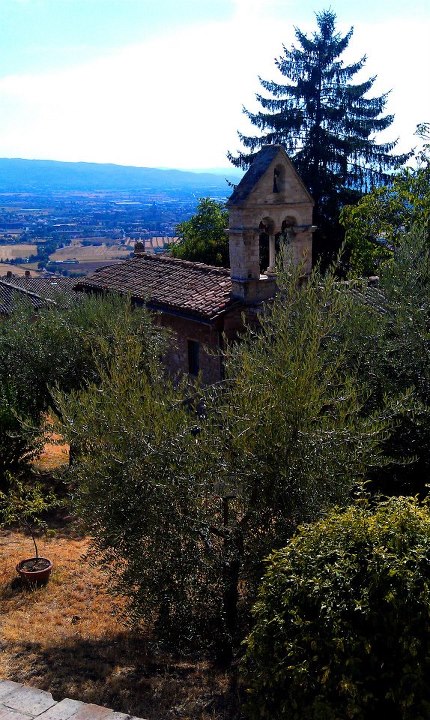 Though I usually try to spend the night, a visiting friend and I made a day trip to Assisi. I have been there in all seasons but the height of summer, until now. By now, I have reported on all the major sites, and mentioned before my favorite little church, essentially untouched in its 900 year history, Santo Stefano.
The diocese is currently planning the church’s (purportedly) first-ever renovation, but it was not clear what that would entail. Hopefully, nothing baroque!
As we approached, we saw a small sign inviting us into the adjacent monastery garden for rest and refreshment. On entering we found a small group of pilgrims from northern Germany who were in town with a total of about 20 from their parish, including the pastor, who were spending a few weeks in Assisi offering this simple hospitality ministry in shifts. Shade, water, and greenery with a view was a most welcome respite in the heat of the day (though much cooler than Rome, at 30C/85F it was still hot!).
Apparently this is the second year of these groups coming to live a few weeks in Assisi and offer the ministry to pilgrims and tourists. I wonder if they take Americans?
Lord I am not worthy…
English masses in Rome after the translation
“Lord, I am not worthy that you should enter my table… roof… whatever…”
I actually heard these words at a liturgy a few months ago. Some of the changed language has caught on beautifully: “Right and Just!” and “..and with your spirit!” were a little easier for everyone here to adopt, since these are in the Italian translation as well.
Because the Italians are not worthy to welcome the Lord at their table, rather than under the roof, however, and every language seems to have translated, rather than transliterated, this idiom previously, there are places where this one is not yet been received. Likewise, the Creed and the Gloria tend to still require the use of the convenient cheat-sheets included now in every church, but often enough, it will be the old Gloria, and an occasionally mumbled Creed.
Of course, it depends where you go. At the NAC-lead English station masses during Lent, you would never know there had been any other way to celebrate the mass. Each of the national colleges or parishes has their own quirks and adaptations, and the international English-language community, with regular worshipers from over twenty countries, probably gets the most variety.
In December, I was preparing for an evening liturgy in one of the Roman basilicas, as the rector proudly showed me the new English-language Roman Missal they had just purchased, our group being the first to use it. So concerned with navigating it, as it was my first use of it as well, I failed to notice the Lectionary was still the 1970 version…
Even in Rome, the biggest contingent of anglophones are those who were, shall we say, less than enthusiastic about the new translations. The second largest would be those who prefer we dump the translations entirely and stick to the Latin and Greek. Already there are rumors about the need for revisions…
A funny thing happened on the way to the Forum today…
OK, I was not anywhere near the forum, but at Villa Richardson, the residence of the U.S. Ambassador to the Holy See, for their annual (anticipatory) Independence Day celebration. But, I have been wanting to use that line since I got to Rome, and never quite worked it in.
So, at Roman noon today, I saw an update from the Vatican’s new-ish news mega-portal, http://www.news.va, officially announcing Cardinal Levada’s retirement and the appointment of Bishop Gerhard Müller to the post of Prefect of the Congregation for the Doctrine of the Faith. So, I reposted it on Facebook.
Tonight, at the Embassy’s Independence Day party, about eight hours later, a curial monsignor mentions to me he heard about the appointment through my Facebook post. “What, there’s no internal memo on these things?” I asked. He just laughed.
Having just celebrated the patronal feast of the city and Church of Rome, it serves as a reminder that, in the Vatican, you can rob Peter to pay the left hand while the right hand does not know what Paul is doing. Or something like that.
Domers in Rome
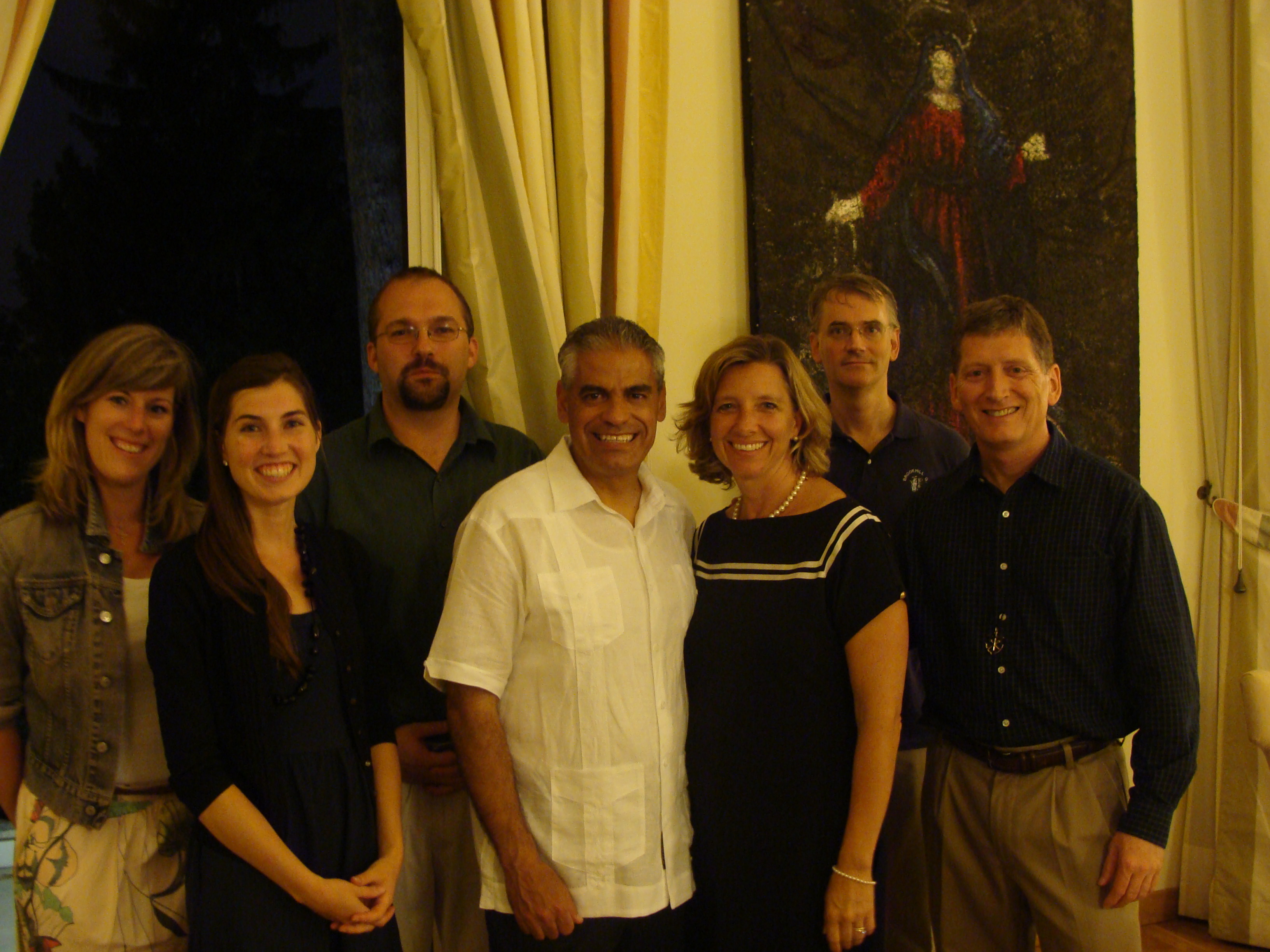
Domers in Rome: Jill, Katie, AJ, Miguel, Marian, TJ, Russ
One of the University of Notre Dame’s greatest strengths is its alumni network. Even here in Italy, there are sons and daughters of Our Lady’s University. We had a gathering of about twenty at Villa Richardson, residence of the U.S. Ambassador to the Holy See, Dr. Miguel Díaz, and his wife, Dr. Marian Díaz, both domers.
It was my first time at the residence, and one of the most striking pieces of art on the beautiful grounds is a large Chihuly, Ducale Tower, on what was once a fountain in the back garden. There’s a short article about it in Slate, with an image.
I have been asked to help form a small leadership group for the alumni club of Italy, to strengthen the club’s activities and in a small way, start paving the road for the new Notre Dame Center of Rome, which will open in a couple of years, we hope. (The building is purchased and being renovated, in Celio not far from the Lay Centre, in fact).

Tempietto di San Pietro, di Bramante
Current ND alumni in Rome include not only the Ambassador and his wife, but Holy Cross priests and brothers, students at pontifical universities, a key staffer at the Pontifical Council for Social Communications, one of Rome’s leading catechetical guides, the director of the University of Mary’s Rome Program, and until recently, Charles Brown, now nuncio to Ireland.
On the way home from the gathering, a few of us were walking by the Spanish Academy, and discovered that the Tempietto di Bramante (San Pietro in Montorio) was open, illuminated, and totally empty. Built as a mausoleum for Ferdinand and Isabel, it was never used for that purpose, but remains quite possibly the smallest church in Rome.
John Paul II Center for Interreligious Dialogue

In the midst of last week’s events surrounding the Fifth Annual John Paul II Lecture on Interreligious Understanding, delivered at the Angelicum by Cardinal Kurt Koch, i was asked to stay on another year as the graduate assistant at the John Paul II Center for Interreligious Dialogue at the Angelicum. So, another year in Rome, at least!
Coincident with the big event – that being the lecture not my assistantship renewal – the Center rolled out a new website, that will continue to expand its content: http://jp2center.org/
While my academic focus has remained ecumenical, the interreligious piece, especially with the Abrahamic faiths, has grown ever entwined in every aspect of my life. It is hard to believe how much time has passed in Rome already, but there is always more to see and do. Please check out the website, and also the Center’s Facebook page.
Building on Nostra Aetate: 50 Years of Christian-Jewish Dialogue, with Cardinal Koch
 The John Paul II Center for Interreligious Dialogue hosted its fifth annual John Paul II Lecture on Interreligious Understanding, featuring Cardinal Kurt Koch, president of the pontifical council for promoting Christian Unity and the commission for religious relations with the Jews. His topic was “Building on Nostra Aetate: 50 Years of Christian-Jewish Dialogue.” (full text)
The lecture was the highlight of a busy week for the Center, with a series of meetings and receptions around the Russell Berrie Fellowship and the relationship of the Angelicum University and the Russell Berrie Foundation, which is made manifest in the John Paul II Center. About 150 people attended, including the president emeritus of Ireland, Mary MacAleese, ambassadors to the Holy See from several countries, the U.S. Special Envoy for combating anti-Semitism, the new rector of the Angelicum Fr. Miroslav Adam, and Cardinal Walter Kasper.
His Eminence addressed the topic in seven sections. Nostra Aetate itself, he summed up with “YES to our Jewish roots, NO to anti-Semitism”, and as the ‘magna charta’ of Jewish-Catholic dialogue. That Nostra Aetate took up this question and set an unambiguous position that “in the Catholic Church, [Jews] have a reliable ally in the struggle against anti-Semitism.” It affirms, as Pope John Paul II said during his 1986 visit to the Roman synagogue, that
“The Jewish religion is not something ‘extrinsic’ to us, but in a certain way is ‘intrinsic’ to our own religion. With Judaism we therefore have a relationship we do not have with any other religion. You are our dearly beloved brothers and in a certain way it could be said, our elder brothers.”
With regard to the reception history of Vatican II, he says that “one can without doubt dare to assert that Nostra Aetate is to be reckoned among those Council texts which have in a convincing manner been able to effect a fundamental reorientation of the Catholic Church following the Council”. This statement, incidentally, points to a hermeneutic that clearly holds that the purpose of the Council was a reorientation of the Catholic Church.
He outlined the historical and theological reasons for including the dialogue with Jews in the Council for Christian Unity rather than the one for Interreligious Dialogue:
“The separation of Church and Synagogue can be considered the first schism in the history of the church, or as the Catholic theologian Erich Przywara has called it, the ‘primal rift’, from which he derives later progressive loss of wholeness in the Catholica.”
This was followed by a survey of post-conciliar documents building on Nostra Aetate, the most recent from the Commission being the 1998 We Remember: A Reflection on the Shoah, and then a similar treatment of global international dialogues and their development, the result of which is that,
“Confrontation has turned into successful collaboration, the previous conflict potential has become positive conflict management, and the coexistence of the past has been replaced by a load-bearing friendship.”
While he acknowledges that the real papal impetus for dialogue began with Paul VI, he points out that this engagement by the leadership of the universal Catholic Church was only really apprehended by the wider public in the form of Pope John Paul II, who “had a refined sense for grand gestures and strong images” as compared to, for example, Pope Benedict XVI, who “relies above all on the power of the word and humble encounter.”
Of Ratzinger, Koch highlighted the theologian Ratzinger’s understanding of the bible as one single book, with the old testament inseparable from the new. He likewise highlights the German Shepherd’s book, Jesus of Nazareth, in which he clearly reiterates Church teaching that the biblical report of the trial of Jesus cannot serve as the basis for any assertion of collective Jewish guilt: “Jesus’ blood raises no call for retaliation, but calls all to reconciliation. It has become as the letter ot the Hebrews shows, itself the permanent Day of Atonement of God.”
He concludes by engaging open theological questions and prospects. The question of the role of Christ in the salvation of the Jews, given the enduring covenant of God: What is the mission to the Jews, if there is one? How do we reconcile these two truths without offering a parallel path of extra-Christological salvation?
Cardinal Koch sees anti-semitism, anti-Judaism, and Marcionism as still-present challenges which the Catholic Church must and does denounce as a betrayal of Christian faith. An expression of this question is found in the recently revised Good Friday prayers for use in the ‘extraordinary form’ of the Latin liturgy, which itself raises questions about “lex orandi, lex credendi”, when we have seen four versions in forty years. Liturgically, he also critiqued both preachers who omit the old testament readings from their reflections, and presiders who “change the mass” omit the original Hebrew meanings of the prayers.
Cardinal Koch with Berrie Fellows
Overheard at the Angelicum…
Something i should have started when i arrived was a list of funny things overheard at the Angelicum, and in Rome generally. Here are a few I’ve managed to remember, or pass on from others:
“The Italian concept of diverse ethnic food is that this restaurant Umbrian, the one next to it is Tuscan, and the one across the street serves Roman cuisine.” – visiting professor at the Gregorian
“New Evangelization? How does that work? Is it a 12-step program?”
“Why do we need to study Augustine when we have St. Thomas?” – seminarian in philosophy class
“Lord, I am not worthy to receive your roof… table… whatever…” – At an English-language mass this spring
“I just got out of my ecumenism exam. Why did I have to study this? All the texts say. the. same. thing!” – priest student amply demonstrating why the need for ecumenical reception
“Who is Kant? How do you spell that?” – another seminarian in philosophy
“A.J., your life is like a Jackson Pollock painting.” – (apparently envious) fellow student
“You have to be a little suspect of people who study theology. You wonder why they aren’t smart enough to study something like medicine or law and make money to support a family.” – a highly-placed Catholic theologian
“The state of Catholicism in Italy? It’s basically paganism…” – an Italian cardinal
“You’re coming to Rome? Now, you must have gelato while you are here: You can see the pope, or not see the pope, but gelato is not negotiable.” – theology student giving advice to visitors
“There’s a GIRL in the library!” – shouted by seminarian in shock upon entering the library at his collegio
“I thought ecumenism and dialogue was about getting paid to go to meetings in exotic places and enjoy nice meals” – dogma professor
“The most interesting thing was that I got to witness a consecrated virgin catfight!” – male student at a reception
Exchange in a post office, translated:
“Can I have a stamp?”
“No, you need an envelope.”
“You won’t sell me a stamp if I don’t have an envelope?”
“That’s right.”
“Well, can I have an envelope, then?”
“No, we don’t sell envelopes to people without stamps.”
“The Roman idea of ecumenism is that Jesuits can take classes at the Dominican university and vice versa. It’s a big accomplishment, after 400 years.” – Angelicum professor
”We had an Anglican bishop speak to us at the NAC last night. It was outrageous. He even wore a clerical colar. Doesn’t he know that we have the copyright on clergy shirts?” – North American seminarian
“My bishop sent me to Rome for five years, and all I got was an STD” – my proposal for a new line of T-shirts…
 The Ecumenism Blog