
Week of Prayer for Christian Unity 2014 (Rome)
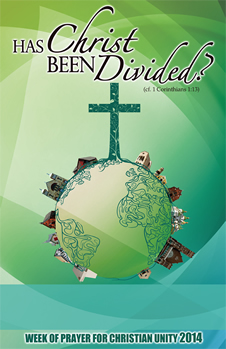
The schedule of events that i could collect to be celebrated here in Rome for the Week of Prayer for Christian Unity. This excludes several parishes which dedicate daily liturgy and/or devotions to the theme.
Settimana di preghiera per l’unità dei Cristiani
Has Christ Been Divided? Cristo non può essere diviso! (I Cor 1.1-17)
General information on the Week of Prayer can be found here.
Thursday, 16 January: Day of Jewish-Christian Dialogue and Reflection
18.00 Jewish-Catholic Dialogue Fifty Years after Nostra Aetate: A Latin-American Perspective
Rabbi Abraham Skorka at the Pontifical Gregorian University
Moderated by Cardinal Kurt Koch
Saturday, 18 January
16.30 Incontro di preghiera dei consacrati/e della Diocesi di Roma
Basilica San Lorenzo fuori le Mura
17.30 Vespers at Capella di Santa Brigida, Piazza Farnese 96
Cardinal Kurt Koch, Archbishop Leo (Chiesa di Finlandia), Bishop Makinen (Luterano),
Bishop Sippo (Diocesi Cattolica di Helsinki), and Bishop Brian Farrell
[invite] Vespers at Pontifical Beda College, Viale San Paolo 18
Very Rev. Ken Howcroft preaching
20.00 Ukrainian Catholic (Byzantine Rite) Divine Liturgy – Basilian Fathers, Santa Maria in Via Lata, Via del Corso 306
Sunday, 19 January
11.00 Catholic Eucharist with Archbishop David Moxon Preaching
Caravita Community, Via del Caravita 7
12.00 Angelus with Pope Francis, Piazza San Pietro
16.00 Celebrazione Ecumenica Finlandese
Bishop Teemu Sippo, SCI (Catholic), Bishop Kari Mäkinen (Lutheran), Archbishop Leo (Orthodox)
Santa Maria Sopra Minerva ,Piazza del Minerva 42
18.00 Incontro di preghiera del Gruppo Romano del SAE
Capella delle Suore Francescane di Maria, Via Macchiavelli 32
18.30 Celebrazione Ecumenica Tedesca with German/Hungarian College, S. Maria dell’Anima
At Christus Kirche Via Sicilia 70
20.00 Roman Catholic (Latin Rite) Eucharist– Archbishop Piero Marini, presiding
Santa Maria in Via Lata, Via del Corso 306
Monday, 20 January
18.00 Anglican Choral Evensong with Ven. Jonathan Boardman Preaching
Basilica San Paolo fuori le mura
18.30 Santa Messa at Parocchia di S. Maria delle Grazie alle Fornaci
19.30 Conferenza “Il movimento ecumenico, la santità”, Padre Ciro Bova
20.00 Greek Catholic (Byzantine Rite) Divine Liturgy – Pontifical Greek College
Santa Maria in Via Lata, Via del Corso 306
Tuesday, 21 January
11:45 Anglican Center Eucharist, Piazza Collegio Romano 2
18.30 Santa Messa, Parrocchia S. Maria delle Grazie alle Fornaci
19.30 Conferenza: L’ecumenismo, il punti di vista dei fratelli ortodossi”, P. Vladimir Zelinsky
20.00 Syro Malankara Catholic (Antiochene Rite) Holy Qurbana – Damascene College
Santa Maria in Via Lata, Via del Corso 306
Wednesday, 22 January
10.30 General Audience with Pope Francis, Sala Audienza Paolo VI
[Invite] Vespers at Pontifical Irish College, Archbishop David Moxon preaching
18:30 Venerable English College, Rev. Keith Pecklers, SJ, preaching
18.30 Santa Messa at Parrocchia di S. Maria delle Grazie alle Fornaci
19.30 Confronto e dibattito sul tema della santita nell/’ecumenismo: P. Ciro Bova, P. Vladimir Zelinsky
20.00 Armenian Catholic (Armenian Rite) Divine Liturgy – Armenian College
Santa Maria in Via Lata, Via del Corso 306
Thursday, 23 January
16.30 Mixed Salad Ecumenism in the Caribbean: Is there a Future?
Archbishop Donald Reece, Archbishop Emeritus of Kingston, Jamaica;
Followed by a Celebration of the Word with
Rev. Willie McCulloch presiding, and Very Rev. Ken Howcroft preaching
At Centro Pro Unione, Via S. Maria dell’Anima 30 (Cosponsored by Lay Centre at Foyer Unitas)
18.30 Diocesan vespers at with Ven. Jonathan Boardman preaching,
SS. Martiri dell’Uganda, Via Adolfo Ravà 31
20.00 Maronite Catholic (Antiochene Rite) Divine Liturgy – Maronite Order of the BVM
Santa Maria in Via Lata, Via del Corso 306
Friday, 24 January
20.00 Gruppo Incontro at Chiesa Valdese, Piazza Cavour
20.00 Romanian Catholic (Byzantine Rite) Divine Liturgy – Romanian College
Santa Maria in Via Lata, Via del Corso 306
Saturday, 25 January
17.30 Papal Vespers, Basilica San Paolo fuori le mura (tickets required)
20.00 Ethiopian Catholic (Alexandrian Rite) Divine Liturgy – Pontifical Ethiopian College
Santa Maria in Via Lata, Via del Corso 306
Sunday, 26 January
16.00 Churches Together in Rome Unity Service
Rev. Dr. Karen Hamilton, Secretary General of Canadian Council of Churches
Basilica San Silvestro in Capite, Piazza di San Silvestro 17A
Monday, 27 January
14:30 Il concilio e ecumenismo: Lectio Conclusiva di ‘Il Concilio Vaticano II: Storia e Sviluppi‘
Bishop Charles Morerod, OP, bishop of Lausanne, Genève et Fribourg
at Pontifical University of St. Thomas Aquinas (Angelicum)

2013 in review (WordPress stats)
The WordPress.com stats helper monkeys prepared a 2013 annual report for this blog.

Here’s an excerpt:
The concert hall at the Sydney Opera House holds 2,700 people. This blog was viewed about 12,000 times in 2013. If it were a concert at Sydney Opera House, it would take about 4 sold-out performances for that many people to see it.
Breakfast at Tiffany’s: An unsettling cultural learning experience

I saw for the first time recently, Breakfast at Tiffany’s. How does anyone not see this as a romance between a call girl and a gigolo? $50 “for the washroom”? That is nearly $400 in 2013 dollars!
I was not the only one with this reaction – and I was kind of shocked that something like this could be such a cult classic and regarded as such a great film of its time. The poor girl who shared it with us, I think, was disappointed that we were not wrapped up in the romance of the film and the dreamy longing for material wealth as something to be admired. It was really one of the most morally bankrupt films I have seen in a long time, and considering I am a Game of Thrones fan (which never pretends to be anything other than brutal), that should say something!
It is awash in racism, materialism, objectification of the person, and touts a kind of celebrity lifestyle that makes Miley Cyrus look… well, ok, I cannot go that far. There is a certain elegance that Hepburn portrays that Cyrus lacks, but the latter is at least honest in the values and freedoms being celebrated: It is all naked truth, if you will. Whereas, at Tiffany’s it is a lie festooned in glitter and deceit. I do not know why my gut reaction was quite so strong, but I have never been so repulsed by a story since reading Ayn Rand. Maybe it is the reputation of the story, whether Tiffany’s or Fountainhead, and the realization that people actually want to emulate the protagonist therein that is so disturbing. Even as I write this I still cannot believe its popularity.
How was it received at the time of its release? When it came out, was it protested like the Last Temptation of Christ or Godfather III? Or did it get all the tweens atwitter looking for big sunglasses and a long cigarillo?
US Embassy to the Holy See: no closure, downgrade, or presidential plot…

Ambassador Hackett presents his credentials to the Holy Father
As always, the busier and more interesting things get, the less time I have to write about them.
But sometimes something comes up that here, you do not even think will be a thing, only to find it exploding the internet on the other side of the Atlantic.
A week ago, the National Catholic Reporter ran a story detailing how five of the former US Ambassadors to the Holy See were upset that the Embassy was being moved. That was the first I had heard of it, and I thought some fo the reactions seemed a bit over the top… but then you cannot expect much from partisan political appointees on either side of the aisle.
Naively, I suppose, I still expect people to read more than headlines. Especially absurd headlines like the following:
- Obama’s call to close Vatican embassy is ‘slap in the face’ to Roman …(Washington Times)
- Obama administration plans to close Vatican embassy in shock move (Irish Central)
- Obama Administration Snubs Catholic Church With Vatican Embassy Downgrade… (LifeNews.com)
- U.S. Pulls Out of the Vatican (Daily Beast)
- Obama to close diplomatic ties with the Vatican (US Finance Post)
- Obama ‘insults’ Catholics in Vatican–embassy shutdown: ‘Massive downgrade’ in relationship with the Holy See (WND.com)
Notice how only one of these misleading leads did not start by blaming President Obama by name?
The facts are simple, and were clear even from the first reports:
- The US is not closing the Embassy to the Holy See
- The US is not pulling out of its diplomatic relationships with the Holy See
- The US is not downgrading the diplomatic status of its relationship with the Holy See (e.g., from Ambassador to Special Envoy, or something)
- The US is not combining the Embassy to the Holy See with the Embassy to Italy
- The US Ambassador is not moving his residence, only the offices.
This was confirmed by the current and immediate past US Ambassadors to the Holy See, and the State Department again in a conference call today.
The US has four places (Rome, Vienna, Brussels, and Paris) with multiple missions in the same city, and in each case there have been moves to bring the separate embassies together physically, while maintaining separate missions, staffs, budgets, and space.

Current US Embassy to the Holy See
The current US Embassy to the Holy See is in a converted private home near the Circo Massimo, and while I daresay it is a better view than to be had by its big sister on Via Veneto, it is hard to have a larger meeting there than about a dozen people. It would probably make the support staff, the local staff and interns, feel a little less isolated, considering they are a much smaller crew than at US Embassy Italy.
While I can certainly see arguments for the separate location in terms of keeping a clear identity, it seems this has already been a consideration and will be seriously maintained. Rome has three, not two, US embassies: One to Italy and San Marino, one to the UN Food Agencies, and one to the Holy See. The first two are already on the same property, but in different buildings. Adding the third does make sense economically, even if it is a drop in the bucket compared to overall waste… every little bit helps.
It is worth noting that the US Embassy to Italy does double duty to the other micro-state completely surrounded by the Italian Republic, that of San Marino. A pretty obvious contrast between that situation and the proposal for that of the Holy See should put to rest any concerns about this being a move to combine or downgrade the Embassy to the Holy See.
What is interesting, yet unsurprising, to me is the narrative of President Obama being rabidly anti-Catholic, and that this is just one more example of his ‘war on religion/the Catholic Church’. While i certainly find several areas of disagreement, which should be rather obvious, I find this assertion as convincing as the narrative of Pope Benedict being a mean-spirited old man who was only interested in rules and regalia while actively covering up the clergy sex abuse scandal. Both have a powerful hold on the imaginations of large portions of the American population; both are false.
The current and former US Ambassador to the Holy See have the most ‘Catholic’ credentials of any persons to hold the office – not in terms of holiness, spirituality, or personal faith, to which I cannot speak – but in terms of ecclesiastical vocation and formation. Both Ambassador Ken Hackett and Miguel Diaz have given their life in service to the Church rather than to partisan politics: Diaz as a theologian, Hackett in Catholic Relief Services. That sets them out from the pack.
The rest were all partisan political appointees, and whether left or right does not matter. Glendon is a law professor; Rooney an investment banker; Nicholson was Republican Party Chairman; Boggs a democrat congresswoman; Flynn was mayor of Boston; Melady was a career diplomat; Shakespeare was president of CBS; and Wilson was a cattle ranching oil magnate.

US Embassy to Italy and San Marino
This is not to say they were not good Catholics (those who were) or good Ambassadors. I am sure they were. Rather, it is simply that no president until Barack Obama had picked ‘church’ people for the post. People who were chosen specifically because of their devotion to the Catholic Church first, and country second, rather than the other way around.
So, while any change will ruffle feathers, of all the Ambassadors in the post, the most qualified to speak to the real situation of this move, as far as the Holy See and the Church are concerned, are precisely the two supporting the move: Hackett and Diaz.
Bottom line: fear not. The US and the Holy See are as engaged as they ever have been, and signs show the relationship is stronger than ever. Moving to a new building next door to two other US Embassies will not change that.
The Pacific Northwest Presence in Rome

St. James Cathedral, Seattle
The last month has confirmed that there is a greater presence of the pacific northwest in Rome (Churchy Rome, that is) than there has been for a very long time.
Earlier this month, Archbishop Sartain of Seattle passed through Rome, mostly on business with the LCWR, it seems. Though there was no time on his busy schedule to meet with us all, it gave an opportunity to reflect on the presence of people from the Emerald City and environs here in the Eternal City. An almost overlapping visit from the Laughlin sisters of St. James Cathedral fame made for a more enjoyable Northwest night out.
We have a record number of students from the Archdiocese, two seminarians and two graduate students. Then, there are a couple of professionals at work around the Vatican.
Michael Dion is a second-year seminarian and from Sacred Heart Parish, Enumclaw. He is studying for a bachelor of sacred theology at the Pontifical Gregorian University.
Kyle Mangloña is another second-year seminarian from Our Lady, Queen of Heaven, Tacoma. He is likewise studying for a bachelor of sacred theology at the Pontifical Gregorian University.
Derek Farmer is a US Navy veteran and former Seattle city hall employee who just finished his MA in Pastoral Studies at Seattle University and was accepted for the Russell Berrie Fellowship in Interreligious Studies. His Certificate program is equivalent to the first year of the license in sacred theology, at the Angelicum. He is from Christ our Hope Parish in Belltown, Seattle, and married to his wife Katy for just over a year.
Cindy Wooden is the senior correspondent of the Catholic News Service Rome Bureau, and she has been here about 20 years. Her previous employer? The Catholic Northwest Progress, the newspaper of the Archdiocese of Seattle. And she’s a Seattle U. grad whose roommate was a parishioner of mine at St. Brendan.
Fr. Steve Bossi, CSP, is the new vice-rector of Santa Susanna, the American parish in Rome, and a Seattle native and still has family in the area. He too is a Seattle U. alumnus.
Msgr. John Cihak from Portland, OR, is a Notre Dame grad, working for the Congregation for Bishops, and the only diocesan priest from the northwest anywhere in the curia, as far as we can tell.
Finally, A.J. Boyd (your humble scribe), a doctoral student in ecumenism at the Angelicum, adjunct theology professor, and graduate assistant at the John Paul II Center for Interreligious Dialogue. A native of North Bend, WA, and former lay ecclesial minister for the Archdiocese of Seattle, I also spent a year in a post-grad program at Seattle U, after studies at Notre Dame and CUA.
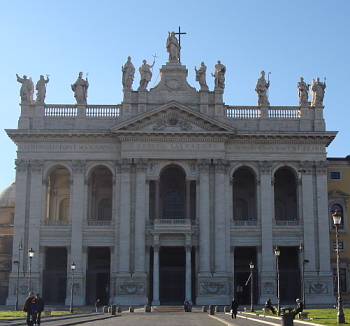
Cathedral of Christ the Savior, Sts. John the Baptist and the Evangelist, Rome
Jeffrey Gros, FSC: In Memoriam

Prof. Jeffrey Gros, FSC
I was in Montenegro when I received word of Br. Jeff’s passing this summer (12 August). For more than a decade, Br. Jeff Gros has been one of my chief ecumenical mentors. There have been many who have helped me along the way, but few as significant an educator and supporter as Brother Jeff. I have been reflecting on his life and his help to me in these years, and I keep finding it a daunting task to do justice to his memory and contributions.
There has never been any vocation for me but that of ecumenist. I barely remember wanting to do anything with my life other than be an ecumenist, even to the point of seeking it out as a university major (not an option, so I had to settle for Theology in general!). Whether the path to living it out was through the presbyterate, diaconate, lay ecclesial ministry, or academic theology always seemed to me to be a secondary question.
Br. Jeff was part of that generation that came of age just at the time of the Second Vatican Council. He completed his BA in the same year that Good Pope John called the council, and spent the years of the Council teaching in high schools and in his own graduate studies. In 1965 he published a master’s thesis on ministry and orders in the presbyterian church. In the very year the council ended! He wrote his doctorate at Fordham in the height of the energy and expectation about ecumenism, at a time when people seemed to think that reunion with Anglicans, Lutherans, and Orthodox, at least, would happen by the end of the decade.
Jeff was hired on as the first Catholic director of Faith and Order for the National Council of Churches during the 80’s, so he was on hand just as the WCC Faith and Orders most famous convergence statement, Baptism, Eucharist, and Ministry, was prepared, published, and received. In the most cutting-edge era of modern ecumenism, Jeff was at the forefront, and widely acknowledged as one of the most knowledgeable and approachable experts in a field populated by many of the best and brightest the Churches had to offer.
After a decade at Faith and Order, he was brought into the staff of the USCCB office for Ecumenism and Interreligious Dialogue, at that office’s height of effort and episcopal support. In the same year Pope Benedict was elected, the USCCB suffered a number of cutbacks and reorganizations, shrinking the office to half its previous staffing levels.
He was a member of the National Association of Evangelicals and of the Society for Pentecostal Studies, being elected president of the later on their 40th anniversary plenary. He knew the churches and communities from the inside out, and I daresay, sometimes better than many of their own leaders (Catholic Church included, of course).
I met Jeff in 2002, the year I finally got connected with national-level ecumenical networking (there was no ecumenical network for youth in the US then!), through my advisor at CUA, John Ford, CSC. First there was the CUIC Inauguration in Memphis, the National Workshop on Christian Unity in Cleveland, and Orientale Lumen in Washington, DC. Jeff was one of the many “rock stars” of the ecumenical movement I encountered for the first time that year. I would have the privilege of his tutelage during the USCCB’s Institute for Ecumenical Leadership twice (basic and advanced) and at several conferences over the years, most commonly the NWCU.
Jeff was a walking encyclopedia of ecumenism. Having lived through the Catholic Church’s entire history of ecumenical commitment since the Council, as an academic and educator throughout, and having witnessed and documented most of it personally as staff at the NCC and USCCB for a quarter century, the number of people who paralleled his first-hand experience and knowledge of the movement can probably be counted on one hand.
I remember sitting at a table with Jeff when I admitted I had been confused when a speaker kept referencing Arminianism, and I had assumed they were talking about the Armenian Apostolic Church (and it was not making much sense). “How could you study the Synod of Dordt and not remember Arminius?” he chided with a smile as he launched into an enthralling history lesson on the intricacies of early 17th-century Dutch Reformed theology and its internecine conflicts. I did not have the heart to tell him that my survey of church history had not even covered the synod.
It was one of many teachable moments i had with Jeff, rather that he had with me, which encouraged me to further study. (Encouragement also sometimes took the form of a kick in the pants: “A.J., you know ecumenism, you know the material, just get your thesis written already!”) In fact, the last correspondence we had before he died was to encourage me to apply to a position as ecumenical officer in a large diocese that would allow me teaching opportunities as well.

Br. Jeff at the NWCU
Talking to other young ecumenists (though I no longer qualify for the young part, I fear), everyone had an encounter with Jeff that pushed them along the path to unity.
But it was not just the external dialogue that Br. Jeff modeled. A lay brother, he knew the sting of clericalism long before lay ecclesial ministry had its rise and subsequent decline. I once found myself complaining to him about the disparity of opportunity for those of us without a Roman collar, when it hit me like a bolt – if Jeff had been ordained, he probably would have been made cardinal, a la Avery Dulles. What I found cause for grumbling, he handled with aplomb and renewed dedication.
He was tireless. He published more in the eleven years I have known him that I have hopes to achieve in a lifetime. More than twenty books bear his name as author, contributor, or editor, and some of them are massive tomes. Others are incredibly practical, pastoral, and handy for catechesis. He has over the 300 articles, and so many book reviews that they would probably fill an entire bookshelf in themselves. He consulted, taught, corresponded, and was present to just about everyone who has engaged in the search for Christian Unity in the Anglophone world in the last fifty years, I suspect.
Brother Jeff was an indefatigable proponent of the Gospel plea for unity in place of uniformity, for communion in place of conflict, for dialogue in place of division. He was and remains an inspiration to two generations of ecumenists, at least, and, I have no doubt, is in a place to intercede on our behalf as we recall and reclaim the final prayer of Christ. He will be missed in this here and now, but I am grateful every day to have counted him a friend and mentor.
Requiem æternam dona eis, Domine,
et lux perpetua luceat eis.
Te decet hymnus Deus, in Sion,
et tibi reddetur votum in Ierusalem.
Exaudi orationem meam;
ad te omnis caro veniet.
Requiem æternam dona eis, Domine,
et lux perpetua luceat eis.
Year of the Deacon: A Proposal
With the success of the Year of the Priest under Pope Benedict, I humbly suggest to Pope Francis (or whomever is reading) that we should have a Year of the Deacon. If anything, the diaconate is suffering from under-attention far more than the presbyterate, so the same motives that made the first so successful and timely apply at least double for this suggestion!
Plus, given that Francis of Assisi is often said to have been a deacon (though this is apparently in some dispute, whether he was ordained at all), it seems all the more appropriate that a bishop of Rome with that name initiate a year to honor and build up these Icons of Christ, Diakonos.
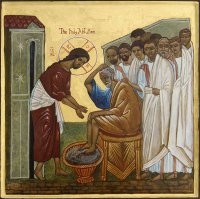
The ‘institution’ of the diaconate
Naturally, it should be done ecumenically, rather than unilaterally. Especially as the discernment of the nature of the diaconate is a shared ecumenical challenge and opportunity. Invite all the heads of communion to declare the same, and have an ecumenical gathering of deacons as part of the celebrations.
I propose that the Year of the Deacon start on the feast of Deacon St. Lawrence of Rome, 10 August 2014 and conclude on the feast of Deacon St. Stephen of Jerusalem, Protomartyr, on 26 December 2015. The highlight events of the year could take place on 30 October 2014 to recognize the 50th anniversary of the vote on Lumen Gentium, which included the call for the restoration of the diaconate to its full and proper place in the Catholic Church. These were the two saints invoked as patrons for the restored diaconate by Pope Paul VI in Sacrum Diaconatus Ordinem.
Would it not be a grand sight, to see St. Peter’s filled with deacons and their wives from around the world, celebrating the liturgy with the bishop of Rome? Dioceses offering catechesis on the ancient office of the deacon, its institution, and the symbolism of the Last Supper as iconic for the diaconal office; a surge in vocational promotions efforts for the diaconate; a special synod on the identity of the deacon, including the question of women as deaconesses (or just as deacons)?
He could even take the opportunity to introduce his new archdeacon…
What else could be done during such a Year of the Deacon? Ideas?

Diaconal Ordination Liturgy, Archdiocese of Seattle 2012
The Pope Needs an Archdeacon
When the Council of Cardinals met with Pope Francis at the beginning of the month to discuss reform of the Roman Curia and the governance of the Church, one of the topics that came up was the role of the Secretariat of State.
Since the initial reforms of Paul VI in Regimi Ecclesiae Universae, the Secretariat has enjoyed prominence in the Curia, and a dual role: it not only exercised the ministry appropriate to the office, that of foreign relations with states, but also in fact as the lead congregation in the curia, coordinating (theoretically at least) the work of the other dicasteries, and managing the relationship of the bishop of Rome to his brother bishops around the world.
For example, when a new officer in the Pontifical Council for Promoting Christian Unity is needed, they get vetted not only by that Council, but also by the Secretariat of State. Or consider the elaborate and secretive process for the nomination of bishops, managed by each nation’s apostolic nuncio – a diplomatic post.
As I suggested in my wish list, these responsibilities should probably be separated from the foreign relations dicastery. In canon law there is a title for the ecclesiastical officer responsible for managing the bishop’s staff, which is “moderator of the curia”. This person is is often a priest or auxiliary bishop, and is frequently also the vicar general. There is some concern about creating a kind of “vice-pope”, though this is a term sometimes used of the Secretary of State already, unofficially of course.
What the bishop of Rome needs is an archdeacon. This ancient ecclesiastical office has fallen into disuse in the Latin Church, and fallen into confused use in other churches (such as the Anglican Communion).
The archdeacon is normally the senior cleric of a diocese after a bishop. Originally, the archdeacon was in fact a deacon, not a presbyter, the reason being that deacons are called to serve as assistants to the bishop with responsibility for administration and governance, representation of the bishop to the rural clergy (ie, the pastors) and to other bishops, managing the financial and human resources of the diocese for the sake of the mission, etc. This kind of vicarious authority was not originally granted to the presbyterate, whose primary functions were advisory, sacramental, and pastoral.
The offices of vicar general and moderator of the curia derive from the office of archdeacon. You can still find this usage in the Ecumenical Patriarchate of Constantinople, where a “Grand” Archdeacon fulfills part of this function.

Archdeacon Maximos with Patriarchal Bartholomew of Constantinople
In the Anglican Communion, the title archdeacon has been attached to the vicars forane, responsible for a subdivision of the diocesan territory. In the Catholic Church these are generally called deans, in English, and is originally a diaconal role, but not that of the archdeacon. The Anglicans have also kept the late medieval practice of having ordained presbyters fill this role, but this should be avoided (do we have deacons serving as archpriests?)
The offices of vicar forane and episcopal vicar (deans and heads of dicasteries/diocesan offices, respectively) derive from the other early diaconal roles. Perhaps revivifying these ancient offices, restoring the diaconate to its full calling, will help in the reform of the curia.
If Pope Francis were to make use of this ancient and venerable office for contemporary needs, one could see it as something of a Chief of Staff for the Roman Curia, rather than as a kind of vice-pope. (Though, realistically, it would be better having an official ‘vice pope’ than having a personal secretary, master of ceremonies, or Secretary of State assume the role in the vacuum!) The role of the Archdeacon and his office would be to manage the internal organization of the curia, increase coordination and communication among the various dicasteries, and leave the diplomatic foreign relations work to the Secretariat of State.
Maybe the Archdeacon’s office could work to coordinate areas of joint concern, so we never have another Anglicanorum Coetibus or Dominus Iesus faux pas, wherein we find ecumenical or interreligious issues being announced without involvement of the offices responsible for ecumenism and interreligious dialogue.
They could also have a central office for ecclesiastical human resources in the curia, working to ensure that the most qualified candidates in the world – lay, religious, or clerical – get into the offices here, rather than some cardinal’s nephew (figuratively speaking, of course). He could work on keeping the curia on mission, and at service to the universal church – especially as the relationship to the Synod of Bishops and the episcopal conferences is expected to change.
But most of all it would seem as something new – not getting confused with the ideas that have arisen around the moderator of the curia title – which in itself should be fine, but because it is often attached to the vicar general or vicar for clergy, could be confused with other offices already in place (such as the two vicars general, one each for the Vatican and the Diocese of Rome; or the prefect of the congregation for clergy which is the Roman curial equivalent of a diocesan vicar for clergy).
Plus, it would be encouragement to dioceses around the world to start looking further back into our tradition for ideas of how to meet the ministry and governance needs of the Church today. If the successor of Peter the Rock can restore the office of Archdeacon, so can the diocese of Little Rock, or anywhere else. This would not only free up a presbyter to get out into the parishes where they are most in need, but restore to the diaconate a stronger sense of its original mission – to extend the ministry of the bishop in matters of governance, administration, and service-leadership.
ICEL 50th Anniversary
On 17 October, the Vatican celebrated the 50th anniversary of the International Commission on English in the Liturgy (ICEL) with a mass at the altar of the chair in St. Peter’s Basilica.

Eucharistic celebration on the 50th anniversary of ICEL
Given recent discussion that the Council of Cardinals may be suggesting reform of the liturgical apparatus of the Vatican first (after the Synod) in its recommendations for the reform of the Curia, it is an event worth reviewing. Especially since one well-established vaticanist referred to it as “farce”.
Why the harsh language? Apparently, none of the members of ICEL prior to its “refounding” a decade ago were even present, and it is not very surprising. Few things epitomize the depths to which the curia had sunk than the bungled handling of ICEL a decade ago and the resulting mess. Though many of the conferences did the best they could given the situation (one can look to the US or England and Wales as examples), bad process always spoils even the best of products.
The advantage of our age is the great access to social media and broad communications, so we can get information quickly, and provide formation broadly. The USCCB and others showed this to great success in 2011 when implementing the new translation of the Roman Missal.
The disadvantage of this same gift is an even shorter memory. The first official translation came in 1972, after about six years of work. It was understood to be rather temporary, and by the end of the decade, work began on a much more serious translation. Everyone agreed the 1972 version was not perfect, but for forty years, the local bishops’ conferences had trusted the work to ICEL in accord with the principle of Sacrosanctum Concilium. After long years of work, the new and improved English translation was finally ready… not in 2011, but in 1998. The English-speaking bishops of the world had approved it, it should have been signed, sealed, and delivered, but something unbecoming of church leaders was afoot.
Over the next five years, all the hard working bishops, liturgists, experts and consultants who had given so much to the Church they loved felt a “cold wind” blowing from Rome, as none-too-subtle (and none-too-kind) change was imposed by a relatively small number of power brokers and their allies.
By 2003, ICEL had been effectively disbanded and replaced by an entirely new commission, Vox Clara, quite different from the mission and composition of the first. It would have been more honest to just say so, and not act as though ICEL had continued as the same entity it was before Vox Clara came on the scene. To quote the late Msgr. Fred McManus, the American peritus at Vatican II who helped the bishops establish ICEL and suffered greatly as he saw it dismantled: “They could at least have the decency to change its name.”
From an impetus to the encounter of the liturgy with culture and cultures, and the reception of those into the liturgy, the focus had moved to a fixation on the Latin language and the culture of Rome. Translation is no longer about bringing the liturgy into new cultures, but about bringing diverse experiences of liturgy into the closest approximation of the Latin as possible.
Sound like a made-for-TV drama or a Dan Brown novel? It can certainly be dramatized… but truth is so often stranger (and sadder) than fiction. Even in the Church.
Whatever you think of the translations, the 1998 or the 2011 versions, the process by which the current version was introduced was inappropriate and embarrassing for the Church, and for the loyal sons and daughters of the church who put so much effort in, as directed, and then were so harshly dismissed.
To read the documents, the history, and the full story of ICEL and what happened to the long-sought after New and Improved English Translation – and why it was replaced by a relative rush-job that was rolled out with great fanfare as the best thing since sliced bread – I recommend some serious reading here, compiled by one of the experts involved in the more recent iteration, appointed to ICEL in 2005.
Some of the disgruntled ask if Pope Francis would completely overturn the translations. I doubt it, and do not think that is the way to go.
What is needed is an honest accounting and a healing of memories. Apologies offered and credit given where it is due. Only then can the repair and reform of the liturgy move forward, which i suspect should include a serious reconsideration of Liturgicam Authenticam (which is deficient not least for its ecumenical shortcomings) and a move to bring the best of both the 1998 and 2011 translations into a single, common Missal. Let the “old mass” inform and enrich the “new”.
Feeling more Catholic than the pope? I find your lack of faith disturbing
By now, most have read that last week’s “interview” between La Repubblica’s Eugenio Scalfari, 89, and Pope Francis, was really more of the former’s recollection of a friendly conversation between the two.
It was obvious from day one that this interview, and its translation, was not on the same par as that published by the Jesuit journals of the world less than two weeks before. That fact has just been underlined, and the gulf of quality widened, by recent revelations. Both remain important, illustrative of the Holy Father’s basic ecclesiological paradigm, his personality, and his vision for the mission of the Church, but not in the same degree. As you would expect.
Scalfari used neither a notepad or a recorder, and while I am sure that any one-on-one with the pope will be memorable enough that you are not likely to forget that much of it, even at such a venerable age, it seems like a journalistic mortal sin to publish conversation as if these are recorded quotes during a professional interview.
Given that, I do not find it surprising that a couple of the details get mixed up. Scalfari is not a theologian, in fact, not even a practicing Catholic. So, the fact that he misremembers whether Pope Francis had his mystical moment before or after accepting the office, or whether he or the translator captured all the nuance of the primacy of conscience is neither surprising nor shocking.
The Vatican confirmed that the basic tone and tenor of the interview was accurate and trustworthy. The thoughts expressed are the pope’s thoughts, technical and translation glitches aside. It is a “reconstruction and not a transcript” and “should be considered faithful on the whole to the mind of the pope, but not necessarily in its particular words and the accuracy of its details.”
One merely needs to read the interview with a basic understanding of Christian teaching and knowledge of the fact that not only is the pope Catholic but that he is, in fact, a bishop of the Church, and there are no theological or doctrinal problems to be found. A little benefit of the doubt is sufficient, to say nothing of thinking with the Church here.
By far, then, the most disturbing news of the week is the vitriolic and unabashed criticism of the bishop of Rome from some voices on what is often called the far right – though there are many self-described conservative Catholics who find this reaction appalling. And well they should.
(Some other rebuttals to this hysteria, and conservative clarifications to calm the nerves, can be found on The Dish, The Deacon’s Bench, National Catholic Register, and even the godfather of ‘far right’ Catholic bloggers, Fr. Z!)
–I suspect there would not have been so much confusion if we had not had such a recent long streak of obsessing with literal translations and verbatim fidelity of words themselves, rather than focusing on the message being conveyed by the words. But I digress —
To be clear, I have no problem with the criticism of any religious leader, including the bishop of Rome. In fact, a healthy Church, one committed to the principle on ongoing reform, is made evident by those that love the Church are the first willing to openly recommend improvements. A culture of fear and thought-control, wherein everyone simply has to toe the party line, is detrimental to the overall wellbeing of any institution, especially the Body of Christ.
But criticism demands responsibility. It is one thing to not like the color of the pope’s shoes as a matter of personal taste, and anyone can express such an opinion. It is something else to claim the pope is a heretic, a relativist, a modernist, or confused about the role of the bishop of Rome without some kind of theological legwork to back up your claim. And when the attack is made ad hominem, it just loses all respectability.
Since the moment he appeared on the balcony in March, I have heard complaints and an unceasing stream of vitriol from either the radical traditionalist set, or the plain old neo-con clericalist set.
Not all who respect tradition are traditionalists, and not all who claim the title traditionalist are “radical” traditionalists. The former may have greeted this latest interview with a raised eyebrow or two, but then immediately began looking through the Italian for translation errors (and there were a few) or intuitively read the pope’s words with the docility of will and humility of intellect required of all faithful , and realized what was being said.
Likewise, not all who identify with the label conservative – whether politically, morally, socially, or theologically – fall into the particular subset of neo-conservative, and not all of these somehow substitute the dogmas of unrestrained capitalism for the Christian gospel. But there are certainly those who do, and they tend also to adhere precisely to these sins of clericalism, careerism, materialism and triumphalism that Pope Francis has been warning us about. No wonder they are upset.
I am happy to be in a Church with traditionalists and conservatives, innovators and liberals, even if (as a reform-minded, ecumenically devoted centrist), we do not agree on everything, because that is the nature of a universal Church. All I expect from all sides is that you think with the Church, you at least give your local bishop or that of Rome the benefit of the doubt, and when that is not sufficient, try harder to employ a hermeneutic of charity.
For my entire lifetime, we have had two popes who were considered conservative even by general Catholic standards, at least concerning matters ad intra. Pope Benedict bent over backwards to accommodate the traditionalist wing, like the Good Shepherd, giving disproportionate attention to a very small minority in the Church that had wandered far from the flock. He was the bishop of Rome, the successor of Peter, and tasked with making hard choices for the sake of unity; this is what he did.
Now we have a pope who nobody could seriously describe as liberal: He will not be changing Church doctrine on abortion, euthanasia, capital punishment, or war anytime soon. Neither is the question of women in the presbyterate, nor gay marriage, suddenly on the fore of the Church’s agenda. Relieved or disappointed, you can take that to the bank.
Call him a reformer, a moderate, a centrist, creative orthodox or just plain Catholic: He will bring change, but only the change that the gospel demands and that which only hubris and fear have withheld. Some will find it too much too fast, others will find it too little too late.
He may not cater to the particular agenda of the parties that have been in ascendancy for an entire generation, if you want to think in those terms, but is instead fixated on the timeless Gospel of Jesus Christ, and willing to free the Church from self-imposed bondage where necessary, to promote that central message and mission. It is about time someone did.

…
NB to the liberal and progressive set: “This is the Church. If you don’t like it, leave!” is exactly the kind of thinking that such über-conservative dissidents have had for the last 35 years for everyone that did not agree with them. Now we come, perhaps, to the turn of the tide, and there is temptation in some quarters to respond in kind. Don’t. The Church needs them, and what they need is conversion and healing, which is unlikely to be found in the outer darkness. Treat them as you wish they had treated you over these last decades: with charity.
 The Ecumenism Blog