
Home » Posts tagged 'Rome' (Page 4)
Tag Archives: Rome
Summer 2013
In the last few months, while the world has witnessed the first resignation of the bishop of Rome in six centuries, the election of one with the hopes of the world on his shoulders, renewed violence in Egypt and ongoing horror in Syria, the change in my own life is both far more modest, and more pleasant to share. Of the others, no doubt more will be said.
In May I was informed that my hours at the John Paul II Center for Interreligious Dialogue will be reduced. The Russell Berrie Foundation and the Angelicum– co-operators in the direction of the Center – have been very generous in keeping me on as the Graduate Assistant (and de facto only regular staff person) for the last two years since my fellowship was concluded. I will continue for the coming academic year in the same capacity, and await anxiously news of the next stage of the Center and the Russell Berrie Fellowship in Interreligious Studies at the Angelicum, and whether I may continue to be a part of it.
The reduction in hours, including two summer months without any work, meant three things:
- I would have to find additional work to pay for my studies and living expenses (no doctoral stipends in Rome!);
- I would have to leave the Lay Centre at Foyer Unitas, my home in Rome the last four years;
- I would have an entirely free summer – and even fewer resources with which to enjoy it.
As with my original move to Rome, however, providence provides.
Within a week, three work opportunities presented themselves, which all eventually came to fruition. One even had the advantage of ‘killing two birds with one stone’ and taking care of the accommodation question as well.
- In mid-August, I take on the role of Resident Manager (Domers, read ‘rector’) for The Catholic University of America’s flagship study abroad program, happily joining the staff of my first graduate school, in the city of my latest.
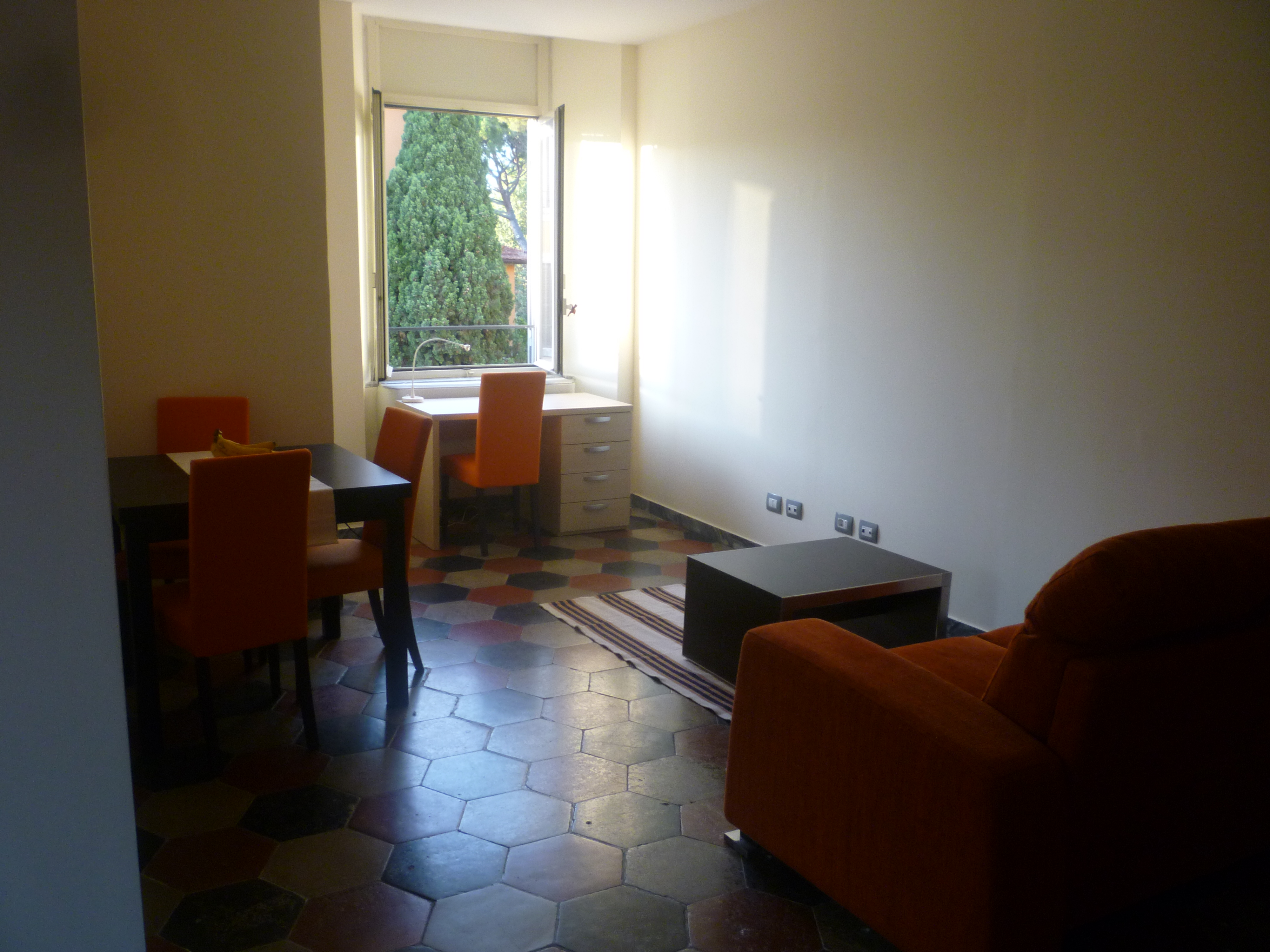
It comes with a spacious corner apartment at the Prati campus – furnished in the colors of Halloween. (I kid you not: Pumpkin-colored couch, dining room chairs, tableware, salad bowl, etc… St. Mary Magdalen folks, Fr. Marquart would have absolutely loved it…).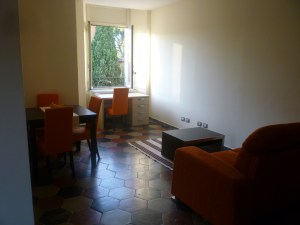
The 70’s would be proud
- In mid-September, I begin teaching my first university level course as an Adjunct Assistant Professor for Assumption College (Worcester, MA) for their new Rome program. My course is part of the core curriculum, titled “Contemporary Catholicism”. And I get to teach it, in Rome, in the semester that Popes John XXXIII and John Paul II are being canonized. How about them apples, fellow theologians? Preparing the syllabus took the first part of my summer vacation, but has been a great deal of fun.
- In February, I start teaching my first specialized course in Ecumenism and Interreligious Dialogue at the university level, this time at one of the Roman colleges (seminaries), the Pontifical Beda College, where second-career Anglophone seminarians usually find themselves. The course is offered during the fourth year, so all of my students will be transitional deacons – which should make for some fun conversations given my research area!
As for the free summer? Staying in Rome is an expensive proposition… but so is returning home to Seattle.
Suddenly, a little casual research into the interplay of Eastern Orthodoxy and Islam in central and southeastern Europe seemed appealing. It is amazing how far you can get there on a limited budget, a ecumenical network, and whatever else providence can provide…
Hope and Change in the Church
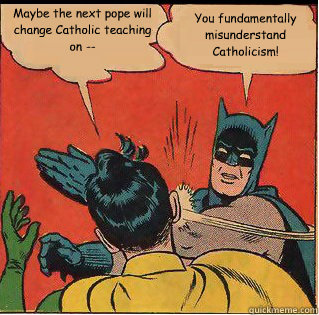
Batman the fundamentalist giving Robin the chance to turn the other cheek
A recent conversation highlights the challenge of talking about “hope” and “change” in the Church.
A few weeks ago I had a quick lunch with an old friend and a new colleague. Eventually my friend (a Notre Dame alumna, “new evangelist” and educator) and I got into a lively discussion about “change” in the Church, given all the hope that has been expressed lately about what changes Pope Francis might bring.
My position is basically this: it is naïve to think that the Church does not change, and it is unhelpful at best and dangerous at worst to suggest that the Church cannot change. The Batman meme above vividly demonstrates a misguided and wrong-headed understanding of the Church.
“The Church should change” does not mean “the truth must/can change”. It is Church discipline – and often really just Church culture – not dogma, which should change in the minds of most. Though there are always exceptions, I suspect most Catholics are not agitating for moral relativism, an end to Trinitarian theology, a return to Arianism, denial of the Resurrection or the Real Presence, promoting abortion or war, that we do away with ordained ministry or that we change the Sunday Eucharist into an hour long drum circle featuring Kumbaya in a dozen different languages.
What most Catholics mean when they say that they hope for change in the Church is ecclesiological, ecumenical, pastoral, and practical. They want a positive gospel message (“God is love” or “Love God and thy neighbor”, and all that radical wishy-washy stuff, you know); they want better preaching, better music, better liturgy; they want transparency and accountability in church decisions, participation in governance, and maybe even more married clergy and less clericalism. They want bishops (and pastors, deacons, DRE’s et al.) to be servant-leaders, not lords of their own fiefdoms. They want ecumenism and interreligious dialogue to work, and to have real effect. They want more effort spent on social justice than on ecclesiastical protocol, more money spent on education and pastoral care than on neo-Baroque bling.
But my experience of most Catholics, admittedly, is based on my experience in parish pastoral ministry and Catholic higher education. My friend has spent several years on the front lines of pre-evangelization, new evangelization, and even good old-fashioned evangelization and catechesis, often in the context of guiding groups of pilgrims and students around Rome’s most sacred sites.
Her position was that “the church should change” is basically code for “the church’s teaching about morals should change to match the social norms of the western world.” When people say change, they mean that the church should get out of its old-fashioned rut, and embrace a woman’s right to choose, gay marriage, equal rights (and rites) for women in the ecclesiastical workforce, and so forth.
That it may be, in some cases, just as in others, “the church should change” means “the church should eliminate the novus ordo, go back to the Tridentine rite, and embrace traditional Catholic culture (circa 1940).”
The problem, though, in assuming that “the church can/must change” is code for a particular agenda is that it stymies the possibility of real conversation and dialogue. The Church is in fact always changing. All we have to do is look at the papacy of Benedict XVI to see a number of examples of change in the church. And no one can accuse Ratzinger of being radical, wishy-washy, or unorthodox.
He changed the liturgy, both in terms of the translations and in terms of the mark his own personal preferences have had. Even just during my four years in Rome, you could see lots of changes to the liturgy at St. Peter’s – longer, less participatory music; rosaries before mass begins; communion no longer offered in the hand; a crucifix and candles dominating the altar; cardinal-deacons vesting in mitre and dalmatic; etc., etc. He changed canon law to exclude deacons from acting “in persona Christi capitis,” making this phrase more about Eucharistic presidency and less about holy orders or leadership in the Church. He innovated in creating ordinariates for disenchanted Anglicans. He pushed forward reforms relating to the sex abuse crisis (at least for priests, if not bishops). He created a personnel office for the Vatican. He called in an outside audit of Vatican finances.
In short, the Church changed a lot under Pope Benedict; why would we not expect it to change with Pope Francis? The Church changes, and survives. Change simply means that things are different than they were before. It is a sign of life, and of fidelity to the principle ecclesia semper purificanda (the church must always be purified). Rather than dismissing the idea of the church changing, embrace it – critically, intelligently, and faithfully.
Remember Dante’s Divine Comedy – God is pure dynamism. The only creature which cannot change is Satan, eternally frozen in the deepest pit of hell.
Reconsidering Pope Francis on Liberation Theology
Another repost from Franciscan Blogger Daniel Horan:
Apostolic Blessing “Urbi et Orbi”: Pope Francis’ first public words

Brothers and sisters, good evening!
You know that it was the duty of the Conclave to give Rome a Bishop. It seems that my brother Cardinals have gone to the ends of the earth to get one… but here we are… I thank you for your welcome. The diocesan community of Rome now has its Bishop. Thank you! And first of all, I would like to offer a prayer for our Bishop Emeritus, Benedict XVI. Let us pray together for him, that the Lord may bless him and that Our Lady may keep him.
Our Father…
Hail Mary…
Glory Be…
And now, we take up this journey: Bishop and People. This journey of the Church of Rome which presides in charity over all the Churches. A journey of fraternity, of love, of trust among us. Let us always pray for one another. Let us pray for the whole world, that there may be a great spirit of fraternity. It is my hope for you that this journey of the Church, which we start today, and in which my Cardinal Vicar, here present, will assist me, will be fruitful for the evangelization of this most beautiful city.
And now I would like to give the blessing, but first – first I ask a favour of you: before the Bishop blesses his people, I ask you to pray to the Lord that he will bless me: the prayer of the people asking the blessing for their Bishop. Let us make, in silence, this prayer: your prayer over me.
[…]
Now I will give the Blessing to you and to the whole world, to all men and women of good will.
[Blessing]
Brothers and sisters, I leave you now. Thank you for your welcome. Pray for me and until we meet again. We will see each other soon. Tomorrow I wish to go and pray to Our Lady, that she may watch over all of Rome. Good night and sleep well!
Hopeful Words (reblog from Simone Brosig)
Thoughts from a Canadian friend i had the occasion to chat with after getting back from the Piazza last night:

Who is this Cardinal Bergoglio? Who will he become, this Pope Francis? My prayer is for a shepherd whose agenda is the Gospel of Jesus Christ. Nothing more. Nothing less. Here are some past words from Cardinal Bergoglio and now Pope Francesco. *

“The unjust distribution of goods persists, creating a situation of social sin that cries out to Heaven and limits the possibilities of a fuller life for so many of our brothers [and sisters].”

“Only someone who has encountered mercy, who has been caressed by the tenderness of mercy, is happy and comfortable with the Lord.”

“We live in the most unequal part of the world, which has grown the most yet reduced misery the least.”

“We have to avoid the spiritual sickness of a self-referential church. . . It’s true that when you get out into the street, as happens to every man and woman, there can…
View original post 160 more words
Perspective from the Piazza: Bishop Francis of Rome
The only problem with being in Piazza San Pietro for the announcement and presentation of the new bishop of Rome is that the cell networks and internet access all jam. Maybe I can reconstruct the impressions and my perspective from Rome tonight, as they came as pithily as possible:
[c.18:30] – just finished giving a conversational English lesson. Pretty sure there will be black smoke in half an hour. Maybe I should run over there anyway? Nah… I’ll just miss the smoke, it’s wet, and I’ve got work to do.
[c.18:50] – hm. I think Philippa Hitchen is on Vatican Radio, they should have the chimney on livecam. At least I can say I saw the black smoke ‘from a distance’ tonight if anyone asks. Heh heh.
[18:52] – a seagull on the chimney, says Msgr. Mark Langham on Facebook. Kinda reminds me of that ND game where the squirrel took to the field sophomore year…
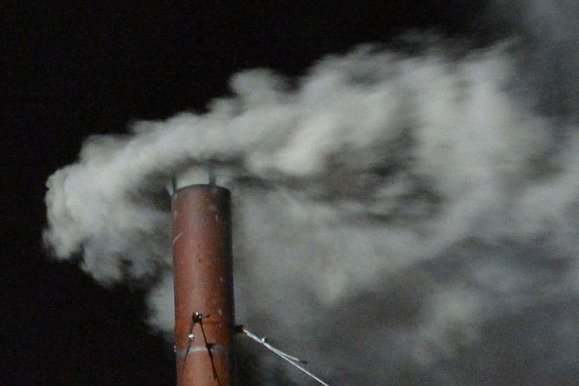
[19:06] – working on editing a friend’s article. Smoke! Hm… looks pretty dark grey. Really dark… e’ nero? E’ bianco? E’ nero. Maybe go back to editing… ok, one last look. Still grey… hey, is that bell moving? [commentator: “looks pretty grey, but wait, the bells!”]. Elected on the fifth ballot?? I thought it would be tomorrow at the earliest! This is only one more than Ratzinger.
[19:07] – knocking on doors. “Habemus papam!” start ringing our bell.
[19:08] – I’m going down there, now. Anyone wants to join me, I’m taking a taxi.
[c.19:20] – five of us went, after waiting forever (five minutes) for some people to change. Halfway to the cab stand, three jumped on the 81. Alex and I got in a cab. At about 19.40, near Chiesa Nuova, we see a group from the Russicum walking by, and we decided to ditch the traffic and join them.
[c.19:50] – arrive in Piazza San Pietro, someone in the group knows one of the security guys and we get into the square, all the way up to the obelisk. I’m wedged between U.S. college students from New York, an Italian sister with a robust singing voice, three Eastern Catholics and a prolific contributor to the New Liturgical Movement.
[time ceases to have meaning]
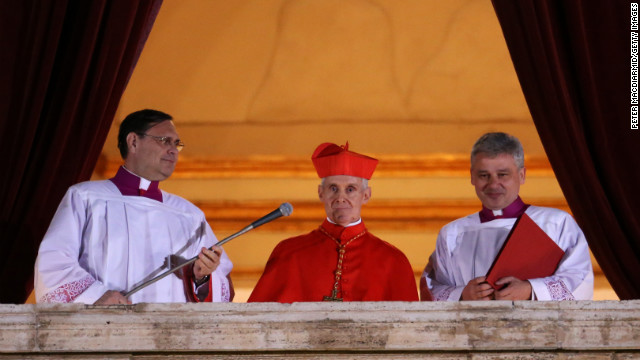
Cardinal Protodeacon Tauran: Annuntio vobis gaudium magnum: habemus Papam!
People of God: wild cheering and applause
Cardinal Tauran: Eminentissimum ac reverendissimum dominum, dominum Georgium
Me: Giorgio? George… maybe George Alencherry, the Syro-Malabar Major Archbishop?
Cardinal Tauran: Sanctæ Romanæ Ecclesiæ Cardinalem Bergoglio qui sibi nomen imposuit Franciscum.
People of God: Huh? Who? – polite applause, much checking of smart phones –
Me: Bergoglio? Which one was he? Italian? Pope Francis? Assisi or Xavier? or both? Can I be cautiously optimistic?
Overheard nearby: Francis? *shudder* That’s not good: All innovation is BAD.
Pope Francis appears a short time later, my impressions:
Hm. Almost nobody seems to recognize him. I remember being told the second election of 1978 was like this, the piazza was almost silent. Nobody knew Wojtyla, and they do not know Bergoglio, apparently. From Argentina, according to someone with web-access…
He reminds me of Papa Luciani, John Paul I, for some reason. Someone nearby says he looks like Pius XI. Simple, severe maybe, but simple. Am I smiling?
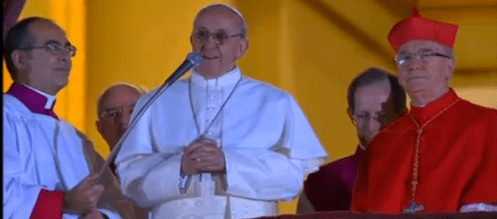
“Buona Serra”? Simple, good start…
“bishop emeritus of Rome Benedict…” how much better that sounds than Pontifex emeritus! Could we have an ecclesiologist pope?
His inclusive language seems to offend the more traditional minded among us…
That’s “bishop of Rome” at least three times now. Not pope, not pontificate, but bishop, bishop of Rome. Be still, my ecclesiologist’s beating heart! I think I really am smiling!
He seems so… humble. Almost awkward, these pregnant pauses, but I get the feeling he really did not expect to be there. Not an actor, not a professor… a pastor? A reformer? An introvert? Not sure what it means.
You know… Marini has not looked up from his shoes this entire time. In fact, he looks a little, um, how do I put this…
“He looks like he’s updating his CV, A.J., that’s what he looks like…”
I think he just said, “before a bishop blesses the people, the people should bless – that is, pray for – the bishop. so, I invite you to pray for me, as we start this journey together.”
“Buona notte!” – I cannot get over how refreshing his simplicity is, his somewhat akward honesty, and I do keep being reminded of Luciani. Francis, indeed. 😀
As we began to leave the Piazza, I ran into a Jesuit friend who supplied some details and reflections of his own: He’s Jesuit! He’s from Buones Aires. He said some very promising things tonight – his choice of name, the ecclesiological awareness of focus on the “bishop of Rome” rather than “universal pastor” or “supreme pontiff”, etc. But, a hesitation: “he brought some division to the Jesuits in Argentina; some see him as too conservative. Personally austere, yes, simple, yes, but we shall see”…
So, in summary: First Francis. First Jesuit. First from the Western Hemisphere. First non-European bishop of Rome in almost 1300 years (Gregory III from Syria). Chose a casual, informal greeting. Asked for the blessing of the assembly before he offered his own, and bowed to receive it from us. Clearly knows the pope is first and fundamentally the “bishop of Rome” (and the pope emeritus is really the bishop emeritus of Rome). He chose the simplest of the vestment options in which to appear (no lace, wooden pectoral cross) He will spend his first day visiting a shrine of Our Lady. He took his name in honor of Francis of Assisi, perhaps the most universally accessible saint we have, known for humility, care of creation and the poor, dialogue with Islam, and “rebuilding” a corrupt and failing Church. I think as we left the Piazza, most people still had no idea who had been elected – or perhaps they were just in a sort of joyful shock, the kind you get when something you have wanted for so long seems to be coming true, but you are not sure whether to believe it or not.
And, well, one of the guys I was with posted this when he got home tonight:
“Re, Sandri, Hummes and Kasper [sic] were on the balcony with him as he winged his way through the appearance. Traddies, get ready to bury your cassocks and black covered liturgical books in the yard.”

Beards for Bishops Campaign: Rome Edition
In the fall of 1997, I remember standing at the door to the Basilica of the Sacred Heart at Notre Dame, as I was congratulated several times on my appointment as auxiliary bishop of Fort Wayne-South Bend.
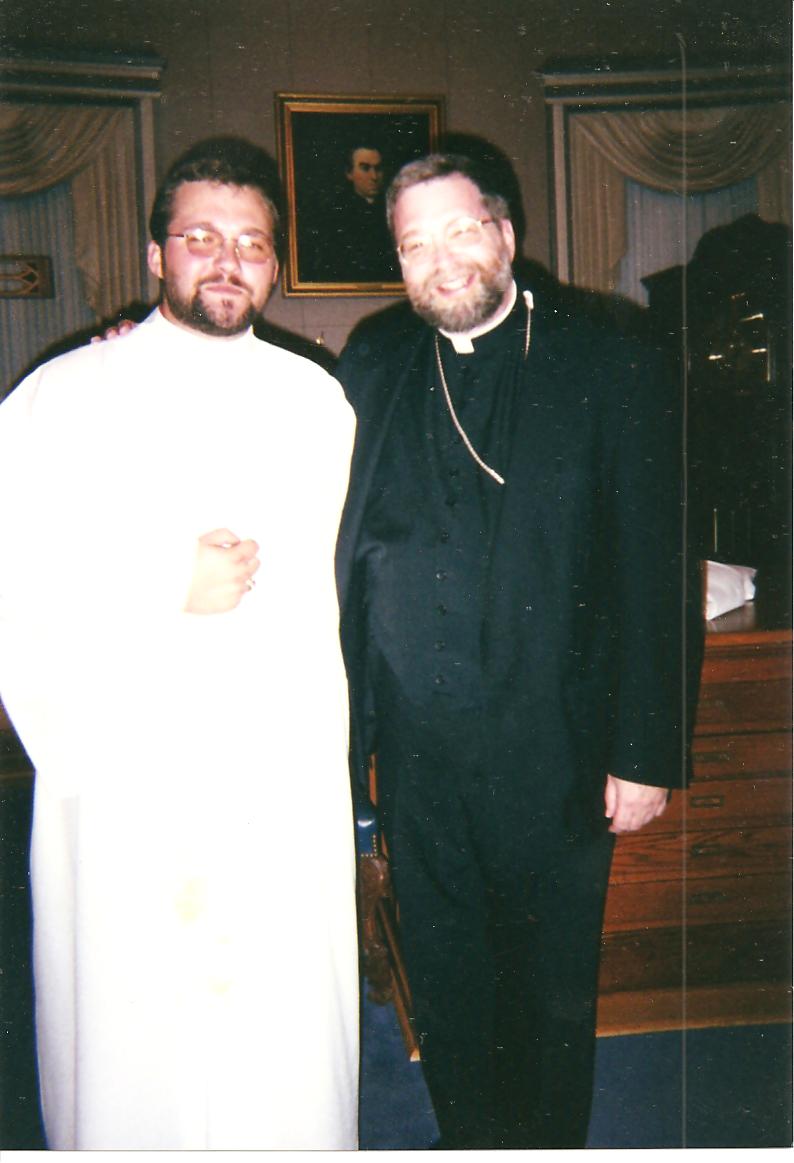
A.J. Boyd, Bishop Daniel Jenky, 1997
Of course, it was not me, but Daniel Jenky, CSC, rector of the basilica who had been so nominated. I was merely serving as vimpa for Bishop John D’Arcy, who was on hand to make the announcement. I was also jokingly referred to among the other servers and basilica staff as Fr. Jenky’s body double, so alike we looked with beard and glasses. Vested in alb and vimp veil, it is no surprise I was mistaken for the bishop-elect on more than one occasion that day.
We decided to dub his excellency as poster-bishop for our newly founded “Beards for Bishops” campaign. We – seminarians, servers, and theology students – felt it was high time for the lingering prejudice against hirsute hierarchs in the Latin church to come to an end.
When differences become polarized divisions, extreme positions are taken in reaction to “the other” that would not be considered in an objective, balanced mindset. Thus Reformed churches become iconoclastic and whitewashed, while Catholic churches spew baroque excess, each extreme fueling an even more extreme reaction. Similarly, as Eastern and Oriental churches maintained and promoted a manful and manly beardliness for its clergy. in the wake of division, the Latin west insisted on the clean shaven route. Perhaps in the wake of that move, clean-shavenness was purported to be too effeminate for the orders of the East, and so on.
In law, starting in the twelfth century, Latin clergy were discouraged and sometimes forbidden from growing their beards. The Council of Toulouse, in 1119, apparently threatened excommunication for those whos facial hair grew (or merely grew unruly, it is not clear), and Pope Alexander III (1159-81) ordered his archdeacon (think vicar general/chief of staff) to ensure that all Roman deacons and presbyters were clean shaven, by force if necessary. Gregory IX incorporated Alexander’s decree into canon law, and there it remained into the twentieth century. In 1866, the second plenary council of Baltimore explicitly outlawed beards for clergy in the U.S. The 1917 Code of Canon Law said merely to keep a simple hair style (CIC 136 §1), so the local law and cultural taboo remained. No legislation regarding facial hair remains in the 1983 code, Deo gratias.

Innocent XII
It was not a consistent ban, despite the attitude and cultural assumptions during the Pian papacies of the 19th and 20th century. The popes from Clement VII (1523) to Inocent XII (d.1700) certainly had beards (as did, if the mosaics at San Paolo fuori le Mura are to be believed, most bishops of Rome from Peter through the first millennium In fact, it was 800 years before we had the first beardless pontiff, in the person of Pope Valentine).
Nevertheless, the late pre-conciliar climate had ossified the ban on barbarous appearance, and even after the apparent change with Vatican II, a bearded bishops was still barely to be found in the western Catholic church. From those humble beginnings in 1997, the Beards for Bishops campaign is now even more humble, and ready to tackle the next challenge: a bearded bishop of Rome.
Quod non fecerunt Barberini fecerunt barbari, anyone?
A sadly small number of cardinal electors willingly wear wisdom-witnessing whiskers:
- George Allencherry, 69,
Major Archbishop of the Syro-Malabar Catholic Church - Moran Mor Baselios Cleemis, 53,
Major Archbishop of the Syro-Malankara Catholic Church - Reinhard Marx, 59,
Archbishop of Munich - Antonius I Nagueb, 77,
Patriarch emeritus of the Coptic Catholic Church - Sean O’Malley, 68,
Archbishop of Boston
One could add to that the hairier heads of the other Catholic Churches sui iuris, whether patriarch or major archbishop, given their office as heads of churches, and whether created cardinal or not, equivalent (at least) to the cardinal-bishops in dignity:
- Ibrahim Isaac Sidrak, 57,
Patriarch of Alexandria for the Coptic Catholic Church - Gregory III Laham, 79,
Patriarch of Antioch for the Greek-Melkite Catholic Church - Mar Ignatius Joseph III Younan, 68,
Patriarch of Antioch for the Syrian Catholic Church - Nerses Bedros XIX Tarmouni, 73,
Patriarch of Cilicia of the Armenian Catholic Church - Sviatoslav Shevchuk, 42,
Major Archbishop of Kyiv–Halyč of the Ukranian Catholic Church
(Their Beatitudes, Patriarchs Bechara Boutrous al-Rahi of the Maronites and Raphael I Louis Sako of the Chaldeans are clean-shaven; rumors of Latinization have neither been confirmed, nor denied.)
Of these ten, then, who is papabile? The retired Coptic patriarch is already a patriarch emeritus and unlikely to succeed another. The Antiochene may be seen as too old. The Ukranian major archbishop, de facto patriarch of the second largest of the Catholic Churches (after the Roman), is seen as the most likely of the non-cardinals, but as more than a decade younger than the youngest cardinal, it is still a long shot. And, the idea of electing an eastern patriarch as bishop of Rome may still be too great a change for too great a number of cardinal-electors, though there is a sort of precedent (thirteen Greeks, four Syrians, and two from modern day Israel/Palestine, if you count Peter himself).
Though I might personally welcome such a move, let us assume it is unlikely. That leaves only two villous vescovi among the princes of the Roman Church.
 Archbishop Reinhard Marx of München serves on the pontifical council for peace and justice and the congregation for catholic education, and is president of the German bishops’ conference Committee for Social Issues. He was elected a year ago as President of the Commission of the Bishops’ Conferences in the European Union. He has published books on Catholic Social Teaching, and has been a bishop since 1996. When he was appointed, German news agency Deutsche-Press Agentur, described him as “left of center” in general, but “moderately conservative” on doctrinal issues. There have been seven or eight German popes, depending on whether you count Stephen IX, born in Lorraine (now France).
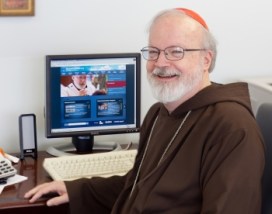 Archbishop Seán Patrick O’Malley of Boston is an Irish American Capuchin, with a record of cleaning up dioceses damaged by the sex abuse scandal (and the bigger scandal of their cover-ups by bishops). He was born in Lakewood, OH (where I lived for all of three months in the wake of the abuse scandal-induced hiring freeze on the diocese there in 2002). His doctorate is in Spanish and Portuguese literature and he was the first cardinal to start a personal blog and podcast, in 2006. He serves on the Congregations for Clergy and Consecrated Life, and on the Council for Family. There has never been a capuchin pope, an American pope, or indeed, a genuinely Western pope (that is, a pope from the western hemisphere!)
Could one of these two men be elected bishop of Rome later this week? If so, the Beards for Bishops Campaign will rejoice in the return of the razorless pontificate after centuries of suppression. Join us in prayer, invoking the patron saints of facial hair, St. Brendan the Navigator and St. Wilgefortis the bearded virgin and martyr.
The first African pope? 1800 years ago…
I was about to start my own blog on the three african popes, because of all the attention being given to Cardinals Turkson, of Ghana, and Arinze, of Nigeria.
But then, i found this blog, and decided it was even better, because it came with a cool map showing the known or presumed birthplace for all known bishops of Rome outside of Europe. He even includes St. Peter.
I am still going to work on a quick post about the geographic distribution of the college of cardinals, and how it might better represent global Catholicism.
Map of Non-European Popes
Pope Benedict XVI’s decision to resign has taken both the Catholic and non-Catholic worlds by immense shock. Some have begun to play the game of “who will be the next Pope?” This game usually ends in a surprise no one saw coming but this does not stop people from trying over and over again. Some have speculated , as they did in 2005 right after the death of Pope John Paul II’s death, that there will be an African or Latin American Pope. Some even go as far to say there could be the “first black Pope in 1,500 years.”I decided to study and map out popes born outside of Europe. There were some surprises among the results.
Of the 265 officially recognized Popes, 217 have been Italian while 17 were French and 13 were Greek (though this includes ethnic and cultural Greeks who were from Greek Italy and Greek Asia). So to solve problems like this I declared a non-European pope to be one who was born outside the modern understanding of what is Europe, regardless of ethnicity or culture.
Three Popes were born in Roman Africa, which today is part of Algeria, Tunisia, and Libya. These African popes were Pope Victor I (189-199), Pope Miltiades (311 to 314), and Pope Gelasius I (492 to 496). These Popes are sometimes described as Black in today’s press because of their African origin. However, the elite in these provinces were descendants of Italian Romans while the population in rural areas were Berbers, who are an olive hue. There is no comparably or historic evidence that the African popes were Black.
Two popes, both ethnically Greek, were born in modern day Turkey. Pope John V (685-686) was from Antioch and Pope John VI was from Ephesus (701-705). John V is sometimes considered “Syrian” due to Antioch’s location in Byzantine Syria.
Four popes were born in “Syria”, modern-day Syria and maybe Lebanon. These are Popes Anicetus (150 to 167), Sisinnius (708), Constantine (708-715), and Gregory III (731-741). Anicetus was born in modern day Homs, site of heavy fighting in the on-going civil war, while the other three were born in newly Muslim conquered Syria. This shows that Christian intellectual thought and leadership were not crushed right away by the new Muslim rulers.
Two popes were born in modern day Israel, depending on who one asks. Saint Peter, the first Pope, was born in the village of Bethsaida along the Sea of Galilee while Pope Theodore I (642-649) was an ethnic Greek from Jerusalem. However, Bethsaida is east of the Jordan River in the Golan Heights region. This is Israel or Syria on depending one’s perspective. Meanwhile, the historic part of Jerusalem where Pope Theodore I was from is mostly likely in the part of the city east of the 1949 cease fire line and therefore either Israel or the West Bank.
So of the eleven popes born outside Europe, at least two were of ethnically non-European origin: Peter (Jewish) and Constantine (Assyrian). Up to three more, the Africans, may have been Berber. So between 0.75% to 1.88% of all Popes were of non-European ethnicity.
Some of these Popes played major roles while pontiff. Pope Theodore I worked hard and proved Roman supremacy over the Emperor and Patriarch in Constantinople. Meanwhile Pope Victor I was the pope who changed the language of the Roman Church from Greek to Latin. Without his change traditionalist Catholics would be lamenting the loss of Greek in today’s liturgies.
Soon the Vatican will announce there is a new Pope. No one yet knows who that person will be and where they will be from. However, now you have a better understanding of the history of non-European popes.
Original post from Geographic Travels.
Benedict Resigns – Vatican Press Office Update (Day 2)
Today’s press conference focused on Pope Benedict’s schedule for the rest of the month, and some of the same questions i addressed earlier today.
The conference can be viewed on Vatican Radio. Official summary here in English.
An unofficial translation via live tweeting is provided by Father Roderick Vonhogen:
Below is a summary of my live tweets at @fatherroderick during the press conference by Fr. Lombardi at the Vatican earlier today.
The Pope’s Last Work Week
Right now, the Pope is working on the things he has to do in the next weeks, like his general audience tomorrow. Until Feb 28, the Pope continues all his work.
Ash Wednesday celebration will be at Saint Peter’s Basilica instead of on the Aventine. The reason for this is because of the large crowd expected to show up.
The last general audience of Pope Benedict XVI will be at February 27 on Saint Peter’s Square because of the large crowd expected to show up. There will probably not be a specific ‘event’ to say goodbye to pope Benedict XVI, he will use the planned events instead.
The pontificate of the Pope ends Feb 28 at 8 pm, because that is normally the hour on which the Pope concludes his working days.
The decision of the Pope has a message for us all: one of humility, courage, wisdom to acknowledge his limitations. The Pope is someone of great realism. Knows the problems of the situation of the Church in today’s world. Has a broad view.
The Pope’s health and reasons to step down
There are no specific illnesses that lead to the Pope’s resignation. Fr. Lombardi says the Pope has had a pacemaker for 10 years. Routine maintenance 3 months ago as reported by newspapers. The trip to Mexico and Cuba was part of the process that led to the Pope’s decision to step back.
World Youth Day
World Youth Day is in its essence a meeting of the youth with the Pope. So it is very, very likely the new pope will be there. Of course, the new pope can decide what he wants, but it is normal to assume that Benedict XVI’s successor will go to Rio.
The Pope’s writings and living quarters after retirement
After his retirement, pope Benedict XVI will have no tasks or responsibilities in the Vatican, it’s possible that in the future, he will choose another place to stay, but for the time being, he will live in the Vatican at the monastery of Mater Ecclesiae.
The Pope’s planned encyclical letter on Faith won’t be released before Feb. 28, instead it will be released later as reflections. Pope Benedict XVI has often expressed his desire to pray and to write. We hope he might write something for us too.
The monastery of Mater Ecclesiae is currently being renovated; the sisters will move out, no new sisters to replace them. The Pope himself made the decision to continue to live at the Vatican. The Pope always walks around in the Vatican to pray the rosary, so he knows the monastery well, and knows what is possible.
Fr. Lombardi says he doesn’t know yet how we will have to call pope Benedict XVI after he steps down. A Journalist uses “Papa Emeritus”, “Pope Emeritus” to indicate the Pope after he steps down. Fr. Lombardi says that the Pope will enter history as pope Benedict XVI, but we await instructions about his title after his resignation. Pope Benedict XVI will certainly remain bishop emeritus of Rome, but we’ll have to see if that is the title he prefers to use.
The decision to announce the resignation was the Pope’s own, but of course there has been consultation about the calendar.
Conclave and Installation Mass
The conclave must begin at least 15 and no later than 20 days after the resignation of pope Benedict XVI and Sede Vacante. On March 1, we have the situation of Sede Vacante.
Preparations of the Conclave then begin. Several meetings
before the Conclave. Date of the Conclave depends on the Apostolic Constitution. Cardinal Marini is studying this.
This is a new situation, so we will have to see what to do with rituals like the destruction of the Pope’s fisherman’s ring. Pope Benedict XVI will not intervene in the process of the election of the new pope. The cardinals will be autonomous. The Pope is not a cardinal. He will not participate in the Conclave.
The new pope
It’s up to pope Benedict and the new pope to decide if he will participate during installation Mass of new pope. The fact that Benedict XVI will continue to live in the Vatican will be no obstacle whatsoever for his successor, on the contrary. It will be a great support for the new Pope to have someone around who understands like no other what it means to be Pope. His successor will probably feel supported by the prayer of pope Benedict XVI after he resigns.
The Pope doesn’t gather the cardinals for the new conclave; they are smart enough to know that they should be here in March. It’s not a problem if some cardinals arrive early in the Vatican to visit the pope.
That’s the end of today’s press conference in the Vatican. Hope you enjoyed my live tweets. I apologize for possible translation errors.

Benedict Resigns – Retired Pope Q & A
[Updates since the writing of this Q & A, usually confirmation of my speculations, are included below in blue.]
The Italians have squelched the discussion of papal resignation in the past by brushing the idea aside with comments like “you cannot have a pope emeritus,” or, “what would you even do with a retired pope?”
Several question, some serious and some mere curiosities have arisen in recent discussions, both virtually and in person here in Rome: Does the pope abdicate, resign, or retire? How does this compare to Pope John Paul II? When will the conclave be? Which cardinals can participate? What will Benedict’s new title be? What is the protocol and prerogatives for a retired pope? What role does he have in the Vatican, the college of Cardinals, or the Church? Does he retain his infallibility? Does he still wear white?
Official plans of the conclave will be publicized shortly, perhaps even today. It should not be difficult, even in the slow-moving Vatican, when many of the cardinals are already gathered for consistory. Though, at the same time, they may need a couple days to deal with the shock of the announcement. It seems only the dean of the college and a very small handful of others had notice even a day or two in advance of Monday’s announcement.
The following includes official answers where available, and speculation or suggestions where indicated.
Abdication, Resignation, or Retirement?
CIC 332§2 Si contingat ut Romanus Pontifex muneri suo renuntiet, ad validitatem requiritur ut renuntiatio libere fiat et rite manifestetur, non vero ut a quopiam acceptetur.
CIC 332§2 If it happens that the Roman Pontiff resigns his office, it is required for validity that the resignation is made freely and properly manifested but not that it is accepted by anyone.
Though “abdication” is the term used when a monarch leaves, the term has not been used officially since the loss of the papal state, for the resignation of the popes. Though technically still an absolute monarch, as sovereign of the Vatican City-State, the pope is the bishop of Rome above all else, and therefore he “resigns.” Though, in this case, “retires” certainly seems a valid description.
[On 18 February, Bishop Thomas Paprocki, bishop of Springfield and serves on the USCCB Committee on Canonical Affairs and Church Governance, with both a JD and an STD, confirmed the correct translation is ‘resignation’ rather than ‘abdication.’]
How does this compare to Pope John Paul II?
We really should not compare the two. John Paul II showed us suffering and ageing in dignity, Benedict XVI teaches us genuine kenosis and leadership with integrity and humility. It is hard to continue a ministry that it seems the Holy Spirit has called you to when your body fails you, it is harder to let go of power so absolute.
Voices that have criticized the Holy Father for resigning, saying things like “a father does not abandon his family,” or, “Wojtyla stayed until the end because one does not come down from the cross” seem to have missed the point.
Being pope is not about suffering, but about serving. A bishop emeritus can give witness to dignified suffering and the value of the elderly, but an impeded pope cannot serve. Benedict has reminded us to separate the office from the person, putting the emphasis on the Petrine ministry, where it belongs.
When will the conclave be held?
The apostolic constitution Universi Dominici Gregis, published by Bl. John Paul II and adapted slightly by Pope Benedict XVI, governs the Conclave, the process for the election of a new pope. According to the constitution, §37,
…from the moment when the Apostolic See is lawfully vacant, the Cardinal electors who are present must wait fifteen full days for those who are absent; the College of Cardinals is also granted the faculty to defer, for serious reasons, the beginning of the election for a few days more. But when a maximum of twenty days have elapsed from the beginning of the vacancy of the See, all the Cardinal electors present are obliged to proceed to the election.
This would seem to put the earliest starting date for the conclave on 15 March, and the latest starting date on 20 March. [This was confirmed by the Vatican Press office on 13 February].
However, since the purpose of this is to allow the cardinals not in Rome to get here, and because they have been given 17 days notice from the announcement to the time the retirement takes effect, perhaps it will be decided that this interregnum could be dispensed with. [A motu proprio to this effect is being considered, as of 22 February.]
Certainly, all hope that there will be a new bishop of Rome by Holy Week, which starts 24 March.
Which cardinals will participate?
The right to elect the Roman Pontiff belongs exclusively to the Cardinals of Holy Roman Church, with the exception of those who have reached their eightieth birthday before the day of the Roman Pontiff’s death or the day when the Apostolic See becomes vacant. (UDG §33)
One cardinal turns 80 on 26 February, and that is Lubomyr Husar, the retired Major Archbishop (de facto patriarch) of the Ukranian Catholic Church. According to the text, he would be excluded from the election, for being too old by less than 48 hours. Two others turn 80 in early March, Walter Kasper (March 5) and Severino Poletto (March 18), but even if the Conclave begins after their birthdays, they would still be admitted.
What is the protocol and prerogatives for a retired pope?
There is nothing in canon law or the apostolic constitution relating this. There are some ancient canons, and the precedent of retired bishops, that will be helpful. We know just a few things at this point, and the rest is speculation. We do know that Benedict XVI will not be involved in the election of his successor, and that he will retire first to Castel Gandolfo, and then to the monastery of cloistered nuns inside the Vatican for a time.
What will Benedict’s new title be?
The pope is the bishop of Rome. That is his title, his office, and the font of all other titles and offices, from Vicar of Christ to Servant of the Servants of God. Therefore the obvious choice would seem to be “bishop emeritus of Rome” just as any other retired bishop. But that is simply this ecclesiologist’s suggestion.
[On 22 February, Cardinal Francesco Coccopalmerio, president of the pontifical council for legislative texts, confirmed that after his retirement, he will be known as “His Holiness, Benedict XVI, bishop emeritus of Rome”.]
What role will he have in the Vatican, the college of Cardinals, or the Church?
Effectively none. In terms of protocol and precedence, one can imagine that he will be “ranked” below only the serving pope. Traditionally, popes have been forbidden from participating in the selection of their successors, and we already know he will be excluded from the coming conclave.
When a powerful leader resigns, it always seems the best practice that he or she basically disappear from the public eye for about a year, at least, to allow his or her successor to settle into the role. When the last Jesuit general retired – another office that was until recently ‘for life’ – he became a librarian in the Holy Land, and kept out of even provincial politics. When Fr. Ted Hesburgh retired as president of Notre Dame after 35 years, he took a year-long road trip and tour, staying away from campus. Mary McAleese, after 14 years as president of Ireland came to Rome and moved into the Lay Centre at Foyer Unitas to return to her studies of canon law.
Does he retain his infallibility?
The pope is not infallible. Not personally, anyway: Infallibility is not a possession or power of the pope, but a divine gift attributed to the Church as a whole, and derivatively to the college of bishops as a whole. The bishop of Rome, in communion with and head of the college of bishops, may exercise that authority in some very limited, very precise conditions, but it goes with the office, not the individual.
Will he still wear white?
I have no idea; I would expect not, but it will be curious to see what is deemed appropriate. Perhaps a black cassock or simar with white trim?
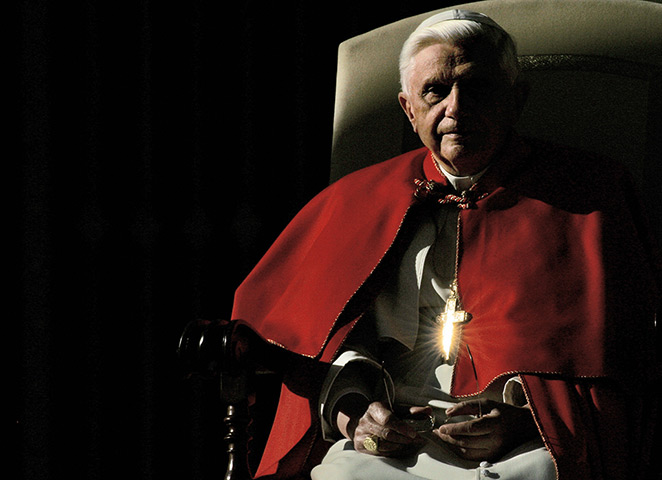
[John Allen, Jr., adds his own Q & A after today’s lengthy press briefing here.]
 The Ecumenism Blog