
Home » Posts tagged 'Rome' (Page 10)
Tag Archives: Rome
The Year of the Priest: Corresponsibility of Priests and Laity
The Lay Centre has three major aspects to its ministry of hospitality and formation. The first is the one most familiar to anyone reading my blog or following my studies, which is the community of students and scholars who live in the house of formation throughout the academic year (Oct-June) and who eat, pray and learn together in an ongoing dialogue of life. The second is the ongoing adult formation offered (mostly) to the English-speaking population of Rome. Theology, spirituality, church history, liturgy, art, and architecture offered by faculty of the pontifical universities and visiting scholars every Thursday morning as part of the Vincent Pallotti Institute.
The third piece of the mission is the summer seminars and retreats offered by the lay centre. During June, July, and September groups come in from around the world to spend a week in Rome. Some have their own agenda and primarily enjoy the hospitality of the Lay Centre, while others are sponsored by the Centre directly and open to anyone from around the world.
A few years ago I remember hearing about Rome’s first-ever symposium on Lay Ecclesial Ministry, and recall thinking to myself, “First? This has been going on 50 years and they are only now talking about it???” Little did I know. (One can hear about how slowly time moves in the Eternal City, but you really have to be there to appreciate it, soak it in, and start wondering what all the fuss was about back when you cared about things like deadlines, traffic laws, and absolute concepts of any kind…)
One of the programs offered this summer was the latest in the series touching on lay ecclesial ministry, but with a timely twist. In honor of the Year of the Priest, and timed to coincide with the closing festivities of the year, the theme was taken from Pope Benedict’s address to the annual convention of the diocese of Rome (given at St. John Lateran on May 26, 2009) and again later to the presbytery of Rome at the beginning of the year: “Corresponsibility of Priests and Laity”.
The unique opportunities for a program like this in Rome include access to so much of the Church’s history within walking distance, access to curia officials, access to representatives of the Church from all over the world, and of course the hospitality of the Lay Centre.
The program progressed through the centuries day by day, with an examination of key saints and their experience of “corresponsibility”. We studied St. Paul and his collaborators with Abbot Edmund Power of the Benedictine Abbey of St. Paul Outside the Walls – guardians of the tomb of the great missionary and co-patron of Rome. St. Justin Martyr, a layman, buried at St. Lawrence Outside the Walls. Pope St. Gregory the Great, with his oratory of St. Andrew is literally just over the wall from my Roman home. St. Vincent Pallotti was an early modern pioneer of lay formation.
Contemporary organizations and developments we looked at included the Emmanuel Community, Sant’Egidio, the Pontifical Council for the Laity, and the Union of the Catholic Apostolate. Presenters included Dr. Marian Diaz, Fr. William Henn of the Gregorian, Ms. Ana Crisitina Villa-Betancourt of the PCL, Fr. Jean Baptiste Edart of the Emmanuel Community, and John Breen of the Beda College in Rome. The participants were mostly students and (both lay and ordained) ministers from the U.S., but included one Dutch pastoral life director.
[Further Reflection to Follow]
Santa Sabina and the Aventine
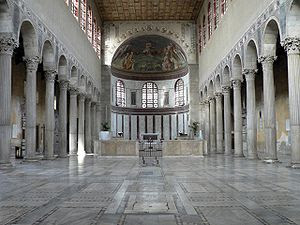
Santa Sabina, Interior
Santa Sabina is the 5th century basilica on the Aventine hill, just south and across the Tiber from the Vatican, that has served as the home of the General Curia (read, worldwide headquarters) for the Order of Preachers since not long after they were founded by St. Dominic in the early 13th century. In the midst of finals, one of my Dominican classmates, Benedict, offered to lead a small group of us through the basilica and adjacent buildings.
A half dozen of us gathered in the very rooms of the founder for mass, both of which were thankfully de-baroquified some years ago. This was another of those inspiring, unscripted days offered by life in Rome, when you can walk in the footsteps of saints and get a taste of the diachronic communion of the Church.
We wandered the hall where Thomas Aquinas slept, studied, and eventually composed at least part of the Summa and other works. The dining room remains the same one that fed the Great Ox. An incredible view of the city and St. Peter’s awaits on the north side. The basilica itself features some unique mosaics and even a stone that pious legend holds was thrown by Satan himself to distract Dominic from prayer. (Another, slightly more recent legend holds that if you touch the stone and it feels cold, you are in a state of mortal sin and must be confessed by a Dominican immediately. Conveniently, the stone is as black as obsidian and kept indoors year round.) Pius V was another resident of the convent, and is often the pope credited for “creating” the tradition of white as the papal color, by refusing to shed his Dominican habit for the then-normal scarlet after election. Whether accurate or not, it is true that Pius V should be well known for publishing the Roman Missal that was the norm for the celebration of the Eucharist throughout the Western church for four centuries – now known most commonly as the Tridentine Rite.
In the neighborhood we also stopped by the basilica of Sant’Alessio and the most famous keyhole in the world, at the headquarters of the Sovereign Military Order of Malta. There, standing in Italian soil, you can gaze through a garden belonging to the SMOM and see a perfectly framed view of the dome of St. Peter’s – three countries in one keyhole. Across the piazza sits the Anselmo, the Benedictine pontifical university that is the traditional center of liturgical education in the Church (outside of Notre Dame, of course!).

View through the keyhole at the Sovereign Military Order of Malta
Intercontinental Cross-Cultural Dialogue is…
… staying up until the early hours in a city that is nearly 2800 years old, talking of life, love and religion with friends from four continents. Feliz Cumpleaño, David!
Pentecost at the Pantheon
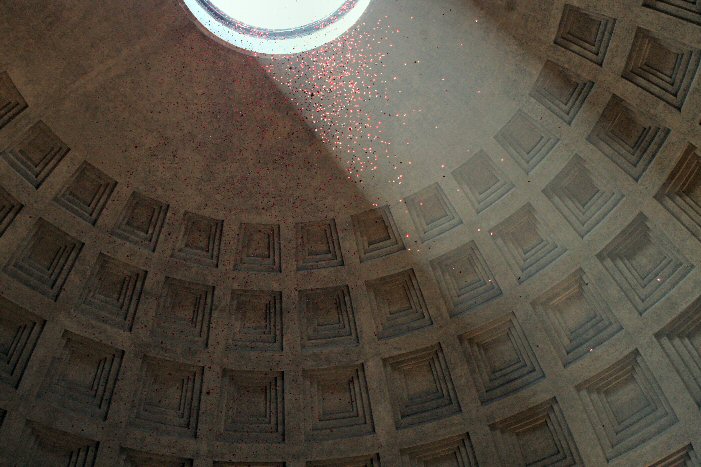
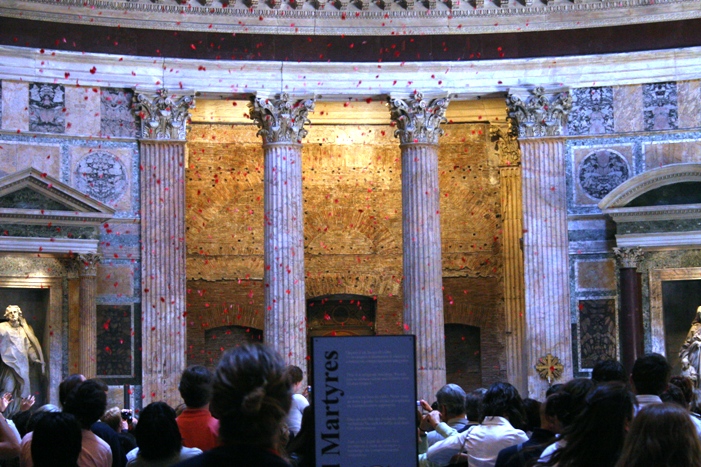
One of the sights to see in Rome is Pentecost at the Pantheon. Since my Jubilee pilgrimage to Rome, they have set up pews and dressed up the altar to bring further attention to the fact that this most-famous of pagan temples is also (since the 6th century) a consecrated church. For the feast of Pentecost, at the end of the liturgy Rome’s fire department drops thousands of red rose petals from the oculus to the floor below, an image of the Spirit appear like tongues of flame around the apostles gathered in the Upper Room. To add to the effect, the sun was clearly cutting through the coouds of incense smoke, and a white bird chose just that moment to fly in and start flying circles around the falling flowers. (One person in the assembly gasped, “look, a dove!” which would have been fitting, but it was just a seagull…)
The Dialogue of Life in Rome
A former student-resident of the Lay Centre returned this semester as a visiting professor at the Pontifical University Gregoriana (the Jesuit university down the road). Dr. Esra Göezler is a Turkish Muslim who had studied in Rome and returned to co-teach a course with Christian and Jewish scholars, and as a scholar-in-residence at the Lay Centre.
Near the end of the semester Esra sat in a panel presentation at the Lay Centre with a German Jesuit and an Italian Jewish reporter titled “Abrahamaic Religions in the Dialogue of Life in Rome” in which each participant shared their experience of living in the Eternal City in the daily life dialogue with the other Abrahamic faiths. The Lay Centre and PISAI – the Pontifical Institute for the Study of Arabic and Islam, another Jesuit faculty in the City – featured prominently in the discussion.
Over the next few days, Esra provided further opportunity for dialogue and encounter, as the Lay Centre hosted the (brand new) Turkish Ambassador to the Holy See, Professor Kenan Gürsoy and his wife for dinner on 25 May. The following evening Padre Miguel Ayuso-Guixot, director of PISAI presided at our final mass and community night of the academic year. We were honored by the presence and insights of all three distinguished guests by Esra’s initiative.
At around the same time we heard good news about our housemate, another extraordinary Muslim scholar, Rezart Beka of Albania. Rezart has been in Rome this year on scholarship from the Nostra Aetate Foundation, set up in 1990 by Pope John Paul II for non-Christians to study Christianity at the pontifical universities in Rome. Scholars usually stay for one semester, and Rezart was already granted an extension. Facing the possibility of losing him as a student next year as the scholarship came to an end, a donor has set up an entirely new scholarship for Muslims to study at PISAI and Rezart is the inaugural recipient!
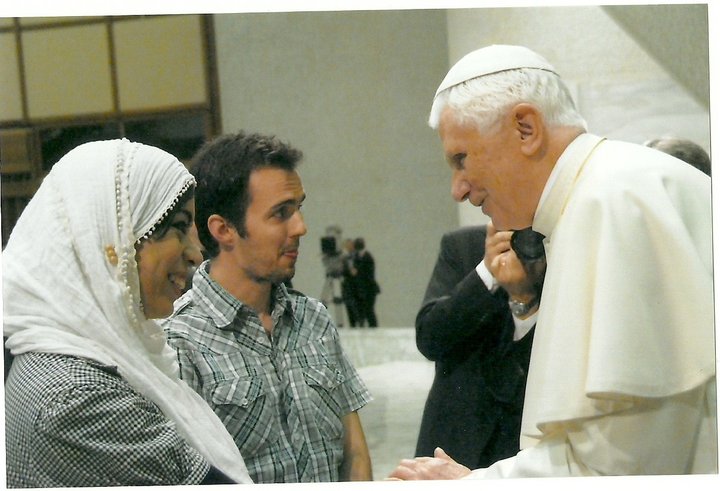
Lay Centre residents Nagwa Zarkaa Elymama (Egypt) and Rezart Beka (Albania) are presented to Pope Benedict XVI
Russian National Orchestra in the Vatican
How often is St. Peter’s Square turned into a parking lot? The cabbie that dropped us off said he has lived in Rome for half his life, and never seen it. But that was the sight that greeted us as we were dropped off at the Paul VI Auditorium for what promised to be an enjoyable afternoon out with the Holy Father (and a few other folk).
These two days have been celebrated as “Russian Culture Days at the Vatican”, one of the key public events of which was today’s concert by the Russian National Orchestra, a gift of the Russian Patriarch Kirill I to Latin Patriarch Benedict XVI.
Metropolitan Hilarion Alfeyev, the President of the Department for External Affairs of the Patriarch of Moscow (read: top ecumenist), personally presented the gift of the concert to His Holiness, which included a Symphony in Five Parts composed by the metropolitan himself. The concert included pieces by Rachmaninov, Rimski-Korsakov, and Musorgskij by the Russian National Orchestra; a variety of pieces by the Russian National Horn Choir, and another selection from Musorgskij and Rachmaninov with the Synod Choir of Moscow before all three combined for the final Symphony piece by Metropolitan Hilarion.
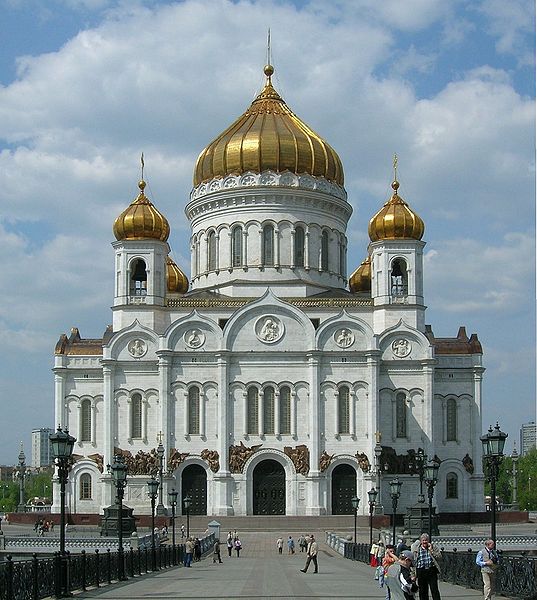
Cathedral of Christ the Savior, Seat of the Patriarch of Moscow and All Russia
On the way into the building, I kept getting saluted by the Swiss Guard. At first I kept looking to see if they were saluting everyone, or if some bishop was walking behind me. Eventually we figured that in my black suit with a small red Jerusalem cross in my lapel (a souvenir from my recent pilgrimage) they may have mistaken me for a Knight of the Holy Sepulcher! Not sure there are any this young, though!
As most know, I have an affinity for things Russian, including the music, so this was a special treat for me – to combine my love of Russia, ecumenism, the Church and the Vatican all into one event. We also got seats just behind and to the right of the Holy Father and the cardinals, which made it that much more exciting. This was my first time inside the Paul VI auditorium, which can seat about 6000 people, and which is entirely powered by solar panels on the roof.
There is no question that, with the election of Benedict XVI and even more so with the election of Kirill I, relations between Rome and Moscow have thawed considerably. We continue to pray for the unity of the world’s largest Orthodox Church and the Catholic Church, and look forward to fruits of dialogue even more beautiful than an afternoon’s concert!
Dinner and a movie – Cajun style!
The Drs. Diaz and family were back at the Lay Centre this evening. This time, the U.S. Ambassador to the Holy See, his wife (and fellow theologian) Marian, and two of their boys brought over a Cajun-themed dinner to help celebrate a culture night focusing on Lousiana. Apparently, culture and movie nights were a fairly common activity at Villa Richardson under Ambassador Mary Ann Glendon, and the Diaz family is looking to continue the custom at least occasionally in partnership with the Lay Centre (which Ambassador Diaz called the family’s second home in Rome this evening!).
The public affairs officer in the Embassy is J. Nathan Bland, a Lousiana native who shared a presentation about the people, faith, culture and cuisine of his home state. We were doubly honored by the presence of Nathan’s mother who was visiting Rome for the first time! Nathan shared his experience growing up as an African-American Catholic, a double minority in northern Louisiana, and his journey of discovery of black Catholic history and experience. The Ambassador then shared thoughts on his experience working with Latino and African-American Catholic theology.
The evening was capped with a viewing of Disney’s Princess and the Frog, notable as the first Disney feature film whose protagonist is an African-American, and is set in New Orleans.
I do not know the last time I have seen a room of 40 grown adults watching a Disney movie, but it was a sight to see! The food was good, too!

Disney's Princess and the Frog
Most popular sport in the world, except in the U.S.
There are 10 men living in the Lay Centre this semester, representing Albania, Chile, Greece, Italy, Mexico, Serbia, and the U.S. When i walked in to the student kitchen to make some tea, they were all there watching a soccer match… all, that is, except for the Americans. Eveline thought it would make a good picture, a glimpse of the “dialogue of sport”, if you will.
(Due to space constraints, Theodosius did not make the picture, along with Claudio’s head and half of Andrea. Note that the sole American in the room is behind the pillar making tea.)

Watching the Game: Andrea, Milvio, David, Dimitrios, Radmilo, Rezart, Claudio
View from the top
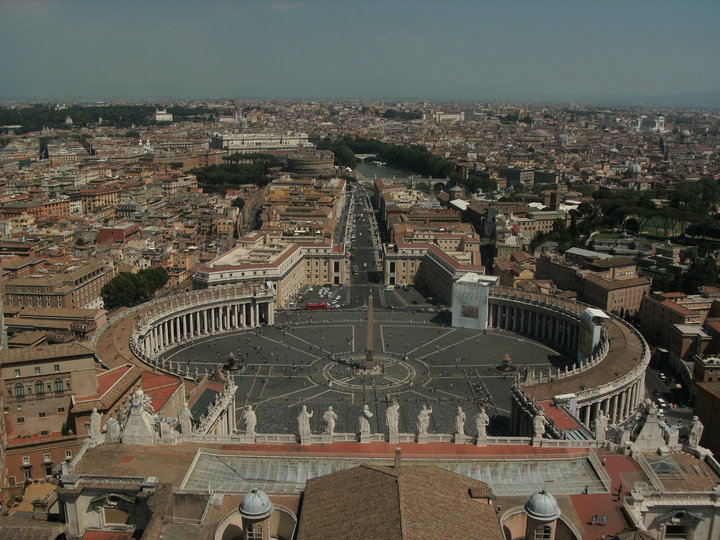
Piazza San Pietro and beyond, our view from the top of the dome
The last day of April was another beautiful sunny day, and the temperature crept toward 80° F (it was 26° C about mid-day): A perfect day to scale the cupola of St. Peter’s Basilica, the highest point in all of Rome. This was my first time to the top, having been to the depths of the Scavi two levels below the Basilica floor when Nancy was in town for Christmas break.
Few great days in Rome start without cappuccino, however, and we made our way to the Antico Caffé della Pace, just a little ways off of Piazza Navona, the quintessence of a Roman street café – shaded tables on a cobblestone pedestrian street in view of a large baroque church. A friend had advised you could get café at the table for the same price as at the bar, but I think the reality is that you get café at the bar for the same price as the table. But it would be worth it to camp out for a few hours and read or people-watch, as we did before heading across the Tiber.
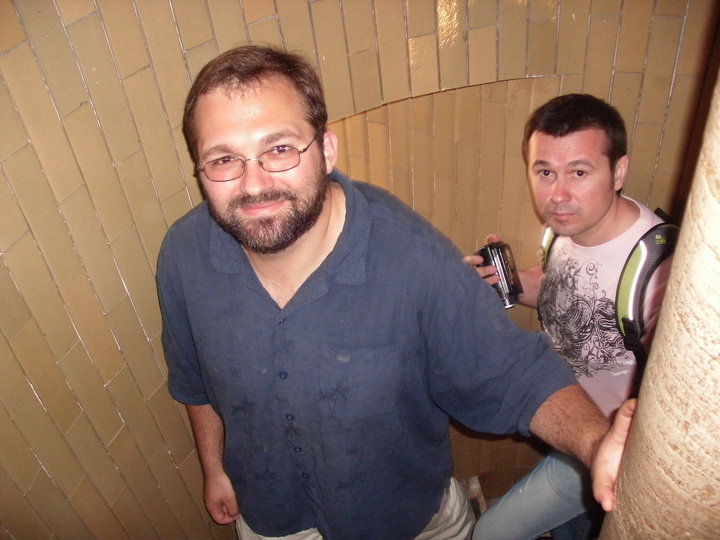
These are spacious compared to what comes next
Once at St. Peter’s, a short elevator ride takes you from the ground floor to the basilica roof, the level of the saints’ statues, for €7. It is not a bad view from this level, but with 323 steps to (almost) the top of the dome waiting, we decided to move on. We re-entered the basilica at this level – and thank God for the metal cage installed in addition to the railing! I have never been that fond of heights, but being inside a building this massive, this high up, was enough to remind me what vertigo feels like. Just a little.
Once you adjust to that, or at least confirm the solidity of the security cage, you can appreciate the mosaics up close and read the entire two-meter- tall inscription “Tv es Petrvs et svper hanc petram aedificabo ecclesiam meam. Tibi dabo claves regni caelorvm” (You are Peter and On this Rock i will build my church… I will give you the keys to heaven). Looking down, if you can handle it, giveds a bird’s eye view of Bernini’s baldachino (with ladder stored on top) and the ant-size people wandering the basilica floor – fifteen stories below.
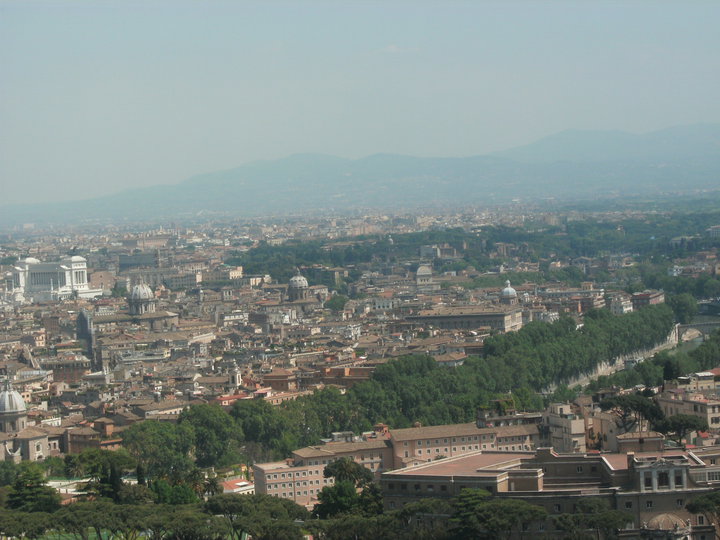
As viewed from the dome: See that green oasis in the middle? In the midst of that is our home at the Lay Centre.
Then we went up. A gently sloping ramp wide enough for four leads to some normal staircases, then a winding spiral staircase big enough for one (no railing) that ends just about the time you wonder whether it ever will. That brings you to the curving level of the cupola itself, and you can actually see the inward curve, which gets steeper until someone my size has to bend over and lean to the right to get through. One more spiral staircase built for people half my size with tiny feet, and we finally make it out to fresh air.
There really is nothing higher than St. Peter’s in Rome. Even the fabled hills of rome barely rate from this height, though we could see the Lay Centre and some of the other features of Rome – the Altar della Patria, the Pantheon roof, the towers of Santa Maria Maggiore, and a commanding view of the Piazza and Via della Conciliazione out to the Tiber. The viewing platform circles the entire base of the lantern at the top of the dome, so there is a good view of the Vatican Museums and gardens, the various buildings. You can see very well how small the world’s smallest sovereign state really is!
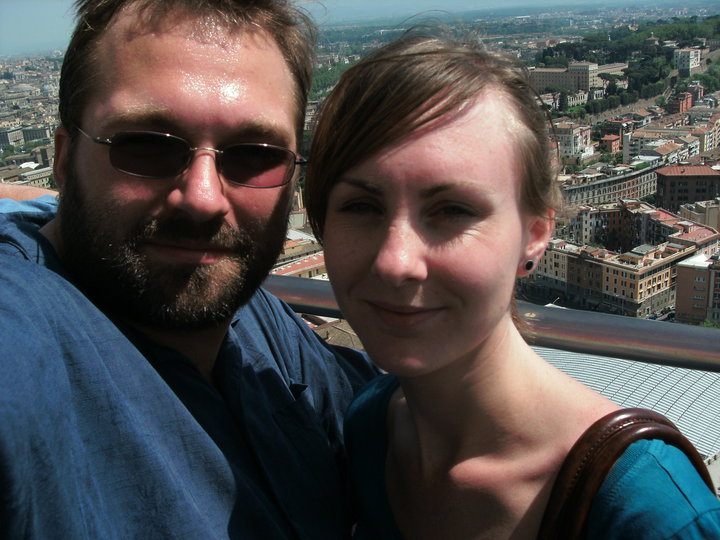
This Dutch diplomat and scholar consented to have her picture taken with me, the Eternal city in the background
While at the top we found a small office for a couple of the staff of the Fabric of St. Peter’s – responsible for the physical plant – who apparently spend the day in a tiny cubicle at the top of the dome minding the tourists. Nearby we could see through a locked gate the stairs to the very top of the lantern, the base of the cross. I do not think I will petition to get through there any time soon. We were already about 440’ up, I do not think another dozen would make much difference.
Going down is actually a little worse… those almost endless spiral steps can make you dizzy, but thankfully once you get back to the basilica roof, refreshment waits. Bathrooms, water, a gift shop and a café all operate on the roof of the world’s largest church to provide services for the stair-weary pilgrim. (To get a small taste of the small stairs, check out someone’s YouTube video)
Rounded out the day with a late lunch of Roman pizza by the slice then gelato from the Old Bridge Gellateria – famous for its generous portions and modest prices, and pretty decent quality, too – before heading back to the Lay Centre for dinner and some overdue blogging!
Dinner with our parish priest
The Lay Centre is located within the V prefecture (deanery) of the diocese of Rome. There are 8 parishes and 18 other churches that offer liturgies weekly, if not daily, making no less than 88 Sunday liturgies within a 20-minute walk of our front gate. The closest church may be the Trinitarian Church of San Tommaso in Formis where we celebrated our inaugural vespers a couple weeks ago, but the parish church is just a few yards further, the Basilica of Santa Maria in Domnica, also known as Santa Maria Navicella.
The pastor of the parish, and prefect of the V prefecture (the dean, or vicar forane), is Don Sergio Ghio, a presbyter of the Priestly Fraternity of St. Charles Borromeo and native of Milan.
[Interesting aside, as I was looking up how to spell Don Sergio’s last name on the diocesan webpage, I noticed that the diocesan pastoral council includes lay representatives of each prefecture/deanery, who are also listed on the site.]
It was our first opportunity to meet with Don Sergio, though most of us had been to the Navicella a couple of times at least, and some have made it their regular Sunday home. Instead of a more formal presentation, we opted for basic introductions and sharing. Father Ghio seemed either surprised or impressed with the international character of the community living just down the street. When Donna asked about what kind of relationship the parish and the Lay Centre could have, and what we could do for the parish, his response was basically this (in Italian):
“I will tell you what I told the Missionaries of Charity [whose Rome house is also in the parish] when they came and offered to help in the parish. Hopefully you will not be as scandalized as they were. I told them, ‘nothing’. There is nothing you should do for the parish. What is your charism, your vocation? Is it parish ministry? No… it is gift enough for the parish that you are here following your vocation. The question is, what can the parish do for you? So, I am telling you the same thing. If some of you get more involved individually, great, but the fact that you are living out your vocation [as lay pontifical students] is gift enough for the parish. What can the parish do for you?”
 The Ecumenism Blog