
Home » Posts tagged 'Lay Centre at Foyer Unitas' (Page 8)
Tag Archives: Lay Centre at Foyer Unitas
The Roman Classroom, or, Reflections on Methodology and Pedagogy in the Pontifical Roman Universities from an American Catholic Paradigm Typified by L’Universite de Notre Dame du Lac
What is it like studying in Rome? Are the courses challenging? Are the students on par with peers in the U.S.? Is the university academically rigorous? Are the faculty orthodox? How does it compare to [Notre Dame/Seattle University/Catholic University]?
These are the kinds of questions I have had from a number of friends and colleagues, and I thought I would address them together once I had had some time to get a sense of the pedagogy here.
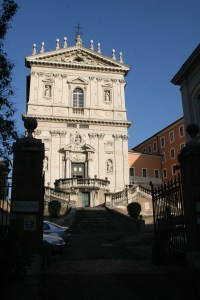
Church of Dominic and Sixtus at the Angelicum University
It is a different system, no question. The first thing to note is the nature of the university. The Universities are really just buildings with classrooms, and very minimal administrative staff. The entirety of the Angelicum – classrooms, offices, chapel, faculty residences, library and bookstore – is about the same size as Hunthausen Hall at SU, Caldwell at CUA, or O’Shaughnessy at ND. This is because the university really only offers the classes, mostly lectures and a small number of seminars. It is assumed that the bulk of your formation actually happens elsewhere, specifically, independent research, formation in community, and the experience of being in Rome.
My specialization does not even use the university library, for example. Instead, we have access to the Centro Pro Unione, run by the Society of the Atonement; that is our library. Sure, it is about a 25 minute walk from the Angelicum, but it’s a walk that passes by the Trevi fountain, the Pantheon, Piazza Navona and some of the most famous gellateria in the city, so one cannot complain. Moreover, there is a lot of time for research, so once I settle on an idea, I will not be bogged down by unwanted topics in order to pursue it.
The presumption of the university is that its students live in a house of formation, one of the “colleges” around Rome – and these are operated entirely separately from the universities. The problem is, of course, that only about 70% of students have access to one of these colleges as they are usually established either by national bishops’ conferences exclusively for priests and seminarians, or by religious communities for their own members. That leaves a significant number of students – deacons, lay ecclesial ministers, non-ecclesial lay students and non-Catholics – without an essential part of their education in Rome. The Lay Centre is the only such college trying to meet this need, and it is a private venture. It is also limited in space, with only room for about 20 residents out of the hundreds needing such a place. (Though get the impression the quality of life and of formation here exceeds what can be found in many of the national colleges for seminarians and priests!)
Further, I think the course load is intentionally light, though it does not appear this way at first. It is normal to be registered for about 8 or 9 courses a semester, one of which is a seminar. Whereas the typical 3-credit course in the States meets for 3 hours in two or three classes a week, here we get 90 minutes, once a week – about half as much time. The reading load is considerably less, too, if you just look at the syllabi. Two of my courses have only one required text of about 200 pages each, for the entire semester. The rest rely entirely on lecture notes. I have a total of 30 pages of writing due this semester, and most final exams are oral rather than written. (I am remembering my first semester sophomore year at ND, over 100 pages on 60 different topics, not counting finals!)
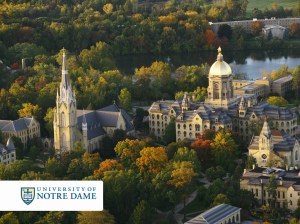
Sacred Heart Basilica and Main Building, University of Notre Dame
The difference between being located in South Bend, IN and in Roma cannot be overstated, though. It is easy to take on a thousand pages of reading a week at ND when there is nothing to do otherwise anyway. Here, if you want to learn about early Christianity or the history of the papacy, go for a walk. San Giovanni in Laterano is ten minutes from here. San Clemente is even closer. The Vatican is a few metro stops away. Just in the last week, we have had dinner with two of the three Catholic representatives on the reconciliation talks with the Lefebvrite schismatics (Archbishop Ladaria and Charles Morerod, OP). The week after the press release about the Anglican personal Ordinariates, we got to talk with two different members of the Pontifical Council for Christian Unity. Then, of course, the discussions had over dinner and caffé more than make up for the pedantic lecture style in some of the classrooms.
It is important to note the international character here too. Granted, ND and CUA were both pretty international, but I think this is the most mixed place I have ever been. I am frequently the only native English speaker in a class, or one of two. It seems to be a good representation of the Church in general: lots of representation from Africa, southeast Asia, India, and Eastern Europe. (Some from Latin and South America, but most of them seem to go to the Gregorianum rather than the Angelicum). This probably makes lecture rather than group discussion in class more feasible, and accounts for what seems like a slow pace.
Ius et Pax Romana
When the Compendium on the Social Doctrine of the Church was published in the year before Pope John Paul II died, some of those who most welcomed it also noted that it should have been affixed with the cautionary sticker, “for external use only!” – The Church has this great tradition, this profound gift, of Catholic Social Teaching to offer to the world, but how is it going about applying these principles to its internal life?
This and a variety of other questions were posed to Father Anthony after dinner and his introduction to the work of the Pontifical Council for Justice and Peace.
Our guest presider and speaker this evening was a presbyter of the diocese of Manchester, NH who has served the last four years with the PCJP, and four years previously as part of the Holy See’s delegation to the United Nations.
He was able to share a few personal observations of the new president of the Council, Cardinal Peter Turkson of Ghana, a “soft-spoken” and “highly intelligent” man who seemed to have hit it off well with the staff that he will lead in the coming years. The Cardinal has currently returned to his home diocese to set things in order before leaving for Rome.
The question of secularism and religion, democracy and Europe came into the conversation from questions, and allowed Fr. Frontiero to relate experiences from his days with at the U.N. and from his doctoral work. At a meeting in Warsaw on human rights, he was compelled to respond to the European Humanist Federation who, while at a meeting on tolerance and non-discrimination, suggested that religion and religious people have no role in public sphere, and no rights of protection against hate-speech:
Monsignor Anthony Frontiero, Pontifical Council for Justice and Peace
“Demonizing Christianity, or deliberately mocking and undermining central tenets of the Christian faith as a means to promoting the rights of other groups is a clear and flagrant contradiction to the religious freedom and mutual respect that all people should enjoy, not to mention the work of building a more just and peaceful community. Such practices and must be seen for what they are: a subversive attempt to dismantle the progress made thus far in the promotion of tolerance and non-discrimination.” (Monsignor Anthony R. Frontiero, representative of the Holy See, HDIM 2007, session 2)
We peppered him with questions about AIDS in Africa, about the Euro-centric focus of the “secular culture” and battle with modernism/relativism, about post-modernism, and the internal ecclesiological applications of the Church’s social principles. (Unfortunately, I forgot to ask: What’s the deal with the Church and unions? There is this historical symbiosis between the two on one hand, and an unspoken allergy to even asking if there could/should be unions of church ministers or other employees…)
To Father Anthony’s credit, he gave honest answers to all questions, including the challenges of reception of the Church’s teaching within her own life – a situation as familiar to ecumenists as to peace and justice advocates, and probably, every office in the Roman curia!
Hallowe’en in Rome, St. Paul Outside the Walls, and All Saints
I nearly forgot it was Halloween yesterday without all the candy and pumpkins in the stores; barely any orange or brown to be found in the city.
Apparently, it has not been a big holiday for Romans, or Italians in general. The big costume holidays are Epiphany, where they tend to dress up as La Befana, a gift-delivering witch who visits on January 6, and Carneval.
A small group of us went out for an evening passagata around the Pantheon and Piazza Navona, stopping for gelato en route, and finishing with a nice bottle of wine at a little wine bar/café. We saw a few Befana hats out early, but really it was only as we were heading home for the night, about midnight, that we saw more people in costume.
For the morning of All Saints, I opted for the Basilica San Paolo fuori la mura (St. Paul Outside the Walls). Rezart, one of my Muslim housemates, is working on a paper about the Eucharist, and he decided to join me so he could compare his first mass experience from Wednesday night here in the Lay Centre to a more formal experience at the Basilica. An added bonus is that Abbot Edmund was presiding at both liturgies, so the difference in personal presider styles could be taken out of the equation. Matthew joined us on location, in exchange for a visit to his parish next week, to which I am looking forward.
St. Paul’s is the huge basilica built over the tomb of St. Paul, outside the old city walls (hence the name), one of the four major basilicas. Until the new St. Peter’s was built (1506-1625), St. Paul’s was the largest church in the world. Along the walls are the images of the bishops of Rome going back to Peter – the source for those posters one finds all over the place.
St. Paul’s has also become significant in Rome’s ecumenical efforts, including being the location of the culminating liturgy for the Week of Prayer for Christian Unity each year. In fact, it was from the steps of St. Paul’s that John XIII announced Vatican II at the end of the celebration for Christian Unity 50 years ago.
Afterwards, Abbot Edmund was generous enough to meet with Rezart and me to answer questions and show us around a little. It is a gift to share the liturgy with someone experiencing it for the first time, especially someone so interested in learning about our worship. The questions remind us of the theology and symbolism we take for granted, and push for better understanding of what we might do out of habit. His first question was like this, he wanted to know why, if the Eucharist itself was a sacrifice made for the forgiveness of sins, why we had a penitential rite just a little while before celebrating the once-and-for-all penitential act! From there we ventured into the symbolism of serving only one species or both, the meaning of incense, and expansion from the homily and so on. It was a blessing for me to just listen!
After returning to the Lay Centre for lunch and a little homework, we ventured out again to All Saints Anglican, to celebrate their patronal feast, and to cheer on Stian who had his acolyting debut. Nine of us in total joined the small English community fro Evensong, then ventured to a pizzeria founded in 1753 (according to the waitress’ t-shirt anyway) and located just down the road, near San Clemente. Donna assured us in advance it was the best pizza in Rome, and we were not disappointed!
Ladri di biciclette
There are bicycle thieves in Rome. Sixty years ago, one of the great classic movies of Italian cinema said it was so. But unfortunately the descendents of these ladri di biciclette live on.
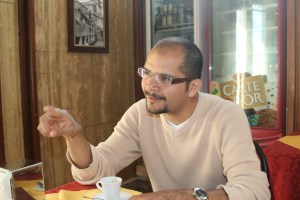
David Garnica, MD; Lay Centre Resident
My housemate, David, is from Mexico. He has already got an M.D., and is here to do a degree in theology, but because his medical background lacks the basic philosophical underpinning required to study theology in the Roman system, his university has him starting all over at the beginning – baccalaureate, year one. (David’s own philosophical grounding probably surpasses the STB program here, however!) In other words, he is going to be here for a while. So his decision to invest in a durable, quality bicycle (€150) while at the Porta Portese market on our second weekend in Rome was a bit of an investment, but for three years it is a lot cheaper than riding the metro or bus every day.
Apparently, Rome’s bicycle-thieving crime syndicate thought so too. Only four days after the classes began, someone took a little too much notice of David’s bike, locked up in front of the Gregorianum. (There are no bike racks here, so everyone locks their bikes to the chains protecting the piazza from the omnipresent motorini and smart cars).
As it happened, David saw the thieves in action and gave a chase worthy of a classic adventure film. Coming down the stairs between classes, he glanced out a window in the direction fo the bikes and saw a few people gathered around his bicycle, paying a little too much attention, so he headed for the door. As he came out the entrance, he saw the lock on the ground – cut by bolt cutters – and one of the ragazzi riding off with his bike in the direction of Piazza Venezia.
David dropped his bag, books, and laptop and sped off in hot pursuit. Somehow hailing a Roman motorist sympathetic to the victim of a dishonorable theft, David jumped on the back of the citizen’s motorini, and together they continued the chase through the narrow streets of Rome.
Despite this valiant effort, though, the thief got away. Thankfully, another student saw the chase and was watching over David’s computer and backpack, or it would have been a total loss.
Remember this was only about 10 days or a couple weeks into our stay together at the Lay Centre; David was a little reticent to share the tale at first, but we are grateful he did – it gave the community an opportunity to show him what community is really about. Last Sunday, we were able to present him with a new bike – and a tougher lock – all organized by students in the house almost from the day we heard about the theft (thanks to Dimitrios for organizing!).
David’s response is worth sharing:
I am so many others. JB What a joyful surprise! I know that my first reaction was just to babble,– I was overwhelmed and felt a little bit shy and silly… therefore I now want to give my “acuse de recibo” I want to share with you what you have done and just how much this means to me, I want to thank you for it – it has made my heart thud – this sign of your friendship, in which is revealed the face of the good God; thank you – all of you – for being a spark (scintilla) with your smiles and your deep tenderness… Not only a coin I have found, a fiets, but also something even better. Thanks and rejoice with me!
The birds
One more than one occasion, I have been reminded of Alfred Hitchcock’s movie. There are no phone booths in Rome anymore, though, so it seems I’m safe for a while yet.
First, there are peacocks on the grounds, five or six, including an albino. Then there’s a flock of some kind of parakeet, about eighteen or twenty.
Monday, as I was exploring the Basilica Santa Prassede with a couple friends, we were flocked by pigeons on the piazza Maria Maggiore nearby (though, these were aided by a grizzled gypsy throwing seeds). Then, yesterday, as i was sitting on the terrace, reading about reception, i was listening to what sounded like a small army of birds in a nearby umbrella pine. Then, as though on cue, they went silent. A moment later the began leaving the tree, perhaps a couple hundred, headed in the general direction of the Vittorio Emmanuele monument. I could see three other flocks of about the same size from different origins headed in the same direction. Then, i looked west.
It took a moment to realize what i was seeing, because they were just on the edge of sight in the fading light of the setting sun -Thousands, probably tens of thousands of these birds. The flock covered the entire western horizon in a 120 degree arc; it had to have been more than a mile long. I’ve never seen anything like it. And they were all moving in the same direction. Somewhere between Pizza Venezia and San Pietro, they began to coalesce and dance – for lack of a better term. Like a swarm, they moved in and out, coalescing and separating, sometimes translucent in the colors of the setting sun. Absolutely breathtaking.
And my camera’s batteries were dead.
On monkishness
“Two monks were walking along in the woods one day, some time ago. As they approached a stream swollen with spring rains, they came across a woman clearly wanting to cross, but afraid to do so because of the strength of the flooded river.
“According to the rule of the order, these monks were prohibited from speaking to women – and certainly from touching a woman. After a brief pause, one monk looked at the other and said, “Ah well”. He then asked the woman if she needed assistance across the river. She eagerly accepted, and he carried her across, with his brother monk following behind. On the other bank, the first monk let the woman down, and she went on her way, in a different direction than the two brothers.
“The monks travelled on in silence for about half an hour. Suddenly, the second monk whipped around to face the first: ‘How could you?! You know the rule! You should not have spoken to that woman, and yet you even picked her up! What were you thinking?’
“’It is true’, replied the first monk, ‘In helping her cross the stream, I carried her for four minutes. But, Brother, you have been carrying her ever since.’”
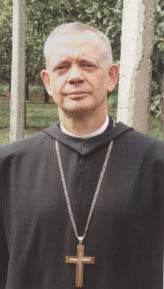
Rt. Rev. Edmund Power, O.S.B., Abbot of St. Paul Outside the Walls
The guest presider and speaker for our community evening tonight was the Right Reverend Edmund Power, Abbot of the Benedictine Abbey at the Major Basilica of St. Paul Outside the Walls. And it was with this story that he opened a discussion on what it means to be a monk.
A monk is a man (as a nun is a woman) who stands in the night with arms outstretched waiting for the dawn – and of course the dawn in Christ. Unlike some of these “modern” orders – like the Franciscans (founded c. 1210) or the Jesuits (founded c.1534) the primary charism of a monastic order like the Order of Saint Benedict (founded c.529) is not a particular work or ministry, but the interior life of prayer and purification of the soul.
This is not to label one order as contemplative, so as to insist that others are not, or to suggest that activity is not involved in the life of a monastic. For of course, monks need work to support their life, but each monastery does whatever work is suitable to it – some farm, others make wine or chocolates, and the Abbey of St. Paul Outside the Walls serves the needs of the Basilica, mostly the pastoral and practical needs of pilgrims.
Each of the major basilicas has a Cardinal Archpriest who is, at least nominally, responsible to be patron of the basilica and an advocate for its upkeep and other needs. The most (in)famous is of course the Cardinal Archpriest of St. Mary Major, Bernard Law.
What was news to me is that until four years ago, St. Paul Outside the Walls did not have a Cardinal Archpriest. The reason being that, historically, the archpriest position was created only after the religious order at each basilica closed or withdrew from service, the last being St. John Lateran several hundred years ago.
During that time, there has remained a Benedictine abbey at St. Paul outside the Walls, and the Abbot has been the equivalent of the Archpriest. With the election of Pope Benedict, however, an archpriest has also been named to St. Paul. (It was the first cardinal archpriest who commissioned the minor excavations that were announced at the close of the Pauline year this summer confirming the presence of first-century remains in the sarcophagus believed to be St. Paul.
And speaking of sarcophagi, as one is wont to do, did you know that the most beautiful of those found underneath St. Paul, the famous Dogmatic Sarcophagus was, ah, “borrowed” in the 19th century? Yes indeed. By Pope Pius IX, for display at the Vatican Museum…
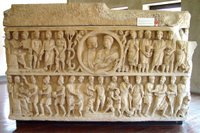
Dogmatic Sarcophagus, 4th century, first known artistic depiction of the Trinity
Welcome home, Kassim!
For the last two weeks, one of our residents has been in the hospital, including a significant amount of that time in quarantine. Tonight, we were able to welcome Kassim Abdallah Bawah back ‘home’!
Not that this could have been known two weeks ago, but apparently this all started in 1989. Kassim began experiencing symptoms then that local medical authorities in Ghana attributed to allergies or some form of asthma or bronchitis. Then, about six years ago, the symptoms became more severe, and he was given medications to suppress the symptoms of bronchitis. But, apparently that’s all it was doing, was suppressing symptoms. A few days into his stay in Rome, after a couple days of extended walking in the late, humid Roman summer, his symptoms came back with a vengeance.
When our local doctor came by he suggested antibiotics, but after a day of no effect, Kassim and our resident nurse, Ann, began to suspect Malaria. With that in mind, the doctor recommended checking into the National Hospital for Tropical and Infectious Diseases out in Trastevere. What follows is clear evidence that we are not in the U.S.!
When Donna took Kassim to the hospital, she was prepared for the typical Italian experience, would not necessarily be an improvement over staying home with a doctor and a nurse in the house. When they arrived, they found a very quiet, locked waiting room. On ringing the buzzer, a gruff Italian voice asked, “Who is it?”
“I am here with a sick person”, Donna replied, and the door opened. No other patients were waiting in the emergency room, but a doctor met them immediately, gave Kassim an initial exam and asked some questions. After 15 minutes or so, he announced, “If we have a bed, we will admit him”. Twenty minutes later, Kassim was admitted. Aside from showing his passport, there were no questions about residency, legal status, insurance or ability to pay. For the first couple of days, Kassim was visited by almost a dozen different doctors, and had regular conversation with the nurses, orderlies and other staff, where language was not a barrier. He was given a private room with a private bathroom, tv, and outside view. Several of us from the Lay Centre were able to visit on his third or fourth day. They began testing for everything – TB, HIV, HepB, etc. Then one day, they locked his door, and no one would enter without full surgical protection. Apparently, his chest X-Ray showed what was either Tuberculosis, or advanced chronic pneumonia. As it turns out it was the later, and it has been slowly killing him for the last six years at least (probably an aggravation of whatever started 20 years ago).
After treating the pneumonia and waiting to be sure it was fully taken care of, they released Kassim to Donna’s care yesterday, with the admonition to spend the next week resting, and to check in with the local doctor at the end of the week. Otherwise, he is healthy, indeed for the first time in two decades.
There was no bill.
A dialogue of hospitality
We had a few guests for dinner at the Lay Centre tonight.
That would be the “necessary but insufficient” description. Allow me to elaborate.
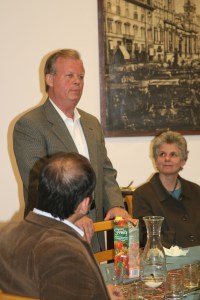
Ambassador Tony Hall
Former U.S. Special Representative to the U.N. agencies in Rome (and former U.S. Representative), Ambassador Tony Hall, his wife Janet, their daughter Jyl and her husband Ryan joined us for dinner. Apparently during their years in Rome, Mrs. Hall was a regular participant of the Centre’s ongoing formation program, the Vincent Pallotti Institute, and she and Ambassador Hall became regular guests and friends of the Lay Centre.
Now back home in the States, they were in Rome for a few days and were able to stop by to see the new location and meet the new members of the community. Ambassador Hall shared with us some reflections on his dedication to eradicate hunger and malnutrition in our world, and gave witness to the fact that it was his faith in Christ, and the conviction of the Gospel, that moved him to spend so much of his life in service to those most in need.
Jyl and Ryan – who, as it turns out, is a native of Bellingham, WA –came across the Adriatic from Macedonia where they are involved in a ministry sponsored by Faith and Learning International. Between sports and art, they are reaching hundreds of youth in the context of a broader outreach in the Balkans. You can read their blog here: http://prayforryanandjyl.blogspot.com/

Daniel Roberts, Dr. Adam Afterman, AJ, Naomi Shank
We were also honored to have Ms. Naomi Shank, director of the Russell Berrie Fellowship program, Mr. Daniel Roberts, director of the Institute for International Education’s Europe Office (IIE), and Dr. Adam Afterman of Hebrew University and the Shalom Hartman Institute in Jerusalem. As you know, my studies at the Angelicum are being funded by one of the Russell Berrie Fellowships, which is coordinated through the IIE, and a part of our fellowship is a seminar in the Holy Land coordinated by Dr. Afterman and the Hartman Institute, so it was a particularly welcome opportunity for me to put faces with the names of those responsible for my grant.
Finally, complete with Caribinieri escort, the newly appointed U.S. Special Representative to the U.N. agencies in Rome, Ambassador Ertharin Cousin, joined us just as Ambassador Hall was beginning his after dinner remarks. Having just arrived to her post the same day I arrived in Rome, not quite two weeks ago, that she was willing to find time to join us was indicative both to the Ambassadors own commitment to interfaith and inter-cultural dialogue and reconciliation, and to the value of the Lay Centre in the life of Rome as a place where the dialogues of life, charity, and hospitality coincide with the dialogue of truth.

Ambassador Ertharin Cousin
For those who do not know – and I certainly did not – the U.S. mission to the U.N. Agencies in Rome is our relationship with the U.N. Agencies for Food and Agriculture, including the Food and Agriculture Organization, the World Food Program and the International Fund for Agricultural Development. It is also responsible for overseeing U.S. participation in the International Development Law Organization, the International Institute for the Unification of Private Law, and the International Center for the Study and Preservation of Cultural Property.
Buongiorno, Princepessa…
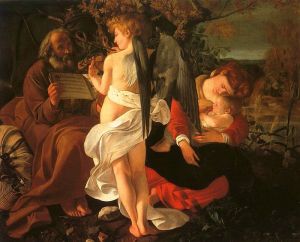
Caravaggio's Rest During the Flight to Egypt
The Galleria Doria Pamphilj is housed in one of the palaces of the Doria Pamphilj family, and just a couple short blocks from the Pantheon, on the Via del Corso in the heart of Rome. Not to be confused with their other Palazzo Pamphilj, which takes up half of the western end of the Piazza Navona, and is now the Brazilian Embassy. Nor the giant Villa Doria Pamphilj not far to the south of the Vatican, in Trastevere, which is second only to the Villa Borghese in size. of course, all this gives you a sense of the scope of wealth and power wielded by this Roman aristocratic family in the last millennium and more. The beauty of the art inside is an even grander testament to a family that has included popes and princes of Rome, and which, according to Roman legend, is descended from the poet Virgil, no less.
And what better way to tour such a place than with Princepessa Gesine and her husband Don Massimiliano?
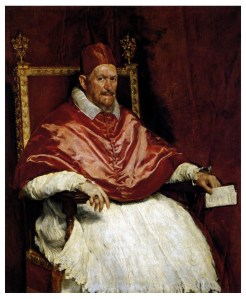
Diego Vasquez' Innocent X
Don Massimiliano, who is a Deacon in one of Rome’s suburbicarian Sees, led the tour of the estate, pointing out several of the more well known artists and pieces. There is, for example, Caravaggio’s last work with any kind of landscape, Rest During the Flight to Egypt, or the famous Portrait of Pope Innocent X by Diego Rodriguez de Silva y Velázquez (upon seeing it, the pope is said to have exclaimed, “It’s too real!”). You can see some of the pieces at the website.
We went through the family chapel, complete with an extensive reliquary and a semi-secret passage to a private observation booth in the adjacent Church where the noble family could observe the elevation of the host without mingling with the masses. Pun intended.
After the tour, the princepessa and her husband provided welcome hospitality in the family room – complete with antique furniture, marble fireplace, and genuine oil-on-canvass portraits of Donna Gesine’s family going back three generations! We have invited them to the Lay Centre to return the favor, and though we have some decent art – including an original sketch of the Council Fathers at Vatican II – ours is a humble abode by comparison!
Ahhh, Bella Roma!
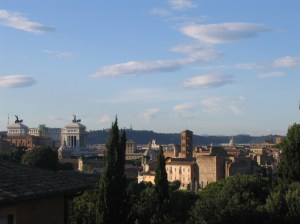
View from my room: Vittorio Emmanuele monument and Roman Forum
I am in Rome. After a flight cancellation, delayed luggage, and a fairly typical (read: nail-biting) taxi ride from Fiumincino airport to my new residence, I arrived at the Lay Centre at Foyer Unitas at about 1700 (5pm for us non-Europeans), just over 24 hours after Nancy dropped me off at SeaTac. Just in time for a brief tour, a moment to admire the view from my room, and a short nap before venturing to the nearby church of Santa Maria in Domenica for Mass and then dinner with the other residents.
With this blog I hope to regularly update family, friends, and insomniac internet wanderers as to my life in the Eternal City, as well as to provide reflections on the courses, research and other theological or ecclesiastical goings on. My intent is to save your inboxes but keep in touch, and to provide either catechesis or opportunity for theological discussion, depending on the reader. Please feel free to respond publicly or privately! I’m looking forward to a view of the church from Rome, though I have a long way to go on my Italian before it becomes unfiltered!
Some initial observations:
Technology: I am seriously considering investing in trans-Atlantic homing pigeons and a stock of quill pens. Our wireless connection at the residence has only worked for a few hours a couple of times over the last week and a half, apparently because of some issue with the electricity – twice the routers have been fried by the electrical system in the monastery! Likewise, the wireless at the Angelicum University has not been connected to the internet any time I have tried it, but I was able to ‘borrow’ a cable from a physics conference on campus last week. Not that it mattered too much, as my laptop crashed literally the first time I turned it on in Rome. Thankfully my files were backed up, but I left some important software backups at home, like my Italian lessons from Rosetta Stone…
Liturgy: My first Sunday Eucharist was the Pontifical Mass at St. Peter’s Basilica for the opening of the Synod of Bishops for Africa. If you’ve been there, you know San Pietro is “in the round”, albeit in a cruciform shape, with the altar in the center – much like St. Brendan’s in Bothell. And, like St Brendan, the presider (in this case the Holy Father) was able to celebrate both ad orientem and versus populum, simultaneously. That is, to face east, one must also face the largest section of the assembly in the long nave adjacent to the piazza. Communion was taken in the hand, along the center aisle, with the Eucharistic ministers moving back and forth between about five or six rows. The cup was not offered, and we stood during the Eucharistic prayer. The mass parts were in Latin, given the international character of the liturgy, but readings in English and Portuguese, with prayers in the languages of Africa, from Ge’ez and Arabic to Swahili and French. Most other liturgy has been in the community; more on that momentarily.
Diet, Exercise, and Environment: The university is just about a 35 minute walk from our residence, and the Centro Pro Unione (Center for Union), which serves as the library for my department, is another 30 minute walk beyond that. Though, as I walk around in my shorts and shirtsleeves sweating enough to flood the colloseo, I no doubt stand out like a sore thumb, as the Romans are all dressed in black, some wearing coats already, all in long pants, and never seem to break a sweat. It must be 75 and its very humid, but apparently it’s a big relief from summer! As for food, I have never eaten so well in my life! After just a few days, I actually feel healthier. Even the cappuccino seems fresher, smaller, and less addictive.
I also really appreciate the pausa – or siesta – the break from about 12:30-3:30pm which is especially necessary on hot days. You just cannot get anything done in the heat, so why not nap, and save your energy for the more active evening time? So classes are held 830-12:30, then 3:30-7:30, and many businesses are on similar hours.
To orient yourself to my daily route, look at a map of Rome (google maps is good), start just south of the Colloseo at the monastery of Sts. John and Paul (on the site of the Temple of Claudius), follow Via Claudia north along the east side of the colloseo, then along the Via dei Fori Imperiali past the Foro Romano and the Foro Augusto to the Monument for Vittorio Emmanuele II. Turn right at Trajan’s Column, up the stairs to the church of Santi Domenico e Sisto – that’s the Angelicum “campus”. From there to the Centro Pro Unione, head back west and somewhat north to the Piazza Navona, passing the Church of the Gesù, Santa Maria sopra Minerva, and the Pantheon if you like. Just behind the Palace Pamphilj, the Society of the Atonement has their headquarters and the Centro. Rest assured, I have already been shown the famous Gellateria La Palma nearby!
Community: I am staying at the Lay Centre at Foyer Unitas, which has an interesting history. Foyer Unitas was originally founded in 1962 by a small Dutch religious order of women known as the Ladies of Bethany as a house of hospitality for any non-Catholic in Rome, just off the Piazza Navona in the same building as the Centro Pro Unione. The Lay Centre is the brainchild of Dr. Donna Orsuto and Riekie van Velzen, who had been connected to the Foyer Unitas, as a college for those of us coming to Rome who did not quite fit in to the ecclesiastical residences. The NAC, for example, houses only seminarians and priests, leaving religious to live with their orders, deacons and lay ecclesial ministers, along with other lay students, to fend for themselves. Founded in 1986, it was housed first at Foyer Unitas (hence the name) and then in the English College, the Irish College, and now at the Passionist Monastery of Sts. John and Paul.
We are 21 residents this year, from Albania, Canada, Germany, Greece, Ghana, Italy, Mexico, the Netherlands, New Zealand, Norway, Serbia, Turkey, and the U.S. Three Muslims, three Eastern Orthodox, an Anglican, and the rest of us are Catholic. We have a medical doctor, a lawyer, and a nurse all studying for new vocations. Breakfast and lunch are self serve during the week, with dinner at 7:45 followed by Compline (night prayer). Wednesdays are our community nights, with mass at 7:00pm followed by dinner and usually a presentation. During our first several days, we’ve had brief presentations during dinner each night, and a day of reflection on Sunday. We’ve already had some orientation to community life from a Jesuit, a Benedictine, an Augustinian, and a Marist, in addition to our director (Donna Orsuto) and assistant (Robert White).
The location is a profound blessing. We are in the historical center or Rome, within the Aurelian walls, but with large enough private gardens that we are removed from the street noise – something unheard of almost anywhere else in the city. We sit on top of one of the famous Seven Hills of Rome, Monte Celio, and my bedroom window looks right down on the Foro Romano, the Colloseum, and the Capitoline Hill with the Monument for Vittorio Emanuele. From our patio ledge, we can see the dome of San Pietro.
 The Ecumenism Blog