
Home » Posts tagged 'Lay Centre at Foyer Unitas' (Page 6)
Tag Archives: Lay Centre at Foyer Unitas
Christmas Day at the Lay Centre
We slept. Instead of venturing back to Piazza San Pietro, we decided to sleep in and watch the Urbi et Orbi on TV – a better view, and with no public transit running, we would have spent half a day just getting there and back.
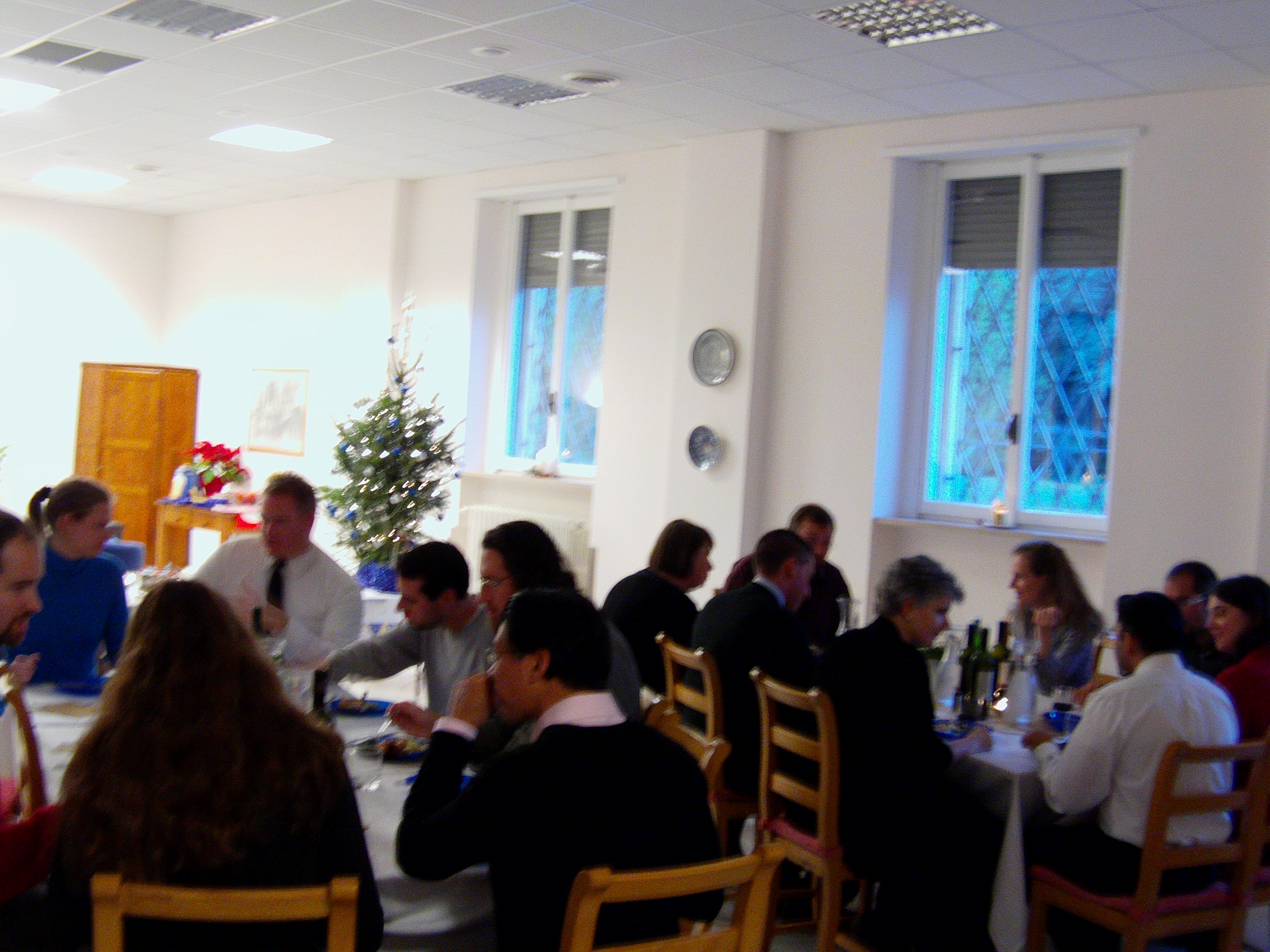
Christmas dinner
In the afternoon, the seven of us staying at the Lay Centre were joined by twice as many guests for a Christmas dinner prepared by Donna with a little help from Nancy and me. As with Thanksgiving, it was nice to offer hospitality to friends and colleagues here in Rome, separated from home and family. We entertained guests from the U.S. and U.K., Ukraine, Uzbekistan, and a few countries that do not start with the letter “U”.

Colosseum "crown of light"
David had spent a day or two preparing a piñata, a custom which only three or four of us were familiar with, and he and I got to torment the blindfolded volunteers with our maneuverings. The measures of success for a piñata: several people tried (and failed), lots of laughter, and lots of candy!
As we were getting ready to head back in for dessert, the Colosseum lit up the sky with a “crown of light” in honor of the coming of the Christ-light into the world. Not as busy as yesterday, but a welcome celebration!
Nativity of the Lord: Christmas Mass at Midnight
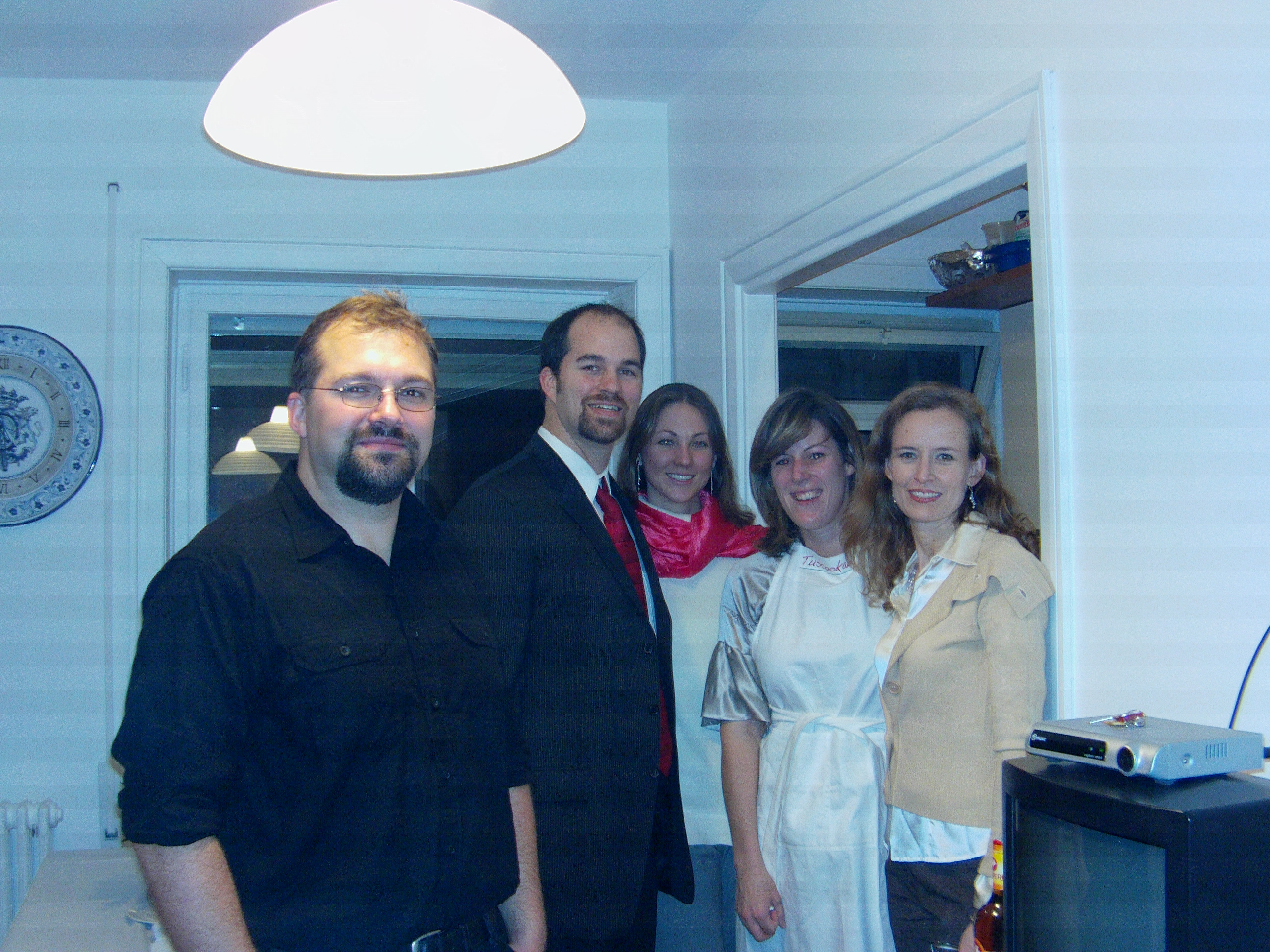
Preparing for Jill's Feast: AJ, Greg, Karina, Jill, Natalie
Nancy and I, and a small group from the Lay Centre started Christmas Eve with a traditional Italian dinner hosted by Jill, another Domer I discovered at the Angelicum. It was incredible! Antipasti and prosecco to start the night off, followed by soup, pasta, fish… and each prepared and served in proper order, it was almost a pity we had to leave for the mass! Seriously, aside from theology, ministry, and guiding tours of Rome she could open her own trattoria. Not only was it all delicious, it was presented so beautifully, it really made a special evening even more delightful.
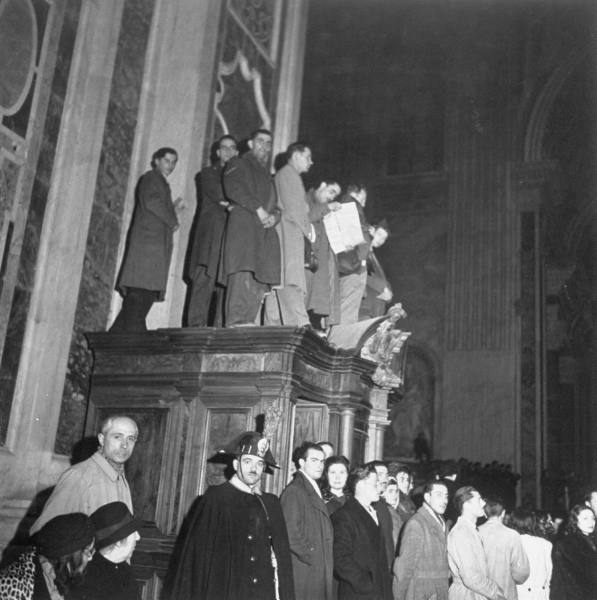
Standing on the confessionals at St. Peter's, Midnight Mass 1944
It is from Jill that I learned that Midnight Mass at St. Peter’s is actually a relatively new phenomenon. Until 1944, the last time the bishop of Rome had celebrated Christmas midnight mass at St. Peter’s is believed to be for the coronation of Charlemagne as Holy Roman Emperor in 800 AD. Otherwise, the traditional location in Rome had been Santa Maria Maggiore – which makes a lot more sense given the indispensible role Mary played in the Nativity, and the location there of the relics of the Nativity including what was believed to be the manger in which the Christ child was laid. Since Pius XII’s celebration just after the liberation of Italy during WWII, the popes have celebrated midnight mass at St. Peter’s; but the Romans still go to Mary Major while the Americans and other pilgrims go pray with the pope – though we were not standing on the confessionals this time.

The line begins outside the Basilica of St. Peter
Jill’s place being mere minutes from Piazza San Pietro, we took some liberty with our arrival time. For the first time, what has traditionally been a Midnight Mass was moved up to 10:00pm so we were advised to arrive three hours early – we got there at 7:30 and got into a line that already wrapped around the entire Piazza and had started doubling up on itself. Waiting just ahead of us in line was an American, a theatre professor from Miami, who was hoping against hope to find a ticket to get into the papal mass. (His name is James Brown. No, really – you can look him up.) As it happens, I had had a friend arrange to get four tickets for us before we knew we would be getting enough through the Lay Centre, so Natalie had borrowed three for friends, and there was just one left over – the Spirit works in small ways too! Unfortunately, we lost Jim in the mass crush when our part of the line finally got inside the Basilica, but in a couple hours of waiting in line at least got to make a new friend.
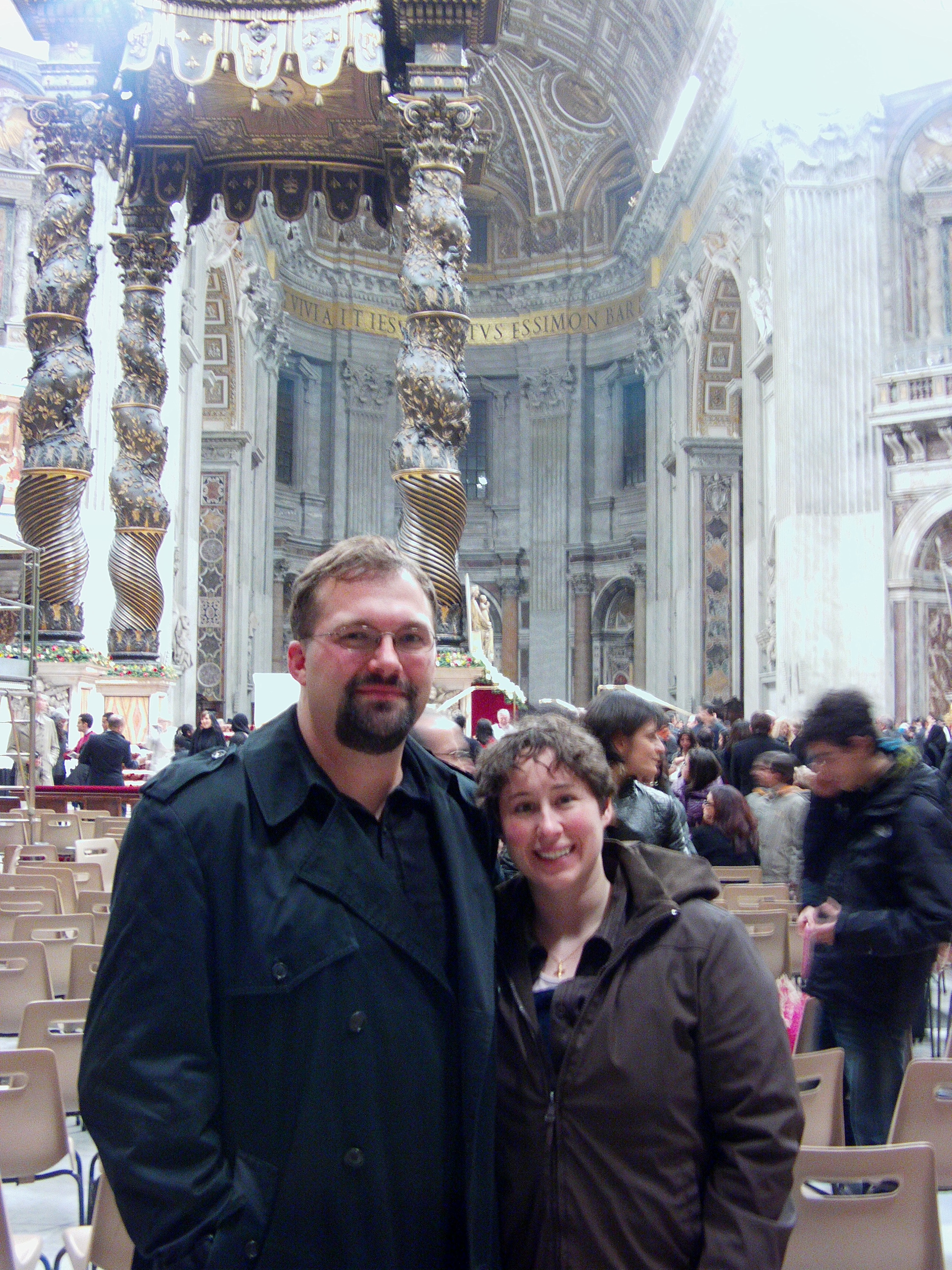
View from our seats, taken after the liturgy
Once inside, we found the massive line had filled the seats in the nave and it looked as if we might have to stand – until they opened the transepts. We got the leftover seats from the “reserved” section in the south transept, directly to the side of the altar. We couldn’t see the pope as he sat in the presiders chair, but had a great view of the liturgy of the Eucharist.
We were placed directly between two of the massive pillars supporting Michelangelo’s Dome, looked over by Sts. John of God and Mary Euphrasia Pellettier on one side and Sts. Juliana Falconieri and Angela Merici on the other. Because of this we could not see very far down the nave toward the main doors. About the time we thought the music was changing from prelude to procession, we heard something like screams, a pause long enough to ask each other what that was about, then cheering. “Ah, they were cheering for the pope like a rock star!” We did not realize that Benedict had been knocked down until after the liturgy and we met up with some students who had been in that part of the Basilica. We did see Cardinal Etchegaray being wheeled out on a gurney behind us, and thought perhaps he had fallen or something. His Holiness did not mention it, and did not even seem fazed by the time we saw him.

Presepe at Piazza San Pietro
The liturgy was beautiful. Last time I was in Rome, for the close of the Jubilee, midnight mass had been held outside, in the Piazza. This was my second papal Eucharist inside St. Peter’s this year, and both times there has really been a sense of reverence and participation in the liturgy, even despite the size of the church and the numbers of people celebrating. The mass parts were in Latin, the readings in Spanish and English, the gospel sung in Latin and the pope’s homily delivered in Italian, the prayers of the faithful in Russian, French, Tagalog, Portugese, and German. The music is increadible, of course: the only places outside Rome I have seen compare for quality liturgy and liturgical music is the Basilica of Sacred Heart at Notre Dame and St. James Cathedral in Seattle. (The National Shrine in D.C. sometimes makes the cut, too…) Nancy was tempted to record the entire liturgy, but we settled for trying to get some of the music.
Afterwards we stood in front of the presepe (crèche, Nativity scene) at the foot of the obelisk in the middle of Bernini’s piazza, listening to a group of sisters singing carols. After an hour of trying to hail a taxi, we got a couple to take us back to the Lay Centre without trying to rip us off (Thank you, Karina!!)
On returning to the Lay Centre, Donna had prepared for us an “American breakfast” – pancakes with Canadian maple syrup, eggs, bacon, and orange juice – the most proper way to celebrate the birth of Jesus at 2:00am! And, to be honest, I do not think I have ever appreciated American fare so much!
Archbishop Michael L. Fitzgerald, M.Afr.
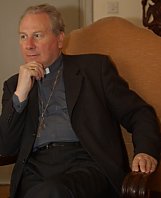
Most Rev. Michael L. Fitzgerald, M. Afr.
Papal Nuncio to Egypt and the Arab League since 2006, Archbishop Fitzgerald had succeeded Cardinal Francis Arinze as president of the Pontifical Council for Interreligious Dialogue in 2002 and has served as secretary of the same Council since 1987. A graduate student in Rome during the Second Vatican Council, he was a student of Bernard Lonergan and had the privilege of attending lectures by Council peritii Karl Rahner, Yves Congar, and others. A student of Arabic and Islam since those early days, he returned to Rome in 1971 as director of the Pontifical Institute for Arabic and Islamic Studies and as a consultor to the Council he would later lead. He was ordained a bishop by Pope John Paul II on the feast of the Epiphany, 1992.
He returned to Rome this week at the invitation of the Centro Pro Unione to deliver a lecture on the role of religious communities in Interreligious Dialogue. The evening before the lecture, he joined us at the Lay Centre to preside at our Eucharistic celebration, and offer a few thoughts about his ministry.
Vespers and hot chocolate
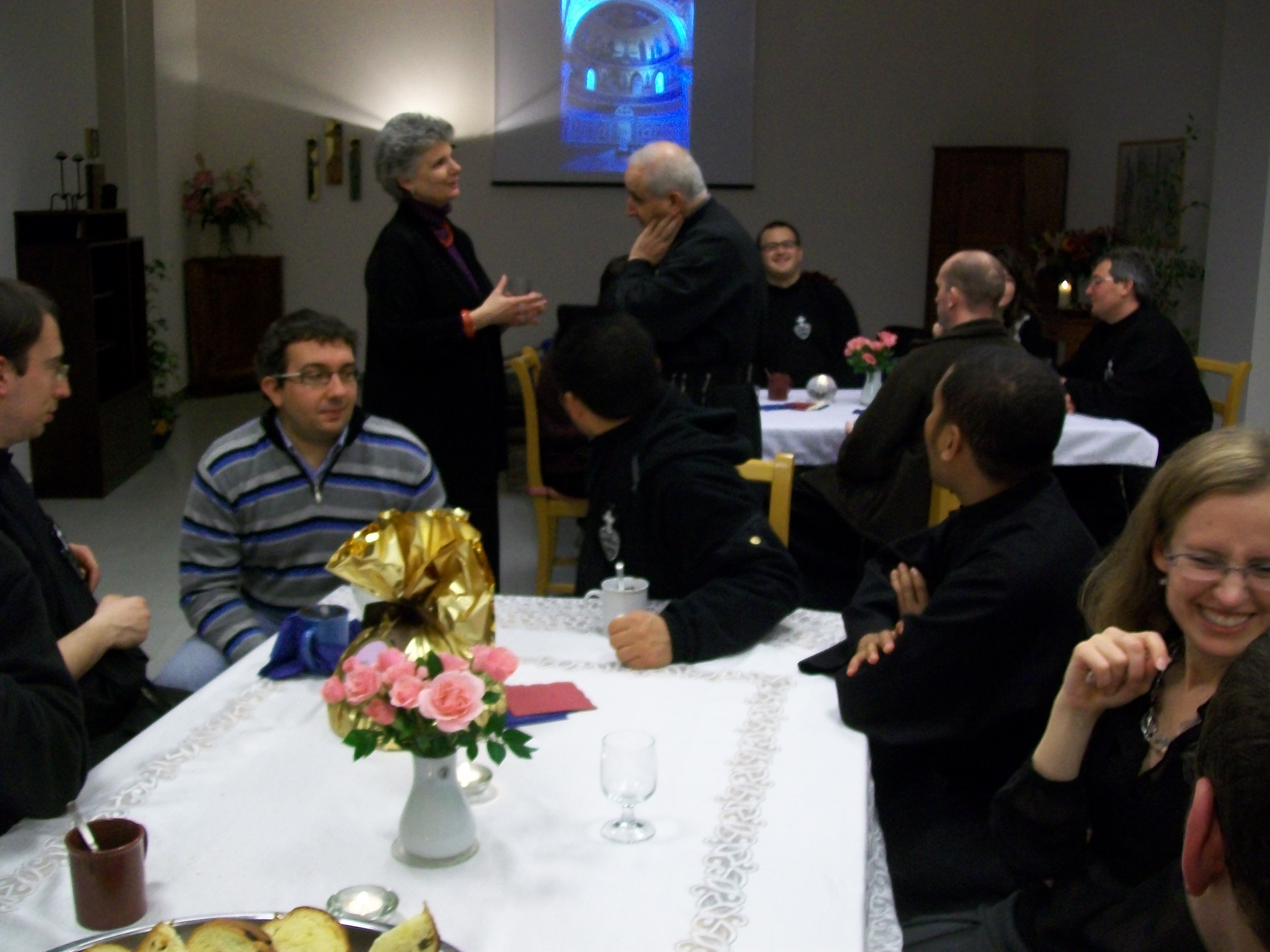
Student mixer, monastic style
- Practicing my Italian (note the hand motions)
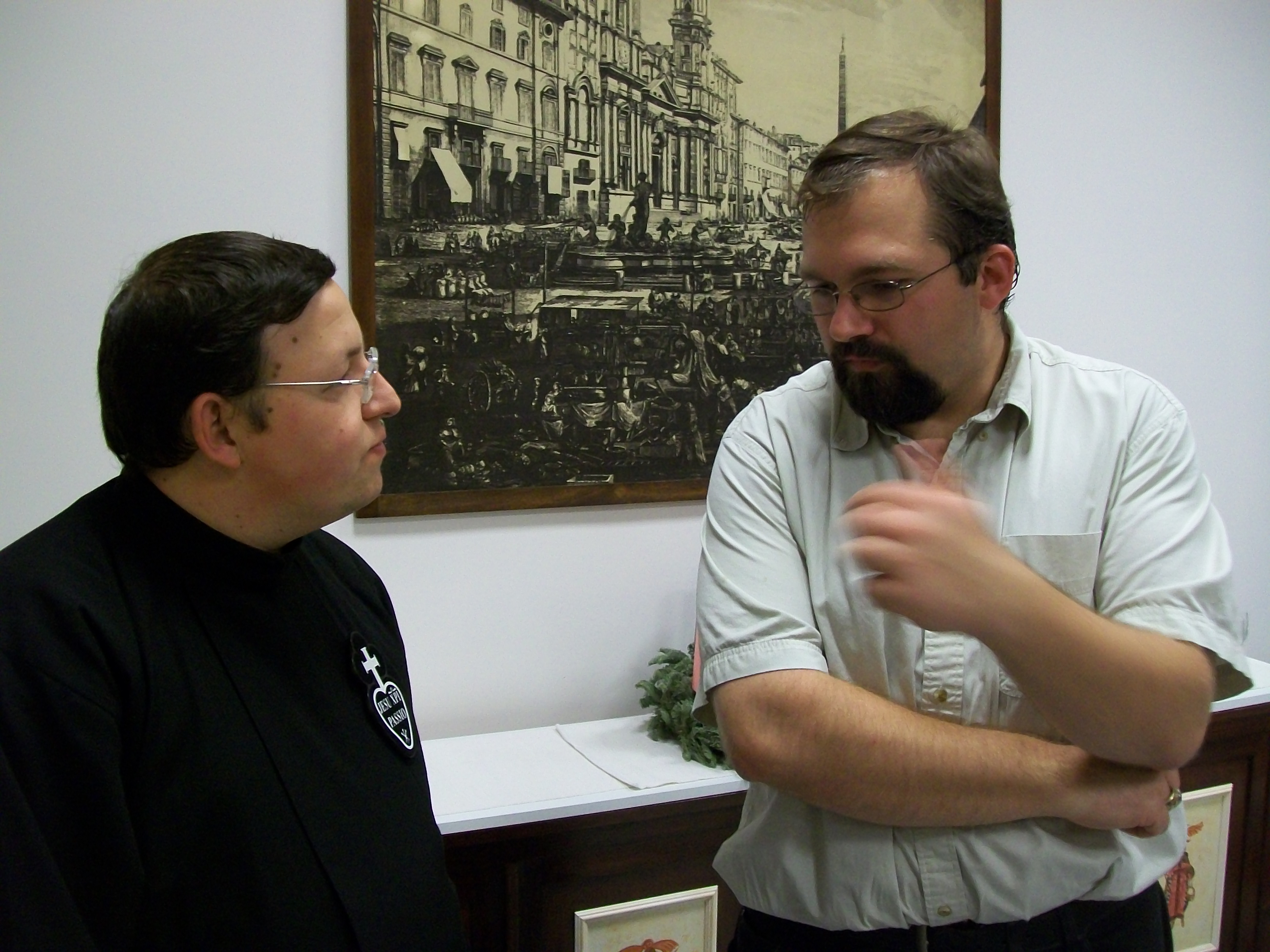
Friday, we met with the Father General of the Passionists and his General Council. Tonight we had the privilege to pray with the Passionist students and invite them over for Italian cioccolate caldo – something more akin to hot chocolate pudding than the kind of drinking hot chocolate I’m used to in the states.
About twenty of their students, most Italians, joined about half the Lay Centre residents in the evening after to get to know one another. It was our first opportunity to put names to the faces we’ve seen here and in the universities. It was also a test of my very minimal Italian, as the brothers I spent most of the night speaking with had virtually no English!

Superior conversation
Donna’s Birthday
13 December is the feast of Santa Lucia (Saint Lucy), which always reminds me of my good friend Colleen, in part because of her devotion to her confirmation patron and in part because one of my favorite pictures we took during our ND graduation festivities is Colleen with a garland tiara reminiscent of those worn with candles on St. Lucy’s feast. Pity it’s in a box at home somewhere, or I’d post it up here for you to see!
In Rome, we also celebrated Donna’s birthday (which one, we don’t know, but we celebrated anyway). Professora Donna Orsuto founded the Lay Centre at Foyer Unitas more than 20 years ago to begin to meet the obvious need for a house of formation for all the non-ordained, non-religious studying at the Pontifical universities in Rome. Sunday lunch, a few friends and visitors, and a couple surprise gifts to honor our founder all came together beautifully.
A small group of us, lead by our resident Renaissance man David, wanted to serenade the birthday girl, but realized that several would not be present due to previous commitments. After two or three horus of plotting, practicing, and dragooning volunteers from their bedrooms the night before the party, we put together a little video that we played for Donna just before lunch.
To get out of singing (or pretending to sing) I volunteered to film the song using my built-in webcam and laptop for recording and special effects – so forgive the sound quality:
Padre Generale di Passionisti
The Lay Centre at Foyer Unitas is no longer at Foyer Unitas in the Palazzo Doria Pamphilj on Piazza Navonna. I have mentioned before that the lay Centre moved just this summer to the Passionist Monastery of Sts. John and Paul on Monte Celio, just south of the coliseum, on the site of what once served as the Temple of Claudius, Nero’s Nymphaeum, and childhood playground for Pope Gregory I the Great.

Father Ottaviani D'Egidio and the General Council of the Passionist Fathers
We met tonight with the men who made such a move possible, Father General Ottaviano D’Egidio and his general council – four Passionist priests who advise the Father General and represent different quarters of the world’s 2200 passionisiti: Fathers Denis Travers (Australia), Clemente Barrón (Texas), Luis Alberto Cano (Spain) and Luigi Vaninetti (Italy). It all started a little over two years ago with an email from Passionist Father and renowned Scripture scholar Donald Senior to members of the General Council suggesting such a move. From there, Fr. Denis met with Donna and conversation commenced. Two years later, we were able to welcome the Passionist general council to dinner as a small sign of thanks to our landlords, and to get to know the community a little better.
Passionists take the traditional three solemn vows of any monastic community – Poverty, Chastity, and Obedience – then add a fourth: to spend his energies in promoting remembrance of the sufferings of Jesus, to keep deep in our hearts the memory of the cross and to do what is in our power to remind others of it. This vow defines the purpose of the Passionist community, and the ubiquitous “Sign” of the order, designed by founder Paul of the Cross, reminds them at every moment of this vow. Likewise, the black habit, which is worn in mourning for the passion and death of Christ on the cross.
The Passionist Sign
Though not the original house of the order, the monastery that the Lay Centre now calls home is the ‘mother house’, and several other groups are present: the Father General and his general curia, the students of the order studying at the Pontifical universities in Rome, the staff of the retreat house and of the Basilica of John and Paul, and sisters who serve as the cooks for the monks – about 80 people in all.
The Father General’s opening remarks noted that at first, some of the order were unsure about admitting a lay community into the monastic grounds – and a coeducational, ecumenical, and interreligious community at that! But after a few weeks, he began to wonder if we had indeed moved in – barely seen or heard, we were like ghosts! I think that’s a compliment coming from someone whose day begins in the early hours before God Himself is stirring from slumber!
For our part, I think we were just grateful for the opportunity to express gratitude at living in the most beautiful compound in the City, second only to the Vatican Gardens themselves.
Carmelite General
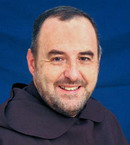
Father Fernando Millan Romeral, Prior General of the Carmelites
Father Fernando Millán Romeral is the Prior General of the Ordo Fratrum Beatissimae Virginis Mariae de Monte Carmelo, better known as the Carmelites. He is an expert on reconciliation, both in its sacramental form and its theological context, and was a professor of sacramental theology. He is also involved in Jewish-Christian dialogue, and has published half dozen books and numerous articles, mostly in his native Spanish. He was elected superior of the order in September 2007, and was the Lay Centre’s guest presider and presenter this evening.
The Carmelites ‘boast’ 17 Saints, 45 Blessed, and over 100 others whose causes have been started and are classed as Venerable or Servants of God. Some of the most well known include St. John of the Cross, and Doctors of the Church St. Therésè of Liseux and St. Teresa of Avila. Carmelite spirituality is one of the most widely practiced and deeply respected in the Church. Unlike so many religious orders which owe their charism and founding to the vision of a saintly founder, the Carmelites have their origin with a community of pilgrim-penitents who lived as hermits near the “spring of Elijah” on Mount Carmel, in Palestine near the end of the 12th century. Their charism is fraternity, service, and contemplation.
Father Fernando’s comments during and after dinner focused on the Sacrament of Reconciliation, and the need for its renewal in the life of the church. Just the name itself, he said, is one indicator of the challenges facing the sacrament. Four different variations are common, each with their own emphasis and champions: Reconciliation, Penance, Confession, and the sacrament of Forgiveness. Though the theology of Vatican II documents clearly prefers Reconciliation, post-Conciliar texts such as the Code of Canon Law use other names. Pope John Paul II was always careful to use the four terms equitably so as not to give favor for one over the other.
One of the first aspects to know with regard to the sacrament is that in response to the call of Sacrosanctum Concilium for the renewal of the liturgy and the revision of the sacramental texts, the work on the sacrament of Reconciliation took the longest. When it was finally completed, in 1984, the most common response was, “well, what changed”? With some exceptions, this sacrament is celebrated in essentially the same form as it was before the revisions (numbers of penitents notwithstanding). Perhaps this indicates that the real renewal of the sacrament has yet to take place.
In anticipation of that renewal, the Carmelite General made several observations. It is a sacrament, therefore it is a liturgy, and should always be celebrated as a liturgy – in community. It should always be celebrated with the Liturgy of the Word. The current Form II – Communal celebration with individual absolution – is really the normative form, the others being exceptions as necessary (either completely individual, or completely communal).
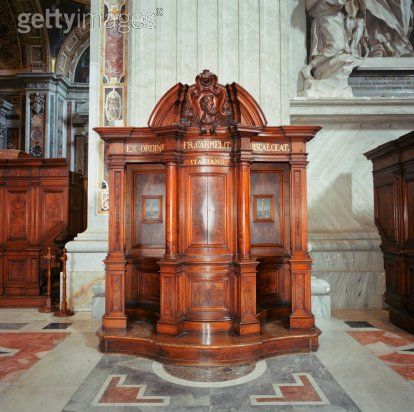
Typical "open" confessional in Rome
Even in Rome, though, it is hard to change the momentum. The prior general told us of how, in his first year as bishop of Rome, Pope Benedict XVI intended to have the sacrament celebrated according to Form II in St. Peters; he ‘was not allowed’ (“Perhaps this is not the best way to say it, but basically, that is what happened!”). The logistics of the normative form were too overwhelming in a culture where you can still find (very beautiful) 18th century wooden confessionals scattered throughout the papal basilicas for penitents to confess their sins to waiting priests in a variety of languages – in some places even while the Eucharist is being celebrated.
Basilica Santa Maria in Domnica
Besides the Lay Centre’s own chapel, the closest church is actually the Basilica of Saints John and Paul of the Cross, attached to the Passionist Monastery that is our landlord. However, given the geography and the means of getting around the property, it is actually closer to go to the local parish church, the Basilica of Santa Maria in Domnica, also known as Santa Maria della Navicella.

Basilica Santa Maria della Navicella
First, a little perspective is in order. Growing up in rural North Bend, WA about 30 miles east of Seattle, the nearest parish was a 15 minute drive away, in neighboring Snoqualmie.
Within a 15 minute walk from the Lay Centre, there are about a dozen churches, including the Cathedral Archbasilica of San Giovanni Laterano, the ancient San Clemente, one of Rome’s three circular churches, San Stefano Rotondo, and a chapel for the Missionaries of Charity. I am still making my rounds!
The parish church derives its dual names from different features of and around the basilica. In front of the church is a marble statue of a small ship (navicella), turned into a fountain by Leo X in the early 16th century as a replica of the original, which had been there ‘since time immemorial’. The official name of Domnica is variously attributed, either in reference to the church as a “house of the Lord” or to the name of a wealthy patroness who lived in the area whose name translated also meant “of the Lord”.
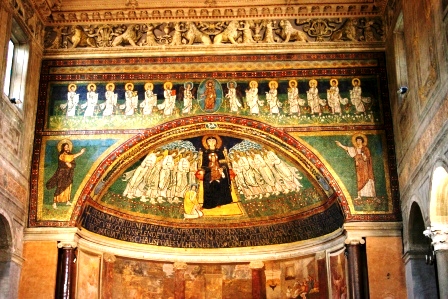
Mosaic at St. Maria in Domnica
Originally built somewhere between the 4th and 7th century on the ruins of a military barracks, it was renovated by Pope Pascal I in the early 9th century, and it was again refurbished by Pope Leo X in the 16th century. Pope Pascal was also connected to the Basilica Santa Prassede, which I mentioned a few weeks ago, also known for its beautiful mosaics, including that of Pascal’s mother, Episcopa Theodora. In Santa Maria Domnica, the mosaic represents an icon of the Theotokos and Christ child, correctly situated in the center rather than at his mother’s side, flanked by saints and angels. Pope Pascal is seen at Mary’s feet, with the square halo indicating he was still alive when the mosaic was completed.
The cardinal-titular of the church is William Cardinal Levada, prefect of the Congregation for the Doctrine of the Faith and former Archbishop of Portland and of San Francisco (and before than an auxiliary under Cardinal Mahony in LA). The basilica also serves as a parish center for the lay movement, Comunione e Liberazione (Communion and Liberation).
Communion and Liberation is one of the many lay ecclesial movements that have been popular in the Italian church and elsewhere in the last 40-50 years. While lay ecclesial ministry developed along the same timeline in northern Europe and North America, these lay ecclesial movements took precedence in Italy and in many of the Latin countries. CL traces its origins to the thought and ministry of an Italian priest Luigi Giussani dating back to the mid-50s, but the movement itself has its identifiable beginning with to a small group of Giussani’s students in 1969. The model is less of definite membership than in attendance in weekly catechetical meetings known as the “School of Community”. Estimates are of about 100,000 attending regularly in Italy, and there is a presence in almost 80 other countries, though nowhere as strong as here in Italy.
For both the feast of the Immaculate Conception, today, and the celebration of the Second Sunday of Advent I joined a group of my housemates from the Lay Centre in participating in the liturgy here. I just did not feel like braving the rain and the Roman crowds (and pickpockets) to make it to the Piazza Spagna for the Papal event there. Maybe next year!
St. Nicholas Sunset
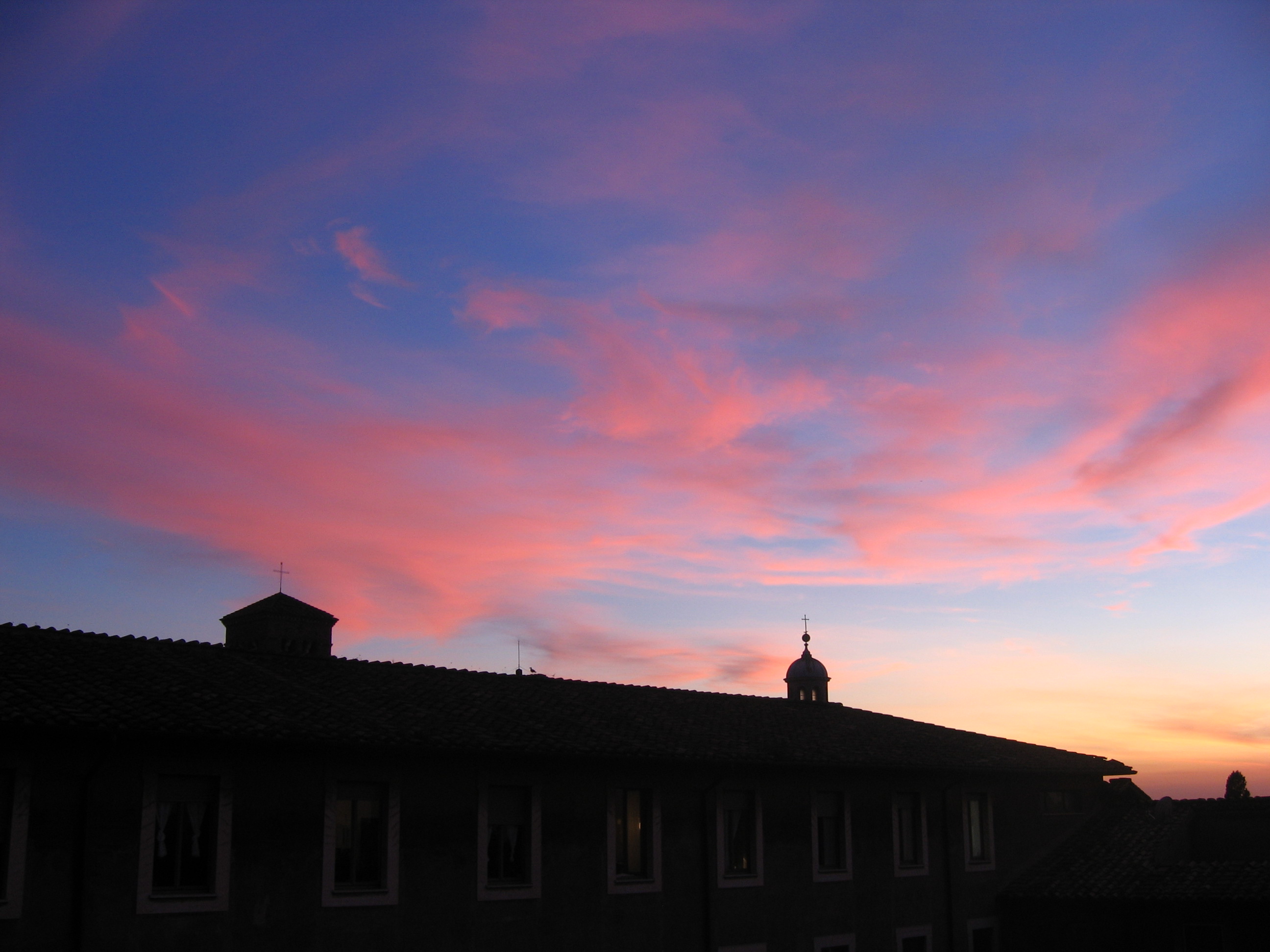
Views from the Lay Centre, 6 December 2009, Feast of St. Nicholas.


Hebrew Bible, Human Rights, and Interreligious Dialogue
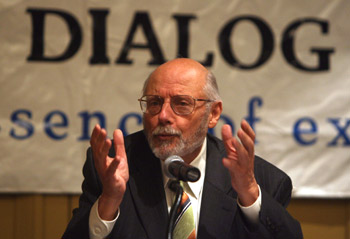
The second Oasis in the City event hosted at the Lay Centre this year featured a presentation by Rabbi Jack Bemporad on the topic The Hebrew Bible, Human Rights, and Interreligious Dialogue. Among his 30 years of experience in international interreligious work, Rabbi Bemporad is the founder and director of the Center for Interreligious Understanding in Englewood, NJ, and has been a visiting professor of Interreligious Dialogue at the Pontifical Angelicum University for 13 years. He has been invited by the Holy See to speak on matters of Jewish-Catholic relations, and met on several occasions with Pope John Paul II personally.
Rabbi Jack Bemporad
During his comments to the Lay Centre residents and community guests, one of the points Rabbi Bemporad raised was the tremendous work of the Catholic Church through Vatican II and especially the efforts of Pope John Paul II with respect to the Jewish community and the relationship of the two religions. Despite the wealth of documents from the Church, he said, especially the USCCB document, God’s Mercy Endures Forever: Guidelines on the Presentation on Jews and Judaism in Catholic Preaching, the international Jewish community has yet to examine its own long-standing description of Christ and Christianity at the same level.
The Hebrew Bible is primarily an account of monotheism directed at those who are not yet monotheists. Further, the revelation of monotheism is integral and necessary for a truly peaceful vision of the world and for the development of the concept of human rights.
“One God implies the possibility of a world of peace and justice. As long as there exists the battle between the gods and the plurality of gods as embodying separate forces of nature, then there is no sense of a world at peace. One God implies one world and one universal goal of justice and peace embodying the greatest possible realization for each individual.”
Six key themes or aspects of the Biblical message highlight the origination of human rights in the Hebrew Bible:
Equality in the Bible does not refer primarily to those of the same rank or class, but indicates a positive action of bringing up those who are weaker than oneself (widow, orphan, stranger, the poor and the slave).
The holy and ethical are inseparable. The prophetic tradition, with Amos as the first clear example, claim that social injustice –not simply idolatry or non-orthodox worship – will bring about national ruination. The value and destiny of a nation is dependent on how it treats its most vulnerable members. This social concern for the vulnerable can be traced back to Israel’s enslavement in Egypt.
The Biblical condern for the stranger and sojourner is essential. Love your fellow human being – not “as yourself” as is often translated – but “because he is like you”. There is but one law for you and for the stranger – a concept still foreign to most nations today!
Sabbath as an institution, which allows even the slave and the stranger to rest and be master of their own time for at least one day a week. By extension, the sabbatical year and the Jubilee year remind us that we are not owners of the land or of property, but stewards only. Poverty and wealth alike are only temporary.
A king is subservient to the law, not the law unto himself. The messianic king will be unlike all other kings, rather than to make war, he will make peace.
Finally, two elements that separate Judaism from the black-and-white view of “our religion is the true one, and all others are totally false and therefore evil”: First, the establishment of the Noachide as a status that taught that one did not have to be an Israelite to be saved. Second, the Tosephta enunciated that “the righteous of all nations have a place in the world to come” an idea now nearly universally accepted in Judaism.
The questions of interreligious dialogue, and our common work in support of human rights, remain: “How can I be true to my faith without being false to yours?” and “What is the place of the other religions I our own self-understanding?”
In the States, according to Rabbi Bemporad, it was the civil rights movement that joined Jews and various Christians to working together, and so we must continue to dialogue to discover the “common moral and ethical elements that are constitutive of our religions and try to unite on a common ethic independent of our theological perspectives.”
 The Ecumenism Blog