
Home » Posts tagged 'interreligious dialogue' (Page 4)
Tag Archives: interreligious dialogue
Hebrew Bible, Human Rights, and Interreligious Dialogue
The second Oasis in the City event hosted at the Lay Centre this year featured a presentation by Rabbi Jack Bemporad on the topic The Hebrew Bible, Human Rights, and Interreligious Dialogue. Among his 30 years of experience in international interreligious work, Rabbi Bemporad is the founder and director of the Center for Interreligious Understanding in Englewood, NJ, and has been a visiting professor of Interreligious Dialogue at the Pontifical Angelicum University for 13 years. He has been invited by the Holy See to speak on matters of Jewish-Catholic relations, and met on several occasions with Pope John Paul II personally.
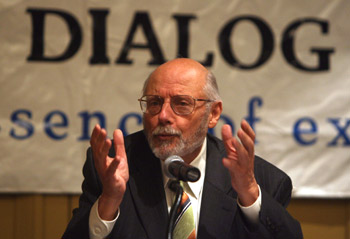
Rabbi Jack Bemporad
During his comments to the Lay Centre residents and community guests, one of the points Rabbi Bemporad raised was the tremendous work of the Catholic Church through Vatican II and especially the efforts of Pope John Paul II with respect to the Jewish community and the relationship of the two religions. Despite the wealth of documents from the Church, he said, especially the USCCB document, God’s Mercy Endures Forever: Guidelines on the Presentation on Jews and Judaism in Catholic Preaching, the international Jewish community has yet to examine its own long-standing description of Christ and Christianity at the same level.
The Hebrew Bible is primarily an account of monotheism directed at those who are not yet monotheists. Further, the revelation of monotheism is integral and necessary for a truly peaceful vision of the world and for the development of the concept of human rights.
“One God implies the possibility of a world of peace and justice. As long as there exists the battle between the gods and the plurality of gods as embodying separate forces of nature, then there is no sense of a world at peace. One God implies one world and one universal goal of justice and peace embodying the greatest possible realization for each individual.”
Six key themes or aspects of the Biblical message highlight the origination of human rights in the Hebrew Bible:
Equality in the Bible does not refer primarily to those of the same rank or class, but indicates a positive action of bringing up those who are weaker than oneself (widow, orphan, stranger, the poor and the slave).
The holy and ethical are inseparable. The prophetic tradition, with Amos as the first clear example, claim that social injustice –not simply idolatry or non-orthodox worship – will bring about national ruination. The value and destiny of a nation is dependent on how it treats its most vulnerable members. This social concern for the vulnerable can be traced back to Israel’s enslavement in Egypt.
The Biblical condern for the stranger and sojourner is essential. Love your fellow human being – not “as yourself” as is often translated – but “because he is like you”. There is but one law for you and for the stranger – a concept still foreign to most nations today!
Sabbath as an institution, which allows even the slave and the stranger to rest and be master of their own time for at least one day a week. By extension, the sabbatical year and the Jubilee year remind us that we are not owners of the land or of property, but stewards only. Poverty and wealth alike are only temporary.
A king is subservient to the law, not the law unto himself. The messianic king will be unlike all other kings, rather than to make war, he will make peace.
Finally, two elements that separate Judaism from the black-and-white view of “our religion is the true one, and all others are totally false and therefore evil”: First, the establishment of the Noachide as a status that taught that one did not have to be an Israelite to be saved. Second, the Tosephta enunciated that “the righteous of all nations have a place in the world to come” an idea now nearly universally accepted in Judaism.
The questions of interreligious dialogue, and our common work in support of human rights, remain: “How can I be true to my faith without being false to yours?” and “What is the place of the other religions I our own self-understanding?”
In the States, according to Rabbi Bemporad, it was the civil rights movement that joined Jews and various Christians to working together, and so we must continue to dialogue to discover the “common moral and ethical elements that are constitutive of our religions and try to unite on a common ethic independent of our theological perspectives.”
The Roman Classroom, or, Reflections on Methodology and Pedagogy in the Pontifical Roman Universities from an American Catholic Paradigm Typified by L’Universite de Notre Dame du Lac
What is it like studying in Rome? Are the courses challenging? Are the students on par with peers in the U.S.? Is the university academically rigorous? Are the faculty orthodox? How does it compare to [Notre Dame/Seattle University/Catholic University]?
These are the kinds of questions I have had from a number of friends and colleagues, and I thought I would address them together once I had had some time to get a sense of the pedagogy here.
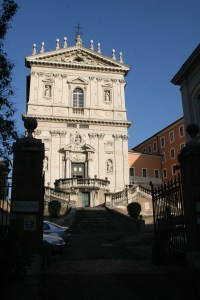
Church of Dominic and Sixtus at the Angelicum University
It is a different system, no question. The first thing to note is the nature of the university. The Universities are really just buildings with classrooms, and very minimal administrative staff. The entirety of the Angelicum – classrooms, offices, chapel, faculty residences, library and bookstore – is about the same size as Hunthausen Hall at SU, Caldwell at CUA, or O’Shaughnessy at ND. This is because the university really only offers the classes, mostly lectures and a small number of seminars. It is assumed that the bulk of your formation actually happens elsewhere, specifically, independent research, formation in community, and the experience of being in Rome.
My specialization does not even use the university library, for example. Instead, we have access to the Centro Pro Unione, run by the Society of the Atonement; that is our library. Sure, it is about a 25 minute walk from the Angelicum, but it’s a walk that passes by the Trevi fountain, the Pantheon, Piazza Navona and some of the most famous gellateria in the city, so one cannot complain. Moreover, there is a lot of time for research, so once I settle on an idea, I will not be bogged down by unwanted topics in order to pursue it.
The presumption of the university is that its students live in a house of formation, one of the “colleges” around Rome – and these are operated entirely separately from the universities. The problem is, of course, that only about 70% of students have access to one of these colleges as they are usually established either by national bishops’ conferences exclusively for priests and seminarians, or by religious communities for their own members. That leaves a significant number of students – deacons, lay ecclesial ministers, non-ecclesial lay students and non-Catholics – without an essential part of their education in Rome. The Lay Centre is the only such college trying to meet this need, and it is a private venture. It is also limited in space, with only room for about 20 residents out of the hundreds needing such a place. (Though get the impression the quality of life and of formation here exceeds what can be found in many of the national colleges for seminarians and priests!)
Further, I think the course load is intentionally light, though it does not appear this way at first. It is normal to be registered for about 8 or 9 courses a semester, one of which is a seminar. Whereas the typical 3-credit course in the States meets for 3 hours in two or three classes a week, here we get 90 minutes, once a week – about half as much time. The reading load is considerably less, too, if you just look at the syllabi. Two of my courses have only one required text of about 200 pages each, for the entire semester. The rest rely entirely on lecture notes. I have a total of 30 pages of writing due this semester, and most final exams are oral rather than written. (I am remembering my first semester sophomore year at ND, over 100 pages on 60 different topics, not counting finals!)
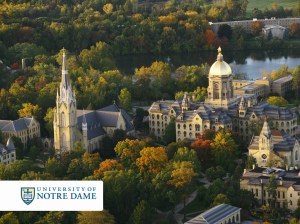
Sacred Heart Basilica and Main Building, University of Notre Dame
The difference between being located in South Bend, IN and in Roma cannot be overstated, though. It is easy to take on a thousand pages of reading a week at ND when there is nothing to do otherwise anyway. Here, if you want to learn about early Christianity or the history of the papacy, go for a walk. San Giovanni in Laterano is ten minutes from here. San Clemente is even closer. The Vatican is a few metro stops away. Just in the last week, we have had dinner with two of the three Catholic representatives on the reconciliation talks with the Lefebvrite schismatics (Archbishop Ladaria and Charles Morerod, OP). The week after the press release about the Anglican personal Ordinariates, we got to talk with two different members of the Pontifical Council for Christian Unity. Then, of course, the discussions had over dinner and caffé more than make up for the pedantic lecture style in some of the classrooms.
It is important to note the international character here too. Granted, ND and CUA were both pretty international, but I think this is the most mixed place I have ever been. I am frequently the only native English speaker in a class, or one of two. It seems to be a good representation of the Church in general: lots of representation from Africa, southeast Asia, India, and Eastern Europe. (Some from Latin and South America, but most of them seem to go to the Gregorianum rather than the Angelicum). This probably makes lecture rather than group discussion in class more feasible, and accounts for what seems like a slow pace.
Hallowe’en in Rome, St. Paul Outside the Walls, and All Saints
I nearly forgot it was Halloween yesterday without all the candy and pumpkins in the stores; barely any orange or brown to be found in the city.
Apparently, it has not been a big holiday for Romans, or Italians in general. The big costume holidays are Epiphany, where they tend to dress up as La Befana, a gift-delivering witch who visits on January 6, and Carneval.
A small group of us went out for an evening passagata around the Pantheon and Piazza Navona, stopping for gelato en route, and finishing with a nice bottle of wine at a little wine bar/café. We saw a few Befana hats out early, but really it was only as we were heading home for the night, about midnight, that we saw more people in costume.
For the morning of All Saints, I opted for the Basilica San Paolo fuori la mura (St. Paul Outside the Walls). Rezart, one of my Muslim housemates, is working on a paper about the Eucharist, and he decided to join me so he could compare his first mass experience from Wednesday night here in the Lay Centre to a more formal experience at the Basilica. An added bonus is that Abbot Edmund was presiding at both liturgies, so the difference in personal presider styles could be taken out of the equation. Matthew joined us on location, in exchange for a visit to his parish next week, to which I am looking forward.
St. Paul’s is the huge basilica built over the tomb of St. Paul, outside the old city walls (hence the name), one of the four major basilicas. Until the new St. Peter’s was built (1506-1625), St. Paul’s was the largest church in the world. Along the walls are the images of the bishops of Rome going back to Peter – the source for those posters one finds all over the place.
St. Paul’s has also become significant in Rome’s ecumenical efforts, including being the location of the culminating liturgy for the Week of Prayer for Christian Unity each year. In fact, it was from the steps of St. Paul’s that John XIII announced Vatican II at the end of the celebration for Christian Unity 50 years ago.
Afterwards, Abbot Edmund was generous enough to meet with Rezart and me to answer questions and show us around a little. It is a gift to share the liturgy with someone experiencing it for the first time, especially someone so interested in learning about our worship. The questions remind us of the theology and symbolism we take for granted, and push for better understanding of what we might do out of habit. His first question was like this, he wanted to know why, if the Eucharist itself was a sacrifice made for the forgiveness of sins, why we had a penitential rite just a little while before celebrating the once-and-for-all penitential act! From there we ventured into the symbolism of serving only one species or both, the meaning of incense, and expansion from the homily and so on. It was a blessing for me to just listen!
After returning to the Lay Centre for lunch and a little homework, we ventured out again to All Saints Anglican, to celebrate their patronal feast, and to cheer on Stian who had his acolyting debut. Nine of us in total joined the small English community fro Evensong, then ventured to a pizzeria founded in 1753 (according to the waitress’ t-shirt anyway) and located just down the road, near San Clemente. Donna assured us in advance it was the best pizza in Rome, and we were not disappointed!
A dialogue of hospitality
We had a few guests for dinner at the Lay Centre tonight.
That would be the “necessary but insufficient” description. Allow me to elaborate.
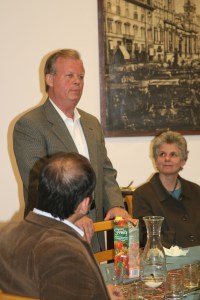
Ambassador Tony Hall
Former U.S. Special Representative to the U.N. agencies in Rome (and former U.S. Representative), Ambassador Tony Hall, his wife Janet, their daughter Jyl and her husband Ryan joined us for dinner. Apparently during their years in Rome, Mrs. Hall was a regular participant of the Centre’s ongoing formation program, the Vincent Pallotti Institute, and she and Ambassador Hall became regular guests and friends of the Lay Centre.
Now back home in the States, they were in Rome for a few days and were able to stop by to see the new location and meet the new members of the community. Ambassador Hall shared with us some reflections on his dedication to eradicate hunger and malnutrition in our world, and gave witness to the fact that it was his faith in Christ, and the conviction of the Gospel, that moved him to spend so much of his life in service to those most in need.
Jyl and Ryan – who, as it turns out, is a native of Bellingham, WA –came across the Adriatic from Macedonia where they are involved in a ministry sponsored by Faith and Learning International. Between sports and art, they are reaching hundreds of youth in the context of a broader outreach in the Balkans. You can read their blog here: http://prayforryanandjyl.blogspot.com/

Daniel Roberts, Dr. Adam Afterman, AJ, Naomi Shank
We were also honored to have Ms. Naomi Shank, director of the Russell Berrie Fellowship program, Mr. Daniel Roberts, director of the Institute for International Education’s Europe Office (IIE), and Dr. Adam Afterman of Hebrew University and the Shalom Hartman Institute in Jerusalem. As you know, my studies at the Angelicum are being funded by one of the Russell Berrie Fellowships, which is coordinated through the IIE, and a part of our fellowship is a seminar in the Holy Land coordinated by Dr. Afterman and the Hartman Institute, so it was a particularly welcome opportunity for me to put faces with the names of those responsible for my grant.
Finally, complete with Caribinieri escort, the newly appointed U.S. Special Representative to the U.N. agencies in Rome, Ambassador Ertharin Cousin, joined us just as Ambassador Hall was beginning his after dinner remarks. Having just arrived to her post the same day I arrived in Rome, not quite two weeks ago, that she was willing to find time to join us was indicative both to the Ambassadors own commitment to interfaith and inter-cultural dialogue and reconciliation, and to the value of the Lay Centre in the life of Rome as a place where the dialogues of life, charity, and hospitality coincide with the dialogue of truth.

Ambassador Ertharin Cousin
For those who do not know – and I certainly did not – the U.S. mission to the U.N. Agencies in Rome is our relationship with the U.N. Agencies for Food and Agriculture, including the Food and Agriculture Organization, the World Food Program and the International Fund for Agricultural Development. It is also responsible for overseeing U.S. participation in the International Development Law Organization, the International Institute for the Unification of Private Law, and the International Center for the Study and Preservation of Cultural Property.
 The Ecumenism Blog