
Home » Posts tagged 'Catholic Church' (Page 7)
Tag Archives: Catholic Church
After 35 Years: A Return to Reform?
My friends can tell you that I have a bad habit. Actually, more than one, but only this one is relevant at the moment. When going through my email inbox, I tend to scan everything, then work from the least important first ‘saving the best for last’, so to speak. Especially after a busy week, I might spend an hour just sorting through quasi-spam and quick reply messages, clearing the space so I can respond to the really important ones. The problem is that I too often run out of time, and messages from my closest friends or strongest ecumenical contacts languish a little too long awaiting attention. The same logic has log-jammed my blog lately.
Since about two weeks after Pope Francis was elected as bishop of Rome, I have sat down several times to start a reflection on his fledgling papacy. The problem is, every time I do this, I get distracted reading about whatever exciting new thing he has done. Often they are little changes, gestures and actions, but they paint a picture of humility and commitment to reform, openness to dialogue and noble simplicity of faith and its expression.
By now the litany of these little things is well known: He appears on the balcony dressed in the simple white simar, like John Paul I, rather than the mozetta and stole of JPII and BXVI. He asks for our blessing before offering his own. He makes personal phone calls. He demonstrates astute ecclesiological acumen by referring to himself as the bishop of Rome, and his predecessor as bishop emeritus of Rome, exclusively. He stops by to pay his hotel bill in person. He moves an entire liturgy out of St. Peter’s and into a juvenile prison. He washes the feet of women and Muslims. He calls the Patriarch of Constantinople ‘my brother Andrew’. He’s formed a representative committee of cardinals to reform the governance of the Catholic Church – or at least the Roman curia. He has unblocked the path to sainthood of one of the 20th century’s great martyrs, Oscar Romero. And so on…
A couple weeks after he was elected, one veteran vaticanist noted that “suddenly, everyone around here is laughing and smiling.” A senior colleague said “I had forgotten what it was like to be so encouraged and inspired.” A fellow student commented that it “felt as if a burden has been removed that I did not know I had been carrying my whole life [c.35 years]”
Although great joy truly has the reaction of the vast majority of people to Francis, not all have been positive. It took the traditionalist fringe all the way until Holy Thursday (15 days after election) to retreat into the old safeholds of disrespect and antagonism. First, they blame the press for creating a false Francis vs. Benedict comparison, and leap on every fan’s expression of praise for Francis as though it were an insult to Benedict. Some immediately decried his humility as false, a kind of stage prop, and held up as a paragon of true humility the faithful master of ceremonies of Benedict XVI, novus Marini, for ‘suffering’ the loss of his lace. They have accused him of being a slob, of undermining the office of the papacy. Basically, they are afraid of change, hurt that the first pope since Pius XII to actually like all the neo-baroque nonsense resigned, and afraid of a return to the days when people were excited about the changes that Vatican II promised. [e.g.]
Everyone else had just long since forgotten what it was like to feel excited about the prospect of change in the church.
Earlier this month a Jesuit friend told me how his confreres have noted that the ‘young people’ do not seem to like Francis very much. The problem, though, here in Rome, is that ‘young people’ are judged as is everything else: clerically. The seminarians under 40, the same ones who were drawn to the priesthood as a power structure, certainly are nervous. But everyone else is giddy. The young, the old, the long-suffering and the fair-weather, everyone is happy but for those who invested in birettas and lace surplices (cf. John Allen, Jr.). But even for them, there remains a place in the Church. How could there not? No one is threatening their particular peculiarities and liturgical peccadilloes. But they simply are no longer being championed as the next big thing.
Yesterday, Pope Francis’ comments to the Conference of Latin American Religious were leaked, in which he seems to suggest not taking the CDF investigation of Religious too seriously, bemoans his own lack of administrative organization, acknowledges the problem of a “gay lobby” in the Vatican, and identifies as two of the most significant concerns today the Pelagianism of restorationist/traditionalist movements, and the Gnosticism of certain spiritualist movements.
One is the Pelagian current that there is in the Church at this moment. There are some restorationist groups. I know some, it fell upon me to receive them in Buenos Aires. And one feels as if one goes back 60 years! Before the Council… One feels in 1940…” The Pope is then said to have illustrated this with a joke: “when I was elected, I received a letter from one of these groups, and they said: “Your Holiness, we offer you this spiritual treasure: 3,525 rosaries.” Why don’t they say, ‘we pray for you, we ask…’, but this thing of counting…
(Though, it strikes me now, what will this mean for all the plenary indulgences I have been able to accrue while living in Rome? I have been saving them up for a rainy day, and now the numbers do not matter? Sheesh…)
Yet, lest you fear (or cheer) His Holiness’ critique of the extreme fringe as a radical departure from his predecessor, Andrea Tornielli reminded us of this commentary on the same topic from then-Cardinal Ratzinger:
…the other face of the same vice is the Pelagianism of the pious. They do not want forgiveness and in general they do not want any real gift from God either. They just want to be in order. They don’t want hope they just want security. Their aim is to gain the right to salvation through a strict practice of religious exercises, through prayers and action. What they lack is humility which is essential in order to love; the humility to receive gifts not just because we deserve it or because of how we act…
Joseph Ratzinger, “Guardare Cristo: esempi di fede, speranza e carità” [Looking at Christ: Examples of faith, hope and charity]. 1986.
The sense now, for most, is that people are hopeful, but hesitate to be too hopeful. More and more, people are reminded of John Paul I, Papa Luciani, who had the same simple, honest way with the Petrine ministry and the hope that he had instilled that the reforms of the Council would continue, only to have those hopes dashed after only 33 days. Three months after Francis’ election, I think some people are still afraid that their hopes will not have the chance to come to fruition. But hope it is.
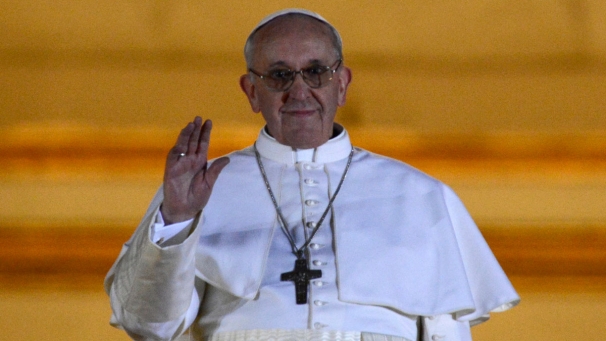
Pope Francis – Jorge Bergoglio
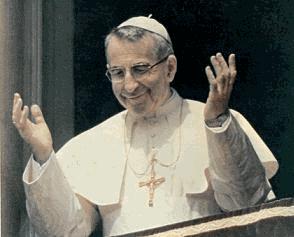
Pope John Paul I – Albino Luciani
Boy Scouts, Gays and the Catholic Church
The Boy Scouts of America recently revised its youth membership policy so that young people would not be excluded solely on the basis of their sexual orientation. I am sure you heard the news. Effective 1 January 2014, the revised policy reads:
Youth membership in the Boy Scouts of America is open to all youth who meet the specific membership requirements to join the Cub Scout, Boy Scout, Varsity Scout, Sea Scout, and Venturing programs. Membership in any program of the Boy Scouts of America requires the youth member to (a) subscribe to and abide by the values expressed in the Scout Oath and Scout Law, (b) subscribe to and abide by the precepts of the Declaration of Religious Principle (duty to God), and (c) demonstrate behavior that exemplifies the highest level of good conduct and respect for others and is consistent at all times with the values expressed in the Scout Oath and Scout Law. No youth may be denied membership in the Boy Scouts of America on the basis of sexual orientation or preference alone.
This means, at least, that
- A youth will not be prevented from receiving a rank award or religious emblem simply for having a same sex attraction.
- A youth will not need to hide the fact that he has or experiences this attraction, but a youth also will not be encouraged or pressured to disclose publicly the experience of such attraction.
- A youth thinking or knowing he has a homosexual inclination should not be afraid that he will be bullied or expelled by the Scouting community by disclosing his sexual orientation.
 I am an Eagle Scout, a Catholic Christian theologian, ecumenist, and a St. George Awardee. I have served on my archdiocesan Committee on Catholic Scouting, as a religious emblems counselor and as chair of religious emblems programs for our archdiocese. My youth experience of scouting was always in a religious-chartered unit, first by a United Methodist Church and then by a Catholic Church. I developed the use of the Bronze Pelican in our diocese as recognition of the use of scouting as Catholic youth ministry. I say all of this just to make clear where I am coming from – for me, scouting and my Catholic Christian faith have always gone hand in hand. They still do.
It all seems very simple to me, so I have to admit I have been shocked and dismayed by some of the very unchristian behavior of some of my fellow Catholics and scouters in response to this decision.
Legally, as the U.S. Supreme Court upheld the right of the BSA to determine its own membership policy (BSA v. Dale, 2000). This was the right legal decision. The right moral decision was for the BSA to make the change that it just did.
Catholic teaching is fairly clear: While sexual activity of any kind would be deemed inappropriate for Scouting-age youth (and this is Scouting’s policy as well), maintaining an unwarranted exclusion of homosexual youth for no other reason than their orientation (or their questioning of their orientation) would constitute an unjust discrimination, and is therefore not allowed. Gays ought to be treated with the same dignity, respect, compassion and sensitivity as all our brothers and sisters. The Church teaches this, unequivocally, without compromising its teaching on sexual activity.
When I was a scout, nobody was checking sexual orientation alongside our merit badges and other rank advancement requirements; nor should they. The new policy simply assures that all young people will have the same access to a safe, positive, patriotic, and religious-friendly organization that can provide them with positive role-modeling, strengthen self confidence and identity, and instill both civic and ethical virtues and values. Who wouldn’t want that?
From a pastoral perspective, it seems to me, all young people need a safe, positive place to grow. Scouting provides that better than any other youth organization I know.
The National Catholic Committee on Scouting issued a clear, articulate and orthodox statement that highlights some important points:
 Scouting is still the best youth-serving program available to all youth
- Any sexual conduct, whether homosexual or heterosexual, by youth of Scouting age is contrary to the virtues of Scouting
- We should be encouraged that the change in BSA’s youth membership standard is not in conflict with Catholic teaching
- We need to use this opportunity to show our commitment to making Catholic Scouting a safe environment for all youth in which the Catholic faith is taught, practiced and nurtured.
- The Boy Scouts of America does not have an agenda on the matter of sexual orientation, and resolving this complex issue is not the role of the organization, nor may any member use Scouting to promote or advance any social or political position or agenda
- The Scout Oath begins with duty to God, and the Scout Law ends with a Scout’s obligation to be reverent. Those will always remain core values of the Boy Scouts of America. The values set forth in the Scout Oath and Law are fundamental to the BSA and central to teaching young people to make better choices over their lifetimes.
In the chairman’s letter, he mentions the blog of the conservative canonist Edward Peters, which can be found here, and is a good summary from a legal perspective.
One final thought, there is no reason to create renegade scout-like groups – I have had friends in the Royal Rangers, Awanas, American Heritage Girls, and the like, but this is not a genuine Catholic approach in this instance. This kind of fissiparous behavior is cliché of Protestantism (and unjustly so in many cases); it is certainly not a real Catholic response to create our own little scouting ghettos. Official scouting allows adaptation to the vision and values of the chartering organization in such a well-balanced way, that it is no surprise that the vast majority of scout units are sponsored by religious organizations.
Particularly disappointing is the rhetoric of a presbyter from my own home diocese, whose talk of “New Boy Scouts” sounds just a little too much like the rad trad habit of referring to the Roman Rite as the novus ordo… wherein “New” is an epithet that reveals an unhealthy hermeneutic of rupture on the part of the speaker. Any “New” Boy Scouts would in fact be the quasi-Scout groups being proposed around the blogosphere.
More disturbing, however, is the vitriolic commentary making direct connection between homosexuality and predatory behavior. (If you want examples, just look at the comments boards on most discussions regarding this – I will not link to any of them). Scouting maintains a strict two-deep leadership policy, rigorous Youth Protection Training, and besides, the association is statistically and scientifically unfounded. In my experience of scouting and youth ministry, the real problem, if any, has been any gay youth – or even any youth that someone even suspected was gay – being the victim of harassment.
My own Church’s experience with the sexual abuse scandal of recent decades shows that the worst contributing factor was the inadequate human formation received in the oppressive, neo-Jansenist atmosphere of “traditional” 1940’s-1960’s seminary formation. Being more honest about sexuality, rather than suppressing the discussion, is the healthiest move that an organization like this can make, as long as it maintains the reasonable protections and values already highlighted above.
The Boy Scouts have been and remain one of the Church’s best options for youth ministry, and one of our society’s best options for fostering civic and religious responsibility – a rare combination in these times. Support the Scouts, pray for the scouts, and keep the faith. Love God and your neighbor; even the gay ones. It really is that simple.
Malines Conversations Group – Communiqué
From March 17 to 20, a group of Anglican and Catholic theologians gathered at the Monastery of Chevetogne in Belgium to initiate a new ecumenical exploration under the title ‘Malines Conversations Group’. Desiring to stand in the tradition of the Malines Conversations, which were convened by Cardinal Mercier of Mechelen (Malines) in the 1920’s, the Group’s first meeting included reflection on socio-cultural, liturgical and ecclesial developments from the time of the Malines Conversations to the present, and on the anthropological dimension of liturgical experience in our two communions.
During the meeting, the Conversation participants joined the monks of Chevetogne for their worship, both in the Byzantine and Latin rite traditions. They also went on pilgrimage to Mechelen and joined in prayer at the tomb of Cardinal Mercier.
Like the Malines Conversations of the 1920’s, the current dialogue is informal and not officially sponsored by Anglican and Catholic Churches, though it has been organized in consultation with and has received the blessing of Church authorities. Archbishop Rowan Williams and Cardinal Godfried Danneels have agreed to serve as Patrons of the Conversations. At the recommendation of those responsible for coordinating ecumenical relations in the Catholic Church and the Anglican Communion, the Malines Conversations Group will remain in communication with both the Anglican-Roman Catholic International Commission (ARCIC) and the International Anglican-Roman Catholic Commission for Unity and Mission (IARCCUM).
Though not intentionally planned this way, the meeting was held during the same historic week as the inauguration of the Petrine Ministry of Pope Francis and the enthronement of Archbishop of Canterbury Justin Welby, and was imbued with the hope which those events carried for the life of our two communions, and the future of our relations.
Anglican participants:
- Rev. Dr. Jennifer Cooper, College of the Resurrection, Mirfield, UK
- Rev. Dr. James Hawkey, Westminster Abbey, London, UK
- Rev. Dr. Simon Jones, Chaplain of Merton College, Oxford, UK
- Rev. Dr. Jeremy Morris, Dean of King’s College, Cambridge, UK
- Rev. Dr. Michael Nai-Chiu Poon, member of ARCIC III, Singapore
- Canon Dr. Nicholas Sagovsky, member of ARCIC III, London, UK
Catholic participants:
- Most Rev. Donald Bolen, Catholic Co-Chair of IARCCUM, Saskatoon, Canada
- Dr. Joris Geldhof, Catholic University of Leuven, Belgium
- Dr. Maryana Hnyp, Catholic University of Leuven, Belgium
- Rev. Dr. Keith Pecklers, S.J., Gregorian University, Rome
- Rev. Dr. Thomas Pott o.s.b., Monk of Chevetogne, University of Sant’Anselmo, Rome
- Rev. Cyrille Vael o.s.b., Monk of Chevetogne
The Malines Conversations Group members expressed their heartfelt thanks to Abbot Philippe Vanderheyden and the monks of Chevetogne for the extraordinary welcome extended to them. Their aim is to meet again next March at a location in the United Kingdom.
Pope Francis greets ecumenical and interreligious delegates
Audience with representatives of
Churches and Ecclesial Communities
and of other Religions
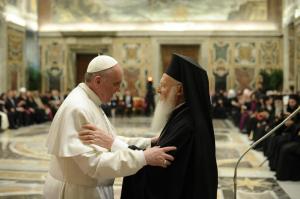
(Reposted from Vatican Radio) On Wednesday, March 20 2013, Pope Francis received several dozen representatives of the various Christian Churches and other world religions, who attended the Pope’s inauguration.
Among them were several leaders from the Orthodox Church, Orthodox Oriental Churches, the Anglican Communion, and various Protestant churches, including the Lutheran, Baptist and Methodist churches. Representatives from the Jewish and Muslim faiths were also present.
Please find below Vatican Radio’s translation of the Pope’s discourse:
Dear Brothers and Sisters,
First of all, heartfelt thanks for what my Brother Andrew* told us. Thank you so much! Thank you so much!
It is a source of particular joy to meet you today, delegates of the Orthodox Churches, the Oriental Orthodox Churches and Ecclesial Communities of the West. Thank you for wanting to take part in the celebration that marked the beginning of my ministry as Bishop of Rome and Successor of Peter.
Yesterday morning, during the Mass, through you , I recognized the communities you represent. In this manifestation of faith, I had the feeling of taking part in an even more urgent fashion the prayer for the unity of all believers in Christ, and together to see somehow prefigured the full realization of full unity which depends on God’s plan and on our own loyal collaboration.
I begin my Apostolic Ministry in this year during which my venerable Predecessor, Benedict XVI, with true inspiration, proclaimed the Year of Faith for the Catholic Church. With this initiative, that I wish to continue and which I hope will be an inspiration for every one’s journey of faith, he wished to mark the 50th anniversary of the Second Vatican Council, thus proposing a sort of pilgrimage towards what for every Christian represents the essential: the personal and transforming relationship with Jesus Christ, Son of God, who died and rose for our salvation. This effort to proclaim this eternal treasure of faith to the people of our time, lies at the heart of the Council’s message.
Together with you I cannot forget how much the council has meaning for the ecumenical journey. I like to remember the words that Blessed John XXIII, of whom we will soon mark 50 years since his death, when he gave his memorable inauguration speech: “The Catholic Church therefore considers it her duty to work actively so that there may be fulfilled the great mystery of that unity, which Christ Jesus invoked with fervent prayer from His heavenly Father on the eve of His sacrifice. She rejoices in peace, knowing well that she is intimately associated with that prayer “.
Yes, dear brothers and sisters in Christ, let us all be intimately united to our Saviour’s prayer at the Last Supper, to his invocation: ut unum sint. We call merciful Father to be able to fully live the faith that we have received as a gift on the day of our Baptism, and to be able to it free, joyful and courageous testimony. The more we are faithful to his will, in thoughts, in words and in deeds, the more we will truly and substantially walk towards unity.
For my part, I wish to assure, in the wake of my predecessors, the firm wish to continue on the path of ecumenical dialogue, and I thank you, the Pontifical Council for the Promotion of Christian Unity, for the help it continues to offer in my name, for this noble cause. I ask you, dear brothers and sisters, to bring my cordial greetings to the Churches and Christian communities who are represented here. And I ask you for a special prayer for me so that I can be a pastor according to the heart of Christ.
And now I turn to you, distinguished representatives of the Jewish people, to whom we are bound by a very special spiritual bond, from the moment that, as the Second Vatican Council said, “thus the Church of Christ acknowledges that according to God’s saving design, the beginnings of her faith and her election are found already among the Patriarchs, Moses and the prophets”.(Decree Nostra Aetate, 4). I thank you for your presence and trust that with the help of the Almighty, we can continue that fruitful fraternal dialogue that the Council wished for. And that it is actually achieved, bringing many fruits, especially during the last decades .
I greet and thank cordially all of you, dear friends belonging to other religious traditions; firstly the Muslims, who worship the one living and merciful God, and call upon Him in prayer. I really appreciate your presence, and in it I see a tangible sign of the wish to grow in recipricol trust and in cooperation for the common good of humanity.
The Catholic Church is aware of the importance of the promotion of friendship and respect between men and women of different religious traditions – this I wish to repeat this: the promotion of friendship and respect between men and women of different religious traditions – this is attested evident also in the valuable work undertaken by the Pontifical Council for Interreligious Dialogue. The Church is equally aware of the responsibility that each of us bring towards our world, abd to the whole of creation, that we must love and protect. And we can do a lot for the good of the less fortunate, for those who are weak and suffering, to promote justice, to promote reconciliation, to build peace.. But above all, we must keep alive in our world the thirst for the absolute, and must not allow the vision of the human person with a single dimension to prevail, according to which man is reduced to what he produces and to what he consumes: this is one most dangerous threats of our times.
We know how much violence has been provoked in recent history by the attempt to eliminate God and the divine from the horizon of humanity, and we feel the need to witness in our societies the original openness to transcendence that is inherent in the human heart. In this we feel the closeness also of those men and women who, while not belonging to any religious tradition, feel, however the need to search for the truth, the goodness and the beauty of God, and who are our precious allies in efforts to defend the dignity of man, in the building of a peaceful coexistence between peoples and in the careful protection of creation.
Dear friends, thank you for your presence. To all, I offer my cordial and fraternal greetings.
*My Brother Andrew – that is, Bartholomew I, Patriarch of Constantinople, Successor of Andrew, the brother of Peter.
Inaugural Homily of Pope Francis
HOMILY OF THE HOLY FATHER POPE FRANCIS
Saint Peter’s Square
Tuesday, 19 March 2013
Solemnity of Saint Joseph

Dear Brothers and Sisters,
I thank the Lord that I can celebrate this Holy Mass for the inauguration of my Petrine ministry on the solemnity of Saint Joseph, the spouse of the Virgin Mary and the patron of the universal Church. It is a significant coincidence, and it is also the name-day of my venerable predecessor: we are close to him with our prayers, full of affection and gratitude.
I offer a warm greeting to my brother cardinals and bishops, the priests, deacons, men and women religious, and all the lay faithful. I thank the representatives of the other Churches and ecclesial Communities, as well as the representatives of the Jewish community and the other religious communities, for their presence. My cordial greetings go to the Heads of State and Government, the members of the official Delegations from many countries throughout the world, and the Diplomatic Corps.
In the Gospel we heard that “Joseph did as the angel of the Lord commanded him and took Mary as his wife” (Mt 1:24). These words already point to the mission which God entrusts to Joseph: he is to be the custos, the protector. The protector of whom? Of Mary and Jesus; but this protection is then extended to the Church, as Blessed John Paul II pointed out: “Just as Saint Joseph took loving care of Mary and gladly dedicated himself to Jesus Christ’s upbringing, he likewise watches over and protects Christ’s Mystical Body, the Church, of which the Virgin Mary is the exemplar and model” (Redemptoris Custos, 1).
How does Joseph exercise his role as protector? Discreetly, humbly and silently, but with an unfailing presence and utter fidelity, even when he finds it hard to understand. From the time of his betrothal to Mary until the finding of the twelve-year-old Jesus in the Temple of Jerusalem, he is there at every moment with loving care. As the spouse of Mary, he is at her side in good times and bad, on the journey to Bethlehem for the census and in the anxious and joyful hours when she gave birth; amid the drama of the flight into Egypt and during the frantic search for their child in the Temple; and later in the day-to-day life of the home of Nazareth, in the workshop where he taught his trade to Jesus.
How does Joseph respond to his calling to be the protector of Mary, Jesus and the Church? By being constantly attentive to God, open to the signs of God’s presence and receptive to God’s plans, and not simply to his own. This is what God asked of David, as we heard in the first reading. God does not want a house built by men, but faithfulness to his word, to his plan. It is God himself who builds the house, but from living stones sealed by his Spirit. Joseph is a “protector” because he is able to hear God’s voice and be guided by his will; and for this reason he is all the more sensitive to the persons entrusted to his safekeeping. He can look at things realistically, he is in touch with his surroundings, he can make truly wise decisions. In him, dear friends, we learn how to respond to God’s call, readily and willingly, but we also see the core of the Christian vocation, which is Christ! Let us protect Christ in our lives, so that we can protect others, so that we can protect creation!
The vocation of being a “protector”, however, is not just something involving us Christians alone; it also has a prior dimension which is simply human, involving everyone. It means protecting all creation, the beauty of the created world, as the Book of Genesis tells us and as Saint Francis of Assisi showed us. It means respecting each of God’s creatures and respecting the environment in which we live. It means protecting people, showing loving concern for each and every person, especially children, the elderly, those in need, who are often the last we think about. It means caring for one another in our families: husbands and wives first protect one another, and then, as parents, they care for their children, and children themselves, in time, protect their parents. It means building sincere friendships in which we protect one another in trust, respect, and goodness. In the end, everything has been entrusted to our protection, and all of us are responsible for it. Be protectors of God’s gifts!
Whenever human beings fail to live up to this responsibility, whenever we fail to care for creation and for our brothers and sisters, the way is opened to destruction and hearts are hardened. Tragically, in every period of history there are “Herods” who plot death, wreak havoc, and mar the countenance of men and women.
Please, I would like to ask all those who have positions of responsibility in economic, political and social life, and all men and women of goodwill: let us be “protectors” of creation, protectors of God’s plan inscribed in nature, protectors of one another and of the environment. Let us not allow omens of destruction and death to accompany the advance of this world! But to be “protectors”, we also have to keep watch over ourselves! Let us not forget that hatred, envy and pride defile our lives! Being protectors, then, also means keeping watch over our emotions, over our hearts, because they are the seat of good and evil intentions: intentions that build up and tear down! We must not be afraid of goodness or even tenderness!
Here I would add one more thing: caring, protecting, demands goodness, it calls for a certain tenderness. In the Gospels, Saint Joseph appears as a strong and courageous man, a working man, yet in his heart we see great tenderness, which is not the virtue of the weak but rather a sign of strength of spirit and a capacity for concern, for compassion, for genuine openness to others, for love. We must not be afraid of goodness, of tenderness!
Today, together with the feast of Saint Joseph, we are celebrating the beginning of the ministry of the new Bishop of Rome, the Successor of Peter, which also involves a certain power. Certainly, Jesus Christ conferred power upon Peter, but what sort of power was it? Jesus’ three questions to Peter about love are followed by three commands: feed my lambs, feed my sheep. Let us never forget that authentic power is service, and that the Pope too, when exercising power, must enter ever more fully into that service which has its radiant culmination on the Cross. He must be inspired by the lowly, concrete and faithful service which marked Saint Joseph and, like him, he must open his arms to protect all of God’s people and embrace with tender affection the whole of humanity, especially the poorest, the weakest, the least important, those whom Matthew lists in the final judgment on love: the hungry, the thirsty, the stranger, the naked, the sick and those in prison (cf. Mt 25:31-46). Only those who serve with love are able to protect!
In the second reading, Saint Paul speaks of Abraham, who, “hoping against hope, believed” (Rom 4:18). Hoping against hope! Today too, amid so much darkness, we need to see the light of hope and to be men and women who bring hope to others. To protect creation, to protect every man and every woman, to look upon them with tenderness and love, is to open up a horizon of hope; it is to let a shaft of light break through the heavy clouds; it is to bring the warmth of hope! For believers, for us Christians, like Abraham, like Saint Joseph, the hope that we bring is set against the horizon of God, which has opened up before us in Christ. It is a hope built on the rock which is God.
To protect Jesus with Mary, to protect the whole of creation, to protect each person, especially the poorest, to protect ourselves: this is a service that the Bishop of Rome is called to carry out, yet one to which all of us are called, so that the star of hope will shine brightly. Let us protect with love all that God has given us!
I implore the intercession of the Virgin Mary, Saint Joseph, Saints Peter and Paul, and Saint Francis, that the Holy Spirit may accompany my ministry, and I ask all of you to pray for me! Amen.
Reconsidering Pope Francis on Liberation Theology
Another repost from Franciscan Blogger Daniel Horan:
Apostolic Blessing “Urbi et Orbi”: Pope Francis’ first public words

Brothers and sisters, good evening!
You know that it was the duty of the Conclave to give Rome a Bishop. It seems that my brother Cardinals have gone to the ends of the earth to get one… but here we are… I thank you for your welcome. The diocesan community of Rome now has its Bishop. Thank you! And first of all, I would like to offer a prayer for our Bishop Emeritus, Benedict XVI. Let us pray together for him, that the Lord may bless him and that Our Lady may keep him.
Our Father…
Hail Mary…
Glory Be…
And now, we take up this journey: Bishop and People. This journey of the Church of Rome which presides in charity over all the Churches. A journey of fraternity, of love, of trust among us. Let us always pray for one another. Let us pray for the whole world, that there may be a great spirit of fraternity. It is my hope for you that this journey of the Church, which we start today, and in which my Cardinal Vicar, here present, will assist me, will be fruitful for the evangelization of this most beautiful city.
And now I would like to give the blessing, but first – first I ask a favour of you: before the Bishop blesses his people, I ask you to pray to the Lord that he will bless me: the prayer of the people asking the blessing for their Bishop. Let us make, in silence, this prayer: your prayer over me.
[…]
Now I will give the Blessing to you and to the whole world, to all men and women of good will.
[Blessing]
Brothers and sisters, I leave you now. Thank you for your welcome. Pray for me and until we meet again. We will see each other soon. Tomorrow I wish to go and pray to Our Lady, that she may watch over all of Rome. Good night and sleep well!
Hopeful Words (reblog from Simone Brosig)
Thoughts from a Canadian friend i had the occasion to chat with after getting back from the Piazza last night:

Who is this Cardinal Bergoglio? Who will he become, this Pope Francis? My prayer is for a shepherd whose agenda is the Gospel of Jesus Christ. Nothing more. Nothing less. Here are some past words from Cardinal Bergoglio and now Pope Francesco. *

“The unjust distribution of goods persists, creating a situation of social sin that cries out to Heaven and limits the possibilities of a fuller life for so many of our brothers [and sisters].”

“Only someone who has encountered mercy, who has been caressed by the tenderness of mercy, is happy and comfortable with the Lord.”

“We live in the most unequal part of the world, which has grown the most yet reduced misery the least.”

“We have to avoid the spiritual sickness of a self-referential church. . . It’s true that when you get out into the street, as happens to every man and woman, there can…
View original post 160 more words
Perspective from the Piazza: Bishop Francis of Rome
The only problem with being in Piazza San Pietro for the announcement and presentation of the new bishop of Rome is that the cell networks and internet access all jam. Maybe I can reconstruct the impressions and my perspective from Rome tonight, as they came as pithily as possible:
[c.18:30] – just finished giving a conversational English lesson. Pretty sure there will be black smoke in half an hour. Maybe I should run over there anyway? Nah… I’ll just miss the smoke, it’s wet, and I’ve got work to do.
[c.18:50] – hm. I think Philippa Hitchen is on Vatican Radio, they should have the chimney on livecam. At least I can say I saw the black smoke ‘from a distance’ tonight if anyone asks. Heh heh.
[18:52] – a seagull on the chimney, says Msgr. Mark Langham on Facebook. Kinda reminds me of that ND game where the squirrel took to the field sophomore year…
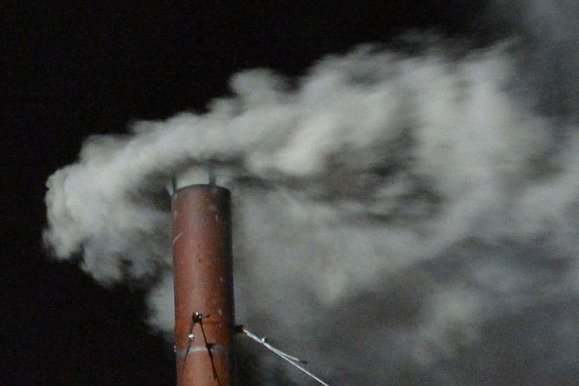
[19:06] – working on editing a friend’s article. Smoke! Hm… looks pretty dark grey. Really dark… e’ nero? E’ bianco? E’ nero. Maybe go back to editing… ok, one last look. Still grey… hey, is that bell moving? [commentator: “looks pretty grey, but wait, the bells!”]. Elected on the fifth ballot?? I thought it would be tomorrow at the earliest! This is only one more than Ratzinger.
[19:07] – knocking on doors. “Habemus papam!” start ringing our bell.
[19:08] – I’m going down there, now. Anyone wants to join me, I’m taking a taxi.
[c.19:20] – five of us went, after waiting forever (five minutes) for some people to change. Halfway to the cab stand, three jumped on the 81. Alex and I got in a cab. At about 19.40, near Chiesa Nuova, we see a group from the Russicum walking by, and we decided to ditch the traffic and join them.
[c.19:50] – arrive in Piazza San Pietro, someone in the group knows one of the security guys and we get into the square, all the way up to the obelisk. I’m wedged between U.S. college students from New York, an Italian sister with a robust singing voice, three Eastern Catholics and a prolific contributor to the New Liturgical Movement.
[time ceases to have meaning]
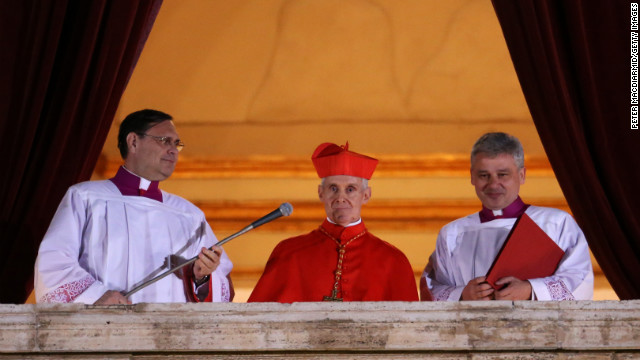
Cardinal Protodeacon Tauran: Annuntio vobis gaudium magnum: habemus Papam!
People of God: wild cheering and applause
Cardinal Tauran: Eminentissimum ac reverendissimum dominum, dominum Georgium
Me: Giorgio? George… maybe George Alencherry, the Syro-Malabar Major Archbishop?
Cardinal Tauran: Sanctæ Romanæ Ecclesiæ Cardinalem Bergoglio qui sibi nomen imposuit Franciscum.
People of God: Huh? Who? – polite applause, much checking of smart phones –
Me: Bergoglio? Which one was he? Italian? Pope Francis? Assisi or Xavier? or both? Can I be cautiously optimistic?
Overheard nearby: Francis? *shudder* That’s not good: All innovation is BAD.
Pope Francis appears a short time later, my impressions:
Hm. Almost nobody seems to recognize him. I remember being told the second election of 1978 was like this, the piazza was almost silent. Nobody knew Wojtyla, and they do not know Bergoglio, apparently. From Argentina, according to someone with web-access…
He reminds me of Papa Luciani, John Paul I, for some reason. Someone nearby says he looks like Pius XI. Simple, severe maybe, but simple. Am I smiling?
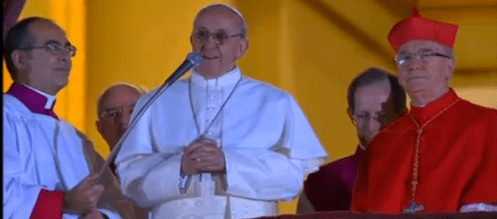
“Buona Serra”? Simple, good start…
“bishop emeritus of Rome Benedict…” how much better that sounds than Pontifex emeritus! Could we have an ecclesiologist pope?
His inclusive language seems to offend the more traditional minded among us…
That’s “bishop of Rome” at least three times now. Not pope, not pontificate, but bishop, bishop of Rome. Be still, my ecclesiologist’s beating heart! I think I really am smiling!
He seems so… humble. Almost awkward, these pregnant pauses, but I get the feeling he really did not expect to be there. Not an actor, not a professor… a pastor? A reformer? An introvert? Not sure what it means.
You know… Marini has not looked up from his shoes this entire time. In fact, he looks a little, um, how do I put this…
“He looks like he’s updating his CV, A.J., that’s what he looks like…”
I think he just said, “before a bishop blesses the people, the people should bless – that is, pray for – the bishop. so, I invite you to pray for me, as we start this journey together.”
“Buona notte!” – I cannot get over how refreshing his simplicity is, his somewhat akward honesty, and I do keep being reminded of Luciani. Francis, indeed. 😀
As we began to leave the Piazza, I ran into a Jesuit friend who supplied some details and reflections of his own: He’s Jesuit! He’s from Buones Aires. He said some very promising things tonight – his choice of name, the ecclesiological awareness of focus on the “bishop of Rome” rather than “universal pastor” or “supreme pontiff”, etc. But, a hesitation: “he brought some division to the Jesuits in Argentina; some see him as too conservative. Personally austere, yes, simple, yes, but we shall see”…
So, in summary: First Francis. First Jesuit. First from the Western Hemisphere. First non-European bishop of Rome in almost 1300 years (Gregory III from Syria). Chose a casual, informal greeting. Asked for the blessing of the assembly before he offered his own, and bowed to receive it from us. Clearly knows the pope is first and fundamentally the “bishop of Rome” (and the pope emeritus is really the bishop emeritus of Rome). He chose the simplest of the vestment options in which to appear (no lace, wooden pectoral cross) He will spend his first day visiting a shrine of Our Lady. He took his name in honor of Francis of Assisi, perhaps the most universally accessible saint we have, known for humility, care of creation and the poor, dialogue with Islam, and “rebuilding” a corrupt and failing Church. I think as we left the Piazza, most people still had no idea who had been elected – or perhaps they were just in a sort of joyful shock, the kind you get when something you have wanted for so long seems to be coming true, but you are not sure whether to believe it or not.
And, well, one of the guys I was with posted this when he got home tonight:
“Re, Sandri, Hummes and Kasper [sic] were on the balcony with him as he winged his way through the appearance. Traddies, get ready to bury your cassocks and black covered liturgical books in the yard.”

Beards for Bishops Campaign: Rome Edition
In the fall of 1997, I remember standing at the door to the Basilica of the Sacred Heart at Notre Dame, as I was congratulated several times on my appointment as auxiliary bishop of Fort Wayne-South Bend.
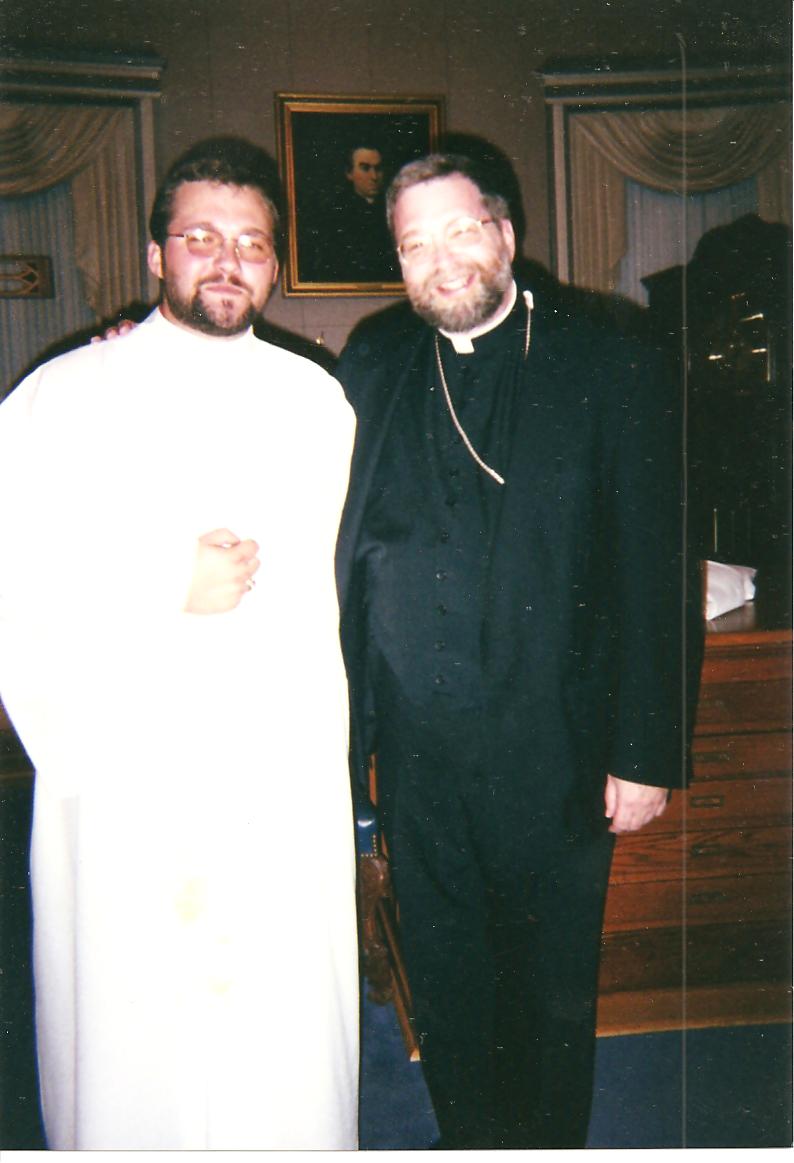
A.J. Boyd, Bishop Daniel Jenky, 1997
Of course, it was not me, but Daniel Jenky, CSC, rector of the basilica who had been so nominated. I was merely serving as vimpa for Bishop John D’Arcy, who was on hand to make the announcement. I was also jokingly referred to among the other servers and basilica staff as Fr. Jenky’s body double, so alike we looked with beard and glasses. Vested in alb and vimp veil, it is no surprise I was mistaken for the bishop-elect on more than one occasion that day.
We decided to dub his excellency as poster-bishop for our newly founded “Beards for Bishops” campaign. We – seminarians, servers, and theology students – felt it was high time for the lingering prejudice against hirsute hierarchs in the Latin church to come to an end.
When differences become polarized divisions, extreme positions are taken in reaction to “the other” that would not be considered in an objective, balanced mindset. Thus Reformed churches become iconoclastic and whitewashed, while Catholic churches spew baroque excess, each extreme fueling an even more extreme reaction. Similarly, as Eastern and Oriental churches maintained and promoted a manful and manly beardliness for its clergy. in the wake of division, the Latin west insisted on the clean shaven route. Perhaps in the wake of that move, clean-shavenness was purported to be too effeminate for the orders of the East, and so on.
In law, starting in the twelfth century, Latin clergy were discouraged and sometimes forbidden from growing their beards. The Council of Toulouse, in 1119, apparently threatened excommunication for those whos facial hair grew (or merely grew unruly, it is not clear), and Pope Alexander III (1159-81) ordered his archdeacon (think vicar general/chief of staff) to ensure that all Roman deacons and presbyters were clean shaven, by force if necessary. Gregory IX incorporated Alexander’s decree into canon law, and there it remained into the twentieth century. In 1866, the second plenary council of Baltimore explicitly outlawed beards for clergy in the U.S. The 1917 Code of Canon Law said merely to keep a simple hair style (CIC 136 §1), so the local law and cultural taboo remained. No legislation regarding facial hair remains in the 1983 code, Deo gratias.

Innocent XII
It was not a consistent ban, despite the attitude and cultural assumptions during the Pian papacies of the 19th and 20th century. The popes from Clement VII (1523) to Inocent XII (d.1700) certainly had beards (as did, if the mosaics at San Paolo fuori le Mura are to be believed, most bishops of Rome from Peter through the first millennium In fact, it was 800 years before we had the first beardless pontiff, in the person of Pope Valentine).
Nevertheless, the late pre-conciliar climate had ossified the ban on barbarous appearance, and even after the apparent change with Vatican II, a bearded bishops was still barely to be found in the western Catholic church. From those humble beginnings in 1997, the Beards for Bishops campaign is now even more humble, and ready to tackle the next challenge: a bearded bishop of Rome.
Quod non fecerunt Barberini fecerunt barbari, anyone?
A sadly small number of cardinal electors willingly wear wisdom-witnessing whiskers:
- George Allencherry, 69,
Major Archbishop of the Syro-Malabar Catholic Church - Moran Mor Baselios Cleemis, 53,
Major Archbishop of the Syro-Malankara Catholic Church - Reinhard Marx, 59,
Archbishop of Munich - Antonius I Nagueb, 77,
Patriarch emeritus of the Coptic Catholic Church - Sean O’Malley, 68,
Archbishop of Boston
One could add to that the hairier heads of the other Catholic Churches sui iuris, whether patriarch or major archbishop, given their office as heads of churches, and whether created cardinal or not, equivalent (at least) to the cardinal-bishops in dignity:
- Ibrahim Isaac Sidrak, 57,
Patriarch of Alexandria for the Coptic Catholic Church - Gregory III Laham, 79,
Patriarch of Antioch for the Greek-Melkite Catholic Church - Mar Ignatius Joseph III Younan, 68,
Patriarch of Antioch for the Syrian Catholic Church - Nerses Bedros XIX Tarmouni, 73,
Patriarch of Cilicia of the Armenian Catholic Church - Sviatoslav Shevchuk, 42,
Major Archbishop of Kyiv–Halyč of the Ukranian Catholic Church
(Their Beatitudes, Patriarchs Bechara Boutrous al-Rahi of the Maronites and Raphael I Louis Sako of the Chaldeans are clean-shaven; rumors of Latinization have neither been confirmed, nor denied.)
Of these ten, then, who is papabile? The retired Coptic patriarch is already a patriarch emeritus and unlikely to succeed another. The Antiochene may be seen as too old. The Ukranian major archbishop, de facto patriarch of the second largest of the Catholic Churches (after the Roman), is seen as the most likely of the non-cardinals, but as more than a decade younger than the youngest cardinal, it is still a long shot. And, the idea of electing an eastern patriarch as bishop of Rome may still be too great a change for too great a number of cardinal-electors, though there is a sort of precedent (thirteen Greeks, four Syrians, and two from modern day Israel/Palestine, if you count Peter himself).
Though I might personally welcome such a move, let us assume it is unlikely. That leaves only two villous vescovi among the princes of the Roman Church.
 Archbishop Reinhard Marx of München serves on the pontifical council for peace and justice and the congregation for catholic education, and is president of the German bishops’ conference Committee for Social Issues. He was elected a year ago as President of the Commission of the Bishops’ Conferences in the European Union. He has published books on Catholic Social Teaching, and has been a bishop since 1996. When he was appointed, German news agency Deutsche-Press Agentur, described him as “left of center” in general, but “moderately conservative” on doctrinal issues. There have been seven or eight German popes, depending on whether you count Stephen IX, born in Lorraine (now France).
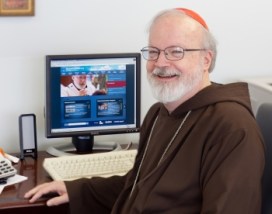 Archbishop Seán Patrick O’Malley of Boston is an Irish American Capuchin, with a record of cleaning up dioceses damaged by the sex abuse scandal (and the bigger scandal of their cover-ups by bishops). He was born in Lakewood, OH (where I lived for all of three months in the wake of the abuse scandal-induced hiring freeze on the diocese there in 2002). His doctorate is in Spanish and Portuguese literature and he was the first cardinal to start a personal blog and podcast, in 2006. He serves on the Congregations for Clergy and Consecrated Life, and on the Council for Family. There has never been a capuchin pope, an American pope, or indeed, a genuinely Western pope (that is, a pope from the western hemisphere!)
Could one of these two men be elected bishop of Rome later this week? If so, the Beards for Bishops Campaign will rejoice in the return of the razorless pontificate after centuries of suppression. Join us in prayer, invoking the patron saints of facial hair, St. Brendan the Navigator and St. Wilgefortis the bearded virgin and martyr.
 The Ecumenism Blog