
Home » Posts tagged 'Angelicum' (Page 4)
Tag Archives: Angelicum
The Rector Magnificus
It is said that the Dominicans have the best sense of humor, and this is because humor is a necessary part of Dominican spirituality. Without question the funniest guest we have had yet at the Lay Centre is the Rector Magnificus (read: President) of the Angelicum, Father Charles Morerod.
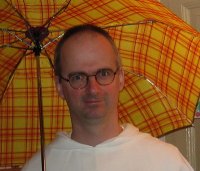
Charles Morerod, OP (Facebook photo)
After celebrating the Eucharist with us, the topic of Father Charles’ discussion was on what it means to be a Dominican. A Swiss Dominican serving as rector of the Angelcium, Secretary of the International Theological Commission, and one of three Catholic representatives on the ongoing dialogue with the schismatic sect of Marcel Lefebvre, there was plenty beyond the Order of Preachers to ask about. (as if that resume is not enough, Fr. Morerod is actually on Facebook! Yes, you can find him on my friend list!)
St Dominic was a Cathedral canon with the Bishop of Osma, Spain on a journey to make arrangements for a royal wedding which never happened. Passing through regions of France dominated by the Albigensians/Cathars, Dominic was taken by the lack of good preaching in the region, which lead the poorly catechized residents to gravitate toward the dualist heresies. Further, he was disturbed by the fact that many of the preachers that were available to the people of the region were failry weatlthy monastics or papal legates. So, instead of returning home, he stayed to preach and eventually a following grew.
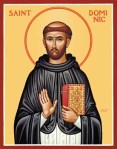
St. Dominic, Founder of the Order of Preachers
He was an efficient organizer, and conscientious that the community not become “his” community (reminds me of Father Scott!) – In fact, his humility was so complete that when he died, his order buried him and promptly forgot which grave was his. When, 13 years later, Pope Gregory IX wanted to formally canonize Dominic, the Order was not entirely sure where to find him. Making their best guess, they opened a sarcophagus and discovered “the smell was quite pleasant, so, it must be the saint!”
Student Pilgrimage to the Sanctuary of St. Gabriele, C.P.
Before coming to Italy, I had never met a Passionist and really did not know much about the order. I think the only one I had even heard of was New Testament scholar Donald Senior, president of Catholic Theological Union in Chicago.
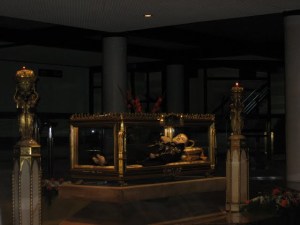
St. Gabriele of Our Lady of Sorrows, 1838-1862
In the nearly 300 year history of the order, however, they have clearly made an impact on Italy and other parts of the world. The monastery where the Lay Centre finds its home is certainly one of the largest in Rome. And one of the Passionist saints, the young St. Gabriele of Our Lady of Sorrows, is one of the most popular in Italy. It was to the shrine and pilgrimage center of St. Gabriele that the students of Rome were invited on Saturday.
This is the seventh annual pilgrimage of the students of Rome at the beginning of the academic year, and the first to go to the Santuario San Gabriele at Isola del Gran Sasso d’Italia, in the Abruzzo region – about two hours bus ride from Rome, and not far from L’Acquila, epicenter of the 5.8 tremor in April.
Of the 308 deaths in the earthquake, 50 were university students, who were remembered at the liturgy and throughout the day at the retreat.

Basilica Antica S. Gabriele
This serious note was mixed with the World Youth Day style music and liturgy that seemed to mark the tradition for the weekend – it reminded me, in fact, of our Archdiocesan Youth Convention for high school students, which was celebrated the same weekend in Seattle. Except that there were a couple hundred priests (mostly graduate students) – so many, in fact, that the communion procession for the presbyterate took longer than for the rest of the assembly, which I do not think I have seen any other time.
The Roman Classroom, or, Reflections on Methodology and Pedagogy in the Pontifical Roman Universities from an American Catholic Paradigm Typified by L’Universite de Notre Dame du Lac
What is it like studying in Rome? Are the courses challenging? Are the students on par with peers in the U.S.? Is the university academically rigorous? Are the faculty orthodox? How does it compare to [Notre Dame/Seattle University/Catholic University]?
These are the kinds of questions I have had from a number of friends and colleagues, and I thought I would address them together once I had had some time to get a sense of the pedagogy here.
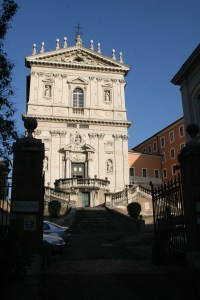
Church of Dominic and Sixtus at the Angelicum University
It is a different system, no question. The first thing to note is the nature of the university. The Universities are really just buildings with classrooms, and very minimal administrative staff. The entirety of the Angelicum – classrooms, offices, chapel, faculty residences, library and bookstore – is about the same size as Hunthausen Hall at SU, Caldwell at CUA, or O’Shaughnessy at ND. This is because the university really only offers the classes, mostly lectures and a small number of seminars. It is assumed that the bulk of your formation actually happens elsewhere, specifically, independent research, formation in community, and the experience of being in Rome.
My specialization does not even use the university library, for example. Instead, we have access to the Centro Pro Unione, run by the Society of the Atonement; that is our library. Sure, it is about a 25 minute walk from the Angelicum, but it’s a walk that passes by the Trevi fountain, the Pantheon, Piazza Navona and some of the most famous gellateria in the city, so one cannot complain. Moreover, there is a lot of time for research, so once I settle on an idea, I will not be bogged down by unwanted topics in order to pursue it.
The presumption of the university is that its students live in a house of formation, one of the “colleges” around Rome – and these are operated entirely separately from the universities. The problem is, of course, that only about 70% of students have access to one of these colleges as they are usually established either by national bishops’ conferences exclusively for priests and seminarians, or by religious communities for their own members. That leaves a significant number of students – deacons, lay ecclesial ministers, non-ecclesial lay students and non-Catholics – without an essential part of their education in Rome. The Lay Centre is the only such college trying to meet this need, and it is a private venture. It is also limited in space, with only room for about 20 residents out of the hundreds needing such a place. (Though get the impression the quality of life and of formation here exceeds what can be found in many of the national colleges for seminarians and priests!)
Further, I think the course load is intentionally light, though it does not appear this way at first. It is normal to be registered for about 8 or 9 courses a semester, one of which is a seminar. Whereas the typical 3-credit course in the States meets for 3 hours in two or three classes a week, here we get 90 minutes, once a week – about half as much time. The reading load is considerably less, too, if you just look at the syllabi. Two of my courses have only one required text of about 200 pages each, for the entire semester. The rest rely entirely on lecture notes. I have a total of 30 pages of writing due this semester, and most final exams are oral rather than written. (I am remembering my first semester sophomore year at ND, over 100 pages on 60 different topics, not counting finals!)
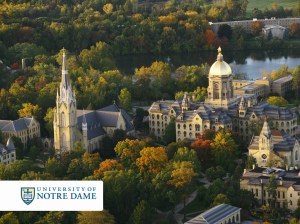
Sacred Heart Basilica and Main Building, University of Notre Dame
The difference between being located in South Bend, IN and in Roma cannot be overstated, though. It is easy to take on a thousand pages of reading a week at ND when there is nothing to do otherwise anyway. Here, if you want to learn about early Christianity or the history of the papacy, go for a walk. San Giovanni in Laterano is ten minutes from here. San Clemente is even closer. The Vatican is a few metro stops away. Just in the last week, we have had dinner with two of the three Catholic representatives on the reconciliation talks with the Lefebvrite schismatics (Archbishop Ladaria and Charles Morerod, OP). The week after the press release about the Anglican personal Ordinariates, we got to talk with two different members of the Pontifical Council for Christian Unity. Then, of course, the discussions had over dinner and caffé more than make up for the pedantic lecture style in some of the classrooms.
It is important to note the international character here too. Granted, ND and CUA were both pretty international, but I think this is the most mixed place I have ever been. I am frequently the only native English speaker in a class, or one of two. It seems to be a good representation of the Church in general: lots of representation from Africa, southeast Asia, India, and Eastern Europe. (Some from Latin and South America, but most of them seem to go to the Gregorianum rather than the Angelicum). This probably makes lecture rather than group discussion in class more feasible, and accounts for what seems like a slow pace.
We had elections? (We have a government??)
Today I was blessed with a lesson in Italian culture that I could not have asked for. I witnessed a genuine Italian election. At least, it was supposed to be an election. And I think I was supposed to vote, too.
As a Catholic and an American, I feel it is more than civil duty to be a well-informed citizen and to participate in elections. It is a moral imperative.
So, when Karina, one of my housemates, mentioned at breakfast this morning that our second class of the day was cancelled due to student elections, I was intrigued. In fact, last night was the first time anyone had mentioned the fact that we even had student representatives, or a government of some kind… though no one was really clear on what they did, who they were, or when the elections were. No mention of this is made in the 300 page, mostly bilingual Ordine degli Studi except in the Italian language calendar which indicates only, “Elezioni Studentesce (10.30-12.15)” on this day.
Today, when we arrived at the Angelicum, there were a few copies of an “avviso” pinned to some classroom doors, apparently informing people (in Italian) that elections were being held today but without explaining much else.
At the appointed hour, our professor seemed mildly surprised to learn that his class was cancelled due to elections, and did not really know where we were supposed to go, or who was coordinating them.
The Angelicum is not really that big. One can peek into every classroom in about 15 minutes, and that is about how long it took me to find no one gathering to elect anyone, anywhere.
A fellow Anglophone student who has been here a few years, Kim, found me and decided he would introduce me to Italian-government-inaction, so together we continued the scavenger hunt for clues. After another search we found canon lawyers getting ready to elect someone from their faculty, some first cycle (Baccalaureate) students who had had elections in their classes, and finally we found a Canadian Anglican priest who had been the License representative last year, but who was equally unaware of where we were supposed to be doing elections this year.
At that point, in true Roman fashion, we decided nothing could be done and headed to the student bar for a cappuccino. Naturally, it was after caffé that someone walking by mentioned that the elections for student president were going to be held in a few minutes in the John Paul II Aula Magna (the giant lecture hall which seast several hundred).
Gathered there were less than 50 people (out of about 1400 registered students), almost all of whom seemed to be Italians (probably the entire Italian student population). The proceedings were held entirely in Italian, and when they started calling for votes, our request for a translation gained only a few brief comments in English.
Apparently, the sitting president was pointing out that with the absence of either the Rector of the university or the General Secretary precluded us from moving forward with the election. Moreover, only one candidate had met the (unpublished) deadline for submitting his name. So the discussion was to either take a non-binding vote to recommend another general assembly, to refer to the rector the current candidate, or to just ask him to appoint somebody.
At that point, people just started to leave. As far as I can tell, we did not really vote on anything, or decide anything. But at least I got to see a genuine Italian electoral process in action!
Unusual garb
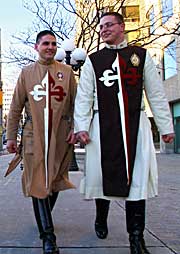
Distinctive garb of the Heralds of the Gospel lay institute
When i mentioned in an earlier post that virtually everyone in Rome has a uniform and/or title, including most of the laity, i was not kidding. (Though, about the “Almost Reverend” i was kidding. Mostly.)
The Heralds of the Gospel are one of the many new lay movements in the church, not a religious order but an “international association of pontifical right” (like Cursillo, or the Militia Immaculata). They have a very distinctive “habit”, which i first encountered on the steps of the Angelicum. I undertand, too, that “habit” is reserved for members of religious orders -and by some accounts, really even more restricted to members of monastic orders only- but the distinctive “uniform” for other forms of religious, consecrated, ecclesiastical or lay life are generally refered to only as “unusual garb”.
We also found some official clerical sandals by Birkenstock at one of the ecclesiastical shopping centers. Fairly reasonably priced, too. Just in case you’re in the market…
Last, but not least, i am told that the Caribinieri (ubiquitus military police) uniforms are designed by Armani. I have seen the officers driving department-issue BMW’s too. Carl: forget the US Border Patrol, come to Italy!
21st century tech in a 16th century university
I am actually now online at the Angelicum. Interestingly, the wireless is open and unencrypted, but you have to meet with one Father Stancotti, OP to get him to enter the secret code to allow your connection to the local network actually reach out to the internet. (It seems we are each assigned a specific IP address that he has to activate from his quarters, or some such). I finally tracked him down this afternoon when a seminar i thought about taking was either cancelled or mysteriously moved without notice.
Anyway, i have mentioned to some that as of last tuesday, i was no longer able to download emails to my outlook client (prior to that, at the Lay Centre once the wireless was up, i had no problem). Sending has been no problem, but recieving has been limited to the webclient, which has been very sketchy.
So, it should be no surprise whatsoever, that for the last 30 minutes my computer has been downloading hundreds of emails dating back to 12 October 2008. Coincidence that my last successfully recieved emails were 12 October 2009? I think not! It means something, I just don’t know what. Any Microsofties out there have an idea?
All those emails that i lost when my laptop crashed in January? They’re all coming back. It remains to be seen if i get those sent in the last week and a half, but at the rate things are going (I’m at 1360 emails and counting, only up to December 20, 2008) I’ll find out in about an hour!
Shopping for Roman collars
Everyone in Rome has a uniform and a title; and that’s if you are a nobody. If you are important, you also have a stamp, a wax seal, and most likely a signet ring. Perhaps this is why electronic means of communicating, providing identification, registering for classes, paying bills, and the like are so difficult and considered downright foreign here. I’ve gone through i don’t know how many hard-copy pictures of myself, and every correspondence to everyone needs to be an original letter, signed, co-signed and countersigned, then stamped in duplicate or triplicate.
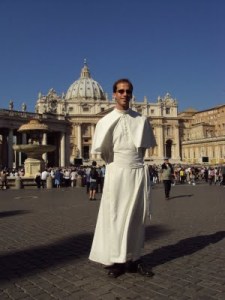
Norbertine Habit
But back to the uniforms: One of the many blessings of being in Rome is seeing the life of the church in all its profound diversity. You cannot maintain the illusion of a monolithic Catholicism very long in this capital of the church. I’ve seen habits for orders i had heard of but never met: Norbertines, for example, dress in a white simar and fascia looking almost identical to the pope. Then there are those i did not even know existed: the Teutonic knights, apparently, are back as a diocesan order, and looking very medieval.
Even most of the lay people around here are in ecclesiastical garb, particularly seminarians and lay religious, even during classes. So, naturally, I am on a mission to discover the appropriate ecclesiastical garb for a lay ecclesial minister. After all, if a student candidate for ministry gets a uniform, so too should someone already in sacred ministry, no?
(The current favored title is “Almost Reverend…”, or “Your Mediocreness”, and the garb is a white or black dress shirt with banded collar, though I am open to suggestions. But, I digress.)
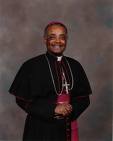
Archbishop Wilton D. Gregory
Allora… I decided to peruse the ecclesiastical shopping district near the Pantheon with Stian, an Anglican seminarian and friend of mine who shares that you can get four clerical shirts in Rome for the price of one in Norway.
We picked up a couple new friends on the way, Matthew, from Australia, and Cosima, from Germany. While Stian was being fitted for his clericals, the rest of us were perusing the mitres, zucchetti, and birettas that seemed to be available over the counter.
Did you know that with an ecclesiastical doctorate one is entitled to wear a biretta with the appropriate color trimming? For theology, it’s scarlet; canon law is green, etc.
As we were about to leave in search of a pizzeria and gellateria, America’s lone representative to the Synod for Africa, Archbishop Wilton Gregory of Atlanta, walked in for some shopping of his own. He was kind enough to stop for a brief chat about the Synod, and exchange a warm greeting before we moved on for pizza and gelato. At least now we know we were in the right shop!
 The Ecumenism Blog