
Home » Theology and Ecumenism (Page 9)
Category Archives: Theology and Ecumenism
Teaching in New Orleans
What does a humanities graduate student do for summer work in this economy? “Not much” is the punch line most are looking for, but I have had a few rewarding opportunities for which I am grateful.
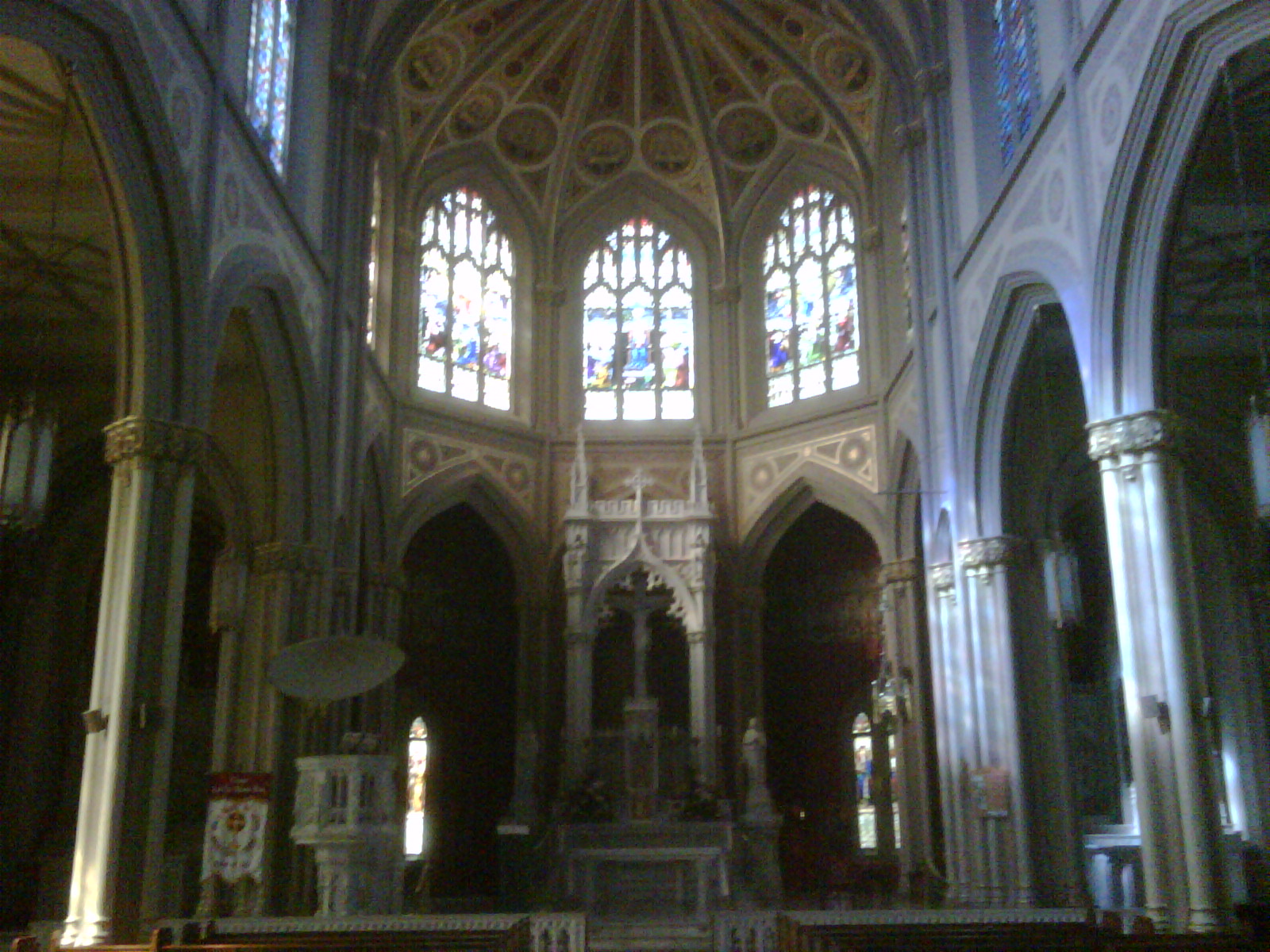
Holy Name of Jesus Parish Church, Loyola Unviersity New Orleans
There is still some room on my schedule for some others, if you know of any! Some of my usual work was not available – I have served as faculty or field staff for the Vicar for Clergy, the Faith Formation, Liturgy, and Youth & Young Adult Ministry offices in the past, but several budgets have been cut, and other classes were booked as early as January, and I only started looking in February!
I will be teaching two courses on the Eucharist for our Liturgy Ministers Institute, and working with a couple parishes on leadership development and reorganizational processes, but the most interesting offer was a 10-hour course for the Archdiocese of New Orleans’ Institute for Catechetics and Spirituality, which I taught this week. “An Introduction to Ecumenism and Interreligious Dialogue” – ten hours is nowhere near enough, but sadly more than most in ministry get!
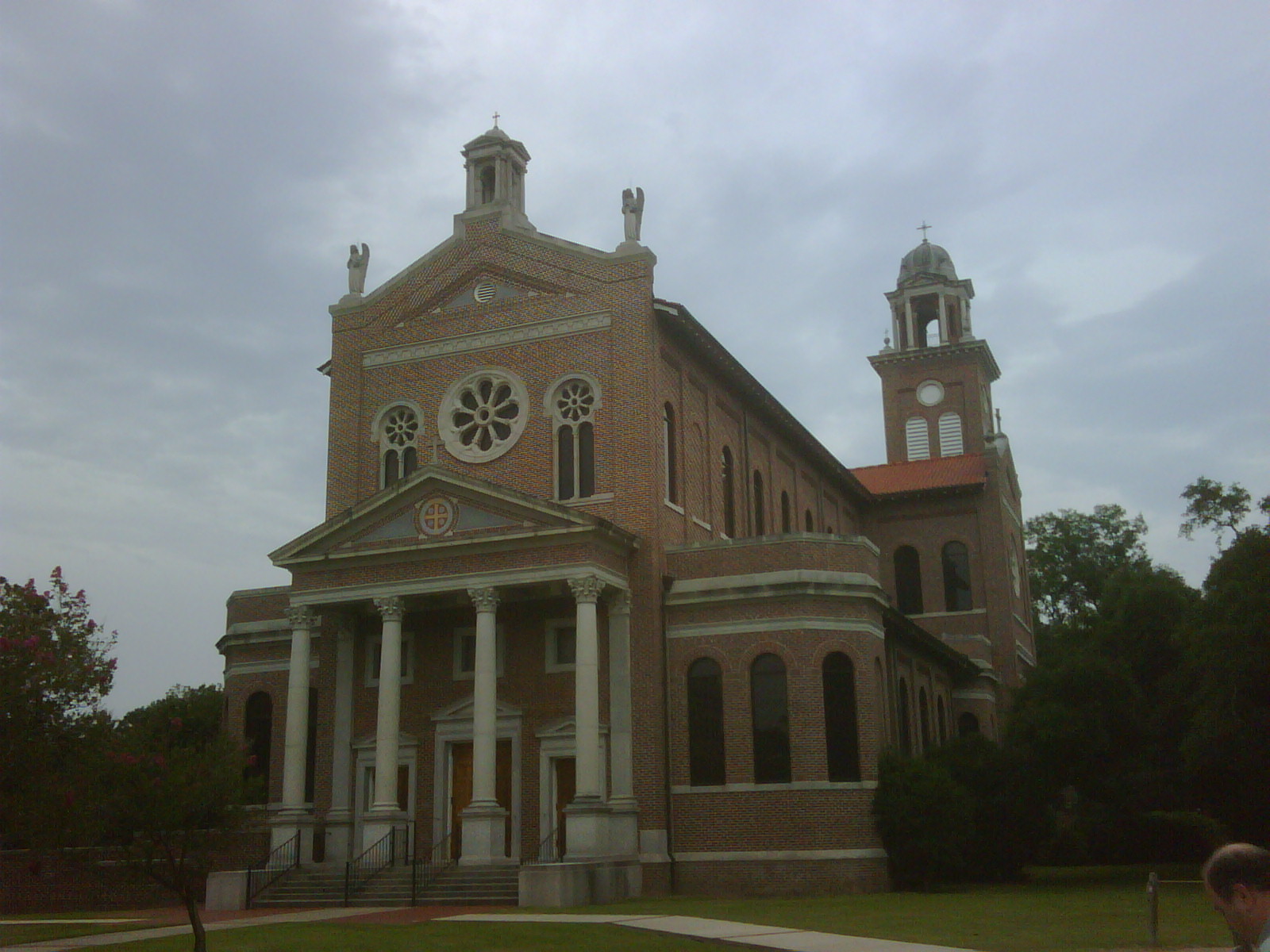
St. Joseph Abbey Church
The Big Easy was hot and humid, but a year and Rome had prepared me. I was only stateside for a few days and just about recovered from jetlag when I left back across the country on a flight almost as long as the one that brought me home from the Netherlands – a reminder that Euclidean geometry does not apply when making flight plans!
My host for the week was a friend and fellow ecumenist/lay ecclesial minister, Buddy Noel. My first moments in New Orleans provided an opportunity for prayer. On his way to the airport to pick me up, Buddy was caught in one of the South’s infamous downpours, and his car hydroplaned into the one in front of him in a backup on the Interstate. At least 12 cars were involved in a number of different collisions in the same area at the same time. His car totaled, Buddy was able to walk away with only bruises from the seatbelt and airbag. As he was making calls from the side of the road, his phone died. Long story short, he got a ride to the airport and had to have them page me, just a couple hours after his accident. I have been given great hospitality before, but this takes things to the extreme!
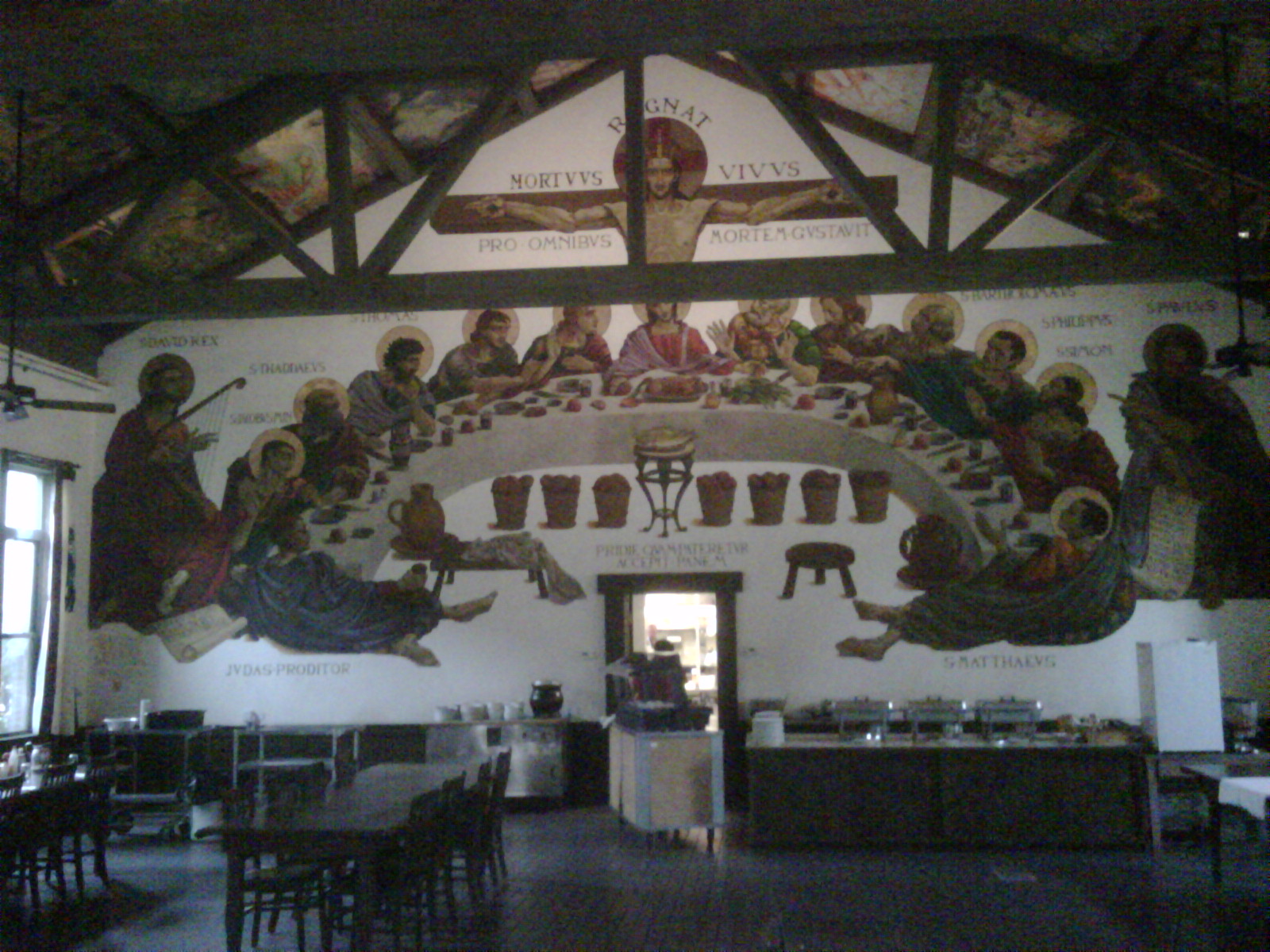
Last Supper, Refectory of St. Joseph Abbey
With a small group for the class, I was able to tailor much of it to some of the questions and expectations of the students, who were a mix of parochial school teachers, parish staff, and interested lay people. And nothing reinforces one’s own studies like teaching a topic, especially when you have to distill the highlights of a dozen years of study into a few hours. It also gave me plenty of time to talk with people and find out a little about the state of the church in one of the Catholic culture centers of the U.S. It was also only my second time to New Orleans, the last being just before Katrina; this time, they were just fitting the well with the new device to see if they could finally stop the largest oil disaster in history.
Last Supper (detail): Salt and pepper shakers, eh?
Archbishop Gregory Aymond has been the Ordinary there for just about a year, the first native of the diocese to serve as its bishop. Everyone I spoke with was positive about his appointment, with sentiments ranging from pride for a home-town boy done well to enthusiasm for his ecclesiology – and apropos to my visit – his commitment to local ecumenism.
The city has recovered its population and most of its infrastructure from Katrina, which hit nearly five years ago, but there have been changes. The Lower Ninth Ward looked like a field with a few funky, new houses scattered throughout – you would never know it had been a crowded urban neighborhood until the storm surge. There were still signs of the Katrina, a few gutted and abandoned houses throughout the city, a few roads sinking into the silt, but these were the exception rather than the rule. One of my students had been involved in a Chinese Catholic community that had been fairly active before the storm, whose members are now in diaspora around the country; A similar story with some of the small Eastern Catholic parishes in the diocese. Several people have simply moved to the other side of Lake Pontchartrain.
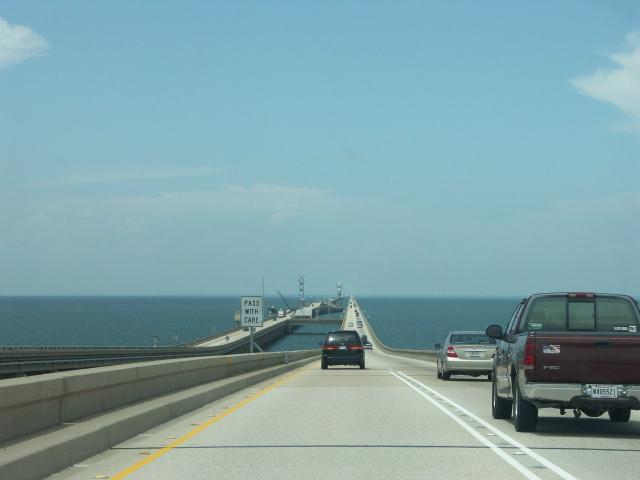
Lake Pontchartrain Causeway
The hospitality was generous and the food was excellent; the company was both! I was blessed to talk with new people each night, sample my first Po’Boys and some Gulf Coast seafood (sans oil), and wander the French Quarter, complete with obligatory beignet and Café au Lait. We prayed evening prayer with the Benedictines at St. Joseph Abbey, and I rode across the longest bridge in the world. Imagine driving onto a bridge and not being able to see land at the far side! The Lake Pontchartrain Causeway is about 24 miles (38.5km) from one shore to the other.
One little tidbit I picked up that fellow pastors and pastoral workers would find interesting, as well as the discussions around parish closings and reconfigurations after Katrina, was the relationship of parish and parochial school. Unlike the northwest, where a fractional minority of Catholic students attend Catholic schools, most in New Orleans do so. The relationship is a little better developed in some respects, as well – for example, the parish Director of Religious Education oversees the curriculum and instruction in both the parish religious education and youth ministry programs as well as the parish school classrooms.
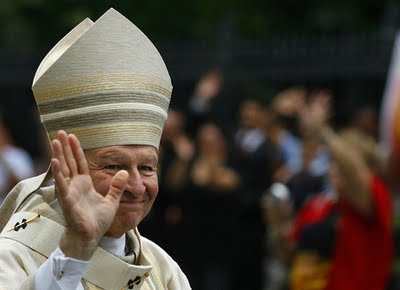
Archbishop Gregory Aymond of New Orleans
The Year of the Priest: Corresponsibility of Priests and Laity
The Lay Centre has three major aspects to its ministry of hospitality and formation. The first is the one most familiar to anyone reading my blog or following my studies, which is the community of students and scholars who live in the house of formation throughout the academic year (Oct-June) and who eat, pray and learn together in an ongoing dialogue of life. The second is the ongoing adult formation offered (mostly) to the English-speaking population of Rome. Theology, spirituality, church history, liturgy, art, and architecture offered by faculty of the pontifical universities and visiting scholars every Thursday morning as part of the Vincent Pallotti Institute.
The third piece of the mission is the summer seminars and retreats offered by the lay centre. During June, July, and September groups come in from around the world to spend a week in Rome. Some have their own agenda and primarily enjoy the hospitality of the Lay Centre, while others are sponsored by the Centre directly and open to anyone from around the world.
A few years ago I remember hearing about Rome’s first-ever symposium on Lay Ecclesial Ministry, and recall thinking to myself, “First? This has been going on 50 years and they are only now talking about it???” Little did I know. (One can hear about how slowly time moves in the Eternal City, but you really have to be there to appreciate it, soak it in, and start wondering what all the fuss was about back when you cared about things like deadlines, traffic laws, and absolute concepts of any kind…)
One of the programs offered this summer was the latest in the series touching on lay ecclesial ministry, but with a timely twist. In honor of the Year of the Priest, and timed to coincide with the closing festivities of the year, the theme was taken from Pope Benedict’s address to the annual convention of the diocese of Rome (given at St. John Lateran on May 26, 2009) and again later to the presbytery of Rome at the beginning of the year: “Corresponsibility of Priests and Laity”.
The unique opportunities for a program like this in Rome include access to so much of the Church’s history within walking distance, access to curia officials, access to representatives of the Church from all over the world, and of course the hospitality of the Lay Centre.
The program progressed through the centuries day by day, with an examination of key saints and their experience of “corresponsibility”. We studied St. Paul and his collaborators with Abbot Edmund Power of the Benedictine Abbey of St. Paul Outside the Walls – guardians of the tomb of the great missionary and co-patron of Rome. St. Justin Martyr, a layman, buried at St. Lawrence Outside the Walls. Pope St. Gregory the Great, with his oratory of St. Andrew is literally just over the wall from my Roman home. St. Vincent Pallotti was an early modern pioneer of lay formation.
Contemporary organizations and developments we looked at included the Emmanuel Community, Sant’Egidio, the Pontifical Council for the Laity, and the Union of the Catholic Apostolate. Presenters included Dr. Marian Diaz, Fr. William Henn of the Gregorian, Ms. Ana Crisitina Villa-Betancourt of the PCL, Fr. Jean Baptiste Edart of the Emmanuel Community, and John Breen of the Beda College in Rome. The participants were mostly students and (both lay and ordained) ministers from the U.S., but included one Dutch pastoral life director.
[Further Reflection to Follow]
The Dialogue of Life in Rome
A former student-resident of the Lay Centre returned this semester as a visiting professor at the Pontifical University Gregoriana (the Jesuit university down the road). Dr. Esra Göezler is a Turkish Muslim who had studied in Rome and returned to co-teach a course with Christian and Jewish scholars, and as a scholar-in-residence at the Lay Centre.
Near the end of the semester Esra sat in a panel presentation at the Lay Centre with a German Jesuit and an Italian Jewish reporter titled “Abrahamaic Religions in the Dialogue of Life in Rome” in which each participant shared their experience of living in the Eternal City in the daily life dialogue with the other Abrahamic faiths. The Lay Centre and PISAI – the Pontifical Institute for the Study of Arabic and Islam, another Jesuit faculty in the City – featured prominently in the discussion.
Over the next few days, Esra provided further opportunity for dialogue and encounter, as the Lay Centre hosted the (brand new) Turkish Ambassador to the Holy See, Professor Kenan Gürsoy and his wife for dinner on 25 May. The following evening Padre Miguel Ayuso-Guixot, director of PISAI presided at our final mass and community night of the academic year. We were honored by the presence and insights of all three distinguished guests by Esra’s initiative.
At around the same time we heard good news about our housemate, another extraordinary Muslim scholar, Rezart Beka of Albania. Rezart has been in Rome this year on scholarship from the Nostra Aetate Foundation, set up in 1990 by Pope John Paul II for non-Christians to study Christianity at the pontifical universities in Rome. Scholars usually stay for one semester, and Rezart was already granted an extension. Facing the possibility of losing him as a student next year as the scholarship came to an end, a donor has set up an entirely new scholarship for Muslims to study at PISAI and Rezart is the inaugural recipient!
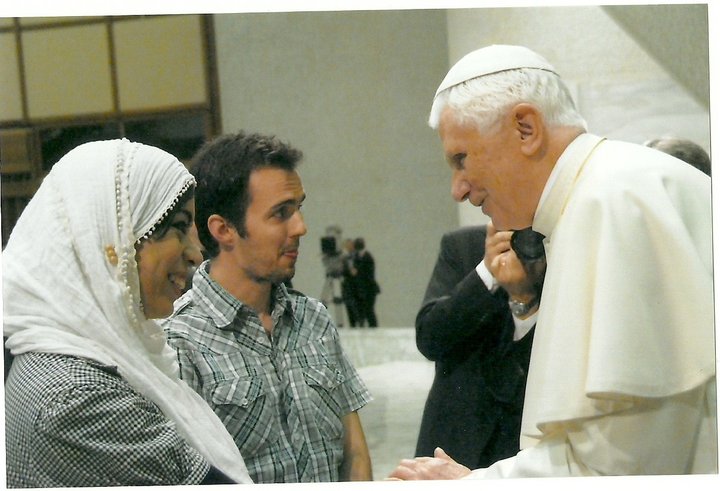
Lay Centre residents Nagwa Zarkaa Elymama (Egypt) and Rezart Beka (Albania) are presented to Pope Benedict XVI
Russian National Orchestra in the Vatican
How often is St. Peter’s Square turned into a parking lot? The cabbie that dropped us off said he has lived in Rome for half his life, and never seen it. But that was the sight that greeted us as we were dropped off at the Paul VI Auditorium for what promised to be an enjoyable afternoon out with the Holy Father (and a few other folk).
These two days have been celebrated as “Russian Culture Days at the Vatican”, one of the key public events of which was today’s concert by the Russian National Orchestra, a gift of the Russian Patriarch Kirill I to Latin Patriarch Benedict XVI.
Metropolitan Hilarion Alfeyev, the President of the Department for External Affairs of the Patriarch of Moscow (read: top ecumenist), personally presented the gift of the concert to His Holiness, which included a Symphony in Five Parts composed by the metropolitan himself. The concert included pieces by Rachmaninov, Rimski-Korsakov, and Musorgskij by the Russian National Orchestra; a variety of pieces by the Russian National Horn Choir, and another selection from Musorgskij and Rachmaninov with the Synod Choir of Moscow before all three combined for the final Symphony piece by Metropolitan Hilarion.
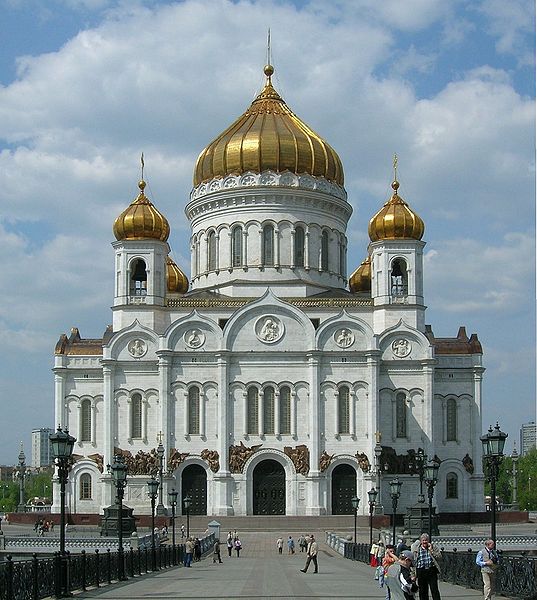
Cathedral of Christ the Savior, Seat of the Patriarch of Moscow and All Russia
On the way into the building, I kept getting saluted by the Swiss Guard. At first I kept looking to see if they were saluting everyone, or if some bishop was walking behind me. Eventually we figured that in my black suit with a small red Jerusalem cross in my lapel (a souvenir from my recent pilgrimage) they may have mistaken me for a Knight of the Holy Sepulcher! Not sure there are any this young, though!
As most know, I have an affinity for things Russian, including the music, so this was a special treat for me – to combine my love of Russia, ecumenism, the Church and the Vatican all into one event. We also got seats just behind and to the right of the Holy Father and the cardinals, which made it that much more exciting. This was my first time inside the Paul VI auditorium, which can seat about 6000 people, and which is entirely powered by solar panels on the roof.
There is no question that, with the election of Benedict XVI and even more so with the election of Kirill I, relations between Rome and Moscow have thawed considerably. We continue to pray for the unity of the world’s largest Orthodox Church and the Catholic Church, and look forward to fruits of dialogue even more beautiful than an afternoon’s concert!
Self-Emptying and Identity in a Secular World
The Gregorian (my current university’s Jesuit rival just around the corner) has been hosting a lecture series this semester on Religion and Identity, featuring speakers from a number of countries speaking on a variety of related topics. While some of my housemates made it to most of the program (Eveline, Rezart, and Esra especially), I had conflicts most days and only made it to one.

Prof. Harvey Cox
As I was walking across the garden on my way out, I ran into Monsignor Dick Liddy, a priest from Seton Hall University who was staying at the Lay Centre this week along with the rest of the New Jersey school’s “core faculty”. Upon inquiry, I told him I was headed to a lecture entitled “Kenosis and Identity in a Secular World” with an American theologian Harvey Cox.
“Harvey Cox? He was big around here when I was a student!” …which was in the late 60’s.
Thus was my introduction to the man shortly thereafter presented at the Pontifical Gregorian University in Rome as the “most renowned contemporary American theologian”. I have to confess, though the name rang a bell because of my post-academic reading in Pentecostalism and postmodernism, I cannot honestly say I encountered his work in four years at Notre Dame, or in two at CUA. It is possible, there was a lot of reading and it is hard to remember every author I encountered. I certainly never read his 1965 landmark work, The Secular City, much to the shock of my north-European colleagues here: “It’s THE book of our age! How could you not have read it?” said one.
Seems I have more to read than thesis material this summer.
Still, it is impressive to meet someone whose work was already so influential 45 years ago, and is still not merely alive and well, but actively teaching and writing!
The key message of his presentation was this: is it ever truly dialogue if we are guaranteed to “emerge safely”? That is, if we know we will emerge unscathed, unchanged, untouched by dialogue, have we actually engaged in dialogue at all? We have to empty ourselves to engage the other, be open to being convinced by the other while being true to our own identity.
His frequently engaged image was that of an anchor. While most of us think of the anchor as the ultimate brake, the best way to stay stuck in one position to ride out the storm, there is another use. Lest we think we must drop anchor and wait til the “storm” (of modernity, postmodernity, society, whatever) passes, we are called to remember the other use for this ancient symbol of our faith – assistance staying upright and navigating the rough seas while on the move to a destination.
[Again, I have a disclaimer, I am writing these up a month behind, and I do much better reading a text than listening. And anyone who has ever seen my handwriting knows that even taking notes without my computer does not help much!]
Indulgences as Ecumenical Barometer
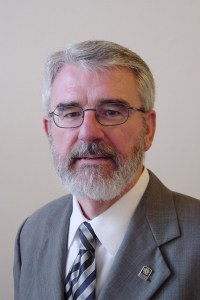
Prof. Michael Root
Leave it to a Lutheran to research and understand indulgences to the point that he probably knows more about them than any Catholic other than the Major Penitentiary himself. Not just any Lutheran, of course, but Professor Michael Root, a lay ecclesial minister and theologian-ecumenist of the Evangelical Lutheran Church in America. I have had the pleasure of meeting Dr. Root and listening to him on a few occasions – at Oberlin for the F&O anniversary, in Graymoor for a USCCB institute, and at a NWCU or two over the years.
He was in Rome to teach an intensive course at the Gregorian on eschatology in ecumenical perspective (which the Angelicum ecumenism students never heard about until after the fact) and he spoke at the Centro Pro Unione this afternoon. For as high-caliber a presentation as this was, attendance was dismal, I am sad to say, perhaps because of good weather combined with the laissez-faire approach to communication in the Eternal City (“Why is it called the Eternal City? Because that’s how long everything takes!”)
Nevertheless, Professor Root presented a finely honed bit of research on the development of the idea of indulgences in the Catholic Church, its perception and reception in ecumenical encounter and dialogue, and suggested that some of the most recent language of the Church on indulgences is palatable even to Lutheran seminarians! We have come a long way since the Reformation.
Despite these deep changes in indulgence theology, one can still find holy cards printed with actual numbers of “days off” of purgatory for each indulgence, as if time exists in eternity! Most people, Catholic and Protestant alike, probably know nothing about the theory of indulgences that represents theology any more recent than the Reformation. Trent, if we are lucky.
In preparing for the Great Jubilee of 2000, Pope John Paul II had called together an ecumenical commission to advise on the preparations for the Jubilee. One of the points raised was the fact that another planning commission had announced a plenary indulgence for the Jubilee before considering its ecumenical impact, and apparently without applying the pope’s own theology of indulgences to the practice! It was what might be called a catechetical moment for some of the Jubilee planners, and the spark that ignited Prof. Root’s interest in the topic.
A small example of the development in indulgence theology and its slow reception was raised by a member of the audience. The Council of Trent banned the sale of indulgences more than 400 years ago, but even in the run up to the Jubilee 2000, the pope’s own Cathedral, San Giovanni Laterno, had prepared worship aids which included something along the lines of “the purchase of indulgences can be done through the following means…” Though there was no actual sale of indulgences, the language still reflected this idea some four centuries after it had been forbidden by the Catholic Church itself!
The text of the lecture itself will be far more valuable than my month old notes on it, but it does not seem to be online yet. Perhaps in the next copy of the Centro Pro Unione Bulletin. I will repost when available. It will be worth the read!
Judaism and Christianity in Islamic Perspective
The Russell Berrie Foundation supports an enormous amount of activity in a wide variety of fields. The John Paul II Center for Interreligious Dialogue and the Russell Berrie Fellowships at the Pontifical University of St. Thomas Aquinas in Rome are just the most recent, though positioned to have profound impact on the life of the church.
One aspect of the Foundation’s work in Rome is the sponsorship of an annual John Paul II Lecture in Interreligious Understanding, featuring a prominent scholar or religious leader. The inaugural lecture was delivered in 2008 by Archbishop Donald Wuerl of Washington, D.C. and the second was offered in 2009 by the Chief Rabbi of Poland, Michael Schudrich. After two years of leading pastors, this year’s lecture was delivered by a world-class scholar, Dr. Mona Siddiqui of the University of Glasgow.
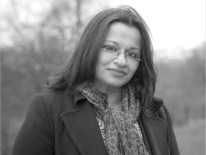
Professor Mona Siddiqui
The original date for the lecture was to take place the day before our Mosque visit, but was delayed to volcanic activity! It turned out to be a good way to celebrate Cinco de Mayo, however!
The Berrie Fellows had the privilege to lunch with Dr. Siddiqui, Ms. Angelica Berrie, and the members of the Foundation and the IIE who were in town for the event yesterday after the seminar on Mary in Islam. In an unexpected re-enactment of the wisdom from Luke 14.1-11, I had situated myself at the end of the table to allow others near the honored guest, and after some shuffling I suddenly found myself placed between Dr. Siddiqui and Ms. Berrie – two fascinating women! And both so very approachable, a gift I appreciate more and more the longer I am in service to the Church.
During today’s featured lecture, Dr. Siddiqui addressed the history of interaction between Jews, Christians, and Muslims from the Islamic perspective, and focusing on the religious rather than the political realities of our day. The importance of dialogue is something she underlined, not for the sake of conversion, but for the sake of compassion.
“Furthermore, many in the West are aware that despite media frenzy at times, dialogue is not a necessity, it is an option even a privilege. Inter religious work can be a symbol of unity across civilisations and it can also reverberate amongst the followers of the faith. But it works best when there is both text and context. There are many Muslims and Christians who remain convinced that dialogue is fundamentally flawed, not just theologically but also in practical terms. How can Muslims and Christians talk about the same God when they hold such different understandings of the same God? If dialogue is not directed at conversion to Christ or to the event of the Qur’an, what is its real purpose? …
Inter religious work has never been about implicit or explicit conversion. As a Muslim who has lived most of her life in the West, I have learnt that faith speaks to faith in many ways. Dialogue has been a process of learning and accepting, of questioning and appreciating, of self-doubt and humility. Most importantly it has been to understand that talking about a common humanity demands much generosity in the face of practical difference.”
The full transcript is available here, and a video of the lecture here.
Mary in Islam
 Dr. Mona Siddiqui presaged tomorrow’s Annual John Paul II Lecture on Interreligious Dialogue with a visit to the seminar Fr. Fred Bliss has been conducting on Mary in Ecumenical Dialogue (which incidentally, uses the Seattle Statement as its primary text). This is my summary of her presentation, with a little reflection.
One of the few things most (western) Christians would know about Islam is that Jesus is respected as a prophet and messenger of God – though not as God himself. Less well known is that Mary is also mentioned from the Qur’an, and considered by some also as a prophet (though not a Messenger). She is, in fact, referenced more frequently in the pages of the Qur’an than in the New Testament. Instead of Mary, Mother of God, the reference is almost always to ‘Isâ, son of Miryam. Mary’s elevation to a place of respect is owing to her being mother of one of the great prophets. There are 114 suras (chapters) in the Muslim holy book, eight of which are devoted to, or named for, a person. One of these is Mary of Nazareth, to whom the 19th sura is dedicated.
Islam does not hold a view of original sin and the need for salvation from sin that dominates Augustinian-influenced Christianity. Adam’s first act of sin was also his first act of the will, and was apparently a part of the divine plan from the beginning that he would populate the Earth (which is part of the result of his choice). We are not born into a state of sin so much as we are inclined to commit particular sins. Nevertheless there is a sort of myth that sometime before birth, we are each of us ‘pricked’ by the devil, which has a similar effect. Mary and Jesus were spared this pricking for much the same reason that the doctrine of the Immaculate Conception was developed, to recognize Mary’s holiness and purity as a worthy mother of a great prophet and Messenger.
ARCIC II Seattle Statement: Mary, Grace and Hope in Christ
The virgin birth of Jesus is affirmed, though the Qur’an and its commentators never focus as much on the physicality of all this, as in some of the extreme Christian views. For Islam, Mary’s purity was ethical and spiritual rather than physical. And nothing about a perpetual virginity.
She is a popular person of devotion, especially for Muslim women. Her role is perhaps not as prominent as Fatima, the daughter of the prophet, who is especially revered among Shi’ah Muslims as the mother of successors to the Prophet Mohammad.
Angelicum Quote of the Day
Thomas F. O'Meara, OP
One of my favorite professors from Notre Dame, an owlish Dominican ecclesiolgist named Tom O’Meara, published an autobiography a few years ago. I had noticed a copy for sale at the Angelicum bookstore the last couple weeks, but have not been inclined to buy too many extra books while here in Rome. Today, however, I discovered an entire table full of clearance priced texts as they get ready to wind down the academic year, including this paperback at about 85% off the previous price.
Randomly flipping through the book as I logged it into my library inventory, I came across this page describing his first days in Europe in the late summer of 1963:
“I spent my first days in Europe at the Angelicum, the Dominican graduate theological school and seminary. It was named after Thomas Aquinas but called the Angelicum because Aquinas’s theological acumen had resembled that of an angel. With a few eccentric scholars, some inedible meals, primitive toilets, officious porters and sacristans, the “Ange” lived up to what I had heard of it from my teachers who had studied there. A year or two before it had been an almost obligatory school to which Dominicans came from all over the world to gain expeditiously a doctorate. The study of dogmatic theology rarely ranged far from collecting passages from Aquinas on some major or minor topic and ignored other theologians from Origen to Maurice Blondel. Historical contexts and contemporary problems were neglected, for this was a citadel of a strict neo-Thomism where the salvation of Jesuit Suarezians was in only a little less doubt than that of Protestant Hussites. On the eve of the Council, one of the Dominican professors at a meeting of advisors to the Vatican had bemoaned the variety and looseness of theological opinions tolerated by the church, views held even in Rome, views such as those of the Redemptorists in moral theology or the Jesuits in the psychology of grace. He devoutly hoped that the Council would proclaim lists of clear positions on canon law and doctrine so that those vagaries opposed to the Dominican school of Thomism would end. Most of my teachers in the Midwest had received their doctorates from the Angelicum in philosophy, theology, and canon law. What soon amazed me was that American Dominicans had lived in Rome without becoming interested in history or art. Their graduate studies had been repetitive, boring, more memorized scholasticism, and the two years were physically and psychologically difficult, the life of prisoners whose goal was survival. Sadly, poverty, isolation, and rigidity of daily schedule – even in a cloister arranged around a fountain and palm trees and perched above the Roman forum- had for most blocked out the history and beauty around them.”
Thomas F. O’Meara, OP, A Theologian’s Journey, 70.
Quote of the Day
Visible union with the Catholic Church does not mean absorption into a monolith, with the absorbed body being lost to the greater whole, the way a teaspoon of sugar would be lost if dissolved in a gallon of coffee. Rather, visible union with the Catholic Church can be compared to an orchestral ensemble. Some instruments can play all the notes, like a piano. There is no note that a piano has that a violin or a harp or a flute or a tuba does not have. But when all these instruments play the notes that the piano has, the notes are enriched and enhanced. The result is symphonic, full communion. One can perhaps say that the ecumenical movement wishes to move from cacophony to symphony, with all playing the same notes of doctrinal clarity, the same euphonic chords of sanctifying activity, observing the rhythm of Christian conduct in charity, and filling the world with the beautiful and inviting sound of the Word of God. While the other instruments may tune themselves according to the piano, when playing in concert there is no mistaking them for the piano. It is God’s will that those to whom the Word of God is addressed, the world, that is, should hear one pleasing melody made splendid by the contributions of many different instruments.
William Cardinal Levada
Five Hundred Years After St. John Fisher: Benedict’s Ecumenical Initiatives to Anglicans
Delivered at Queen’s University, Kingston, Ontario
March 6, 2010
 The Ecumenism Blog