
Home » La vita Roma (Page 21)
Category Archives: La vita Roma
We had elections? (We have a government??)
Today I was blessed with a lesson in Italian culture that I could not have asked for. I witnessed a genuine Italian election. At least, it was supposed to be an election. And I think I was supposed to vote, too.
As a Catholic and an American, I feel it is more than civil duty to be a well-informed citizen and to participate in elections. It is a moral imperative.
So, when Karina, one of my housemates, mentioned at breakfast this morning that our second class of the day was cancelled due to student elections, I was intrigued. In fact, last night was the first time anyone had mentioned the fact that we even had student representatives, or a government of some kind… though no one was really clear on what they did, who they were, or when the elections were. No mention of this is made in the 300 page, mostly bilingual Ordine degli Studi except in the Italian language calendar which indicates only, “Elezioni Studentesce (10.30-12.15)” on this day.
Today, when we arrived at the Angelicum, there were a few copies of an “avviso” pinned to some classroom doors, apparently informing people (in Italian) that elections were being held today but without explaining much else.
At the appointed hour, our professor seemed mildly surprised to learn that his class was cancelled due to elections, and did not really know where we were supposed to go, or who was coordinating them.
The Angelicum is not really that big. One can peek into every classroom in about 15 minutes, and that is about how long it took me to find no one gathering to elect anyone, anywhere.
A fellow Anglophone student who has been here a few years, Kim, found me and decided he would introduce me to Italian-government-inaction, so together we continued the scavenger hunt for clues. After another search we found canon lawyers getting ready to elect someone from their faculty, some first cycle (Baccalaureate) students who had had elections in their classes, and finally we found a Canadian Anglican priest who had been the License representative last year, but who was equally unaware of where we were supposed to be doing elections this year.
At that point, in true Roman fashion, we decided nothing could be done and headed to the student bar for a cappuccino. Naturally, it was after caffé that someone walking by mentioned that the elections for student president were going to be held in a few minutes in the John Paul II Aula Magna (the giant lecture hall which seast several hundred).
Gathered there were less than 50 people (out of about 1400 registered students), almost all of whom seemed to be Italians (probably the entire Italian student population). The proceedings were held entirely in Italian, and when they started calling for votes, our request for a translation gained only a few brief comments in English.
Apparently, the sitting president was pointing out that with the absence of either the Rector of the university or the General Secretary precluded us from moving forward with the election. Moreover, only one candidate had met the (unpublished) deadline for submitting his name. So the discussion was to either take a non-binding vote to recommend another general assembly, to refer to the rector the current candidate, or to just ask him to appoint somebody.
At that point, people just started to leave. As far as I can tell, we did not really vote on anything, or decide anything. But at least I got to see a genuine Italian electoral process in action!
Understanding Life in Rome…
If you have not seen this yet, do take a few minutes.
Blatant ethnic cultural stereotyping? No doubt. But, according to the locals, it is all true:
Santa Prassede and Episcopa Theodora
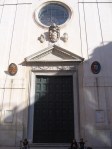 Monday, we went exploring. Eveline consented to allow Matthew and me, two lowly Angelicum students, to meet her at the august and incomparable Pontifical Gregorian University, right around the corner, for pranzo and some church-hopping.
First stop was a pizzeria near the Gregorian rumored to have pizza at €1 per slice, but alas, for us Anglophones they could only slice €2.40 worth of pizza. But, it was still good, and the first Roman pizza I’ve had since I got here, so I think worth it.
We then ventured to the Chiesa Santa Maria sopra Minervae (Church of St. Mary over Minerva). It is the only gothic church among Rome’s 900 places of worship, and is recognizable by the small Egyptian obelisk mounted on top of a Baroque Bernini elephant, and the fact that it is literally built over (sopra) a temple dedicated to Isis, who was later assimilated in worship to Minerva. The obelisk is one of several found buried on the site.
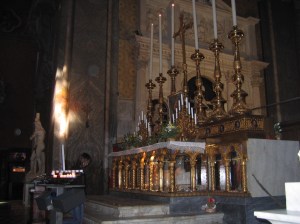
Saint Catherine of Siena
Two Medici popes and the artist, Blessed Fra Angelico are buried here, along with a number of other once-famous Italian nobility. One of Michelangelo’s sculptures is found inside, Christ bearing the Cross.
The church is probably better known, though, for the saint who died in a small room past the sacristy and who is entombed under the altar: St. Catherine of Siena. Catherine was a lay oblate/tertiary of the Dominicans and known for her extensive reform efforts in the church, including campaigning for the return of the papacy to Rome from Avignon. St. Catherine enjoys a particular devotion from our Eveline, and we had been talking about coming to visit for most of the last week.
As a Dominican church, it was here too that Galileo was tried for his Copernican cosmology, and where he reportedly uttered his famous exit-line, “but it does move.”
Afterwards we set out east, in the direction of Santa Maria Maggiore to find a smaller but no less important minor basilica, Santa Prassede. As we were there sometime before the 4:00pm end of lunch-break, we spent some time over at Mary Major, and then opted for gelato on the Piazza in front of the church. It was there where we were flocked by birds, goaded on by a toothless Roma who wanted coins in return for having taken pictures of the pigeons he was feeding.
On returning to the basilica, I discovered a small plaque next to the entrance of the adjacent monastery. In Slavonic and Italian, the plaque identified this humble building as the place where the saints Cyril and Methodius developed the written Cyrillic alphabet and the form of the Byzantine Liturgy used by the Slavic churches, like the Russian Orthodox, during the years 867-869. (Incidentally, Cyril was born in Thessalonica, the same city where two of my housemates are from, Dimitrios and Theodosius).
The basilica was built in 822, and is filled with Byzantine mosaics, including the Chapel of St. Zeno. In addition to the two first-century saints who inspired for whom the church is dedicated, Sts. Praxeses and Pudentia, you can see Pope Paschal and his mother Episcopa Theodora.
Theodora’s image is an intriguing one, for it figures strongly in the debate about the role of women in the church, especially regarding ordination and jurisdiction.
Given that episcopa is the feminine form of the word used for bishop from the sub-Apostolic age onward (and usually translated that way in the Bible), the simplest way to read the inscription is Bishop Theodora, providing one of a handful of first-millennium images interpreted to indicate the ordination of women in the earlier church.
Current practice in both Catholic and Orthodox churches of the Byzantine tradition is that wives of clergy are given the feminized title of their husband’s order, presbytera or deaconess, and this leads to the interpretation that Theodora is so named as the wife of a bishop (and mother of another).
A third possibility is based on the fact that many medieval abbeys held more influence and jurisdictional authority than some dioceses, and the abbess could in many places be the ordinary for several parishes, and entitled to various episcopal regalia, such as the pectoral cross, mitre, and crozier. And given the early beginning of the development of this time of an ecclesiology that saw the episcopate as a jurisdictional category rather than as a holy order in itself, it seems reasonable that a woman with the juridical office basically identical to bishop might be named episcopa.
After all that, we decided it was time to head home, so we walked Matthew to Termini, and Eveline and I hoped on a bus for home. Actually, the bus we chose turned out to be an express, and we overshot our destination and ended up in Largo Argentina, so we then switched busses to get back to Piazza Venezia, the switched again to get to the Coliseo and walk home from there. A long day, but well worth the walk!
Unusual garb
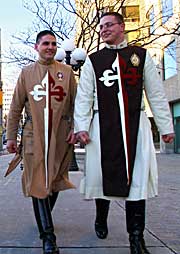
Distinctive garb of the Heralds of the Gospel lay institute
When i mentioned in an earlier post that virtually everyone in Rome has a uniform and/or title, including most of the laity, i was not kidding. (Though, about the “Almost Reverend” i was kidding. Mostly.)
The Heralds of the Gospel are one of the many new lay movements in the church, not a religious order but an “international association of pontifical right” (like Cursillo, or the Militia Immaculata). They have a very distinctive “habit”, which i first encountered on the steps of the Angelicum. I undertand, too, that “habit” is reserved for members of religious orders -and by some accounts, really even more restricted to members of monastic orders only- but the distinctive “uniform” for other forms of religious, consecrated, ecclesiastical or lay life are generally refered to only as “unusual garb”.
We also found some official clerical sandals by Birkenstock at one of the ecclesiastical shopping centers. Fairly reasonably priced, too. Just in case you’re in the market…
Last, but not least, i am told that the Caribinieri (ubiquitus military police) uniforms are designed by Armani. I have seen the officers driving department-issue BMW’s too. Carl: forget the US Border Patrol, come to Italy!
Dutch Katholieke Kerk and All Saints Anglican
I had two great experiences of church today. This morning, i had the priveledge to join my friend Eveline at the Dutch church in Rome for the Sunday Eucharist, and this evening we joined our friend Stian at an Anglican celebration of Evensong (Vespers) at All Saints.
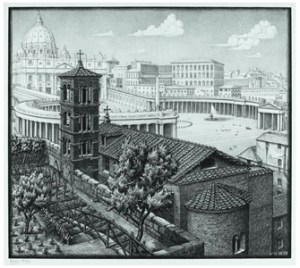
Saint Michele dei Frisoni, National Church of the Netherlands in Rome
The Dutch church, San Michele dei Frisoni, is located just over the international border at Piazza San Pietro, on the Italy side – litteraly right out from the piazza, hang right and up the stairs. Voila! You are I the Kerk van de Friezen. The Friezen, apparently, are one of the regional cultural groups in the Netherlands, like Holland. (If that link does not work, or, more likely, if you cannot read Dutch, try this one.)
It is a beautiful language, especially when sung. I have the sense always of being just on the edge of comprehension. The common Germanic root of English and Dutch makes it as if listening to a conversation in another room, so that you feel like you can almost make out what is being said, but not quite.
After the liturgy, I was asked about differences with my experience of the mass in America and in Rome. Obviously, the language, and some small details (for example, almost no one made the small sign of the cross at the gospel). But, the mass is the mass, and coffee hour, apparently, is coffee hour.
More noticeably, though, was a real quality of the congregational singing; there was only a small choir yet every song was richly done. That and the assembly filled the church, but was on average noticeably older than what I am familiar with. They did announce a pilgrimage from the diocese of Tilburg coming next week, though, so it will be interesting to see if it is young people or older.
Speaking of pilgrimages, one of the members present was called forth for a special blessing and recognition. He had walked from the Netherlands to Rome, a journey that took him a little over three months, and about 2000 km/1400mi. I wish I knew more about his experience to share, but it was all in Dutch. Though Eveline was kind enough to translate the highlights of the homily, we decided the announcements were fine left in the original!
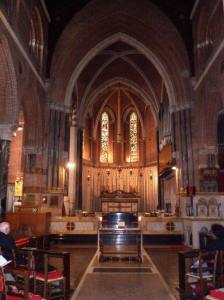
All Saints Anglican Church, the Church of England parish in Rome
In the evening Stian, Eveline and I trekked to All Saints for Festal Evensong (Vespers), one of two Anglican churches in Rome. All Saints is the Church of England parish, while St. Pauls-within-the-Walls is the (American) Episcopalian parish. The church was celebrating the feast of their dedication, so there was a choir from Hexam Abbey and the guest preacher was British Monsignor Mark Langham who is the person responsible for relations with Anglicans in Rome, from the Pontifical Council for Promoting Christian Unity.
Father Mark opened his homily by admitting that, as he sat to begin writing his remarks this week, he found himself wishing that he had been invited to preach last week – before the press conference that has made such an impression on Anglican-Catholic relations. Without ignoring the challenges posed by the announcement, the reflections genuinely focused on the community of All Saints and on the community as one of the many expressions of the unity to which we are all called.
Whether this is an aspect of British culture I am not familiar with, I do not know, but several times he employed some very good humor, and it seemed as though the three of us were the only ones appreciating it. (At the beginning he said something about the news of the week causing ripples in the “normally tranquil waters of ecumenical dialogue.” Tranquil waters indeed!)
It was enough that we were wondering how much was perhaps some latent tension surrounding the presence of a guest preacher form the Holy See in such proximity to the announcement of the Personal Ordinariates. To his great credit, Father Langham neither sidestepped the question, nor did he dwell on it, focusing on the cause for celebration, the dedication feast of All Saints parish in Rome.
The prayers of the faithful were also interesting, “Let ecumenical dialogue be honest… and charitable,” being the most memorable among a list of prayers for unity.
As beautiful as the service was, it was difficult to fully participate. The songs were choral, rather than congregational, and often in unfamiliar settings. Though my internal liturgist recoils at the thought, I suppose there can be times to sit back and appreciate the beauty of liturgy without engaging more than the receptive senses!
Welcome home, Kassim!
For the last two weeks, one of our residents has been in the hospital, including a significant amount of that time in quarantine. Tonight, we were able to welcome Kassim Abdallah Bawah back ‘home’!
Not that this could have been known two weeks ago, but apparently this all started in 1989. Kassim began experiencing symptoms then that local medical authorities in Ghana attributed to allergies or some form of asthma or bronchitis. Then, about six years ago, the symptoms became more severe, and he was given medications to suppress the symptoms of bronchitis. But, apparently that’s all it was doing, was suppressing symptoms. A few days into his stay in Rome, after a couple days of extended walking in the late, humid Roman summer, his symptoms came back with a vengeance.
When our local doctor came by he suggested antibiotics, but after a day of no effect, Kassim and our resident nurse, Ann, began to suspect Malaria. With that in mind, the doctor recommended checking into the National Hospital for Tropical and Infectious Diseases out in Trastevere. What follows is clear evidence that we are not in the U.S.!
When Donna took Kassim to the hospital, she was prepared for the typical Italian experience, would not necessarily be an improvement over staying home with a doctor and a nurse in the house. When they arrived, they found a very quiet, locked waiting room. On ringing the buzzer, a gruff Italian voice asked, “Who is it?”
“I am here with a sick person”, Donna replied, and the door opened. No other patients were waiting in the emergency room, but a doctor met them immediately, gave Kassim an initial exam and asked some questions. After 15 minutes or so, he announced, “If we have a bed, we will admit him”. Twenty minutes later, Kassim was admitted. Aside from showing his passport, there were no questions about residency, legal status, insurance or ability to pay. For the first couple of days, Kassim was visited by almost a dozen different doctors, and had regular conversation with the nurses, orderlies and other staff, where language was not a barrier. He was given a private room with a private bathroom, tv, and outside view. Several of us from the Lay Centre were able to visit on his third or fourth day. They began testing for everything – TB, HIV, HepB, etc. Then one day, they locked his door, and no one would enter without full surgical protection. Apparently, his chest X-Ray showed what was either Tuberculosis, or advanced chronic pneumonia. As it turns out it was the later, and it has been slowly killing him for the last six years at least (probably an aggravation of whatever started 20 years ago).
After treating the pneumonia and waiting to be sure it was fully taken care of, they released Kassim to Donna’s care yesterday, with the admonition to spend the next week resting, and to check in with the local doctor at the end of the week. Otherwise, he is healthy, indeed for the first time in two decades.
There was no bill.
21st century tech in a 16th century university
I am actually now online at the Angelicum. Interestingly, the wireless is open and unencrypted, but you have to meet with one Father Stancotti, OP to get him to enter the secret code to allow your connection to the local network actually reach out to the internet. (It seems we are each assigned a specific IP address that he has to activate from his quarters, or some such). I finally tracked him down this afternoon when a seminar i thought about taking was either cancelled or mysteriously moved without notice.
Anyway, i have mentioned to some that as of last tuesday, i was no longer able to download emails to my outlook client (prior to that, at the Lay Centre once the wireless was up, i had no problem). Sending has been no problem, but recieving has been limited to the webclient, which has been very sketchy.
So, it should be no surprise whatsoever, that for the last 30 minutes my computer has been downloading hundreds of emails dating back to 12 October 2008. Coincidence that my last successfully recieved emails were 12 October 2009? I think not! It means something, I just don’t know what. Any Microsofties out there have an idea?
All those emails that i lost when my laptop crashed in January? They’re all coming back. It remains to be seen if i get those sent in the last week and a half, but at the rate things are going (I’m at 1360 emails and counting, only up to December 20, 2008) I’ll find out in about an hour!
Anglican-Catholic Personal Ordinariates
Two days ago, Rome announced a forthcoming Apostolic Constitution establishing Personal Ordinariates for former Anglicans seeking full communion with the Catholic Church.
As the Constitution itself has not been actually published, there’s a great deal more speculation on the blogs and newswires that real information, but a few things were made clear in the news conference.
Unfortunately, my presence on Vatican property and proximity to the halls of power has not really increased my access to information about the decisions made there. We did have dinner tonight with an official from the Pontifical Council for Promoting Christian Unity, however, which probably would not have been possible in Seattle – so there are some advantages!
So, some immediate observations:
The “note” and press conference was delivered by two of the highest ranking Americans in the Holy See, Cardinal William Levada, prefect of the Congregation for the Doctrine of the Faith, and Archbishop Augustin DiNoia, secretary (#2) in the Congregation for Divine Worship and the Discipline of the Sacraments. Why two Americans? Why no Brits? Probably because of the offices they hold, but Romans seem to be skeptical of coincidences. I’m merely curious.
Conspicuous by absence is any representative of the Pontifical Council for Promoting Christian Unity. Indeed, Cardinal Kasper, president of the council, is not even in Rome, but in Cyprus for the 11th meeting of the Joint International Commission for Theological Dialogue between the Catholic Church and the Orthodox Church.
Personal Ordinariates are not exactly like a Personal Prelature (which is what Opus Dei is), but are basically what the Military Ordinariates are – essentially a diocese serving people of a certain characteristic rather than a geographic structure. Instead of members of the armed forces, the membership will be former Anglicans.
Something like this, or the establishment of a new Church sui iuris with its own patriarch or major archbishop, has been discussed as a structural option for the future full communion between the Anglican Communion and the Catholic Church. I think that may still be seen as an eventual option, because the Personal Ordinariates are not fully autonomous churches in that sense, but particular churches like a diocese, still within the context of the Roman church and its national conferences.
Nevertheless, the specter of “uniatism” will no doubt be raised again in the Eastern Orthodox world, and possibly, in the Anglican and Protestant world too. This move could be seen from those corners as proof that Rome really is just interested in co-opting non-Roman liturgical and theological patrimony just for the sake of proselytism. While such an accusation has some historical bases, especially concerning the Latinization of Eastern Catholic Churches, it is clearly not the reality of the current Eastern Catholic Churches, and I do not think it is the reality for these Personal Ordinariates, either. Still, the perception itself could be damaging to the ongoing reception of ecumenical advances with the apostolic chuches in the East.
There is one line that I found particularly interesting, even though it seemed to be made almost off-hand: When explaining that the ordinary of these Ordinariates (read: diocesan bishop) may be either a (celibate) bishop or a (celibate or married) priest, the note states, “Historical and ecumenical reasons preclude the ordination of married men as bishops in both the Catholic and Orthodox Churches.”
Really? that’s new…
Historically, the Latin Church has had married bishops, at least when we also had married presbyters and deacons as a rule (that is, most of the first 1200 years). If we do not have a requirement of celibacy for either deacons or presbyters, as would be the case in these Ordinariates, there is no historical reason for requiring it of bishops (in Western practice).
Ecumenically, as far as I am aware, to restore this discipline would not pose a challenge to the Orthodox, as they see no objection to the Western Church having married bishops even while the Eastern Church does not. The difference in custom is based on the practice of selecting bishops from the diocesan clergy (as in the West) rather than from the monastic clergy (as is most common in the East). So while there is historic precedent for a celibate episcopate in the Eastern Catholic and Orthodox churches, it does not hold for the Western churches, except inasmuch as we currently have a (mostly) celibate presbyterate and have discontinued the ancient practice of selecting bishops from the diaconate.
I would really like to see the ecumenical and historical rationale behind this piece of the note; presumably it is in the forthcoming Apostolic Constitution. Either way, it has got my curiosity piqued; I’ll look into it and follow up!
Hapiness is…
Spending the day reading theology on the terrace, in the warm Roman sun, with a view of the Forum and the dome of St. Peter’s just over the Palatine Hill, in the company of a good friend with a sharp mind and a merry disposition! Oh yeah, tea and “biscuits” help, too!
Shopping for Roman collars
Everyone in Rome has a uniform and a title; and that’s if you are a nobody. If you are important, you also have a stamp, a wax seal, and most likely a signet ring. Perhaps this is why electronic means of communicating, providing identification, registering for classes, paying bills, and the like are so difficult and considered downright foreign here. I’ve gone through i don’t know how many hard-copy pictures of myself, and every correspondence to everyone needs to be an original letter, signed, co-signed and countersigned, then stamped in duplicate or triplicate.
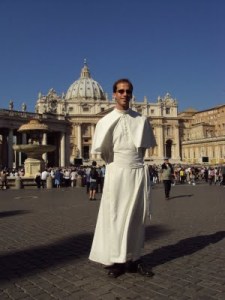
Norbertine Habit
But back to the uniforms: One of the many blessings of being in Rome is seeing the life of the church in all its profound diversity. You cannot maintain the illusion of a monolithic Catholicism very long in this capital of the church. I’ve seen habits for orders i had heard of but never met: Norbertines, for example, dress in a white simar and fascia looking almost identical to the pope. Then there are those i did not even know existed: the Teutonic knights, apparently, are back as a diocesan order, and looking very medieval.
Even most of the lay people around here are in ecclesiastical garb, particularly seminarians and lay religious, even during classes. So, naturally, I am on a mission to discover the appropriate ecclesiastical garb for a lay ecclesial minister. After all, if a student candidate for ministry gets a uniform, so too should someone already in sacred ministry, no?
(The current favored title is “Almost Reverend…”, or “Your Mediocreness”, and the garb is a white or black dress shirt with banded collar, though I am open to suggestions. But, I digress.)
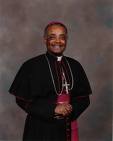
Archbishop Wilton D. Gregory
Allora… I decided to peruse the ecclesiastical shopping district near the Pantheon with Stian, an Anglican seminarian and friend of mine who shares that you can get four clerical shirts in Rome for the price of one in Norway.
We picked up a couple new friends on the way, Matthew, from Australia, and Cosima, from Germany. While Stian was being fitted for his clericals, the rest of us were perusing the mitres, zucchetti, and birettas that seemed to be available over the counter.
Did you know that with an ecclesiastical doctorate one is entitled to wear a biretta with the appropriate color trimming? For theology, it’s scarlet; canon law is green, etc.
As we were about to leave in search of a pizzeria and gellateria, America’s lone representative to the Synod for Africa, Archbishop Wilton Gregory of Atlanta, walked in for some shopping of his own. He was kind enough to stop for a brief chat about the Synod, and exchange a warm greeting before we moved on for pizza and gelato. At least now we know we were in the right shop!
 The Ecumenism Blog