
Home » Church Reform (Page 4)
Category Archives: Church Reform
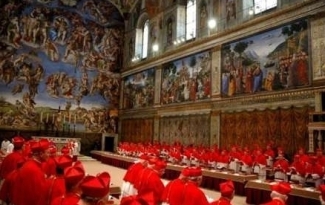
Church Reform Wishlist: The College of Cardinals
The College of Cardinals
[Alternative to many of these ideas, of course, is that the college could be disbanded entirely, and certain offices designated electors ex officio. There is a certain appeal in this, but perhaps it is not prudent at this time.]
- Zero tolerance for cardinals found to be implicated in the cover up of sex abuse cases. They should be removed from the college of cardinals, not just from ministry.
- Patriarchs and major archbishops should not be created cardinal, which is proper to the Latin Church (indeed, to the Roman clergy!), though they should be included in conclave, ex officio.
- The heads of a number of the largest religious orders, male and female, as well as the largest ecclesial lay movements should be either made cardinals, or at least included in the conclave, ex officio.
- The presidents of the bishops’ conferences could be made cardinals, ex officio.
- Cardinals should not be ordained bishops unless they are going to serve as bishops (diocesan ordinaries).
- Cardinal-deacons should not be “promoted” to cardinal-presbyters after 10 years, but retain the dignity of their diaconal office – which ought to be considered equal to that of the cardinal-presbyters.
- Cardinal-deacons should be deacons, chosen from the ranks of deacons, who serve in diaconal posts such as the dicasteries of the Roman curia, the diplomatic corps, etc.
- As a sign of gratitude for their leadership in the last half-century, all the surviving Council Fathers (about 19 in number*) should be named cardinal. The only exception being if they have been found complicit in the sex abuse crisis, or left communion with the church. [*63 at the time of original publication]
- Lay men or women, whether theologians, religious, or lay ecclesial ministers, who are appointed to top offices in the curia could be made cardinals. Preferably after being ordained to the diaconate.
- Women cardinals? If women deacons, or deaconesses, then yes. Maybe better not to make it about being cardinal, but by virtue of the office being given the same rights and responsibilities, same access, and same dignity – and taken as seriously.
- Lay cardinals? The pope could do it, though with the historical connection of the cardinals to the clergy of Rome, perhaps that would take a more monumental shift – like eliminating the college, or eliminating the canonical distinction between cleric and lay states (NOT eliminating the ministries, holy orders, priesthood, etc!)
Jump to:
- Church Reform Wishlist: Open Letter and Introduction
- Church Reform Wishlist: The Eastern Catholic Churches
- Church Reform Wishlist: The College of Bishops
- Church Reform Wishlist: The College of Cardinals
- Church Reform Wishlist: The Roman Curia
- Church Reform Wishlist: Ministry and Holy Orders
- Church Reform Wishlist: Precedence and Papal Honors
- Church Reform Wishlist: Catholic Education
- Church Reform Wishlist: Liturgy
Church Reform Wishlist: The Roman Curia
The Roman Curia:
- Get the most qualified people. This means, at least:
- Some kind of open hiring process that allows anyone qualified to be considered. The Anglicans even advertise their top openings on their website. We could have something similar. Jobs.va? Why not?
- A doctorate and experience in the particular field is a must. No more non-liturgists running liturgy, diplomats running theology, etc.
- If anything, the ordinary minister of any curia should be a deacon.
- If a presbyter is not theologically or canonically required for a position, it should not normally be given to a presbyter.
- Lay ecclesial ministers, theologians, other lay persons, religious, and some priests or bishops may also be called upon, but they should ordinarily then be ordained to the diaconate (if appropriate).
- This could be a good example of a place where the return of the deaconess, or of women in the diaconate, would be appropriate.
- The diplomatic corps should be reformed
- The same considerations as for the curia, though perhaps a doctorate is not necessary.
- The ordinary ministers of the diplomatic corps should be deacons
- The ecclesiastical academy should be open to all qualified, fully initiated Catholics
- Candidates should not be drawn from seminary, but should either be a separate track or have proven field experience first
- The nuncio should not be a bishop, but a deacon (perhaps an archdeacon, or protodeacon), unless they have already been ordained a bishop before being called to diplomatic service.
- Communication – one apparatus to rule them all. There are what, seven different offices for communication in the Vatican? Things have improved a little, but this really needs to be coordinated. Also, people, even cardinals, whose competence is in a specific area should not be publicly speaking on the record about other areas (e.g., the President of the PCPCU should not be talking about liturgical changes, and the Prefect of the CDW should not be making ecumenical judgments.)
- The councils and congregations should be made up of committees of the synod – or from the episcopal conferences. The staff should really be staff to these committees, not the driving force.
- All dicasteries are equal, according to Pastor Bonus, but some dicasteries appear more equal than others. Change that. The Council for Christian Unity should be able to promulgate policy with the same authority as the Congregation for the Doctrine fo the Faith
- Ecumenical review of doctrinal, liturgical, and canonical decisions – the PCPCU should be involved in the vetting process of decisions made by the CDF, CDW, etc. to help formulate the best policy that is both orthodox and ecumenically helpful. The reverse is already true and should continue.
- The Secretariat of State should focus on diplomacy, not act as moderator of the curia or, generally, mediator on local ecclesiastical issues. Let there be a separate office to organize the work of the curia.
- Most theologians are laity, true? Certainly in the western world, but I think now also universally. This should be reflected in the staff of the dicasteries, the pontifical academies, and in the pontifical universities. Though, in the case of the curia, they could be ordained to the diaconate once selected for office.
- The support staff in many offices is quasi-hereditary, and almost exclusively Italian. If only there were a bunch of universities nearby with graduate students from all over the world looking for internships, assistantships, and part time work, we could tap into some of the greatest young talent the church has to offer… oh well…
Jump to:
- Church Reform Wishlist: Open Letter and Introduction
- Church Reform Wishlist: The Eastern Catholic Churches
- Church Reform Wishlist: The College of Bishops
- Church Reform Wishlist: The College of Cardinals
- Church Reform Wishlist: The Roman Curia
- Church Reform Wishlist: Ministry and Holy Orders
- Church Reform Wishlist: Precedence and Papal Honors
- Church Reform Wishlist: Catholic Education
- Church Reform Wishlist: Liturgy
Church Reform Wishlist: Ministry and Holy Orders
Ministry and Holy Orders:
- Jesus Christ is the only priest in Christianity; All Christians share in his priesthood. What makes the second of the three holy orders unique is that it is the presbyterate, not that it is a priesthood unto itself. This is not to deny the sacramental priesthood of holy orders (including deacons), but to suggest that perhaps we should officially restore the ancient and official title of ‘presbyter’ to the common lexicon in reference to those ordained to the presbyterate.
- Deacons participate in the ‘headship’ of Christ and the governance of the church, just not the presbyterate or the episcopate. Let’s make that clear.
- Traditionally (patristically), presbyters advise, deacons assist. The presbyterate acts in council, the deacons act individually. The presbyters preside locally in sacraments and spiritual life, the deacons assist the bishop preside in administration of the church’s goods – financial, human resources, diplomacy, ecumenism and dialogue, pastoral leadership. There has been too much overlap, let’s clarify this a little.
- Lay ecclesial ministry needs to be formally and canonically acknowledged. Catechists, pastoral workers, pastoral associates, lay preachers, and other such offices ought to require incardination into a diocese and a relationship with the bishop, a common set of norms for formation, and perhaps inclusion into something like the minor orders – they are not ordained, but they are not following a lay vocation, either.
- Clerical compensation and the financial crises are closely linked. There is no clear line in many cases between the pastor’s funds and those of the parish, and no clear accountability. This is one reason for a deacon being assigned responsibility for administration, and answerable to the bishop directly, while a presbyter is responsible for sacraments and spirituality. Why not just make compensation the same for all ministers, whether presbyter, deacon, or lay ecclesial? A simple salary or stipend.
- Support for all candidates for ministry should be equitable, whether for presbyterate, diaconate, or lay eccleisal.
- Clerical clothing is for clerics, meaning:
- Deacons have a right to clerical clothing, even if married! Canon law does not allow a bishop to restrict this right, much less a local pastor
- Seminarians do not, and should not be dressing up as if they are ordained.
- If we do not just do away with clerical clothing altogether, some kind of distinctive garb could be considered for lay ecclesial ministers, as long as we have such a thing for clergy. Different colors if need be, but the same basic idea: easy identification of those in pastoral leadership and ministry. Not to be confused with those in training for such.
- Eliminate the last vestiges of the cursus honorem
- Eliminate the transitional diaconate outright. A transitional diaconate makes as much sense theologically as a transitional presbyterate for deacon candidates.
- Allow deacons to transition to the presbyterate (and vice versa) if and only if an office to which they are called requires it.
- Acolyte and Reader, as instituted ministries should be moved out of seminaries and into parishes/dioceses, as the actual lay ministries that execute these functions in the liturgy. No more stepping-stone for seminarians, but actual readers and servers at mass. Add ministers of communion and any others that seem appropriate. Extend them to women.
- However, the original idea has merit. Perhaps before ordination to either diaconate or presbyterate, candidates should have earned at least an STB or BA in theology and philosphy, and served five-seven years in pastoral ministry. The best way to discern which order you should be ordained into is in practice! Then, they could go back for the M.Div., STL, or JCL and move on to the appropriate track: diaconate or presbyterate.
- The age of ordination to the presbyterate should be raised to 35. It should make no difference whether celibate or married.
- Leave the diaconate age for ordination at 35 as well, and also make no difference if celibate or married.
- I prefer the Assyrian and Anglican practice of allowing clergy to marry before or after ordination, since it is much easier for some of us to discern a vocation to ministry than to discern a vocation to celibacy or marriage and it seems like time wasted in the interim. But, the Greek practice of marriage before ordination has been the compromise between the extremes of mandatory celibacy and the above since Nicaea, so it is certainly reasonable to retain. At least it should be seriously, and ecumenically, reconsidered, however.
- We need more married presbyters, and more celibate deacons. The diaconate is not defined by marriage and marriage is not essential to the diaconate, neither is the presbyterate defined by celibacy nor is celibacy essential to the presbyterate. We have some of each already, we just need greater balance.

Jump to:
- Church Reform Wishlist: Open Letter and Introduction
- Church Reform Wishlist: The Eastern Catholic Churches
- Church Reform Wishlist: The College of Bishops
- Church Reform Wishlist: The College of Cardinals
- Church Reform Wishlist: The Roman Curia
- Church Reform Wishlist: Ministry and Holy Orders
- Church Reform Wishlist: Precedence and Papal Honors
- Church Reform Wishlist: Catholic Education
- Church Reform Wishlist: Liturgy
Church Reform Wishlist: Precedence and Papal Honors
Of Precedence and Papal Honors (Or, “Monsignors, medals, and more!”)
Full disclosure: i helped get some acquaintances a papal knightood for their commendable service to the Church, i know some others. I know several monsignori, most quite deserving of recognition. If we have these things, we should use them, but first ask whether we should have them at all.
- The presbyterate and diaconate are equal in ‘rank and dignity’. We really should not even be talking about ‘rank’ with regard to the life of the Church anyway. Are not all equal in Christ?
- I am not sure we should, but as long as we do still care about an order of precedence, patriarchs precede cardinals, and major archbishops ought to be considered equal to cardinal-bishops. .
- On one hand I think we should eliminate the vestiges of the renaissance court – the three grades of monsignori, the five grades of papal knights, the two medals, and perhaps even the college of cardinals, honorary canons, etc.
- On the other hand, I believe that if we do have these things – and there are reasons to have the means of recognizing good and faithful service to the church – they ought to be exercised more equitably and transparently, to whit:
- Clear qualifications or requirements for each honor should be widely available, clearly understandable, and published on the Vatican website.
- There should be universal consistency, too. A parish organist of fifty years and a Swiss Guard of two can both receive the Benemerenti medal. Likewise some dioceses do not have monsignori at all, some award it after a set number of years of service, and if you work in the curia, it was, until quite recently, all but guaranteed after five years (one term) of service.
- Nominations should have an open process that allows at least initial proposals to come from all corners of the Church. There are many deserving people who will never be recognized simply because nobody knows how to get it done.
- Generous donors should either not be so awarded, or only granted the lowest category of particular order. The higher levels reserved for those who have given of their time and talent.
- We should make broader use of the awards as appropriate for ecumenical, interreligious, and even non-believing leaders who have contributed in someway to the Church and to the world.
- e.g., the diplomats accredited to the Holy See are frequently made Knights of the Order of Pope Pius IX. Maybe it would be appropriate to make the outgoing Representative of the Archbishop of Canterbury to the Holy See an honorary canon of St. Peter’s, or of St. Paul’s without the Walls? Or at least a Pian Knight, too!
- If the papal knighthoods are for the laity, and the monsignori for the clergy, then deacons should be able to be awarded with all the levels of monsignor. Alternatively, restrict the highest (protonotary apostolic) to the diaconate (which is the historic origin of this role anyway), the middle (honorary prelate) to the presbyterate, and the lowest (chaplain of his holiness) to lay ecclesial ministers, or to both presbyters and deacons.
- Publish a report each year, and a sum total of all awards given, which includes clarification of who was awarded, for what reason, and where they are. I would be happy to help with the research!
- Gentlemen of His Holiness are, basically, finely dressed ushers. Is it really an honorific? Why not just have the ushers do this job? If it is an honorific, let it become more systematic like the rest.

Jump to:
- Church Reform Wishlist: Open Letter and Introduction
- Church Reform Wishlist: The Eastern Catholic Churches
- Church Reform Wishlist: The College of Bishops
- Church Reform Wishlist: The College of Cardinals
- Church Reform Wishlist: The Roman Curia
- Church Reform Wishlist: Ministry and Holy Orders
- Church Reform Wishlist: Precedence and Papal Honors
- Church Reform Wishlist: Catholic Education
- Church Reform Wishlist: Liturgy
Church Reform Wishlist: Catholic Education and Pastoral Formation
Education
- All candidates for pastoral ministry, whether presbyterate, diaconate, or lay ecclesial ministry, are required to take an introductory course in ecumenism, and in interreligious dialogue. At last count, only about 1/3 of seminaries were in compliance. Enforce this.
- No minor seminaries!
- Seminarians should not be isolated in their formation, but prepare for a life of ministry with deacons and lay ecclesial ministers alongside candidates for the diaconate and lay ecclesial ministry
- There should be an accreditation system for pontifical universities that utilizes Catholic higher education leaders from around the world and from outside the pontifical/ecclesiastical system
- The clericalism contained in the Congregation for Education’s governing documents on the distinction between “theology” (only for priests) and “religious studies” (for religious and laity) should be rooted out completely.
- A commitment to consultation and collaboration, and an understanding of the difference, should be inculcated in all called to pastoral ministry.
- Formation for ministry in the U.S. means, generally, a BA in philosophy and theology or a BA in something else with some prerequisite work, and then a Master of Divinity or similar. In Rome, the degree for ordination is a Baccalaureate in THeology, after a partial degree in Philosophy. What about psychology, leadership, non-profit administration, etc? Why a seven year program in one system, and a five year program in another?
- The Roman pontifical system needs a desperate overhaul. It needs to accept that there have been lay students earning theology degrees for a century and adapt accordingly. There is so much overlap and repetition between the universities and institutes, a lack of funding, a surplus faculty and a deficiency of staff, and a tendency to be isolated from the broader theological and academic world. Do there really need to be seven faculties of canon law, and two dozen faculties of theology? All the universities, athenae, and institutes combined probably only have 10,000 students in residence. Perhaps it is time to have an actual system in place here, to which all the participating universities belong. This would take an extensive blog in itself….
Jump to:
- Church Reform Wishlist: Open Letter and Introduction
- Church Reform Wishlist: The Eastern Catholic Churches
- Church Reform Wishlist: The College of Bishops
- Church Reform Wishlist: The College of Cardinals
- Church Reform Wishlist: The Roman Curia
- Church Reform Wishlist: Ministry and Holy Orders
- Church Reform Wishlist: Precedence and Papal Honors
- Church Reform Wishlist: Catholic Education
- Church Reform Wishlist: Liturgy
Church Reform Wishlist: Liturgy
Liturgy
- Actually, i do not have too much to say. So much has been said, and liturgy is probably the best case of successful, ongoing reform, despite the bumps. So just a couple small things: put into law that which theology and history holds to be evident. Or, where we have two practices that go back centuries, the older one should be the norm, for example:
- The most ancient form of receiving communion is in the hand. Make this the norm, and receiving in the tongue, a later practice, an accepted alternative.
- Communion under both species as the norm, with exceptions as appropriate
- Translate the universal version of the GIRM into each language on the Vatican website – currently the English is actually the adaptations for the USCCB and does not reflect the original, universal, Latin version. It leads to some confusion.
- The Eucharist is the Sunday Liturgy, it should be more or less limited to Sundays. The rest of the week should have the liturgy of the hours publicly celebrated in parishes.
- The Creed should be recited without the Filioque, as a norm, in all liturgies.
- The portions of Liturgicam Autenticam which violate previous ecumenical agreements should be abrogated.

Jump to:
- Church Reform Wishlist: Open Letter and Introduction
- Church Reform Wishlist: The Eastern Catholic Churches
- Church Reform Wishlist: The College of Bishops
- Church Reform Wishlist: The College of Cardinals
- Church Reform Wishlist: The Roman Curia
- Church Reform Wishlist: Ministry and Holy Orders
- Church Reform Wishlist: Precedence and Papal Honors
- Church Reform Wishlist: Catholic Education
- Church Reform Wishlist: Liturgy
Vatican Bank’s first-ever Annual Report
As if there was not enough in the Church reform circuit today, with the Roman pontiff’s second big interview and the first meeting of the Council of Cardinals responsible for reforming the apparati of universal governance, the Istituto per le Opere di Religione (Institute for the Works of Religion), better known as the Vatican Bank, issued its first-ever annual report in its 125 year history.
The groundwork was laid by Pope Benedict in 2010, whose most successful reform efforts, arguably, revolved around Vatican finances. The efforts were accelerated after Pope Francis was elected.
In 2012, the IOR commemorated 125 years of history since the creation of its predecessor, the “Commissione ad Pias Causas”, by Pope Leo XIII in 1887.
According to the president’s letter,
The Annual Report seeks to contribute to the transparency which the Catholic Church, our customers, our correspondent banks, our authorities and the public rightfully expect.
The IOR posted earnings of EUR 86.6 million, which allowed us to contribute EUR 54.7 million towards the budget of the Holy See, while transferring EUR 31.9 m to our general operating risk reserves.
And we are conservative: in 2012 we had a balance sheet total of EUR 5 billion in assets, with equity of EUR 769 million. On an operating level, we stand on very solid foundations.
The IOR has about 18,900 customers, half of which are religious orders. The dicasteries and nunciatures of the Holy See account for another 15%. Bishops and other clergy are about 13%, dioceses 9%, and the rest split between employees, educational institutes, and of course, the Holy See itself and the Vatican City-State.
The IOR launched its first website in July of this year: www.ior.va.
The full 100-page report is available for download or review here.
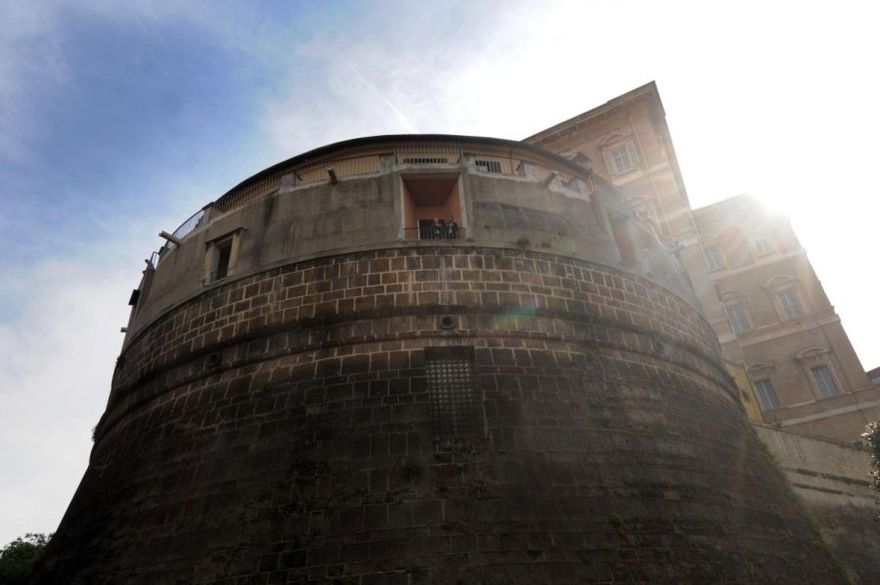
Tower of Nicholas V – HQ of the IOR
Pope Francis Interview with La Repubblica – Top Seven “Quotes”
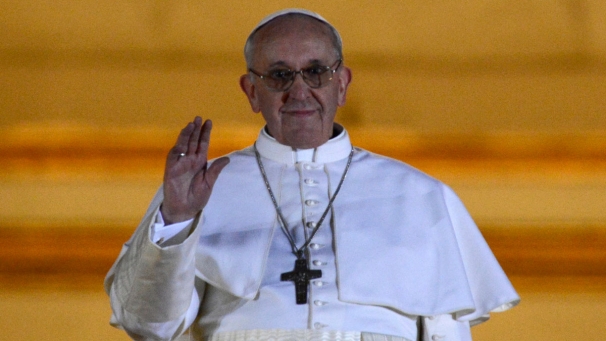
“The most serious of the evils that afflict the world these days are youth unemployment and the loneliness of the old. The old need care and companionship; the young need work and hope but have neither one nor the other, and the problem is they don’t even look for them any more. They have been crushed by the present.”
“Leaders of the Church have often been narcissists, flattered and thrilled by their courtiers. The court is the leprosy of the papacy.”
“Narcissism …indicates an excessive love for oneself and this is not good, it can produce serious damage not only to the soul of those affected but also in relationship with others, with the society in which one lives. The real trouble is that those most affected by this – which is actually a kind of mental disorder – are people who have a lot of power. Often bosses are narcissists”
“This Vatican-centric view [of the Roman Curia] neglects the world around us. I do not share this view and I’ll do everything I can to change it. The Church is or should go back to being a community of God’s people, and priests, pastors and bishops who have the care of souls, are at the service of the people of God.”
“It also happens to me that when I meet a clericalist, I suddenly become anti-clerical. Clericalism should not have anything to do with Christianity. St. Paul, who was the first to speak to the Gentiles, the pagans, to believers in other religions, was the first to teach us that.”
“A religion without mystics is a philosophy.”
“We will also discuss the role of women in the Church. Remember that the Church (la chiesa) is feminine.”
Commentary explaining problems with the interview here. Turns out the interview was not recorded or notes taken, but the result of the recollection of the 89-year old Scalfari. The tone of the text, the spirit of the interview if you will, is confirmed as accurate by the Vatican, though the details and vocabulary – and the translation- need to be taken with a grain of salt. As is to be expected with Italian journalism. The contrast in the quality of the interview with the one given to the Jesuits last week is striking. The readiness of some supposedly Catholic commentators to throw the bishop of Rome under the bus because of mistranslations or misremembered timelines – even without trying to find the original first it seems – is the most shocking aspect of all, however.
Married Priests: Optional Celibacy among Eastern Catholics – Past and Present
Report on the Chrysostom Seminar at the Domus Australia, Rome
November 2012

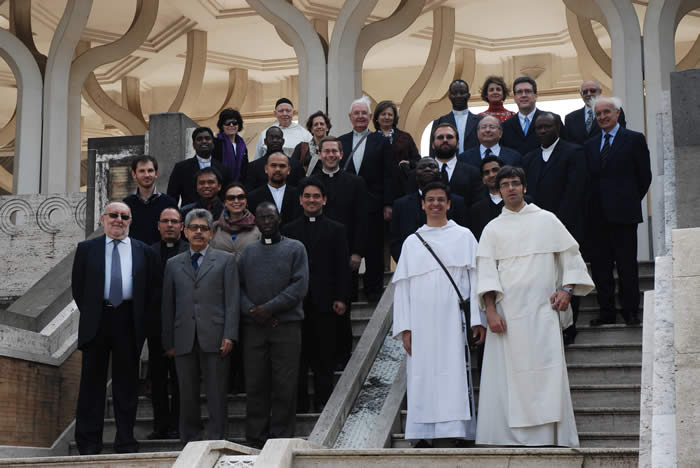
Presentation Panelists with their host
Did you know that there are now more married Roman Catholic priests in the U.S. than Eastern Catholic priests?
I do not actually remember a time when I did not know that there were married Catholic presbyters, so it has always been amusing to encounter people who find this a scandal in some way. The real scandal is that Catholic Churches with a right (and a rite!) to ordain married men are not allowed to do so, basically because of 19th and 20th century anti-immigrant sentiment, in the U.S.
That was not a main theme of the conference this morning, but it was certainly an interesting fact that was new to me.
Of the varied and lively discussion, probably the main take-away theme was this: The Gospel does not coerce, but offers conversion.
In other words, conversion is a response of the heart, whereas coercion is an exercise of power. Any relationship of supposedly sister churches, say, of Rome and of Constantinople – or of New York and Parma, for that matter – which is experienced as a relationship of coercion, becomes a church-dividing issue. This came up repeatedly regarding the imposition of a Latin discipline – mandatory celibacy for diocesan presbyterate – on non-Latin churches.
Speakers for the day included:
- Archpriest Lawrence Cross, Archpriest, Centre for Early Christian Studies, Australian Catholic University
- Rev. Prof. Basilio Petrà, Facoltà Teologica dell’Italia Centrale (Firenze)
- Rev. Thomas Loya, Tabor Life Institute, Chicago:
- Protopresbyter James Dutko, Emeritus Dean of the Orthodox Seminary of Christ the Savior, PA
- Archpriest Peter Galazda, Sheptytsky Institute, Saint Paul University, Ottawa
Archpriest Dr. Lawrence Cross spoke on “Married Clergy: At the Heart of Tradition.” Father Cross opened by stating for the record that the conference here was not a critique on the Latin practice, internally, but a protest against what he described as ‘bullying’ in some parts of the Latin Church against Eastern sister churches in communion with Rome: namely, the requirements in some places (such as the U.S.) that Eastern Catholic churches not allow married clergy because of pressure from the Latin (Roman) Catholic bishops.
Both married and celibate clergy belong to the deep tradition of the church. Though some try to point to the origins of mandatory celibacy as far back as the Council of Trullo in Spain, it is really from the 11th century Gregorian reforms – based on monasticism and coincident with a resurgence of manichaeism in the Church.
One of the results of this, much later, is the novelty, he says, of speaking of an ontological change in ordination, or an ontological configuration to Christ, as in Pastores Dabo Vobis 20, which sees married priesthood as secondary. One US Cardinal, he did not name, has referred to the ontological change of priesthood as analogous to the Incarnation or transubstantiation. The problem with the analogy is that the humanity of Christ is unchanged! Trying to assert an essential link between priesthood and celibacy, something which has been relatively recent in its effort, is problematic.
Indeed, there is no celibacy per se, in the Eastern tradition, just married or monastic life. Both require community, and vows to commit one to that community. The Code of Canons of the Eastern Church 374-5 highlights to mutual blessing that marriage and ordination offer to each other. He wonder why Pope John Paul II, who seemed to have such a high respect for the “primordial sacrament” did not see fit to apply it to the presbyterate.
Professor Basilio Petrà of the Theological Faculty of Central Italy (in Firenze), spoke on the topic of “Married Priests: A Divine Vocation.” Two immediate thoughts he shared were that the Catholic Church has always, officially at least, affirmed married priesthood, and to consider that vocation is always a call of the community and not of the individual. Marriage and priesthood are two separate callings, but both sacraments and therefore complementary not competitive.
Fr. Petrà drew attention to the recent apostolic exhortation, Ecclesia in Medio Oriente, which included this paragraph:
48. Priestly celibacy is a priceless gift of God to his Church, one which ought to be received with appreciation in East and West alike, for it represents an ever timely prophetic sign. Mention must also be made of the ministry of married priests, who are an ancient part of the Eastern tradition. I would like to encourage those priests who, along with their families, are called to holiness in the faithful exercise of their ministry and in sometimes difficult living conditions. To all I repeat that the excellence of your priestly life will doubtless raise up new vocations which you are called to cultivate.
While he emphasized the positive nature of the bishop of Rome including the married priesthood as a respected and ancient tradition in the east, it is interesting to note that while celibacy is a priceless gift of God” which “ought to be received in East and West alike,” married priesthood is not categorized as a gift of god but “a part of the tradition” and only in “the East.”
Father Thomas Loya of the Tabor Life Institute in Chicago, and a regular part of EWTN programming, presented on the topic, “Celibacy and the Married Priesthood: Rediscovering the Spousal Mystery.” Married priesthood witnesses to the Catholic tradition of a life that is ‘both-and’ rather than ‘either-or.’ We need a more integrated approach to monasticism and marriage, and relocating celibacy in its proper monastic context. But the continued practice of requiring eastern Catholic churches to defer to the Latin church hierarchy with respect to married clergy is to act as though the Latin Church is the real Catholic Church and the eastern churches are add-ons – fodder for accusations of uniatism if ever there was.
One of the clear problems of this was that when, in 1929, celibacy was imposed upon eastern churches in the US and elsewhere, married priesthood was part of the strength of these churches. Since then vocations have disappeared, evangelization has all but ceased, and the general life of the churches has withered. After “kicking this pillar of ecclesial life out from under the churches” it offered nothing to hold them up in its place, and the Church is still suffering.
Can you imagine a better seedbed for presbyteral vocations than a presbyteral family? What better way for a woman to know what it would be like to marry a priest than to be the daughter of a priest?
Married priesthood is part of the structure of the Church, but celibacy always belonged to the monasteries. Without a monastic connection, a celibate priest is in a dangerous situation, lacking the vowed relationship of either marriage or monastic life to balance the call to work. Every celibate must be connected to a monastery in some way.
Just as a celibate monastic must be a good husband to the church and community, so too must a married couple be good monastics. The relationship of monasticism and marriage ought to be two sides of the same coin and mutually enriching. The call to service in ordained ministry comes from these two relationships to serve. This would be a sign of an integrated and healthy church.
Protopresbyter James Dutko is retired academic dean and rector of the Orthodox Seminary of Christ the Savior in Johnstown, PA. His topic was “Mandatory Celibacy among Eastern Catholics: A Church-Dividing Issue.” Father Dutko was the only Orthodox presenter on the panel (and the only one without a beard, incidentally…) The bottom line? As long as the Latin Church (that is the Roman Catholic Church) imposes its particular practice on other Churches even within its own communion, there will be no ecumenical unity. Stop the Latinization, and the Eastern Orthodox may be more inclined to restore full communion.
 The Ecumenism Blog