
Home » Church and World (Page 8)
Category Archives: Church and World
Year in Review
As the Year of Grace 2011 ended, I reviewed my “to write” file for the blog, and found no less than 22 pages of notes on events and ideas I had not had time to develop into full posts. Here is a list of some highlights from the last year, with links to posts if I have them and as I develop them!
December:
- Mom visits Rome!
- Christmas at Caravita; generosity of hosts for Christmas Eve (Cindy) and Christmas Day (Jill)
- Lay Centre Board member Ralph Dwan called home to God
- Interdisciplinary Conference on Sharing Sacred Spaces
- Lord Jonathan Sacks lecture
- Lay Centre 25th Anniversary and Papal Knighthood for co-founders
- Chicago CTU Board in Rome, new Alliance with Lay Centre
- my step-sister wins a new car!
November:
- Cardinal Kasper in the classroom: Unity, Catholicity, and Apostolicity of the Church
- Colloquium on Anglican Patrimony in Light of the Apostolic Constitution: Liturgical Perspectives – Bishop Stephen Platten of Wakefield; Canon Jonathan Goodall; Fr. Keith Pecklers, SJ
- Board of Governors of the Anglican Centre visit the Lay Centre
- Canon Nicholas Sagovsky lecture, “Being an Anglican in 21st century”
- Embassy DVC on Religion in Foreign Policy with ND
- Angelicum Rector Charles Morerod, OP nominated bishop of Fribourg, Lausanne, and Geneva
- Casa Internationale Giovanni XXIII: The other lay collegio in Rome
October:
- Pilgrimage of Peace, Pilgrimage of Truth: 25th Anniversary of Assisi gathering of World’s Religious Leaders
- Tom Ryan, CSP in Rome
- Russell Berrie Orientation: Shabbat Shopping during Sukkot
- Lay Centre Orientation: Yom Kippur and an Israeli’s first Mass
- Ambassador Miguel Diaz helps launch Religion in Foreign Policy initiative
September:
August:
- Short visit home in the Pacific Northwest
- Cascade Covenant Church
- Helping my sister move: 16 hours on the road, 45 minutes unpacking the truck
- My brother’s new house
July:
- Netherlands: visiting Eveline, Clare
- New York/New Jersey: visiting Courtney, Liam, Rob
- Lay Centre 25th Anniversary Colloquium: My paper on the laity and ecumenism
June:
- Archbishop Sartain of Seattle in Rome for Pallium
- EuroPride in Rome – monastic perspectives from the hill
May
- Notre Dame Chorale Concert at Sant’Ignazio: Michael and Kerri Castorano
- Eucharistic Procession with Cardinal Marc Ouellet
- Notre Dame Glee Club and Fr. Michael Driscoll in Rome
- Lay Centre alumnus Theodosius Kyriakidis debuts his documentary film on Greek Christians in Asia Minor; another alumnus Mustafa Cenap Aydin of Turkey responds
- Archbishop Michael Fitzgerald and Leijla Demiri present on Interfaith Dialogue of life
- Beatification of JPII
April:
- Fr. Michael Casey, O.Cist. visits Lay Centre
- Assisi and Florence with Courtney and co.
- David Ford and Stephen Kepnes: The Future of Theology
- Annual JPII Lecture David Ford on Scriptural Reasoning
- Paschal Triduum in Rome
- Culture Week in Rome
- Meeting with Fr. Norbert Hofmann
March:
- Cardinal Walter Kasper, “Why I am a Man of Hope” lecture at Lay Centre
- Dame Mary Tanner at Anglican Center
- Colloquium on Anglican Patrimony in light of the Apostolic Constitution: A Canon Law Perspective
Earlier unwritten posts:
- Cardinal Levada visits the Lay Centre
- Springtime of Faith Summit in Rome – local presenters include two cardinals, two professors, and me!
Ideas, ongoing or upcoming:
- Liberal and Conservative in the Church (see june 26, Feb 2)
- Nostra Aetate, Dabru Amet, and Common Word
- ARCIC III and Personal Ordinariates
- Clericalism and Anti-clericalism
- Laïcite, laity, secularism, and secularity
- Vocations: discernment or recruiting office?
- Catholic Education beyond parochial schools
- “Catholic” vs. “Roman Catholic”: What’s in a Name?
- The Bologna Process and Pontifical Universities
- Papal honors as ecclesiological indicator
- Liturgy Wars: Episode V – The New Translation
- Call for a Common Easter
- The Big Sort
- Ecumenical Updates: Where have we got with all this dialogue?
- Wikipedia as Courtyard of the Gentiles: A call for biographical articles on great ecumenists and other theologians
- A Parable: The Kingdom of God is like the Electromagnetic Spectrum and it is Easier for a Colorblind Man to Pass Through 400-789 Terrahertz than to Enter it…
- Upcoming article in Koinonia
- Upcoming article and presentation for Assisi 2012: Ecclesiological Investigations Network conference
And finally: “The Diaconate in the International Ecumenical Dialogues: Toward an Understanding of the Deacon as Minister of Unity.” a tesina to be submitted for the License in Sacred Theology…
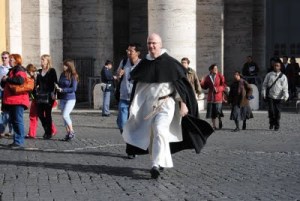
Bishop-elect Charles Morereod, OP
The first priest I knew to be made a bishop was my look-alike Daniel Jenky, CSC from Notre Dame (now Bishop Daniel of Peoria). My first professor to become a bishop was Bishop Donald Bolen of Saskatoon. But this is the first time a Facebook friend has been named a bishop.
Fr. Charles Morerod was instructor of a course I took in my first year on the “Philosophical Elements in the Catholic-Protestant Dialogue”, and has been Rector Magnificus of the Angelicum University for a little over two years. He has doctorates in both philosophy and theology, and serves as the secretary general of the International Theological Commission, as well as teaching at three universities.
News of his appointment leaked via Swiss news radio on 2 November, though the official VIS announcement was made the following day on 3 November.
Though it has since been retracted, it is interesting to note that on the same day, the Society of St. Pius X seemed to indicate its rejection of the doctrinal preamble offered by the Congregation for the Doctrine of the Faith as a requisite for the restoration of full communion of the schismatic sect with the Catholic Church.
Interesting to note, I say, because Bishop-elect Charles was one of three theologians appointed by the CDF two years ago to engage the SSPX in dialogue in an effort to close the only formal schism that resulted from Vatican II, along with Archbishop Luis Ladaria, Secretary of the CDF and Msgr. Fernando Ocariz, vicar general of Opus Dei. Moreover, his new diocese is the home of the SPPX seminary and the place of its short-lived status as a legitimate Catholic organization (SSPX was a diocesan ‘pius union’, what would now be called an ‘association of the faithful’, from 1970-1975).
But back to the good bishop-to-be. I keep running into him these days at the Angelicum, and he leaves this weekend for his home diocese, where he will be ordained and installed on 11 December. The following seems to portray his humility rather well:

Cari [fratelli e sorelle],
…Io pensavo d’essere nella nostra cara Università fino alla pensione (o alla morte). La lascio con grande tristezza, e timore per quel che trovo davanti a me. Ma non ho pensato di poter dire di no, perché non avevo motivi gravi d’andare contro una richiesta diretta del Santo Padre. “Quando il Papa ha visto i nomi, ha detto che doveva essere Lei. Perché la conosce.”
… Cosa rispondere, lo prendo come ho sempre preso la mia vocazione: umanamente ho paura, ma mi fido della volontà divina che non delude. E vedo bene qualche urgenza pastorale in Svizzera: da questo punto di vista sono felice di poter aiutare un po’.
Sono davvero triste di dover rinunciare al nostro lavoro comune… Cercherò di trovare qualche modo d’aiutare l’Angelicum a distanza. Preghiamo gli uni per gli altri.
fr. Charles
My translation, with some help from Google:
Dear brothers and sisters
… I thought to be in our beloved University until retirement (or death). I leave with great sadness, and fear of what I find before me. But I did not think I could say ‘no’, because I had no serious reasons to go against a direct request of the Holy Father. “When the Pope saw the names, he said it had to be you. Because he knows.”
… With that answer, I take it as I have always taken my vocation: As a human, I am afraid, but I trust God will not disappoint. And I can see some pastoral urgency in Switzerland: From this point of view I am happy to help a little. ‘
I am really sad to have to give up our joint work … I will try to find some way of helping the Angelicum from a distance. Let us pray for one another.
Fr. Charles has been a guest at the Lay Centre each year, and one of the main supporters of the the new John Paul II Center for Interreligious Dialogue at the Angelicum in the past year, and of the Russell Berrie Fellowship. He will certainly be missed!
The Angelicum community bids Bishop-elect Charles a fond farewell on Friday, 11 November, with a reception at 12:15.
The official bio:
The Rev.do P. Charles Morerod, OP, was born in Riaz (diocese of Lausanne, Genève et Fribourg) October 28, 1961. He studied philosophy and theology at the Faculty of Theology, University of Fribourg, concluding with a degree in Theology. In 1983 he entered the novitiate of the Order of Friars Preachers Swiss province and has made his vows in 1987.
He was ordained April 30, 1988 in Geneva.
From 1987 to 1989 he served in pastoral ministry, first as a deacon and then as viassociate pastor of the parish of St. Paul in Geneva. From 1989 to 1992 he was Assistant at the Faculty of Theology, University of Fribourg from 1991 to 1994 and chaplain of the University of Fribourg. In 1993 he received his doctorate in theology and a licentiate in philosophy in 1996.
From 1994 to 1999 he was adjunct professor of Fundamental Theology at the University of Fribourg and since 1996 professor at the Pontifical University of St.Thomas Aquinas. Since 1997 he is editor of the edition in French of Nova et Vetera Magazine.
In 1999 he became full-time professor at the Pontifical University of St. Thomas Aquinas. From 1999 to 2002 he also taught at the Faculty of Theology of Lugano. He was Vice-Dean of the Faculty of Theology from 2003 to 2009 and Dean of the Faculty of Philosophy at the Pontifical University of St. Thomas Aquinas. In 2004 he obtained his doctorate in philosophy at the Catholic Institute of Toulouse. Since 2008 he is also Director of the Roman Catholic Studies Program at the University of St. Thomas (St. Paul, Minn.).
In April 2009 he was appointed Secretary General of the International Theological Commission and Consultant of the Congregation for the Doctrine of the Faith and in September 2009, also Rector of the Pontifical University of St. Thomas Aquinas.
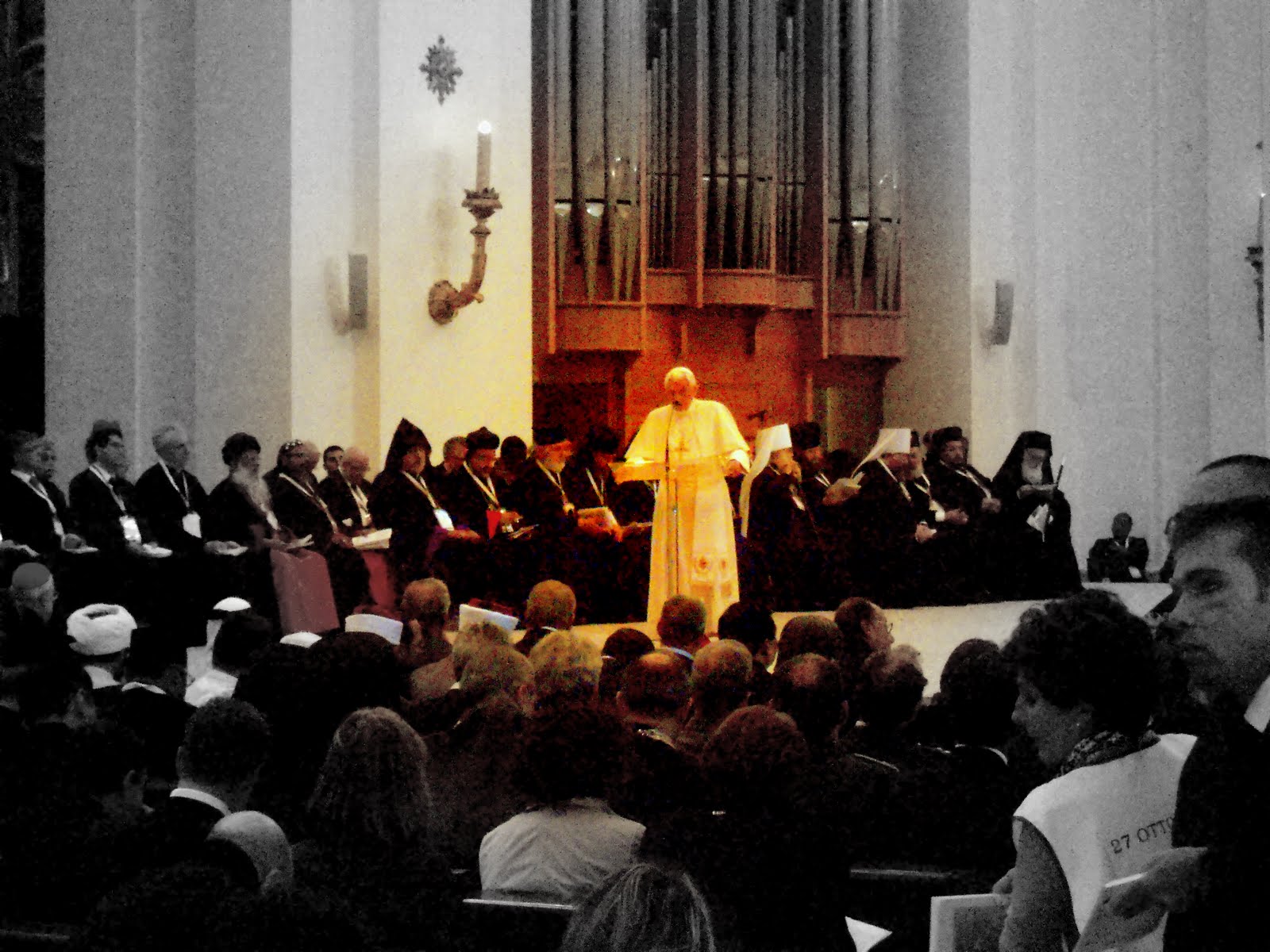
Assisi 2011: Pope Benedict XVI
Dear Brothers and Sisters,
Distinguished Heads and Representatives of Churches, Ecclesial Communities and World Religions,
Dear Friends,Twenty-five years have passed since Blessed Pope John Paul II first invited representatives of the world’s religions to Assisi to pray for peace. What has happened in the meantime? What is the state of play with regard to peace today? At that time the great threat to world peace came from the division of the earth into two mutually opposed blocs. A conspicuous symbol of this division was the Berlin Wall which traced the border between two worlds right through the heart of the city. In 1989, three years after Assisi, the wall came down, without bloodshed. Suddenly the vast arsenals that stood behind the wall were no longer significant. They had lost their terror. The peoples’ will to freedom was stronger than the arsenals of violence. The question as to the causes of this dramatic change is complex and cannot be answered with simple formulae. But in addition to economic and political factors, the deepest reason for the event is a spiritual one: behind material might there were no longer any spiritual convictions. The will to freedom was ultimately stronger than the fear of violence, which now lacked any spiritual veneer. For this victory of freedom, which was also, above all, a victory of peace, we give thanks. What is more, this was not merely, nor even primarily, about the freedom to believe, although it did include this. To that extent we may in some way link all this to our prayer for peace.
But what happened next? Unfortunately, we cannot say that freedom and peace have characterized the situation ever since. Even if there is no threat of a great war hanging over us at present, nevertheless the world is unfortunately full of discord. It is not only that sporadic wars are continually being fought – violence as such is potentially ever present and it is a characteristic feature of our world. Freedom is a great good. But the world of freedom has proved to be largely directionless, and not a few have misinterpreted freedom as somehow including freedom for violence. Discord has taken on new and frightening guises, and the struggle for freedom must engage us all in a new way.
Let us try to identify the new faces of violence and discord more closely. It seems to me that, in broad strokes, we may distinguish two types of the new forms of violence, which are the very antithesis of each other in terms of their motivation and manifest a number of differences in detail. Firstly there is terrorism, for which in place of a great war there are targeted attacks intended to strike the opponent destructively at key points, with no regard for the lives of innocent human beings, who are cruelly killed or wounded in the process. In the eyes of the perpetrators, the overriding goal of damage to the enemy justifies any form of cruelty. Everything that had been commonly recognized and sanctioned in international law as the limit of violence is overruled. We know that terrorism is often religiously motivated and that the specifically religious character of the attacks is proposed as a justification for the reckless cruelty that considers itself entitled to discard the rules of morality for the sake of the intended “good”. In this case, religion does not serve peace, but is used as justification for violence.
The post-Enlightenment critique of religion has repeatedly maintained that religion is a cause of violence and in this way it has fuelled hostility towards religions. The fact that, in the case we are considering here, religion really does motivate violence should be profoundly disturbing to us as religious persons. In a way that is more subtle but no less cruel, we also see religion as the cause of violence when force is used by the defenders of one religion against others. The religious delegates who were assembled in Assisi in 1986 wanted to say, and we now repeat it emphatically and firmly: this is not the true nature of religion. It is the antithesis of religion and contributes to its destruction. In response, an objection is raised: how do you know what the true nature of religion is? Does your assertion not derive from the fact that your religion has become a spent force? Others in their turn will object: is there such a thing as a common nature of religion that finds expression in all religions and is therefore applicable to them all? We must ask ourselves these questions, if we wish to argue realistically and credibly against religiously motivated violence. Herein lies a fundamental task for interreligious dialogue – an exercise which is to receive renewed emphasis through this meeting. As a Christian I want to say at this point: yes, it is true, in the course of history, force has also been used in the name of the Christian faith. We acknowledge it with great shame. But it is utterly clear that this was an abuse of the Christian faith, one that evidently contradicts its true nature. The God in whom we Christians believe is the Creator and Father of all, and from him all people are brothers and sisters and form one single family. For us the Cross of Christ is the sign of the God who put “suffering-with” (compassion) and “loving-with” in place of force. His name is “God of love and peace” (2 Cor 13:11). It is the task of all who bear responsibility for the Christian faith to purify the religion of Christians again and again from its very heart, so that it truly serves as an instrument of God’s peace in the world, despite the fallibility of humans.
If one basic type of violence today is religiously motivated and thus confronts religions with the question as to their true nature and obliges all of us to undergo purification, a second complex type of violence is motivated in precisely the opposite way: as a result of God’s absence, his denial and the loss of humanity which goes hand in hand with it. The enemies of religion – as we said earlier – see in religion one of the principal sources of violence in the history of humanity and thus they demand that it disappear. But the denial of God has led to much cruelty and to a degree of violence that knows no bounds, which only becomes possible when man no longer recognizes any criterion or any judge above himself, now having only himself to take as a criterion. The horrors of the concentration camps reveal with utter clarity the consequences of God’s absence.
Yet I do not intend to speak further here about state-imposed atheism, but rather about the decline of man, which is accompanied by a change in the spiritual climate that occurs imperceptibly and hence is all the more dangerous. The worship of mammon, possessions and power is proving to be a counter-religion, in which it is no longer man who counts but only personal advantage. The desire for happiness degenerates, for example, into an unbridled, inhuman craving, such as appears in the different forms of drug dependency. There are the powerful who trade in drugs and then the many who are seduced and destroyed by them, physically and spiritually. Force comes to be taken for granted and in parts of the world it threatens to destroy our young people. Because force is taken for granted, peace is destroyed and man destroys himself in this peace vacuum.
The absence of God leads to the decline of man and of humanity. But where is God? Do we know him, and can we show him anew to humanity, in order to build true peace? Let us first briefly summarize our considerations thus far. I said that there is a way of understanding and using religion so that it becomes a source of violence, while the rightly lived relationship of man to God is a force for peace. In this context I referred to the need for dialogue and I spoke of the constant need for purification of lived religion. On the other hand I said that the denial of God corrupts man, robs him of his criteria and leads him to violence.
In addition to the two phenomena of religion and anti-religion, a further basic orientation is found in the growing world of agnosticism: people to whom the gift of faith has not been given, but who are nevertheless on the lookout for truth, searching for God. Such people do not simply assert: “There is no God”. They suffer from his absence and yet are inwardly making their way towards him, inasmuch as they seek truth and goodness. They are “pilgrims of truth, pilgrims of peace”. They ask questions of both sides. They take away from militant atheists the false certainty by which these claim to know that there is no God and they invite them to leave polemics aside and to become seekers who do not give up hope in the existence of truth and in the possibility and necessity of living by it. But they also challenge the followers of religions not to consider God as their own property, as if he belonged to them, in such a way that they feel vindicated in using force against others. These people are seeking the truth, they are seeking the true God, whose image is frequently concealed in the religions because of the ways in which they are often practised. Their inability to find God is partly the responsibility of believers with a limited or even falsified image of God. So all their struggling and questioning is in part an appeal to believers to purify their faith, so that God, the true God, becomes accessible. Therefore I have consciously invited delegates of this third group to our meeting in Assisi, which does not simply bring together representatives of religious institutions. Rather it is a case of being together on a journey towards truth, a case of taking a decisive stand for human dignity and a case of common engagement for peace against every form of destructive force. Finally I would like to assure you that the Catholic Church will not let up in her fight against violence, in her commitment for peace in the world. We are animated by the common desire to be “pilgrims of truth, pilgrims of peace”.
© Copyright 2011 – Libreria Editrice Vaticana
Assisi 2011: The delegates
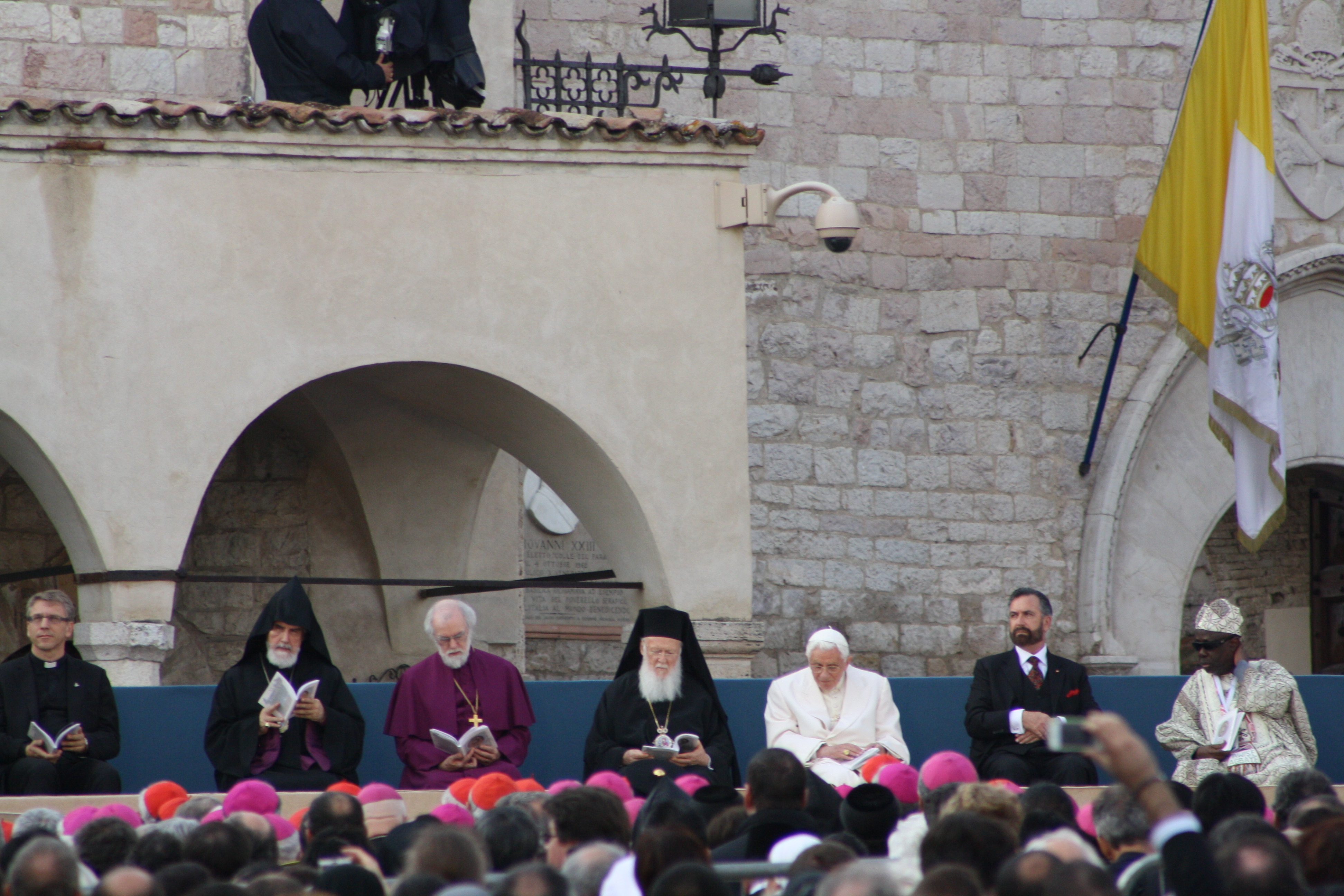
The official Christian delegates included Patriarch Bartholomew I of Constantinople, Archbishop Rowan Williams of Canterbury, Archbishop Norvan Zakaryan of the Armenian Apostolic Church, Secretary General Olav Fyske Tveit of the World Council of Churches.
In all, there were representatives of the Orthodox Churches from the Patriarchates of Constantinople, Alexandria, Antioch, Moscow, Serbia, Romania, and the Ukrainian, Belarusian, Cypriot, Polish and Albanian churches. The Oriental Orthodox were represented by the Syrian Patriarchate of Antioch, the Armenian Apostolic Church (both Catholicossates) and the Malankara Orthodox Syrian Church. The Assyrian Church of the East was represented by the Metropolitan of India, the bishop of California and a priest.
The Anglican Communion, the Old Catholic Church, Lutheran World Federation, World Communion of Reformed Churches, the World Methodist Council, the Baptist World Alliance, World Convention of the Churches of Christ, the Mennonite World Conference, the World Evangelical Alliance, and the World Council of Churches were all represented, along with the Church of Scotland, the Disciples of Christ, the Salvation Army, and the classical Pentecostal churches.
176 representatives of non-Christian religions were present, including Reform and Orthodox Judaism; Sunni, Shi’a, Alawite and Ismaili Muslims; Hinduism (including Rajmohan Gandhi, grandson of the Mahatma); Jainism; Zoroastrianism; Buddhism (including Shaolin, Zen, Tibetan, Theravada, Tendai, Jogye, Jodo-Shu, and other forms); Confucianism; Taoism; Shinto; Mandaean (Gnostics); Sikh; Baha’i; traditional African, American, and Indian Religions; and “new religions” such as Tenrikyo, Ennokyo, and Myochi-kai.
Four “non-believers” were invited, a first, emphasizing Pope Benedict’s interest in the New Evanglization and his effort to engage secularism and religion on a level of common interest in the quest for truth. These included Julia Kristeva, Bulgarian-French psychoanalyst; Guillermo Hurtado, the Mexican philosopher; Walter Baier, a politician from Austria; and Remo Bodei an Italian professor of Aesthetic and philosophy.
Assisi 2011: The pilgrims

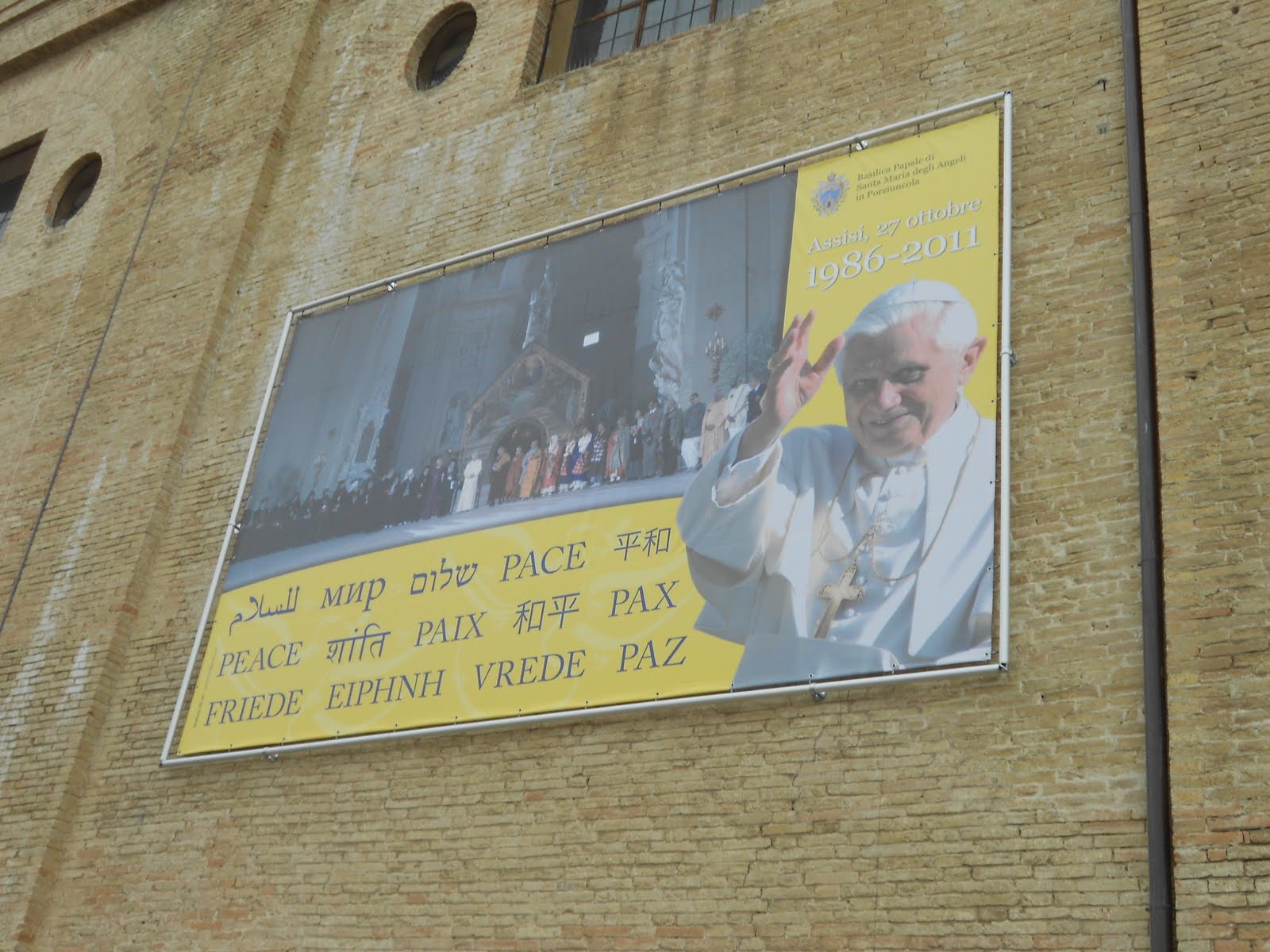
The Lay Centre at Foyer Unitas, in collaboration with the new Pope John Paul II Center for Interreligious Dialogue, planned a day trip to Assisi on 27 October 2011 to join Pope Benedict XVI and world religious leaders – and a few secular agnostics – in a day of pilgrimage toward peace.
Our group included seven from the Lay Centre, six Russell Berrie Fellows and alumni, and one who could count for both. Additionally, we were joined by Rev. Tom Ryan, CP, of the Paulist Office for Ecumenical and Interreligious Affairs; Anna Maria Kloss, wife of the Austrian Ambassador to the Holy See; and seven other pontifical university students, including two from the Gregoriana’s late Interdisciplinary Center for the study of Religion and Culture.
We were 24 people representing 16 countries, including: Austria, Belarus, Bosnia i Herzegovina, India, Indonesia, Israel, Italy, the Netherlands, Nigeria, Philippines, Poland, Portugal, Rwanda, Turkey, the U.S., and Venezuela.
Our day began at 0500, enough time to get up and ready for an 0600 departure by tourbus, for the 3 hour drive to Assisi. At a coffee break on the way, we ran into the Turkish Ambassador to the Holy See. After arrival in Assisi we met up with our local guide and Lay Centre alumna, Lori King; Dr. Marian Diaz and staff of the U.S. Embassy to the Holy See.
The schedule of the day was relatively light. At 1030 the morning session at the Basilica of Santa Maria degli Angeli, in the valley below Assisi proper, lasted for a little under two hours. We then made our way up the hill to a restaurant near the Basilica of Santa Chiara (St. Clare) for lunch. After lunch a leisurely stroll took us to the other end of town, to join a World Youth Day in miniature going on in the lower piazza before the delegates arrived. The closing event started at 1630, and was over in time for us to get a quick pizza and be on the road to Rome by 2000.
Assisi was, if anything, quieter than many of my visits. Expecting large crowds for the event, most who did not have tickets stayed away, so in fact there was just a right amount – those with tickets admitted into the venues, and then only locals from Assisi and nearby towns lining the roadways or in the piazza outside the church. It was a welcome change from the unruly hordes that accompany papal events in Rome. Inside the basilica in the morning, we were seated barely 15 meters from the platform, though at an obscure angle. In the afternoon, the lowere piazza was filled, but it is not very large, and we were seated at just the place where the pope, patriarch, and archbishop disembarked their shuttle.
At one point, just before the delegates arrived for the afternoon program, one of our company had gone looking for water. We wanted to find him before it was too late to re-enter the piazza, but were barred from exiting by security as the delegates who were coming on foot were about to arrive. As we watched the nearly 300 religious delegates enter the piazza, wondering where Muhammad had gone, there he comes in the middle of the delegates procession, engaged in deep conversation with a professor from Sarajevo! It looked so natural, that security did not even think to stop him. It was classic, and again, left me wishing I had had a working camera with me!
In the end, the trip came together wonderfully, especially in that most of it was put together in only a week. It is a once in a decade event, made well worth it with the companionship of friends and colleagues in dialogue.
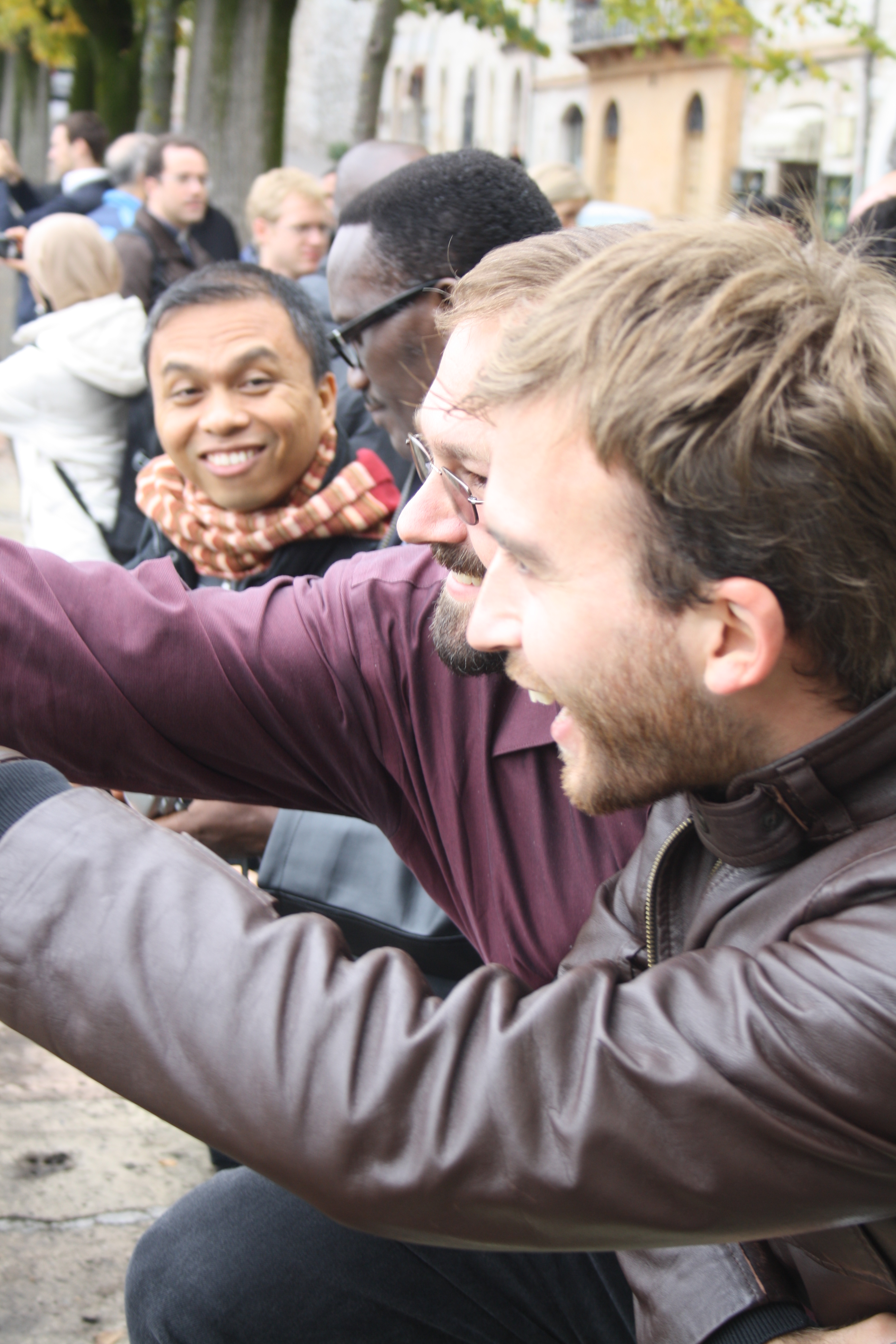
Muhamed and I engaged in some serious dialogue and sightseeing
Assisi 2011: Pilgrims of Truth, Pilgrims of Peace
“Assisi alone is enough reason to beatify Pope John Paul II” was the headline of the Catholic Herald in the UK last April, a fortnight before the late pope was approved for veneration on the calendar of the diocese of Rome and in Poland as one of the “Blessed”. Karol Wojtyła became a pope of many firsts, and John Allen, Jr. has recently quipped that Joseph Ratzinger has become a pope of seconds – but that these second times can be as important as the first.
In part, this is because it gives certain sustainability to an event or program, showing that it was not a personal proclivity of the past pope, doomed to die with him. This has been true of World Youth Day, and now of the Assisi pilgrimage for peace.
Another aspect is this: Pope Wojtyła was an actor, a master of stage and screen. He had the timing and the panache to make big waves with spectacular images and actions. One curial cardinal was asked, at a meeting of his dicastery, “When will we see some of these grand images of [the pope’s] turn into policy?” The cardinal leaned to his secretary and was overheard to say, “Come si dice ‘senza fiato’ in inglese? (How do you say, ‘we are out of breath’ in English?) … We can barely keep up with him!”
The current bishop of Rome is a theologian, a teacher, and an introvert. He takes a few of these grand points, and is digging deeper, giving them ‘staying power’ in the system and with reflection. In the process, he is adding his own spin on things, too. Much ado was made of the fact that this time around, the fourth gathering of interreligious leaders to Assisi for the cause of peace, there would be no ‘common prayer’ so that not even the most rigorous of the right-wing could cry foul (or so it was thought).
Never mind that there was never ‘common prayer’ in the first case, either. Coming together to pray is different than coming to pray together. In 1986, the day concluded with a series of prayers, each religious group leading its own prayer, while other participants looked on in respectful silence. It was close enough that even Ratzinger was reserved about the appropriateness at the time.
(In the annals of the bizarre, and as a reminder of how much of Italian journalism at the time was about inflammatory rhetoric more than fact, one Italian reporter made claims that African animists sacrificed a chicken on the altar of the Basilica of Santa Chiara, inciting charges of sacrilege and syncretism. The fact that the basilica was closed and no such act ever took place does not stop certain elements from bringing it up from time to time to discredit the Spirit of Assisi and Pope John Paul II.)
This year, the day started at the Basilica Santa Maria degli Angeli with a series of 10 scheduled talks on peace, after an introduction from Cardinal Turkson of the Pontifical Council for Justice and Peace, which organized this year’s event. The appeals were offered by four Christians, followed by five non-Christian religious leaders, and one ‘non-believer’. There was a confused moment as the apparent Muslim guest was brought to the lectern, refused the notes he was offered, and went on to explain in Arabic that he was not the person listed on the program, but offered a reflection anyway. Only after the last scheduled speaker was the original Muslim representative produced to deliver his address; I still do not know who the first Muslim presenter was or what else he said.
Before the day, Fr. Tom had asked what language the day would be presented in. Based on my experiences in Rome for major liturgies and events, I indicated Italian, with only smatterings of others. I was wrong. Throughout the day, the three cardinals all spoke in English. In the morning, it was clear that efforts were made to be as universally understood as possible: English was used by the Anglican, WCC, Jewish, Muslim, Hindu, African animist religious representatives. French was spoken by the Orthodox and agnostic. The Buddhist representative spoke in Korean, and the unplanned Muslim speaker was in Arabic. In the afternoon, native languages were used, and worth noting that Arabic was not just “the Muslim language” but also that of the Syrian Orthodox and the Lutheran representatives.
Instead of a series of prayers lead by different religious groups, this time the afternoon session in the lower piazza of the Basilica San Francesco included a series of solemn commitments to peace by assorted religious leaders. This was introduced by Cardinal Jean-Louis Tauran of the Pontifical Council for Interreligious Dialogue, and lead by the Ecumenical Patriarch, Bartholomew I. Ten religious leaders and another non-believer made their solemn commitments, followed by an address of Pope Benedict XVI, and closed with an invitation to exchange a sign of peace by Cardinal Kurt Koch of the Pontifical Council for Promoting Christian Unity (and the Pontifical Commission for Religious Relations with the Jews).
There is no question that it was a beautiful day, and inspiring simply to bring all of these people together as a witness for peace, the positive contribution of people of faith to the world, and even of the potential to overcome the modern myth of a necessary animosity between “people of faith” and “people of science” – ie, secularity.
Yet, there also is no question in my mind that something was lost with the over-emphasized intentional lack of prayer. How can a ‘pilgrimage’ be true to its nature without prayer? How can you gather religious leaders together, and tell them not to pray? This year, there were not even the sequestered opportunities for prayer that marked the last such event, in 2002, held in response to the terrorist attacks of 9/11, much less the series of prayers offered in public that marked the first event 25 years ago.
There was a moment of silence in the afternoon session for everyone to “pray or commit their thoughts to peace” – on one hand, very hospitable for even those who do not pray. On the other, I think the type of prayer offered in 1986 lends itself less to accusations of syncretism (exaggerated in either case), where each tradition is allowed to be true to itself, rather than having a single, mixed, everybody-do-what-you-want moment or prayer and positive thoughts.
Some of the speakers offered prayers spontaneously as part of their delivery, others quoted scriptures.
For our own part, an unplanned opportunity presented itself. In what must be a first for a papal event, the closing ceremony actually finished half an hour early, and the restaurant we planned for a quick pizza before returning to Rome was not yet open. With half an hour to kill, our group split in various directions, some to shop, some to wander, some to pray. About ten of us wandered up to the 13th century Church of Santo Stefano, a beautifully simple church whose bells were said to have miraculously pealed at the moment of Francis’ death.
As the Christians prayed in the front of the church, some of our Muslim pilgrims prepared for their own evening prayer, at the back of the church. As Christians finished, instead of walking out past the praying Muslims, most stopped and waited as respectful observers. It was just a few minutes, it was spontaneous, and it made the day a genuine pilgrimage of truth, for peace.
Dear Father Facebook: You are not married
 Dear Father Facebook,
We have been friends for a while, possibly in real life, but certainly on this social networking site, which is far more important at the moment.
You are a priest of the Catholic Church. I am pretty good at ecclesiology, and having studied and discerned ordained and non-ordained ecclesial ministry my whole life, and I am quite sure that the norm of celibacy is still in force for the Latin Church. I have a deep respect and love of Eastern Catholic Churches, which generally allow their diocesan clergy to wed, but I happen to know that you are thoroughly Latin.
That being the case, unless you are an Anglican priest or Lutheran pastor who has come into full communion since your ordination, you are not married.
Please change your relationship status.
Yes, I know you are not alone, and it is not a clear cut choice. There is no “celibate” option on the relationship status list, last time I checked, so you and your brother presbyters have to choose between “single”, “in a relationship”, or “it’s complicated”, etc. Several of you have opted to present yourself as “married”, but I suggest this is not a good idea. Primarily because, well, you are not married.
You could say you are single, which is the most obvious true choice. The problem is that it might imply that you are available, and if you are chaste in your celibacy, as I am sure you are, then you are not available and I can understand that you do not want to give that impression.
You could say you are in a relationship, or that it is complicated, indicating you are not available, but neither are you engaged or married. These might be better, because, again, they are honest descriptions, though hopefully your commitment to your orders is not really that complicated. And it never says what kind of relationship you are in, so this could work.
But the one thing you are not is “married” (nor “engaged”, for you seminarians reading this). These very clearly indicate a vowed, committed lifelong relationship between two people that is a sign of love and union, and open to children. If you are religious you are in a vowed relationship as well, but it is not marriage. If you are diocesan (secular, for you old-school types), you are not even in vows, but an oath of fealty to your bishop.
Sure, back in the day when local churches elected their own bishops for life, it was spoken of as “being married to the church” – but when princes and popes took the power of placement away from the people, and when bishops began to move from see to shining see with impunity, the analogy began to break down.
And, sure, we can joke about people being “married to the job” because of their commitment and dedication, but these parallels and analogies are not the real thing. As Catholic Christians we view holy marriage as a sacrament – Pope John Paul II called it the “primordial sacrament” – and we should not treat it lightly.
For that reason too, as well as respecting the human person, it is probably not a good idea to refer to your breviary, your calendar, or your bishop even jokingly as your “wife”.
While we are on the topic of mixed messages – please do not wear a wedding band. You are not married.
Symbols are powerful. Consider if all the baptized and confirmed began wearing a stole as a symbol of their priesthood. Even though based on a true doctrinal reality – that by Christian Initiation all share in the priesthood of Christ – we reserve that particular symbol for a particular participation in His priesthood: that of the ordained bishop, presbyter or deacon. Similarly, the wedding band is reserved for those who actually participate in the sacrament of marriage, not a parallel image, no matter how sincere the intent or worthy the service.
If you want to begin a petition for Facebook to offer a “celibate” or “vowed religious” or even “consecrated virgin” relationship status, I will “like” it. I hope you can post an honest descriptor on your page, showing to the socially networked world the sacrifice you have made “for the sake of the kingdom”.
Until that time, however, please help me in supporting the traditional definition of marriage… by removing it from your profile.
Sincerely,
your (unmarried) brother in Christ.
Liberalism (and Conservativism) Today
My friend and colleague, Dr. Matthew Tan, has his own blog, the Divine Wedgie, which lately has been more active than mine. Probably because he has finished his license and i am still procrastinating toiling away.
Recently, he posted this little bit about “Liberalism today” and prompted my thoughts, below. This continues a thread loosely connected on the topic of partisan labeling, in the Church especially, started with a quote from the famous canonist Ladislas Orsy, and followed by a former parishioner’s response.
First, Matthew’s remarks:
The American radical social activist Saul Alinsky has been dubbed as one of the “great American leaders of the non-socialist left”. He once said that a Liberal was someone that left the room before an argument began.
That was the 20th century, now that Liberalism has established itself as the dominant institutional paradigm in the 21st century (even when articulated through some ostensibly postmodern voices), we find the Liberal being the only one in the room and who bars entry into it before an argument begins.
One should not be surprised, since Liberalism, in its attempt to provide a space for all to behave however they want regardless of communal telos, paradoxically enjoins a particular pattern of behaviour that seeks to undercut and displace any pattern of virtue it claims it wants to include. To the extent it seeks to do this, Liberalism becomes not the opposite to but equates to a form of totalitarianism.
[Warning, liberal use of dry wit below. Or is it conservative use?]
My immediate response:
This sounds rather like late 20th century liberalism, not the contemporary kind. At least in the States, the 80s and 90s were the days of overly uptight political correctness, and you could be sued for sexual harassment for opening a door for a woman. Only the intolerant could not be tolerated. Totalitarian and liberal, in the contemporary sense, are anything but synonymous. Today’s “liberals” really do just want to listen, and be welcoming, which is what gets them labeled as such….
Unless you really do mean Liberalism with a capital L. Because we do not call them Liberals anymore, in the classical sense, probably because they would get confused with the liberals, so they are now called neo-conservatives for some reason. And your description fits well, since they do not care much for dialogue. Or people.
Thankfully in the Church things are much clearer.
Church liberals are the people who are trying to maintain the status quo, or at least the status quo of the last generation or two. They may find themselves fighting fiercely to maintain the serenity and balance of the way things are, lest they be destroyed by these young radicals. Their concern is with tradition as they received it, and protecting the Church from the damage done by irresponsible change.
Church conservatives are radical change agents, dissatisfied with the current state and confused as to why everyone else does not see the obvious need for “reform” (or the abandonment of all that is good and holy, if you are on the other side). They are trying to look back beyond the last couple generations to a previous period, and bring back a ‘purer age’ unencumbered by the historical accretions that are represented in the ‘golden age’ that the reactionaries (above) idealize.
… Does anyone else miss the good old days? You know, back when men were men, roses were red, conservatives were sticks-in-the-mud, and liberals were singing kumbayah?
*sigh*
The decaffeinated Other
However, a closer look reveals how [progressive liberal] multicultural tolerance and respect of differences share with those who oppose immigration the need to keep others at a proper distance. “The others are OK, I respect them,” the liberals say, “but they must not intrude too much on my own space. The moment they do, they harass me – I fully support affirmative action, but I am in no way ready to listen to loud rap music.” What is increasingly emerging as the central human right in late-capitalist societies is the right not to be harassed, which is the right to be kept at a safe distance from others. A terrorist whose deadly plans should be prevented belongs in Guantánamo, the empty zone exempted from the rule of law; a fundamentalist ideologist should be silenced because he spreads hatred. Such people are toxic subjects who disturb my peace.
On today’s market, we find a whole series of products deprived of their malignant property: coffee without caffeine, cream without fat, beer without alcohol. And the list goes on: what about virtual sex as sex without sex? The Colin Powell doctrine of warfare with no casualties (on our side, of course) as warfare without warfare? The contemporary redefinition of politics as the art of expert administration as politics without politics? This leads us to today’s tolerant liberal multiculturalism as an experience of the Other deprived of its Otherness – the decaffeinated Other.
Slavoj Zizek, if you are not familiar, is a rather atypical thinker.
I would add school Christmas concerts without Christmas songs to his list. Christmas without Christ? I am sure there are others.
An interesting quote i thought i would pass on, referenced during a presentation last week on interreligious dialogue. I am not sure it is fair to progressive liberals as it sounds more like libertarian liberals, and then there are plenty of people self-describing as liberal who would not fit either… but it does highlight the problem of tolerance if seen as a sufficient goal, and the idea of a whitewashed, bland, decaffeinated neutral zone in which no one is allowed religious or cultural expression under the guise of allowing all a safe place to be together.
A truly safe place is one in which we can be ourselves while respecting the other, not the place where we all have to give up who we are so as not to ‘inflict our religion/politics/personality’ on the other. The challenge is to be true to ourselves while being true to the other. It is not (as the right extreme would have it) that by allowing the other to be truly present we are short-changing our own self and therefore should not or cannot enter into dialogue and encounter, nor is it (as the left extreme would have it) that we must all refrain from being our true selves so that all can be present together in an empty nothingness of secular space.
On the removal of bishops
Twice in the last three months, Vatican Information Service has announced something which, for the last decade, Vatican officials have said was not actually possible: The pope has removed bishops from the pastoral care of their dioceses.
I have mixed feelings on these announcements.
On March 31, VIS reported that the Holy Father had removed his brother bishop Jean-Claude Makaya Loemba from the pastoral care of the diocese of Pointe-Noire, Republic of the Congo. On May 2, it was announced that he had removed Bishop William M. Morris from the pastoral care of the diocese of Toowoomba, Australia. In neither case was the relevant canon cited which would indicate the actual conditions under which the bishop was ‘removed’.
Bishop Bill has been getting lots of press, both supportive and critical. There has been virtually nothing else on Bishop Jean-Claude. This is the first disappointment – a Caucasian Anglophone bishop gets removed and there is all sorts of coverage, but an African bishop gets the same and… nothing? Really? I know there can be lots of reasons for this: access to internet media, maybe it is all being reported in French, maybe there just is not support for Bishop Jean-Claude as there was for Bishop William, etc. But it still looks bad.
The reasons noted in press outlets for Bishop Jean-Claude’s removal include “mismanagement problems (not moral ones) and tensions in his diocese” – by which is apparently meant tensions with his presbyterate. If every bishop with management problems were removed, we would see this kind of thing a lot more often. This is something that commentators on both left and right picked up on: mismanagement alone is not sufficient for the removal of a bishop, according to canon law. In a global corporation, maybe that would be the case, but this is the Church. So maybe it’s the issue of tensions with the presbyterate – we saw in the case of Cardinal Law that he was not asked to go until his priests declared ‘no confidence’ in his leadership, no matter how many protests from the laity and other ministers.
For the last decade of the sexual abuse crisis, amid calls for the Pope to do something more direct, we have constantly heard that he cannot simply remove malfeasant bishops, that a process must be followed. And then this, where he appears to do just that. But I think partially it is that he appears to do that – and probably this is an inaccurate report by VIS. Both EWTN and Ed Peters, both decidedly right-of-center on ecclesiastical issues, comment on this, so put to rest any accusations of this being a ‘liberal’ complaint.
This is an issue from at least two directions. First, a bad process always leads to a bad decision, even if the actual outcome is a good one. This is moral theology 101 – the ends do not justify the means. So, either there was a better process in place (seems likely) and it was just poorly communicated (still part of the process), or it was a bad process from start to finish.
Second, and more importantly, bishops are not middle management, carrying out their tasks vicariously authorized by the pope – at least, in theory (theology) and in law. In practice however, and in popular Catholicism, this is exactly what they are. The problem here is, if this is what they are, then the Holy See is liable for lawsuit on abuse claims based on the idea that the pope is the supervisor of the bishops. The Vatican’s defense in recent cases was precisely based on Catholic ecclesiology that the bishops are not branch-managers of a global conglomerate. However, if they can be appointed and removed at will by the ‘central office’ then, legally, that is exactly what they are – and the Vatican itself becomes liable for their actions while in office.
With the case of Bishop William “Bill” of Toowoomba, which has generally been focused on a 2006 pastoral letter in which the bishop mused on creative alternatives to the priest shortage in his diocese:
Given our deeply held belief in the primacy of Eucharist for the identity, continuity and life of each parish community, we may well need to be much more open towards other options for ensuring that Eucharist may be celebrated. As has been discussed internationally, nationally and locally the ideas of:
- ordaining married, single or widowed men who are chosen and endorsed by their local parish community;
- welcoming former priests, married or single, back to active ministry;
- ordaining women, married or single;
- recognising Anglican, Lutheran and Uniting Church Orders.
We remain committed to actively promoting vocations to the current celibate male priesthood and open to inviting priests from overseas.
The obvious problem point is “ordaining women, married or single”. At least, it should be obvious. Since 1994 and the publication of Ordinatio Sacerdotalis, the popular understanding is that “we cannot talk about ordaining women anymore”. This is not exactly accurate, as the possibility of ordaining women to the diaconate, or as deaconesses, is not excluded and is still very much debated. (I am currently reading an interesting book by Bishop Gerhard Müller who argues that this document meant to exclude the diaconate as well, however).
Many people are not aware that the CDF, under Joseph Ratzinger, a year later issued a Responsum ad Dubium stating, “This teaching… has been set forth infallibly by the ordinary and universal Magisterium” – probably because this claim was repudiated by various theologians expert in the infallible magisterium of the papacy as “not fitting the criterion” to make it such. Some of this was confusion between ex cathedra teaching (which this clearly is not) and the more ambiguous claim to infallibility because it is an exercise of the ordinary and universal magisterium. Much however is based on the argument that the exclusion of women from ordination is not a matter of faith or morals, but of ecclesiastical discipline, and therefore not eligible for “infallible status”.
The rest are valid and viable ideas, to differing degrees. Canon 277.1 obliges all clerics to “observe perfect and perpetual continence … and therefore are bound to celibacy”, but the same canon (277.3) allows the diocesan bishop to establish more specific norms or dispense with this requirement. This is used regularly for deacons, and for priests who are former Orthodox or Anglican priests or Lutheran pastors. Clearly, as a discipline, clerical celibacy is not part of the deposit of faith, is neither irreformable nor infallible, and a (theologically and pastorally, if not politically or prudently) reasonable option for discussion.
Ecumenical dialogue has as one of its goals the recognition of orders and ministries – we can certainly pray for the day when either we can honestly recognize in the orders of these other churches the full understanding of ordained ministry we see in our own, as we already do with the Orthodox and other ancient eastern Churches. And we hope for the day when those ministries are exercised together in full communion with the Catholic Church.
Fundamentally, though, the question comes down to this: If the Holy Father can “remove from the pastoral care of a diocese” bishops whose fault is less serious than shielding pedophile priests, why can we not do the same for those who do?
 The Ecumenism Blog