
Home » Church and World (Page 7)
Category Archives: Church and World
Year of Faith Calendar
The 50th anniversary of Vatican II first session is being celebrated in Rome by a ‘Year of Faith.’ Edward Pentin of the National Catholic Register collated most of the events, below.
BY EDWARD PENTIN, ROME CORRESPONDENT
With just two months to go until the Year of Faith begins, the Vatican has released a calendar of all the major meetings, celebrations and initiatives taking place in Rome.
The events, which are aimed at deepening the diverse religious and cultural themes related to the yearlong celebration, begin shortly before the official opening on Oct. 11, according to the calendar compiled by L’Osservatore Romano and published Aug. 1.
The Court of the Gentiles will be holding a meeting of dialogue between believers and nonbelievers in Assisi Oct. 6, followed by the opening of the XIII General Assembly of the Synod of Bishops on Oct. 7 at the Vatican. The synod will last until Oct. 28.
The Pope is then to formally open the Year of Faith at a solemn celebration in St. Peter’s Square, beginning at 10am on Oct. 11. The Holy Father will be joined by the Synod Fathers and presidents of the world’s bishops’ conferences. In the evening, the Italian Catholic movement L’Azione Cattolica will hold a procession from Castel Sant’Angelo to St. Peter’s Square to commemorate the 50th anniversary of the opening of the Second Vatican Council.A large number of events will then begin to take place over the next 12 months, all emphasizing the meaning of faith and evangelization. These include a meeting on the theme “The Faith of Dante,” an artistic and cultural evening that will take place at the Jesuit Chiesa del Gesu in Rome Oct. 12, partly organized by the Pontifical Council for Culture.
On Oct. 20, a pilgrimage and vigil for missionaries will take place on the Janiculum hill close to the Vatican, organized by the Congregation for the Evangelization of Peoples.
The following day, Sunday Oct. 21, Benedict XVI will preside over the canonization of six martyrs and blesseds: Jacques Barthieu, a Jesuit missionary, martyred in Madagascar in 1896; Pietro Calungsod, a lay catechist, martyred in the Philippines in 1672; Giovanni Battista Piamarta, an Italian priest who founded the Congregation of the Holy Family of Nazareth for men and the Humble Servants of the Lord for women, who died in 1913; two Americans: Blessed Marianne Cope of Molokai, who spent 30 years ministering to lepers on the Hawaiian island of Molokai; and Blessed Kateri Tekakwitha, a native American, baptized by a Jesuit missionary in 1676 when she was 20, who died four years later; Blessed Carmen Salles y Barangueras, a religious in Spain who worked with disadvantaged girls and prostitutes and died in 1911; and Anna Schäffer, a lay Bavarian woman who accepted her infirmity as a way of sanctification, who died in 1925.
Then, Oct. 26-30, a congress of the World Union of Catholic Teachers will take place in Rome, focusing on the role of the teacher and the family in the integral formation of students, with the participation of the Congregation for Catholic Education.
Nov. 15-17, the 27th International Conference of the Pontifical Council for Health Care will be held on the theme “The Hospital, a Place of Evangelization: the Human and Spiritual Mission.”
After the Holy Father celebrates the first vespers of Advent for the pontifical universities in Rome and other institutes of formation on Dec. 1, an exhibition on the Year of Faith will be inaugurated Dec. 20 in Castel Sant’Angelo. The exhibition will last until May 1, 2013.
As is tradition, an ecumenical prayer service with Pope Benedict will take place Jan. 25, 2013, at the Basilica of St. Paul Outside the Walls, but next year’s celebration on the Solemnity of the Conversion of St. Paul will also see an art exhibit on display in the basilica until Nov. 24; it is entitled Sanctus Paolus Extra Moenia et Concilium Oecumenicum Vaticanum II.
On Feb. 2, Benedict XVI will celebrate the World Day of Men and Women Religious in St. Peter’s; and a Feb. 25-26 symposium, “Sts. Cyril and Methodius Among the Slavic Peoples: 1,150 Years From the Beginning of the Missions,” will take place at the Pontifical Oriental Institute and the Pontifical Gregorian University.
On March 24, Benedict XVI will celebrate Palm Sunday, a day traditionally offered for young people in preparation for World Youth Day.
Between April 4-6, the Congregation for Catholic Education will co-host an international conference as part of the celebration.
A concert, “Oh My Son,” will be performed in the Paul VI Hall April 13, while, from April 15-17, the Congregation for Catholic Education will be organizing a study day to discuss the relevance of the documents of Vatican II and the Catechism of the Catholic Church in the formation of candidates for the priesthood and in the ongoing revision of the Ratio Fundamentalis Institutionis Sacerdotalis (Spiritual Formation in Seminaries).
April 28 will be a day dedicated to all boys and girls who have received the sacrament of confirmation; the Holy Father is scheduled to confirm a small group of young people on this day. On May 5, the Pope will celebrate a day dedicated to confraternities and popular piety.
On the vigil of Pentecost, May 18, the Pope will dedicate the celebrations to all the faith-based movements, together with pilgrims at the tomb of Peter, and invoke the Holy Spirit. June 2, the feast of Corpus Domini, will be a day of solemn Eucharistic adoration, presided by the Pope. As part of the Year of Faith, adoration will take place throughout the world.
A day dedicated to Blessed Pope John Paul’s 1995 encyclical Evangelium Vitae will take place June 16, in the presence of the Pope. It will be dedicated to the witness of the gospel of life, to the defense of the dignity of the person from conception to natural death.

PEW Study: Catholics More Satisfied with Leadership of Religious Sisters than of American Bishops
An interesting report from the Pew Forum, and comments from a Franciscan blogger in D.C., who i met in Assisi…
McDonalds, Chick-Fil-A, and Voltaire

This picture came across Facebook, which is where I have been getting most of my US news that for some reason does not seem headline worthy internationally… like the whole Chick-Fil-A thing. Of which, honestly, I know little, and did not want to go researching too deeply. For all i know, this was photoshopped. Or, it could be the opinion of a local franchise manager and not corporate HQ.
But there’s still a timely lesson there, so I reposted with my favorite quote from Voltaire,
“I may disagree with what you have to say, but I will defend to the death your right to say it.”
So, is McDonalds saying they agree politically with Chick-fil-A? Or simply asserting their support for a corporation to act according to the principles and values of its ownership? Personally, I have never been to a Chick-Fil-A, they just do not exist in my part of the country, and I have rarely been to a McDonalds in the last decade.
Not knowing much about the original controversy, I could not say whether I agree with Chick-Fil-A or its critics, both, or neither.
I can say that I support both companies in this: they are not the government, and therefore they have the right to be religious or not religious, to run their company according to Christian, Muslim, Jewish, or secular humanist principles as they see fit. There is no law that says a privately held or publicly traded company must maintain a wall of separation between church and boardroom – or rather that even if there is a distinction between the two, it is not the case that the one has no business influencing the other’s business.
I would especially applaud McDonalds if they disagreed with Chick-Fil-A politically, but supported them anyway, with their right to run their business according to principles. Then they would be in the place of Voltaire, ironically reminding us all of the need for a little civility in civil discourse and political disagreement! Also a reminder that religious freedom is not eclipsed at the doorway to the church, synagogue, or mosque; it extends to the public sphere, and even into the corporate offices of fast food restaurants.
A couple more relevant facebook-shared images:


Lord I am not worthy…
English masses in Rome after the translation
“Lord, I am not worthy that you should enter my table… roof… whatever…”
I actually heard these words at a liturgy a few months ago. Some of the changed language has caught on beautifully: “Right and Just!” and “..and with your spirit!” were a little easier for everyone here to adopt, since these are in the Italian translation as well.
Because the Italians are not worthy to welcome the Lord at their table, rather than under the roof, however, and every language seems to have translated, rather than transliterated, this idiom previously, there are places where this one is not yet been received. Likewise, the Creed and the Gloria tend to still require the use of the convenient cheat-sheets included now in every church, but often enough, it will be the old Gloria, and an occasionally mumbled Creed.
Of course, it depends where you go. At the NAC-lead English station masses during Lent, you would never know there had been any other way to celebrate the mass. Each of the national colleges or parishes has their own quirks and adaptations, and the international English-language community, with regular worshipers from over twenty countries, probably gets the most variety.
In December, I was preparing for an evening liturgy in one of the Roman basilicas, as the rector proudly showed me the new English-language Roman Missal they had just purchased, our group being the first to use it. So concerned with navigating it, as it was my first use of it as well, I failed to notice the Lectionary was still the 1970 version…
Even in Rome, the biggest contingent of anglophones are those who were, shall we say, less than enthusiastic about the new translations. The second largest would be those who prefer we dump the translations entirely and stick to the Latin and Greek. Already there are rumors about the need for revisions…
Look West, Young Church!
For the last several decades, the US Catholic Church has been demographically shifting from the 19th century bulwarks of New England and the upper Midwest, to the South and the West.
That does not mean that fact is quickly grasped by individuals or institutions. At one national conference I attended annually for nearly a decade, it was clear that the organizers thought of it as a nation-wide event. Yet, in its 45+ year history, only two had been held in the Northwest, both in the ‘80s; fewer than ¼ of the meetings had been held in the western half of the U.S.
Or consider that of nine cardinalatial sees in the U.S., seven are east of the Mississippi. And one of those that is west of the mighty river, Galveston-Houston, is so close as to still be part of the eastern half of the mainland U.S.
This is not as bad as the need to redraw diocesan boundaries in Ireland, which have been unchanged for just over 900 years, yet it is still slow… But, I digress…
 Recent moves indicate that Seattle is making its mark felt again on the national, and international, ecclesiastical scene. Not since the days of Archbishop Hunthausen has the Church in Western Washington captured attention much beyond its own boundaries.
Fast-forward a quarter of a century, and for the most part Seattle had dropped off the radar, but not gone silent. Just in the years since Archbishop Murphy took over from Archbishop Hunthausen, the Catholic population has nearly tripled due to immigration – now there are as many Spanish-speaking Catholics in western Washington as there were total Catholics 15 years ago. Bishop George of Helena, Bishop Joseph of Yakima, and Auxiliary Bishop Eusebio have all been ordained from the local presbyterate, the first such ordinations in nearly half a century.
The reputation of being on the cutting edge of lay involvement and creative pastoral ministry solutions, social justice and ecumenical commitment has slipped in recent decades, both among those who cheer the change and those who lament it. My age-peers in the presbyterate are as likely to be interested in the traditionalist movement and the extraordinary form as their peers anywhere else in the country, and some of the most well known Catholic voices to have come out of the Seattle milieu – author George Weigel and blogger Mark Shea – are not known for their particularly progressive mien.
Consider, though a few highlights of the last few years that suggest that there is attention shifting back towards the Emerald City and her local Church – both Catholic and Ecumenical. Some of these are newsworthy enough to get attention here, across the atlantic, so they certainly say something is happening. Significantly, you cannot pigeonhole all of these into “progressive” or “conservative” success stories, but nevertheless indicate that, perhaps, Seattle is on the radar again.

Very Rev. Michael G. Ryan
By now virtually everyone knows some part of the liturgy wars saga. Most people do not know it all; I certainly make no claim to such comprehensive view of the last fifty years of liturgical reform, renewal, development, reform of the reform and rejection of reform.
To recap the most recent, let us say that the updated translation everyone was waiting on was ready and fully approved by episcopal conferences around the globe in 1999. It then got delayed as a new Prefect of the congregation for divine worship rewrote the guidelines for liturgical translation, and the entire process was started anew with new rules and much controversy – and it was done quickly. After only a decade, the implementation was looming.
Enter the Very Reverend Michael G. Ryan, pastor of the Cathedral parish of St. James, where he has served as quite possibly the city’s most popular Catholic pastor since 1988. In December 2009 he penned an article for America asking the question, “What if we just said, ‘wait’?” , and launched a website gathering signatures and comments. In short order over 23,000 people signed – and a counter movement was launched. “We’ve waited long enough!” collected just over 5,000 signatures and practically launched the blogging notoriety of “Fr. Z” and his (proudly) rubricist blog, What Does the Prayer Really Say?… and it all started with the quintessential Seattle presbyter, Fr. Michael.
Just the other day I was at the retirement party for the superior general of one of the religious orders, and conversation turned to Fr. Ryan’s stand and his recent article, “What’s Next?” Naturally, the group included supporters and critics alike, but several who were neither from the west coast or the U.S. at all – this is news throughout the Anglophone world.
In the three years since, coterminous with my time in Rome, there have been other indicators. Some smaller – like the meeting of the National Catholic Melkite Convention there in summer 2010 and the scheduling of the upcoming conference of the Society for Pentecostal Studies. Some have a bigger profile, like the June 2011 meeting of the USCCB in Bellevue.
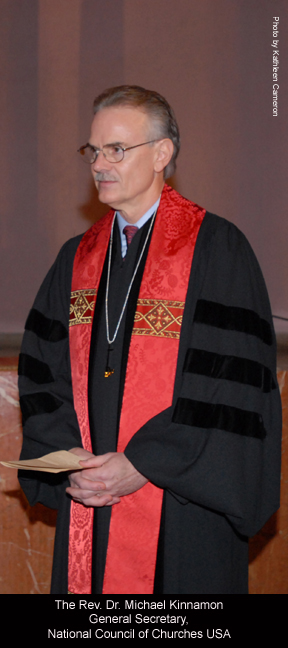
Rev. Dr. Michael Kinnamon
In terms of ecumenism and lay ministry, there have been some exciting personnel moves:
In Summer 2011, Dr. Michael Reid Trice was hired at Seattle University as the associate dean of the School of Theology and Ministry. Michael and I have known each other for several years, and he is one of the most active young ecumenists in the country, having served since the age of 35 as the associate director of the ELCA’s ecumenical and interreligious office.
Shortly thereafter, it was announced that Dr. Rick McChord was retiring after 25 years in the USCCB office for laity, marriage and family – and picking up a consulting contract with Seattle-based (and Domer-founded) Reid Group, which specializes in leadership development, strategic planning and mediation for religious groups.
The latest came in April while i was in Assisi, with the retirement of Rev. Dr. Michael Kinnamon as General Secretary of the National Council of Churches, and his own move to a three-year contract at Seattle University, starting this fall.
Finally, the biggest spotlight to hit Seattle in recent years, ecclesially speaking, is the appointment of the relatively new metropolitan, Archbishop J. Peter Sartain, to lead the five-year overhaul of the Leadership Conference of Women Religious. Striking every note of consultation, careful listening, and collaboration a person in his position possibly could during the press conference and interviews later with John Allen in Rome, it seems like the best has been made of an unpleasant situation.
These are exciting times to be in the church-world in Seattle. Almost a pity I am in Rome!
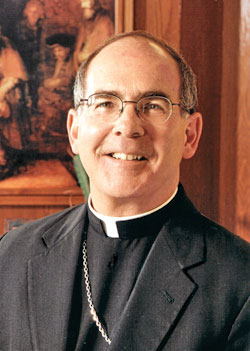
Most Rev. J. Peter Sartain
Bishop Gerhard Müller to CDF
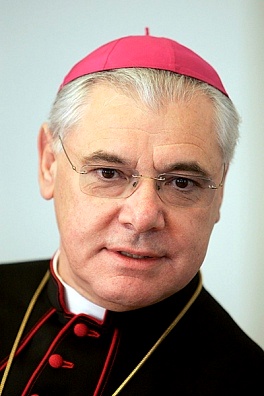 The rumor has been floating around for some months, and this week it was announced that Cardinal Levada has retired as prefect of the Congregation of the Doctrine of the Faith, and the bishop of Regensburg, Gerhard Müller, has been appointed to take his place.
His official biography and extensive information can be found in English at his diocesan website.
The two NCRs cover the story here:
- National Catholic Register (moderately conservative)
- National Catholic Reporter (moderately liberal)
Talking with one of my German colleagues in Rome, she was complaining how the German press has continued to remind people that this was once the office of the Universal Inquisition. That, and that Müller has been widely painted as an archconservative and favoring the current trend towards traditionalism.
I chuckled and pointed out that most of the English-language blogosophere seems to focus on his connection to Liberation Theology, and that if anything, the traditionalists have protested because he is “heretic” and a “modernist” – terms almost inevitably misused, but that is nothing new.
I have read only one of Müller ’s books, and that is his Priesthood and Diaconate, which I have used for my License thesis. He writes to counter the arguments made by some German feminist theologians that women have been and ought to be ordained to the diaconate. The major argument he sets out to counter is that, although the question of ordination to the priesthood – understood as the presbyterate and the episcopate in this case – has been closed since John Paul II’s 1994 Apostolic Letter Ordinatio Sacerdotalis, the question of the ordination of women to the diaconate remains (ostensibly) open.
First, it is interesting to note that in the translation, there are a couple of humorous editorial notes attached to his text. This same German friend keeps remarking that the problem with German theologians, ministers and ecclesiastics is that they all think that “the German Church is the center of the Catholic Church”- or whatever issues are big in the German world must be the main issues for the universal church. Not unlike the American/anglo-phone phenomenon, actually.
At various points in his book, Müller demonstrates this by saying something like “theologians in the whole world are asking this question” or “everyone seems to think this is an inevitability”. But after the translator and editor have their input, it looks like this: “theologians in the whole [German-speaking] world are asking this question” or “everyone [in Germany] seems to think this is an inevitability.”
More substantially, I was struck that he seemed not to address the most fundamental ecclesiological point of the argument he was trying to counter and correct. The argument for the ordination of women to the diaconate, in the current context, is that, if you maintain that within the one sacrament of holy orders there are not only three orders, but two distinct classes of orders – one to the priesthood and one to ministry/diakonia – then you can argue that a prohibition of ordaining women to priesthood does not necessarily dictate a prohibition to the ordination of women to diaconate.
However, if you argue that the three distinct orders within the one sacrament are modeled in a Trinitarian concept, then this argument might collapse, and if women cannot be ordained to one order or another it can be argued that they cannot be ordained to all of them. Müller’s strongest move, it seems, if his intent is to demonstrate that women cannot be ordained even to the diaconate, would have been to argue the unity of the sacrament. Instead, he maintains throughout his text this scholastic division between priesthood and other, the very point that the target of his investigation needs to retain in order to make her argument.
It is also interesting to note is that Bishop Müller was heavily involved in the International Theological Commission’s Report on the Diaconate, From the Diakonia of Christ to the Diakonia of the Apostles, which itself does not close the door on the question of ordaining women to the diaconate.
All in all, he seems an accomplished theologian, interested in ecclesiology and ecumenism, with a healthy ability not to get stuck in some of the old images and models of theology; he is able to judge aspects of liberation theology on its merits, rather than treat it like a bad word, as so many in the anglophone world are sadly wont to do. On the other hand, it seems that the question of women in the diaconate may be closed soon, before the non-German speaking world even had a chance to realize it was open.
I am looking forward to reading more, and seeing what the future brings.
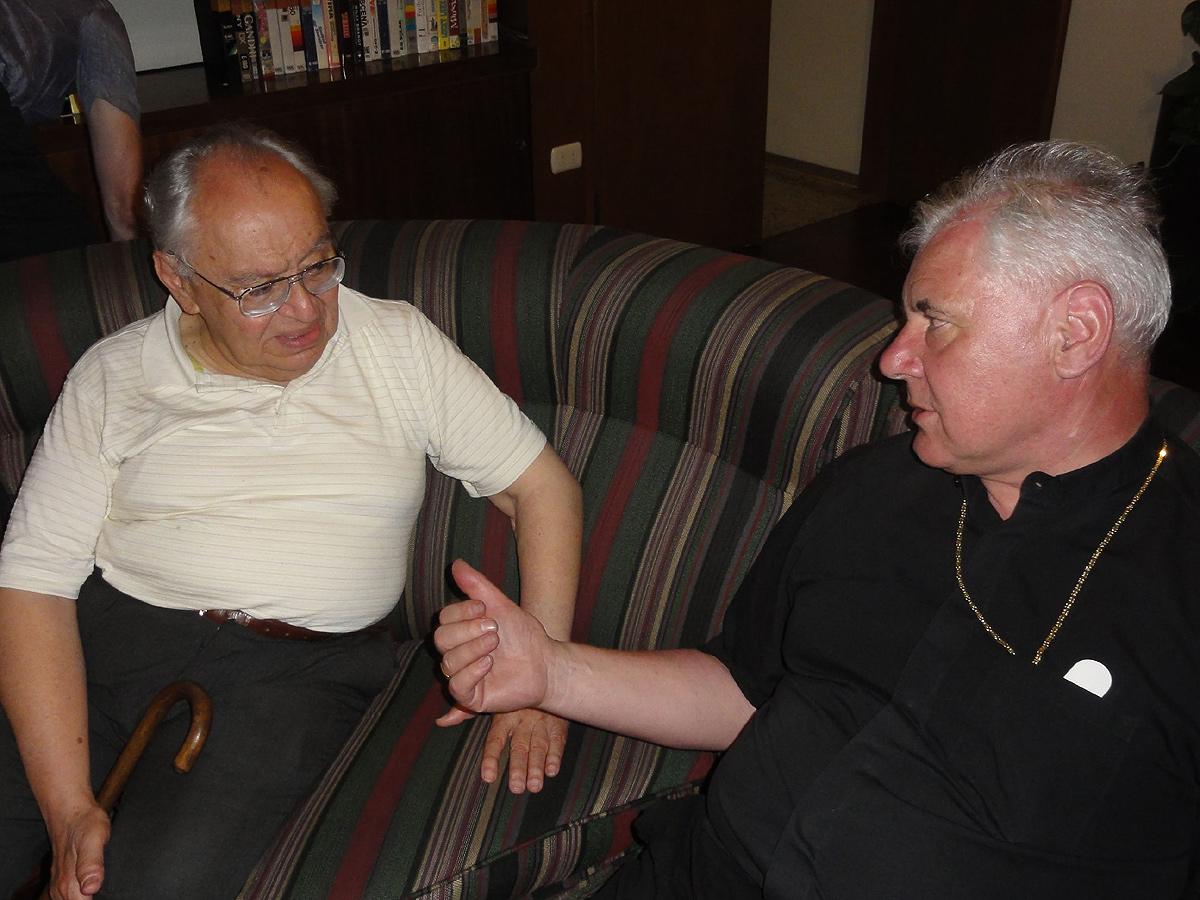
Gustavo Gutierrez, father of liberation theology, and Gerhard Muller, at one of their annual sessions.
Quote of the Day
Speaking at a meeting of Austrian Catholic newsmen, Cardinal Koenig said:
“Do not wait for the bishop or for a report from Rome, if you have something to say about the Council. Sound a warning whenever you feel that you ought to. Urge, when you feel urging is necessary… Report everything that the people and the Catholics expect concerning the Council.”
Taken from Conciliaria: Fifty Years Ago Today at the Second Vatican Council. If you have not discovered this gem of a blog yet, you ought to.
Can you imagine many people still having that same fearless confidence in the Holy Spirit speaking through the people of God, today? “Don’t wait for us, speak up!” Not exactly the dominant ecclesiastical paradigm half a century later!
What do Catholic traditionalists and extreme feminists have in common?
Quote of the Day:
In every age there are people for whom history does not exist…Curiously, the Catholic restorationist who identifies the Gospel with certain vestments from the 1880s, with one biblical translation, or with a vessel from the fifth century or the fifteenth century has somewhat the same mind-set as the extreme feminist who rejects the past three millennia of cultures because their attitudes toward women in public life were limited. Both fixate on one time -whether that is in the past or today – and reject variety and progress. … The deepest enemy of every fundamentalism is history.
Thomas P. O’Meara, OP, Theology of Ministry, (New York: Paulist Press, 1999), 86
[Between the number of friends i count among both feminists and traditionalist Catholics, i trust everyone is equally piqued.]
Communion under one kind
The Lay Centre welcomed Monsignor Nicola Filipi, the secretary to Cardinal Agostino Vallini, the Vicar General of Rome. He is, if you will, the vicar general’s vicar general. Don Nicola joins us each year with an update about the life of the Roman Church – and no, I do not mean the Catholic Church as a whole there, but the properly called Church of Rome – the local metropolitan diocese.
I have mentioned elsewhere the great liturgical variety I see in Rome, certainly in respect the kinds of things that would have self-appointed liturgical police crying foul. But we experienced something perfectly legit, yet rather unusual, so it is worth commenting.
Much ado is made here about communion under both species – as in, they tend to forget that this is the norm.* In fact, most of Italy does not offer the cup to the assembly, or, if they do, they offer intinction. Either case is odd for someone coming from a local church where the normative value of offering and receiving under both kinds has always been strongly emphasized. At the lay centre we normally have both offered, but accommodate presider preference.
 With a small community, we also try to prepare exact numbers of hosts, and while the Blessed Sacrament is reserved in the chapel, it is usually just a single host in a lunette or small monstrance withing the tabernacle. While this is more faithful to the norms of the Church, it is unusual in Italy, where parishes sometimes have so many reserved hosts that they will celebrate the Eucharist and then offer communion from the tabernacle – a clear liturgical no-no.
We had an unexpected number of guests that evening, and Don Nicola had decided to offer the cup by intinction. When it came to the last two in the communion procession, we were out of consecrated hosts. Turning to the tabernacle and finding only a single host in the lunette, he opted instead to offer the cup alone.
Communion under one kind only is sacramentally sufficient, albeit liturgically lacking, and foreseen only when there is no alternative or if there is some grave reason – like wheat allergy or alcoholism – to avoid the other species. Often in Italy it takes the form of the host only, and not the cup. It was nice to see the liturgical principle put into practice for exactly and only the reason it was intended, however.
What i find interesting is the choice to leave something in the tabernacle rather than offer it as communion.
*Sviluppo: I have been informed by an eminent italian canon lawyer, that in fact, the norm for communion in Italy, as promulgated by the national bishops’ conference, is the host alone. The legal norm is not the only norm, however. I have seen the situation best described by Paul Ford thus: “It is, in truth, acknowledged by many eminent authorities, that the Sacrament, as thus administered to the laity, loses a part of its significance, and may lose a part of its grace also, not of the grace of salvation, but of the grace of sanctification.” The sacramental norm, if you will, is both kinds, while the legal norm in this case is the host only.
Nidaros Cathedral, Trondheim
In January, i was in Trondheim, Norway for the ordination of a friend of mine as a pastor in the (Lutheran) Church of Norway. More about that in another post, but here’s something about the Cathedral, which was for centuries the northernmost cathedral in the world.
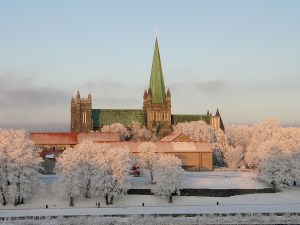
Located at about the same latitude as Fairbanks, Alaska, the city that is now called Trondheim was founded as Nidaros by King Olaf I Tryggvason, in AD 997 – that would be the same King Olaf who received Leif Eriksson and introduced him to Chrstianity, just before the latter made his famous voyage to establish “Vinland” – modern-day Newfoundland, Canada.
The diocese was erected by St. Olav (King Olaf II Haraldsson) in about AD 1030 and elevated to metropolitan see in 1153 with suffragan sees in Norway, Iceland, Greenland, and the Kingdom of Mann and the Isles. The cathedral was constructed during the later part of the 11th century and the entirety of the 12th. In the mid-1530s the Church of Norway came under the influence of the Lutheran reformation, and, like the Church of England, broke communion with Rome, and became an established church. For four centuries there was no official Catholic presence there, until a mission was re-established in the 1930s; now the de-facto Catholic cathedral of the Territorial Prelature of Trondheim sits just across the road from Nidarosdomen, in a squat temporary building. (A capital campaign is underway to build a new Catholic church there.)
Nidaros Cathedral houses the remains of St. Olav, patron of Norway – though the exact whereabouts have been unknown since a 16th century iconoclasm. The only known relic of St. Olav is his arm, which is located in the (Catholic) Cathedral of Oslo.
Next to the Cathedral one can still find the archbishop’s palace, though there is no longer an archbishop. The (Lutheran) Bishop of Nidaros has his offices there, and hosted us for an intimate reception after the ordination. The presiding bishop of the Church of Norway also officially has some offices there, as Nidaros is the primatial see of Norway, though she spends most of her time in Oslo, the national capital.
 The Ecumenism Blog