
In Good Hands
I have a message to my dear friends and colleagues who are women religious in the United States: “You are in good hands!”
Thursday evening, I had the privilege of serving as MC with Archbishop Joseph Tobin, the new secretary for the dicastery formerly known as the Congregation for Religious (now officially the Pontifical Congregation for Institutes of Consecrated Life and Societies of Apostolic Life.
In many ways, the liturgy was filled with minor disasters, from an MC’s point of view. I am a little out of practice, despite the last 20 years spent in some form of liturgical ministry, most of that as a server, MC, and/or liturgy coordinator. We had only two servers (we could have done with 4-6), not enough ushers, no time for a rehearsal, no stand for crozier or processional cross, an unfamiliar worship space, and when it came time for the collect we discovered the book at the chair was an old lectionary rather than the new translation of the Roman Missal (did I mention this was our first large-scale mass in the Vox Clara translation of the Mass? I even blurted out “and also with you” instead of “and with your Spirit” to the first greeting, right next to the Archbishop!) I could go on. Thankfully, all these little things went largely unnoticed by most, or were overshadowed by the big surprise that went off beautifully well.
Through it all, Archbishop Tobin was gracious, generous, and understanding.
Even after the mass, there was some confusion, leaving the Archbishop and I stuck waiting for his coat and bags to arrive while the reception went on without us. Instead of displaying any annoyance, he sat down and played a tune on the piano in the Passionist student chapel where we were waiting.
It is amazing what a difference such things make. He was the quintessential non-anxious presence the entire night. Where others I have known, of lower position than he, would have had an anxiety attack (myself possibly included!) he took it all in with good grace.
It is a small thing perhaps, one experience of only about two hours. But it says a lot about how the man handles stress, details not going well, and his attitude toward those who are not his peers or superiors in the ecclesiastical hierarchy. Based on that experience, and with advent hope, I can say to my sister friends in the States, who have been given a hard time of it lately, “you are in good hands!”
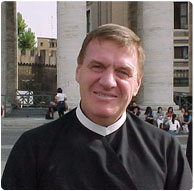
Archbishop Joseph Tobin, CSsR
… As a post-script, at one point in the evening I accidentally refered to the Passionists as the Paulists. I caught myself, and added that that had happened a few times, and he chuckled, responding that he had done something similar himself not long ago. It occurred to me to ask a question of the one man who probably knew the answer to one of the great Mysteries of Faith: Exactly how many religious orders are there in the Church? He laughed again, “Between 2000 and 2500… Over a million members worldwide, however.”
So now we know the answer to my question: God only knows!
The Pig War, or, The War of Canadian Aggression
In the Lay Centre this year, we have students representing 16 countries, and this means representatives of countries or of nations that have had a history of conflict.
Currently, for example, we have students from Bosnia, Croatia, and Serbia – the Balkan wars of the late 1990’s marked almost exactly the years of my high school education. All three were children during the time, old enough to remember the experiences of war.
Since 1979, before the birth of our representative residents, Egypt and Israel have had a peace treaty. Before that, however, there were a series of conflicts starting with the founding of the state of Israel, and notably including the Yom Kippur War and the Six Day War.
In the late 1940’s, immediately following World War II, Indonesia fought for independence from the Dutch Empire. We have in the house the grandson of a Dutch military officer and the grandniece of Indonesian freedom fighters that fought in the same battles during the revolution.
What people have not realized, we discovered last week over lunch, is an even older history of conflict between two other countries represented in the house this year: The United States of America, and the only country to have successfully sacked the U.S. Capital since our Independence, Canada.
[Warning, remainder of post includes tongue-in-cheek humour].
That’s right, Canada. Granted, during the War of 1812, some consider it to be a continuation of the Revolution and really that it was still England we were fighting, as our northern neighbors were still a colony. However, in my part of the country, we know who the real threat is was. This is owed, in no small part, to the victory we celebrate today, 25 November.
Today in 1872, in what is now Washington State, the Canadian occupation was ended, its forces cast out, and the U.S. could finally declare victory against the only enemy against which we have ever lost. At anything.*
For, it was on this day 139 years ago that the last contingent of [Canadian] Royal Marines withdrew from San Juan Island, ending the incident known to history as the Pig War.
At least, that is the popular name. I prefer “War of Northern Aggression” for obvious reasons. However, as that name was stolen by Confederate sympathizers for the U.S. Civil War of the same era, we will stick to the popular one.
And, fair enough, I suppose, as it commemorates the lone causality of the war, a Canadian-owned pig shot and killed by an American settler (the Canadians would say, squatter) on 15 June 1859. From that single incident, to the end of August, the military build-up on the island lead to a force of 461 American soldiers with 14 field canons and 8 naval guns facing off against three Canadian naval warships with 62 total naval canons and a complement of Royal Marines experienced in amphibious assault.
If you want the details, go to the National Park Service page on San Juan Island.
The bottom line is, however, that after years of joint military control under tense powder-keg conditions which might have ignited the entire continent in a conflagration that could have set off World War I half a century early, the Canadians were finally forced to withdraw after Kaiser Wilhelm I, serving as an international arbiter, ruled in favor of the U.S. Today is a day to celebrate the end of Canadian colonialism in the Pacific Northwest, and it is appropriate that this year it is celebrated the day after Thanksgiving.
In the spirit of dialogue and the famous hospitality of the Lay Centre, however, I ask my housemates to remember that we do not hold our Canadian community member responsible for the actions of her forebears; I and the other U.S. residents want to take the time today to offer her our forgiveness and graciously extend the hand of friendship.

Go America! Beat Canada!
* Not counting Cuba, North Korea, Viet Nâm, the War against Drugs, the Taliban, Wall Street Capitalism, etc.
Bishop-elect Charles Morereod, OP
The first priest I knew to be made a bishop was my look-alike Daniel Jenky, CSC from Notre Dame (now Bishop Daniel of Peoria). My first professor to become a bishop was Bishop Donald Bolen of Saskatoon. But this is the first time a Facebook friend has been named a bishop.
Fr. Charles Morerod was instructor of a course I took in my first year on the “Philosophical Elements in the Catholic-Protestant Dialogue”, and has been Rector Magnificus of the Angelicum University for a little over two years. He has doctorates in both philosophy and theology, and serves as the secretary general of the International Theological Commission, as well as teaching at three universities.
News of his appointment leaked via Swiss news radio on 2 November, though the official VIS announcement was made the following day on 3 November.
Though it has since been retracted, it is interesting to note that on the same day, the Society of St. Pius X seemed to indicate its rejection of the doctrinal preamble offered by the Congregation for the Doctrine of the Faith as a requisite for the restoration of full communion of the schismatic sect with the Catholic Church.
Interesting to note, I say, because Bishop-elect Charles was one of three theologians appointed by the CDF two years ago to engage the SSPX in dialogue in an effort to close the only formal schism that resulted from Vatican II, along with Archbishop Luis Ladaria, Secretary of the CDF and Msgr. Fernando Ocariz, vicar general of Opus Dei. Moreover, his new diocese is the home of the SPPX seminary and the place of its short-lived status as a legitimate Catholic organization (SSPX was a diocesan ‘pius union’, what would now be called an ‘association of the faithful’, from 1970-1975).
But back to the good bishop-to-be. I keep running into him these days at the Angelicum, and he leaves this weekend for his home diocese, where he will be ordained and installed on 11 December. The following seems to portray his humility rather well:

Cari [fratelli e sorelle],
…Io pensavo d’essere nella nostra cara Università fino alla pensione (o alla morte). La lascio con grande tristezza, e timore per quel che trovo davanti a me. Ma non ho pensato di poter dire di no, perché non avevo motivi gravi d’andare contro una richiesta diretta del Santo Padre. “Quando il Papa ha visto i nomi, ha detto che doveva essere Lei. Perché la conosce.”
… Cosa rispondere, lo prendo come ho sempre preso la mia vocazione: umanamente ho paura, ma mi fido della volontà divina che non delude. E vedo bene qualche urgenza pastorale in Svizzera: da questo punto di vista sono felice di poter aiutare un po’.
Sono davvero triste di dover rinunciare al nostro lavoro comune… Cercherò di trovare qualche modo d’aiutare l’Angelicum a distanza. Preghiamo gli uni per gli altri.
fr. Charles
My translation, with some help from Google:
Dear brothers and sisters
… I thought to be in our beloved University until retirement (or death). I leave with great sadness, and fear of what I find before me. But I did not think I could say ‘no’, because I had no serious reasons to go against a direct request of the Holy Father. “When the Pope saw the names, he said it had to be you. Because he knows.”
… With that answer, I take it as I have always taken my vocation: As a human, I am afraid, but I trust God will not disappoint. And I can see some pastoral urgency in Switzerland: From this point of view I am happy to help a little. ‘
I am really sad to have to give up our joint work … I will try to find some way of helping the Angelicum from a distance. Let us pray for one another.
Fr. Charles has been a guest at the Lay Centre each year, and one of the main supporters of the the new John Paul II Center for Interreligious Dialogue at the Angelicum in the past year, and of the Russell Berrie Fellowship. He will certainly be missed!
The Angelicum community bids Bishop-elect Charles a fond farewell on Friday, 11 November, with a reception at 12:15.
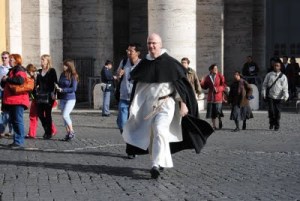
The official bio:
The Rev.do P. Charles Morerod, OP, was born in Riaz (diocese of Lausanne, Genève et Fribourg) October 28, 1961. He studied philosophy and theology at the Faculty of Theology, University of Fribourg, concluding with a degree in Theology. In 1983 he entered the novitiate of the Order of Friars Preachers Swiss province and has made his vows in 1987.
He was ordained April 30, 1988 in Geneva.
From 1987 to 1989 he served in pastoral ministry, first as a deacon and then as viassociate pastor of the parish of St. Paul in Geneva. From 1989 to 1992 he was Assistant at the Faculty of Theology, University of Fribourg from 1991 to 1994 and chaplain of the University of Fribourg. In 1993 he received his doctorate in theology and a licentiate in philosophy in 1996.
From 1994 to 1999 he was adjunct professor of Fundamental Theology at the University of Fribourg and since 1996 professor at the Pontifical University of St.Thomas Aquinas. Since 1997 he is editor of the edition in French of Nova et Vetera Magazine.
In 1999 he became full-time professor at the Pontifical University of St. Thomas Aquinas. From 1999 to 2002 he also taught at the Faculty of Theology of Lugano. He was Vice-Dean of the Faculty of Theology from 2003 to 2009 and Dean of the Faculty of Philosophy at the Pontifical University of St. Thomas Aquinas. In 2004 he obtained his doctorate in philosophy at the Catholic Institute of Toulouse. Since 2008 he is also Director of the Roman Catholic Studies Program at the University of St. Thomas (St. Paul, Minn.).
In April 2009 he was appointed Secretary General of the International Theological Commission and Consultant of the Congregation for the Doctrine of the Faith and in September 2009, also Rector of the Pontifical University of St. Thomas Aquinas.
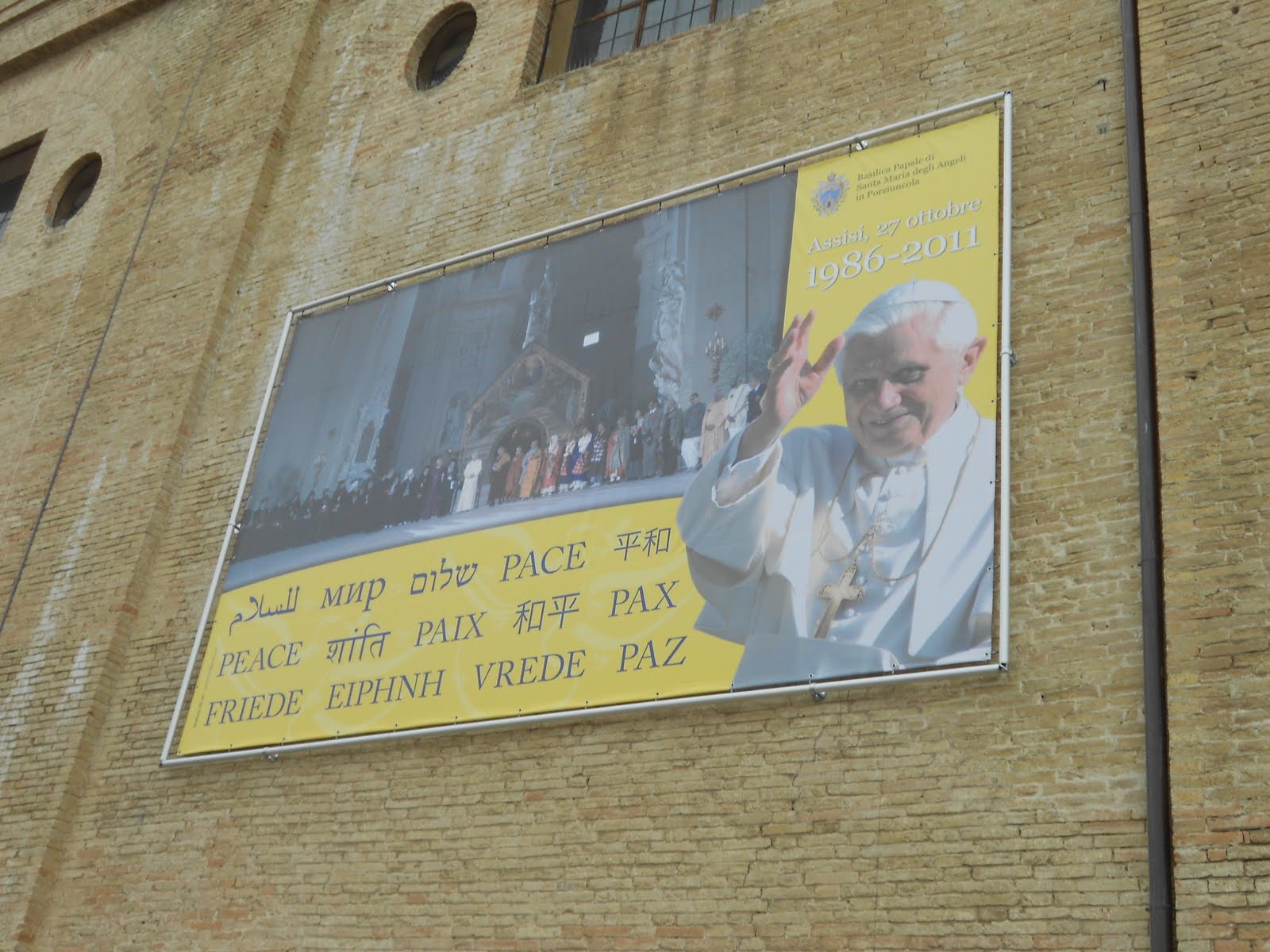
Assisi 2011: Pope Benedict XVI
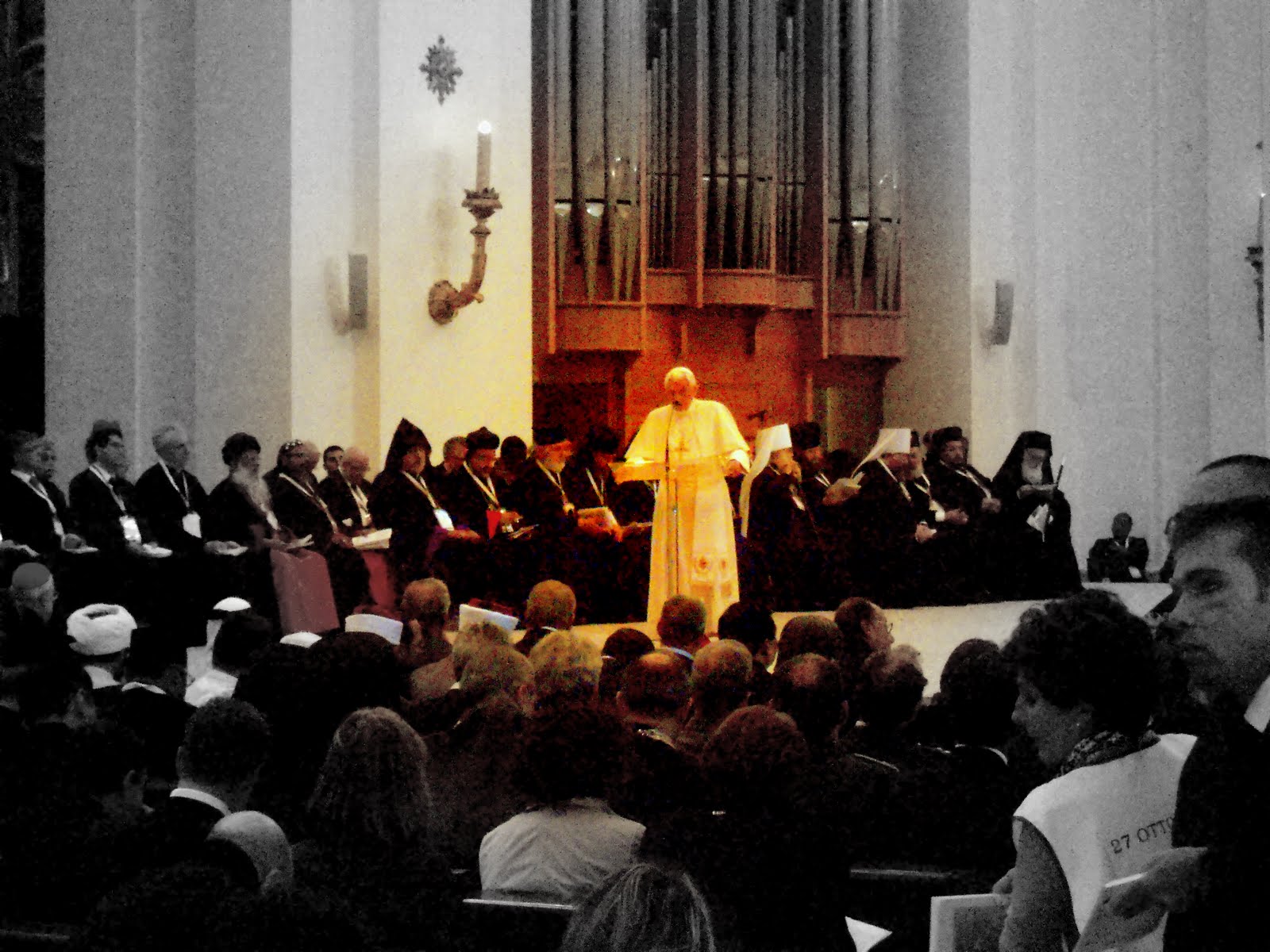
Dear Brothers and Sisters,
Distinguished Heads and Representatives of Churches, Ecclesial Communities and World Religions,
Dear Friends,Twenty-five years have passed since Blessed Pope John Paul II first invited representatives of the world’s religions to Assisi to pray for peace. What has happened in the meantime? What is the state of play with regard to peace today? At that time the great threat to world peace came from the division of the earth into two mutually opposed blocs. A conspicuous symbol of this division was the Berlin Wall which traced the border between two worlds right through the heart of the city. In 1989, three years after Assisi, the wall came down, without bloodshed. Suddenly the vast arsenals that stood behind the wall were no longer significant. They had lost their terror. The peoples’ will to freedom was stronger than the arsenals of violence. The question as to the causes of this dramatic change is complex and cannot be answered with simple formulae. But in addition to economic and political factors, the deepest reason for the event is a spiritual one: behind material might there were no longer any spiritual convictions. The will to freedom was ultimately stronger than the fear of violence, which now lacked any spiritual veneer. For this victory of freedom, which was also, above all, a victory of peace, we give thanks. What is more, this was not merely, nor even primarily, about the freedom to believe, although it did include this. To that extent we may in some way link all this to our prayer for peace.
But what happened next? Unfortunately, we cannot say that freedom and peace have characterized the situation ever since. Even if there is no threat of a great war hanging over us at present, nevertheless the world is unfortunately full of discord. It is not only that sporadic wars are continually being fought – violence as such is potentially ever present and it is a characteristic feature of our world. Freedom is a great good. But the world of freedom has proved to be largely directionless, and not a few have misinterpreted freedom as somehow including freedom for violence. Discord has taken on new and frightening guises, and the struggle for freedom must engage us all in a new way.
Let us try to identify the new faces of violence and discord more closely. It seems to me that, in broad strokes, we may distinguish two types of the new forms of violence, which are the very antithesis of each other in terms of their motivation and manifest a number of differences in detail. Firstly there is terrorism, for which in place of a great war there are targeted attacks intended to strike the opponent destructively at key points, with no regard for the lives of innocent human beings, who are cruelly killed or wounded in the process. In the eyes of the perpetrators, the overriding goal of damage to the enemy justifies any form of cruelty. Everything that had been commonly recognized and sanctioned in international law as the limit of violence is overruled. We know that terrorism is often religiously motivated and that the specifically religious character of the attacks is proposed as a justification for the reckless cruelty that considers itself entitled to discard the rules of morality for the sake of the intended “good”. In this case, religion does not serve peace, but is used as justification for violence.
The post-Enlightenment critique of religion has repeatedly maintained that religion is a cause of violence and in this way it has fuelled hostility towards religions. The fact that, in the case we are considering here, religion really does motivate violence should be profoundly disturbing to us as religious persons. In a way that is more subtle but no less cruel, we also see religion as the cause of violence when force is used by the defenders of one religion against others. The religious delegates who were assembled in Assisi in 1986 wanted to say, and we now repeat it emphatically and firmly: this is not the true nature of religion. It is the antithesis of religion and contributes to its destruction. In response, an objection is raised: how do you know what the true nature of religion is? Does your assertion not derive from the fact that your religion has become a spent force? Others in their turn will object: is there such a thing as a common nature of religion that finds expression in all religions and is therefore applicable to them all? We must ask ourselves these questions, if we wish to argue realistically and credibly against religiously motivated violence. Herein lies a fundamental task for interreligious dialogue – an exercise which is to receive renewed emphasis through this meeting. As a Christian I want to say at this point: yes, it is true, in the course of history, force has also been used in the name of the Christian faith. We acknowledge it with great shame. But it is utterly clear that this was an abuse of the Christian faith, one that evidently contradicts its true nature. The God in whom we Christians believe is the Creator and Father of all, and from him all people are brothers and sisters and form one single family. For us the Cross of Christ is the sign of the God who put “suffering-with” (compassion) and “loving-with” in place of force. His name is “God of love and peace” (2 Cor 13:11). It is the task of all who bear responsibility for the Christian faith to purify the religion of Christians again and again from its very heart, so that it truly serves as an instrument of God’s peace in the world, despite the fallibility of humans.
If one basic type of violence today is religiously motivated and thus confronts religions with the question as to their true nature and obliges all of us to undergo purification, a second complex type of violence is motivated in precisely the opposite way: as a result of God’s absence, his denial and the loss of humanity which goes hand in hand with it. The enemies of religion – as we said earlier – see in religion one of the principal sources of violence in the history of humanity and thus they demand that it disappear. But the denial of God has led to much cruelty and to a degree of violence that knows no bounds, which only becomes possible when man no longer recognizes any criterion or any judge above himself, now having only himself to take as a criterion. The horrors of the concentration camps reveal with utter clarity the consequences of God’s absence.
Yet I do not intend to speak further here about state-imposed atheism, but rather about the decline of man, which is accompanied by a change in the spiritual climate that occurs imperceptibly and hence is all the more dangerous. The worship of mammon, possessions and power is proving to be a counter-religion, in which it is no longer man who counts but only personal advantage. The desire for happiness degenerates, for example, into an unbridled, inhuman craving, such as appears in the different forms of drug dependency. There are the powerful who trade in drugs and then the many who are seduced and destroyed by them, physically and spiritually. Force comes to be taken for granted and in parts of the world it threatens to destroy our young people. Because force is taken for granted, peace is destroyed and man destroys himself in this peace vacuum.
The absence of God leads to the decline of man and of humanity. But where is God? Do we know him, and can we show him anew to humanity, in order to build true peace? Let us first briefly summarize our considerations thus far. I said that there is a way of understanding and using religion so that it becomes a source of violence, while the rightly lived relationship of man to God is a force for peace. In this context I referred to the need for dialogue and I spoke of the constant need for purification of lived religion. On the other hand I said that the denial of God corrupts man, robs him of his criteria and leads him to violence.
In addition to the two phenomena of religion and anti-religion, a further basic orientation is found in the growing world of agnosticism: people to whom the gift of faith has not been given, but who are nevertheless on the lookout for truth, searching for God. Such people do not simply assert: “There is no God”. They suffer from his absence and yet are inwardly making their way towards him, inasmuch as they seek truth and goodness. They are “pilgrims of truth, pilgrims of peace”. They ask questions of both sides. They take away from militant atheists the false certainty by which these claim to know that there is no God and they invite them to leave polemics aside and to become seekers who do not give up hope in the existence of truth and in the possibility and necessity of living by it. But they also challenge the followers of religions not to consider God as their own property, as if he belonged to them, in such a way that they feel vindicated in using force against others. These people are seeking the truth, they are seeking the true God, whose image is frequently concealed in the religions because of the ways in which they are often practised. Their inability to find God is partly the responsibility of believers with a limited or even falsified image of God. So all their struggling and questioning is in part an appeal to believers to purify their faith, so that God, the true God, becomes accessible. Therefore I have consciously invited delegates of this third group to our meeting in Assisi, which does not simply bring together representatives of religious institutions. Rather it is a case of being together on a journey towards truth, a case of taking a decisive stand for human dignity and a case of common engagement for peace against every form of destructive force. Finally I would like to assure you that the Catholic Church will not let up in her fight against violence, in her commitment for peace in the world. We are animated by the common desire to be “pilgrims of truth, pilgrims of peace”.
© Copyright 2011 – Libreria Editrice Vaticana
Assisi 2011: The delegates
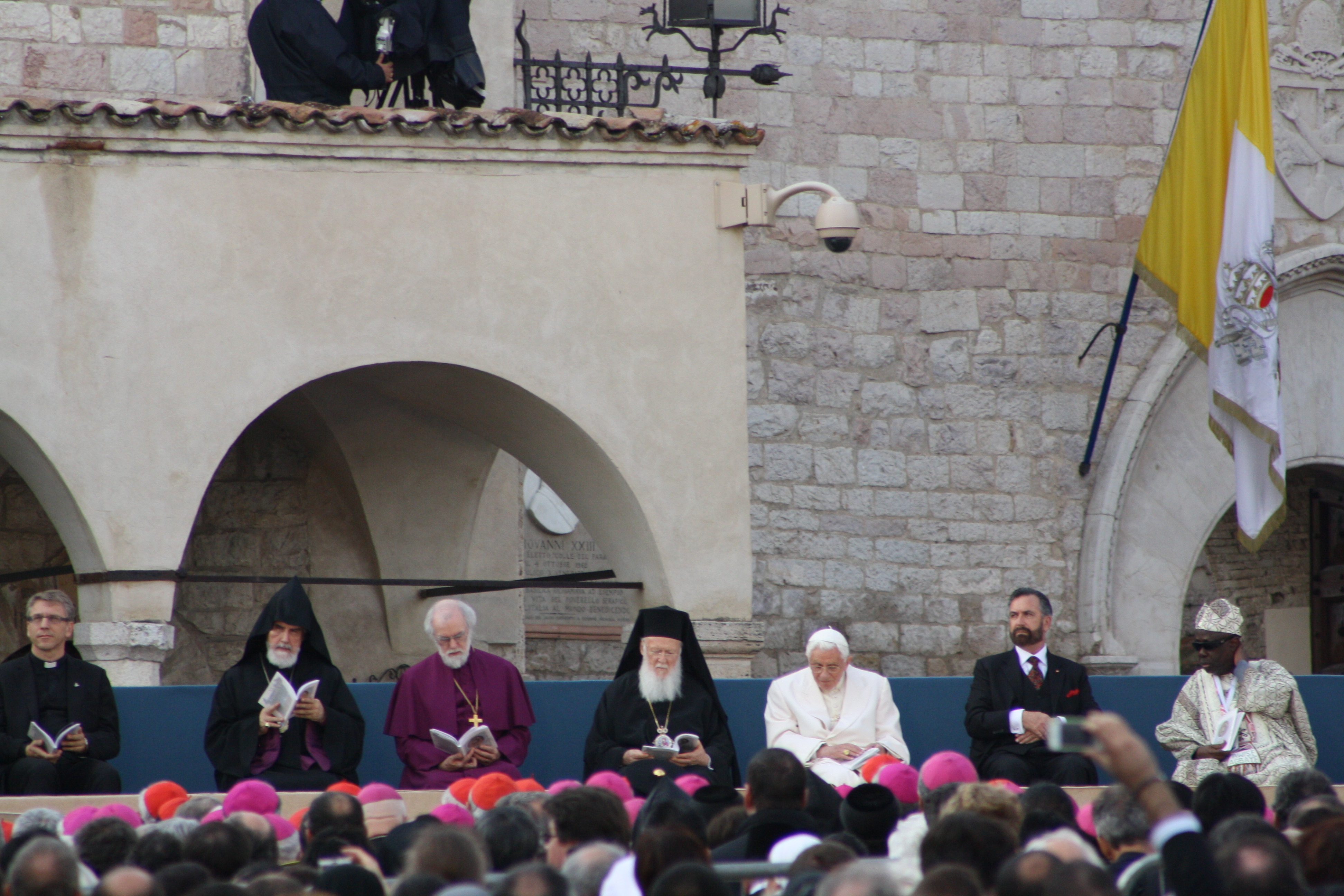
The official Christian delegates included Patriarch Bartholomew I of Constantinople, Archbishop Rowan Williams of Canterbury, Archbishop Norvan Zakaryan of the Armenian Apostolic Church, Secretary General Olav Fyske Tveit of the World Council of Churches.
In all, there were representatives of the Orthodox Churches from the Patriarchates of Constantinople, Alexandria, Antioch, Moscow, Serbia, Romania, and the Ukrainian, Belarusian, Cypriot, Polish and Albanian churches. The Oriental Orthodox were represented by the Syrian Patriarchate of Antioch, the Armenian Apostolic Church (both Catholicossates) and the Malankara Orthodox Syrian Church. The Assyrian Church of the East was represented by the Metropolitan of India, the bishop of California and a priest.
The Anglican Communion, the Old Catholic Church, Lutheran World Federation, World Communion of Reformed Churches, the World Methodist Council, the Baptist World Alliance, World Convention of the Churches of Christ, the Mennonite World Conference, the World Evangelical Alliance, and the World Council of Churches were all represented, along with the Church of Scotland, the Disciples of Christ, the Salvation Army, and the classical Pentecostal churches.
176 representatives of non-Christian religions were present, including Reform and Orthodox Judaism; Sunni, Shi’a, Alawite and Ismaili Muslims; Hinduism (including Rajmohan Gandhi, grandson of the Mahatma); Jainism; Zoroastrianism; Buddhism (including Shaolin, Zen, Tibetan, Theravada, Tendai, Jogye, Jodo-Shu, and other forms); Confucianism; Taoism; Shinto; Mandaean (Gnostics); Sikh; Baha’i; traditional African, American, and Indian Religions; and “new religions” such as Tenrikyo, Ennokyo, and Myochi-kai.
Four “non-believers” were invited, a first, emphasizing Pope Benedict’s interest in the New Evanglization and his effort to engage secularism and religion on a level of common interest in the quest for truth. These included Julia Kristeva, Bulgarian-French psychoanalyst; Guillermo Hurtado, the Mexican philosopher; Walter Baier, a politician from Austria; and Remo Bodei an Italian professor of Aesthetic and philosophy.
Assisi 2011: The pilgrims

The Lay Centre at Foyer Unitas, in collaboration with the new Pope John Paul II Center for Interreligious Dialogue, planned a day trip to Assisi on 27 October 2011 to join Pope Benedict XVI and world religious leaders – and a few secular agnostics – in a day of pilgrimage toward peace.
Our group included seven from the Lay Centre, six Russell Berrie Fellows and alumni, and one who could count for both. Additionally, we were joined by Rev. Tom Ryan, CP, of the Paulist Office for Ecumenical and Interreligious Affairs; Anna Maria Kloss, wife of the Austrian Ambassador to the Holy See; and seven other pontifical university students, including two from the Gregoriana’s late Interdisciplinary Center for the study of Religion and Culture.
We were 24 people representing 16 countries, including: Austria, Belarus, Bosnia i Herzegovina, India, Indonesia, Israel, Italy, the Netherlands, Nigeria, Philippines, Poland, Portugal, Rwanda, Turkey, the U.S., and Venezuela.
Our day began at 0500, enough time to get up and ready for an 0600 departure by tourbus, for the 3 hour drive to Assisi. At a coffee break on the way, we ran into the Turkish Ambassador to the Holy See. After arrival in Assisi we met up with our local guide and Lay Centre alumna, Lori King; Dr. Marian Diaz and staff of the U.S. Embassy to the Holy See.
The schedule of the day was relatively light. At 1030 the morning session at the Basilica of Santa Maria degli Angeli, in the valley below Assisi proper, lasted for a little under two hours. We then made our way up the hill to a restaurant near the Basilica of Santa Chiara (St. Clare) for lunch. After lunch a leisurely stroll took us to the other end of town, to join a World Youth Day in miniature going on in the lower piazza before the delegates arrived. The closing event started at 1630, and was over in time for us to get a quick pizza and be on the road to Rome by 2000.
Assisi was, if anything, quieter than many of my visits. Expecting large crowds for the event, most who did not have tickets stayed away, so in fact there was just a right amount – those with tickets admitted into the venues, and then only locals from Assisi and nearby towns lining the roadways or in the piazza outside the church. It was a welcome change from the unruly hordes that accompany papal events in Rome. Inside the basilica in the morning, we were seated barely 15 meters from the platform, though at an obscure angle. In the afternoon, the lowere piazza was filled, but it is not very large, and we were seated at just the place where the pope, patriarch, and archbishop disembarked their shuttle.
At one point, just before the delegates arrived for the afternoon program, one of our company had gone looking for water. We wanted to find him before it was too late to re-enter the piazza, but were barred from exiting by security as the delegates who were coming on foot were about to arrive. As we watched the nearly 300 religious delegates enter the piazza, wondering where Muhammad had gone, there he comes in the middle of the delegates procession, engaged in deep conversation with a professor from Sarajevo! It looked so natural, that security did not even think to stop him. It was classic, and again, left me wishing I had had a working camera with me!
In the end, the trip came together wonderfully, especially in that most of it was put together in only a week. It is a once in a decade event, made well worth it with the companionship of friends and colleagues in dialogue.
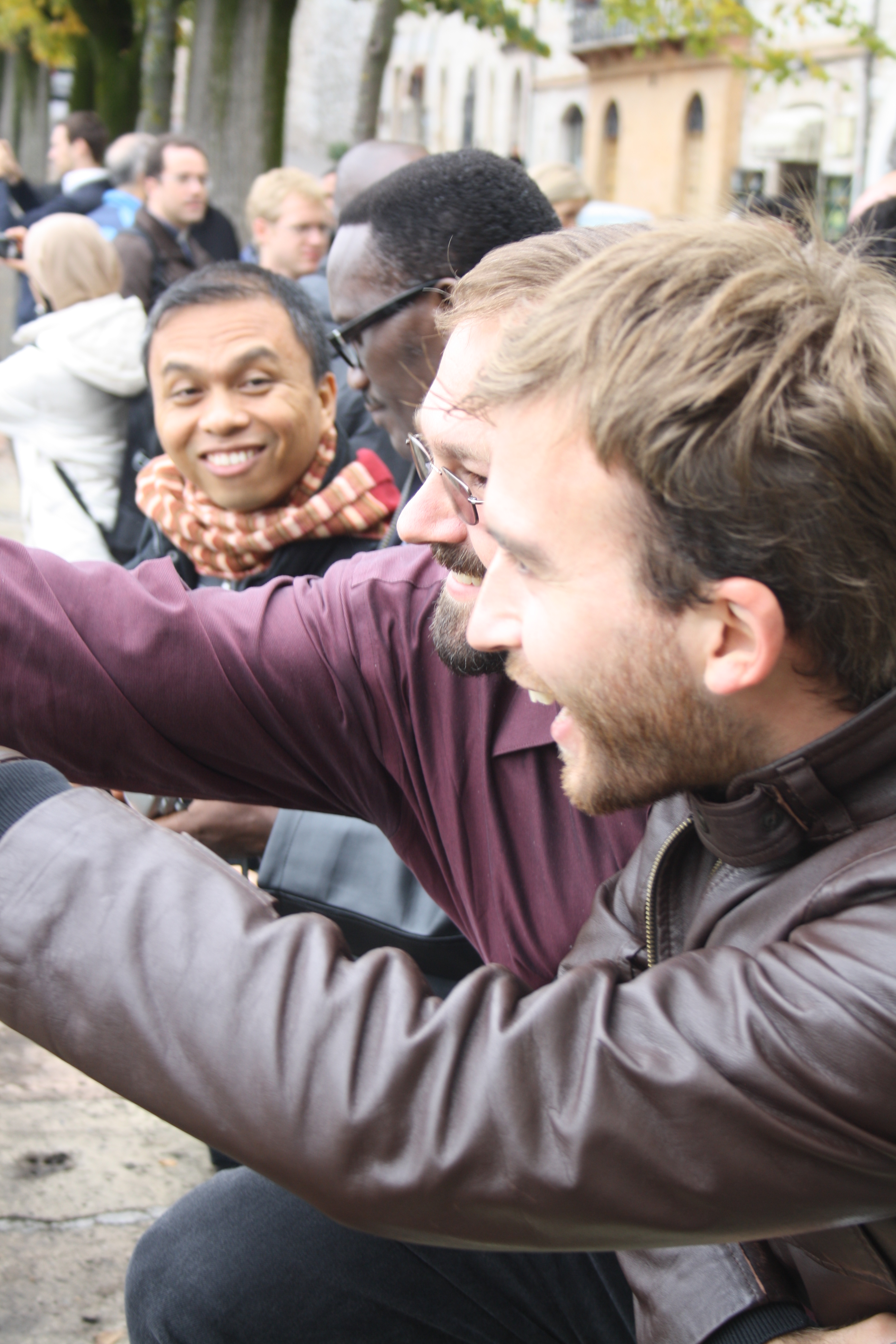
Muhamed and I engaged in some serious dialogue and sightseeing
Assisi 2011: Pilgrims of Truth, Pilgrims of Peace
“Assisi alone is enough reason to beatify Pope John Paul II” was the headline of the Catholic Herald in the UK last April, a fortnight before the late pope was approved for veneration on the calendar of the diocese of Rome and in Poland as one of the “Blessed”. Karol Wojtyła became a pope of many firsts, and John Allen, Jr. has recently quipped that Joseph Ratzinger has become a pope of seconds – but that these second times can be as important as the first.
In part, this is because it gives certain sustainability to an event or program, showing that it was not a personal proclivity of the past pope, doomed to die with him. This has been true of World Youth Day, and now of the Assisi pilgrimage for peace.
Another aspect is this: Pope Wojtyła was an actor, a master of stage and screen. He had the timing and the panache to make big waves with spectacular images and actions. One curial cardinal was asked, at a meeting of his dicastery, “When will we see some of these grand images of [the pope’s] turn into policy?” The cardinal leaned to his secretary and was overheard to say, “Come si dice ‘senza fiato’ in inglese? (How do you say, ‘we are out of breath’ in English?) … We can barely keep up with him!”
The current bishop of Rome is a theologian, a teacher, and an introvert. He takes a few of these grand points, and is digging deeper, giving them ‘staying power’ in the system and with reflection. In the process, he is adding his own spin on things, too. Much ado was made of the fact that this time around, the fourth gathering of interreligious leaders to Assisi for the cause of peace, there would be no ‘common prayer’ so that not even the most rigorous of the right-wing could cry foul (or so it was thought).
Never mind that there was never ‘common prayer’ in the first case, either. Coming together to pray is different than coming to pray together. In 1986, the day concluded with a series of prayers, each religious group leading its own prayer, while other participants looked on in respectful silence. It was close enough that even Ratzinger was reserved about the appropriateness at the time.
(In the annals of the bizarre, and as a reminder of how much of Italian journalism at the time was about inflammatory rhetoric more than fact, one Italian reporter made claims that African animists sacrificed a chicken on the altar of the Basilica of Santa Chiara, inciting charges of sacrilege and syncretism. The fact that the basilica was closed and no such act ever took place does not stop certain elements from bringing it up from time to time to discredit the Spirit of Assisi and Pope John Paul II.)
This year, the day started at the Basilica Santa Maria degli Angeli with a series of 10 scheduled talks on peace, after an introduction from Cardinal Turkson of the Pontifical Council for Justice and Peace, which organized this year’s event. The appeals were offered by four Christians, followed by five non-Christian religious leaders, and one ‘non-believer’. There was a confused moment as the apparent Muslim guest was brought to the lectern, refused the notes he was offered, and went on to explain in Arabic that he was not the person listed on the program, but offered a reflection anyway. Only after the last scheduled speaker was the original Muslim representative produced to deliver his address; I still do not know who the first Muslim presenter was or what else he said.
Before the day, Fr. Tom had asked what language the day would be presented in. Based on my experiences in Rome for major liturgies and events, I indicated Italian, with only smatterings of others. I was wrong. Throughout the day, the three cardinals all spoke in English. In the morning, it was clear that efforts were made to be as universally understood as possible: English was used by the Anglican, WCC, Jewish, Muslim, Hindu, African animist religious representatives. French was spoken by the Orthodox and agnostic. The Buddhist representative spoke in Korean, and the unplanned Muslim speaker was in Arabic. In the afternoon, native languages were used, and worth noting that Arabic was not just “the Muslim language” but also that of the Syrian Orthodox and the Lutheran representatives.
Instead of a series of prayers lead by different religious groups, this time the afternoon session in the lower piazza of the Basilica San Francesco included a series of solemn commitments to peace by assorted religious leaders. This was introduced by Cardinal Jean-Louis Tauran of the Pontifical Council for Interreligious Dialogue, and lead by the Ecumenical Patriarch, Bartholomew I. Ten religious leaders and another non-believer made their solemn commitments, followed by an address of Pope Benedict XVI, and closed with an invitation to exchange a sign of peace by Cardinal Kurt Koch of the Pontifical Council for Promoting Christian Unity (and the Pontifical Commission for Religious Relations with the Jews).
There is no question that it was a beautiful day, and inspiring simply to bring all of these people together as a witness for peace, the positive contribution of people of faith to the world, and even of the potential to overcome the modern myth of a necessary animosity between “people of faith” and “people of science” – ie, secularity.
Yet, there also is no question in my mind that something was lost with the over-emphasized intentional lack of prayer. How can a ‘pilgrimage’ be true to its nature without prayer? How can you gather religious leaders together, and tell them not to pray? This year, there were not even the sequestered opportunities for prayer that marked the last such event, in 2002, held in response to the terrorist attacks of 9/11, much less the series of prayers offered in public that marked the first event 25 years ago.
There was a moment of silence in the afternoon session for everyone to “pray or commit their thoughts to peace” – on one hand, very hospitable for even those who do not pray. On the other, I think the type of prayer offered in 1986 lends itself less to accusations of syncretism (exaggerated in either case), where each tradition is allowed to be true to itself, rather than having a single, mixed, everybody-do-what-you-want moment or prayer and positive thoughts.
Some of the speakers offered prayers spontaneously as part of their delivery, others quoted scriptures.
For our own part, an unplanned opportunity presented itself. In what must be a first for a papal event, the closing ceremony actually finished half an hour early, and the restaurant we planned for a quick pizza before returning to Rome was not yet open. With half an hour to kill, our group split in various directions, some to shop, some to wander, some to pray. About ten of us wandered up to the 13th century Church of Santo Stefano, a beautifully simple church whose bells were said to have miraculously pealed at the moment of Francis’ death.
As the Christians prayed in the front of the church, some of our Muslim pilgrims prepared for their own evening prayer, at the back of the church. As Christians finished, instead of walking out past the praying Muslims, most stopped and waited as respectful observers. It was just a few minutes, it was spontaneous, and it made the day a genuine pilgrimage of truth, for peace.
The Golden Ring
The Gospel reading of the day reminded me of a column i had written as a college senior for our campus newspaper, The Observer, as part of what was called the “Inside Column” – a chance for the editorial staff to say whatever they wanted. It is interesting to read something i wrote over a decade ago and see how my style has changed… and where it has not.
It has also come up on occasion here in Rome, since so many people have commented on my Notre Dame ring. The class ring is not a common practice over here, and several of my classmates have admitted wondering if i was a bishop incognito when they first saw it! I have been promising a rediscovery of this article for some time:
We take pride in no symbol of our status as Notre Dame students and alumni than our class rings. No other school in the country has alumni as fanatic about proving their school pride so blatantly as our fellow Domers, and rightly so, for ours is a tradition of unparalleled family and excellence. But, as with all symbols, its meaning is polyvalent and there is much more to my class ring than simply showing off my bachelor of arts.
First, it is a sign that, at some point in my life, I had around $600* to shell out on a piece of jewelry. For myself; not as a gift or as a donation to someone who needed the money for food or clothing, but for a pretty piece of gold to sit on my finger.
It is a sign that I have literally bought into the very disease that I railed against when I first saw it permeating the ostensibly Catholic character of this institution. It is a malign corruption of life known as materialism, the cure for which is harder to find than “for a camel to pass through the eye of a needle.”
There are times when I feel the weight of my ring on my right hand and am forced to think of the chains that Marley wears in his visit to Ebeneezer Scrooge. It seems I have forged the first link in my own chains of eternal bondage, and I fear it is larger than most. Worse, I find no comfort in the idea that comes from a fundamental reading of Matthew 25:29 that reads: “For to one who has, more will be given and he will grow rich; but from the one who has not, even what he has will be taken away.” It is an idea that seems to be incorporated into the mission statement of both financial aid and development offices.
Although I have only had my ring since July, I have already noticed several dings and imperfections. At first I was overwhelmed with what people would think when they saw how ugly my ring had become. I worried that I had not been able to keep it aesthetically perfect. Then I realized that its condition was a perfect allegory of Notre Dame itself.
When you’re here long enough to learn to care for the place and the people here, you pay attention to everything and you begin to see the dings and imperfections. For people of a good heart and a righteous soul, it is easy to become obsessed with these, discouraged that they exist and cynical that anyone could see beauty in something so horribly flawed.
But then you realize that despite a discoloration here or a small dent there, the whole of the ring is still gold, and to anyone who meets you and doesn’t inspect it with an overcritical eye, it may as well be unblemished.
Much the same can be said of the Notre Dame experience. Despite what corruption or frustrations you may find, in time (though usually not until after you graduate), you will learn to see again the gold of the whole and not just the damage of one small area.
Finally, it is a symbol of the office of Notre Dame Alumnus (or Alumna), which carries a unique power and responsibility. It is a sign of our education and our commitment to service. It is a sign that we can accomplish great things against formidable odds. It is a sign that will allow us unhindered passage into positions at any number of corporations, firms and grad schools. It is above all a reminder that “Much will be required of the person entrusted with much, and still more will be demanded of the person entrusted with more!” (Luke 12.48)
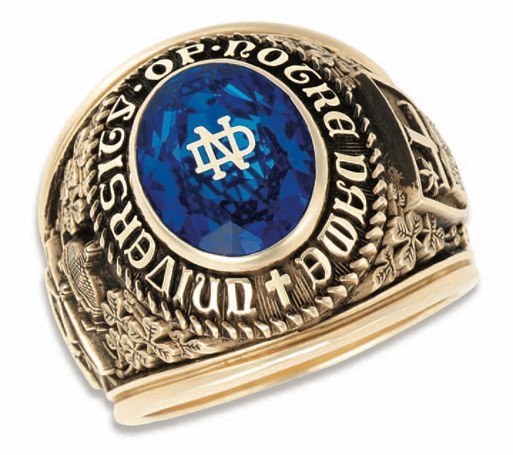
*That was in 1999. Inflation and rising gold costs have nearly doubled the cost for today’s students and alumni.
Original publication: http://www.nd.edu/~observer/02032000/Inside/0.html
ND Class Ring website: http://web.me.com/edobal488/Notre_Dame_Rings/Welcome.html
Return to Rome
Time Flies. Two years on the Russell Berrie Fellowship in Interreligious Studies have come and gone. For those who know me well, it is unsurprising that my two major goals here – learn Italian and write my thesis – are still works in progress, despite a number of other accomplishments.
I am returning for a third year to the Lay Centre at Foyer Unitas, Rome’s pre-eminent collegio for the tired, the poor, the huddled masses yearning to breathe free lay students. Which is, basically, anyone who cannot play on a pontifical university football (soccer) team for the annual Clericus Cup – but I digress.
Only two of us, aside from director Donna Orsuto and assistant Robert White, are back for a third consecutive year: the other being my newly-wed friend and next-door neighbor from Morelia, Mexico, David. Others who were here last year, or at least part of the year, include Muhamed (Bosnia), Marija (Croatia), and Julia (Hong Kong).
In total, we have citizens of 16 countries this year:
Belarus, Bosnia, Canada, Croatia, Czech Republic, Egypt, Georgia, Germany, Hong Kong, Indonesia, Israel, Mexico, the Netherlands, Romania, Serbia, and the U.S.A.
Religiously we are:
- 1 Secular Jew
- 3 Muslims (2 Sunni, 1 Shi’a)
- 4 Orthodox Christians (Belarusian, Georgian, Romanian, and Serbian Churches)
- 13 Catholic Christians (12 Latin, 1 Syro-Malabar)
This year I also start a new role continuing the relationship with the Russell Berrie Foundation, through the Institute for International Education, in the form of a graduate assistantship at the new John Paul II Center for Interreligious Dialogue, housed at the Angelicum.
The first month back in Italy consisted of jet lag, a severe cold, orientation week for new Lay Centre residents, and then orientation week for new Russell Berrie Fellows. The tesina awaits. There are a few highlights I will be, ah, highlighting shortly.
Shi’a Muslim – Monastic Catholic Dialogue
Barely recovered from jet lag, the first event of my third year in Rome was a presentation on Muslim-Monastic dialogue at the Primatial Abbey of Sant’Anselmo on the Aventine hill.
For years, the monastic interfaith dialogue focused on the Buddhists, particularly in its Japanese Zen form, and one can remember easily the relationship of Thomas Merton and Tich Nacht Hanh. In the last decade though, there has been a general realization that we need not look so far from home, so to speak, and the Benedictines decided to initiate a dialogue with Islam… in this case, with Shi’a scholars from Qom, the study center for the Shi’a in Iran.
The public lecture was part of the schedule of the official dialogue, and our host was the Abbot Primate of the Benedictine Confederation, the Rt. Rev. Notker Wolf… also known for being a rock star. Literally. It was organized and introduced by Fr. William Skudlarek, the Secretary General of Monastic Interreligious Dialogue.
The lecturer was Abbot Timothy Wright, OSB, Delegate for Monastic-Muslim Relations, and the respondent was Dr. Mohammad Ali Shomali, Director of the new International Institute for Islamic Studies in Qom – a center which focuses on brining in western students to study Shi’a theology and jurisprudence in Iran.
Abbot Timothy highlighted the common core values of monastic spirituality and Shi’a Islam, though, to be honest, there was little that seemed to me to be particularly monastic about the spirituality he mentioned:
- Affirmation of God revealed in Word
- Day and night punctuated by prayer
- Exercise of opened word – lectio divina, e.g.
Though, the shared lectio divina he described sounded not unlike the scriptural reasoning programme in Cambridge and elsewhere. Yet, with the rule of Benedict as a guide, it certainly does not hurt to have monastic engagement.
Dr. Shomali responded with an affirmation that the key to good dialogue is the building up of good relationships first, in which dialogue can happen. Relationships rather than events, should drive our encounter with the other… though obviously events can provide for the beginnings and deepening of relationships with people we might not otherwise encounter.
“Dialogue is not a formality or fashion but a part of my religious obligation. Neither is it dependent on reciprocation or appreciation. In this it is like prayer and fasting. If no one appreciates my prayer and fasting, I do not stop!”
His advice to those interested in dialogue was simply to be a good listener, and shared the story of Moses and Pharaoh from the Quran, in which Moses objects to God sending him to waste his time trying to dialogue with someone not interested in dialogue: Pharaoh.
“Go and speak softly”, instructs the Almighty, “ for even in him there is a chance of his heart being softened.”
Consider this then. The most difficult dialogue is with the person who does not think he/she needs to dialogue with anyone – the person with a hard heart. But if there is even a chance of the heart of pharaoh being turned by soft-spoken dialogue, then there remains hope for everyone. In Dr. Shomali’s words, dialogue requires you to master being a good listener and gentle, soft and wise speaker.
 The Ecumenism Blog