
Home » 2010 (Page 7)
Yearly Archives: 2010
There’s a new doc’ in town
My fellow Russell Berrie Fellow Matthew John Paul Tan was celebrated for two significant milestones at Rome’s most famous Austrian restaurant today. My Singaporean-Aussie classmate was officially awarded his Ph.D. in theology from the Australian Catholic University on Friday, just two days before his 30th birthday today.
Though he put in several years of effort toward the first achievement, credit is largely due elsewhere for the second. Nevertheless we threw him a party for both.
Actually, he invited us. So it is not so much that we threw a party for him as that we showed up for his party. But we brought gifts!
Well, a gift, anyway. Moving on…
Cantina Tirolese is famous, at least among Vatican-watching theology nerds, as the favorite haunt of the former prefect of the Congregation for the Doctrine of the Faith, Cardinal Ratzinger, whose presence was frequent enough that he had a perpetually reserved booth. I do not know if he has been back since his election five years ago, though. Maybe they deliver?
Congrats again to Matthew!
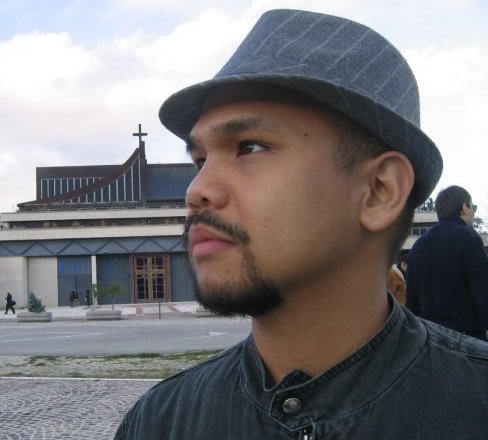
Dr. Matthew John Paul Tan
Paschal Triduum 2010
The first time I participated in the Easter Triduum was also my altar serving debut. I was in third grade, nine years old. My training was held right after school by Sr. Mary Thorne, if I recollect correctly, and a few hours later I was serving my first mass, on Holy Thursday. That was twenty-three years ago and I have never intentionally missed any part of the Triduum.
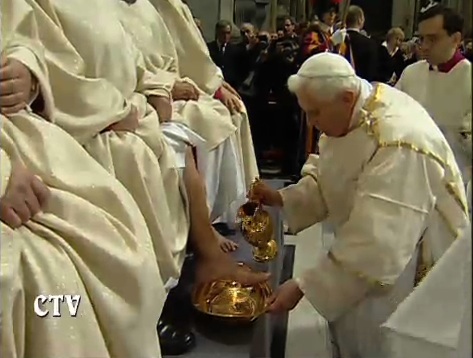
Holy Father washing feet of 12 presbyters at Holy Thursday Mass
In fact, I can only remember missing the whole thing once, because I was sick – but I had already done all the planning and training for the liturgies, and had very reliable volunteer lay liturgical ministers to rely upon in absentia. One other year, I was in the ER during the Easter vigil with a friend. Other than these two, I have worshipped during the high holy days, and usually as a server, lector, or liturgist and master of ceremonies. Even in my last interim parish ministry, where I was not the primary liturgist, I still had a contingent of catechumens to bring through the rites.
That said, it is kind of nice (but also a bit weird) to be absolutely and completely free of responsibility throughout the Triduum, and to be in Rome. There are three places where every Catholic should spend Holy Week at least once, in my opinion: Jerusalem, Rome, and Notre Dame. Though not necessarily in that order.
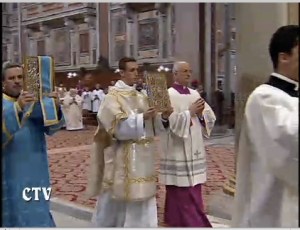
Latin and Greek Deacons in Gospel Procession, Holy Thursday, Archbasilica San Giovanni
Throughout my four years at Notre Dame, I was an altar server in the Basilica of the Sacred Heart, and sometime assistant MC there and sacristan/liturgy coordinator at the Chapel of Our Lady of Guadalupe in Keough Hall. Triduum was always a great deal of work, but always masterfully done, accompanied by beautiful music, and in the words of one visiting curial cardinal (who so enjoyed Holy Week at ND he came back twice while I was there), “This is better than Saint Peter’s!”.
I am inclined to agree, but with qualification. To be clear, I am disappointed in nothing of the Triduum here in Rome, except for the mob (the Romans’ answer to the queue, or line).
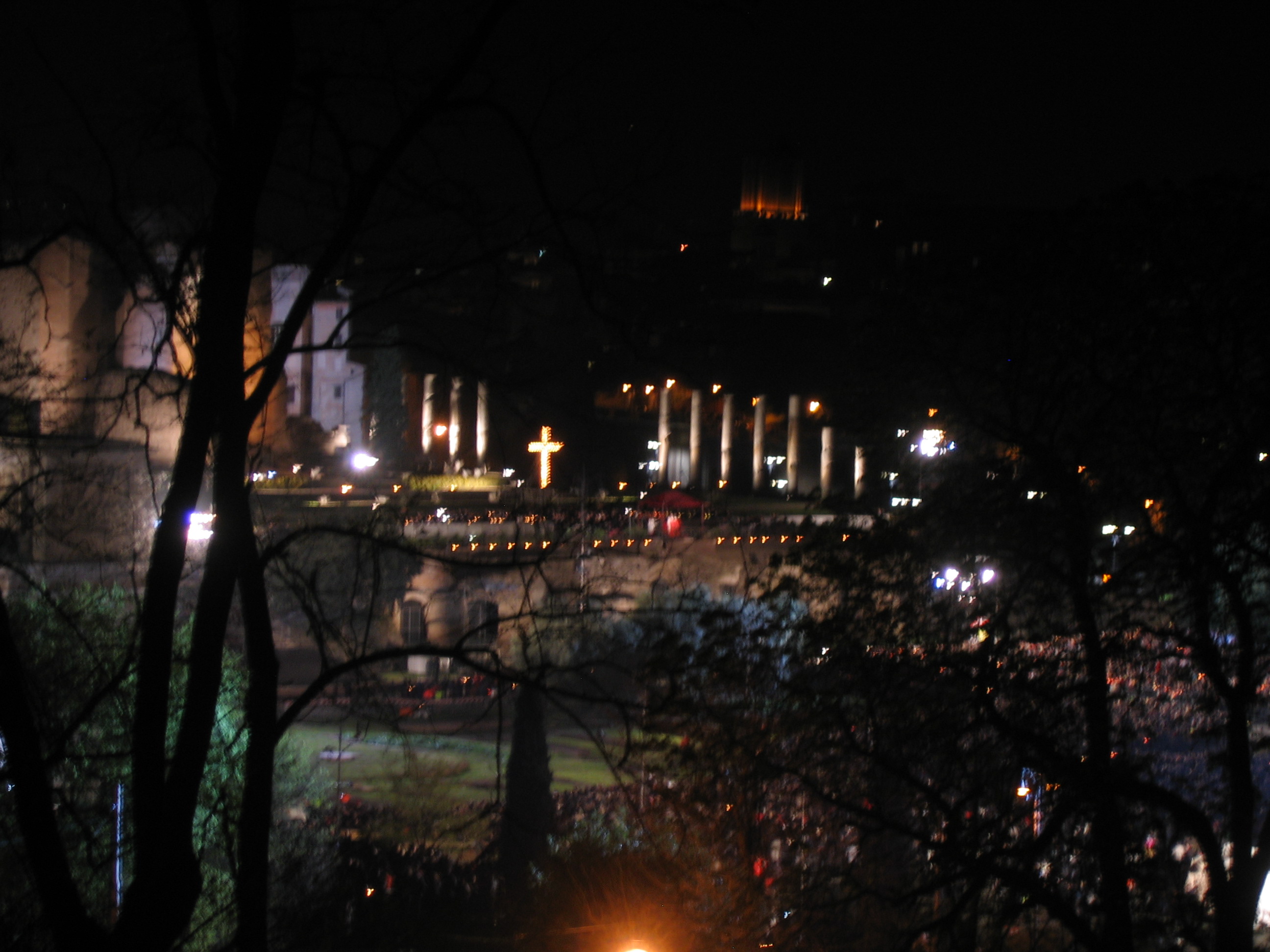
Way of the Cross - my view was not this blurry
This is, after all, the first church (not in chronology, but in order). The Mass of the Lord’s Supper on Holy Thursday was celebrated at the Pope’s Cathedral, the Archbasilica of Saint John Lateran, Mother-Church of Rome. The Service of Our Lord’s Passion on Good Friday and the Great Vigil of Easter were celebrated at the Vatican Basilica of Saint Peter. All were presided by the Bishop of Rome, Benedict XVI, and he was homilist at the first and last (Raniero Cantalamesa, OFM Cap., the preacher of the papal household, had the homily on Good Friday, as you may have heard.) I prayed the Way of the Cross from the edge of our property, a bluff overlooking the Coliseum with clear line-of-sight of the Holy Father about 300 meters away.

Raniero Cantalamessa, OFM Cap., Papal Preacher on Good Friday
The prayer guides are published pocket-sized booklets, illustrated with prints of 15th and 16th century frescoes from Italian churches. The liturgy was celebrated in Latin, the mass parts chanted in Gregorian style, and deacons blessed with angelic voices chanted the gospel – on Thursday it was proclaimed twice, once each in both Latin and Greek! (Presumably in honor of the fact that this year, Passover and Easter on both the Julian and Gregorian calendars all coincide). The prayers of the faithful throughout the three-day liturgy were offered in French, Spanish, English, Polish, German, Portuguese, Russian, Tagalog, Swahili and Arabic. Readings were in Italian, Greek, Latin, French, English, German, and Spanish.
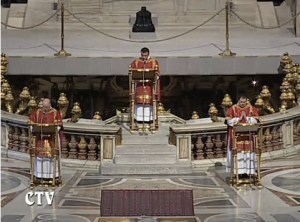
Deacons Proclaiming the Passion
The exultet in Latin is amazing. The Passion on Good Friday in slowly chanted Latin is impressive, but also a little hard on the back. (OK, yes, the very act of complaining about listening to the passion, when it is after all, the passion, is a sin I will publicly confess here and now: Mea culpa, ego sum mereum humanum.)
I found this interesting, though: Over the last few years in liturgical circles we have been encouraged to discourage the reading of the Passion in parts, as it is often printed in the missalletes and music books, and instead just have three deacons or readers proclaim the reading in turn. At the papal liturgy at San Pietro, with the ‘new’ Marini in charge, they had each deacon proclaim different parts (Narrator, Jesus, Peter/others) and the choir as the crowd/assembly.
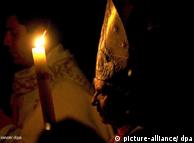
Pope Benedict during the Great Vigil's Service of Light
This touches on one of the great reasons to be in Rome: The liturgical diversity. I do not just mean the fact that there are representatives of all the major rites of the Church here in the city (Alexandrian, Antiochene, Armenian, Byzantine, Chaldean, and Latin), but also that within the Latin rites, within the Roman rite specifically, you have diversity. Just between the Roman Cathedral (San Giovanni) and the Vatican Basilica (San Pietro), with the same pope presiding and the same papal MC, you find different ways of celebrating and different customs.
One small example, during the Eucharistic prayer: At San Giovanni, we do not kneel, and there is no bell during the epiclesis and the two elevations, but there is incense. At San Pietro, we kneel from the epiclesis to the mystery of faith, and there is a bell for the epiclesis and two elevations, but no incense.
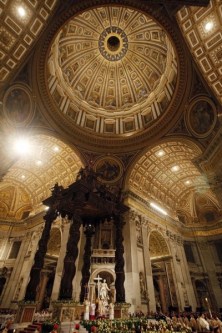
Easter Vigil 2010 San Pietro
Another interesting note, if a little random. While the Mass of the Lord’s Supper traditionally commemorates the institution of the Eucharist in the form of the Last Supper, it has traditionally been called the institution of the priesthood, through the act of the washing of feet. Historically, of course, and theologically, this is not entirely accurate so back home we had long since opted away from this simplistic phrasing lest it require a great deal of explanation. However, in the pre-liturgy announcements at San Giovanni, there it was “The Institution of the Eucharist and of the ministerial priesthood”.
Twelve presbyters were the mandatum at the Holy Thursday Mass of the Lord’s Supper, whose feet the Holy Father washed, though none of this was visible to me. The diplomatic corps were invited to communion with the Holy Father as minister, which they recieveed kneeling and on the tongue, or, they recieved a blessing instead of communion, if appropriate; but everyone else recieved communion along the aisles (standing, and in tongue or hand as the communicant prefered).
After returning to the Lay Centre for dinner, a group of us spent the evening in an adoration pilgrimage of seven churches during the traditional period until midnight: Basilica San Giovanni e Paolo, Basilica Santa Maria in Domnica, the Baptistry of San Giovanni, Archbasilica San Giovanni, Basilica Sant’Antonio di Padova, Basilica Santi Quattri Coronatti, and the Chapel of the Holy Trinity.
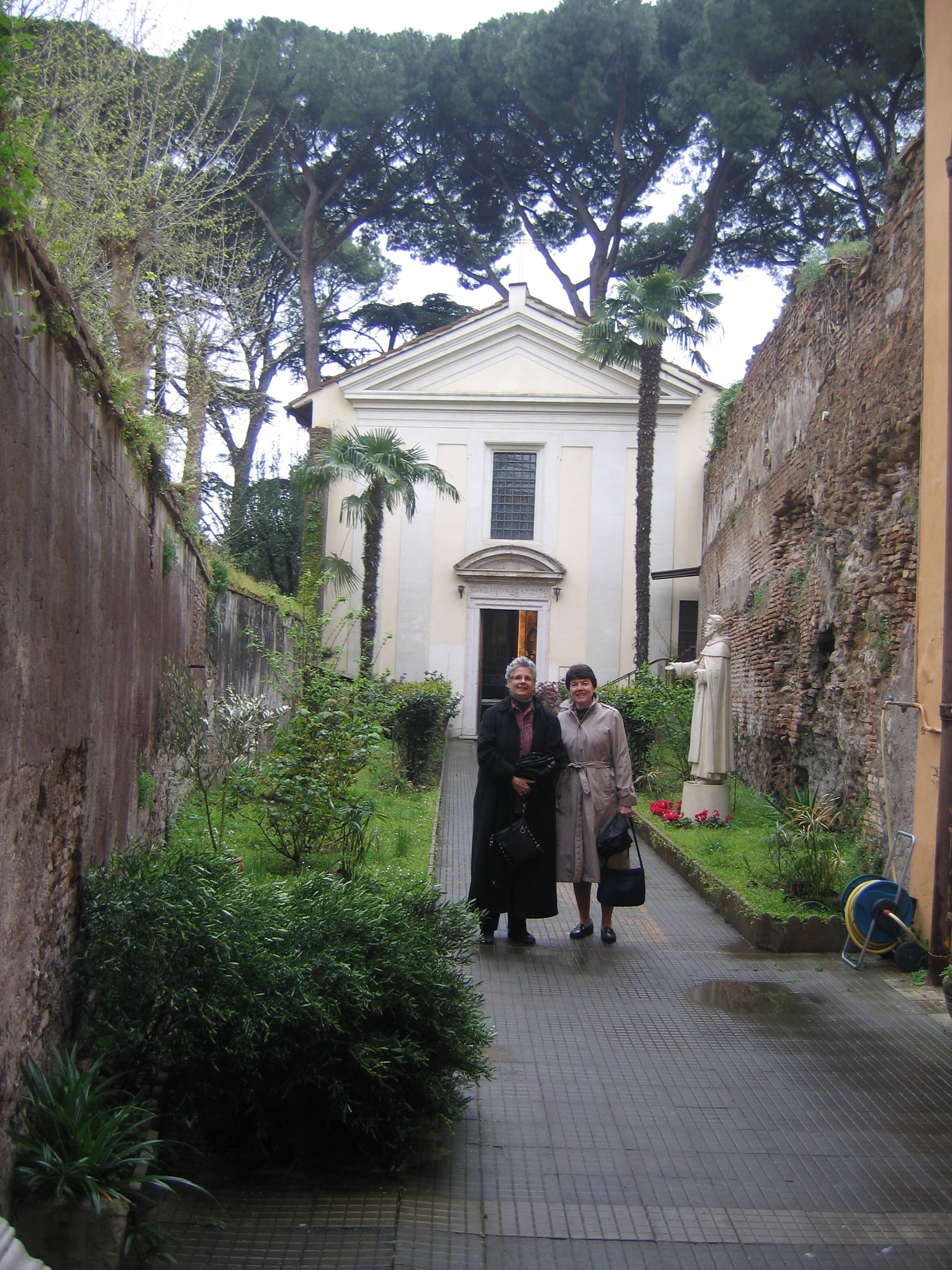
San Tommaso in Formis, with Dr. Orsuto and Dr. Hagstrom
St. Peter’s has a capacity of over 60,000 roughly the same as Notre Dame Stadium before the 1997 expansion. That plus room for another 400,000 in the piazza makes for a somewhat larger assembly than the 2500 or so who can fill the Basilica of Sacred Heart at Notre Dame. For an experience of the Church universal in the heart of the Church, you cannot beat Rome. But for that Church universal manifest in a local church, I do not think even Rome can beat Notre Dame. To a degree, its like apples and oranges. The assembly is different, and the considerations are different. One aims for a liturgy that represents the whole church, which is probably represented pretty well by those present. The other aims for a liturgy of the local church being wholly church in its place. For Latin and the biggest of big liturgy, it is Rome. For best liturgy captured in a particular church, music that is beautiful, reverent and accessible, it is Notre Dame. I am happy to have had my four years at ND, and hope to get a few more here in Rome!
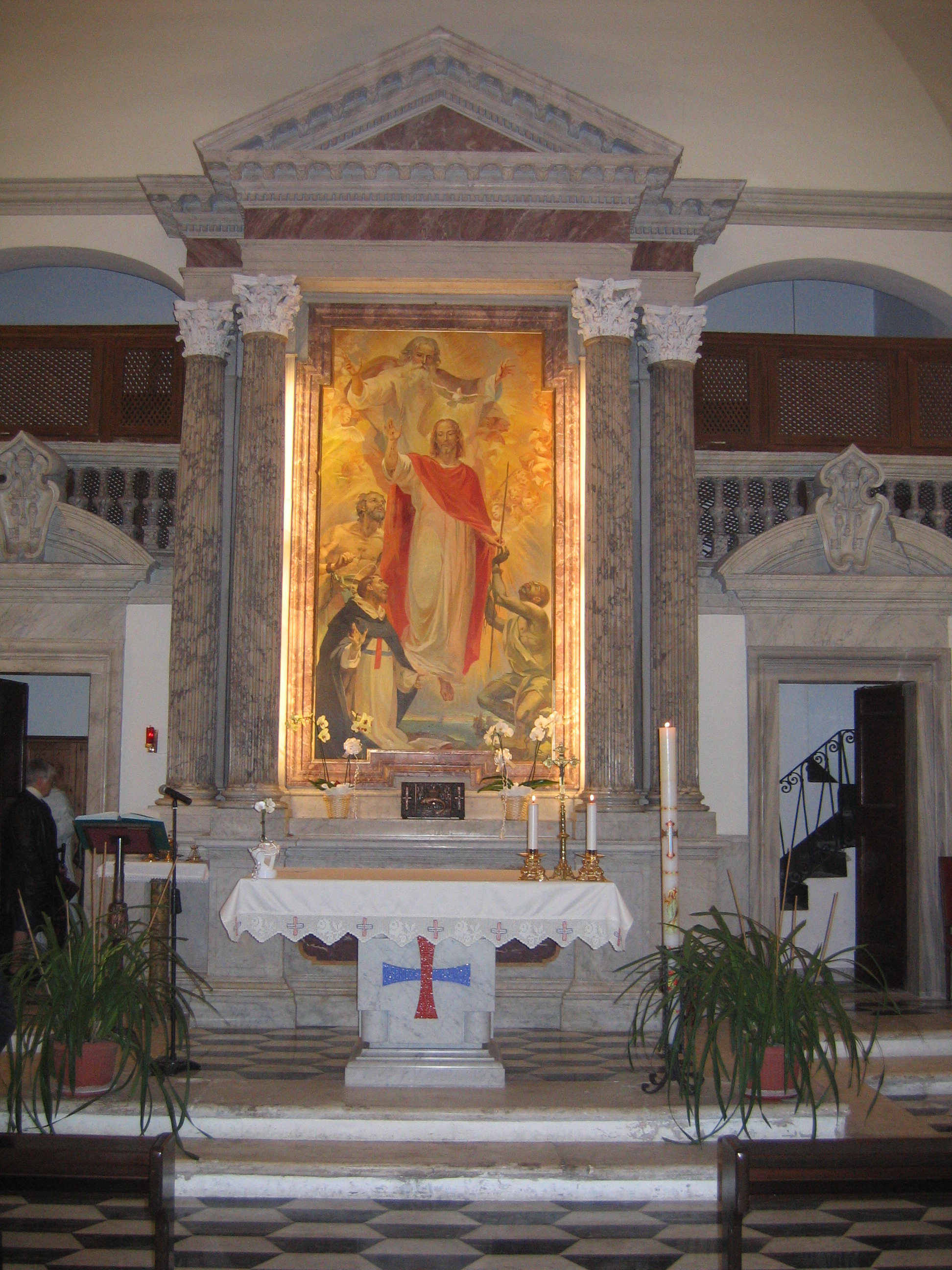
Church of San Tommaso in Formis
For Easter Sunday, between the full papal Triduum experience and the rain, I decided to go to the little church served by the Trinitarian Fathers, Chiesa San Tomasso in Formis (St. Thomas in Chains), literally just outside our front gate and around the corner. About 30 people filled the church, including two priests and two other Lay Centre folk, director Donna Orsuto and visiting scholar Dr. Aurelie Hagstrom, chair of the theology department at Providence College in Rhode Island who is here for a month of Marian research. Such a different experience after the big liturgies to be in a small community! The only space for the after-mass social was the tiny sacristy behind the altar, as long as we entered from one side and exited the other!
After a quick cappuccino and cornetto to celebrate the end of Lenten fasting, we watched the Urbi et Orbi on TV and prepared for a mid-afternoon Easter feast. Only a couple guests joined us, making us about fifteen in all – a perfect way to spend a drizzly Easter afternoon.
Bishop Don Bolen
He got the call on the feast of the Immaculate Conception, 8 December 2009. “The Holy Father would like you to be bishop of Saskatoon.”
It is significant then, that his ordination as bishop take place today, on the feast of the Annunciation, 25 March 2010.
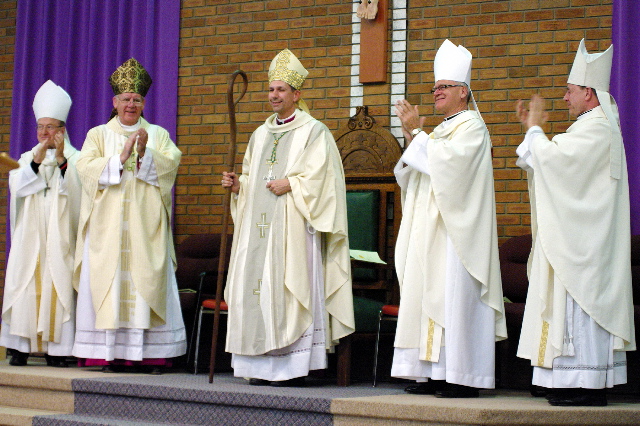
Bishop Don Bolen at his ordination
In between these two events, I had the privilege of being the bishop-elect’s student in Rome for his half of a course on Methodism and its dialogue with the Catholic Church. I even wrote up a short blog article about the class and my first encounter with Msgr. Bolen, here.
I had offered some first impressions at the end of that blog. Over lunch on his next-to-last day in Rome, Father Don mentioned that someone had directed him to my blog about him, and he suggested that perhaps I should revisit my impressions now that we had gone through an entire class together. Fair enough.
The people of Saskatoon are blessed among Canadians. That is all there is to it.
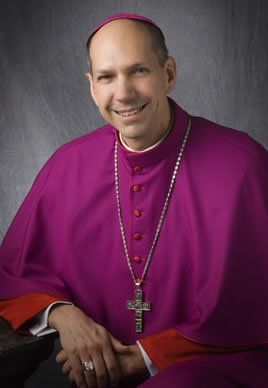
Bishop Don Bolen of Saskatoon, Saskatchewan, Canada
Most bishops have no training or formation to become bishop, not really. They see how their bishop acts, think what they would do, and that’s about it. Bishop Bolen spent years on the Vatican desk covering the dialogues with the Anglicans and the Methodists, where episcopacy and authority, indeed ecclesiology in general, are the major issues of discussion. What better formation than to be a theologian-pastor studying the highest level conversations about what it means to be a bishop, ecumenically, especially when Ratzinger is Pope and Kasper is President of the Pontifical Council for Promoting Christian Unity? Granted, it is one thing to engage in discussion about the episcopacy, and another to live it out, but what an opportunity!
So that’s the leadership aspect. What about teaching? At the end of our course, (team taught by Bishop Don and the Rev. Dr. Trevor Hoggard, the Methodist Representative to the Holy See) several of us had concluded this was one of the most valuable courses offered, in terms of both method and content. It was pretty straightforward: Get a solid introduction to the Methodist church from a Methodist pastor/theologian, get a thorough overview of the dialogue from the Catholic perspective, and culminate in a mock-dialogue with actual participants from the international dialogues, complete with Anglican observer.
The celebration of his ordination as bishop in Saskatoon was attended by several ecumenical leaders locally, and by a delegation from Rome that included Bishop Brian Farrell, Secretary of the PCPCU, Fr. James Puglisi, SA, Father-General of the Friars of the Atonement and Director of the Centro Pro Unione, Very Rev. David Richardson, ChStJ, the Archbishop of Canterbury’s Representative to the Holy See, and others. I have included a link to the pictures that the diocese has put up about the event, including a slide show.
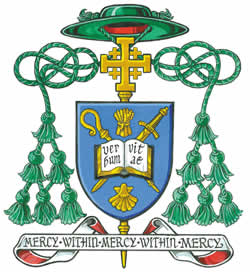 His motto is “Mercy within Mercy within Mercy” and his coat of arms and biographical information are here. Weslyan hymns specifically chosen by the bishop were a central part of the ordination liturgy, as was an ecumenical prayer service that looks to have been very well attended.
Being bishop is no easy task and my prayers are with this newest of Canada’s episcopate. Coming from a diocese that has not seen a ‘normal’ transition of episcopal leadership since before I was born, I can especially appreciate what it means for a local church to find a shepherd that makes such a good fit, and I hope the coming years are fruitful and filled with the Spirit.
Maronite Mass with Fr. John Paul Kimes
Father John Paul Kimes is a Maronite presbyter serving in the Supreme Tribunal of the Congregation for the Doctrine of the Faith, the section which deals with grave delicts, those sins which involve the desecration of the sacraments and, since 2001, the sexual abuse of minors by clergy.
The Maronite Church is one of the 23 “self-governing” churches that make up the Catholic Church, and is the only patriarchal church with no Orthodox counterpart. The short version of the history is that while communion between the church of Rome and the church of Lebanon was never broken, communication was lost for some centuries at a time. However, at any opportunity where communion could be expressed, it was. So, it is common to say that the Maronite church was always a part of the Catholic communion. Born of the Syrian tradition surrounding Antioch and Edessa, this church settled in Lebanon and took its name from a hermit-priest of the late fourth century, St. Maron.
Given the connection to these communities, the liturgical rites are West Syrian, or Antiochene, and the liturgical language is a variation of Aramaic, and also includes Arabic. While most of our celebration was in English, some key prayers and responses were said in Arabic, and only our Egyptian Muslim and our Italian scripture scholar could keep up without the transliteration!
It’s a beautiful liturgy, even in the simple setting of our chapel. Perhaps especially so. After my experience with the Syro-Malabar Divine Liturgy recently, I was stuck by how much more of a role the deacon has in the Maronite rite. Also that neither the Alleluia nor the Gloria are omitted in the Maronite liturgy during Lent. (I found a Maronite liturgy on YouTube you could check out)
After dinner Fr. Kimes engaged questions and shared something of his work in the CDF. One of the questions posed was around the role of lay people in curial offices. There are few offices which are actually required, by law, to be held by a cleric, and the CDF tribunal is one of them. In most dicasteries it is simply a culture that has not been challenged. When he was prefect of the CDF, Cardinal Ratzinger apparently filled as many positions as he could with qualified non-ordained people. Even when, after becoming pope, the Congregation needed the very particular expertise of a lay person in a position reserved in canon law to a cleric, Pope Benedict granted it without question.
So why hasn’t this openness translated into changes across the curia now that he’s pope? He leaves his deputies to do the hiring themselves; rather than micromanage he prefers to lead by example. I’m not sure it’s a clear example, however, to most that are unaware of this. There remains, too, what might be described as a benign clericalism (my term, not his), a belief that the limitations to certain offices to clergy is broader than it actually is. In some cases this is more explicit and less benign. But even in the case of the Supreme Tribunal of the CDF, which is clearly clerical by law, Fr. Kimes expressed the opinion that this was a wisdom – some of what is dealt with is so heinous, the thought is that the judges need all the sacramental graces and spiritual strength that they can have, hence the preference in law for someone ordained.
St. Patrick’s in Roma
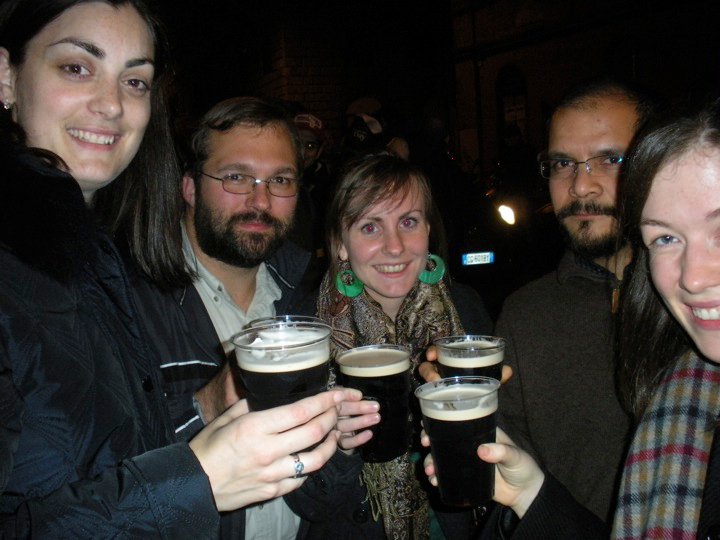 I never knew there would be so many Irish pubs in Rome. The last time I was in Europe, I discovered that almost every city on the continent of any decent size includes three requisite cuisine options beyond the local fare: an Irish pub, a Chinese restaurant, and a McDonald’s. But I read recently that there were nearly 100 Irish pubs in the greater Rome area, and I even encounter a group of American undergrads making their best effort to visit all of them today.
Thankfully, there’s one just across the park from the front gates, complete with Guinness on tap. Less thankfully, everyone in the Celio neighborhood decided it would be a good idea to celebrate St. Patrick’s Day there. So a contingent of us ventured over after our community night for a pint. One pint, only, mind you. Nevertheless, that was enough to induce an impromptu lesson in Irish dancing for some of my companions…
But, back to our community evening: these are, I may have said, one of the greatest aspects of formation in Rome, the opportunity to meet with curial officials and other church leaders on a weekly basis, celebrating the liturgy with them and hearing a little of their thoughts, their stories, and their insights.
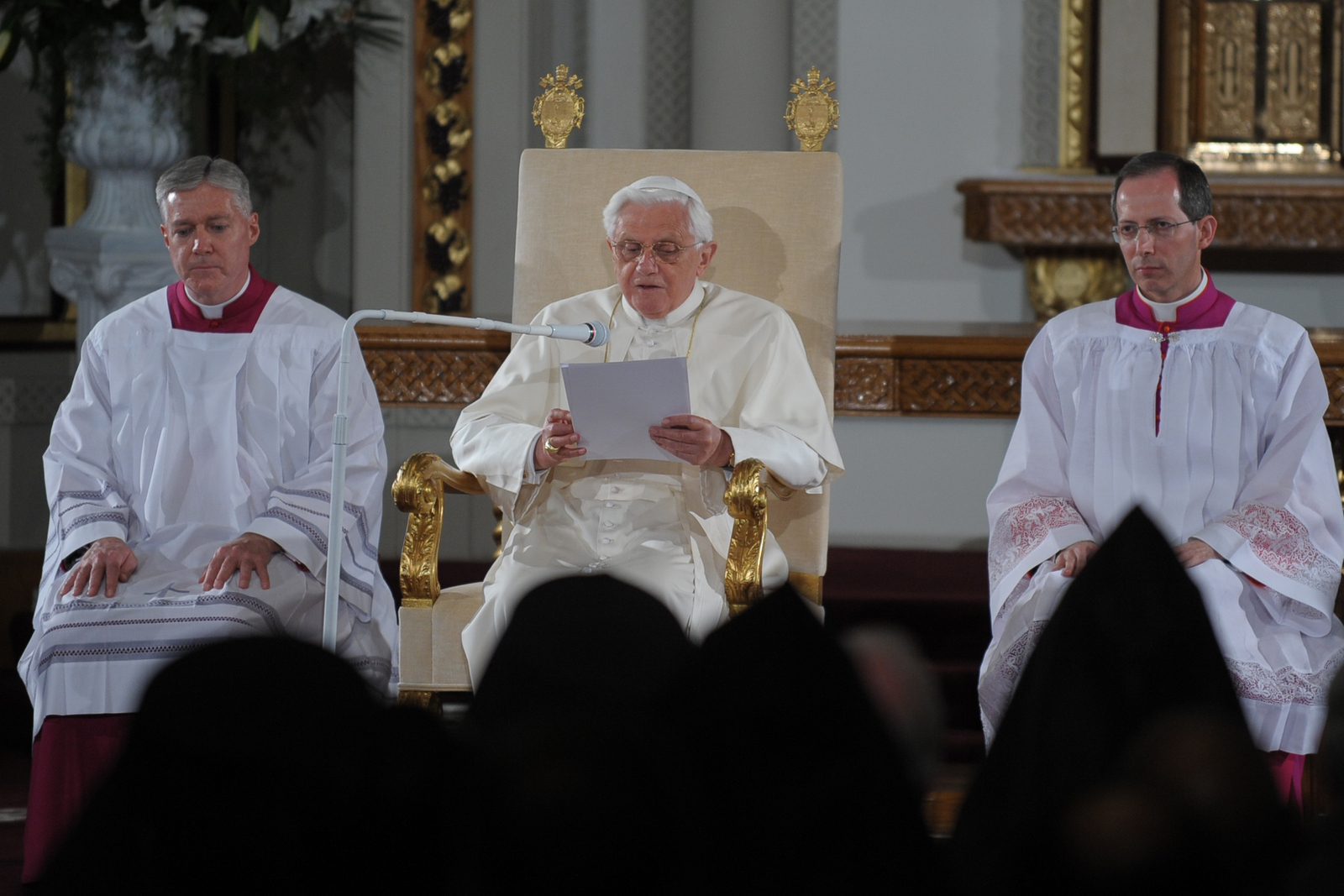
Msgr. Millea, Pope Benedict, Msgr. Marini
Tonight we were pleased to welcome Monsignor William Millea, an American who works in the Secretariat of State, General Affairs Section. This is the section that might parallel white house staff, in the sense that they handle appointments to curial offices, translations and publication of official texts and speeches, etc. An additional duty Father Millea has had is serving as one of the masters of ceremonies for the pope, and can often be seen with the papal master of liturgical celebrations, Monsignor Marini, alongside the Holy Father. This was the case throughout the pope’s pastoral visit to the Unites States a couple years ago. (At which point, as the token American in the Vatican retinue, it was to Millea that Pope Benedict turned after the big Eucharist at Yankee Stadium: “That’s what the liturgy is supposed to be!”)
Like so many we have talked to, he came to Rome for a year, and then came back for more and never left. His love of Latin and things classical certainly helped land him in a position to do much of the translating and interactions with things American and Anglophone for the Secretariat.
The Ides of March

Julius Caesar's Pyre & Temple
I remember being told by some middle school science teacher that each of us probably had two molecules of Caesar’s last breath in our biological makeup. Naturally, given my birth on the anniversary of his assassination, I have always had an interest – I do not think I would go so far as to say a connection – with the Roman Dictator.
I also cannot tell you how many times in my life I have heard the phrase uttered, “Beware the Ides of March” instead of the usual “Happy Birthday!”
With March being full of intensive courses, I was not able to get the full effect of Rome’s celebration honoring its first leader to be officially deified. The site of his funeral pyre, in the heart of the ancient Foro Romano, is modest by comparison to some of the temples around it, but is still adorned with fresh flowers almost daily by Roman devotees. Near the statue of Julius on the Via Forii Imperialli we witnessed a troop of costumed youth re-enacting the story of Caesar and his assassination in 44 B.C.

Julius Caesar statue on Fori Imperiali
While the Roman Senate house is still visible on the Roman forum, it was not in this building where as many as 60 senators participated in his assassination. Instead, meetings were taking place across town, near the Area Sacra at Largo Argentina, in the Theatre of Pompey. There is a restaurant, I’m told, where you can access the basement and eat in part of what was the building in which Caesar was killed. I did not get around to making reservations this year, but maybe next!
Instead, we had a typically great meal at the Lay Centre, and thanks to the intervention of my favorite Dutch theologian-diplomat, Feda baked a delicious flourless chocolate cake popular in Italy known as Torta della Nonna (Grandmother’s Cake).
Lay Centre Featured on Rome Reports
Rome Reports, an English-language news agency that broadcasts to several countries, did a feature about the Lay Centre at Foyer Unitas that aired last week:
Angelicum Leads the Way in Rome for Eucharistic Adoration
Rome Reports is an English-language news program based in Rome, and broadcasting to several countries. They recently did a feature of the Angelicum, apparently the only Pontifical Univeristy in Rome with daily Eucharistic Adoration, including interviews with familiar faces: Benedict Croell, OP; Matthew John Paul Tan, PhD (another Russell Berrie Fellow); and Jill Alexy, M.Div. (fellow Notre Dame alumn).
You can watch the clip here: http://www.youtube.com/watch?v=z8Wh3YqLOoU
Quote of the Day
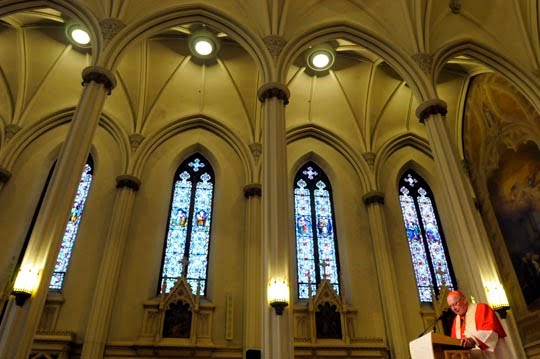
Visible union with the Catholic Church does not mean absorption into a monolith, with the absorbed body being lost to the greater whole, the way a teaspoon of sugar would be lost if dissolved in a gallon of coffee. Rather, visible union with the Catholic Church can be compared to an orchestral ensemble. Some instruments can play all the notes, like a piano. There is no note that a piano has that a violin or a harp or a flute or a tuba does not have. But when all these instruments play the notes that the piano has, the notes are enriched and enhanced. The result is symphonic, full communion. One can perhaps say that the ecumenical movement wishes to move from cacophony to symphony, with all playing the same notes of doctrinal clarity, the same euphonic chords of sanctifying activity, observing the rhythm of Christian conduct in charity, and filling the world with the beautiful and inviting sound of the Word of God. While the other instruments may tune themselves according to the piano, when playing in concert there is no mistaking them for the piano. It is God’s will that those to whom the Word of God is addressed, the world, that is, should hear one pleasing melody made splendid by the contributions of many different instruments.
William Cardinal Levada
Five Hundred Years After St. John Fisher: Benedict’s Ecumenical Initiatives to Anglicans
Delivered at Queen’s University, Kingston, Ontario
March 6, 2010
 The Ecumenism Blog