
Home » Posts tagged 'Vatican' (Page 3)
Tag Archives: Vatican
Bishop Gerhard Müller to CDF
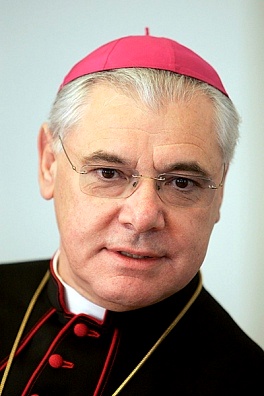 The rumor has been floating around for some months, and this week it was announced that Cardinal Levada has retired as prefect of the Congregation of the Doctrine of the Faith, and the bishop of Regensburg, Gerhard Müller, has been appointed to take his place.
His official biography and extensive information can be found in English at his diocesan website.
The two NCRs cover the story here:
- National Catholic Register (moderately conservative)
- National Catholic Reporter (moderately liberal)
Talking with one of my German colleagues in Rome, she was complaining how the German press has continued to remind people that this was once the office of the Universal Inquisition. That, and that Müller has been widely painted as an archconservative and favoring the current trend towards traditionalism.
I chuckled and pointed out that most of the English-language blogosophere seems to focus on his connection to Liberation Theology, and that if anything, the traditionalists have protested because he is “heretic” and a “modernist” – terms almost inevitably misused, but that is nothing new.
I have read only one of Müller ’s books, and that is his Priesthood and Diaconate, which I have used for my License thesis. He writes to counter the arguments made by some German feminist theologians that women have been and ought to be ordained to the diaconate. The major argument he sets out to counter is that, although the question of ordination to the priesthood – understood as the presbyterate and the episcopate in this case – has been closed since John Paul II’s 1994 Apostolic Letter Ordinatio Sacerdotalis, the question of the ordination of women to the diaconate remains (ostensibly) open.
First, it is interesting to note that in the translation, there are a couple of humorous editorial notes attached to his text. This same German friend keeps remarking that the problem with German theologians, ministers and ecclesiastics is that they all think that “the German Church is the center of the Catholic Church”- or whatever issues are big in the German world must be the main issues for the universal church. Not unlike the American/anglo-phone phenomenon, actually.
At various points in his book, Müller demonstrates this by saying something like “theologians in the whole world are asking this question” or “everyone seems to think this is an inevitability”. But after the translator and editor have their input, it looks like this: “theologians in the whole [German-speaking] world are asking this question” or “everyone [in Germany] seems to think this is an inevitability.”
More substantially, I was struck that he seemed not to address the most fundamental ecclesiological point of the argument he was trying to counter and correct. The argument for the ordination of women to the diaconate, in the current context, is that, if you maintain that within the one sacrament of holy orders there are not only three orders, but two distinct classes of orders – one to the priesthood and one to ministry/diakonia – then you can argue that a prohibition of ordaining women to priesthood does not necessarily dictate a prohibition to the ordination of women to diaconate.
However, if you argue that the three distinct orders within the one sacrament are modeled in a Trinitarian concept, then this argument might collapse, and if women cannot be ordained to one order or another it can be argued that they cannot be ordained to all of them. Müller’s strongest move, it seems, if his intent is to demonstrate that women cannot be ordained even to the diaconate, would have been to argue the unity of the sacrament. Instead, he maintains throughout his text this scholastic division between priesthood and other, the very point that the target of his investigation needs to retain in order to make her argument.
It is also interesting to note is that Bishop Müller was heavily involved in the International Theological Commission’s Report on the Diaconate, From the Diakonia of Christ to the Diakonia of the Apostles, which itself does not close the door on the question of ordaining women to the diaconate.
All in all, he seems an accomplished theologian, interested in ecclesiology and ecumenism, with a healthy ability not to get stuck in some of the old images and models of theology; he is able to judge aspects of liberation theology on its merits, rather than treat it like a bad word, as so many in the anglophone world are sadly wont to do. On the other hand, it seems that the question of women in the diaconate may be closed soon, before the non-German speaking world even had a chance to realize it was open.
I am looking forward to reading more, and seeing what the future brings.
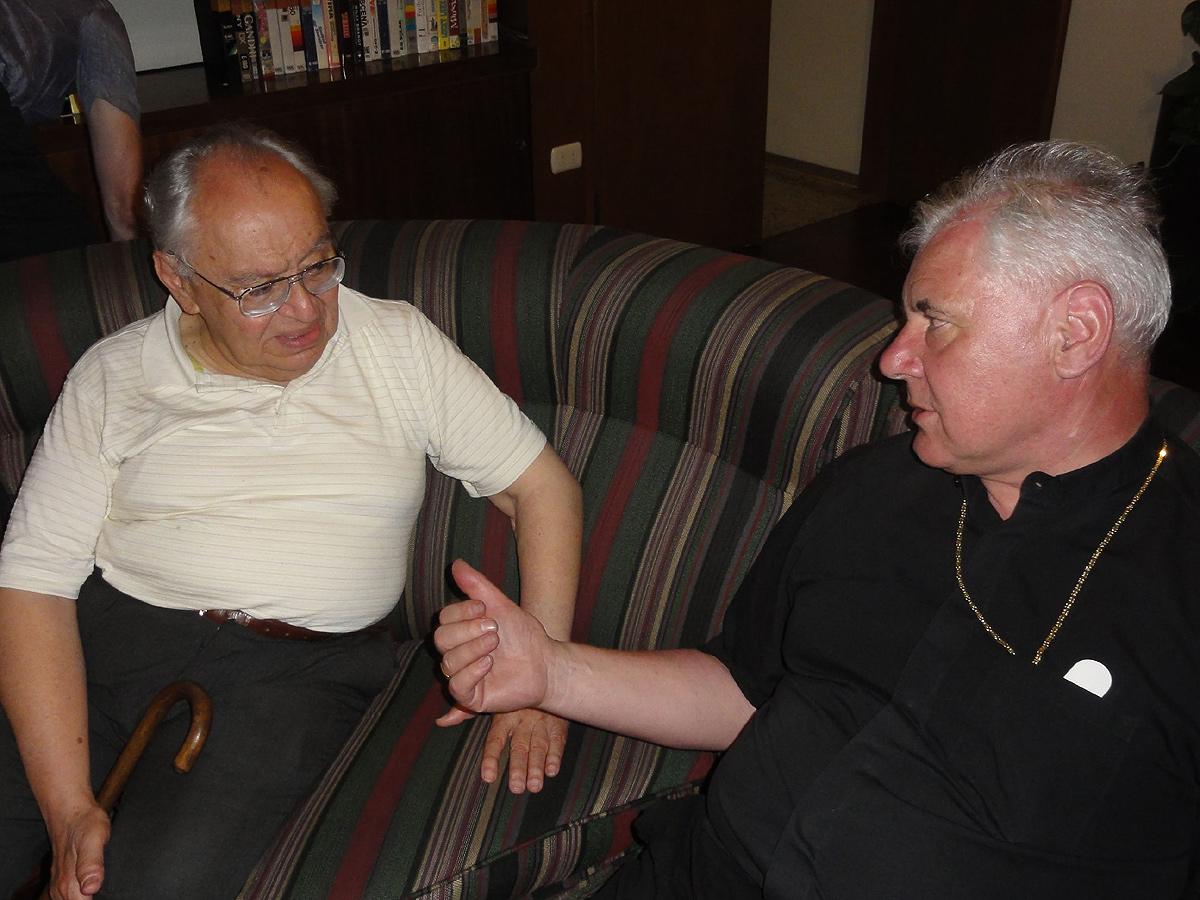
Gustavo Gutierrez, father of liberation theology, and Gerhard Muller, at one of their annual sessions.
A funny thing happened on the way to the Forum today…
OK, I was not anywhere near the forum, but at Villa Richardson, the residence of the U.S. Ambassador to the Holy See, for their annual (anticipatory) Independence Day celebration. But, I have been wanting to use that line since I got to Rome, and never quite worked it in.
So, at Roman noon today, I saw an update from the Vatican’s new-ish news mega-portal, http://www.news.va, officially announcing Cardinal Levada’s retirement and the appointment of Bishop Gerhard Müller to the post of Prefect of the Congregation for the Doctrine of the Faith. So, I reposted it on Facebook.
Tonight, at the Embassy’s Independence Day party, about eight hours later, a curial monsignor mentions to me he heard about the appointment through my Facebook post. “What, there’s no internal memo on these things?” I asked. He just laughed.
Having just celebrated the patronal feast of the city and Church of Rome, it serves as a reminder that, in the Vatican, you can rob Peter to pay the left hand while the right hand does not know what Paul is doing. Or something like that.
Fighting Irish in Rome; Vatican Communications
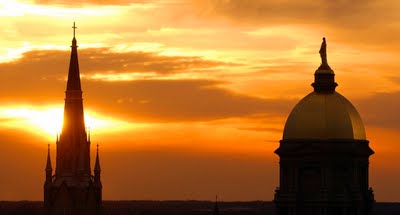
Sacred Heart Basilica and Main Building at Notre Dame
The Notre Dame Alumni Club of Italy is not particularly large, there are only about 60 people on the mailing list, and most are clustered around Rome or Milan. We had our first club gathering that I was able to attend tonight at the Holy Cross generalate, an apartment building owned by the order in a residential neighborhood just a few bus stops from the west end of the metro A line. There were about a dozen of us, a few Holy Cross priests including the superior general, Fr. Hugh Cleary, a couple of fellow Angelicum students, a couple of curial staff , and a young couple teaching at the American International School of Rome.
Conversation ranged from the usual introductions and getting to know you chatter to the challenges of life in Rome and obtaining the fabled Permesso di soggiorno or even Italian citizenship or a driver license. Given the state of the Church these days, however, one of the interesting topics was the clergy sex abuse/cover up scandal, the Holy Father’s role in cleaning up the Church, and mostly, the Church’s communication challenges.
Much has improved in the last decade, on one hand. You need only compare the responses of the curial leadership to the crisis in Europe in the last few months with the responses to the crisis in America in 2002 to see that Pope Ratzinger has had a positive effect on dealing with the problem realistically, but there is still a lot of work to be done – not just in the substance of solutions, but even more in the Vatican’s communication’s organs and “getting the word out” of the good work already done.
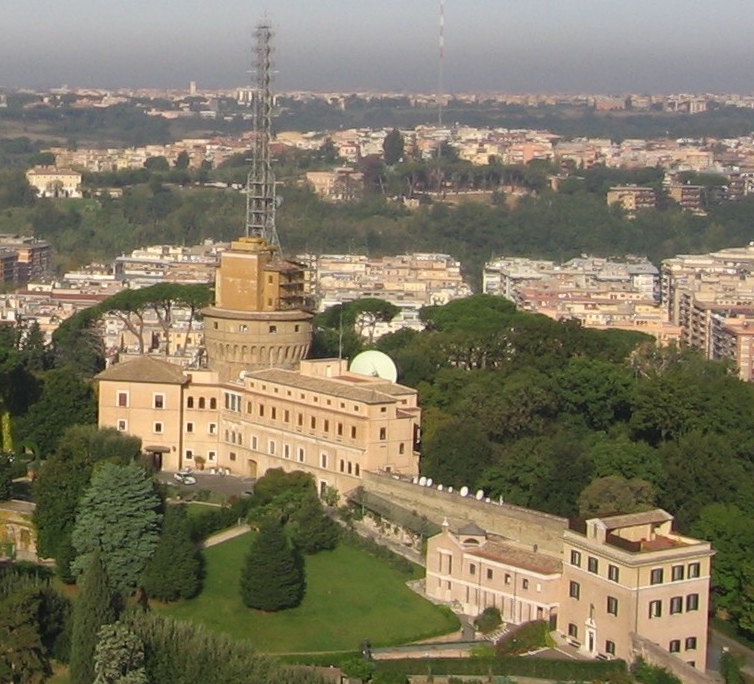
Vatican Radio building
Few people realize just how disjointed the Holy See’s communications systems really are, though that has been made painfully clear with some of the well-intentioned but misguided attempts to “defend” the pope by some church leaders recently. There is no Vatican communication plan, no central organizing body. Each was set up in response to the development of a new media. Guttenburg comes along and we get the Vatican press; then Marconi and Vatican Radio; TV, a web page, etc, etc.
There is a Pontifical Council for Social Communications, but without the juridical authority of a Congregation, they can only make suggestions and maintain good working relations with the other communications apparatus’, which include:
- Vatican Information Service
- L’Osservatore Romano (The Vatican Newspaper)
- The Vatican Publishing House
- Sala Stampa della Santa Sede (The Vatican Press Office)
- Centro Televisivo Vaticano (Vatican TV)
- Radio Vaticana
- The Holy See’s Web page www.vatican.va
Not only are each of these separate, but most are in different buildings, some in several (Vatican Radio, for instance, has three different locations, I believe). Moreover, some have their own web-presence that does not go directly through the Vatican web page. Some dicasteries have their own information services and bulletins, from the Acta Apostolica Sedes to the PCPCU Information Service, which are not always available electronically or in translation.
It seems like the time is ripe for a major restructuring. It would not be easy, no doubt, and the directive has to come from the top, but there is no shortage of skilled lay people in the Church who could create a more effective communications strategy. In fact, they do not have to look further than the sons and daughters of Our Lady’s University to find a gold mine of resources right here in the Eternal City!
Witness through Sharing Stories; WPCU Day #2
From the official material prepared by the World Council of Churches and the Pontifical Council for Poromoting Christian Unity:
Scripture
Jeremiah 1:4-8, Go to all to whom I send you.
Psalm 98, Sing to the Lord a new song.
Acts 14:21-23, They strengthened the souls of the disciples.
Luke 24:13-17a, What are you discussing with each other while you walk along?
Meditation
Sharing our stories is a powerful way in which we give witness to our faith in God. Listening to one another with respect and consideration allows us to encounter God in the very person with whom we are sharing. The reading from Jeremiah offers us a powerful witness of God’s call to the prophet. He is to share what he has received, and so allow God’s Word to be heard and lived out. This call to proclaim God’s Word is also experienced by the disciples in the early Church, as witnessed to in the reading from Acts. Our psalm allows us to sing to God with a spirit of praise and thanksgiving.
Today’s gospel passage presents a Jesus who enlightens our blindness and dispels our disillusionment. He helps us to understand our stories within the one unfolding plan of God. During this Week of Prayer for Christian Unity, we listen to the faith stories of other Christians in order to encounter God in the variety of ways God’s very self is revealed to us. In listening with attentiveness we grow in faith and love. In spite of the diversity of our personal and collective witness, we find ourselves intertwined in the one story of God’s love for us revealed in Jesus Christ.
Prayer
God of history, we thank you for all who have shared their story of faith with us and so have given witness to your presence in their lives. We praise you for the variety of our stories both as individuals and churches. In these stories we see the unfolding of the one story of Jesus Christ. We pray for the courage and the conviction to share our faith with those with whom we come into contact, and so allow the message of your Word to spread to all. Amen.
Reflection Questions
Are you “gossiping the Gospel” or just gossiping?
How open are you or your church to be drawn into the stories of others?
How open are you to share with others your stories of faith, and so give witness to God’s presence in your personal experiences of life and of death?
Are you aware of the enormous potential for good that modern means of communication offer the Church today?
 The Ecumenism Blog