
Home » Posts tagged 'theology' (Page 4)
Tag Archives: theology
Remembering Salvadoran Martyrs
Twenty years ago today, in the morning hours, U.S.-trained military personnel of the El Salvadoran government assaulted the Jesuit residence at the University of Central America, in San Salvador, killing eight people – six Jesuit faculty and leadership of the university, the housekeeper, and her 16-year old daughter.
President Mauricio Fuñes announced earlier this month that the priests would receive the National Order of Jose Matías Delgado – the nation’s highest honor – in a national service of atonement today. It was not clear if Celina and Julia Elba would likewise be honored, though I certainly hope so. The U.S. Congress also passed a resolution honoring “these eight spiritual, courageous and generous priests, educators and laywomen” and encouraging commemorations of the anniversary.
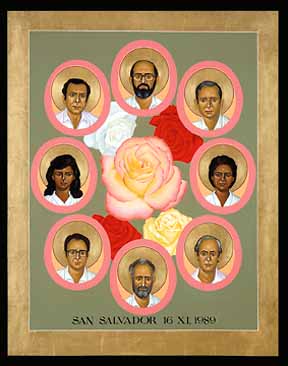
We remember today:
Julia Elba Ramos, 42,
cook and housekeeper for the Jesuit seminarians at the university
Celina Mariset, 16,
Ramos’ daughter
Ignacio Ellacuria, SJ, 59,
Rector of University of Central America
Ignacio Martin-Maro, SJ, 44,
Vice-Rector and Director of the UCA Public Opinion Institute
Segundo Montes, SJ, 56,
Dean of the department of social sciences
Amando Lopez, SJ, 53,
professor of theology and philosophy
Juan Ramon Moreno, SJ, 56,
professor of theology
Joaquin Lopez y Lopez, SJ, 71,
founder and director of Fe y Alegria (Faith and Joy),
which opened thirty educational centers in communities throughout El Salvador
+
Martyred November 16, 1989
El Salvador
The developed world is not at all the desired utopia,
even as a way to overcome poverty, much less to overcome injustice.
Indeed, it is a sign of what should not be and of what should not be done.
We must turn this sinful history upside down, and out of poverty
we must build a civilization in which all can have life and dignity.
– Ignacio Ellacuria, SJ
(Thanks to Catholic Anarchy for the icon and prayer!)
Dr. Rick Gaillardetz and Archdeacon Johnathan Boardman
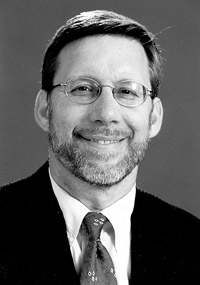 Author of seven pastoral booklets, eight books, and over 100 journal articles, Dr. Richard R. Gaillardetz is one of the most accomplished U.S. ecclesiologists of the current generation. He has been a member of the U.S. Catholic-Methodist dialogue, and his doctoral director was Dominican Father Thomas O’Meara at Notre Dame (who was also my systematics and ecclesiology professor as an undergrad). Rick is married, with four children, and currently serving as the Murray/Bacik Professor of Catholic Studies at the University of Toledo (Ohio, not Spain).
The Venerable Jonathan Boardman is an Anglican presbyter, rector (pastor) of All Saints parish in Rome, and Archdeacon of Italy and Malta for the Anglican diocese of Gibraltar, which covers all of continental Europe.
[An archdeacon in the Anglican Communion, as it once was in the Catholic Church, is basically the vicar general, and in this case one of several where each is assigned a geographic portion of a diocese. Though traditionally this was a role for a deacon, the eventual usurping of all diaconal ministries into the presbyterate included this high office.]
Having either one of these men as guests for dinner and conversation over tea would have been a treat, especially now in the wake of the apostolic constitution Anglicanorum Coetibus. To have both on the same night was a true privilege, especially for an ecumenist/ecclesiologist like me. I would have been happy just to sit back sipping my tea, and listen to them discuss the personal Ordinariates, the history of Anglicans in Rome, and the ecclesiologies of our communions today. Both men are as engaging as they are erudite, though, and welcomed questions and comments from those of us who decided to stay and converse rather than head across town for a party with the other lay students of Rome. (Still working on that bilocation thing)

Anglican Father Jonathan Boardman and Professor Richard Gaillardetz
Professor Gaillardetz has written a great deal in exactly the areas of ecclesiology that interest me, including ecumenism, the diaconate, lay ecclesial ministry and a wide range of other topics. I have no doubt that his work will make a significant contribution to my thesis and dissertation, and it is always a blessing to make a real-life connection with someone whose work informs your own.
Father Jonathan I have met on my two forays to All Saints, first for their dedication feast – the Sunday after the press announcement of the Personal Ordinariates – and for Stian’s debut as Evensong Acolyte Extraordinaire. His comments on the Personal Ordinariates, and his personal openness about his reactions since the first announcement and the subsequent publication of the constitution, were welcome, enlightening, and honest.
[In fact, as i write this, i suddenly realize who it is that Fr. Boardman reminds me of: Bishop Daniel Jenky, CSC! Some similar physical characteristics, spoken style and personality. Good preacher. hmmm….]
“I am not angry about all this… and yet, I’m surprised how angry I was!” probably best describes one of the most common reactions, echoed by Father Boardman while relating an incident where an innocent joke about “competition” [between Catholics and Anglicans] by a Vatican colleague touched a raw nerve.
While both the Archbishop of Canterbury and the Holy See’s own Council for Promoting Christian Unity had little notice before the public announcement, and many Anglicans and Catholics alike have seen this as either “arrogant” or at least “unilateral and insensitive”, some Anglicans have also noted that it is not as if the Anglican Communion or its constituent national churches have always consulted Rome or Constantinople before making a decision that had ecumenical ramifications (such as the ordination of women to the episcopate).
Further, as my friends remind me, there are probably more Catholics – including priests – who have “swam the Tiber” in the other direction than Anglicans who have come into communion with Rome over the last three or four decades.
We also spent some time discussing the theology of the episcopate – or lack thereof – in the apostolic constitution, and wondered why at least a “conditional” ordination wasn’t proposed given the development of Catholic theology on orders in general and Anglican orders specifically since Leo XIII issued Apostolicae Curae.
I have an upcoming post updating my thoughts on the constitution, and I am incorporating some of my gleanings from this conversation there, so I do not want to duplicate it here!
Translating Roman and American degrees
So, I am studying for a License in Sacred Theology (STL). What is that? How does it compare to the MA in Theology that almost/never was? How do the American and Roman degrees correlate?
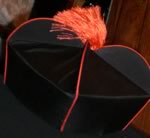
Academic Biretta, worn by a Doctor of Sacred Theology
Rome has answered a frustration I had at CUA, which was shared by several of my classmates: the graduate courses there seemed to be really geared at a more basic, undergraduate level. Some blamed the overwhelming presence of seminarians, for whom classes had to be “dumbed down”. Others attributed it to “the lack of academic freedom” at the only U.S. University officially run by the Catholic Church (as opposed to a religious congregation or non-profit). I believe this to be primarily the result of the difference between the Roman and secular/American degree systems, and a less-than-efficient blending of the two.
Europe has a host of different practices, i find out, and for the last decade they have been in the process of synchronizing the systems. Some graduate secondary (high school) at 17, then have a 3-year bachelors program. Others graduate secondary at 19. Italy currently has what they are calling a 3+2 program for college studies, the three years for a bachelors, and the 2 for a masters – or what we might call a masters. But Italy is different than the Pontifical system.
In the pontifical system, you earn the Baccalaureate first, then a License, and then a Doctorate. If you are studying theology, however, you need at least two years of Philosophy first, then a Bachelors in theology, before doing the License and Doctorate. So, the STB really is an undergraduate degree, and it makes little sense to compare it to an M.Div., though these are respectively the basic ministry degrees required by each system.
So, if one were to go straight through in each of the systems it would look something like this:
| HS + yrs | Pontifical | American |
| +1 | ||
| +2 | Philosophy (no degree) | Associate (AA) |
| +3 | ||
| +4 | Bachelor (BA/BS) | |
| +5 | Baccalaureate (STB) | |
| +6 | Master (MA), or | |
| +7 | License (STL) | Professional (M.Div.) |
| +8 | ||
| +9 | Doctorate (STD) | Pastoral Doctorate (D.Min) |
| +10 | Research Doctorate (Ph.D.) |
Thus, my License is both the completion of the work i began at CUA for the MA in Theology, and the begining of my doctoral work.
Grand(father) Inquisitor at the Lay Centre
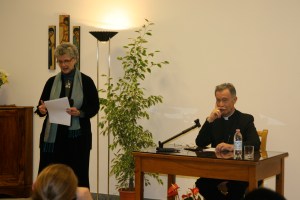
Dr. Donna Orsuto, Most Rev. Luis Ladaria Ferrer, SJ
When meeting with the second-ranking official of the dicastery known for most of its history as the Holy Office of the Inquisition (now the Congregation for the Doctrine of the Faith, CDF), one might not expect a relaxed and cheerful pastor.
One certainly does not expect to hear such pearls as, “We are not here to judge who is ‘really’ Catholic and who is not. We are all striving for holiness, but none of us has reached it. We offer people formation in the Catholic ideal, but everyone struggles with the real application of this in their life” or “Let him who is without sin cast the first stone!”
Yet, this is exactly what we got in the “grandfatherly” Jesuit Spaniard, Archbishop Luis Ladaria Ferrer, Secretary of the CDF at Tuesday night’s inaugural Oasis in the City at the new location of the Lay Centre.
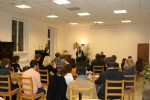
Oasis in the City event at the Lay Centre
Equally reassuring of the man’s Christian heart was his reaction to the fact that the car service that had been arranged to get him to the Lay Centre was 45 minutes late, having left the Archbishop waiting for his ride, without any notice. Any normal person could reasonably expect to be irritated or upset. A typical “VIP” might have just given up and given up on us. More than a couple U.S. hierarchs I have encountered might have thrown a royal fit at such inconvenience. But when the archbishop finally arrived, he got out of the car laughing and waving away Donna’s profuse apologies as if they were not even needed: “These things happen all the time”, he says.

Archbishop Ladaria, Secretary of the Congregation for the Doctrine of the Faith
The bulk of his lecture was on the unsurprising CDF 2008 instruction Dignitas Personae, dealing with a range of bioethical issues including IVF, stem cells, and cloning. It was the questions afterword that brought some of the most interesting comments, including the two quotes above, the first being in response to a question about where to draw the line when someone (such as a politician) does not act or profess a view entirely commensurate with Catholic moral teaching on these complicated issues. Others challenged the Church’s insistence that “human life/personhood begins at conception” from a Thomistic framework which allows for a later development.
My Italian is not good enough to have followed the lecture in its entirety, but the conversation afterword was just as lively. Now if only all of our American hierarchy were as pastoral as this CDF honcho! (Yes, you read that correctly!!)
UPDATE: Didn’t realize the press was here too: http://www.catholic.org/international/international_story.php?id=34844&cb300=vocations
The Roman Classroom, or, Reflections on Methodology and Pedagogy in the Pontifical Roman Universities from an American Catholic Paradigm Typified by L’Universite de Notre Dame du Lac
What is it like studying in Rome? Are the courses challenging? Are the students on par with peers in the U.S.? Is the university academically rigorous? Are the faculty orthodox? How does it compare to [Notre Dame/Seattle University/Catholic University]?
These are the kinds of questions I have had from a number of friends and colleagues, and I thought I would address them together once I had had some time to get a sense of the pedagogy here.
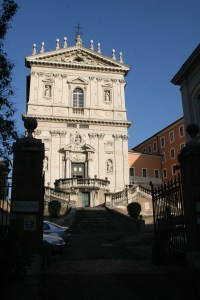
Church of Dominic and Sixtus at the Angelicum University
It is a different system, no question. The first thing to note is the nature of the university. The Universities are really just buildings with classrooms, and very minimal administrative staff. The entirety of the Angelicum – classrooms, offices, chapel, faculty residences, library and bookstore – is about the same size as Hunthausen Hall at SU, Caldwell at CUA, or O’Shaughnessy at ND. This is because the university really only offers the classes, mostly lectures and a small number of seminars. It is assumed that the bulk of your formation actually happens elsewhere, specifically, independent research, formation in community, and the experience of being in Rome.
My specialization does not even use the university library, for example. Instead, we have access to the Centro Pro Unione, run by the Society of the Atonement; that is our library. Sure, it is about a 25 minute walk from the Angelicum, but it’s a walk that passes by the Trevi fountain, the Pantheon, Piazza Navona and some of the most famous gellateria in the city, so one cannot complain. Moreover, there is a lot of time for research, so once I settle on an idea, I will not be bogged down by unwanted topics in order to pursue it.
The presumption of the university is that its students live in a house of formation, one of the “colleges” around Rome – and these are operated entirely separately from the universities. The problem is, of course, that only about 70% of students have access to one of these colleges as they are usually established either by national bishops’ conferences exclusively for priests and seminarians, or by religious communities for their own members. That leaves a significant number of students – deacons, lay ecclesial ministers, non-ecclesial lay students and non-Catholics – without an essential part of their education in Rome. The Lay Centre is the only such college trying to meet this need, and it is a private venture. It is also limited in space, with only room for about 20 residents out of the hundreds needing such a place. (Though get the impression the quality of life and of formation here exceeds what can be found in many of the national colleges for seminarians and priests!)
Further, I think the course load is intentionally light, though it does not appear this way at first. It is normal to be registered for about 8 or 9 courses a semester, one of which is a seminar. Whereas the typical 3-credit course in the States meets for 3 hours in two or three classes a week, here we get 90 minutes, once a week – about half as much time. The reading load is considerably less, too, if you just look at the syllabi. Two of my courses have only one required text of about 200 pages each, for the entire semester. The rest rely entirely on lecture notes. I have a total of 30 pages of writing due this semester, and most final exams are oral rather than written. (I am remembering my first semester sophomore year at ND, over 100 pages on 60 different topics, not counting finals!)
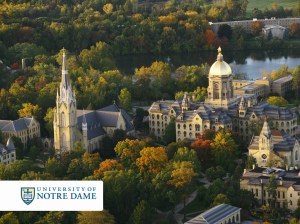
Sacred Heart Basilica and Main Building, University of Notre Dame
The difference between being located in South Bend, IN and in Roma cannot be overstated, though. It is easy to take on a thousand pages of reading a week at ND when there is nothing to do otherwise anyway. Here, if you want to learn about early Christianity or the history of the papacy, go for a walk. San Giovanni in Laterano is ten minutes from here. San Clemente is even closer. The Vatican is a few metro stops away. Just in the last week, we have had dinner with two of the three Catholic representatives on the reconciliation talks with the Lefebvrite schismatics (Archbishop Ladaria and Charles Morerod, OP). The week after the press release about the Anglican personal Ordinariates, we got to talk with two different members of the Pontifical Council for Christian Unity. Then, of course, the discussions had over dinner and caffé more than make up for the pedantic lecture style in some of the classrooms.
It is important to note the international character here too. Granted, ND and CUA were both pretty international, but I think this is the most mixed place I have ever been. I am frequently the only native English speaker in a class, or one of two. It seems to be a good representation of the Church in general: lots of representation from Africa, southeast Asia, India, and Eastern Europe. (Some from Latin and South America, but most of them seem to go to the Gregorianum rather than the Angelicum). This probably makes lecture rather than group discussion in class more feasible, and accounts for what seems like a slow pace.
Shopping for Roman collars
Everyone in Rome has a uniform and a title; and that’s if you are a nobody. If you are important, you also have a stamp, a wax seal, and most likely a signet ring. Perhaps this is why electronic means of communicating, providing identification, registering for classes, paying bills, and the like are so difficult and considered downright foreign here. I’ve gone through i don’t know how many hard-copy pictures of myself, and every correspondence to everyone needs to be an original letter, signed, co-signed and countersigned, then stamped in duplicate or triplicate.
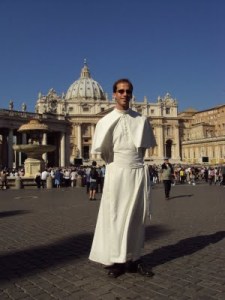
Norbertine Habit
But back to the uniforms: One of the many blessings of being in Rome is seeing the life of the church in all its profound diversity. You cannot maintain the illusion of a monolithic Catholicism very long in this capital of the church. I’ve seen habits for orders i had heard of but never met: Norbertines, for example, dress in a white simar and fascia looking almost identical to the pope. Then there are those i did not even know existed: the Teutonic knights, apparently, are back as a diocesan order, and looking very medieval.
Even most of the lay people around here are in ecclesiastical garb, particularly seminarians and lay religious, even during classes. So, naturally, I am on a mission to discover the appropriate ecclesiastical garb for a lay ecclesial minister. After all, if a student candidate for ministry gets a uniform, so too should someone already in sacred ministry, no?
(The current favored title is “Almost Reverend…”, or “Your Mediocreness”, and the garb is a white or black dress shirt with banded collar, though I am open to suggestions. But, I digress.)
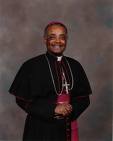
Archbishop Wilton D. Gregory
Allora… I decided to peruse the ecclesiastical shopping district near the Pantheon with Stian, an Anglican seminarian and friend of mine who shares that you can get four clerical shirts in Rome for the price of one in Norway.
We picked up a couple new friends on the way, Matthew, from Australia, and Cosima, from Germany. While Stian was being fitted for his clericals, the rest of us were perusing the mitres, zucchetti, and birettas that seemed to be available over the counter.
Did you know that with an ecclesiastical doctorate one is entitled to wear a biretta with the appropriate color trimming? For theology, it’s scarlet; canon law is green, etc.
As we were about to leave in search of a pizzeria and gellateria, America’s lone representative to the Synod for Africa, Archbishop Wilton Gregory of Atlanta, walked in for some shopping of his own. He was kind enough to stop for a brief chat about the Synod, and exchange a warm greeting before we moved on for pizza and gelato. At least now we know we were in the right shop!
Life Together
My spiritual reading this Sunday was Dietrich Bonhoeffer’s Life Together: A Discussion of Christian Fellowship. It was mentioned by our Augustinian guest last week, Father Bob Guessetto, as the source of the famous quote that “the person who loves his dream of community more than the Christian community itself becomes a destroyer of the latter, even though his personal intentions may be ever so honest and earnest and sacrificial.”
Bonhoeffer, a Lutheran pastor and theologian, was a martyr of the Nazis at Flossenburg in April 1945, only a couple months before Allied victory in Europe. Prior to his capture in 1943, he was active in the Confessing Church and the German resistance, teaching in an underground seminary (like the one Karol Wojtyla attended in Poland) and ministering to the Germans who fought against Hitler’s regime.
His discussion is only about 120 pages, touching on the themes of the community itself, the day with others, the day alone, ministry in the community, confession and communion. Leave it to a Lutheran to give one of the most eloquent descriptions and defenses of confession I have ever read! (Luther, as you probably know, was a devoted participant in the sacrament of Reconciliation, originally keeping it along with Baptism and Eucharist as truly sacraments).
He highlights the aspects/gifts of ministry in community as The Ministry of Holding One’s Tongue, The Ministry of Meekness, The Ministry of Listening, The Ministry of Helpfulness, The Ministry of Bearing, The Ministry of Proclaiming, and the Ministry of Authority.
The book is definitely worth a read, for anyone living in Christian community (including family life!) or serving in ministry. I thought I’d share a few nuggets worth expropriating:
“First, Christian community is not an ideal, but a divine reality. Second, Christian community is a spiritual and not a psychic reality.”
“Life together under the Word will remain sound and healthy only where it does not form itself intoa movement, and order, a society, but rather where it understands itself as being a part of the one, holy, catholic, Christian Church, where it shares actively and passively in the sufferings and struggles and promise of the whole church”
“It is not the experience of Christian community, but solid and certain faith in community that holds us together. … We are bound together by faith, not by experience. … for Jesus Christ alone is our unity”
“Listening can be a greater service than speaking. He who can no longer listen to his brother will soon be no longer listening to God either; he will be doing nothing but prattle in the presence of God too.”
“The day of the Lord’s Supper is an occasion of joy for the Christian community. Reconciled in their hearts with God and the brethren, the congregation receives the gift of the body and blood of Jesus Christ, and receiving that, received forgiveness, new life and salvation. … The fellowship of the Lord’s Supper is the superlative fulfillment of Christian fellowship. … Here the community has reached its goal. Here joy in Christ and his community is complete. The life of Christians together under the Word has reached its perfection in the sacrament.”
Philo of Alexandria
Today, I completed my first course at the Angelicum, exam and all. Granted, it’s only a credit and a half, but not bad for the first week of classes.
It has been 12 years since David Burrell’s survey of Ancient and Medieval Philosophy, so I’m a bit rusty when it comes to middle-Platonist Jewish philosophers. Thankfully, there’s really only one.
Philo of Alexandria is a fascinating person. In attempting to synthesize his Jewish faith with the Greek philosophy in which he was proficient, he had a remarkable influence on the early Church Fathers – and virtually none on Judaism until the late medieval era. He was a Hellenized Jew in Alexandria, of nearly the last generation of Ancient Judaism, before the destruction of the Temple and the birth of both Christianity and Rabbinical Judaism from the ashes.
Twenty-five years older than Jesus, and dying just a few years after Christ, his work probably even influenced some of the Gospels. John’s prologue owes at least a little to the concept of the Word (the Logos) present in Philo. He even has a type of Trinity – though not completely – of God, Logos, and Powers. With Philo, the transcendent, inscrutable God is knowable only through the Son (the Logos), and the dynamies/powers of mercy and justice. “You can only come to the Father through the Son” sound familiar?
He’s also known for his allegorical interpretation of scripture, especially Genesis and the creation story, wherein man=our mental capacity and spiritual self, and woman=our sensory capacity and physical self, so that when man and woman cleave together to become one flesh, it really does mean one person – combining our intellect and sense-perception, our spiritual and our material aspects, to be the human-kind we know.
Probably one of his biggest contributions is in the uniting of the religious side of Platonism with Biblical faith, bringing the idea of a totally transcendent “unmoved mover” into the same conversation as the very personal and immanent God of the Hebrew Scriptures. Totaliter aliter and Emmanuel, all in one divine bundle.
No wonder it feels like all the great ideas have already been thought!
 The Ecumenism Blog