
Home » Posts tagged 'Rome' (Page 14)
Tag Archives: Rome
Basilica Santa Maria in Domnica
Besides the Lay Centre’s own chapel, the closest church is actually the Basilica of Saints John and Paul of the Cross, attached to the Passionist Monastery that is our landlord. However, given the geography and the means of getting around the property, it is actually closer to go to the local parish church, the Basilica of Santa Maria in Domnica, also known as Santa Maria della Navicella.

Basilica Santa Maria della Navicella
First, a little perspective is in order. Growing up in rural North Bend, WA about 30 miles east of Seattle, the nearest parish was a 15 minute drive away, in neighboring Snoqualmie.
Within a 15 minute walk from the Lay Centre, there are about a dozen churches, including the Cathedral Archbasilica of San Giovanni Laterano, the ancient San Clemente, one of Rome’s three circular churches, San Stefano Rotondo, and a chapel for the Missionaries of Charity. I am still making my rounds!
The parish church derives its dual names from different features of and around the basilica. In front of the church is a marble statue of a small ship (navicella), turned into a fountain by Leo X in the early 16th century as a replica of the original, which had been there ‘since time immemorial’. The official name of Domnica is variously attributed, either in reference to the church as a “house of the Lord” or to the name of a wealthy patroness who lived in the area whose name translated also meant “of the Lord”.
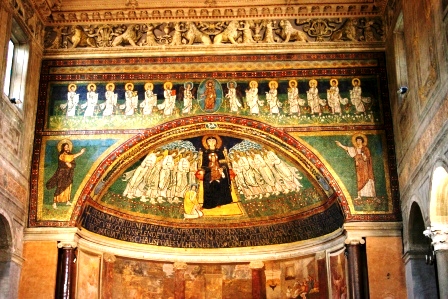
Mosaic at St. Maria in Domnica
Originally built somewhere between the 4th and 7th century on the ruins of a military barracks, it was renovated by Pope Pascal I in the early 9th century, and it was again refurbished by Pope Leo X in the 16th century. Pope Pascal was also connected to the Basilica Santa Prassede, which I mentioned a few weeks ago, also known for its beautiful mosaics, including that of Pascal’s mother, Episcopa Theodora. In Santa Maria Domnica, the mosaic represents an icon of the Theotokos and Christ child, correctly situated in the center rather than at his mother’s side, flanked by saints and angels. Pope Pascal is seen at Mary’s feet, with the square halo indicating he was still alive when the mosaic was completed.
The cardinal-titular of the church is William Cardinal Levada, prefect of the Congregation for the Doctrine of the Faith and former Archbishop of Portland and of San Francisco (and before than an auxiliary under Cardinal Mahony in LA). The basilica also serves as a parish center for the lay movement, Comunione e Liberazione (Communion and Liberation).
Communion and Liberation is one of the many lay ecclesial movements that have been popular in the Italian church and elsewhere in the last 40-50 years. While lay ecclesial ministry developed along the same timeline in northern Europe and North America, these lay ecclesial movements took precedence in Italy and in many of the Latin countries. CL traces its origins to the thought and ministry of an Italian priest Luigi Giussani dating back to the mid-50s, but the movement itself has its identifiable beginning with to a small group of Giussani’s students in 1969. The model is less of definite membership than in attendance in weekly catechetical meetings known as the “School of Community”. Estimates are of about 100,000 attending regularly in Italy, and there is a presence in almost 80 other countries, though nowhere as strong as here in Italy.
For both the feast of the Immaculate Conception, today, and the celebration of the Second Sunday of Advent I joined a group of my housemates from the Lay Centre in participating in the liturgy here. I just did not feel like braving the rain and the Roman crowds (and pickpockets) to make it to the Piazza Spagna for the Papal event there. Maybe next year!
Snow
You may have noticed the light dusting of snow falling on the blog. It hardly feels like December without it, and i was sitting on the terrace this weekend in only a T-shirt soaking up the sun, so i do not anticipate seeing the real thing while in Rome. I thought it was nice of wordpress to offer a taste of winter for those of us in more tropical climes!
My courses…
Allora… people have asked, and I keep forgetting to answer. This is my fall semester lineup:
The Catholic Church in Ecumenical Dialogue
Rev. Dr. Frederick Bliss, SM, Professor incaricatus from New Zealand
Hebrew Bible, Human Rights, and Interreligious Dialogue
Rabbi Jack Bemporad, visiting professor from the Center for Interreligious Studies, USA
Knowing the Christian East: Encounter and Experience
Rev. Dr. Joseph Ellul, OP, professor incaricatus from Malta
Methodism and its Dialogue with the Catholic Church
Rev. Dr. Trevor Hoggard, Methodist Representative to the Holy See, from U.K.
Monsignor Donald Bolen, former staff of Pontifical Council for Promoting Christian Unity, from U.K.
Philo of Alexandria and his Influence on Early Christianity
Dr. Adam Afterman, visiting professor from Hebrew University, Jerusalem
Prophecy and Wisdom
Rabbi Jack Bemporad, visiting professor from the Center for Interreligious Studies, USA
Reception and Receptive Ecumenism
Rev. Dr. Frederick Bliss, SM, Professor incaricatus from New Zealand
Russell Berrie Fellowship Seminar in Jerusalem (Feb 5-13)
Various lecturers, coordinator: Dr. Adam Afterman of Shalom Hartman Center and Hebrew University
Social Teaching in Pope John Paul II
Various Lecturers, coordinator: Sr. Dr. Helen Alford, OP, Dean of the faculty of Social Sciences, from U.K.
Sociologia della Conoscenza (Sociology of Knowledge, in Italian)
Dr. Bennie Callebaut, visiting professor from Katholieke Universiteit Leuven, Belgium
St. Nicholas Sunset
Views from the Lay Centre, 6 December 2009, Feast of St. Nicholas.


Hebrew Bible, Human Rights, and Interreligious Dialogue
The second Oasis in the City event hosted at the Lay Centre this year featured a presentation by Rabbi Jack Bemporad on the topic The Hebrew Bible, Human Rights, and Interreligious Dialogue. Among his 30 years of experience in international interreligious work, Rabbi Bemporad is the founder and director of the Center for Interreligious Understanding in Englewood, NJ, and has been a visiting professor of Interreligious Dialogue at the Pontifical Angelicum University for 13 years. He has been invited by the Holy See to speak on matters of Jewish-Catholic relations, and met on several occasions with Pope John Paul II personally.
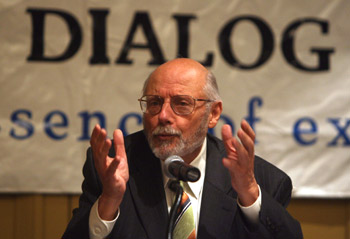
Rabbi Jack Bemporad
During his comments to the Lay Centre residents and community guests, one of the points Rabbi Bemporad raised was the tremendous work of the Catholic Church through Vatican II and especially the efforts of Pope John Paul II with respect to the Jewish community and the relationship of the two religions. Despite the wealth of documents from the Church, he said, especially the USCCB document, God’s Mercy Endures Forever: Guidelines on the Presentation on Jews and Judaism in Catholic Preaching, the international Jewish community has yet to examine its own long-standing description of Christ and Christianity at the same level.
The Hebrew Bible is primarily an account of monotheism directed at those who are not yet monotheists. Further, the revelation of monotheism is integral and necessary for a truly peaceful vision of the world and for the development of the concept of human rights.
“One God implies the possibility of a world of peace and justice. As long as there exists the battle between the gods and the plurality of gods as embodying separate forces of nature, then there is no sense of a world at peace. One God implies one world and one universal goal of justice and peace embodying the greatest possible realization for each individual.”
Six key themes or aspects of the Biblical message highlight the origination of human rights in the Hebrew Bible:
Equality in the Bible does not refer primarily to those of the same rank or class, but indicates a positive action of bringing up those who are weaker than oneself (widow, orphan, stranger, the poor and the slave).
The holy and ethical are inseparable. The prophetic tradition, with Amos as the first clear example, claim that social injustice –not simply idolatry or non-orthodox worship – will bring about national ruination. The value and destiny of a nation is dependent on how it treats its most vulnerable members. This social concern for the vulnerable can be traced back to Israel’s enslavement in Egypt.
The Biblical condern for the stranger and sojourner is essential. Love your fellow human being – not “as yourself” as is often translated – but “because he is like you”. There is but one law for you and for the stranger – a concept still foreign to most nations today!
Sabbath as an institution, which allows even the slave and the stranger to rest and be master of their own time for at least one day a week. By extension, the sabbatical year and the Jubilee year remind us that we are not owners of the land or of property, but stewards only. Poverty and wealth alike are only temporary.
A king is subservient to the law, not the law unto himself. The messianic king will be unlike all other kings, rather than to make war, he will make peace.
Finally, two elements that separate Judaism from the black-and-white view of “our religion is the true one, and all others are totally false and therefore evil”: First, the establishment of the Noachide as a status that taught that one did not have to be an Israelite to be saved. Second, the Tosephta enunciated that “the righteous of all nations have a place in the world to come” an idea now nearly universally accepted in Judaism.
The questions of interreligious dialogue, and our common work in support of human rights, remain: “How can I be true to my faith without being false to yours?” and “What is the place of the other religions I our own self-understanding?”
In the States, according to Rabbi Bemporad, it was the civil rights movement that joined Jews and various Christians to working together, and so we must continue to dialogue to discover the “common moral and ethical elements that are constitutive of our religions and try to unite on a common ethic independent of our theological perspectives.”
Saint Andrew the Protoclete
Andrew was the first Apostle of Our Lord, first having been a disciple of John the Baptizer. Sometimes, for some reason, my fellow western Christians forget this and refer to Peter as the first. Peter would have died an anonymous Galilean fisherman if not for his brother, Andrew, who brought him to the Christ.
One of the early successors to Peter and Paul decided to settle the question of when the church year should begin by determining that the first Sunday of Advent, and therefore the first Sunday of the ecclesiastical year, should be that Sunday nearest the feast of the first Apostle. Before that, advent was celebrated in local churches as anywhere from three days to six weeks.
My patron and namesake is also patron of Greece, Russia, Scotland, and Romania, as well as the apostolic founder and patron of the Holy See of Constantinople and the Ecumenical Patriarchate.
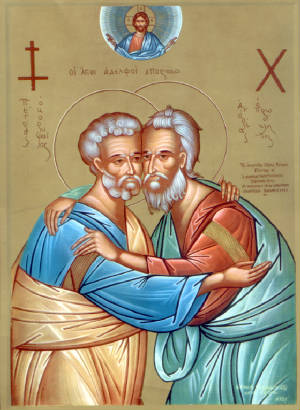
Icon of the Holy Brother Apostles, Peter and Andrew
One of my favorite icons is of the brothers Andrew and Peter embracing. This Icon of the Holy Brother Apostles was written for the 1964 meeting of Patriarch Athenagoras I and Pope Paul VI, a gift from the Successor of Andrew to the Successor of Peter, as a sign of the fraternal relationship of the two churches (also called “sister churches”). A copy of this icon was given to me for my service on the National Planning Committee of the NWCU by then-chairman Allen Johnson.
While much of the western ecumenical world was caught up in the announcement by the Congregation for the Doctrine of the Faith about the Anglican-Catholic personal Ordinariates in October, Cardinal Kasper joined Metropolitan Zizioulas and other representatives of the Catholic and Orthodox Churches on Cyprus for the 11th plenary round of the Joint International Commission for Theological Dialogue. The topic of this round of conversation is “The Role of the Bishop of Rome in the Communion of the Church in the First Millennium”.
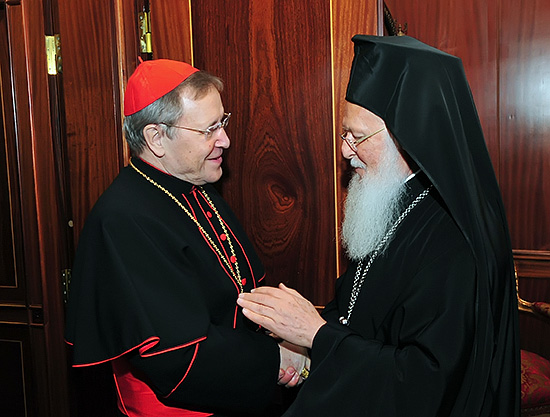
His All Holiness Bartholomew I greets His Eminence Walter Kasper
In honor of the feast of Andrew, the Holy Father sends a personal message and a high-ranking delegation to the Patriarch of Constantinople; a return delegation is sent to the See of Rome to honor the patronal feast of Sts. Peter and Paul every June 29. This year’s address indicated signs of hope for the ongoing dialogue and the central questions to our restored unity – the role and relationship of the universal primacy of Rome and the other major Patriarchates, and the local churches.
The Holy Father’s message to Patriarch Bartholomew for the feast of St. Andrew today highlighted this work as a sign of the growing unity of the churches, and acknowledged the many areas for cooperation even as we are still on the journey to full unity.
Patriarch Bartholomew’s message of welcome to the Roman delegation likewise highlighted the work of the Commission, now tackling some of the most fundamental ecclesiological issues which remain to divide us, namely, primacy in general and that of Rome in particular.
“We are, therefore, convinced that the study of Church history during the first millennium, at least with regard to this matter, will also provide the touchstone for the further evaluation of later developments during the second millennium, which unfortunately led our Churches to greater estrangement and intensified our division.”
He also called attention to the slow progress being made toward the calling of a Great Council of the entire Orthodox world, an event which has not happened in centuries, and which would be akin to an Orthodox Vatican II.
Dinner, the Roman way.
We walked to the ristorante, got there at 10:15pm.
Red house wine, acqua (still), and pizzas, which arrived at almost 11:00.
Ordered dessert at 12:00 midnight. Some kind of delicious strawberries and creme with hot drizzled chocolate and cocoa.
Going to bed at 1:30am, listening to the discotech music coming from around the Colloseum (ah, to be young!).
Post-script: Fireworks at 1:50am, right outside my window. Literally, between here and il Colosseo.
Skeletons, saints, and scandalous ecstasy
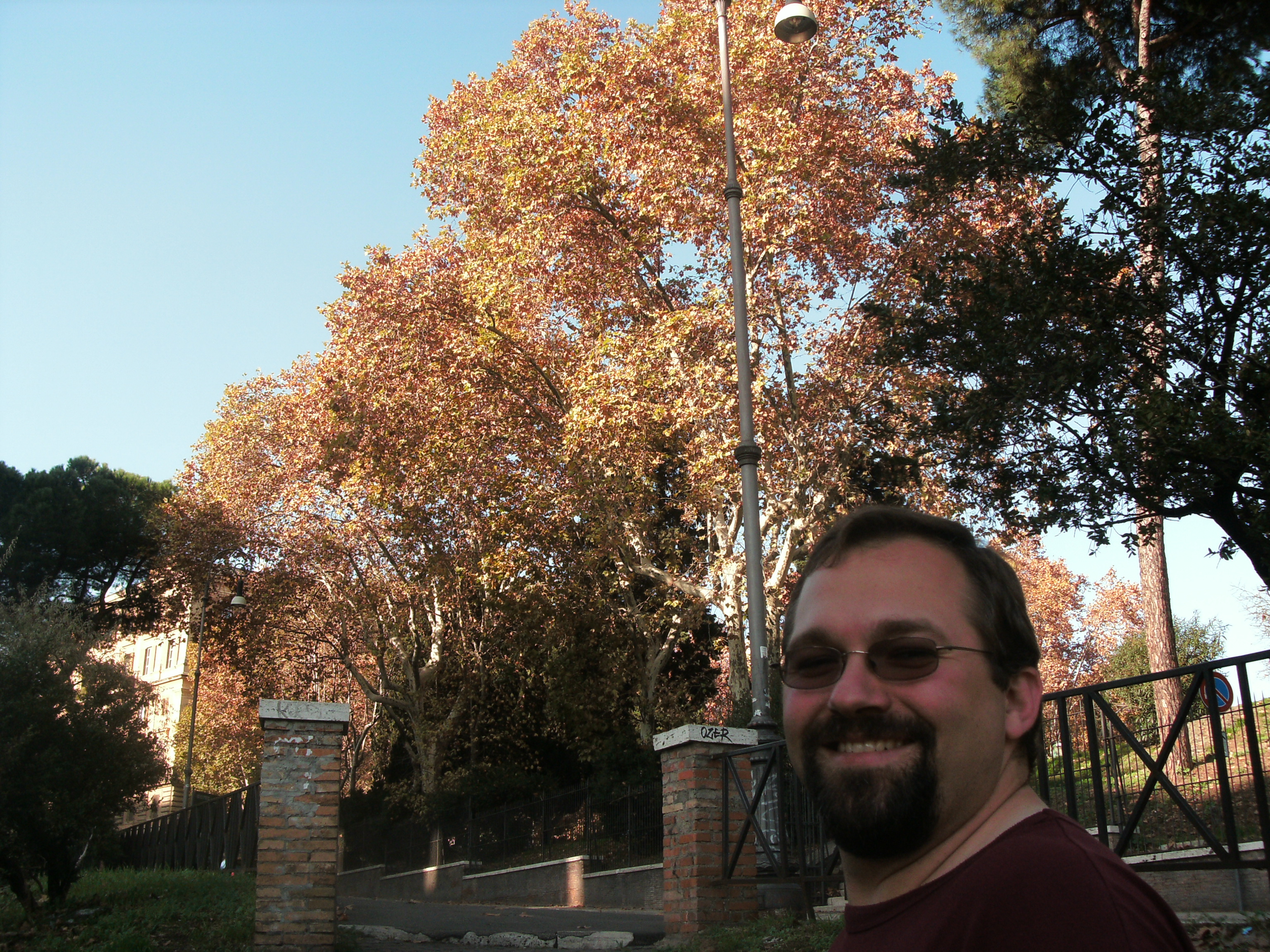
Enjoying the Roman folliage
An unexpectedly beautiful Saturday afternoon today in Rome. There was nothing to be done but go for an afternoon passagata around to some of the better-known churches in Rome.
Just across the street from Santa Susanna is Santa Maria della Vittoria, best known for Bernini’s sculpture of St. Teresa in Ecstasy, which he completed in 1652. The church itself is quintessential Baroque, overwhelming the senses. Built as a chapel for the Carmelites, it is currently the titular church of Cardinal Sean O’Malley of Boston.
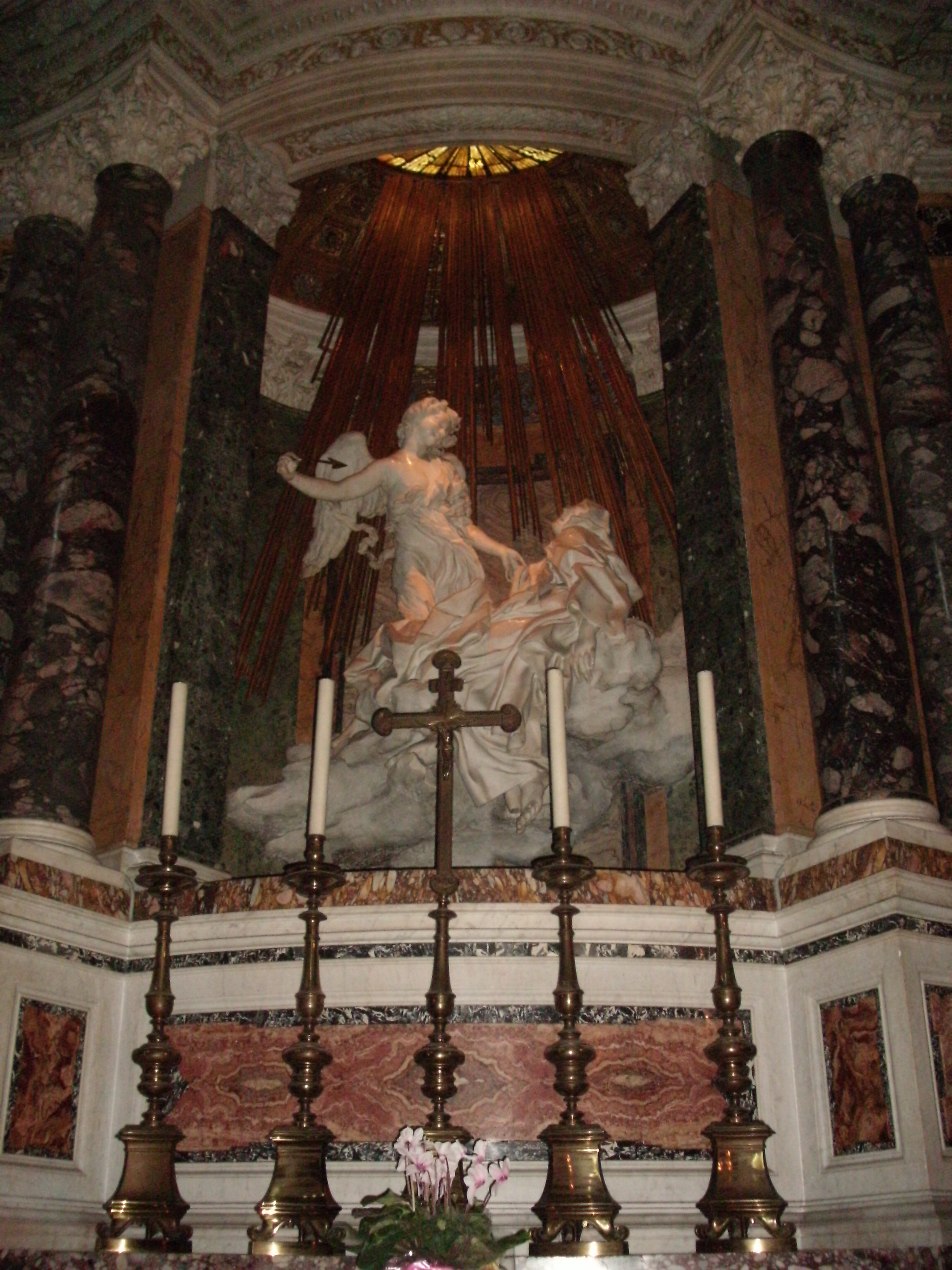
St. Teresa in Ecstasy, Chiesa Santa Maria della Vittoria
We also wanted to go in for a more casual perusal of Santa Susanna, but it was closed for the day. Likewise, San Pietro in Vincoli (Saint Peter in Chains) which we stopped at on our way from the Lay Centre. It is easy to forget about that three hour lunch break sometimes.
Not far from Susanna and Maria della Vittoria, on the pricey Via Veneto, is the church of Santa Maria della Concezione dei Cappuccini (St. Mary of the Conception of the Capuchins), the ossuary of which is generally known as the Capuchin Crypt. Famously macabre, the crypt is six rooms decorated almost entirely with the mortal remains of about 4000 Capuchin friars who died between the 16th and 19th century.
Capuchin Crypt
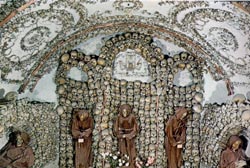
- Cappuchin Crypt
“What you are now we used to be; what we are now you will be…”
An American Thanksgiving in Rome
When I was studying in the states, at Notre Dame and Catholic University, Thanksgiving was a welcome calm before the storm, a few days to catch one’s breath before the final push toward final exams. Here, the semester is just nearing mid-term, and of course it is not an Italian holiday. I did notice that none of the NAC residents came to class today: The North American College, the residence for diocesan seminarians and priests from the states, had their big Thanksgiving feast for lunch.
Our director, Professora Donna Orsuto and our chef, Feda, spent all day preparing a traditional Thanksgiving feast for the residents and about 25 guests. We had invited classmates and other ‘homeless’ Americans to join us. Two gorgeous roast turkeys, mashed potatoes and gravy, corn and green beans, stuffing, and even pumpkin pie. I was appropriately stuffed. We’re pretty well fed, and Feda does a great job with the Italian fare every night, but for the visitors who were used to living on their own in Rome I think getting a taste of home was truly appreciated.
It is always a nice surprise when a member of the community shares a gift that you did not know they had. The other American students in the house are a married couple, Greg and Karina, from Chicago and Houston, respectively. Karina closed our feast with a soulful rendition of Amazing Grace in a beautiful voice. You could hear a pin drop. There is much to be thankful for, being in Rome in such a community, but moments like that highlight the gifts God gives in a special way.
Happy Thanksgiving from across the pond! May you be blessed with bounty, faith, and friendship!
Centro Pro Unione
We had our first meeting of the ecumenical section tonight, in the famous Centro Pro Unione.

Palazzo Doria Pamphilj at Piazza Navona
At the Angelicum, there are four ‘Faculties’: Theology, Philosophy, Social Sciences, and Canon Law. The Theology Faculty, being by far the largest, is further divided into sections: Biblical Theology, Dogmatic Theology, Thomist Theology, Spiritual Theology, Moral Theology, and Ecumenical Theology.
By reputation, at least, the two pillars of the Angelicum are its Thomist and Ecumenical sections. Part of the reason I decided to study here, in fact, is that it is the only specifically ecumenical licentiate/doctoral program offered by a Catholic university, and one of only three in the English speaking world (the others being at the Ecumenical Institute of the WCC at Bossey, Switzerland and the Irish School of Ecumenics in Dublin).
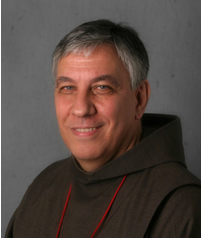
James Puglisi, SA, Director of Centro Pro Unione
The ecumenical section is coordinated by James Puglisi, SA, the Minister General of the Franciscian Friars of the Atonement and director of the Centro Pro Unione. The Centro serves as the library for the ecumenical section, being the most complete ecumenical library in the world since its inception in 1962. It is located in the Collegium Innocenzium, part of the Palazzo Doria Pamphilj overlooking Piazza Navona. Originally the guest house for the family, part of it then became a house of hospitality named Foyer Unitas, run by the Ladies of Bethany, and the rest a place for the ecumenical observers at Vatican II to gather, named the Centro Pro Unione.
The main meeting room is therefore steeped in history, both Roman and ecumenical. As the guest house of the noble family, this room is where Vivaldi first performed his “four seasons” after the premier in Florence. Franz List and Caruso played here, and so many others. During Vatican II, this room, with a grand view of the Piazza and its fountain, is where the ecumenical observers would gather with bishops and peritii for their weekly briefing, and where some of the most important texts of the council were born or developed: Gaudium et Spes, Unitatis Redintegratio, Nostra Aetate, and Dignitatis Humanae.
There were 21 members of the section present or accounted for, and I am not sure how many others there may be. Six are from Africa, four from India, three each from the Philippines, Eastern Europe, and North America, one Italian and one Australian. One-third are lay, and two-thirds are priests; no religious and no deacons. There is currently only one woman (and she is technically in Philosophy, not Theology, but as a Russell Berrie Fellow is included in the section too).
 The Ecumenism Blog