
Home » Posts tagged 'Pope Benedict XVI' (Page 4)
Tag Archives: Pope Benedict XVI
St. André Bessette and company
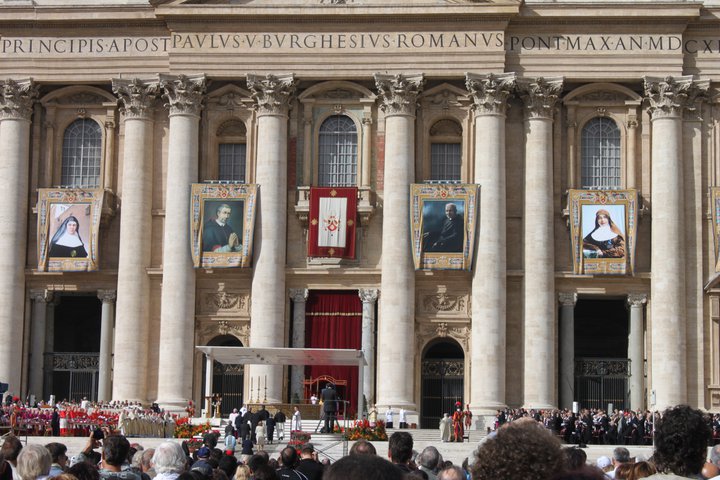
Saints banners on St. Peter's
Six new saints were declared by Pope Benedict XVI during the weekend of 17 October, but one in particular stands out. Brother Andre Bessetté, CSC has been a familiar name to me since Notre Dame, and his story I had known something about even before then. In fact, throughout my four years of service on the altar at the Basilica of the Sacred Heart, the Litany of Saints always concluded with a robust “Blessed Brother André… Pray for Us!”
Those years of prayer are ‘paid off’ today, in the official recognition of the Congregation of Holy Cross’ first saint – though rumour is the cause of CSC founder, Father Basil Moreau may be ready as early as 2012. Brother Andre is also the first native-born male saint of North America, having been born and raised in Canada.
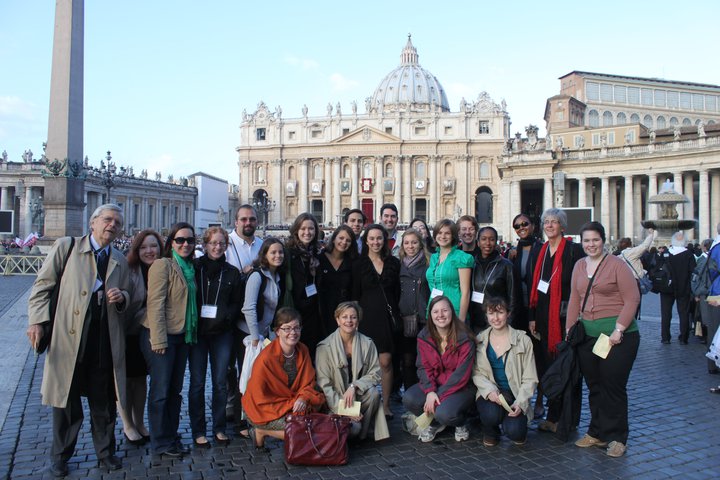
Notre Dame pilgrims for canonizations
He was a simple porter, a door-keeper, not educated enough for presbyteral ordination, but a man gifted with healing and a particular devotion to St. Joseph in a time when Marian piety defined Catholic spirituality. One man’s simple prayer to see a small shrine to Our Lord’s earthly father near the school where he served lead eventually to the impressive St. Joseph Oratory of Mount Royal, in Montreal, Quebec. The oratory offers a biography of the new saint here.
A delegation of Holy Cross brothers and priests, Notre Dame students, alumni, and faculty converged on Rome along with thousands of Canadians and others devoted to Brother André. About two dozen of us participated in a program offered by ND’s Center for Social Concerns. On the eve of the canonization day, these pilgrims filled the church of St. Andrea della Valle to standing-room capacity, about five thousand by estimates I have seen.
One of the Domer alumns from the states was my friend and classmate Julie Fritsch, who i literally picked up from Leonardo DaVinci airport as i dropped off Simone. From pro-life marches in D.C. to canonizations in Rome, it is nice to know you can share the journey with friends over the course of decades!
We got to participate in the vigil at Sant’Andrea della Valle, the canonization mass at St. Peter’s, the premier of Salt and Light’s documentary of his life, “God’s Doorkeeper”, and a presentation by ND Professor Kathleen Sprows Cummings on the process of canonization.
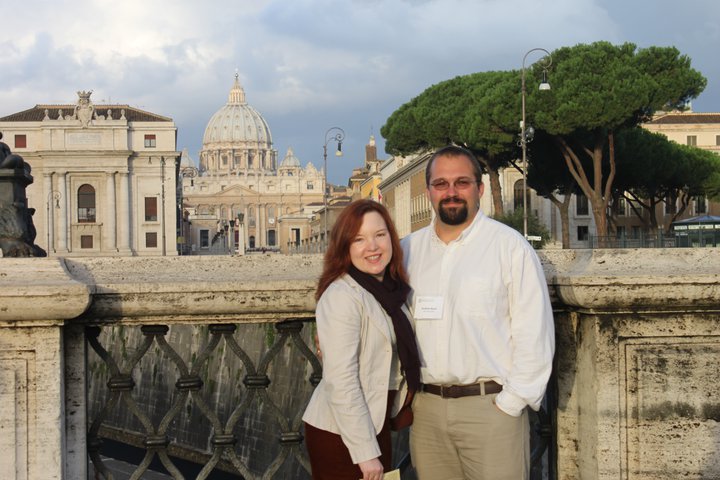
Julie and I on Ponte Sant'Angelo
Leading up to the weekend, the only names of the soon-to-be saints i knew were Brother André and Australia’s first saint, Sr. Mary MacKillop, founder of an order of women religious and contemporary of St. André. The program on the morning of the liturgy described the six thus: One priest (Stanisław Kazimierczyk, Polish, 15th cent.), one religious (Br. Andre), and four “virgins”. IN addition to Mary MacKillop, there were two Italian sisters Giulia Salzano and Camilla Battista da Varano and Spanish nun Candida Maria of Jesus.
Why the four women were not identified as religious, as sisters, or even the three as founders of orders, i do not know. While chaste virginity can be holy (as can chaste marriage or celibacy) it seems to mischaracterize their vocations. After all, none were consecrated virgins, so much as religious and founders. Giulia and Candida were educators and catechists, Camilla was a princess turned nun, an example of the wealthy giving up materialism for service to the poor. Mary has been championed by some as an example for those persecuted by ecclesiastical authority for remaining true to the Gospel rather than “obedience” to abusive leaders.
Four of the six were all born in the 1840’s: André, Mary, Giulia and Candida. The other two were born mid-15th century.
Feast of Sts. Peter and Paul
It is appropriate that my last full day in Rome for this year should be the patronal feast of the city.
The idea of tourists coming to Rome to see the Pope is a modern phenomenon. For centuries, pilgrims came to Rome primarily to pray at the tombs of the two great martyr-saints who are honored as the “co-founders” of the Church of Rome, even though Christians were certainly present in the city before either Apostle arrived: Sts. Peter and Paul.
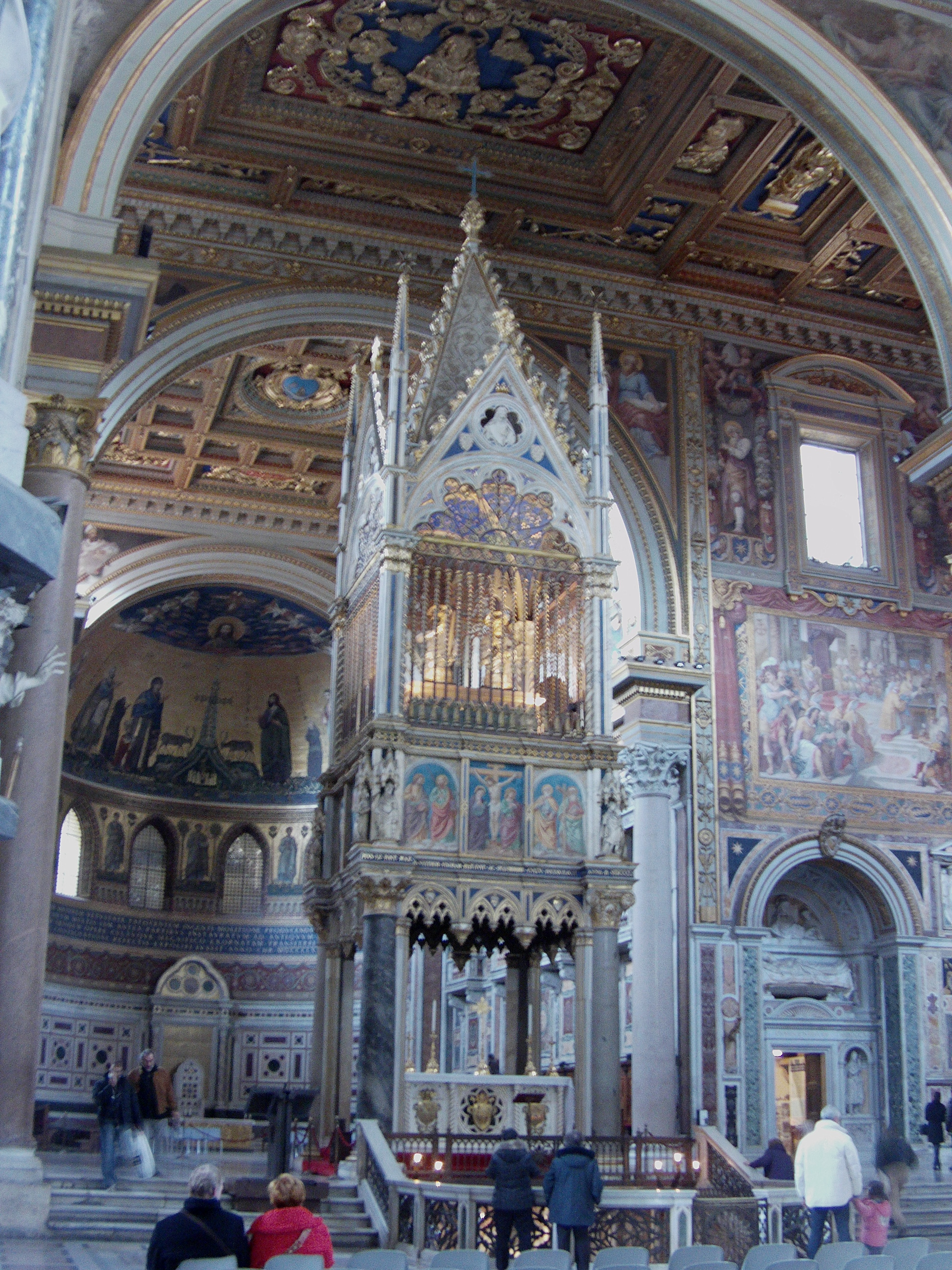
Relics of Sts. Peter and Paul above Papal Altar at San Giovanni Laterano
Throughout the Eternal City, you will see both saints together. On the Piazza in front of St. Peter’s Basilica, you see two giant statues, Peter on the left and Paul on the right. Atop the baldachino over the papal altar in Rome’s Cathedral-Basilica, St. John Lateran, two gold reliquaries house purported relics of each of the saints. The oldest known depiction of either saint is a depiction of both, at the catacombs of St. Thecla.
If you want to see the famous mosaics of the bishops of Rome, from Peter to Benedict, you go not to the Vatican Basilica, but to St. Paul’s Outside the Walls, which from the 4th to the 16th centuries was the largest church in Rome, until the new St. Peter’s was built. The “Successors of Peter” were honored at the Tomb of Paul. No wonder ecclesiologists point out the pope is better named “Successor of Peter and Paul” – if they are not too busy pointing out that neither Peter nor Paul were bishops of the city in the modern sense, but that is another debate.
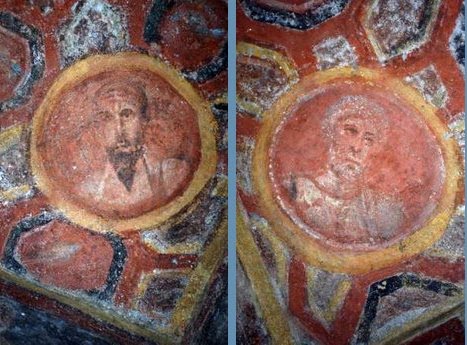
Recently discovered images of Paul (left) and Peter (right), oldest known
Since the beginning of the dialogue between Orthodox and Catholic, one of the traditional signs of fraternity is the exchange of delegations on the feast days of the two Apostolic Sees. Rome sends a delegation to Constantinople on the Feast of St. Andrew, November 30, and Constantinople returns the delegation on the Feast of Sts. Peter and Paul. Metropolitan Gennadios of Sassima lead the group this year, and was the only person to receive the Sign of Peace from the Pope during the morning’s liturgy. In addressing the delegation, Pope Benedict spoke strongly and favorable of the progress toward unity being made in Catholic-Orthodox dialogue, and praised the Patriarch’s recent encyclical on ecumenism (a short read I strongly recommend to all). http://www.patriarchate.org/documents/sunday-orthodoxy-2010
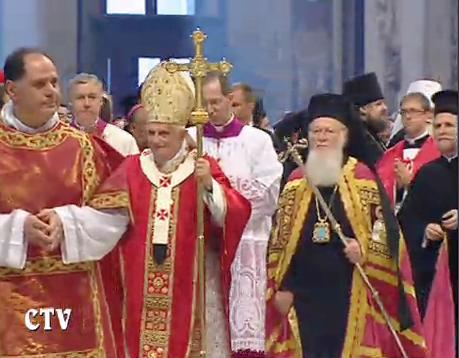
Pallium Mass 2008 - Patriarch Bartholomew and Pope Benedict, the later wearing an adaptation of the pallium
This celebration also serves as the “Pallium Mass” when the (Catholic) Metropolitan Archbishops appointed within the last year come to Rome to receive the symbol of their office. Made from wool shorn of sheep blessed on the Feast of St. Agnes, the pallium is one of the oldest liturgical vestments, having changed size and function over the centuries but remaining in use throughout. The tradition of metropolitans coming to Rome to receive the pallium is recent, however, dating only from 1984. Prior to this they were vested in their own cathedral at the time of their installation as Metropolitan. However, it serves as a powerful symbol of the communion of the bishop of Rome with the archbishops throughout the world.

Metropolitan Gennaidos of Sassima, 2010 delegate of the Patriarch of Constantinople to Rome on the occassion of the Patronal Feast of Sts. Peter and Paul
The unity of the Church is the clear theme of the day– the pallium celebrating the existing full communion between Rome and the churches represented by the new metropolitan Archbishops, and the kiss of peace and exchange with the Orthodox delegation celebrating the impaired communion with the Orthodox Church in hope for full communion in the near future. Appropriate that the city that sees itself at the centre of this union is guided, not by a solitary figure, but the “dynamic duo” of two very different Apostles. May the church continued to be blessed by their common patronage and the balance that they represent!
Over the summer months I will be travelling a little, teaching a little, and spending a lot of time with family and friends near Seattle. My blogging will slow (and indeed I am writing some of these rather post-facto) but I will also have some time for more meaty reflection on some of the themes and events raised during this incredible year in Rome.
Russian National Orchestra in the Vatican
How often is St. Peter’s Square turned into a parking lot? The cabbie that dropped us off said he has lived in Rome for half his life, and never seen it. But that was the sight that greeted us as we were dropped off at the Paul VI Auditorium for what promised to be an enjoyable afternoon out with the Holy Father (and a few other folk).
These two days have been celebrated as “Russian Culture Days at the Vatican”, one of the key public events of which was today’s concert by the Russian National Orchestra, a gift of the Russian Patriarch Kirill I to Latin Patriarch Benedict XVI.
Metropolitan Hilarion Alfeyev, the President of the Department for External Affairs of the Patriarch of Moscow (read: top ecumenist), personally presented the gift of the concert to His Holiness, which included a Symphony in Five Parts composed by the metropolitan himself. The concert included pieces by Rachmaninov, Rimski-Korsakov, and Musorgskij by the Russian National Orchestra; a variety of pieces by the Russian National Horn Choir, and another selection from Musorgskij and Rachmaninov with the Synod Choir of Moscow before all three combined for the final Symphony piece by Metropolitan Hilarion.
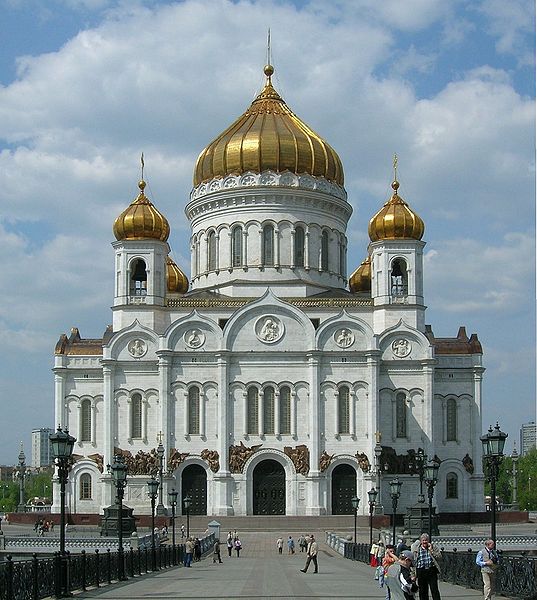
Cathedral of Christ the Savior, Seat of the Patriarch of Moscow and All Russia
On the way into the building, I kept getting saluted by the Swiss Guard. At first I kept looking to see if they were saluting everyone, or if some bishop was walking behind me. Eventually we figured that in my black suit with a small red Jerusalem cross in my lapel (a souvenir from my recent pilgrimage) they may have mistaken me for a Knight of the Holy Sepulcher! Not sure there are any this young, though!
As most know, I have an affinity for things Russian, including the music, so this was a special treat for me – to combine my love of Russia, ecumenism, the Church and the Vatican all into one event. We also got seats just behind and to the right of the Holy Father and the cardinals, which made it that much more exciting. This was my first time inside the Paul VI auditorium, which can seat about 6000 people, and which is entirely powered by solar panels on the roof.
There is no question that, with the election of Benedict XVI and even more so with the election of Kirill I, relations between Rome and Moscow have thawed considerably. We continue to pray for the unity of the world’s largest Orthodox Church and the Catholic Church, and look forward to fruits of dialogue even more beautiful than an afternoon’s concert!
Quote of the Day
First tip to Catholic News Service; full quote from John Allen, Jr.:
In terms of what we today can discover in this message, attacks against the pope or the church don’t come just from outside the church. The suffering of the church also comes from within the church, because sin exists in the church. This too has always been known, but today we see it in a really terrifying way. The greatest persecution of the church doesn’t come from enemies on the outside, but is born in sin within the church. The church thus has a deep need to re-learn penance, to accept purification, to learn on one hand forgiveness but also the necessity of justice. Forgiveness does not exclude justice. We have to re-learn the essentials: conversion, prayer, penance, and the theological virtues.
Pope Benedict XVI,
In-flight press conference en route to Portugal
Papal Q & A in Malta
On his brief visit to Malta, the Holy Father entertained questions from Maltese “youth” (Euro-speak for young adults in their 20s and 30s). The opener speaks for more young Catholics I have met in my ministry than any other, and the Pope’s response is worth reading.
The Question:
I wish to speak on behalf of those young people who, like me feel they are on the outskirts of the Church. We are the ones who do not fit comfortably into stereotyped roles. This is due to various factors among them: either because we have experienced substance abuse; or because we are experiencing the misfortune of broken or dysfunctional families; or because we are of a different sexual orientation; among us are also our immigrant brothers and sisters, all of us in some way or another have encountered experiences that have estranged us from the Church. Other Catholics put us all in one basket. For them we are those “who claim to believe yet do not live up to the commitment of faith.”
To us, faith is a confusing reality and this causes us great suffering. We feel that not even the Church herself recognizes our worth. One of our deepest wounds stems from the fact that although the political forces are prepared to realize our desire for integration, the Church community still considers us to be a problem. It seems almost as if we are less readily accepted and treated with dignity by the Christian community than we are by all other members of society.
We understand that our way of life puts the Church in an ambiguous position, yet we feel that we should be treated with more compassion – without being judged and with more love.
We are made to feel that we are living in error. This lack of comprehension on the part of other Christians causes us to entertain grave doubts, not only with regards to community life, but also regarding our personal relationship with God. How can we believe that God accepts us unconditionally when his own people reject us?
Your Holiness, we wish to tell you that on a personal level – and some of us, even in our respective communities – are persevering to find ways in which we may remain united in Jesus, who we consider to be our salvation.
However, it is not that easy for us to proclaim God as our Father, a God who responds to all those who love him without prejudice. It is a contradiction in terms when we bless God’s Holy Name, whilst those around us make us feel that we are worth nothing to him.
We feel emarginated, almost as if we had not been invited to the banquet. God has called to him all those who are in the squares and in the towns, those who are on the wayside and in the country side, however we feel he has bypassed our streets. Your Holiness, please tell us what exactly is Jesus’ call for us. We wish you to show to us and the rest of the Church just how valid is our faith, and whether our prayers are also heard. We too wish to give our contribution to the Catholic community.
Your Holiness, what must we do?
The Answer:
“Every personal encounter with Jesus is an overwhelming experience of love. Previously, as Paul himself admits, he had ‘persecuted the church of God violently and tried to destroy it’ (Gal 1:13). But the hatred and anger expressed in those words was completely swept away by the power of Christ’s love. For the rest of his life, Paul had a burning desire to carry the news of that love to the ends of the earth.
Maybe some of you will say to me, Saint Paul is often severe in his writings. How can I say that he was spreading a message of love?
My answer is this. God loves every one of us with a depth and intensity that we can hardly begin to imagine. And he knows us intimately, he knows all our strengths and all our faults. Because he loves us so much, he wants to purify us of our faults and build up our virtues so that we can have life in abundance. When he challenges us because something in our lives is displeasing to him, he is not rejecting us, but he is asking us to change and become more perfect.
That is what he asked of Saint Paul on the road to Damascus. God rejects no one. And the Church rejects no one. Yet in his great love, God challenges all of us to change and to become more perfect.
Saint John tells us that perfect love casts out fear (cf. 1 Jn 4:18). And so I say to all of you, “Do not be afraid!” How many times we hear those words in the Scriptures! They are addressed by the angel to Mary at the Annunciation, by Jesus to Peter when calling him to be a disciple, and by the angel to Paul on the eve of his shipwreck. To all of you who wish to follow Christ, as married couples, as parents, as priests, as religious, as lay faithful bringing the message of the Gospel to the world, I say, do not be afraid! You may well encounter opposition to the Gospel message.
Today’s culture, like every culture, promotes ideas and values that are sometimes at variance with those lived and preached by our Lord Jesus Christ.
Often they are presented with great persuasive power, reinforced by the media and by social pressure from groups hostile to the Christian faith. It is easy, when we are young and impressionable, to be swayed by our peers to accept ideas and values that we know are not what the Lord truly wants for us. That is why I say to you: do not be afraid, but rejoice in his love for you; trust him, answer his call to discipleship, and find nourishment and spiritual healing in the sacraments of the Church.
Here in Malta, you live in a society that is steeped in Christian faith and values. You should be proud that your country both defends the unborn and promotes stable family life by saying no to abortion and divorce. I urge you to maintain this courageous witness to the sanctity of life and the centrality of marriage and family life for a healthy society. In Malta and Gozo, families know how to value and care for their elderly and infirm members, and they welcome children as gifts from God. Other nations can learn from your Christian example.
In the context of European society, Gospel values are once again becoming counter-cultural, just as they were at the time of Saint Paul In this Year for Priests, I ask you to be open to the possibility that the Lord may be calling some of you to give yourselves totally to the service of his people in the priesthood or the consecrated life. Your country has given many fine priests and religious to the Church. Be inspired by their example, and recognize the profound joy that comes from dedicating one’s life to spreading the message of God’s love for all people, without exception.
I have spoken already of the need to care for the very young, and for the elderly and infirm.
Yet a Christian is called to bring the healing message of the Gospel to everyone. God loves every single person in this world, indeed he loves everyone who has ever lived throughout the history of the world. In the death and Resurrection of Jesus, which is made present whenever we celebrate the Mass, he offers life in abundance to all those people.
As Christians we are called to manifest God’s all-inclusive love. So we should seek out the poor, the vulnerable, the marginalized; we should have a special care for those who are in distress, those suffering from depression or anxiety; we should care for the disabled, and do all we can to promote their dignity and quality of life; we should be attentive to the needs of immigrants and asylum seekers in our midst; we should extend the hand of friendship to members of all faiths and none.
That is the noble vocation of love and service that we have all received.
Paschal Triduum 2010
The first time I participated in the Easter Triduum was also my altar serving debut. I was in third grade, nine years old. My training was held right after school by Sr. Mary Thorne, if I recollect correctly, and a few hours later I was serving my first mass, on Holy Thursday. That was twenty-three years ago and I have never intentionally missed any part of the Triduum.
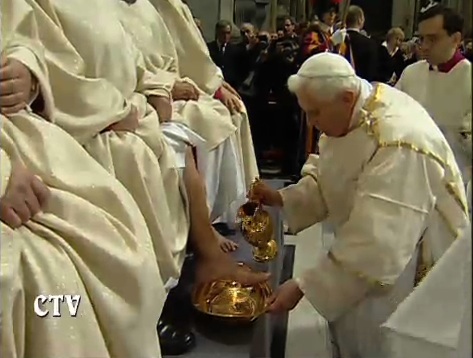
Holy Father washing feet of 12 presbyters at Holy Thursday Mass
In fact, I can only remember missing the whole thing once, because I was sick – but I had already done all the planning and training for the liturgies, and had very reliable volunteer lay liturgical ministers to rely upon in absentia. One other year, I was in the ER during the Easter vigil with a friend. Other than these two, I have worshipped during the high holy days, and usually as a server, lector, or liturgist and master of ceremonies. Even in my last interim parish ministry, where I was not the primary liturgist, I still had a contingent of catechumens to bring through the rites.
That said, it is kind of nice (but also a bit weird) to be absolutely and completely free of responsibility throughout the Triduum, and to be in Rome. There are three places where every Catholic should spend Holy Week at least once, in my opinion: Jerusalem, Rome, and Notre Dame. Though not necessarily in that order.
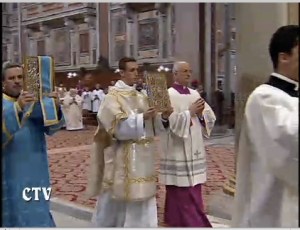
Latin and Greek Deacons in Gospel Procession, Holy Thursday, Archbasilica San Giovanni
Throughout my four years at Notre Dame, I was an altar server in the Basilica of the Sacred Heart, and sometime assistant MC there and sacristan/liturgy coordinator at the Chapel of Our Lady of Guadalupe in Keough Hall. Triduum was always a great deal of work, but always masterfully done, accompanied by beautiful music, and in the words of one visiting curial cardinal (who so enjoyed Holy Week at ND he came back twice while I was there), “This is better than Saint Peter’s!”.
I am inclined to agree, but with qualification. To be clear, I am disappointed in nothing of the Triduum here in Rome, except for the mob (the Romans’ answer to the queue, or line).
Way of the Cross - my view was not this blurry
This is, after all, the first church (not in chronology, but in order). The Mass of the Lord’s Supper on Holy Thursday was celebrated at the Pope’s Cathedral, the Archbasilica of Saint John Lateran, Mother-Church of Rome. The Service of Our Lord’s Passion on Good Friday and the Great Vigil of Easter were celebrated at the Vatican Basilica of Saint Peter. All were presided by the Bishop of Rome, Benedict XVI, and he was homilist at the first and last (Raniero Cantalamesa, OFM Cap., the preacher of the papal household, had the homily on Good Friday, as you may have heard.) I prayed the Way of the Cross from the edge of our property, a bluff overlooking the Coliseum with clear line-of-sight of the Holy Father about 300 meters away.

Raniero Cantalamessa, OFM Cap., Papal Preacher on Good Friday
The prayer guides are published pocket-sized booklets, illustrated with prints of 15th and 16th century frescoes from Italian churches. The liturgy was celebrated in Latin, the mass parts chanted in Gregorian style, and deacons blessed with angelic voices chanted the gospel – on Thursday it was proclaimed twice, once each in both Latin and Greek! (Presumably in honor of the fact that this year, Passover and Easter on both the Julian and Gregorian calendars all coincide). The prayers of the faithful throughout the three-day liturgy were offered in French, Spanish, English, Polish, German, Portuguese, Russian, Tagalog, Swahili and Arabic. Readings were in Italian, Greek, Latin, French, English, German, and Spanish.
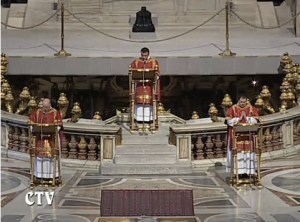
Deacons Proclaiming the Passion
The exultet in Latin is amazing. The Passion on Good Friday in slowly chanted Latin is impressive, but also a little hard on the back. (OK, yes, the very act of complaining about listening to the passion, when it is after all, the passion, is a sin I will publicly confess here and now: Mea culpa, ego sum mereum humanum.)
I found this interesting, though: Over the last few years in liturgical circles we have been encouraged to discourage the reading of the Passion in parts, as it is often printed in the missalletes and music books, and instead just have three deacons or readers proclaim the reading in turn. At the papal liturgy at San Pietro, with the ‘new’ Marini in charge, they had each deacon proclaim different parts (Narrator, Jesus, Peter/others) and the choir as the crowd/assembly.
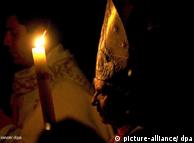
Pope Benedict during the Great Vigil's Service of Light
This touches on one of the great reasons to be in Rome: The liturgical diversity. I do not just mean the fact that there are representatives of all the major rites of the Church here in the city (Alexandrian, Antiochene, Armenian, Byzantine, Chaldean, and Latin), but also that within the Latin rites, within the Roman rite specifically, you have diversity. Just between the Roman Cathedral (San Giovanni) and the Vatican Basilica (San Pietro), with the same pope presiding and the same papal MC, you find different ways of celebrating and different customs.
One small example, during the Eucharistic prayer: At San Giovanni, we do not kneel, and there is no bell during the epiclesis and the two elevations, but there is incense. At San Pietro, we kneel from the epiclesis to the mystery of faith, and there is a bell for the epiclesis and two elevations, but no incense.
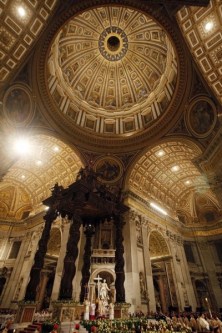
Easter Vigil 2010 San Pietro
Another interesting note, if a little random. While the Mass of the Lord’s Supper traditionally commemorates the institution of the Eucharist in the form of the Last Supper, it has traditionally been called the institution of the priesthood, through the act of the washing of feet. Historically, of course, and theologically, this is not entirely accurate so back home we had long since opted away from this simplistic phrasing lest it require a great deal of explanation. However, in the pre-liturgy announcements at San Giovanni, there it was “The Institution of the Eucharist and of the ministerial priesthood”.
Twelve presbyters were the mandatum at the Holy Thursday Mass of the Lord’s Supper, whose feet the Holy Father washed, though none of this was visible to me. The diplomatic corps were invited to communion with the Holy Father as minister, which they recieveed kneeling and on the tongue, or, they recieved a blessing instead of communion, if appropriate; but everyone else recieved communion along the aisles (standing, and in tongue or hand as the communicant prefered).
After returning to the Lay Centre for dinner, a group of us spent the evening in an adoration pilgrimage of seven churches during the traditional period until midnight: Basilica San Giovanni e Paolo, Basilica Santa Maria in Domnica, the Baptistry of San Giovanni, Archbasilica San Giovanni, Basilica Sant’Antonio di Padova, Basilica Santi Quattri Coronatti, and the Chapel of the Holy Trinity.
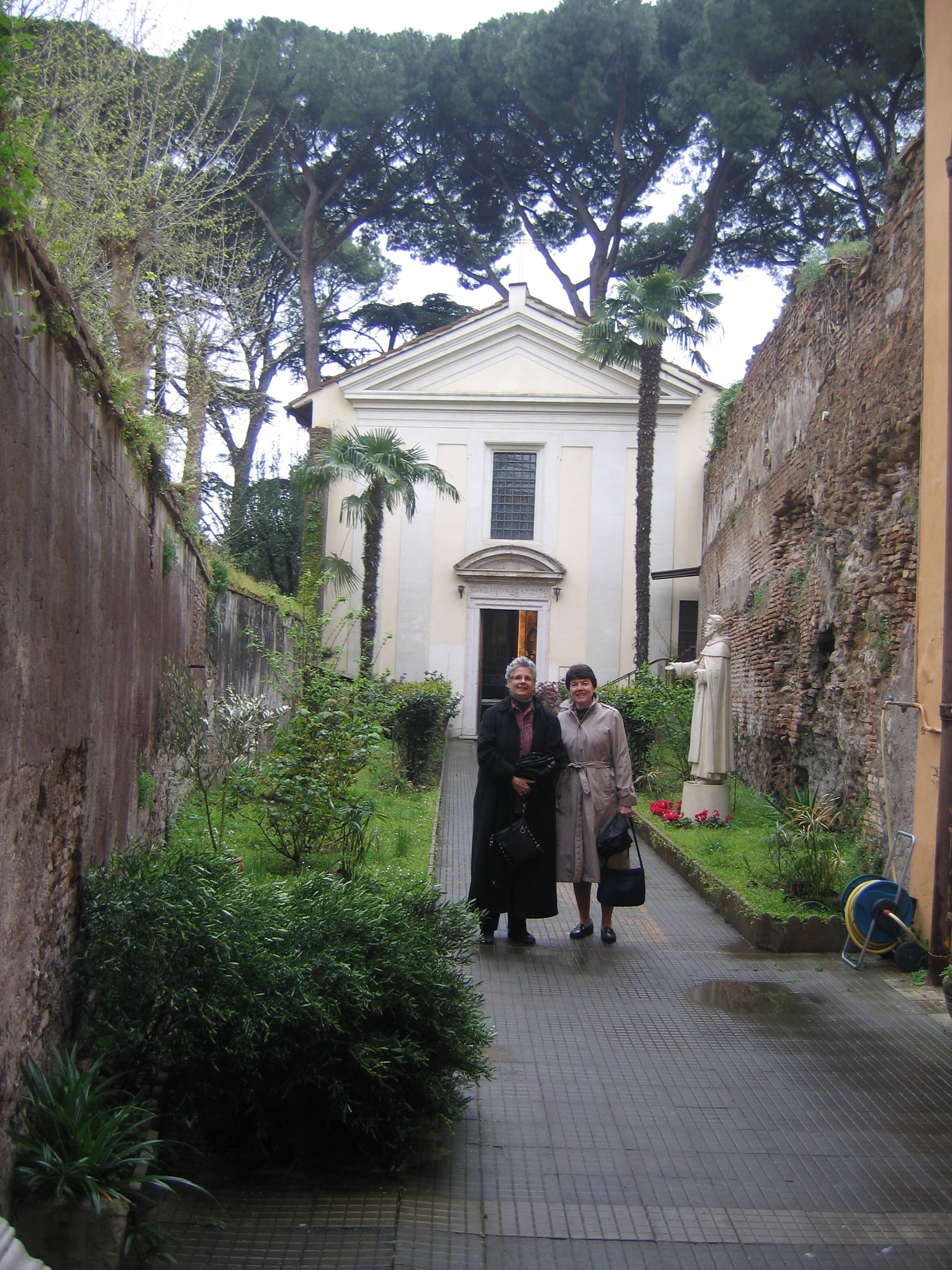
San Tommaso in Formis, with Dr. Orsuto and Dr. Hagstrom
St. Peter’s has a capacity of over 60,000 roughly the same as Notre Dame Stadium before the 1997 expansion. That plus room for another 400,000 in the piazza makes for a somewhat larger assembly than the 2500 or so who can fill the Basilica of Sacred Heart at Notre Dame. For an experience of the Church universal in the heart of the Church, you cannot beat Rome. But for that Church universal manifest in a local church, I do not think even Rome can beat Notre Dame. To a degree, its like apples and oranges. The assembly is different, and the considerations are different. One aims for a liturgy that represents the whole church, which is probably represented pretty well by those present. The other aims for a liturgy of the local church being wholly church in its place. For Latin and the biggest of big liturgy, it is Rome. For best liturgy captured in a particular church, music that is beautiful, reverent and accessible, it is Notre Dame. I am happy to have had my four years at ND, and hope to get a few more here in Rome!
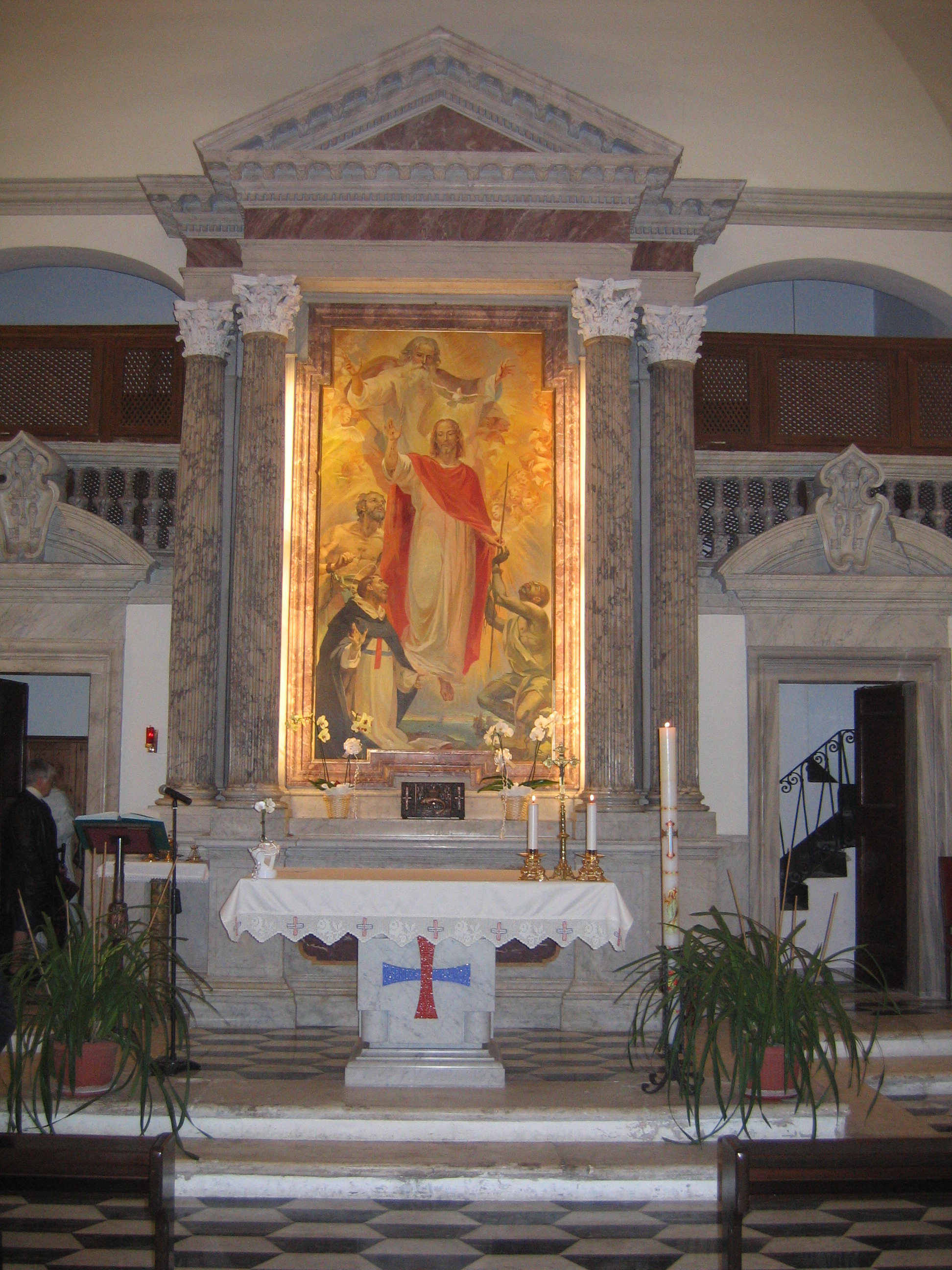
Church of San Tommaso in Formis
For Easter Sunday, between the full papal Triduum experience and the rain, I decided to go to the little church served by the Trinitarian Fathers, Chiesa San Tomasso in Formis (St. Thomas in Chains), literally just outside our front gate and around the corner. About 30 people filled the church, including two priests and two other Lay Centre folk, director Donna Orsuto and visiting scholar Dr. Aurelie Hagstrom, chair of the theology department at Providence College in Rhode Island who is here for a month of Marian research. Such a different experience after the big liturgies to be in a small community! The only space for the after-mass social was the tiny sacristy behind the altar, as long as we entered from one side and exited the other!
After a quick cappuccino and cornetto to celebrate the end of Lenten fasting, we watched the Urbi et Orbi on TV and prepared for a mid-afternoon Easter feast. Only a couple guests joined us, making us about fifteen in all – a perfect way to spend a drizzly Easter afternoon.
Papal Ecumenical Vespers on the Conversion of St. Paul
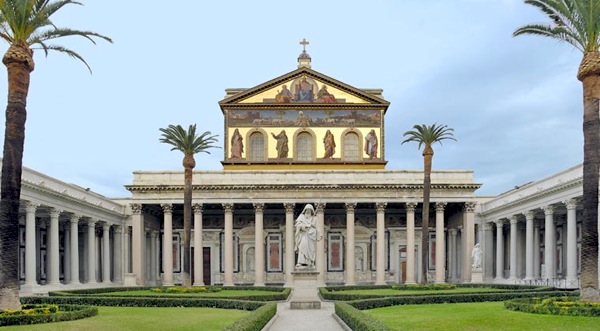
Papal Basilica of St. Paul Outside the Walls
The closing of the very busy Week of Prayer for Christian Unity every year in Rome is the Papal Ecumenical Vespers (Evening Prayer) at the Patriarchal Basilica of St. Paul Outside the Walls. Built over the tomb of St. Paul, re-confirmed by tests revealed at the end of the Year of Paul last summer, and administered by Abbot Edmund Power and the Benedictine Abbey there, the basilica is known for its ecumenical significance.
In fact, it was at the end of this very service on 25 January 1959, closing the Week of Prayer for Christian Unity, that Pope John XIII announced his intention to convene the Second Vatican Council, making very clear that ecumenism was to be one of the major themes of the council, along with the aggiornamento of the Church and a reconciled engagement with the modern world.
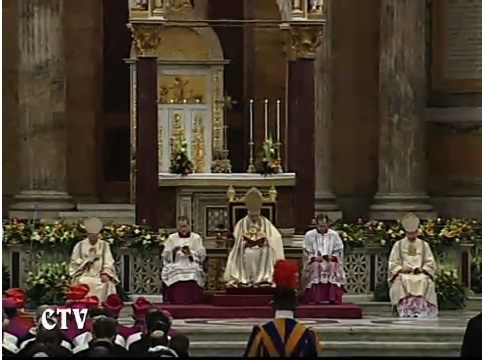
Pope Benedict XVI presiding at Ecumenical Vespers for the Week of Prayer for Christian Unity
This year, probably Cardinal Walter Kasper’s last as President of the Pontifical Council for Promoting Christian Unity, Pope Benedict XVI made special note of the 100th anniversary of the 1910 World Missionary Conference in Edinburgh, which marks the beginning of the modern ecumenical movement.
The basilica is outside the walls of the historic city centre, but only a few stops away by metro. Between exams and bad weather, and limited tickets, only a few of us from the Lay Centre were able to attend: Andrea, an Italian canon law student; Anna, our New Zealand liturgy student, and myself in one section; with our three Orthodox housemates Theodosius, Dimitrios, and Radmilo, escorted to the front as scholars of the Pontifical Council for Christian Unity.
The readings and prayers of intercession were all offered by ecumenical guests and leadership, including the Archbishop of Canterbury’s permanent representative to the Holy See, Very Rev. David Richardson of the Anglican Centre in Rome.
The Holy Father’s homily is included in full below.
****
Dear Brothers and Sisters,
Gathered together in this fraternal liturgical assembly, on the Feast of the Conversion of St Paul, today we conclude the annual Week of Prayer for Christian Unity. I greet all of you warmly, in particular Cardinal Walter Kasper, President of the Pontifical Council for Promoting Christian Unity, and the Archpriest of this Basilica, Archbishop Francesco Monterisi, along with the Abbot and the Community of monks whose guests we are. I also extend my cordial thoughts to the Cardinals here present, to the Bishops and to all who represent the Churches and ecclesial Communities of this City who are here today.
Only a few months have passed since the conclusion of the Year dedicated to St Paul, which gave us an opportunity to deepen our awareness of his extraordinary work as a preacher of the Gospel and also of our call to be missionaries of the Gospel, as the theme of the Week of Prayer for Christian Unity reminds us “You are witnesses of these things” (Lk 24: 48).
Paul, although he retained an intense memory of his own past as a persecutor of Christians, did not hesitate to call himself an Apostle. For him, the basis of that title lay in his encounter with the Risen One on the road to Damascus, which also became the beginning of his tireless missionary activity. In this he was to spend every ounce of his energy, proclaiming to all the peoples the Christ whom he had met personally.
Thus Paul, from being a persecutor of the Church, was in his turn to become a victim of persecution for the sake of the Gospel to which he witnessed: “Five times I have received at the hands of the Jews the forty lashes less one. Three times I have been beaten with rods; once I was stoned…. On frequent journeys, in danger from rivers, danger from robbers, danger from my own people, danger from Gentiles, danger in the city, danger in the wilderness, danger at sea, danger from false brethren; in toil and hardship, through many a sleepless night, in hunger and thirst, often without food, in cold and exposure. And, apart from other things, there is the daily pressure upon me of my anxiety for all the churches” (2 Cor 11: 24-25, 26-28). Paul’s witness reached its culmination in his martyrdom when, not so far from here, he was to give proof of his faith in Christ who conquers death.
The dynamic of Paul’s experience is clearly expressed in the pages of the Gospel that we have just heard. The disciples of Emmaus, after having recognized the Risen Lord, return to Jerusalem and find the Eleven gathered together with the others. The Risen Christ appears to them, comforts them, overcomes their fear and doubts, and eats with them. Thus he opens their hearts to the intelligence of the Scriptures, recalling what had to happen, which would constitute the nucleus of the Christian proclamation. Jesus affirms: “Thus it is written, that the Christ should suffer and on the third day rise from the dead, and that repentance and forgiveness of sins should be preached in his name to all nations, beginning from Jerusalem” (Lk 24: 46-47). These are the events to which the disciples of the first hour were to bear witness, followed by believers in Christ of all times and places. It is important, however, to emphasize that this witness, then just as now, is born from the encounter with the Risen One, is fed by a constant relationship with him and animated by a profound love for him. One can only be his witness if one has had the experience of feeling Christ alive and present “See my hands and my feet, that it is I myself” (Lk 24: 39) of sitting at table with him, of listening as he sets one’s heart aflame! For this, Jesus promises his disciples and each of us a powerful aid from on high, a new presence, that of the Holy Spirit, gift of the Risen Christ, who guides us to the whole truth: “And behold, I send the promise of my Father upon you” (Lk 24: 49). The Eleven were to spend their whole lives proclaiming the Good News of the death and Resurrection of the Lord. Almost all of them were to seal their witness with the blood of martyrdom, a fertile seed that has produced an abundant harvest.
The choice of the theme of this year’s Week of Prayer for Christian Unity the invitation, that is, to a common witness of the Risen Christ in accordance with the mandate he entrusted to his disciples is linked to the memory of the 100th anniversary of the Edinburgh Missionary Conference, in Scotland, widely considered a crucial event in the birth of the modern ecumenical movement.
In the summer of 1910, in the Scottish capital, over 1,000 missionaries from diverse branches of Protestantism and Anglicanism, who were joined by one Orthodox guest, met to reflect together on the necessity of achieving unity in order to be credible in preaching the Gospel of Jesus Christ. In fact, it is precisely this desire to proclaim Christ to others and to carry his message of reconciliation throughout the world that makes one realize the contradiction posed by division among Christians.
Indeed, how can non-believers accept the Gospel proclamation if Christians even if they all call on the same Christ are divided among themselves? Moreover, as we know, the same Teacher, at the end of the Last Supper, had prayed to the Father for his disciples: “That they may all be one… so that the world may believe” (Jn 17: 21). The communion and unity of Christ’s disciples is therefore a particularly important condition to enhance the credibility and efficacy of their witness.
Now a century after the Edinburgh event, the intuition of those courageous precursors is still very timely. In a world marked by religious indifference, and even by a growing aversion to the Christian faith, it is necessary to discover a new, intense method of evangelization, not only among the peoples who have never known the Gospel but also among those where Christianity has spread and is part of their history. Unfortunately, the issues that separate us from each other are many, and we hope that they can be resolved through prayer and dialogue. There is, however, a core of the Christian message that we can all proclaim together: the fatherhood of God, the victory of Christ over sin and death with his Cross and Resurrection, and faith in the transforming action of the Spirit.
While we journey toward full communion, we are called to offer a common witness in the face of the ever increasingly complex challenges of our time, such as secularization and indifference, relativism and hedonism, the delicate ethical issues concerning the beginning and end of life, the limits of science and technology, the dialogue with other religious traditions. There are also other areas in which we must from now on give a common witness: the safeguard of Creation, the promotion of the common good and of peace, the defense of the centrality of the human person, the commitment to overcome the shortcomings of our time, such as hunger, poverty, illiteracy, and the unequal distribution of goods.
The commitment to unity among Christians is not the work of a few only, nor is it an incidental undertaking for the life of the Church. Each one of us is called to make his or her contribution towards the completion of those steps that lead to full communion among the disciples of Christ, without ever forgetting that this unity is above all a gift from God to be constantly invoked. In fact, the force that supports both unity and the mission flows from the fruitful encounter with the Risen One, just as was the case for St Paul on the road to Damascus, and for the Eleven and the other disciples gathered at Jerusalem.
May the Virgin Mary, Mother of the Church, grant that her Son’s desire may be fulfilled as soon as possible: “That they may all be one… so that the world may believe” (Jn 17: 21).
© Copyright 2010 — Libreria Editrice Vaticana
Theologian of the Papal Household
His study has a view of a small courtyard where the papal guillotine once stood, and where a pillar likely used for the flogging of heretics and criminals can still be seen. The corridor leading from his office is lined with Roman tombstones, and the Swiss Guard are omnipresent with full regalia and halberds. Once known as the Master of the Sacred Palace, the Theologian of the Papal Household has four large paintings in his room each depicting miniature portraits of his nearly 100 predecessors (all Dominicans), starting with St. Dominic himself.

Fr. Wojciech Giertych, OP, Theologian of the Papal Household
Fr. Wojciech Giertych, OP was appointed in December of 2005 by Pope Benedict XVI, and is just beginning his fifth of a five-year term of office. A Polish Dominican born and raised in London, he describes himself as a true “prisoner of the Vatican”, albeit in a gilded cage. Outspoken, jovial, and unafraid to tell it how it is, Fr. Giertych shared with the lay centre residents his thoughts on Thomas, on theology and philosophy, the vocation of the laity, the challenge of contemporary religious life, contemporary challenges arising from the “crisis of 1968” (not Vatican II, note) including relativism, and the practical life of a Vatican officer.
One might be inclined to ask, “Why does the pope need a theologian?” especially a pope like Benedict, the first theologian to be elected pope in a couple centuries. Traditionally, there were three duties ascribed to the office: Offering theological instruction to the papal court (back when most of the court were not monsignori with doctorates in theology, philosophy, or canon law), reviewing any theological books published in Rome, and vetting the papal addresses (especially important at a time when most popes were politicians, warriors, or, worse, nobility).
Now, this means reviewing the drafts of papal allocutions drafted by the staff of Vatican speech writers, though he is neither the first nor the last word on the matter. And, Fr. Wojtech points out, his role is to examine theological content and look for phrases that could be misunderstood, especially by mass media – not to judge the prudence of an address (questions around Regensburg were raised). The most interesting papal addresses are the ones he does not see – those that the pope prepares personally: in Benedict’s case, his encyclicals, major homilies, and annual advent address to the Roman Curia. Given how much is written for the pope, it is like having a graduate seminar with Professor Ratzinger almost every day – even if the personal meetings are less often.
Occasionally the various dicasteries in the curia ask him for theological input on a document, and he serves as consultor to the Congregation for the Doctrine of the Faith. In one of the oldest continuously operating bureaucracies on the planet, he’s one man serving in an office consisting of only himself. It can be hard to tell what effect his work is having without the constant interaction of peers. This touches on one of the challenges for a friar used to life in community, used to working and living in constant contact and consultation with other people, now working in a more solitary position.
He did get invited to lunch with the pope, once. It is fairly common knowledge that Pope Benedict normally prefers to eat alone or with the sisters who prepare his meals – understandable for an introvert in an intensely public office! However, when a film crew came in to film a “day in the life of the pope” for international TV consumption, it happened that the Holy Father would be seen having a ‘working lunch’ with three members of the papal family, including, as it happens, Fr. Giertych. (“A great, open conversation. We three had wine, while the pope had juice”) As it was viewed around the world, some cardinals expressed how lucky our Friar Preacher was – even they had never had lunch with the pope!
“Never mix theology and philosophy, because philosophy always wins.” Despite the irony of such a statement from a Thomist, or perhaps because of it, this comment alone sparked a conversation that continued with some of us well after Fr. Wojciech left for the evening. While philosophy – in the broad sense of all the ‘sciences’ and other disciplines – can serve the church and our study of theology, they should never be confused as if they are theology, or as if the revelation of the Word should be judged according to the criterion of philosophy, politics, or social sciences. When this happens you end up getting the problems that, for him, have stemmed especially from 1968, and include the identification of the faith with one political party (‘as a good Catholic you must vote for candidate X or party Y’), the revision of the life of faith to fit in with what people expect from other fields, and end up with relativism (‘there may be a Truth, but we can’t know the Truth, so you have your truth and I have my truth’).
The conversation got really interesting as we delved into the vocation, identity, and relationships of the laity, clergy, and religious. Religious should be visible in the world, and laity should be “discreet” (leaven in the world, to use another phrase) – and we have had trouble with religious being more like laity and laity being more like religious. Specifcally, he noted some religious orders without habits of any kind (“it doesn’t matter what kind: a modern habit or a medieval habit or a 19th century habit”) living in apartments where you can hardly find them, or some of the lay movements whose first order of business seems to be deciding what kind of habit to design – and the more medieval the better!
When I asked about lay people serving in ministry positions, his response was about people wanting to be the lector all the time, or spend all their time helping at the church because something is amiss in their real life or they do not understand that the primary lay ministry is in the world, not collecting money at mass or something, “don’t spend your life holding on to the sacristy door”. But what about lay people serving the church in a paid, full time manner? Even the Roman curia has lay ministers in its employ?
“Well, of course the church will always need administrative personnel, computer technicians, finance experts, people to manage the facilities – especially in places where the church is burdened with such institutions as schools and hospitals”. Pastors should not be “running the plant”, but should be engaged in sacramental and pastoral ministry. But even this was more about ‘secular’ jobs that one could do for the church or for another entity, not so much ecclesial vocations; we tried a different track: We are here in Rome, studying at pontifical universities, to get ecclesiastical degrees – what would he expect for us to do with them?
“We have a saying in Poland: man cannot live on theology alone!” As a lay person you should be thinking of making a living, to support a family, you cannot do this with a theology degree. You cannot come from a degree and demand a job from the bishop – he may not have the money. [Can you imagine anyone demanding a job from a bishop???] We need the people (mentioned above) to be theologically trained, but it should be a secondary to your primary education. He shared his experience fromPoland, where a degree is a civil, legal contract – maybe in that system there is a “demand” to be employed in the field. But he wondered most people studying in Poland for theology degrees should have instead been studying harder subjects like medicine or law, but admitted that each country is different: “We have 100 friars living at the monastery in Krakow, 14 masses a day, confessions with two-hour waiting lines” and no experience of a non-ordained person devoting their life to the church outside of a religious community.
“I’d rather see thirty ‘normal’ people give one hour a week, than to pay one person for thirty hours a week, if that person does not have the best formation…” But, he admits he may be wrong as he quoted the Dominican Cardinal Yves Congar, who wrote after being dragged to Rome to be questioned in the 1950’s, wrote in his journals “I may be getting the answers wrong, but these are real questions – and that’s what enervates these people here in Rome!” He was asking questions about the laity and ministry and looking to scripture and the patristic sources for answers. We have to keep asking these real questions, even if it takes time to get the right answers; that is better than ignoring the problems!
Nativity of the Lord: Christmas Mass at Midnight
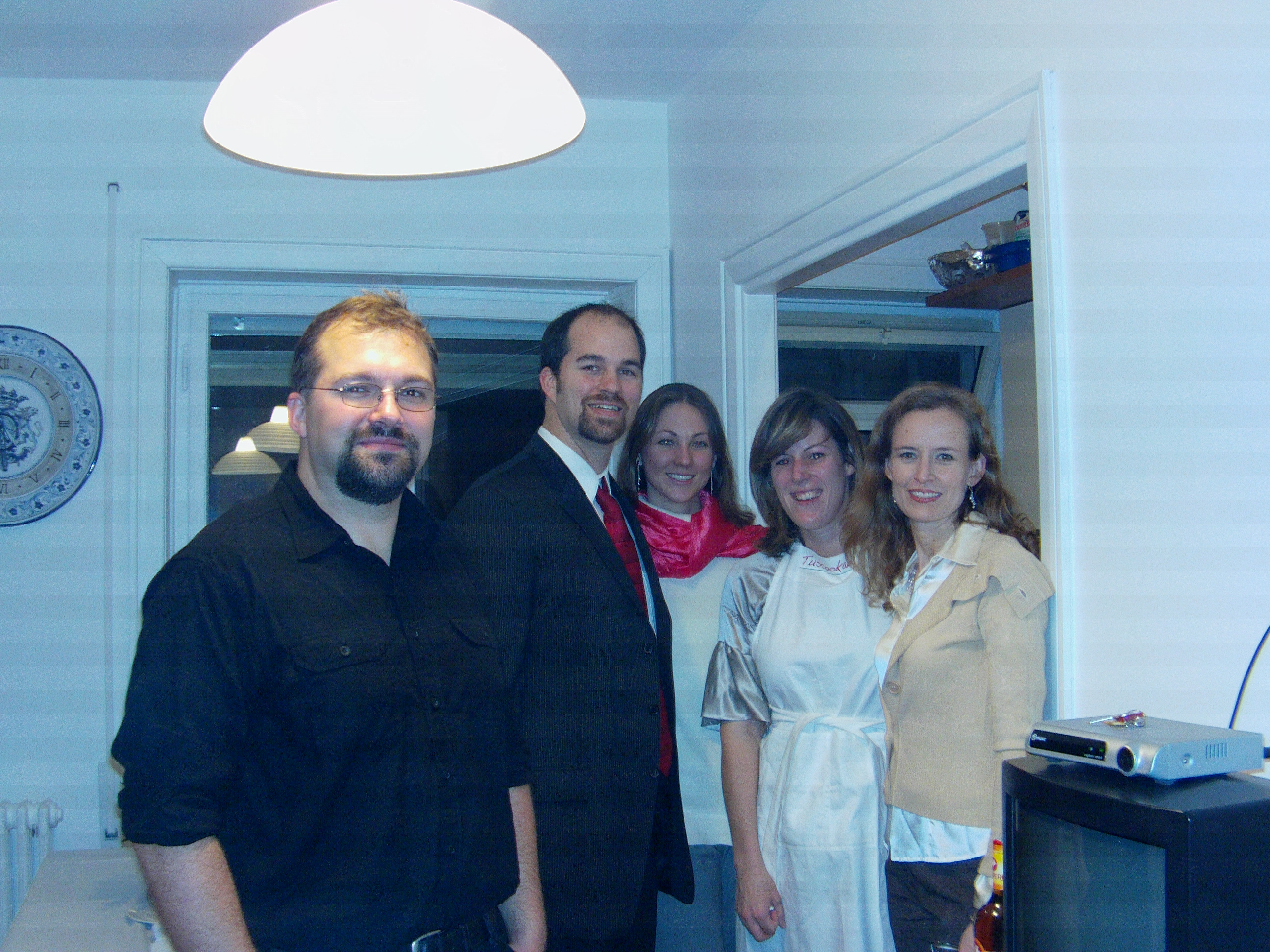
Preparing for Jill's Feast: AJ, Greg, Karina, Jill, Natalie
Nancy and I, and a small group from the Lay Centre started Christmas Eve with a traditional Italian dinner hosted by Jill, another Domer I discovered at the Angelicum. It was incredible! Antipasti and prosecco to start the night off, followed by soup, pasta, fish… and each prepared and served in proper order, it was almost a pity we had to leave for the mass! Seriously, aside from theology, ministry, and guiding tours of Rome she could open her own trattoria. Not only was it all delicious, it was presented so beautifully, it really made a special evening even more delightful.
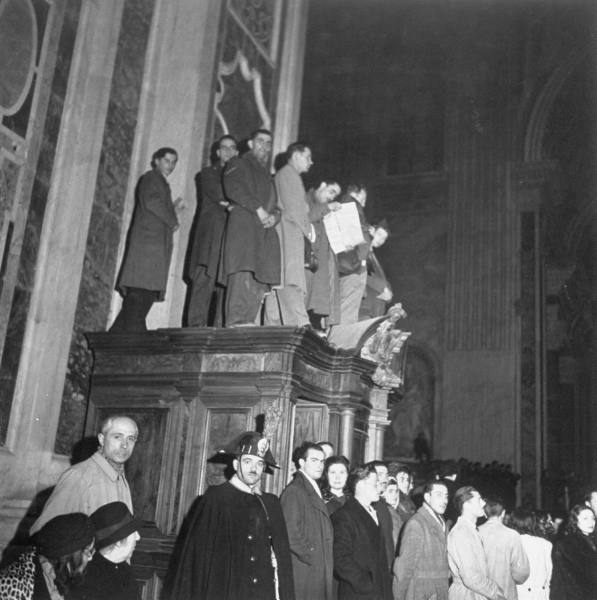
Standing on the confessionals at St. Peter's, Midnight Mass 1944
It is from Jill that I learned that Midnight Mass at St. Peter’s is actually a relatively new phenomenon. Until 1944, the last time the bishop of Rome had celebrated Christmas midnight mass at St. Peter’s is believed to be for the coronation of Charlemagne as Holy Roman Emperor in 800 AD. Otherwise, the traditional location in Rome had been Santa Maria Maggiore – which makes a lot more sense given the indispensible role Mary played in the Nativity, and the location there of the relics of the Nativity including what was believed to be the manger in which the Christ child was laid. Since Pius XII’s celebration just after the liberation of Italy during WWII, the popes have celebrated midnight mass at St. Peter’s; but the Romans still go to Mary Major while the Americans and other pilgrims go pray with the pope – though we were not standing on the confessionals this time.

The line begins outside the Basilica of St. Peter
Jill’s place being mere minutes from Piazza San Pietro, we took some liberty with our arrival time. For the first time, what has traditionally been a Midnight Mass was moved up to 10:00pm so we were advised to arrive three hours early – we got there at 7:30 and got into a line that already wrapped around the entire Piazza and had started doubling up on itself. Waiting just ahead of us in line was an American, a theatre professor from Miami, who was hoping against hope to find a ticket to get into the papal mass. (His name is James Brown. No, really – you can look him up.) As it happens, I had had a friend arrange to get four tickets for us before we knew we would be getting enough through the Lay Centre, so Natalie had borrowed three for friends, and there was just one left over – the Spirit works in small ways too! Unfortunately, we lost Jim in the mass crush when our part of the line finally got inside the Basilica, but in a couple hours of waiting in line at least got to make a new friend.
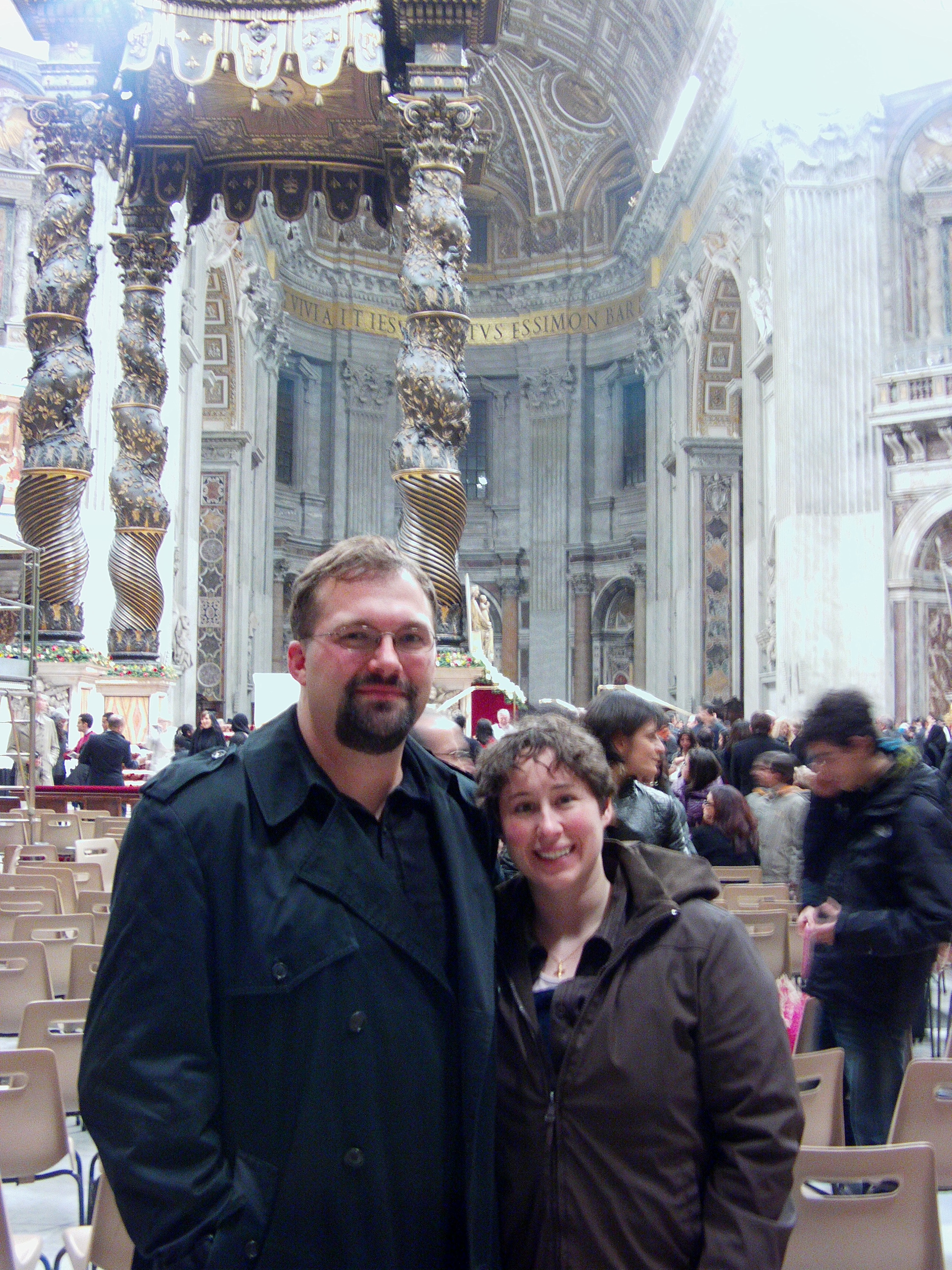
View from our seats, taken after the liturgy
Once inside, we found the massive line had filled the seats in the nave and it looked as if we might have to stand – until they opened the transepts. We got the leftover seats from the “reserved” section in the south transept, directly to the side of the altar. We couldn’t see the pope as he sat in the presiders chair, but had a great view of the liturgy of the Eucharist.
We were placed directly between two of the massive pillars supporting Michelangelo’s Dome, looked over by Sts. John of God and Mary Euphrasia Pellettier on one side and Sts. Juliana Falconieri and Angela Merici on the other. Because of this we could not see very far down the nave toward the main doors. About the time we thought the music was changing from prelude to procession, we heard something like screams, a pause long enough to ask each other what that was about, then cheering. “Ah, they were cheering for the pope like a rock star!” We did not realize that Benedict had been knocked down until after the liturgy and we met up with some students who had been in that part of the Basilica. We did see Cardinal Etchegaray being wheeled out on a gurney behind us, and thought perhaps he had fallen or something. His Holiness did not mention it, and did not even seem fazed by the time we saw him.

Presepe at Piazza San Pietro
The liturgy was beautiful. Last time I was in Rome, for the close of the Jubilee, midnight mass had been held outside, in the Piazza. This was my second papal Eucharist inside St. Peter’s this year, and both times there has really been a sense of reverence and participation in the liturgy, even despite the size of the church and the numbers of people celebrating. The mass parts were in Latin, the readings in Spanish and English, the gospel sung in Latin and the pope’s homily delivered in Italian, the prayers of the faithful in Russian, French, Tagalog, Portugese, and German. The music is increadible, of course: the only places outside Rome I have seen compare for quality liturgy and liturgical music is the Basilica of Sacred Heart at Notre Dame and St. James Cathedral in Seattle. (The National Shrine in D.C. sometimes makes the cut, too…) Nancy was tempted to record the entire liturgy, but we settled for trying to get some of the music.
Afterwards we stood in front of the presepe (crèche, Nativity scene) at the foot of the obelisk in the middle of Bernini’s piazza, listening to a group of sisters singing carols. After an hour of trying to hail a taxi, we got a couple to take us back to the Lay Centre without trying to rip us off (Thank you, Karina!!)
On returning to the Lay Centre, Donna had prepared for us an “American breakfast” – pancakes with Canadian maple syrup, eggs, bacon, and orange juice – the most proper way to celebrate the birth of Jesus at 2:00am! And, to be honest, I do not think I have ever appreciated American fare so much!
Grand(father) Inquisitor at the Lay Centre
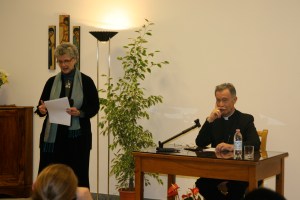
Dr. Donna Orsuto, Most Rev. Luis Ladaria Ferrer, SJ
When meeting with the second-ranking official of the dicastery known for most of its history as the Holy Office of the Inquisition (now the Congregation for the Doctrine of the Faith, CDF), one might not expect a relaxed and cheerful pastor.
One certainly does not expect to hear such pearls as, “We are not here to judge who is ‘really’ Catholic and who is not. We are all striving for holiness, but none of us has reached it. We offer people formation in the Catholic ideal, but everyone struggles with the real application of this in their life” or “Let him who is without sin cast the first stone!”
Yet, this is exactly what we got in the “grandfatherly” Jesuit Spaniard, Archbishop Luis Ladaria Ferrer, Secretary of the CDF at Tuesday night’s inaugural Oasis in the City at the new location of the Lay Centre.
Oasis in the City event at the Lay Centre
Equally reassuring of the man’s Christian heart was his reaction to the fact that the car service that had been arranged to get him to the Lay Centre was 45 minutes late, having left the Archbishop waiting for his ride, without any notice. Any normal person could reasonably expect to be irritated or upset. A typical “VIP” might have just given up and given up on us. More than a couple U.S. hierarchs I have encountered might have thrown a royal fit at such inconvenience. But when the archbishop finally arrived, he got out of the car laughing and waving away Donna’s profuse apologies as if they were not even needed: “These things happen all the time”, he says.

Archbishop Ladaria, Secretary of the Congregation for the Doctrine of the Faith
The bulk of his lecture was on the unsurprising CDF 2008 instruction Dignitas Personae, dealing with a range of bioethical issues including IVF, stem cells, and cloning. It was the questions afterword that brought some of the most interesting comments, including the two quotes above, the first being in response to a question about where to draw the line when someone (such as a politician) does not act or profess a view entirely commensurate with Catholic moral teaching on these complicated issues. Others challenged the Church’s insistence that “human life/personhood begins at conception” from a Thomistic framework which allows for a later development.
My Italian is not good enough to have followed the lecture in its entirety, but the conversation afterword was just as lively. Now if only all of our American hierarchy were as pastoral as this CDF honcho! (Yes, you read that correctly!!)
UPDATE: Didn’t realize the press was here too: http://www.catholic.org/international/international_story.php?id=34844&cb300=vocations
 The Ecumenism Blog