
Home » Posts tagged 'Lay Centre at Foyer Unitas' (Page 5)
Tag Archives: Lay Centre at Foyer Unitas
Prayers for for the faithful departed
Eternal rest grant unto them, O Lord, and let perpetual light shine upon them. May the souls of the faithful departed, through the mercy of God, rest in peace. Amen.
There was a time in my life when it seemed I was bouncing from one crisis to another, from one tragedy to another. Often these were the deaths of friends or family, or the family of good friends. Because of my own losses, I became particularly sensitive to those of my friends, and there was a time when it seemed every email I sent out was a plea for prayers.
As many of my friends know, by the time I turned 21 I had experienced the death of 21 friends, family, and acquaintances – I had been to more funerals than weddings until sometime in my early or mid-20’s. I have learned (or, better, begun to learn) the importance of grieving, of celebrating life, and the reality that death is not the only way to lose someone – sometimes it is not even the most painful.
Whatever fear of death I may have had has long gone, though the fear the loss of people I love remains – but i know even the worst are only temporary. There is a reason for our hope in Christ, our belief in the resurrection and in the communion of saints, after all!
This has been a hard week for a number of people. I have specific prayer intentions that I want to share, but I do so with a certain caveat (or two).
First, by this small series of losses, I am overwhelmed again by the destruction in Haiti and the massive loss of life there, and the ongoing struggle for basic needs to be met in what has long been the poorest nation in the Western hemisphere. To steal from another commentator, what has happened there is not one huge tragedy, but the concentration of a million tragedies. The individual story should not be lost in the large numbers. For me, these few stories unrelated to the Haiti disaster have put it in stark relief, and refreshed my prayer for the people there.
Second, these are not self-interested intentions. My breath caught at reading one email, and I can relate to the people most affected, but I am not the one who has lost friends or family this week: So please do not pray for “AJ’s bad week”!
On Wednesday (24 Feb), Dr. Gail Walton, the longtime director of the liturgical Choir at Notre Dame’s Basilica of the Sacred Heart died after a long battle with cancer. I knew Gail personally from my four years at ND, as an altar server at the basilica during the same liturgy that her choir served. Several friends, including a couple among my closest at ND, were in the Liturgical Choir and are attending her funeral tomorrow. It is for them, and for Gail’s family and dearest friends that I ask prayers.
On Thursday (25 Feb) it was reported that an alumnus of my high school, Mt. Si in Snoqualmie, WA, was killed in action in Afghanistan. I did not know Eric Ward, as he graduated 12 years after me, but he is the first Mt. Si alumn killed in the war on terror, and I remember vividly how much death can impact the small community there.
On Friday, (26 Feb) one of my fellow Fellows, Fr. M. Thangaraj from Tamil Nadu, India sent a brief email letting us know that his brother, Irudayaraj had died the previous day and was being buried on Friday. Given such a quick burial, Thangaraj was not planning on heading back to India.
On Saturday, (27 Feb) as you all know an 8.8 earthquake hit Chile, the epicenter being not far from Concepción where new Lay Centre resident Claudio is from. He was eventually able to reach a cousin who had heard from his immediate family and assured him that they were OK, but as of yesterday he had not been able to talk to them directly through phone or Skype. Obviously this also reminded everyone of the recent quake in Haiti, where another intended Lay Centre resident, Luis, was working for the archdiocese.
Today (Monday, 1 March) I got another email from Val, our reluctant Fellowship go-to guy, who passed on word that Fr. Thangaraj’s mother had died as well – just a few days after her elder son. Given the loss of mother and brother within days of each other, Thangaraj is heading home to India.
For Thangaraj especially, but for all whose lives have been touched by death and disaster this week, please pray for healthy grief, for healing, for faith in times of trial, and for the perseverance of hope.
Out of the depths I cry to You, O Lord; Lord, hear my voice.
Let Your ears be attentive to my voice in supplication.
If You, O Lord, mark iniquities, Lord, who can stand?
But with You is forgiveness, that You may be revered.
I trust in the Lord; my soul trusts in His word.
My soul waits for the Lord more than sentinels wait for the dawn.
More than sentinels wait for the dawn, let Israel wait for the Lord,
For with the Lord is kindness and with Him is plenteous redemption;
And He will redeem Israel from all their iniquities.
(De Profundis, Psalm 130)
Archbishop Giorgio Corbellini
The Secretary of the Governorate of the Vatican State and the President of the Office of the Labour of the Vatican State joined us for the celebration of the Eucharist and a short dinner presentation. This is the office responsible for the civil government aspects of the world’s smallest soverieng nation – Utilities, communications, stamps and coins, goods and supplies, facilities, police and fire services, and labor. Though each office within the Holy See has its own recruiting and hiring practices, the Labor office is responsible for orientation to employment in the Vatican and to ongoing human resource concerns. There also exists a labor council, elected from among Vatican employees of different fields, to advise the Cardinal President of the Governorate.
The archbishops responsibilities also extend to the extraterritorial buildings and properties in and around Rome, which enjoy – to various degrees – status similar to an embassy, a little bit of one country in the middle of another. At least part of the Passionist Monastery in which the Lay Centre resides is considered extraterritorial, depending on whether you ask the Archbishop’s boss or the city of Rome!
Archbishop Corbellini is one of just a handful of bishops ordained personally by Pope Benedict XVI since his election as bishop of Rome in 2005.
“Legacy” discussion with Ambassadors Ertharin Cousin and Miguel Diaz
It was the first time I had to prepare my passport just to come home for dinner. But, it is a small price to have a “movie night” with two sitting U.S. Ambassadors.
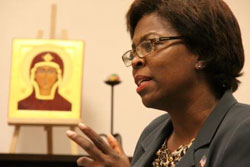
U.S. Ambassador Ertharin Cousin at the Lay Centre
In honor of African-American history month, the first celebrated in Rome by two of our ambassadors both appointed by our first African-American President, the Lay Centre co-hosted a viewing of the PBS documentary, Legacy, with a discussion afterword led by U.S. Ambassador to the Holy See, Dr. Miguel Diaz, and U.S. Ambassador to the U.N. Food Organizations in Rome, Ms. Ertharin Cousin.
It was a change of pace from the theological, philosophical, and pastoral discussions that dominate the day, and the two Ambassadors made a good team, sharing from their personal experience and staying to answer a number of questions and facilitate discussion from a well-mixed audience of about 50 (the limit imposed by embassy security, apparently).
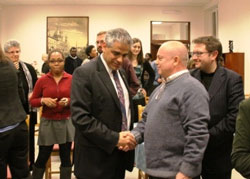
Ambassador Miguel Diaz at the Lay Centre
Much of the discussion ranged around the elements common to any family or individual succesfuly overcoming individual and systemic oppression, disadvantage, or other challenges. Faith, family and community were the key themes, especially noted as the only sources to help when even “the system” failed in its intended aid. (I can think of one person in my own life, for example, who though qualified to receive unemployment still has not – after being unemployed for six months! Sometimes the Roman beaurocracy does not seem so bad…)
In an age when the postmodern generations are facing the juxtaposition between a life of being told “you can be whatever you want to be” by parents, teachers,a nd society at large with a decade of economic crises and limited opportunity, even Ambassador Cousin’s son once commented to her, “how can we ever achieve more than your generation has achieved? There’s nothing left for us!” Echoing the generation across social and racial lines, the “entitlement” generation which was “promised” six-figure salaries straight out of college often cannot even get a job at McDonalds. How is that for disillusionment on a large scale?
This is the new challenge – instead of trying to instill hope when adversity seems everywhere, how do you instill humility instead of entitlement?
Ash Wednesday with Timothy Radcliffe, OP
“The problem is, in our culture, we tend to equate doctrine with doctrinaire and morals with moralism.”

Timothy Radcliffe, OP
The former Master of the Dominican Order, the British Friar Timothy Radcliffe addressed a packed Salonne Vincenzo Palotti in the Lay Centre at Foyer Unitas tonight – about 120 people in all, including more women religious than I have seen at any event in Rome outside of a papal liturgy!
Balancing genuine evangelization and witness, with dialogue and charity, seems to be the greatest challenge facing Christians today. We have to counter a broad-culture message of relativism, but do so without falling into fundamentalism. How to show a better way, without arrogance? This seems like the simplest message of the Gospel, but any honest listener will hear thousands of stories of would-be or former Christians who lost their faith – not in God – but in the poor example of the Christians they encountered.
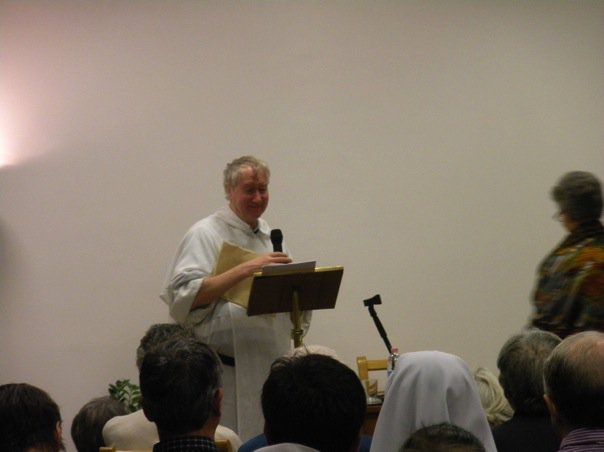
Fr. Timothy at Lay Centre
On one hand, you hear casual dismissal of dogma and doctrine as if such concepts are passé, and not worth discussion. On the other, you hear defenders of the faith doing more damage than any secular press ever could. So, how do be true to the Gospel while in a positive engagement of culture? That was the part of Fr. Timothy’s address that I was able to hear.
He is a gifted preacher – no surprise, given his years at the helm of the Order of Preachers – and a humble man of apparent spirituality. If you ever have the chance to hear him, I suggest you do so. I look forward to an opportunity when I am not taking my turn as porter, so I can get the full message!
Il Potere e la Grazia: I Santi Patroni d’Europa
Power and Grace: Patron Saints of Europe
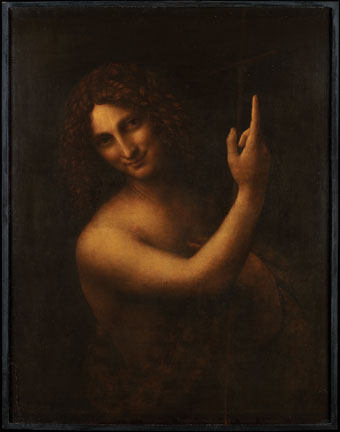
Leonardo's John the Baptist
The Palazzo Venezia has had an art exhibit running this month displaying various art forms depicting various saints of Europe, including on loan from the Louvre Leonardo da Vinci’s John the Baptist. A small group of us from the Lay Centre decided to go on the penultimate night of the exhibit, which was free and open until midnight.
The display was organized into rooms depicting the progression of sainthood around the needs of the times and the kind of saints honored, starting with biblical figures, then martyrs, monastics, confessors, theologian-bishops, founders of orders, the ‘military saints’ (George, Michael, etc), royalty, and those martyred in the struggles of church (grace) and state (power), such as Jean d’Arc or Thomas More.
The art chosen focused on those who were patron saints of the nations of Europe, and from a variety of media: icons, stained glass, sculpture, carving, oil on canvas, illuminated manuscripts, even old black and white films.
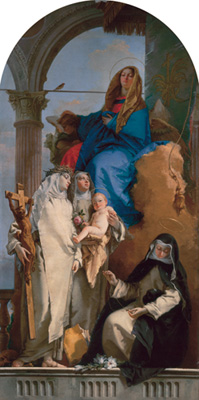
Madonna with Catherine of Siena, Rose of Lima, and Agnes of Montepulciano (Giambattista Tiepolo)
Did you know that Europe, as a continent, has six patron saints? Three male and three female, three from the first millennium and three from the second: Benedict of Norcia, Cyril and Methodius of Thessalonica, Birgitta of Sweden, Caterina of Siena, and Teresa Benedicta of the Cross (Edith Stein). Each nation then has its own patron saint(s) – some with as many as 10!
Dimitrios and I finished some time before the others, so we had a chance to discuss the exhibit, the nature of Greece’s concerns with the name chosen by the Former Yugoslav Republic of Macedonia, and apophatic gelato – which prompted a debate about the distinction between that and kataphatic gelato, scholastic gelato, and postmodern gelato. Needless to say we took a detour to La Palma when Kassim, Greg and Karina joined us!
As it turns out, we were not the only ones who waited till the last weekend to go: Pope Sneaks Out of Vatican to Visit Exhibit
Theologian of the Papal Household
His study has a view of a small courtyard where the papal guillotine once stood, and where a pillar likely used for the flogging of heretics and criminals can still be seen. The corridor leading from his office is lined with Roman tombstones, and the Swiss Guard are omnipresent with full regalia and halberds. Once known as the Master of the Sacred Palace, the Theologian of the Papal Household has four large paintings in his room each depicting miniature portraits of his nearly 100 predecessors (all Dominicans), starting with St. Dominic himself.

Fr. Wojciech Giertych, OP, Theologian of the Papal Household
Fr. Wojciech Giertych, OP was appointed in December of 2005 by Pope Benedict XVI, and is just beginning his fifth of a five-year term of office. A Polish Dominican born and raised in London, he describes himself as a true “prisoner of the Vatican”, albeit in a gilded cage. Outspoken, jovial, and unafraid to tell it how it is, Fr. Giertych shared with the lay centre residents his thoughts on Thomas, on theology and philosophy, the vocation of the laity, the challenge of contemporary religious life, contemporary challenges arising from the “crisis of 1968” (not Vatican II, note) including relativism, and the practical life of a Vatican officer.
One might be inclined to ask, “Why does the pope need a theologian?” especially a pope like Benedict, the first theologian to be elected pope in a couple centuries. Traditionally, there were three duties ascribed to the office: Offering theological instruction to the papal court (back when most of the court were not monsignori with doctorates in theology, philosophy, or canon law), reviewing any theological books published in Rome, and vetting the papal addresses (especially important at a time when most popes were politicians, warriors, or, worse, nobility).
Now, this means reviewing the drafts of papal allocutions drafted by the staff of Vatican speech writers, though he is neither the first nor the last word on the matter. And, Fr. Wojtech points out, his role is to examine theological content and look for phrases that could be misunderstood, especially by mass media – not to judge the prudence of an address (questions around Regensburg were raised). The most interesting papal addresses are the ones he does not see – those that the pope prepares personally: in Benedict’s case, his encyclicals, major homilies, and annual advent address to the Roman Curia. Given how much is written for the pope, it is like having a graduate seminar with Professor Ratzinger almost every day – even if the personal meetings are less often.
Occasionally the various dicasteries in the curia ask him for theological input on a document, and he serves as consultor to the Congregation for the Doctrine of the Faith. In one of the oldest continuously operating bureaucracies on the planet, he’s one man serving in an office consisting of only himself. It can be hard to tell what effect his work is having without the constant interaction of peers. This touches on one of the challenges for a friar used to life in community, used to working and living in constant contact and consultation with other people, now working in a more solitary position.
He did get invited to lunch with the pope, once. It is fairly common knowledge that Pope Benedict normally prefers to eat alone or with the sisters who prepare his meals – understandable for an introvert in an intensely public office! However, when a film crew came in to film a “day in the life of the pope” for international TV consumption, it happened that the Holy Father would be seen having a ‘working lunch’ with three members of the papal family, including, as it happens, Fr. Giertych. (“A great, open conversation. We three had wine, while the pope had juice”) As it was viewed around the world, some cardinals expressed how lucky our Friar Preacher was – even they had never had lunch with the pope!
“Never mix theology and philosophy, because philosophy always wins.” Despite the irony of such a statement from a Thomist, or perhaps because of it, this comment alone sparked a conversation that continued with some of us well after Fr. Wojciech left for the evening. While philosophy – in the broad sense of all the ‘sciences’ and other disciplines – can serve the church and our study of theology, they should never be confused as if they are theology, or as if the revelation of the Word should be judged according to the criterion of philosophy, politics, or social sciences. When this happens you end up getting the problems that, for him, have stemmed especially from 1968, and include the identification of the faith with one political party (‘as a good Catholic you must vote for candidate X or party Y’), the revision of the life of faith to fit in with what people expect from other fields, and end up with relativism (‘there may be a Truth, but we can’t know the Truth, so you have your truth and I have my truth’).
The conversation got really interesting as we delved into the vocation, identity, and relationships of the laity, clergy, and religious. Religious should be visible in the world, and laity should be “discreet” (leaven in the world, to use another phrase) – and we have had trouble with religious being more like laity and laity being more like religious. Specifcally, he noted some religious orders without habits of any kind (“it doesn’t matter what kind: a modern habit or a medieval habit or a 19th century habit”) living in apartments where you can hardly find them, or some of the lay movements whose first order of business seems to be deciding what kind of habit to design – and the more medieval the better!
When I asked about lay people serving in ministry positions, his response was about people wanting to be the lector all the time, or spend all their time helping at the church because something is amiss in their real life or they do not understand that the primary lay ministry is in the world, not collecting money at mass or something, “don’t spend your life holding on to the sacristy door”. But what about lay people serving the church in a paid, full time manner? Even the Roman curia has lay ministers in its employ?
“Well, of course the church will always need administrative personnel, computer technicians, finance experts, people to manage the facilities – especially in places where the church is burdened with such institutions as schools and hospitals”. Pastors should not be “running the plant”, but should be engaged in sacramental and pastoral ministry. But even this was more about ‘secular’ jobs that one could do for the church or for another entity, not so much ecclesial vocations; we tried a different track: We are here in Rome, studying at pontifical universities, to get ecclesiastical degrees – what would he expect for us to do with them?
“We have a saying in Poland: man cannot live on theology alone!” As a lay person you should be thinking of making a living, to support a family, you cannot do this with a theology degree. You cannot come from a degree and demand a job from the bishop – he may not have the money. [Can you imagine anyone demanding a job from a bishop???] We need the people (mentioned above) to be theologically trained, but it should be a secondary to your primary education. He shared his experience fromPoland, where a degree is a civil, legal contract – maybe in that system there is a “demand” to be employed in the field. But he wondered most people studying in Poland for theology degrees should have instead been studying harder subjects like medicine or law, but admitted that each country is different: “We have 100 friars living at the monastery in Krakow, 14 masses a day, confessions with two-hour waiting lines” and no experience of a non-ordained person devoting their life to the church outside of a religious community.
“I’d rather see thirty ‘normal’ people give one hour a week, than to pay one person for thirty hours a week, if that person does not have the best formation…” But, he admits he may be wrong as he quoted the Dominican Cardinal Yves Congar, who wrote after being dragged to Rome to be questioned in the 1950’s, wrote in his journals “I may be getting the answers wrong, but these are real questions – and that’s what enervates these people here in Rome!” He was asking questions about the laity and ministry and looking to scripture and the patristic sources for answers. We have to keep asking these real questions, even if it takes time to get the right answers; that is better than ignoring the problems!
Mario López Barrio, SJ and Ignatian Spirituality
Former Jesuit provincial in Mexico, Padre Mario López Barrio, SJ and a small contingent of Mexican Jesuits from the Pontifical Gregorian university joined us tonight for mass and community evening. Though it may seem that the reason for their visit was the personal serenade for David and his visiting girlfriend, the real point of Fr. Lopez Barrio’s conversation was about St. Ignatius and the Spiritual Exercises.
It’s a Small (Catholic) World After All
I think John Allen, Jr. said that if you stand in the same place in Rome long enough, you will meet every Catholic you have ever known, or at least someone who knows them.
Nancy left for home on Thursday after three weeks here in Italy, and I spent the next day sleeping to recover from vicarious jetlag! As Sunday approached I had not yet decided where I would be worshipping in my quest to pray in as many of Rome’s different churches as possible (without becoming just a liturgical tourist). So when Donna asked me to deliver some propaganda for Lay Centre events to the “Caravita”, the oratory of St. Francis that Nancy and I had been to a couple weeks ago, I agreed, still thinking I should be going somewhere new.
The Spirit works in little ways too.
When I arrived at del Caravita, I looked around for someone to ask about the material – where to put it, if we could announce the events, etc. As I watched two people seemed to be the “go-to” folk, one was a woman clearly preparing to serve as lector, and the other a tall, thin, bald guy who seemed to know everyone. So, i approached him with, “you seem to know whats going on around here, who would I talk to about this?” He offers to introduce me to the lector, “Cindy”, who would know. Here’s a transcript:
Me: Hi, my name is AJ Boyd, and I’m from…
Cindy: Oh my God! You’re AJ! I’m Cindy… Me: [Shocked expression] Cindy: …Woodin!
Me: Oh that Cindy!
Cindy: So you’re at the Angelicum right? Are you in Don’s class [indicating tall, thin, bald guy]?
Me: No, I just met him.
Cindy: He’s teaching a course on Methodism, and he’s just been named bishop of Saskatoon…
Me: That’s Don Bolen?! I didn’t recognize him! I am taking his class… it starts tomorrow.
Ok, so it was more comical in real life. Cindy is a college friend of one of my parishioners from St. Brendan, and when I decided to come to Rome, she decided to put the two of us in touch. Cindy and I had been exchanging sporadic emails since July, and just had not yet met in person. She has lived in Rome for 20 years as part of the Catholic News Service Vatican Bureau.
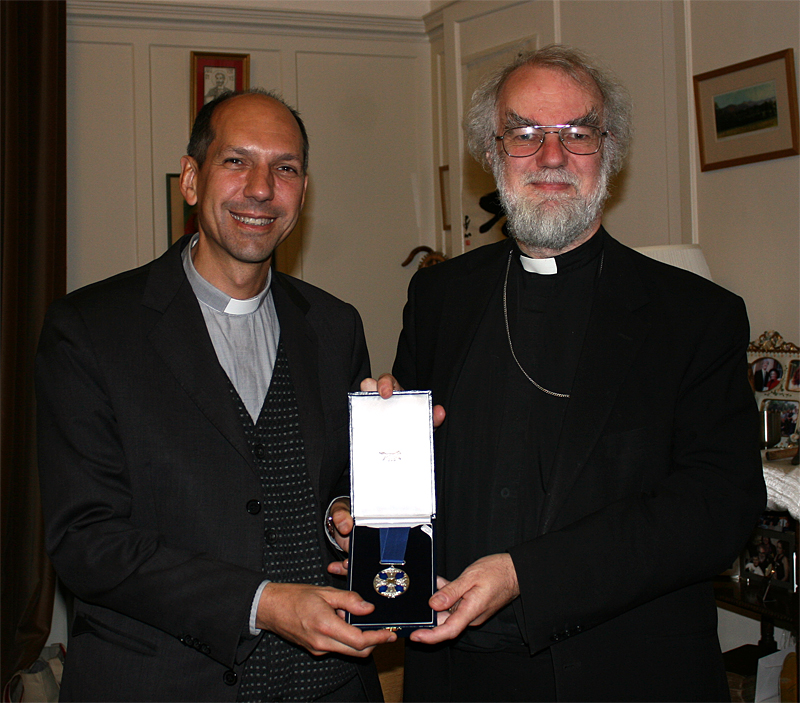
Monsignor Don Bolen recieving the Cross of St. Augustin from Archbishop Rowan Williams
Monsignor Don Bolen is the vicar general of the Archdiocese of Regina, Saskatchewan, Canada, and former staff of the Anglican/Methodist desk at the Pontifical Council for Promoting Christian Unity. Over Christmas break his election as bishop was announced, which I followed and even posted on Facebook. He’s teaching the second half of our course, Methodism and its Dialogue with the Catholic Church. He was the presider and homilist for the Sunday Eucharist, and was clearly loved by the people who had known him there from his time in Rome.
First impressions – after one mass and one class – is that the people of Saskatoon are blessed among Canadians. Home of the Prairie Centre for Ecumenism, it seems like a great fit, and any diocese would welcome a bishop who is so genuine, humble, intelligent and obviously a gifted ecumenist. A good preacher and teacher too!
Roman Weather, Translated
I had to share the following email from a friend and fellow Lay Centre resident. Just another sign of the cultural encounter living in Rome:
Our local weather forecast from the American “weather.com”:
Rome: Windy, rain.
But when you click on the Rome weather forecast from the big Italian weather website, they say that the forecast is:
PEGGIORAMENTO, marcata fase perturbata e ventosa per Capodanno.
LAZIO PROSSIMI GIORNI: Il vento di Ponente sarà il vero protagonista dell’avvio del 2010 e sono attese mareggiate piuttosto consistenti sulle zone costiere esposte. Si avrà un calo termico, che potrà favorire qualche nevicata sui monti appenninici. Il freddo diverrà maggiore nel week-end, quando tuttavia si attende un temporaneo miglioramento con ampi rasserenamenti.Which roughly means:
A WORSENING, with markedly disrupted (perturbed) phases and windiness for the New Year.
LAZIO in the coming days: The West Wind will be the real protagonist of the start of 2010, and expectations are for quite large storm surges on exposed coastal areas. There will be a thermal drop, which may encourage some snow on the Apennines. The cold will become even greater during the weekend, however, when a temporary improvement is expected, with ample clearing (literally: ample re-serenity-making).
PS: I am way behind on updating posts, so you’ll get most of the Christmas holiday updates in one fell swoop when i edit and upload pictures; we are off to Assisi tomorrow for a couple days so it will be after that! Do not forget to look for “older” posts that might show up later!
New Year’s in Rome: Best View in the City!
It rained, it poured; God provided his own fireworks display. So, we stayed indoors with a simple dinner and watched Angels and Demons to identify landmarks and pull apart Dan Brown’s ignorance of conclave procedures! Just in time for the display at the Colosseo though, the rain let up and we went up to the terrace. It is as if they planned them just for us!
Here are a couple clips that Nancy filmed from my window – the show starts about 20 seconds into the first one. They are literally firing them off just at the edge of our gardens; no zoom necessary.
[OK, it seems i cannot embed videos without an upgrade. I will load them to YouTube, which you can access here.]
 The Ecumenism Blog