
Home » Posts tagged 'ecumenism' (Page 7)
Tag Archives: ecumenism
Papal Ecumenical Vespers on the Conversion of St. Paul
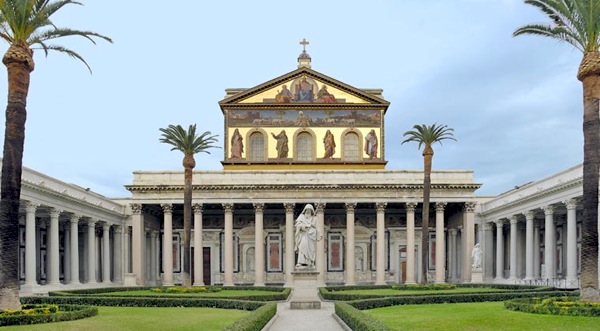
Papal Basilica of St. Paul Outside the Walls
The closing of the very busy Week of Prayer for Christian Unity every year in Rome is the Papal Ecumenical Vespers (Evening Prayer) at the Patriarchal Basilica of St. Paul Outside the Walls. Built over the tomb of St. Paul, re-confirmed by tests revealed at the end of the Year of Paul last summer, and administered by Abbot Edmund Power and the Benedictine Abbey there, the basilica is known for its ecumenical significance.
In fact, it was at the end of this very service on 25 January 1959, closing the Week of Prayer for Christian Unity, that Pope John XIII announced his intention to convene the Second Vatican Council, making very clear that ecumenism was to be one of the major themes of the council, along with the aggiornamento of the Church and a reconciled engagement with the modern world.
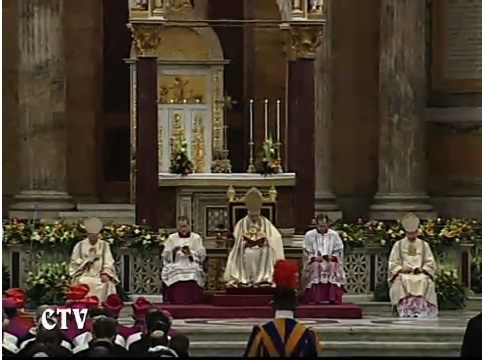
Pope Benedict XVI presiding at Ecumenical Vespers for the Week of Prayer for Christian Unity
This year, probably Cardinal Walter Kasper’s last as President of the Pontifical Council for Promoting Christian Unity, Pope Benedict XVI made special note of the 100th anniversary of the 1910 World Missionary Conference in Edinburgh, which marks the beginning of the modern ecumenical movement.
The basilica is outside the walls of the historic city centre, but only a few stops away by metro. Between exams and bad weather, and limited tickets, only a few of us from the Lay Centre were able to attend: Andrea, an Italian canon law student; Anna, our New Zealand liturgy student, and myself in one section; with our three Orthodox housemates Theodosius, Dimitrios, and Radmilo, escorted to the front as scholars of the Pontifical Council for Christian Unity.
The readings and prayers of intercession were all offered by ecumenical guests and leadership, including the Archbishop of Canterbury’s permanent representative to the Holy See, Very Rev. David Richardson of the Anglican Centre in Rome.
The Holy Father’s homily is included in full below.
****
Dear Brothers and Sisters,
Gathered together in this fraternal liturgical assembly, on the Feast of the Conversion of St Paul, today we conclude the annual Week of Prayer for Christian Unity. I greet all of you warmly, in particular Cardinal Walter Kasper, President of the Pontifical Council for Promoting Christian Unity, and the Archpriest of this Basilica, Archbishop Francesco Monterisi, along with the Abbot and the Community of monks whose guests we are. I also extend my cordial thoughts to the Cardinals here present, to the Bishops and to all who represent the Churches and ecclesial Communities of this City who are here today.
Only a few months have passed since the conclusion of the Year dedicated to St Paul, which gave us an opportunity to deepen our awareness of his extraordinary work as a preacher of the Gospel and also of our call to be missionaries of the Gospel, as the theme of the Week of Prayer for Christian Unity reminds us “You are witnesses of these things” (Lk 24: 48).
Paul, although he retained an intense memory of his own past as a persecutor of Christians, did not hesitate to call himself an Apostle. For him, the basis of that title lay in his encounter with the Risen One on the road to Damascus, which also became the beginning of his tireless missionary activity. In this he was to spend every ounce of his energy, proclaiming to all the peoples the Christ whom he had met personally.
Thus Paul, from being a persecutor of the Church, was in his turn to become a victim of persecution for the sake of the Gospel to which he witnessed: “Five times I have received at the hands of the Jews the forty lashes less one. Three times I have been beaten with rods; once I was stoned…. On frequent journeys, in danger from rivers, danger from robbers, danger from my own people, danger from Gentiles, danger in the city, danger in the wilderness, danger at sea, danger from false brethren; in toil and hardship, through many a sleepless night, in hunger and thirst, often without food, in cold and exposure. And, apart from other things, there is the daily pressure upon me of my anxiety for all the churches” (2 Cor 11: 24-25, 26-28). Paul’s witness reached its culmination in his martyrdom when, not so far from here, he was to give proof of his faith in Christ who conquers death.
The dynamic of Paul’s experience is clearly expressed in the pages of the Gospel that we have just heard. The disciples of Emmaus, after having recognized the Risen Lord, return to Jerusalem and find the Eleven gathered together with the others. The Risen Christ appears to them, comforts them, overcomes their fear and doubts, and eats with them. Thus he opens their hearts to the intelligence of the Scriptures, recalling what had to happen, which would constitute the nucleus of the Christian proclamation. Jesus affirms: “Thus it is written, that the Christ should suffer and on the third day rise from the dead, and that repentance and forgiveness of sins should be preached in his name to all nations, beginning from Jerusalem” (Lk 24: 46-47). These are the events to which the disciples of the first hour were to bear witness, followed by believers in Christ of all times and places. It is important, however, to emphasize that this witness, then just as now, is born from the encounter with the Risen One, is fed by a constant relationship with him and animated by a profound love for him. One can only be his witness if one has had the experience of feeling Christ alive and present “See my hands and my feet, that it is I myself” (Lk 24: 39) of sitting at table with him, of listening as he sets one’s heart aflame! For this, Jesus promises his disciples and each of us a powerful aid from on high, a new presence, that of the Holy Spirit, gift of the Risen Christ, who guides us to the whole truth: “And behold, I send the promise of my Father upon you” (Lk 24: 49). The Eleven were to spend their whole lives proclaiming the Good News of the death and Resurrection of the Lord. Almost all of them were to seal their witness with the blood of martyrdom, a fertile seed that has produced an abundant harvest.
The choice of the theme of this year’s Week of Prayer for Christian Unity the invitation, that is, to a common witness of the Risen Christ in accordance with the mandate he entrusted to his disciples is linked to the memory of the 100th anniversary of the Edinburgh Missionary Conference, in Scotland, widely considered a crucial event in the birth of the modern ecumenical movement.
In the summer of 1910, in the Scottish capital, over 1,000 missionaries from diverse branches of Protestantism and Anglicanism, who were joined by one Orthodox guest, met to reflect together on the necessity of achieving unity in order to be credible in preaching the Gospel of Jesus Christ. In fact, it is precisely this desire to proclaim Christ to others and to carry his message of reconciliation throughout the world that makes one realize the contradiction posed by division among Christians.
Indeed, how can non-believers accept the Gospel proclamation if Christians even if they all call on the same Christ are divided among themselves? Moreover, as we know, the same Teacher, at the end of the Last Supper, had prayed to the Father for his disciples: “That they may all be one… so that the world may believe” (Jn 17: 21). The communion and unity of Christ’s disciples is therefore a particularly important condition to enhance the credibility and efficacy of their witness.
Now a century after the Edinburgh event, the intuition of those courageous precursors is still very timely. In a world marked by religious indifference, and even by a growing aversion to the Christian faith, it is necessary to discover a new, intense method of evangelization, not only among the peoples who have never known the Gospel but also among those where Christianity has spread and is part of their history. Unfortunately, the issues that separate us from each other are many, and we hope that they can be resolved through prayer and dialogue. There is, however, a core of the Christian message that we can all proclaim together: the fatherhood of God, the victory of Christ over sin and death with his Cross and Resurrection, and faith in the transforming action of the Spirit.
While we journey toward full communion, we are called to offer a common witness in the face of the ever increasingly complex challenges of our time, such as secularization and indifference, relativism and hedonism, the delicate ethical issues concerning the beginning and end of life, the limits of science and technology, the dialogue with other religious traditions. There are also other areas in which we must from now on give a common witness: the safeguard of Creation, the promotion of the common good and of peace, the defense of the centrality of the human person, the commitment to overcome the shortcomings of our time, such as hunger, poverty, illiteracy, and the unequal distribution of goods.
The commitment to unity among Christians is not the work of a few only, nor is it an incidental undertaking for the life of the Church. Each one of us is called to make his or her contribution towards the completion of those steps that lead to full communion among the disciples of Christ, without ever forgetting that this unity is above all a gift from God to be constantly invoked. In fact, the force that supports both unity and the mission flows from the fruitful encounter with the Risen One, just as was the case for St Paul on the road to Damascus, and for the Eleven and the other disciples gathered at Jerusalem.
May the Virgin Mary, Mother of the Church, grant that her Son’s desire may be fulfilled as soon as possible: “That they may all be one… so that the world may believe” (Jn 17: 21).
© Copyright 2010 — Libreria Editrice Vaticana
Witness through Hospitality: WPCU Day #8
From the official material prepared by the World Council of Churches and the Pontifical Council for Promoting Christian Unity
Scripture
Genesis 18:1-8, Let me bring a little bread, that you may refresh yourselves.
Psalm 146, He who gives justice to the oppressed and gives food to the hungry.
Romans 14:17-19, Pursue what makes for peace and mutual edification.
Luke 24:41-48, Then he opened their minds to understand the scriptures.
Meditation
Today, electronic communication has made us neighbors in one small and overloaded planet. As in the time of Luke, many peoples and communities have had to leave their homes, wandering and journeying to strange lands. People of the world’s great faiths have arrived bringing new beliefs and cultures to our communities.
In the Week of Prayer for Christian Unity we recognize in our shared journey towards unity the hospitality and companionship of Christians of all churches. Christ also calls us to both offer and to receive the hospitality of the stranger who has become our neighbor. Surely, if we cannot see Christ in the other, then we cannot see Christ at all.
The story in Genesis describes how Abraham receives God in opening his house and offering hospitality to strangers. The God of all creation also stands with the prisoner, the blind, the stranger. Our psalm is an offering of praise for God’s everlasting faithfulness and all that God has done for us.
The text from Romans reminds us that the kingdom of God comes about through justice and peace and joy in the Holy Spirit.
The resurrected Christ brings his disciples together, eats with them and they recognize him again. He reminds them of what the scriptures said about him and explains what they did not understand before. Thus, he frees them from their doubts and fears and sends them out to become witnesses of these things. In creating this space for encounter with him he enables them to receive his peace, that implies justice for the oppressed, care for the hungry and the mutual up-building as the gifts of the new world of the resurrection. Christians throughout history have found the risen Lord as they have served others and been served by others in faith, so we too can encounter Christ when we share our lives and our gifts.
Prayer
God of love, You have shown us your hospitality in Christ. We acknowledge that through sharing our gifts with all, we meet you. Give us the grace that we may become one on our journey together and recognize you in one another. In welcoming the stranger in your name may we become witnesses to your hospitality and your justice. Amen.
Reflection Questions
To what extent is the country in which you live hospitable to the stranger?
How in your own neighborhood can the stranger find hospitality and a space to live?
How might you show gratitude for those who have shown you hospitality by being available?
How does the cross show us that God’s hospitality is a hospitality lived out in total self-giving?
Witness through Hope and Trust: WPCU Day #7
From the official material prepared by the Pontifical Council for Promoting Christian Unity and the World Council of Churches:
Scripture
Job 19:23-27, God whom I shall see on my side.
Psalm 63, My soul thirsts for You.
Acts 3:1-10, What I have, I give you.
Luke 24:36-40, The disciples were startled and terrified.
Meditation
During their journey in life and faith, all Christians experience moments of doubt. The challenge faced by Christians is to continue to believe that even when they do not see or feel God, God remains with them. The virtues of faith, hope and trust allow them to give witness that their faith goes beyond their own possibilities.
The character Job gives us an example of someone who faced difficult trials and tribulations and even argued with God. In faith and hope however, he believed that God would remain on his side. This reliance and conviction is also shown by the actions of Peter and John in the account with the lame man as told in Acts. Their belief in the Name of Jesus allows them to witness powerfully to all who were present. Today’s psalm is a prayer reflecting our deep desire for God’s steadfast love.
Our meeting during this Week of Prayer for Christian Unity allows our communities to grow in shared faith, hope and love. We bear witness to God’s steadfast love to all people, and God’s faithfulness to the one church we are called to be. The more we witness together, the stronger our message will be.
Prayer
God of hope, share Your vision of the one church with us, and overcome our doubts. Increase our faith in your presence, that all who profess belief in you may worship together in spirit and in truth. We especially pray for all who are in doubt right now, or whose lives are spent in the shadow of danger and fear. Be with them and give them your consoling presence. Amen.
Reflection Questions
How do you deal with your own fears and doubts?
How might you be a cause of fear and anxiety for others by your behaviour?
When have you faced up to your own fears and doubts and so given witness to your faith in Christ by overcoming these difficulties?
How may Christian communities encourage one another in faith and hope?
Witness through Faithfulness to the Scriptures: WPCU Day #6
From the official material prepared by the Pontifical Council for Promoting Christian Unity and the World Council of Churches:
Scripture
Isaiah 55:10-11, The word that goes forth from my mouth does not return to me empty.
Psalm 119:17-40, Open my eyes that I may see the wonders of your Law.
2 Timothy 3:14-17, All scripture is inspired by God.
Luke 24:28-35, Jesus opens the Scriptures to His disciples.
Meditation
Christians encounter God’s Word in a privileged way through reading the Sacred
Scriptures and celebrating the sacraments. In faithfully listening to the proclamation of Holy Scripture, and by prayerfully reading the various books of the Bible, they open their hearts and minds to receive the very Word of God. Jesus promised His disciples that He would send the Holy Spirit to make them understand the Word of God, and to guide them in all truth.
Historically, Christians have been divided in reading and understanding the Word of God. Fortunately, in recent times, in their search for unity, Sacred Scripture has brought Christians closer to one another. Shared Bible study has become a major means of growing together among them. The Christian journey that we celebrate during this Week of Prayer for Christian Unity is one that is firmly rooted in our shared listening to God’s Word, trying together to understand and to live it.The prophet Isaiah reminds us that God’s Word powerfully proclaimed is indeed effective and operative. It does not return to God empty but succeeds in the purpose for which He sent it.
This message is repeated in the words addressed to Timothy, as he is directed to believe in the efficacy of the Scriptures by which the faithful are equipped for every good work. Our psalm gives praise for God’s words and statutes and implores God to give understanding, that we may keep the Holy Law with our whole heart.
During this Week of Prayer for Christian Unity we pray that all Christians may enter more deeply into the mystery of God’s wonderful revelation as it comes to us in Holy Scripture. We ask the Holy Spirit to help us better comprehend the Word of God and to direct us on our common journey of faith until we will all be gathered again around the one table of the Lord.
Prayer
God, we praise and thank you for your saving Word as it reaches out to us through the Sacred Scriptures. We thank you too for the brothers and sisters with whom we share your Word and discover together the abundance of Your love. We pray for the light of the Holy Spirit, so that Your Word may lead and direct us in our quest for greater unity. Amen.
Reflection Questions
What are the passages of Scripture that mean most to you?
Who or what in your life makes your heart burn with a passion for the gospel and a desire to give witness to Christ?
Which passages from the Scriptures have helped you to better understand the witness of other Christians?
How may our churches use the Scripture more effectively in their daily life and prayer?
Witness through suffering: WPCU Day #5
From the official material prepared by the Pontifical Council for Promoting Christian Unity and the World Council of Churches:
Scripture
Isaiah 50:5-9, The one who vindicates me is near.
Psalm 124, Our help is in the name of the Lord.
Romans 8:35-39, God’s love shown forth in Jesus Christ.
Luke 24:25-27, He interpreted to them the things about himself.
Meditation
The reality of suffering is something that the Prophet Isaiah speaks about forcefully in today’s text, in which he reminds us that God is never resigned to seeing humanity suffer. In response the Psalm proclaims the trust that believers must maintain in their Savior.
The letter to the Romans proclaims the certainty that love is always strongest and that suffering and sorrow will never prevail. For before offering the resurrection to the world, Christ entered into a terrible death and into the dark depths of the tomb so as to be completely with us at our very lowest ebb.
In the Lord’s footsteps, Christians who seek full unity show their solidarity to those amongst them who are confronted in their lives with tragic situations of suffering, by confessing that love is stronger than death. And that it was from the extreme humiliation of the tomb that resurrection came like a new sun for humanity; a clamoring annunciation of life, forgiveness and immortality.
Prayer
God our Father, look with compassion on our situations of poverty, suffering, sin and death, we ask you for forgiveness, healing, comfort and support in our ordeals. We give you thanks for all who manage to see light in their affliction. May your divine Spirit teach us the greatness of your compassion and help us stand alongside our sisters and brothers in difficulty. Filled with its blessings, may we in unity proclaim and share with the world the victory of your Son who lives for ever. Amen.
Reflection Questions
How can you show empathy to those who suffer and are in difficulties?
What wisdom and deeper understanding have you gained through suffering you have known in your own life?
How do you live out solidarity with the suffering and oppression that so many people living in poverty in our world experience, and what is your own experience of it?
How would you bear witness to the mercy of God and to the hope you find in the light of the cross of Christ?
Theologian of the Papal Household
His study has a view of a small courtyard where the papal guillotine once stood, and where a pillar likely used for the flogging of heretics and criminals can still be seen. The corridor leading from his office is lined with Roman tombstones, and the Swiss Guard are omnipresent with full regalia and halberds. Once known as the Master of the Sacred Palace, the Theologian of the Papal Household has four large paintings in his room each depicting miniature portraits of his nearly 100 predecessors (all Dominicans), starting with St. Dominic himself.

Fr. Wojciech Giertych, OP, Theologian of the Papal Household
Fr. Wojciech Giertych, OP was appointed in December of 2005 by Pope Benedict XVI, and is just beginning his fifth of a five-year term of office. A Polish Dominican born and raised in London, he describes himself as a true “prisoner of the Vatican”, albeit in a gilded cage. Outspoken, jovial, and unafraid to tell it how it is, Fr. Giertych shared with the lay centre residents his thoughts on Thomas, on theology and philosophy, the vocation of the laity, the challenge of contemporary religious life, contemporary challenges arising from the “crisis of 1968” (not Vatican II, note) including relativism, and the practical life of a Vatican officer.
One might be inclined to ask, “Why does the pope need a theologian?” especially a pope like Benedict, the first theologian to be elected pope in a couple centuries. Traditionally, there were three duties ascribed to the office: Offering theological instruction to the papal court (back when most of the court were not monsignori with doctorates in theology, philosophy, or canon law), reviewing any theological books published in Rome, and vetting the papal addresses (especially important at a time when most popes were politicians, warriors, or, worse, nobility).
Now, this means reviewing the drafts of papal allocutions drafted by the staff of Vatican speech writers, though he is neither the first nor the last word on the matter. And, Fr. Wojtech points out, his role is to examine theological content and look for phrases that could be misunderstood, especially by mass media – not to judge the prudence of an address (questions around Regensburg were raised). The most interesting papal addresses are the ones he does not see – those that the pope prepares personally: in Benedict’s case, his encyclicals, major homilies, and annual advent address to the Roman Curia. Given how much is written for the pope, it is like having a graduate seminar with Professor Ratzinger almost every day – even if the personal meetings are less often.
Occasionally the various dicasteries in the curia ask him for theological input on a document, and he serves as consultor to the Congregation for the Doctrine of the Faith. In one of the oldest continuously operating bureaucracies on the planet, he’s one man serving in an office consisting of only himself. It can be hard to tell what effect his work is having without the constant interaction of peers. This touches on one of the challenges for a friar used to life in community, used to working and living in constant contact and consultation with other people, now working in a more solitary position.
He did get invited to lunch with the pope, once. It is fairly common knowledge that Pope Benedict normally prefers to eat alone or with the sisters who prepare his meals – understandable for an introvert in an intensely public office! However, when a film crew came in to film a “day in the life of the pope” for international TV consumption, it happened that the Holy Father would be seen having a ‘working lunch’ with three members of the papal family, including, as it happens, Fr. Giertych. (“A great, open conversation. We three had wine, while the pope had juice”) As it was viewed around the world, some cardinals expressed how lucky our Friar Preacher was – even they had never had lunch with the pope!
“Never mix theology and philosophy, because philosophy always wins.” Despite the irony of such a statement from a Thomist, or perhaps because of it, this comment alone sparked a conversation that continued with some of us well after Fr. Wojciech left for the evening. While philosophy – in the broad sense of all the ‘sciences’ and other disciplines – can serve the church and our study of theology, they should never be confused as if they are theology, or as if the revelation of the Word should be judged according to the criterion of philosophy, politics, or social sciences. When this happens you end up getting the problems that, for him, have stemmed especially from 1968, and include the identification of the faith with one political party (‘as a good Catholic you must vote for candidate X or party Y’), the revision of the life of faith to fit in with what people expect from other fields, and end up with relativism (‘there may be a Truth, but we can’t know the Truth, so you have your truth and I have my truth’).
The conversation got really interesting as we delved into the vocation, identity, and relationships of the laity, clergy, and religious. Religious should be visible in the world, and laity should be “discreet” (leaven in the world, to use another phrase) – and we have had trouble with religious being more like laity and laity being more like religious. Specifcally, he noted some religious orders without habits of any kind (“it doesn’t matter what kind: a modern habit or a medieval habit or a 19th century habit”) living in apartments where you can hardly find them, or some of the lay movements whose first order of business seems to be deciding what kind of habit to design – and the more medieval the better!
When I asked about lay people serving in ministry positions, his response was about people wanting to be the lector all the time, or spend all their time helping at the church because something is amiss in their real life or they do not understand that the primary lay ministry is in the world, not collecting money at mass or something, “don’t spend your life holding on to the sacristy door”. But what about lay people serving the church in a paid, full time manner? Even the Roman curia has lay ministers in its employ?
“Well, of course the church will always need administrative personnel, computer technicians, finance experts, people to manage the facilities – especially in places where the church is burdened with such institutions as schools and hospitals”. Pastors should not be “running the plant”, but should be engaged in sacramental and pastoral ministry. But even this was more about ‘secular’ jobs that one could do for the church or for another entity, not so much ecclesial vocations; we tried a different track: We are here in Rome, studying at pontifical universities, to get ecclesiastical degrees – what would he expect for us to do with them?
“We have a saying in Poland: man cannot live on theology alone!” As a lay person you should be thinking of making a living, to support a family, you cannot do this with a theology degree. You cannot come from a degree and demand a job from the bishop – he may not have the money. [Can you imagine anyone demanding a job from a bishop???] We need the people (mentioned above) to be theologically trained, but it should be a secondary to your primary education. He shared his experience fromPoland, where a degree is a civil, legal contract – maybe in that system there is a “demand” to be employed in the field. But he wondered most people studying in Poland for theology degrees should have instead been studying harder subjects like medicine or law, but admitted that each country is different: “We have 100 friars living at the monastery in Krakow, 14 masses a day, confessions with two-hour waiting lines” and no experience of a non-ordained person devoting their life to the church outside of a religious community.
“I’d rather see thirty ‘normal’ people give one hour a week, than to pay one person for thirty hours a week, if that person does not have the best formation…” But, he admits he may be wrong as he quoted the Dominican Cardinal Yves Congar, who wrote after being dragged to Rome to be questioned in the 1950’s, wrote in his journals “I may be getting the answers wrong, but these are real questions – and that’s what enervates these people here in Rome!” He was asking questions about the laity and ministry and looking to scripture and the patristic sources for answers. We have to keep asking these real questions, even if it takes time to get the right answers; that is better than ignoring the problems!
Bearing witness through celebrating the faith we have received: WPCU Day #4
From the official material prepared by the World Council of Churches and the Pontifical Council for Promoting Christian Unity:
Scripture
Deuteronomy 6:3-9, The Lord is our God, the Lord alone.
Psalm 34, I will bless the Lord at all times.
Acts 4:32-35, Of one heart and soul.
Luke 24:17-21, But we had hoped…
Meditation
We have an enormous debt of gratitude to those whose faith has provided the foundation for our Christian lives today. Numerous men and women through their prayer, witness and worship have ensured that the faith is handed down to the next generations.
Today’s readings affirm the importance of supporting the community of faith in order to ensure the dissemination of the Word of God. The passage from Deuteronomy gives us the beautiful prayer of our Jewish sisters and brothers who every day use these words to praise God. The Psalm invites us to bear witness through praise for what we have received as believers, so that our faith may be shown through glorifying and thanksgiving. The extract from Acts reveals a community united in faith and charity. The gospel passage shows us Jesus as the center of what we have received in faith.
As we unite with our Christian brothers and sisters in praying for unity during this week, we welcome the rich variety of our Christian heritage. We pray that awareness of our common heritage may unite us more closely as we progress in faith.
Prayer
Lord God, we give you thanks for all the people and communities who have communicated the message of the Good News to us, and thus given us a solid foundation for our faith today. We pray that we too may together bear witness to our faith, so that others may know you and place their trust in the truth of salvation offered in Jesus Christ for the life of the world. Amen.
Reflection questions
Who inspired you in your faith?
What are the aspects of faith which inspire you in your everyday life?
What do you feel were the most important teachings which were passed on to you?
How can you recognize God at work with you in the transmission of faith the future generations?
Witness through Awareness: WPCU Day #3
From the official material prepared by the World Council of Churches and the Pontifical Council for Promoting Christian Unity:
Scripture
1 Samuel 3:1-10, Speak, Lord, your servant is listening.
Psalm 23, The Lord is my Shepherd.
Acts 8:26-40, Philip proclaimed to him the Good News about Jesus.
Luke 24:13-19a, …their eyes were kept from recognizing him.
Meditation
Growing in faith is a complex journey. It is easy to miss God’s revealing love to us in our everyday life and experiences. The more pressure and activity we surround ourselves with, then the greater the possibility of overlooking what is in fact before our very eyes. Like the two disciples in the gospel, we sometimes think we know what is real, and try to explain our view to others, yet we are not aware of the full truth. In our world today we are invited to be aware of God in the surprising and unlikely events of life.
In our Old Testament reading, we hear how God calls and invites Samuel to bear witness. Samuel first of all has to hear this word. Hearing requires an open disposition and a willingness to listen to God.
This desire to hear God’s Word is also experienced by both Philip and the Ethiopian in the reading from Acts. They witness to their faith by responding to what is asked of them at that precise moment in time. They listen attentively and respond accordingly. The psalm of the Good Shepherd reflects the quiet trust of the one who is aware of the tender care of God, who gathers the flock and leads them to green pastures.
During this Week of Prayer for Christian Unity, we seek to be aware of God in our everyday events and experiences. We meet people who are familiar and others who are strangers. In these encounters we learn from each other’s spiritual experiences and so get a new view of God’s reality. This awareness of God’s presence challenges us to work for Christian unity.
Prayer
Lord Jesus, Good Shepherd, You encounter us and remain with us in everyday life. We pray for the grace to be aware of all you do for us. We ask that you prepare us to be open to all you offer us and bring us together in one flock. Amen.
Reflection Questions
When have you been aware of God’s presence in your life? Are you aware of global celebrations and tragedies, and how might our churches together respond to these? Is being aware enough, or is there something more that you might do in order to give witness to your faith? How do you make yourself aware of God when the reality of God’s presence does not correspond to your expectations?
Witness through Sharing Stories; WPCU Day #2
From the official material prepared by the World Council of Churches and the Pontifical Council for Poromoting Christian Unity:
Scripture
Jeremiah 1:4-8, Go to all to whom I send you.
Psalm 98, Sing to the Lord a new song.
Acts 14:21-23, They strengthened the souls of the disciples.
Luke 24:13-17a, What are you discussing with each other while you walk along?
Meditation
Sharing our stories is a powerful way in which we give witness to our faith in God. Listening to one another with respect and consideration allows us to encounter God in the very person with whom we are sharing. The reading from Jeremiah offers us a powerful witness of God’s call to the prophet. He is to share what he has received, and so allow God’s Word to be heard and lived out. This call to proclaim God’s Word is also experienced by the disciples in the early Church, as witnessed to in the reading from Acts. Our psalm allows us to sing to God with a spirit of praise and thanksgiving.
Today’s gospel passage presents a Jesus who enlightens our blindness and dispels our disillusionment. He helps us to understand our stories within the one unfolding plan of God. During this Week of Prayer for Christian Unity, we listen to the faith stories of other Christians in order to encounter God in the variety of ways God’s very self is revealed to us. In listening with attentiveness we grow in faith and love. In spite of the diversity of our personal and collective witness, we find ourselves intertwined in the one story of God’s love for us revealed in Jesus Christ.
Prayer
God of history, we thank you for all who have shared their story of faith with us and so have given witness to your presence in their lives. We praise you for the variety of our stories both as individuals and churches. In these stories we see the unfolding of the one story of Jesus Christ. We pray for the courage and the conviction to share our faith with those with whom we come into contact, and so allow the message of your Word to spread to all. Amen.
Reflection Questions
Are you “gossiping the Gospel” or just gossiping?
How open are you or your church to be drawn into the stories of others?
How open are you to share with others your stories of faith, and so give witness to God’s presence in your personal experiences of life and of death?
Are you aware of the enormous potential for good that modern means of communication offer the Church today?
Witness through Celebrating Life; Week of Prayer for Christian Unity, Day #1
From the official material prepared by the Pontifical Council for Promoting Christian Unity and the World Council of Churches:
Scripture
Genesis 1:26-31, God saw all that he had made, and indeed, it was very good.
Psalm 104:1-24, O Lord, how manifold are your works.
Corinthians 15:12-20, If the dead are not raised, then Christ has not been raised.
Luke 24:1-5, Why do you look for the living among the dead?
Meditation
Our journey of Christian unity is firmly rooted in our common belief that in the resurrection of Jesus Christ, – we celebrate not only the life God has given us but the offer of new life through Jesus’ conquering death once and for all. As we meet together during this Week of Prayer for Christian Unity, we witness to our shared faith by our concern for the life of all.
The reading from the book of Genesis reminds us of the creative power and energy of God. It is this power and energy that St. Paul encounters in experiencing Jesus’ resurrection. He challenges the people of Corinth to put their total trust in the Risen Lord and his offer of new life. The psalm continues this theme as it proclaims the glory of God’s creation.
Our gospel passage challenges us to look for new life in the face of a culture of death that our world frequently presents to us. It encourages us to trust in Jesus’ power, and so to experience life and healing.
Today, we thank God for all that shows God’s love for us: for all of creation; for brothers and sisters in all parts of the world; for communion in love, for forgiveness and healing and for life eternal.
Prayer
God our creator, we praise you for all who give witness to their faith by their words and actions. In living life to the full we encounter your loving presence in the many experiences you offer us. May our common witness of celebrating life unite us in blessing you, the author of all life. Amen.
Reflection Questions
To what extent do your own witness and the witness of your church celebrate life? Will others know from your witness that Christ has been raised from the dead? What do you see as the areas of growth in your life? Are there things of the past that the churches cling to which ought to be laid to rest because of a new ecumenical consciousness?
 The Ecumenism Blog