
Home » Posts tagged 'ecumenism' (Page 6)
Tag Archives: ecumenism
Russian National Orchestra in the Vatican
How often is St. Peter’s Square turned into a parking lot? The cabbie that dropped us off said he has lived in Rome for half his life, and never seen it. But that was the sight that greeted us as we were dropped off at the Paul VI Auditorium for what promised to be an enjoyable afternoon out with the Holy Father (and a few other folk).
These two days have been celebrated as “Russian Culture Days at the Vatican”, one of the key public events of which was today’s concert by the Russian National Orchestra, a gift of the Russian Patriarch Kirill I to Latin Patriarch Benedict XVI.
Metropolitan Hilarion Alfeyev, the President of the Department for External Affairs of the Patriarch of Moscow (read: top ecumenist), personally presented the gift of the concert to His Holiness, which included a Symphony in Five Parts composed by the metropolitan himself. The concert included pieces by Rachmaninov, Rimski-Korsakov, and Musorgskij by the Russian National Orchestra; a variety of pieces by the Russian National Horn Choir, and another selection from Musorgskij and Rachmaninov with the Synod Choir of Moscow before all three combined for the final Symphony piece by Metropolitan Hilarion.
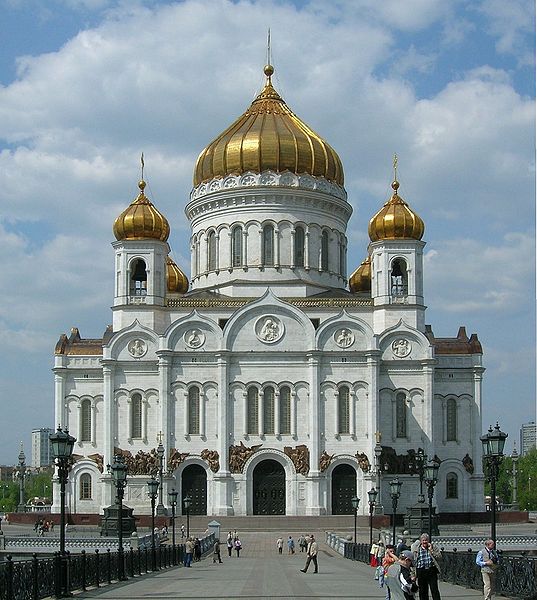
Cathedral of Christ the Savior, Seat of the Patriarch of Moscow and All Russia
On the way into the building, I kept getting saluted by the Swiss Guard. At first I kept looking to see if they were saluting everyone, or if some bishop was walking behind me. Eventually we figured that in my black suit with a small red Jerusalem cross in my lapel (a souvenir from my recent pilgrimage) they may have mistaken me for a Knight of the Holy Sepulcher! Not sure there are any this young, though!
As most know, I have an affinity for things Russian, including the music, so this was a special treat for me – to combine my love of Russia, ecumenism, the Church and the Vatican all into one event. We also got seats just behind and to the right of the Holy Father and the cardinals, which made it that much more exciting. This was my first time inside the Paul VI auditorium, which can seat about 6000 people, and which is entirely powered by solar panels on the roof.
There is no question that, with the election of Benedict XVI and even more so with the election of Kirill I, relations between Rome and Moscow have thawed considerably. We continue to pray for the unity of the world’s largest Orthodox Church and the Catholic Church, and look forward to fruits of dialogue even more beautiful than an afternoon’s concert!
Indulgences as Ecumenical Barometer
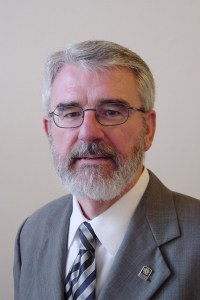
Prof. Michael Root
Leave it to a Lutheran to research and understand indulgences to the point that he probably knows more about them than any Catholic other than the Major Penitentiary himself. Not just any Lutheran, of course, but Professor Michael Root, a lay ecclesial minister and theologian-ecumenist of the Evangelical Lutheran Church in America. I have had the pleasure of meeting Dr. Root and listening to him on a few occasions – at Oberlin for the F&O anniversary, in Graymoor for a USCCB institute, and at a NWCU or two over the years.
He was in Rome to teach an intensive course at the Gregorian on eschatology in ecumenical perspective (which the Angelicum ecumenism students never heard about until after the fact) and he spoke at the Centro Pro Unione this afternoon. For as high-caliber a presentation as this was, attendance was dismal, I am sad to say, perhaps because of good weather combined with the laissez-faire approach to communication in the Eternal City (“Why is it called the Eternal City? Because that’s how long everything takes!”)
Nevertheless, Professor Root presented a finely honed bit of research on the development of the idea of indulgences in the Catholic Church, its perception and reception in ecumenical encounter and dialogue, and suggested that some of the most recent language of the Church on indulgences is palatable even to Lutheran seminarians! We have come a long way since the Reformation.
Despite these deep changes in indulgence theology, one can still find holy cards printed with actual numbers of “days off” of purgatory for each indulgence, as if time exists in eternity! Most people, Catholic and Protestant alike, probably know nothing about the theory of indulgences that represents theology any more recent than the Reformation. Trent, if we are lucky.
In preparing for the Great Jubilee of 2000, Pope John Paul II had called together an ecumenical commission to advise on the preparations for the Jubilee. One of the points raised was the fact that another planning commission had announced a plenary indulgence for the Jubilee before considering its ecumenical impact, and apparently without applying the pope’s own theology of indulgences to the practice! It was what might be called a catechetical moment for some of the Jubilee planners, and the spark that ignited Prof. Root’s interest in the topic.
A small example of the development in indulgence theology and its slow reception was raised by a member of the audience. The Council of Trent banned the sale of indulgences more than 400 years ago, but even in the run up to the Jubilee 2000, the pope’s own Cathedral, San Giovanni Laterno, had prepared worship aids which included something along the lines of “the purchase of indulgences can be done through the following means…” Though there was no actual sale of indulgences, the language still reflected this idea some four centuries after it had been forbidden by the Catholic Church itself!
The text of the lecture itself will be far more valuable than my month old notes on it, but it does not seem to be online yet. Perhaps in the next copy of the Centro Pro Unione Bulletin. I will repost when available. It will be worth the read!
Vatican Radio Feature: Haven of Hospitality
Vatican Radio featured the Lay Centre today, after the celebration dedicating our new site yesterday evening. The twenty-minute interview features co-founder and director Dr. Donna Orsuto, assistant director Robert White, Dr. Aurelie Hagstrom of Providence College, and this humble scribe.
Click here to listen. (You may need RealPlayer)
Bishop Don Bolen
He got the call on the feast of the Immaculate Conception, 8 December 2009. “The Holy Father would like you to be bishop of Saskatoon.”
It is significant then, that his ordination as bishop take place today, on the feast of the Annunciation, 25 March 2010.
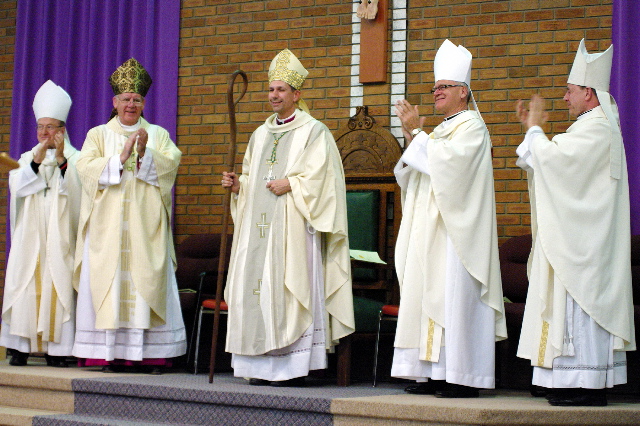
Bishop Don Bolen at his ordination
In between these two events, I had the privilege of being the bishop-elect’s student in Rome for his half of a course on Methodism and its dialogue with the Catholic Church. I even wrote up a short blog article about the class and my first encounter with Msgr. Bolen, here.
I had offered some first impressions at the end of that blog. Over lunch on his next-to-last day in Rome, Father Don mentioned that someone had directed him to my blog about him, and he suggested that perhaps I should revisit my impressions now that we had gone through an entire class together. Fair enough.
The people of Saskatoon are blessed among Canadians. That is all there is to it.
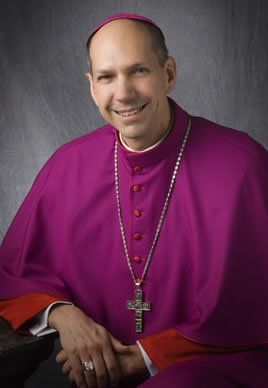
Bishop Don Bolen of Saskatoon, Saskatchewan, Canada
Most bishops have no training or formation to become bishop, not really. They see how their bishop acts, think what they would do, and that’s about it. Bishop Bolen spent years on the Vatican desk covering the dialogues with the Anglicans and the Methodists, where episcopacy and authority, indeed ecclesiology in general, are the major issues of discussion. What better formation than to be a theologian-pastor studying the highest level conversations about what it means to be a bishop, ecumenically, especially when Ratzinger is Pope and Kasper is President of the Pontifical Council for Promoting Christian Unity? Granted, it is one thing to engage in discussion about the episcopacy, and another to live it out, but what an opportunity!
So that’s the leadership aspect. What about teaching? At the end of our course, (team taught by Bishop Don and the Rev. Dr. Trevor Hoggard, the Methodist Representative to the Holy See) several of us had concluded this was one of the most valuable courses offered, in terms of both method and content. It was pretty straightforward: Get a solid introduction to the Methodist church from a Methodist pastor/theologian, get a thorough overview of the dialogue from the Catholic perspective, and culminate in a mock-dialogue with actual participants from the international dialogues, complete with Anglican observer.
The celebration of his ordination as bishop in Saskatoon was attended by several ecumenical leaders locally, and by a delegation from Rome that included Bishop Brian Farrell, Secretary of the PCPCU, Fr. James Puglisi, SA, Father-General of the Friars of the Atonement and Director of the Centro Pro Unione, Very Rev. David Richardson, ChStJ, the Archbishop of Canterbury’s Representative to the Holy See, and others. I have included a link to the pictures that the diocese has put up about the event, including a slide show.
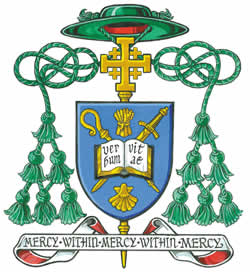 His motto is “Mercy within Mercy within Mercy” and his coat of arms and biographical information are here. Weslyan hymns specifically chosen by the bishop were a central part of the ordination liturgy, as was an ecumenical prayer service that looks to have been very well attended.
Being bishop is no easy task and my prayers are with this newest of Canada’s episcopate. Coming from a diocese that has not seen a ‘normal’ transition of episcopal leadership since before I was born, I can especially appreciate what it means for a local church to find a shepherd that makes such a good fit, and I hope the coming years are fruitful and filled with the Spirit.
Quote of the Day
Visible union with the Catholic Church does not mean absorption into a monolith, with the absorbed body being lost to the greater whole, the way a teaspoon of sugar would be lost if dissolved in a gallon of coffee. Rather, visible union with the Catholic Church can be compared to an orchestral ensemble. Some instruments can play all the notes, like a piano. There is no note that a piano has that a violin or a harp or a flute or a tuba does not have. But when all these instruments play the notes that the piano has, the notes are enriched and enhanced. The result is symphonic, full communion. One can perhaps say that the ecumenical movement wishes to move from cacophony to symphony, with all playing the same notes of doctrinal clarity, the same euphonic chords of sanctifying activity, observing the rhythm of Christian conduct in charity, and filling the world with the beautiful and inviting sound of the Word of God. While the other instruments may tune themselves according to the piano, when playing in concert there is no mistaking them for the piano. It is God’s will that those to whom the Word of God is addressed, the world, that is, should hear one pleasing melody made splendid by the contributions of many different instruments.
William Cardinal Levada
Five Hundred Years After St. John Fisher: Benedict’s Ecumenical Initiatives to Anglicans
Delivered at Queen’s University, Kingston, Ontario
March 6, 2010
Mar Bawai Soro
One of my intensive courses this semester is “The History of Aramaic Christianity”, taught by Mar Bawai Soro, a bishop of the Chaldean Catholic Church whose name is probably familiar to anyone who has been involved in ecumenism the last few years. He was also our guest for dinner at the Lay Centre this evening. (And though he did not share this, he was the person who, during the Jubilee Year 2000, recieved from Pope John Paul II the cross carried at the Stations of the Cross at the Colosseum. The pope carried it to the first two stations, handed off to Bishop Bawai for the second two, who then handed it off again.)
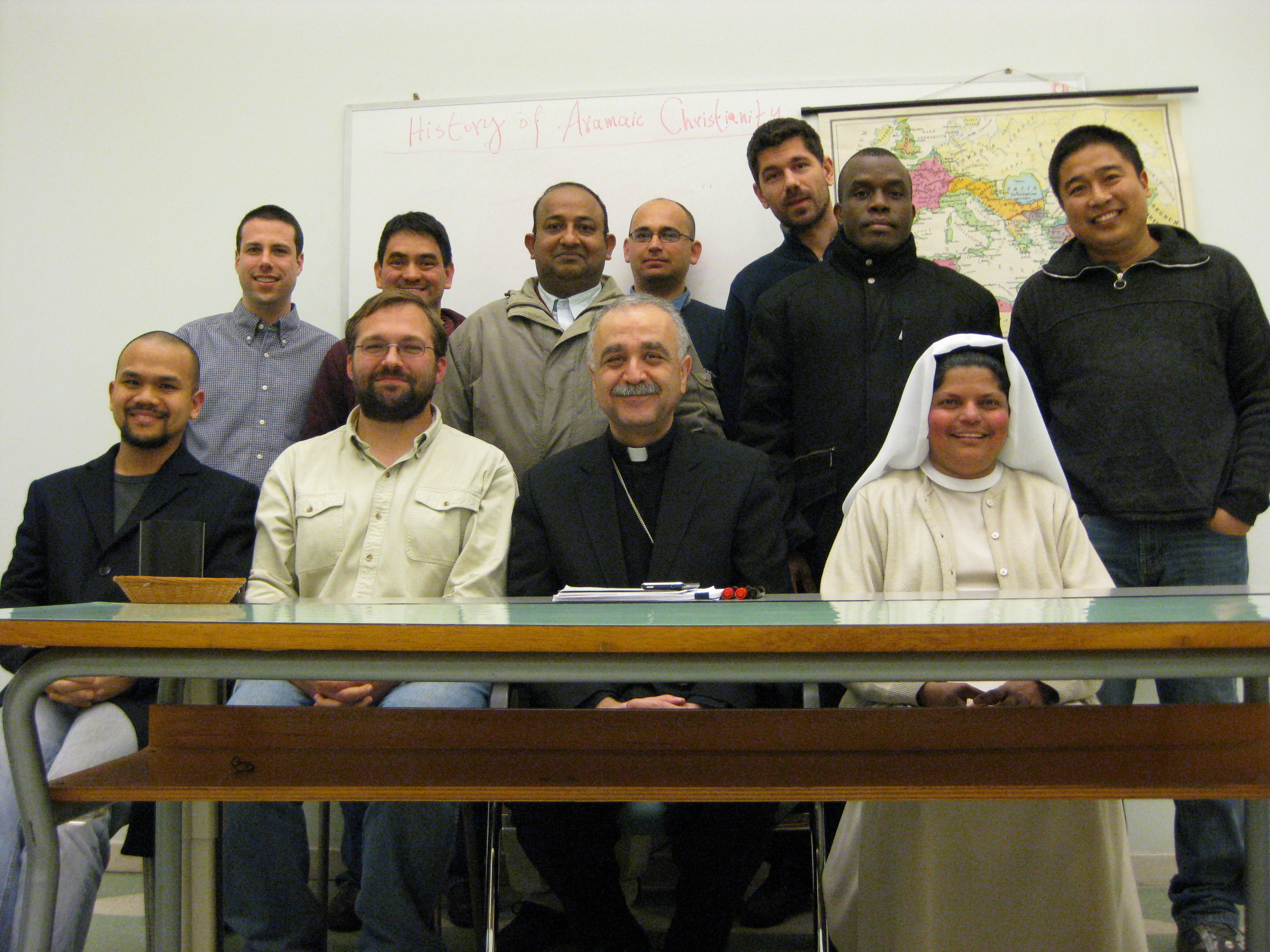
History of Aramaic Christianity, Angelicum, 2010
In most church history classes I have taken or taught, the focus is usually on the history of the Church within the Roman empire, and subsequently the nations were in direct succession from that Empire. Sometimes it gets even more eclipsed if the focus is purely on the Latin Church, the churches directly associated with the ritual and patriarchal patrimony of the church of Rome itself (ie, the Roman Catholic Church). It is sometimes news enough for people to realize there were four other apostolic sees within the Roman empire besides Rome! But we have often forgotten entirely the church in Asia, beyond the borders of the ancient Roman Empire.
The focus of our studies for this course have been on that Church of the East – not the Eastern or Oriental Orthodox Churches, but further east, in Mesopotamia and what was part of the Persian Empire at the time of Constantine. This church never enjoyed the status of being an official religion of the empire, as did the church in the empire of Rome and Constantinople. In fact, persecution only increased after Christianity became associated with the enemy to the west. To this day, being Christian in this area makes you suspect of collaboration with the “West” – whether that is Emperor Constantine or President Bush, and whether the dominant religion is Persian Zoroastrianism or Shi’a Islam.
This was the church of refuge for the Nestorians and the theological School of Antioch, driven across the border in the aftermath of the Council of Ephesus in 431, and a place where the theological battle between Monophysites and Nestorians was waged for centuries. The first stopping point for the missionary activity of the Apostle Thomas, the Mesopotamian church was the mother church of the earliest Christians in India, still known as Mar Thoma (St. Thomas) Christians. Missionaries of this church had reached Mongolia and China by the sixth century, and some scholars have suggested communities as far as Japan.
The current heirs to this tradition include:
- The Assyrian Church of the East, with about 250,000 members, traditionally centered in Iraq
- The Chaldean Catholic Church, with about 750,000 members, centered in Iraq
- The Syro-Malabar Catholic Church, with about 4 million members centered in the state of Kerala, India

Mar Bawai Soro
Much of the Church of the East’s history has been marked by political and ecclesial isolation – first by being the Christians outside the Roman empire, then ecclesially, and throughout by being more or less constantly a persecuted minority in Zoroastrian Persia, or Muslim Arab and Mongol rule. Several times in the last six centuries dioceses and other groups of the faithful would resume full communion with Rome. The first, in 1445 was the archbishop of Cyprus and his diocese, who after a couple generations were unfortunately Latinized and assimilated into the Latin (Roman) Catholic Church. A couple others only lasted for a century or so, eventually leaving communion again. Finally, the Patriarch (one of two rivals, anyway) and his cohort came in to full communion in 1830, giving us the current Chaldean Catholic Church. The rival patriarchal line and those in communion with it remain today as the Assyrian Church of the East, though they were the line which had been in Catholic communion for a century or so during the 16th and 17th centuries.
For 20 years, Bishop Bawai served this church as a bishop and as their top theologian and ecumenical officer (a sort of Ratzinger-Kasper combo, if you will), and participated in the Assyrian-Catholic dialogue from its inception, through the Common Christological Declaration of 1994 and the preparation of the Common Sacramental Declaration that was to follow.
For those who wonder about the products of ecumenism, it only took 8 years of dialogue to resolve the Christological issue that split the church 1500 years ago, and confess together that :
Our Lord Jesus Christ is true God and true man, perfect in his divinity and perfect in his humanity, consubstantial with the Father and consubstantial with us in all things but sin. His divinity and his humanity are united in one person, without confusion or change, without division or separation. In him has been preserved the difference of the natures of divinity and humanity, with all their properties, faculties and operations. But far from constituting “one and another”, the divinity and humanity are united in the person of the same and unique Son of God and Lord Jesus Christ, who is the object of a single adoration.
This is why there is always hope!
 Of course, that hope is always needed. The reality of the impending full communion with the Catholic Church provoked some nervousness. Understandably, I suppose: Comparatively, we are beyond huge (4400 Catholics for every one Assyrian Christian), and the prospect of the Patriarch becoming a mere cardinal, as some bloggers have put it, was uninviting. Their decision was to suspend the dialogue, and to suspend the bishop.
After finding no appeal, Mar Bawai and about 5000 faithful, including 30 deacons and a half dozen priests, came into full communion with the Chaldean Catholic Church in 2008.
New Semester in Rome
It is hard to believe my first semester is already finished! That is ¼ of the way through for the two years of my Fellowship and the S.T.L. – and a good time for a general progress report!
I had hoped to return to grad school and maintain a perfect GPA, since my undergraduate and first round of grad school grades were moderately good, but not great.
(That’s the problem with being so involved in extracurricular activities, you tend to forget important details like deadlines! I calculated, near the end of my time at ND, that my cumulative GPA would have been .5 higher if I had just turned everything in on time!)
The Roman academic system grades on a 10-point scale, rather than a 4-point scale. According to our Order of Studies, they look like this:
- 10-9.75 Summa Cum Laude (Highest Honors) = 3.9-4.0
- 9.74-8.51 Magna Cum Laude (High Honors) = 3.4-3.89
- 8.50-7.51 Cum Laude (Honors) = 3.0-3.39
- 7.50-6.51 Bene (Good/Acceptable) = 2.6- 2.99
- 6.50-6.00 Probatus (Probation) = 2.4-2.6
- 6.00-0.00 Fail
Another difference between the Roman system and the American version that I am more used to, is that while the Roman system (at least at the Angelicum) tends to have less required reading and papers, your entire grade for a semester can depend on one 15-minute oral exam, or a single written in-class final.
There is a two-week break between classes when all the exams are supposed to take place, but with our Jerusalem seminar in the middle of that period, most of mine were done when the exam period started.
The second semester is already shaping up to include a bit more reading and more balanced variety of assignments. Here is the list of my courses for the rest of the year:
- Acting Acts: Survey on the Pentecostal/Charismatic Movement
- Catholic Understanding of Interreligious Dialogue
- Christ Beyond the Church
- History of Aramaic Christianity
- Methodology of Biblical Interpretation and its Significance for Jewish-Catholic Understanding
- Ministry of the Ecumenical Officer
- Philosophical Elements in Catholic-Protestant Dialogue
- Reformation Theology in Context
- Sacramental Character
So the perfect 10 I was aiming for? Missed it, with just one class – and I do not know what I got wrong on the final! Ah well, at least it leaves room for improvement! Other good news, is that when i met with the dean to register for the second semester, he pointed out that with the credit i have been given from my previous academic work and experience, i could finish the License early – i only have a couple seminars left, the thesis and comprehensive oral exam.
Quote of the Day
The advice of Pope Saint Gregory the Great (590-604) to Augustine of Canterbury, as a model of communion for the contemporary (postmodern?) ecclesial scene:
Agustine’s Second Question: Even though the faith is one, are there varying customs in the churches? And is there one form of Mass in the Holy Roman Church and another in Gaulish churches?
Pope Gregory answered: My brother, you know the customs of the Roman Church in which, of course, you were brought up. But it is my wish that if you have found any customs in the Roman or the Gaulish church or any other church which may be more pleasing to Almighty God, you should make a careful selection of them and sedulously teach the Church of the English, which is still new in the faith, what you have been able to gather from other churches. For things are not to be loved for the sake of a place, but places are to be loved for the sake of their good things. Therefore choose from every individual Church whatever things are devout, religious, and right. And when you have collected these as it were into one bundle, see that the minds of the English grow accustomed to it.
From The Venerable Bede, Ecclesiastical History of the English People, as quoted in Frederick M. Bliss, Catholic and Ecumenical: History and Hope – Why the Catholic Church is Ecumenical and What She is Doing About It, p9.
[emphasis mine]
Quote of the Day
Orientale Lumen 20, Pope John Paul II, 1995
[T]he Church of Rome has always felt was an integral part of the mandate entrusted by Jesus Christ to the Apostle Peter: to confirm his brothers in faith and unity (cf. Lk 22:32). Attempts in the past had their limits, deriving from the mentality of the times and the very understanding of the truths about the Church. But here I would like to reassert that this commitment is rooted in the conviction that Peter (cf. Mt 19:17 – 19) intends to place himself at the service of a Church united in charity. “Peter’s task is to search constantly for ways that will help preserve unity. Therefore he must not create obstacles but must open up paths. Nor is this in any way at odds with the duty entrusted to him by Christ: ‘strengthen your brothers in the faith’ (cf. Lk 22:32). It is significant that Christ said these words precisely at the moment when Peter was about to deny him. It was as if the Master himself wanted to tell Peter: ‘Remember that you are weak, that you, too, need endless conversion. You are able to strengthen others only insofar as you are aware of your own weakness. I entrust to you as your responsibility the truth, the great truth of God, meant for man’s salvation, but this truth cannot be preached or put into practice except by loving.’
(Emphasis mine)
 The Ecumenism Blog