
The Ecumenism Blog

Home » Posts tagged 'ecumenism' (Page 3)

Tag Archives: ecumenism

Cantaur comes to the Lay Centre

The voicemail was indistinct there almost too much distortion to hear the speaker at the other end. Only after a third attempt could I recognize the familiar Australian accent of Dr. Margie Richardson, wife of Canon David Richardson of the Anglican Centre in Rome.

So I resorted to checking my personal email at work to see if there was news:

“The Archbishop of Canterbury may want to stop by tomorrow morning to see the garden and say hello. A.J., would you please welcome him and show him around?”

Even in Rome, that does not happen every day! How could I say no?

His Grace started this morning at San Gregorio Magno, the point from which Gregory the Great sent Augustine to Canterbury to evangelize more of the British Isles, and where the Archbishop and the Pope Benedict celebrated a solemn vespers together earlier this year to mark the 1000th anniversary of the Camaldoli community there.

Then, with the Richardsons, Msgr. Mark Langham of the Pontifical Council for Promoting Christian Unity, and Canon Jonathan Goodall, theologian-ecumenist of Lambeth Palace, the Archbishop toured the Passionist-operated Basilica of San Giovanni e Paolo, and received a brief tour of the Lay Centre and Passionist gardens, including the remains of the Temple of Divine Claudius.

After admiring our view and a few moments of gracious conversation, they were whisked away in Vatican state cars to the Anglican Centre for lunch and preparation for the Archbishop’s address to the Synod of Bishops this evening.

The Bible plus: The four books of Mormonism | The Christian Century

Reposted from The Bible plus: The four books of Mormonism | The Christian Century.

If you haven’t read this yet, a very helpful and concise review of LDS scripture. 

The Bible plus:
The four books of Mormonism

Aug 08, 2012 by Kathleen Flake

A Latter-day Saint friend of mine once invited an evangelical coworker to church. The coworker found much that was familiar in the LDS service: hymn singing, an informal sermon style, robust fellowshiping and scripture-driven Sunday school. But then came the moment when the Sunday school teacher, after beginning with Genesis, said “Let’s now turn to the Book of Moses” and began reading: “The presence of God withdrew from Moses . . . and he said unto himself: Now, for this cause I know that man is nothing, which thing I never had supposed.’” I am told that the visitor reflexively searched through his Bible before he realized that he’d never heard of such a book, though of course the story of the burning bush was familiar. And while he didn’t mind the sentiments expressed in the words he’d heard, he knew that they were not in his Bible.

This mix of the familiar and the strange is a common experience for any who have spent even minimal time with the Latter-day Saints. The greatest contributing factor to this mix is Mormonism’s dependence on and sophisticated redaction of the Bible. All of Mormonism, even its most unfamiliar tenants, rests in some element of the biblical narrative. Academics would explain this in terms of intertextuality, noting that the meanings of Mormonism, even its unique scriptures, are achieved within the larger complex of the Christian canon. You don’t need to be a scholar to recognize this. You need only open and read the first words you see in any one of Mormonism’s unique scriptures.

The Latter-day Saint canon consists of four books: the Bible and three other texts—the Book of Mormon, the Book of Doctrine and Covenants and the Pearl of Great Price. Each reads very much like the Bible in type and breadth of thematic concerns and literary forms (history, law, psalm). Even the rhetorical stance of each canon is biblical: God is speaking to prophets faced with temporal crises of spiritual significance. In terms of the authority granted these four texts, all have equal weight, including both Bible testaments, as historical witnesses to God’s promise of salvation, enacted by covenant with the Israelites and fulfilled in the atonement of Jesus Christ as the only begotten of the Father.

The LDS Church’s confidence in the authority and historicity of the Bible is mitigated only by scruples regarding the Bible’s history as a book. The Bible is “the word of God insofar as it is translated correctly.” The other three Latter-day Saint scriptures are also believed to be historical witnesses to God’s promise of salvation. Considered translations by or direct revelation to Joseph Smith, the church’s founding prophet, they are considered correct in their representation of God’s will and word, though they possibly contain flaws resulting from “the mistakes of men.” What follows is a brief description of these three texts and a few examples of how they reshape Christian tradition and influence Latter-day Saint belief and practice.

The Book of Mormon is the narrative of a prophet-led people’s experience with God over a thousand-year period, beginning with the flight of two Israelite families from Jerusalem in the sixth century BCE on the eve of Babylonian captivity. The people of God eventually create a complex civilization in the Western Hemisphere. The story is a cautionary tale of cycles of conversion and backsliding. It concludes in approximately the fourth century CE with an account of wickedness and consequent destruction. The climax of the narrative occurs midway with the appearance of Jesus Christ immediately after his resurrection to a chastened remnant in the Americas who are taught by him to repent, embrace the gospel and establish a church. Thus, the Book of Mormon not only echoes the narrative style and certain contents of the Bible, such as the Beatitudes, but also functions as second witness to the Bible’s testimony that Jesus is the source of salvation for all.

The Book of Mormon clearly deviates from Christian tradition by not limiting Christ’s ministry to a particular people and time. The rejection of such limitations is one of the book’s main points. The claim that “we need no more Bible” is made the object of God’s rebuke: “Know ye not that there are more nations than one? . . . because that I have spoken one word ye need not suppose that I cannot speak another.” Clearly, the Book of Mormon’s purpose is not only to second the biblical witness but also to evidence the ongoing revelation of the gospel. Notwithstanding its orthodox representation of that gospel, the Book of Mormon takes a position on certain historic theological questions. For example, while teaching the reality and catastrophe of the Fall, the prophets of the Book of Mormon reject notions of human creatureliness and depravity. Humans are not utterly foreign to God’s being. They are inherently made capable of acting for good, though only through Christ’s sacrifice is this capacity liberated from the enslaving effect of the Fall on human will. It is “by grace we are saved after all we can do.” Thus in Mormonism God’s economy of salvation is broad, though not universal in its promise of glory. Humans are prone to sin, free to reject grace and may fall from grace. Nevertheless, grace is freely given to those who in faith repent.

The LDS Church’s third canonical text, the Book of Doctrine and Covenants, is composed of revelations received largely by Joseph Smith between 1830 and 1844. Essentially a book of order and doctrine, it is the most discursive of the church’s scriptures. Again, much is familiar to non-Mormons, such as believer’s baptism, confirmation through the laying on of hands for the gift of the Holy Spirit, and affirmations such as “justification through the grace of our Lord and Savior Jesus Christ is just and true. “ Less conventional but still acceptable is the book’s emphasis on sanctifying endowments of heavenly power “through the grace of our Lord and Savior Jesus Christ . . . to all those who love and serve God with all their mights, minds and strengths.” For example, the D&C contains a version of the catalogue of the gifts of faith in 1 Corinthians, all of which are embraced within Mormonism.

LDS Church offices, too, are initially familiar: deacon, teacher, priest, elder and bishop. But the church’s charismatic offices, such as high priest, apostle and prophet, are unfamiliar in a modern context. Particularly indicative of the canon’s sanctification of the Christian life is the D&C’s provision for an ordained priesthood of all believers authorized to perform every ordinance as well as all pastoral and preaching duties.

The D&C contains a number of teachings, especially related to temple worship, that are unique to the Latter-day Saints. Space permits discussion of only one: saving ordinances, such as baptism and confirmation, performed not only for the living but also by proxy for the dead. D&C 124 describes this practice and provides a good illustration of the way in which the LDS Church’s canon leverages biblical concepts to create beliefs outside the tradition as if from within it. This text explicitly roots baptism by proxy for the deceased in Matthew 16’s reference to authority that can “bind” heavenly possibilities by earthly acts. It further grounds the doctrine in 1 Corinthians’s rhetorical question: “Now if there is no resurrection, what will those do who are baptized for the dead? If the dead are not raised at all, why are people baptized for them?”

D&C 124 claims that the answer to Paul’s question comes as deeply from within the tradition as does the question itself. First, it refers to Malachi’s promise that Elijah would come to “turn the hearts of the parents to their children, and the hearts of the children to their parents.” Smith claimed that Elijah had returned in 1836 to restore the heavenly keys to such a turning of hearts, an event recorded in D&C 110. This turning—or, as Smith termed it, binding—of the generations by sanctifying covenants with God animates the church’s genealogy program, as well as its practice of sealing marriages for eternity.

Second, the biblical imperative of Hebrews 11 is cited in D&C 124 to show the necessity of this sacramental work on behalf those who died without the gospel: “For their salvation is necessary and essential to our salvation, as Paul says concerning the fathers—that they without us cannot be made perfect—neither can we without our dead be made perfect.” Though Latter-day Saints believe that the deceased may reject grace and nullify the sacraments performed on their behalf, providing the option is the duty of the faithful to those who were without the gospel in this life.

Innumerable examples can be given of Mormonism’s canonical similarities and dissimilarities with traditional Christianity. By employing both biblical forms and hermeneutic, Latter-day Saint scripture is profoundly adaptive of historic Christianity’s theological traditions. To fully understand this phenomenon, however, one more aspect of Mormonism’s extended canon needs to be considered. Notwithstanding the D&C’s tendency to discourse, the most powerful force at work in Latter-day Saint differentiation is the narrative function of its canon. The Pearl of Great Price is the obvious case in point, though in a more subtle way it is true of the Book of Mormon as well.

The Pearl of Great Price is a compendium of several writings attributed to Joseph Smith’s revelatory powers. The two largest portions are called the Book of Moses and the Book of Abraham. Both books include a retelling of the creation story. Most significantly, this retelling includes an event before creation in which God met with his children regarding the next step in their existence. This step required the gift of more expansive powers of agency in order to learn by experience to distinguish good from evil, thus enabling human progress to higher levels of being.

The event is characterized by two contrasting concepts of how earthly existence should be ordered. The contender for one concept insisted on the use of force to ensure that humans made the right choice. The other advocated God’s original plan that offered salvation from wrong choices through sacrificial atonement. This advocate further agreed to be the sacrifice, leaving the glory to God. As you no doubt have guessed, the first contender is Lucifer, who rebelled against God, lost whatever light his name suggests and became the devil. The second petitioner became God’s only begotten son, and by virtue of his redemptive power became in all ways like God the Father.

God’s challenge to Job’s memory and his call to Jeremiah, as well as Isaiah’s lament and Paul’s dictum in Romans, may supply biblical evidence for the premortal existence of humankind. But canonization of a Bible-like narrative that directly counters the theological tradition of creation ex nihilo is one of the most provocative aspects of Mormonism. Some non-Mormons have been so provoked as to accuse the Latter-day Saints of believing the devil is a brother of Jesus in the sense that they share the same nature and power. This could not be further from the church’s canon and teachings regarding the divinity of Christ. Regardless, the belief that sacred history extends to a premortal existence for human life and to events before creation has a definitive affect on Mormons’ self-understanding and their sense of time and eternity. It is fundamental to their answer to the classic existential question, Where did we come from?

The two other questions that preoccupy religious thought are why are we here and where are we going, and the Saints’ extended canon tackles these questions as well. As noted by the Sunday school teacher mentioned earlier, the Pearl of Great Price contains an account of Moses’ theophany on Mount Horeb. The prophet is depicted as having been amazed at his nothingness after being shown the earth and its inhabitants. But he is not so dumbfounded that he fails to ask God why these creations exist, and he receives this answer: “There is no end to my works, neither to my words. For behold, this is my work and my glory—to bring to pass the immortality and eternal life of man.”

This short verse defines God in terms of his capacity to “bring to pass” or engender in his children the quality of the life he possesses—“immortality and eternal life.” The verse contravenes centuries of Christian theological anthropology that insists there is an unbridgeable ontological gulf between God and humankind. Or, in more technical terms, traditional Christianity teaches that God’s nature is fundamentally unrelated to human nature—the one uncreated, the other created. The Latter-day Saint canon asserts to the contrary that God is best understood by his fundamental relatedness, his fatherhood.

The effect of this view on the Latter-day Saints’ identity is probably immeasurable. They believe that God has known them, as he said to Jeremiah, before they were in the womb and that they are, if faithful, predestined for glory in Pauline terms. When things get tough, as in the case of Job, the Saints are to remember the time when “the morning stars sang together” about what they believe was a loving Father’s plan for their ultimate glory. On the basis of these alternative accounts of creation and Moses’ theophany, Latter-day Saints believe that the truest measure of God’s greatness is his generativity, not his sovereignty or prescient omniscience that predestines outcomes. Thus, when they voice their Christian perfectionism in terms of becoming like God, Latter-day Saints are not aspiring to power over others. As we have seen, the primordial event in their canon’s salvation history uses Lucifer’s fate as a warning against such aspiration. Rather, they understand their divine potential in terms of parenting, even the promise of an endowment of sanctifying grace that enables the faithful to facilitate spiritual, not merely physical, birth. To obtain such generativity is, for Latter-day Saints, why humans exist, and it constitutes the deep doctrinal stratum of what is typically seen as merely a sentimental attachment to family.

As for the third existential dilemma—where we are going—Latter-day Saint scripture elaborates on John 5 and 1 Corinthians 15 to affirm a variety of degrees of glory to which virtually all of God’s children will be raised after judgment. D&C 76 is the most complete discourse on this subject, and it incorporates the Pauline metaphors of sun, moon and stars to describe the varieties of glory in the afterlife. The effect is, in part, to counter the idea of a one-size-fits-all heaven capable of accommodating the varieties of human desire and action. Rather, it is hell that lacks diversity, accommodating only “those sons of perdition who deny the Son after the Father has revealed him . . . crucified him unto themselves and put him to open shame.” The rest of humanity “shall be brought forth . . . through the triumph and the glory of the Lamb, who was slain, who was in the bosom of the Father before the worlds were made. And this is the gospel, the glad tidings.” Thus, in Latter-day Saint eschatology there are many degrees of glory or “mansions” (to use John 14 KJV, since it better conveys the idea of glory than does the NIV’s “rooms”), but hell is an undiversified site with a narrowly defined population. As a consequence of these scriptural differences, Latter-day Saints do not judge religious differences as meriting consignment of people to hell, nor do they threaten nonbelievers with such a fate.

Narrative remains the preferred method of conveying Latter-day Saint teachings, however—even in eschatological matters. D&C 138 contains an account of Christ’s visit to the world of spirits mentioned in 1 Peter. It describes Christ being greeted joyfully by the righteous who had been waiting for the day of his triumph over death. But the focus of the story is on Jesus’ concern for the unjust, who also awaited their fate, and on how he chose “from among the righteous . . . messengers, clothed with power and authority, and commissioned them to go forth and carry the light of the gospel to them that were in darkness, even to all the spirits of men; and thus was the gospel preached to the dead.” This passage clearly relates to the Saints’ sense of duty to prepare for the possibility that some will accept the gospel after death. But more significantly, for believing readers D&C 138’s elaboration on 1 Peter satisfies questions about God’s justice in a world where few have known of Jesus and many are so burdened by temporal cares that they cannot hear his message. Ultimately, these two sections of the D&C, coupled with the expanded canon’s expansive view of the scope of the atonement and the power of Christ’s resurrection, are a source of great personal assurance to the Saints about everyone’s destiny because God’s saving work is ongoing.

Each year in a repeating four-year cycle, one of these canonical texts is the subject of the LDS Church’s Sunday school curriculum for youth and adults. Members are expected to read the designated scripture from beginning to end. Each book of scripture is considered as essential as any other, though the Bible is given two years of this cycle, one for each testament. The Book of Moses and the Book of Abraham are treated seamlessly within the Old Testament curriculum, as was done the day my friend brought his coworker friend to class. There is no canon within a canon—only a single history of God’s efforts to be heard in all places and by every generation.

Mormons are not theologians or even particularly doctrinaire; they are primarily narrativists. They inhabit the world of the book. They read themselves into the salvation history it tells and orient themselves to the horizon created by its promises. In sum, Latter-day Saint scriptures play a definitive role in the lives of believing readers, informing them of who they are in relation to God, why they are here and where it is possible for them and their loved ones to go. In respect to this world and the next, the Saints’ scriptures give them a distinctively positive sense of human potential based on God’s capacity and desire to save them and everyone else, as it says in the Book of Mormon, “through the merits, and mercy, and grace of the Holy Messiah.”

Look West, Young Church!

For the last several decades, the US Catholic Church has been demographically shifting from the 19th century bulwarks of New England and the upper Midwest, to the South and the West.

That does not mean that fact is quickly grasped by individuals or institutions. At one national conference I attended annually for nearly a decade, it was clear that the organizers thought of it as a nation-wide event. Yet, in its 45+ year history, only two had been held in the Northwest, both in the ‘80s; fewer than ¼ of the meetings had been held in the western half of the U.S.

Or consider that of nine cardinalatial sees in the U.S., seven are east of the Mississippi. And one of those that is west of the mighty river, Galveston-Houston, is so close as to still be part of the eastern half of the mainland U.S.

This is not as bad as the need to redraw diocesan boundaries in Ireland, which have been unchanged for just over 900 years, yet it is still slow… But, I digress…

Recent moves indicate that Seattle is making its mark felt again on the national, and international, ecclesiastical scene. Not since the days of Archbishop Hunthausen has the Church in Western Washington captured attention much beyond its own boundaries.

Fast-forward a quarter of a century, and for the most part Seattle had dropped off the radar, but not gone silent. Just in the years since Archbishop Murphy took over from Archbishop Hunthausen, the Catholic population has nearly tripled due to immigration – now there are as many Spanish-speaking Catholics in western Washington as there were total Catholics 15 years ago.  Bishop George of Helena, Bishop Joseph of Yakima, and Auxiliary Bishop Eusebio have all been ordained from the local presbyterate, the first such ordinations in nearly half a century.

The reputation of being on the cutting edge of lay involvement and creative pastoral ministry solutions, social justice and ecumenical commitment has slipped in recent decades, both among those who cheer the change and those who lament it. My age-peers in the presbyterate are as likely to be interested in the traditionalist movement and the extraordinary form as their peers anywhere else in the country, and some of the most well known Catholic voices to have come out of the Seattle milieu – author George Weigel and blogger Mark Shea – are not known for their particularly progressive mien.

Consider, though a few highlights of the last few years that suggest that there is attention shifting back towards the Emerald City and her local Church – both Catholic and Ecumenical. Some of these are newsworthy enough to get attention here, across the atlantic, so they certainly say something is happening. Significantly, you cannot pigeonhole all of these into “progressive” or “conservative” success stories, but nevertheless indicate that, perhaps, Seattle is on the radar again.

Very Rev. Michael G. Ryan

By now virtually everyone knows some part of the liturgy wars saga. Most people do not know it all; I certainly make no claim to such comprehensive view of the last fifty years of liturgical reform, renewal, development, reform of the reform and rejection of reform.

To recap the most recent, let us say that the updated translation everyone was waiting on was ready and fully approved by episcopal conferences around the globe in 1999. It then got delayed as a new Prefect of the congregation for divine worship rewrote the guidelines for liturgical translation, and the entire process was started anew with new rules and much controversy – and it was done quickly. After only a decade, the implementation was looming.

Enter the Very Reverend Michael G. Ryan, pastor of the Cathedral parish of St. James, where he has served as quite possibly the city’s most popular Catholic pastor since 1988. In December 2009 he penned an article for America asking the question, “What if we just said, ‘wait’?” , and launched a website gathering signatures and comments. In short order over 23,000 people signed – and a counter movement was launched. “We’ve waited long enough!”  collected just over 5,000 signatures and practically launched the blogging notoriety of “Fr. Z” and his (proudly) rubricist blog, What Does the Prayer Really Say?… and it all started with the quintessential Seattle presbyter, Fr. Michael.

Just the other day I was at the retirement party for the superior general of one of the religious orders, and conversation turned to Fr. Ryan’s stand and his recent article, “What’s Next?” Naturally, the group included supporters and critics alike, but several who were neither from the west coast or the U.S. at all – this is news throughout the Anglophone world.

In the three years since, coterminous with my time in Rome, there have been other indicators. Some smaller – like the meeting of the National Catholic Melkite Convention there in summer 2010 and the scheduling of the upcoming conference of the Society for Pentecostal Studies. Some have a bigger profile, like the June 2011 meeting of the USCCB in Bellevue.

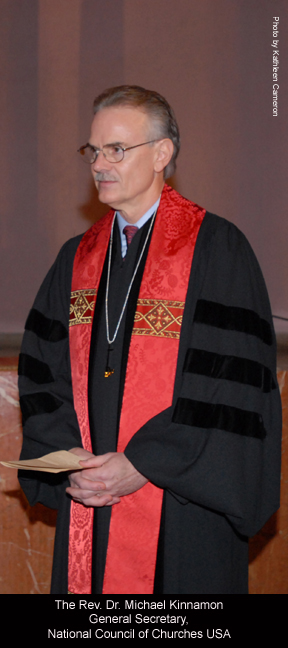
Rev. Dr. Michael Kinnamon

In terms of ecumenism and lay ministry, there have been some exciting personnel moves:

In Summer 2011, Dr. Michael Reid Trice was hired at Seattle University as the associate dean of the School of Theology and Ministry. Michael and I have known each other for several years, and he is one of the most active young ecumenists in the country, having served since the age of 35 as the associate director of the ELCA’s ecumenical and interreligious office.

Shortly thereafter, it was announced that Dr. Rick McChord was retiring after 25 years in the USCCB office for laity, marriage and family – and picking up a consulting contract with Seattle-based (and Domer-founded) Reid Group, which specializes in leadership development, strategic planning and mediation for religious groups.

The latest came in April while i was in Assisi, with the retirement of Rev. Dr. Michael Kinnamon as General Secretary of the National Council of Churches, and his own move to a three-year contract at Seattle University, starting this fall.

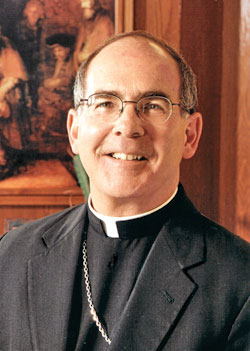
Finally, the biggest spotlight to hit Seattle in recent years, ecclesially speaking, is the appointment of the relatively new metropolitan, Archbishop J. Peter Sartain, to lead the five-year overhaul of the Leadership Conference of Women Religious. Striking every note of consultation, careful listening, and collaboration a person in his position possibly could during the press conference and interviews later with John Allen  in Rome, it seems like the best has been made of an unpleasant situation.

These are exciting times to be in the church-world in Seattle. Almost a pity I am in Rome!

Most Rev. J. Peter Sartain

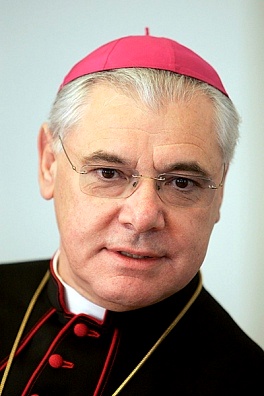
Bishop Gerhard Müller to CDF

The rumor has been floating around for some months, and this week it was announced that Cardinal Levada has retired as prefect of the Congregation of the Doctrine of the Faith, and the bishop of Regensburg, Gerhard Müller, has been appointed to take his place.

His official biography and extensive information can be found in English at his diocesan website.

The two NCRs cover the story here:

Talking with one of my German colleagues in Rome, she was complaining how the German press has continued to remind people that this was once the office of the Universal Inquisition. That, and that Müller  has been widely painted as an archconservative and favoring the current trend towards traditionalism.

I chuckled and pointed out that most of the English-language blogosophere seems to focus on his connection to Liberation Theology, and that if anything, the traditionalists have protested because he is “heretic”  and a “modernist” – terms almost inevitably misused, but that is nothing new.

I have read only one of Müller ’s books, and that is his Priesthood and Diaconate, which I have used for my License thesis. He writes to counter the arguments made by some German feminist theologians that women have been and ought to be ordained to the diaconate. The major argument he sets out to counter is that, although the question of ordination to the priesthood – understood as the presbyterate and the episcopate in this case – has been closed since John Paul II’s 1994 Apostolic Letter Ordinatio Sacerdotalis, the question of the ordination of women to the diaconate remains (ostensibly) open.

First, it is interesting to note that in the translation, there are a couple of humorous editorial notes attached to his text. This same German friend keeps remarking that the problem with German theologians, ministers and ecclesiastics is that they all think that “the German Church is the center of the Catholic Church”- or whatever issues are big in the German world must be the main issues for the universal church. Not unlike the American/anglo-phone phenomenon, actually.

At various points in his book, Müller  demonstrates this by saying something like “theologians in the whole world are asking this question” or “everyone seems to think this is an inevitability”. But after the translator and editor have their input, it looks like this: “theologians in the whole [German-speaking] world are asking this question” or “everyone [in Germany] seems to think this is an inevitability.”

More substantially, I was struck that he seemed not to address the most fundamental ecclesiological point of the argument he was trying to counter and correct. The argument for the ordination of women to the diaconate, in the current context, is that, if you maintain that within the one sacrament of holy orders there are not only three orders, but two distinct classes of orders – one to the priesthood and one to ministry/diakonia – then you can argue that a prohibition of ordaining women to priesthood does not necessarily dictate a prohibition to the ordination of women to diaconate.

However, if you argue that the three distinct orders within the one sacrament are modeled in a Trinitarian concept, then this argument might collapse, and if women cannot be ordained to one order or another it can be argued that they cannot be ordained to all of them. Müller’s strongest move, it seems, if his intent is to demonstrate that women cannot be ordained even to the diaconate, would have been to argue the unity of the sacrament. Instead, he maintains throughout his text this scholastic division between priesthood and other, the very point that the target of his investigation needs to retain in order to make her argument.

It is also interesting to note is that Bishop Müller  was heavily involved in the International Theological Commission’s Report on the Diaconate, From the Diakonia of Christ to the Diakonia of the Apostles, which itself does not close the door on the question of ordaining women to the diaconate.

All in all, he seems an accomplished theologian, interested in ecclesiology and ecumenism, with a healthy ability not to get stuck in some of the old images and models of theology; he is able to judge aspects of liberation theology on its merits, rather than treat it like a bad word, as so many in the anglophone world are sadly wont to do. On the other hand, it seems that the question of women in the diaconate may be closed soon, before the non-German speaking world even had a chance to realize it was open.

I am looking forward to reading more, and seeing what the future brings.

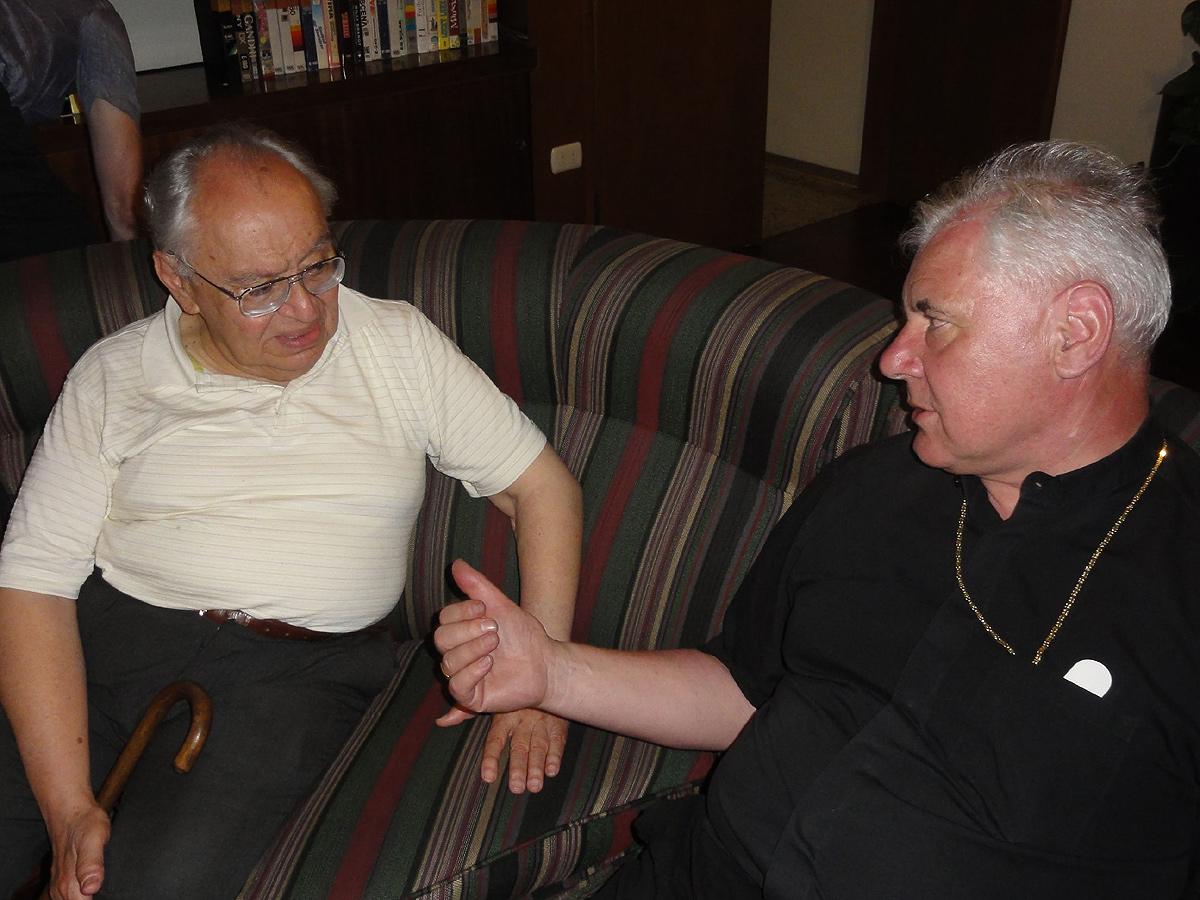
Gustavo Gutierrez, father of liberation theology, and Gerhard Muller, at one of their annual sessions.

Assisi 2012 – Where we Dwell in Common.

So, I have had a bit of a break from blogging, mostly to focus on other writing, and owing to other distractions. Rome can do that.

However, I find myself now with about 30 pages of back-notes for blogs, and sitting in Assisi for a conference of the Ecclesiological Investigations Network, so it seemed opportune to begin again with some observations from the first day. The theme is Assisi 2012: Where we Dwell in Common – Pathway sofr Dialogue in the 21st Century. The three thematic tracks are intra/inter ecclesial issues (ecumenism/ecclesiology), interfaith/interreligious issues, and Faith and World/Culture.

We arrived yesterday and started with an opening plenary prayer in the Basilica of Santa Maria degli Angeli, home of the Porzincula, and greeted by Assisi Archbishop Domenic Sorrentino and Friar Fabrizio Migliasso, Custodian of the basilica.

There are a few familiar faces (Peter Phan, Rick Gillardetz, Dennis Doyle, Michael Kinnamon), and a few names I finally get to put faces to (Paul Murray from Durham, the other Viggo Mortensen).  But I confess I am a little surprised how few I knew or knew of – one more reminder of how insulated pontifical academia can get.

Participants number over 200, from 55 countries, and several different churches and faiths. The opening panel offered insights into the theological situation in Italy for the participants, and the opening keynote was offered by Paul Arthur of North Ireland, offering lessons from the peace process there for dialogue initiatives. Peter Phan offered a humorous evening toast, and Dennis Doyle delivered a deadpan response. This morning began with a plenary panel composed of Brad Hinze (US), Mary Getui (Kenya), and Eleni Kasselour Hatzivassiliadi (Greece)  and a response from Deivit Montealegre (Argentina).

The late morning, we had parallel plenaries, with mine focused on interchurch issues, such as:

  • The Burdens of History: Must Tribalism Always Prevail?
  • Hierarchy or Network of Truths? Hermenutical Principles and Challenges of Dialogue about Doctrinal Issues
  • Does a Doctrinal Teaching Office have an Ecumenical Future? (Which focused on a recent report of the Group des Dombes)

The afternoon held smaller breakout sessions with panels of smaller papers, and more direct discussion. I chose one with a Chilean and Tanzanian students from Louven, and Michael Walsh, the British church historian. He offered a look into an as-yet unpublished encyclical of Pius XI, Ecclesia Christi – On the True Church of Christ. It is one of two released in the archives of his pontificate.

It is so healthy, and people are so approachable. It is like a retreat, except that daily life in Rome is like a retreat, so I guess having a packed schedule is the retreat from the retreat. Having the daily intellectual stimulation with world class scholars is a nice break though. It is such a culture clash from the daily pontifical experience though, nobody is here speaking in official capacity, and everyone is quite open. No holds barred in critiquing the narrowing hermeneutic of the Council, calling to task shoddy scholarship, or directly challenging other churches for inconsistencies or unusual doctrinal stances.

I present on Friday, offering some observations on non-priestly ministries as opportunities for ecumenical convergence. Diaconate and lay ecclesial ministry anyone? 

The Camaldoli at 1000… più o meno.

The Lay Centre enjoyed the opportunity to host some of Rome’s most well-respected ecumenical leaders for lunch today, offering an oasis in time and space to what is already a busy and historic week for all involved.

Some will have heard already that the Archbishop of Canterbury is coming to the neighborhood next weekend to celebrate the Camaldolese community at San Gregorio Magno al Celio on the occasion of their millennial anniversary. It was Gregory the Great that sent Augustine to Canterbury to convert the Angles, famously quipping how they better resembled angles, after all, and the connection between the local churches of Rome and England has a long history. That history is tied to this very spot, and the relationship with the Camaldolese at the site of Gregory’s family estate has its own long history – with a recent twist noted below.

The bishop of Rome has decided to join him for vespers next Saturday at San Gregorio marking the occasion. As it is a small church, I have been assured the only way I will get a ticket is if I poison some monsignor and take his – and since all things baroque seem to be in vogue just now, it might be socially acceptable if I did just that!

Alas, I am too much stuck in the ways of my youth, and will just pray for intervention from Sts. Gregory, George, and Jude, instead.

Nevertheless, the Archbishop will be presiding and preaching at St. Paul’s Within the Walls, the Episcopalian (read: American Anglican) Church of Rome on Sunday morning, and offering a conference on monasticism and ecumenism with the prior of the Camaldolese monastery in California at San Gregorio in the afternoon. No tickets (and thus no poisons) are necessary.

All of this is to celebrate the 1000 year anniversary of the Camaldoli community, a Benedictine offshoot that uniquely comprises both monastics and hermits in lives of contemplation. But, in fact, it seems that historians have dated the actual establishment about 12 years later… the event being predated for political reasons at an early stage. Nevertheless we know the community was founded by St. Romuald, a monk in the abbey of St. Apollinaris in Classe at Ravenna, who “reproposed the original call of believers to a radical faithfulness to the gospel and interior freedom, guaranteed not by human power or strict disciplinary norms, but by faithfulness to the Spirit of God.”

The community’s website can be found here: http://www.camaldoli.it/en_index.htm

Ecumenical witness in the life of Camaldoli

This is not all that has been going on, and not all we were celebrating, however, for this Benedictine offshoot congregation on the Caelian hill. Several weeks ago, they elected a new prior: Dom Peter John Hughes. Dom Peter has been an Anglican priest for a number of years, and a Camaldolese monk for fifteen. How fitting, that on the eve of their millennial anniversary, the community living in the house that was that of the pope who sent the Apostle of England would choose as their Roman prior a priest of the Communion born from the Church of England?

After fifteen years of ecumenical witness as an Anglican priest active in a Catholic order, the election presented a crossroads. Clearly, the prior must be in full communion with the Catholic Church – and there is no personal Ordinariate established in Italy. Therefore, Dom Peter was brought into full communion and welcomed into the Catholic presbyterate at a quiet liturgy presided by Archbishop Bruno Forte of Chieti-Vasto, “Italy’s most famous theologian”. Forte has been rumored as a possible successor to Cardinal Levada in the CDF, and was one of the first appointees to the Council on the New Evangelization.

Below is a selection of his homily:

My dear Peter! In order to become a monk in the community at Camaldoli, you were required first to become a member of the Catholic Church. While you understood and accepted this, you felt it paradoxical that, in order to embrace monasticism as a sign of an ecclesial mystery larger than that of each single tradition and of the unity which lies beyond all divisions, a decision was required which seemed to point in the opposite direction. Despite the consequences of disunion, we can nevertheless recognise and celebrate gifts of grace and continuity. Where there was discontinuity because of the non-recognition of your Anglican Orders, the continuity was maintained in your decision to live the monastic life, in the light of the understanding of Camaldoli, as an ecumenical witness, with its goal of full visible unity in faith and sacraments. When you were recently appointed to lead the Camaldoli monastic community in Rome, you were also invited to consider receiving Holy Orders in the Catholic Church.

After much thought and prayer, you have come to see this as a response to a call, an invitation to exercise to the full the service of leadership now asked of you, and an opportunity to offer a fuller witness within the Catholic Church. By giving such a response, you do not deny your origins or identity or the value of your long and fruitful ministry in the Anglican communion, and you do not intend to break this communion. On the contrary, your ordination to-day opens the way for you to continue your service to the unity for which Jesus prayed, liberating it for a fuller realisation within the Catholic Church that has received you as a member and has called you to exercise this ministry. Our sincere wish is that this act today might also be celebrated as expression of this deeper Christian fellowship we already share in Christ, and linked as it is with the monastic witness, may be welcomed as a positive and constructive contribution to the ecumenical journey.

By all accounts of those present, every effort was made to recognize the value of Peter’s entire ministry and his dedication to the community, and there was not a drop of Roman triumphalism, much to the credit of Archbishop Forte and the curial offices involved. One can be received into Catholic orders in a way that does not invalidate the ongoing participation in the priesthood of Christ, that someone such as Dom Peter so clearly exemplifies. We must continue to pray for the day when such steps are no longer necessary.

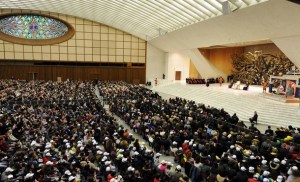
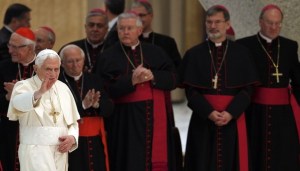
Pope Benedict General Audience for the WPCU

“The Unity for Which We Pray Requires Interior Conversion, Both Communal and Personal”

VATICAN CITY, JAN. 18, 2012 (Zenit.org).- Here is a translation of the Italian-language catechesis Benedict XVI gave today during the general audience held in Paul VI Hall. The Pope reflected on the Week of Prayer for Christian Unity, which begins today.

* * *

Dear brothers and sisters,

Today marks the beginning of the Week of Prayer for Christian Unity, which for more than a century has been celebrated by Christians of all Churches and ecclesial Communities, in order to invoke that extraordinary gift for which the Lord Jesus Himself prayed during the Last Supper, before His Passion: “that they may all be one; even as thou, Father, art in me, and I in thee, that they also may be in us, so that the world may believe that thou hast sent me” (John 17:21). The practice of the Week of Prayer for Christian Unity was introduced in 1908 by Father Paul Wattson, founder of an Anglican religious community that subsequently entered the Catholic Church. The initiative received the blessing of Pope St. Pius X and was then promoted by Pope Benedict XV, who encouraged its celebration throughout the Church with the Brief, Romanorum Pontificum, promulgated Feb. 25, 1916.

The octave of prayer was developed and perfected in the 1930s by Abbé Paul Couturier of Lyon, who promoted prayer “for the unity of the Church as Christ wills, and in accordance with the instruments He wills.” In his later writings, Abbé Couturier sees this Week as a way of allowing the prayer of Christ to “enter into and penetrate the entire Christian Body”; it must grow until it becomes “an immense, unanimous cry of the whole People of God” who ask God for this great gift. And it is precisely during the Week of Christian Unity that the impetus given by the Second Vatican Council toward seeking full communion among all of Christ’s disciples each year finds one of its most forceful expressions. This spiritual gathering, which unites Christians of all traditions, increases our awareness of the fact that the unity to which we tend will not be the result of our efforts alone, but will rather be a gift received from above, a gift for which we must constantly pray.

Each year, the booklets for the Week of Prayer are prepared by an ecumenical group from a different region of the world. I would like to pause to consider this point. This year, the texts were proposed by a mixed group comprised of representatives of the Catholic Church and of the Polish Ecumenical Council, which includes the country’s various Churches and ecclesial Communities. The documentation was then reviewed by a committee made up of members of the Pontifical Council for the Promotion of Christian Unity and of the Faith and Order Commission of the Council of Churches.  This work, carried out together in two stages, is also a sign of the desire for unity that animates Christians, and of the awareness that prayer is the primary way of attaining full communion, since it is in being united with the Lord that we move toward unity.

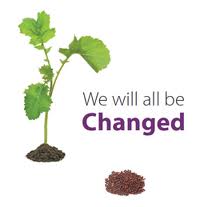
The theme of the Week this year — as we heard — is taken from the First Letter to the Corinthians: “We Will All Be Changed By the Victory of Our Lord Jesus Christ” — His victory will transform us. And this theme was suggested by the large ecumenical Polish group I just mentioned, which — in reflecting on their own experience as a nation — wanted to underscore how strong a support the Christian faith is in the midst of trial and upheaval, like those that have characterized Poland’s history. After ample discussion, a theme was chosen that focuses on the transforming power of faith in Christ, particularly in light of the importance it has for our prayer for the visible unity of Christ’s Body, the Church. This reflection was inspired by the words of St. Paul who, addressing himself to the Church of Corinth, speaks about the perishable nature of what belongs to our present life — which is also marked by the experience of the “defeat” that comes from sin and death — compared to what brings us Christ’s victory over sin and death in His paschal mystery.

The particular history of the Polish nation, which knew times of democratic coexistence and of religious liberty — as in the 16th century — has been marked in recent centuries by invasions and defeat, but also by the constant struggle against oppression and by the thirst for freedom. All of this led the ecumenical group to reflect more deeply on the true meaning of “victory” — what victory is — and “defeat.” Compared with “victory” understood in triumphalistic terms, Christ suggests to us a very different path that does not pass by way of force and power. In fact, He affirms: “If anyone would be first, he must be last of all and servant of all” (Mark 9:35). Christ speaks of a victory through suffering love, through mutual service, help, new hope and concrete comfort given to the least, to the forgotten, to those who are rejected. For all Christians, the highest expression of this humble service is Jesus Christ Himself — the total gift He makes of Himself, the victory of His love over death on the Cross, which shines resplendent in the light of Easter morning.

We can take part in this transforming “victory” if we allow ourselves to be transformed by God — but only if we work for the conversion of our lives, and if this transformation leads to conversion. This is the reason why the Polish ecumenical group considered particularly fitting for their own reflection the words of St. Paul: “We will all be changed by the victory of Christ, Our Lord” (cf. 1 Corinthians 15:51-58).

The full and visible unity of Christians for which we long demands that we allow ourselves to be ever more perfectly transformed and conformed to the image of Christ. The unity for which we pray requires interior conversion, both communal and personal. It is not simply a matter of kindness and cooperation; above all, we must strengthen our faith in God, in the God of Jesus Christ, who has spoken to us and who made Himself one of us; we must enter into new life in Christ, which is our true and definitive victory; we must open ourselves to one another, cultivating all the elements of that unity that God has preserved for us and gives to us ever anew; we must feel the urgency of bearing witness before the men of our times to the living God, who made Himself known in Christ.

The Second Vatican Council put the ecumenical pursuit at the center of the Church’s life and work: “The Sacred Council exhorts all the Catholic faithful to recognize the signs of the times and to take an active and intelligent part in the work of ecumenism” (Unitatis redintegratio, 4). Blessed John Paul II stressed the essential nature of this commitment, saying: “This unity, which the Lord has bestowed on his Church and in which he wishes to embrace all people, is not something added on, but stands at the very heart of Christ’s mission. Nor is it some secondary attribute of the community of his disciples. Rather, it belongs to the very essence of this community (Ut unum sint, 9). The ecumenical task is therefore a responsibility of the whole Church and of all the baptized, who must make the partial, already existing communion between Christians grow into full communion in truth and charity. Therefore, prayer for unity is not limited to this Week of Prayer but rather must become an integral part of our prayer, of the life of prayer of all Christians, in every place and in every time, especially when people of different traditions meet and work together for the victory, in Christ, over all that is sin, evil, injustice, and that violates human dignity.

From the time the modern ecumenical movement was born over a century ago, there has always been a clear recognition of the fact that the lack of unity among Christians prevents the Gospel from being proclaimed more effectively, because it jeopardizes our credibility. How can we give a convincing witness if we are divided? Certainly, as regards the fundamental truths of the faith, much more unites us than divides us. But divisions remain, and they concern even various practical and ethical questions — causing confusion and distrust, and weakening our ability to hand on Christ’s saving Word. In this regard, we do well to remember the words of Blessed John Paul II, who in the Encyclical Ut unum sint, speaks of the damage caused to Christian witness and to the proclamation of the Gospel by the lack of unity (cf. no. 98,99). This is a great challenge for the new evangelization, which can be more fruitful if all Christians together announce the truth of the Gospel of Jesus Christ and give a common response to the spiritual thirst of our times.

The Church’s journey, like that of all peoples, is in the hands of the Risen Christ, who is victorious over the death and injustice that He bore and suffered on behalf of all mankind. He makes us sharers in His victory. Only He is capable of transforming us and changing us — from being weak and hesitant — to being strong and courageous in working for good. Only He can save us from the negative consequences of our divisions. Dear brothers and sisters, I invite everyone to be more intensely united in prayer during this Week for Unity, so that common witness, solidarity and collaboration may grow among Christians, as we await the glorious day when together we may profess the faith handed down by the Apostles, and together celebrate the Sacraments of our transformation in Christ. Thank you.

[Translation by Diane Montagna]
[In English, he said:]

Dear Brothers and Sisters,

The Week of Prayer for Christian Unity which begins today invites all the Lord’s followers to implore the gift of unity. This year’s theme – We Will All Be Changed By The Victory Of Our Lord Jesus Christ – was chosen by representatives of the Catholic Church and the Polish Ecumenical Council. Poland’s experience of oppression and persecution prompts a deeper reflection on the meaning of Christ’s victory over sin and death, a victory in which we share through faith. By his teaching, his example and his paschal mystery, the Lord has shown us the way to a victory obtained not by power, but by love and concern for those in need. Faith in Christ and interior conversion, both individual and communal, must constantly accompany our prayer for Christian unity. During this Week of Prayer, let us ask the Lord in a particular way to strengthen the faith of all Christians, to change our hearts and to enable us to bear united witness to the Gospel. In this way we will contribute to the new evangelization and respond ever more fully to the spiritual hunger of the men and women of our time.

* * *

I offer a cordial welcome to all the English-speaking pilgrims and visitors present at today’s Audience. My special greeting goes to the Lutheran pilgrims from Finland. I also greet the group of sailors and marines from the United States. Upon all of you and your families I cordially invoke God’s abundant blessings!

© Copyright 2012 – Libreria Editrice Vaticana
Zenit original: http://www.zenit.org/article-34139?l=english
Vatican original with video: http://www.vatican.va/holy_father/benedict_xvi/audiences/2012/documents/hf_ben-xvi_aud_20120118_en.html
Prayer for Christian Unity?

One of the most well advertised annual events during the Week of Prayer for Christian Unity in Rome has nothing to do with ecumenism.

At least, not explicitly.

Every night at 8:00pm during the WPCU, there is a liturgy at Santa Maria in Via Lata, just off the Via del Corso. Instead of inviting in the Orthodox, Anglican, and Protestant communities in Rome to lead worship in rotation, every one of these liturgies is Catholic. The unique aspect of the series, however, is that each is celebrated according to a different liturgical rite, sponsored by different of the Churches sui iuris that make up the Catholic communion.

It is a great idea, but the question is whether it is appropriate for the week of prayer that is meant to focus on the restoration of unity with other Christians. Is it a celebration of the unity-in-diversity that already exists in a real but imperfect way in the Catholic Church? Does it smack of uniatism, or of Catholic imperialism? Is it enough to remind Roman Catholics that not all Catholics are Roman, that we do not all do things the same way, and therefore demonstrate a fundamental principle of ecumenism – that unity does not mean uniformity?

This year’s schedule includes most of the major liturgical traditions – though the East Syrian, or Assyrian/Chaldean rite is notably absent for some reason:

  • January 18: Byzantine Rite, Greek Catholic Church
    (organized by the Pontifical Greek College)
  • January 19: Byzantine Rite, Ukrainian Catholic Church
    (organized by the Basilian Fathers of St. Giosafat)
  • January 20: Byzantine Rite, Romanian Catholic Church
    (organized by the Pontifical Romanian College)
  • January 21: Maronite Rite, Maronite Catholic Church
    (organized by the Maronite Order of the Blessed Virgin Mary)
  • January 22: Latin Rite, Roman Catholic Church
    (presided by Archbishop Piero Marini)
  • January 23: West-Syrian Rite, Syro-Malankara Catholic Church
    (organized by the Pontifical Damascene College)
  • January 24: Armenian Rite, Armenian Catholic Church
    (organized by the Pontifical Armenian College)
  • January 25: Ge’ez Rite, Ethiopian Catholic Church
    (organized by the Pontifical Ethiopian College)

First, I have to say it is a great opportunity to celebrate the liturgical diversity of the Catholic Church. In a way it recalls Bl. John XXIII’s decision to open Vatican II in the Ambrosian Rite rather than in the Roman – a reminder that there is always more than one way to be Catholic.

It is also helpful for us Latins to remember that the Catholic Church is actually catholic, and not simply an extension of Latin-Roman/Western culture. All Roman Catholics are Catholic, but not all Catholics are Roman Catholic.

(It should go without saying the ecumenically obvious statement that not all catholics are Catholic, either, but that does not merit calling all Catholics ‘Roman Catholic’. Capisce?)

One caveat is that it can reduce the respective churches of the Catholic communion merely to their liturgical patrimony, as if the Catholic Church simply enjoys liturgical diversity in a single monolithic ecclesial entity, rather than in fact being a communion of churches.

Another is that such a celebration during the Week of Prayer for Christian Unity could communicate an unintended model of unity, some kind of liturgical uniatism – or, as one my first ecumenical dialogue partners, an avid Trekkie, would put it, this model makes the Catholic Church out to be the Borg, with a simple message: “Your patrimony will be absorbed and added to our own. Resistance is futile.”

Certainly, that is not ecumenism according to the Catholic Church. (Though there is at least a hint of receptivity!)

Nevertheless, it is a celebration of Christian Unity – to be precise, of Catholic unity – to be able to celebrate the same Eucharistic mystery in such varied and ancient liturgical traditions, all of which are found within the Catholic Church. It just is not the kind of Christian Unity, or not the whole scope of the kind of unity, envisioned by the Week of Prayer.

It might be more fitting, however, if the week included Anglican, Protestant, and Orthodox Eucharistic liturgies, in which it is precisely our inability to share communion that compels us to strive for the unity for which Christ himself prays. Or let us celebrate the rich diversity of the Catholic communion in the same manner, but in a different week: perhaps the Pentecost octave. Then at least we would have time to participate in both!


Settimana di Preghiera per l’unità dei Cristiani 2012 in Roma

If you ever thought that Rome was not interested in ecumenism, you should think again. The calendar below is an unofficial list of everything going on during these days that has been advertised in connection to the Week of Prayer for Christian Unity, or the preceding Day of Reflection on Jewish-Christian Dialogue.

WEEK OF PRAYER FOR CHRISTIAN UNITY
SETTIMANA DI PREGHIERA PER L’UNITÀ DEI CRISTIANI
ROMA + 18 – 25 JANUARY 2012

Tutti Saremo Trasformati dalla Vittoria di Gesu Cristo, Nostro Signore”
“We will all be transformed by the victory of our Lord Jesus Christ”

Tuesday, 17 January

1730     Giornata di Riflessione Ebraico-Cristiana: La Sesta Parola: «NON UCCIDERAI»
S. E. Mons. Benedetto Tuzia Commissione diocesana per l’Ecumenismo e il Dialogo
Ecc.mo Rav Riccardo Di Segni Rabbino Capo della Comunità Ebraica di Roma
Prof. Mauro Cozzoli Professore Ordinario di Teologia Morale, Pont. Università Lateranense
Pontificia Universitá Lateranense, Aula Pio XI

Wednesday, 18 January

1730      The Encounter of the African Traditional Religions, Islam and Christianity in Northeastern Nigeria:
Toward a Contextual Theology of Interreligious Dialogue
Doctoral Defense of Rev. John Bogna Bakeni, Russell Berrie Alumnus
Pontificia Universitá San Tommaso, Aula X

1830       The Venerable English College – Celebration of the Week of Prayer for Christian Unity

1900      Celebrazione, Consulta delle Chiese Evangeliche Romane
Pastore Herbert Anders, Chiesa Luterana
S. E. Mons. Benedetto Tuzia Commissione diocesana per l’Ecumenismo e il Dialogo
Chiesa luterana, via Toscana 7

Thursday, 19 January

1600     Celebrazione ecumenica finlandese, festa di S. Enrico di Finlandia
S.E.R. Mons. Teemu Sippo, vescovo della diocesi cattolica di Helsinki.
Rev.mo Seppo Hakkinen, vescovo della diocesi evangelico-luterana di Mikkeli.
Basilica di Santa Maria Sopra Minerva

1630      Impulses of the Spirit: Promotion of Human Rights, Justice, and Peace since Vatican II
Rev. Drew Christiansen, SJ, editor-in-chief of America Magazine
Ecumenical Celebration of the Word
Canon David Richardson, ChStJ, Archbishop of Canterbury’s Representative to the Holy See
Monsignor Mark Langham, Pontifical Council for Promoting Christian Unity
Centro Pro Unione, Via del Anima 30 (Piazza Navona)

1830       Veglia Ecumenica Diocesana di Preghiera
Basilica Santa Maria in Trastevere

Friday, 20 January

1730      Vespri ecumenica
Rev.mo Seppo Hakkinen, vescovo della diocesi evangelico-luterana di Mikkeli
S.E. Teemu Sippo, vescovo della diocesi cattolica di Helsinki
S.E. Mons. Brian Farrell e Mons. Mathias  Türk.
Chiesa di S. Brigida, Piazza Farnese 96

Saturday, 21 January

1000      Abdullahi An-Na’im Human Rights Theory and Jacques Maritain’s Natural Law: A Comparative Study
Doctoral Defense of Dott.ssa. Paola Bernardini, Russell Berrie Alumna
Pontificia Universitá San Tommaso

Sunday, 22 January

1100      Catholic Eucharist with guest preacher,
Canon David Richardson, ChStJ, Archbishop of Canterbury’s Representative to the Holy See

Oratorio di San Francesco Saverio del Caravita

1830       Ecumenical Prayer Service/Churches Together in Rome
Prof.ssa Donna Orsuto, DSG, Preaching
Ponte Sant’Angelo Methodist Church, Piazza di Ponte Sant’Angelo

Tuesday, 24 January

1245      Anglican Eucharist with guest preacher
Rev. Kenneth Howcraft, Methodist Representative to the Holy See
Anglican Center in Rome, Piazza del Collegio Romano 2

1830       Dialogo Interreligioso in Chiara Lubich e nel Movimento dei Focolari
Dott. Roberto Catalano, Centro Dialogo Interreligioso
Istituto Tevere – Centro pro Dialogo, Via di Monte Brianzo 82

Wednesday, 25 January

1730      Vespers at the Papal Basilica of San Paolo fuori le Mura
Pope Benedict XVI Solemn Closing of the Week of Prayer for Christian Unity

2000     Veglia di preghiera ecumenica
Mons. Charles Scicluna
Chiesa Santa Brigida, Piazza Farnese 96

Thursday, 26 January

1800      Chiesa Cattolica: Essenza – Realtà – Missione
Presentazione: Dott. Rosino Gibellini
Intervento: S.E.R. Cardinal Walter Kasper
Responso: S.E.R. Cardinal Kurt Koch
Centro Pro Unione, Via Santa Maria dell’Anima 30