
Home » Posts tagged 'Catholic' (Page 3)
Tag Archives: Catholic
Dutch Katholieke Kerk and All Saints Anglican
I had two great experiences of church today. This morning, i had the priveledge to join my friend Eveline at the Dutch church in Rome for the Sunday Eucharist, and this evening we joined our friend Stian at an Anglican celebration of Evensong (Vespers) at All Saints.
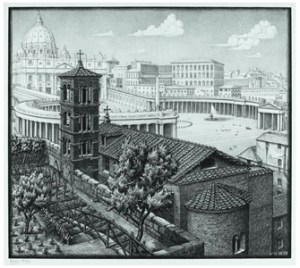
Saint Michele dei Frisoni, National Church of the Netherlands in Rome
The Dutch church, San Michele dei Frisoni, is located just over the international border at Piazza San Pietro, on the Italy side – litteraly right out from the piazza, hang right and up the stairs. Voila! You are I the Kerk van de Friezen. The Friezen, apparently, are one of the regional cultural groups in the Netherlands, like Holland. (If that link does not work, or, more likely, if you cannot read Dutch, try this one.)
It is a beautiful language, especially when sung. I have the sense always of being just on the edge of comprehension. The common Germanic root of English and Dutch makes it as if listening to a conversation in another room, so that you feel like you can almost make out what is being said, but not quite.
After the liturgy, I was asked about differences with my experience of the mass in America and in Rome. Obviously, the language, and some small details (for example, almost no one made the small sign of the cross at the gospel). But, the mass is the mass, and coffee hour, apparently, is coffee hour.
More noticeably, though, was a real quality of the congregational singing; there was only a small choir yet every song was richly done. That and the assembly filled the church, but was on average noticeably older than what I am familiar with. They did announce a pilgrimage from the diocese of Tilburg coming next week, though, so it will be interesting to see if it is young people or older.
Speaking of pilgrimages, one of the members present was called forth for a special blessing and recognition. He had walked from the Netherlands to Rome, a journey that took him a little over three months, and about 2000 km/1400mi. I wish I knew more about his experience to share, but it was all in Dutch. Though Eveline was kind enough to translate the highlights of the homily, we decided the announcements were fine left in the original!
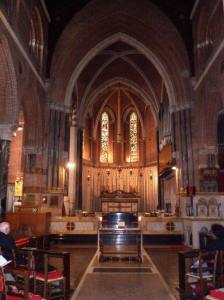
All Saints Anglican Church, the Church of England parish in Rome
In the evening Stian, Eveline and I trekked to All Saints for Festal Evensong (Vespers), one of two Anglican churches in Rome. All Saints is the Church of England parish, while St. Pauls-within-the-Walls is the (American) Episcopalian parish. The church was celebrating the feast of their dedication, so there was a choir from Hexam Abbey and the guest preacher was British Monsignor Mark Langham who is the person responsible for relations with Anglicans in Rome, from the Pontifical Council for Promoting Christian Unity.
Father Mark opened his homily by admitting that, as he sat to begin writing his remarks this week, he found himself wishing that he had been invited to preach last week – before the press conference that has made such an impression on Anglican-Catholic relations. Without ignoring the challenges posed by the announcement, the reflections genuinely focused on the community of All Saints and on the community as one of the many expressions of the unity to which we are all called.
Whether this is an aspect of British culture I am not familiar with, I do not know, but several times he employed some very good humor, and it seemed as though the three of us were the only ones appreciating it. (At the beginning he said something about the news of the week causing ripples in the “normally tranquil waters of ecumenical dialogue.” Tranquil waters indeed!)
It was enough that we were wondering how much was perhaps some latent tension surrounding the presence of a guest preacher form the Holy See in such proximity to the announcement of the Personal Ordinariates. To his great credit, Father Langham neither sidestepped the question, nor did he dwell on it, focusing on the cause for celebration, the dedication feast of All Saints parish in Rome.
The prayers of the faithful were also interesting, “Let ecumenical dialogue be honest… and charitable,” being the most memorable among a list of prayers for unity.
As beautiful as the service was, it was difficult to fully participate. The songs were choral, rather than congregational, and often in unfamiliar settings. Though my internal liturgist recoils at the thought, I suppose there can be times to sit back and appreciate the beauty of liturgy without engaging more than the receptive senses!
Anglican-Catholic Personal Ordinariates
Two days ago, Rome announced a forthcoming Apostolic Constitution establishing Personal Ordinariates for former Anglicans seeking full communion with the Catholic Church.
As the Constitution itself has not been actually published, there’s a great deal more speculation on the blogs and newswires that real information, but a few things were made clear in the news conference.
Unfortunately, my presence on Vatican property and proximity to the halls of power has not really increased my access to information about the decisions made there. We did have dinner tonight with an official from the Pontifical Council for Promoting Christian Unity, however, which probably would not have been possible in Seattle – so there are some advantages!
So, some immediate observations:
The “note” and press conference was delivered by two of the highest ranking Americans in the Holy See, Cardinal William Levada, prefect of the Congregation for the Doctrine of the Faith, and Archbishop Augustin DiNoia, secretary (#2) in the Congregation for Divine Worship and the Discipline of the Sacraments. Why two Americans? Why no Brits? Probably because of the offices they hold, but Romans seem to be skeptical of coincidences. I’m merely curious.
Conspicuous by absence is any representative of the Pontifical Council for Promoting Christian Unity. Indeed, Cardinal Kasper, president of the council, is not even in Rome, but in Cyprus for the 11th meeting of the Joint International Commission for Theological Dialogue between the Catholic Church and the Orthodox Church.
Personal Ordinariates are not exactly like a Personal Prelature (which is what Opus Dei is), but are basically what the Military Ordinariates are – essentially a diocese serving people of a certain characteristic rather than a geographic structure. Instead of members of the armed forces, the membership will be former Anglicans.
Something like this, or the establishment of a new Church sui iuris with its own patriarch or major archbishop, has been discussed as a structural option for the future full communion between the Anglican Communion and the Catholic Church. I think that may still be seen as an eventual option, because the Personal Ordinariates are not fully autonomous churches in that sense, but particular churches like a diocese, still within the context of the Roman church and its national conferences.
Nevertheless, the specter of “uniatism” will no doubt be raised again in the Eastern Orthodox world, and possibly, in the Anglican and Protestant world too. This move could be seen from those corners as proof that Rome really is just interested in co-opting non-Roman liturgical and theological patrimony just for the sake of proselytism. While such an accusation has some historical bases, especially concerning the Latinization of Eastern Catholic Churches, it is clearly not the reality of the current Eastern Catholic Churches, and I do not think it is the reality for these Personal Ordinariates, either. Still, the perception itself could be damaging to the ongoing reception of ecumenical advances with the apostolic chuches in the East.
There is one line that I found particularly interesting, even though it seemed to be made almost off-hand: When explaining that the ordinary of these Ordinariates (read: diocesan bishop) may be either a (celibate) bishop or a (celibate or married) priest, the note states, “Historical and ecumenical reasons preclude the ordination of married men as bishops in both the Catholic and Orthodox Churches.”
Really? that’s new…
Historically, the Latin Church has had married bishops, at least when we also had married presbyters and deacons as a rule (that is, most of the first 1200 years). If we do not have a requirement of celibacy for either deacons or presbyters, as would be the case in these Ordinariates, there is no historical reason for requiring it of bishops (in Western practice).
Ecumenically, as far as I am aware, to restore this discipline would not pose a challenge to the Orthodox, as they see no objection to the Western Church having married bishops even while the Eastern Church does not. The difference in custom is based on the practice of selecting bishops from the diocesan clergy (as in the West) rather than from the monastic clergy (as is most common in the East). So while there is historic precedent for a celibate episcopate in the Eastern Catholic and Orthodox churches, it does not hold for the Western churches, except inasmuch as we currently have a (mostly) celibate presbyterate and have discontinued the ancient practice of selecting bishops from the diaconate.
I would really like to see the ecumenical and historical rationale behind this piece of the note; presumably it is in the forthcoming Apostolic Constitution. Either way, it has got my curiosity piqued; I’ll look into it and follow up!
Shopping for Roman collars
Everyone in Rome has a uniform and a title; and that’s if you are a nobody. If you are important, you also have a stamp, a wax seal, and most likely a signet ring. Perhaps this is why electronic means of communicating, providing identification, registering for classes, paying bills, and the like are so difficult and considered downright foreign here. I’ve gone through i don’t know how many hard-copy pictures of myself, and every correspondence to everyone needs to be an original letter, signed, co-signed and countersigned, then stamped in duplicate or triplicate.
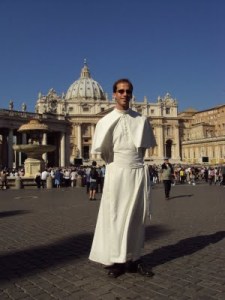
Norbertine Habit
But back to the uniforms: One of the many blessings of being in Rome is seeing the life of the church in all its profound diversity. You cannot maintain the illusion of a monolithic Catholicism very long in this capital of the church. I’ve seen habits for orders i had heard of but never met: Norbertines, for example, dress in a white simar and fascia looking almost identical to the pope. Then there are those i did not even know existed: the Teutonic knights, apparently, are back as a diocesan order, and looking very medieval.
Even most of the lay people around here are in ecclesiastical garb, particularly seminarians and lay religious, even during classes. So, naturally, I am on a mission to discover the appropriate ecclesiastical garb for a lay ecclesial minister. After all, if a student candidate for ministry gets a uniform, so too should someone already in sacred ministry, no?
(The current favored title is “Almost Reverend…”, or “Your Mediocreness”, and the garb is a white or black dress shirt with banded collar, though I am open to suggestions. But, I digress.)
Archbishop Wilton D. Gregory
Allora… I decided to peruse the ecclesiastical shopping district near the Pantheon with Stian, an Anglican seminarian and friend of mine who shares that you can get four clerical shirts in Rome for the price of one in Norway.
We picked up a couple new friends on the way, Matthew, from Australia, and Cosima, from Germany. While Stian was being fitted for his clericals, the rest of us were perusing the mitres, zucchetti, and birettas that seemed to be available over the counter.
Did you know that with an ecclesiastical doctorate one is entitled to wear a biretta with the appropriate color trimming? For theology, it’s scarlet; canon law is green, etc.
As we were about to leave in search of a pizzeria and gellateria, America’s lone representative to the Synod for Africa, Archbishop Wilton Gregory of Atlanta, walked in for some shopping of his own. He was kind enough to stop for a brief chat about the Synod, and exchange a warm greeting before we moved on for pizza and gelato. At least now we know we were in the right shop!
 The Ecumenism Blog