
Home » Posts tagged 'Catholic Church' (Page 8)
Tag Archives: Catholic Church
Catholic or catholic?
If you do not know the blog Get Religion, you should, especially if you have any interest in reporting on religion in secular media, or any interest in how religions present themselves to the world through the secular media.
There was a recent post discussing the terms Catholic and catholic, and what they mean. While doing a good job of looking at catholic as universal versus Catholic as referring to the Catholic Church, it left a few vagaries intact, that I have always struggled with, especially in secular reporting on the Catholic Church.
Briefly, the most misunderstood aspect of secular reporting on these terms is to always conflate ‘Roman Catholic Church’ and Catholic Church.
I have mentioned it before, but, simply put, the Catholic Church is the Catholic Church. It is not the only church that is catholic, nor is it the entire church catholic, but there is only one church called, officially, the Catholic Church., and it is the 1.1 billion member church in communion with Rome.
Roman Catholic, at most, indicates only a part of the Catholic Church – one of the 23 sui iuris churches that make up the Catholic Church. Roman Catholic and Latin Catholic are basically synonymous. However, Roman Catholic Church and Catholic Church are not synonymous. A Ukranian-Greek Catholic, a Chaldean Catholic, or a Maronite Catholic are all Catholic, but none are Roman Catholic.
More strictly, as I write from Rome, Roman Catholic means those Catholics who belong to the Church of Rome – that is, the Diocese of Rome. There are less than 3 million. Neither should the entire Catholic Church be referred to as the Roman Church – that would be like referring to the Anglican Communion as the Church of Canterbury, or to the Lutheran World Federation as the Augsburgian Church.
Yet, the AP style manual still insists on using ‘Roman Catholic’ instead of simply Catholic. In the end, admitting that the Catholic Church is properly called Catholic and not Roman Catholic does not mean it is, or thinks it is, the only catholic church, nor that it is the entire church catholic, but it is ecumenically appropriate to call a Church what it calls itself. The Catholic Church is the Catholic Church, and no high-church Anglicans were harmed in the making of this statement.
The first African pope? 1800 years ago…
I was about to start my own blog on the three african popes, because of all the attention being given to Cardinals Turkson, of Ghana, and Arinze, of Nigeria.
But then, i found this blog, and decided it was even better, because it came with a cool map showing the known or presumed birthplace for all known bishops of Rome outside of Europe. He even includes St. Peter.
I am still going to work on a quick post about the geographic distribution of the college of cardinals, and how it might better represent global Catholicism.
Map of Non-European Popes
Pope Benedict XVI’s decision to resign has taken both the Catholic and non-Catholic worlds by immense shock. Some have begun to play the game of “who will be the next Pope?” This game usually ends in a surprise no one saw coming but this does not stop people from trying over and over again. Some have speculated , as they did in 2005 right after the death of Pope John Paul II’s death, that there will be an African or Latin American Pope. Some even go as far to say there could be the “first black Pope in 1,500 years.”I decided to study and map out popes born outside of Europe. There were some surprises among the results.
Of the 265 officially recognized Popes, 217 have been Italian while 17 were French and 13 were Greek (though this includes ethnic and cultural Greeks who were from Greek Italy and Greek Asia). So to solve problems like this I declared a non-European pope to be one who was born outside the modern understanding of what is Europe, regardless of ethnicity or culture.
Three Popes were born in Roman Africa, which today is part of Algeria, Tunisia, and Libya. These African popes were Pope Victor I (189-199), Pope Miltiades (311 to 314), and Pope Gelasius I (492 to 496). These Popes are sometimes described as Black in today’s press because of their African origin. However, the elite in these provinces were descendants of Italian Romans while the population in rural areas were Berbers, who are an olive hue. There is no comparably or historic evidence that the African popes were Black.
Two popes, both ethnically Greek, were born in modern day Turkey. Pope John V (685-686) was from Antioch and Pope John VI was from Ephesus (701-705). John V is sometimes considered “Syrian” due to Antioch’s location in Byzantine Syria.
Four popes were born in “Syria”, modern-day Syria and maybe Lebanon. These are Popes Anicetus (150 to 167), Sisinnius (708), Constantine (708-715), and Gregory III (731-741). Anicetus was born in modern day Homs, site of heavy fighting in the on-going civil war, while the other three were born in newly Muslim conquered Syria. This shows that Christian intellectual thought and leadership were not crushed right away by the new Muslim rulers.
Two popes were born in modern day Israel, depending on who one asks. Saint Peter, the first Pope, was born in the village of Bethsaida along the Sea of Galilee while Pope Theodore I (642-649) was an ethnic Greek from Jerusalem. However, Bethsaida is east of the Jordan River in the Golan Heights region. This is Israel or Syria on depending one’s perspective. Meanwhile, the historic part of Jerusalem where Pope Theodore I was from is mostly likely in the part of the city east of the 1949 cease fire line and therefore either Israel or the West Bank.
So of the eleven popes born outside Europe, at least two were of ethnically non-European origin: Peter (Jewish) and Constantine (Assyrian). Up to three more, the Africans, may have been Berber. So between 0.75% to 1.88% of all Popes were of non-European ethnicity.
Some of these Popes played major roles while pontiff. Pope Theodore I worked hard and proved Roman supremacy over the Emperor and Patriarch in Constantinople. Meanwhile Pope Victor I was the pope who changed the language of the Roman Church from Greek to Latin. Without his change traditionalist Catholics would be lamenting the loss of Greek in today’s liturgies.
Soon the Vatican will announce there is a new Pope. No one yet knows who that person will be and where they will be from. However, now you have a better understanding of the history of non-European popes.
Original post from Geographic Travels.
Benedict Resigns – Vatican Press Office Update (Day 2)
Today’s press conference focused on Pope Benedict’s schedule for the rest of the month, and some of the same questions i addressed earlier today.
The conference can be viewed on Vatican Radio. Official summary here in English.
An unofficial translation via live tweeting is provided by Father Roderick Vonhogen:
Below is a summary of my live tweets at @fatherroderick during the press conference by Fr. Lombardi at the Vatican earlier today.
The Pope’s Last Work Week
Right now, the Pope is working on the things he has to do in the next weeks, like his general audience tomorrow. Until Feb 28, the Pope continues all his work.
Ash Wednesday celebration will be at Saint Peter’s Basilica instead of on the Aventine. The reason for this is because of the large crowd expected to show up.
The last general audience of Pope Benedict XVI will be at February 27 on Saint Peter’s Square because of the large crowd expected to show up. There will probably not be a specific ‘event’ to say goodbye to pope Benedict XVI, he will use the planned events instead.
The pontificate of the Pope ends Feb 28 at 8 pm, because that is normally the hour on which the Pope concludes his working days.
The decision of the Pope has a message for us all: one of humility, courage, wisdom to acknowledge his limitations. The Pope is someone of great realism. Knows the problems of the situation of the Church in today’s world. Has a broad view.
The Pope’s health and reasons to step down
There are no specific illnesses that lead to the Pope’s resignation. Fr. Lombardi says the Pope has had a pacemaker for 10 years. Routine maintenance 3 months ago as reported by newspapers. The trip to Mexico and Cuba was part of the process that led to the Pope’s decision to step back.
World Youth Day
World Youth Day is in its essence a meeting of the youth with the Pope. So it is very, very likely the new pope will be there. Of course, the new pope can decide what he wants, but it is normal to assume that Benedict XVI’s successor will go to Rio.
The Pope’s writings and living quarters after retirement
After his retirement, pope Benedict XVI will have no tasks or responsibilities in the Vatican, it’s possible that in the future, he will choose another place to stay, but for the time being, he will live in the Vatican at the monastery of Mater Ecclesiae.
The Pope’s planned encyclical letter on Faith won’t be released before Feb. 28, instead it will be released later as reflections. Pope Benedict XVI has often expressed his desire to pray and to write. We hope he might write something for us too.
The monastery of Mater Ecclesiae is currently being renovated; the sisters will move out, no new sisters to replace them. The Pope himself made the decision to continue to live at the Vatican. The Pope always walks around in the Vatican to pray the rosary, so he knows the monastery well, and knows what is possible.
Fr. Lombardi says he doesn’t know yet how we will have to call pope Benedict XVI after he steps down. A Journalist uses “Papa Emeritus”, “Pope Emeritus” to indicate the Pope after he steps down. Fr. Lombardi says that the Pope will enter history as pope Benedict XVI, but we await instructions about his title after his resignation. Pope Benedict XVI will certainly remain bishop emeritus of Rome, but we’ll have to see if that is the title he prefers to use.
The decision to announce the resignation was the Pope’s own, but of course there has been consultation about the calendar.
Conclave and Installation Mass
The conclave must begin at least 15 and no later than 20 days after the resignation of pope Benedict XVI and Sede Vacante. On March 1, we have the situation of Sede Vacante.
Preparations of the Conclave then begin. Several meetings
before the Conclave. Date of the Conclave depends on the Apostolic Constitution. Cardinal Marini is studying this.
This is a new situation, so we will have to see what to do with rituals like the destruction of the Pope’s fisherman’s ring. Pope Benedict XVI will not intervene in the process of the election of the new pope. The cardinals will be autonomous. The Pope is not a cardinal. He will not participate in the Conclave.
The new pope
It’s up to pope Benedict and the new pope to decide if he will participate during installation Mass of new pope. The fact that Benedict XVI will continue to live in the Vatican will be no obstacle whatsoever for his successor, on the contrary. It will be a great support for the new Pope to have someone around who understands like no other what it means to be Pope. His successor will probably feel supported by the prayer of pope Benedict XVI after he resigns.
The Pope doesn’t gather the cardinals for the new conclave; they are smart enough to know that they should be here in March. It’s not a problem if some cardinals arrive early in the Vatican to visit the pope.
That’s the end of today’s press conference in the Vatican. Hope you enjoyed my live tweets. I apologize for possible translation errors.

Benedict Resigns – Retired Pope Q & A
[Updates since the writing of this Q & A, usually confirmation of my speculations, are included below in blue.]
The Italians have squelched the discussion of papal resignation in the past by brushing the idea aside with comments like “you cannot have a pope emeritus,” or, “what would you even do with a retired pope?”
Several question, some serious and some mere curiosities have arisen in recent discussions, both virtually and in person here in Rome: Does the pope abdicate, resign, or retire? How does this compare to Pope John Paul II? When will the conclave be? Which cardinals can participate? What will Benedict’s new title be? What is the protocol and prerogatives for a retired pope? What role does he have in the Vatican, the college of Cardinals, or the Church? Does he retain his infallibility? Does he still wear white?
Official plans of the conclave will be publicized shortly, perhaps even today. It should not be difficult, even in the slow-moving Vatican, when many of the cardinals are already gathered for consistory. Though, at the same time, they may need a couple days to deal with the shock of the announcement. It seems only the dean of the college and a very small handful of others had notice even a day or two in advance of Monday’s announcement.
The following includes official answers where available, and speculation or suggestions where indicated.
Abdication, Resignation, or Retirement?
CIC 332§2 Si contingat ut Romanus Pontifex muneri suo renuntiet, ad validitatem requiritur ut renuntiatio libere fiat et rite manifestetur, non vero ut a quopiam acceptetur.
CIC 332§2 If it happens that the Roman Pontiff resigns his office, it is required for validity that the resignation is made freely and properly manifested but not that it is accepted by anyone.
Though “abdication” is the term used when a monarch leaves, the term has not been used officially since the loss of the papal state, for the resignation of the popes. Though technically still an absolute monarch, as sovereign of the Vatican City-State, the pope is the bishop of Rome above all else, and therefore he “resigns.” Though, in this case, “retires” certainly seems a valid description.
[On 18 February, Bishop Thomas Paprocki, bishop of Springfield and serves on the USCCB Committee on Canonical Affairs and Church Governance, with both a JD and an STD, confirmed the correct translation is ‘resignation’ rather than ‘abdication.’]
How does this compare to Pope John Paul II?
We really should not compare the two. John Paul II showed us suffering and ageing in dignity, Benedict XVI teaches us genuine kenosis and leadership with integrity and humility. It is hard to continue a ministry that it seems the Holy Spirit has called you to when your body fails you, it is harder to let go of power so absolute.
Voices that have criticized the Holy Father for resigning, saying things like “a father does not abandon his family,” or, “Wojtyla stayed until the end because one does not come down from the cross” seem to have missed the point.
Being pope is not about suffering, but about serving. A bishop emeritus can give witness to dignified suffering and the value of the elderly, but an impeded pope cannot serve. Benedict has reminded us to separate the office from the person, putting the emphasis on the Petrine ministry, where it belongs.
When will the conclave be held?
The apostolic constitution Universi Dominici Gregis, published by Bl. John Paul II and adapted slightly by Pope Benedict XVI, governs the Conclave, the process for the election of a new pope. According to the constitution, §37,
…from the moment when the Apostolic See is lawfully vacant, the Cardinal electors who are present must wait fifteen full days for those who are absent; the College of Cardinals is also granted the faculty to defer, for serious reasons, the beginning of the election for a few days more. But when a maximum of twenty days have elapsed from the beginning of the vacancy of the See, all the Cardinal electors present are obliged to proceed to the election.
This would seem to put the earliest starting date for the conclave on 15 March, and the latest starting date on 20 March. [This was confirmed by the Vatican Press office on 13 February].
However, since the purpose of this is to allow the cardinals not in Rome to get here, and because they have been given 17 days notice from the announcement to the time the retirement takes effect, perhaps it will be decided that this interregnum could be dispensed with. [A motu proprio to this effect is being considered, as of 22 February.]
Certainly, all hope that there will be a new bishop of Rome by Holy Week, which starts 24 March.
Which cardinals will participate?
The right to elect the Roman Pontiff belongs exclusively to the Cardinals of Holy Roman Church, with the exception of those who have reached their eightieth birthday before the day of the Roman Pontiff’s death or the day when the Apostolic See becomes vacant. (UDG §33)
One cardinal turns 80 on 26 February, and that is Lubomyr Husar, the retired Major Archbishop (de facto patriarch) of the Ukranian Catholic Church. According to the text, he would be excluded from the election, for being too old by less than 48 hours. Two others turn 80 in early March, Walter Kasper (March 5) and Severino Poletto (March 18), but even if the Conclave begins after their birthdays, they would still be admitted.
What is the protocol and prerogatives for a retired pope?
There is nothing in canon law or the apostolic constitution relating this. There are some ancient canons, and the precedent of retired bishops, that will be helpful. We know just a few things at this point, and the rest is speculation. We do know that Benedict XVI will not be involved in the election of his successor, and that he will retire first to Castel Gandolfo, and then to the monastery of cloistered nuns inside the Vatican for a time.
What will Benedict’s new title be?
The pope is the bishop of Rome. That is his title, his office, and the font of all other titles and offices, from Vicar of Christ to Servant of the Servants of God. Therefore the obvious choice would seem to be “bishop emeritus of Rome” just as any other retired bishop. But that is simply this ecclesiologist’s suggestion.
[On 22 February, Cardinal Francesco Coccopalmerio, president of the pontifical council for legislative texts, confirmed that after his retirement, he will be known as “His Holiness, Benedict XVI, bishop emeritus of Rome”.]
What role will he have in the Vatican, the college of Cardinals, or the Church?
Effectively none. In terms of protocol and precedence, one can imagine that he will be “ranked” below only the serving pope. Traditionally, popes have been forbidden from participating in the selection of their successors, and we already know he will be excluded from the coming conclave.
When a powerful leader resigns, it always seems the best practice that he or she basically disappear from the public eye for about a year, at least, to allow his or her successor to settle into the role. When the last Jesuit general retired – another office that was until recently ‘for life’ – he became a librarian in the Holy Land, and kept out of even provincial politics. When Fr. Ted Hesburgh retired as president of Notre Dame after 35 years, he took a year-long road trip and tour, staying away from campus. Mary McAleese, after 14 years as president of Ireland came to Rome and moved into the Lay Centre at Foyer Unitas to return to her studies of canon law.
Does he retain his infallibility?
The pope is not infallible. Not personally, anyway: Infallibility is not a possession or power of the pope, but a divine gift attributed to the Church as a whole, and derivatively to the college of bishops as a whole. The bishop of Rome, in communion with and head of the college of bishops, may exercise that authority in some very limited, very precise conditions, but it goes with the office, not the individual.
Will he still wear white?
I have no idea; I would expect not, but it will be curious to see what is deemed appropriate. Perhaps a black cassock or simar with white trim?
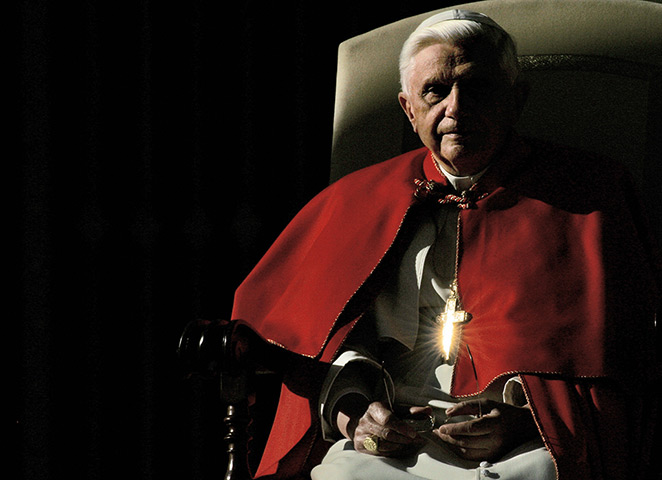
[John Allen, Jr., adds his own Q & A after today’s lengthy press briefing here.]
Lay Centre on EWTN
In other news… The Lay Centre at Foyer Unitas appears on the 4 February, EWTN “Vaticano” feature. The Lay Centre at Foyer Unitas is Rome’s premier collegio for lay students at the pontifical universities, institutes, and athenae.
The whole clip is only 27.00 long, and the section on the Lay Centre begins at 21.00
[embedding is not functioning at the moment, but you can go to the link here:]
Eastern Catholics explain tradition, value of married priests
Tuesday, November 13, 2012
By Cindy Wooden Catholic News Service
ROME (CNS) — In Eastern Christianity — among both Catholics and Orthodox — a dual vocation to marriage and priesthood are seen as a call “to love more” and to broaden the boundaries of what a priest considers to be his family, said Russian Catholic Father Lawrence Cross.
Father Cross, a professor at the Australian Catholic University in Melbourne, was one of the speakers at the Chrysostom Seminar in Rome Nov. 13, a seminar focused on the history and present practice of married priests in the Eastern churches.
The Code of Canons of the Eastern (Catholic) Churches insist that “in the way they lead their family life and educate their children, married clergy are to show an outstanding example to other Christian faithful.”
Speakers at the Rome conference — sponsored by the Australian Catholic University and the Sheptytsky Institute of Eastern Christian Studies at St. Paul University in Ottawa — insisted the vocation of married priests in the Eastern churches cannot be understood apart from an understanding of the sacramental vocation of married couples.
“Those who are called to the married priesthood are, in reality, called to a spiritual path that in the first place is characterized by a conjugal, family form of life,” he said, and priestly ordination builds on the vocation they have as married men.
Father Cross and other speakers at the conference urged participants to understand the dignity of the vocation of marriage in the way Blessed John Paul II did: as a sacramental expression of God’s love and as a path to holiness made up of daily acts of self-giving and sacrifices made for the good of the other.
“Married life and family life are not in contradiction with the priestly ministry,” Father Cross said. A married man who is ordained is called “to love more, to widen his capacity to love, and the boundaries of his family are widened, his paternity is widened as he acquires more sons and daughters; the community becomes his family.”
Father Basilio Petra, an expert in Eastern Christianity and professor of theology in Florence, told the conference, “God does not give one person two competing calls.”
If the church teaches — as it does — that marriage is more than a natural institution aimed at procreation because it is “a sign and continuation of God’s love in the world,” then the vocations of marriage and priesthood “have an internal harmony,” he said.
Father Petra, who is a celibate priest, told the conference that in the last 30 or 40 years some theologians and researchers have been making a big push to “elaborate the idea that celibacy is the only way to fully configure oneself to Christ,” but such a position denies the tradition of married priests, configured to Christ, who have served the church since the time of the apostles.
Father Thomas J. Loya, a Byzantine Catholic priest and member of the Tabor Life Institute in Chicago, told the conference it would be a betrayal of Eastern tradition and spirituality to support the married priesthood simply as a practical solution to a priest shortage or to try to expand the married priesthood without, at the same time, trying to strengthen Eastern monasticism, which traditionally was the source of the celibate clergy.
He called for a renewed look at what the creation of human beings as male and female and their vocations says about God to the world.
Father Peter Galadza of the Sheptytsky Institute told conference participants that the problem of “cafeteria Catholics” who pick and choose which church teachings they accept is found not just among Catholics who reject the authority of the church’s leaders; “those who believe they are faithful to the magisterium” also seem to pick and choose when it comes to the church’s official recognition of and respect for the Eastern tradition of married priests.
“We know we are only 1 percent of the world’s Catholics, but Eastern Catholics have a right to be themselves,” he said.
“As we celebrate the 50th anniversary of the opening of the Second Vatican Council, we hope the same Holy Spirit who guided the authors of its decrees would guide us in implementing them,” he said, referring specifically to Vatican II’s affirmation of the equality of the Latin and Eastern churches and its call that Eastern churches recover their traditions.
“There has been a long history of confusing ‘Latin’ and ‘Catholic,'” he said, and that confusion has extended to an assumption that the Latin church’s general discipline of having celibate priests is better or holier than the Eastern tradition of having both married and celibate priests.
The speakers unanimously called for the universal revocation of a 1929 Vatican directive that banned the ordination and ministry of married Eastern Catholic priests outside the traditional territories of their churches. The directive, still technically in force, generally is upheld only when requested by local Latin-rite bishops.
Copyright (c) 2012 Catholic News Service/U.S. Conference of Catholic Bishops
http://www.uscatholic.org/news/2012/11/eastern-catholics-explain-tradition-value-married-priests
Married Priests: Optional Celibacy among Eastern Catholics – Past and Present
Report on the Chrysostom Seminar at the Domus Australia, Rome
November 2012

Presentation Panelists with their host
Did you know that there are now more married Roman Catholic priests in the U.S. than Eastern Catholic priests?
I do not actually remember a time when I did not know that there were married Catholic presbyters, so it has always been amusing to encounter people who find this a scandal in some way. The real scandal is that Catholic Churches with a right (and a rite!) to ordain married men are not allowed to do so, basically because of 19th and 20th century anti-immigrant sentiment, in the U.S.
That was not a main theme of the conference this morning, but it was certainly an interesting fact that was new to me.
Of the varied and lively discussion, probably the main take-away theme was this: The Gospel does not coerce, but offers conversion.
In other words, conversion is a response of the heart, whereas coercion is an exercise of power. Any relationship of supposedly sister churches, say, of Rome and of Constantinople – or of New York and Parma, for that matter – which is experienced as a relationship of coercion, becomes a church-dividing issue. This came up repeatedly regarding the imposition of a Latin discipline – mandatory celibacy for diocesan presbyterate – on non-Latin churches.
Speakers for the day included:
- Archpriest Lawrence Cross, Archpriest, Centre for Early Christian Studies, Australian Catholic University
- Rev. Prof. Basilio Petrà, Facoltà Teologica dell’Italia Centrale (Firenze)
- Rev. Thomas Loya, Tabor Life Institute, Chicago:
- Protopresbyter James Dutko, Emeritus Dean of the Orthodox Seminary of Christ the Savior, PA
- Archpriest Peter Galazda, Sheptytsky Institute, Saint Paul University, Ottawa
Archpriest Dr. Lawrence Cross spoke on “Married Clergy: At the Heart of Tradition.” Father Cross opened by stating for the record that the conference here was not a critique on the Latin practice, internally, but a protest against what he described as ‘bullying’ in some parts of the Latin Church against Eastern sister churches in communion with Rome: namely, the requirements in some places (such as the U.S.) that Eastern Catholic churches not allow married clergy because of pressure from the Latin (Roman) Catholic bishops.
Both married and celibate clergy belong to the deep tradition of the church. Though some try to point to the origins of mandatory celibacy as far back as the Council of Trullo in Spain, it is really from the 11th century Gregorian reforms – based on monasticism and coincident with a resurgence of manichaeism in the Church.
One of the results of this, much later, is the novelty, he says, of speaking of an ontological change in ordination, or an ontological configuration to Christ, as in Pastores Dabo Vobis 20, which sees married priesthood as secondary. One US Cardinal, he did not name, has referred to the ontological change of priesthood as analogous to the Incarnation or transubstantiation. The problem with the analogy is that the humanity of Christ is unchanged! Trying to assert an essential link between priesthood and celibacy, something which has been relatively recent in its effort, is problematic.
Indeed, there is no celibacy per se, in the Eastern tradition, just married or monastic life. Both require community, and vows to commit one to that community. The Code of Canons of the Eastern Church 374-5 highlights to mutual blessing that marriage and ordination offer to each other. He wonder why Pope John Paul II, who seemed to have such a high respect for the “primordial sacrament” did not see fit to apply it to the presbyterate.
Professor Basilio Petrà of the Theological Faculty of Central Italy (in Firenze), spoke on the topic of “Married Priests: A Divine Vocation.” Two immediate thoughts he shared were that the Catholic Church has always, officially at least, affirmed married priesthood, and to consider that vocation is always a call of the community and not of the individual. Marriage and priesthood are two separate callings, but both sacraments and therefore complementary not competitive.
Fr. Petrà drew attention to the recent apostolic exhortation, Ecclesia in Medio Oriente, which included this paragraph:
48. Priestly celibacy is a priceless gift of God to his Church, one which ought to be received with appreciation in East and West alike, for it represents an ever timely prophetic sign. Mention must also be made of the ministry of married priests, who are an ancient part of the Eastern tradition. I would like to encourage those priests who, along with their families, are called to holiness in the faithful exercise of their ministry and in sometimes difficult living conditions. To all I repeat that the excellence of your priestly life will doubtless raise up new vocations which you are called to cultivate.
While he emphasized the positive nature of the bishop of Rome including the married priesthood as a respected and ancient tradition in the east, it is interesting to note that while celibacy is a priceless gift of God” which “ought to be received in East and West alike,” married priesthood is not categorized as a gift of god but “a part of the tradition” and only in “the East.”
Father Thomas Loya of the Tabor Life Institute in Chicago, and a regular part of EWTN programming, presented on the topic, “Celibacy and the Married Priesthood: Rediscovering the Spousal Mystery.” Married priesthood witnesses to the Catholic tradition of a life that is ‘both-and’ rather than ‘either-or.’ We need a more integrated approach to monasticism and marriage, and relocating celibacy in its proper monastic context. But the continued practice of requiring eastern Catholic churches to defer to the Latin church hierarchy with respect to married clergy is to act as though the Latin Church is the real Catholic Church and the eastern churches are add-ons – fodder for accusations of uniatism if ever there was.
One of the clear problems of this was that when, in 1929, celibacy was imposed upon eastern churches in the US and elsewhere, married priesthood was part of the strength of these churches. Since then vocations have disappeared, evangelization has all but ceased, and the general life of the churches has withered. After “kicking this pillar of ecclesial life out from under the churches” it offered nothing to hold them up in its place, and the Church is still suffering.
Can you imagine a better seedbed for presbyteral vocations than a presbyteral family? What better way for a woman to know what it would be like to marry a priest than to be the daughter of a priest?
Married priesthood is part of the structure of the Church, but celibacy always belonged to the monasteries. Without a monastic connection, a celibate priest is in a dangerous situation, lacking the vowed relationship of either marriage or monastic life to balance the call to work. Every celibate must be connected to a monastery in some way.
Just as a celibate monastic must be a good husband to the church and community, so too must a married couple be good monastics. The relationship of monasticism and marriage ought to be two sides of the same coin and mutually enriching. The call to service in ordained ministry comes from these two relationships to serve. This would be a sign of an integrated and healthy church.
Protopresbyter James Dutko is retired academic dean and rector of the Orthodox Seminary of Christ the Savior in Johnstown, PA. His topic was “Mandatory Celibacy among Eastern Catholics: A Church-Dividing Issue.” Father Dutko was the only Orthodox presenter on the panel (and the only one without a beard, incidentally…) The bottom line? As long as the Latin Church (that is the Roman Catholic Church) imposes its particular practice on other Churches even within its own communion, there will be no ecumenical unity. Stop the Latinization, and the Eastern Orthodox may be more inclined to restore full communion.
Christians in the Middle East, with Dr. Habib Malik
On Monday, Nov 5, the Social Sciences Faculty of the Angelicum hosted a lecture on Christians in the Middle East, as a kickoff event for their new Al Liqa’ Project.
History Prof. Habib Charles Malik of the Lebanese American university offered his reflections and recommendations on the Christians of the Middle East focused on the events between the Arab Spring, and the release of the Apostolic Exhortation, Ecclesia in Medio Oriente, which was delivered during Pope Benedict’s Apostolic visit to Lebanon in September.
Prof. Malik began with the state of the question. There are about 12 million Christians in the middle East he estimates, not counting Latin immigrants, which include about 8 million Copts in Egypt, another 3 million in the Levant – Melkites, Maronite, Syriac, Greeks, Armenians, Latins and Protestants – and the Assyrians and Chaldeans in Iraq, a population that has been decimated since the U.S.-lead invasion of 2003. There remain less than a million.
Emigration out of the region has been going on since the advent of the 21st century, due laregely to attacks on the communities. During the raging civil war in Syria, he describes both sides – the Alawite Shi’a administration and the Salfist Sunni insurgents (and others) – as targeting Christians and attempting to pin the attacks on the opposing forces. They have become the primary targets of opportunity.
Malik was critical of the Arab Spring as a misnomer – the so-called Facebook generation of young democracy-minded types had not held together beyond the revolutions, and instead we have what he suggested to be called a ‘Salafi Spring.’ Tunisia is one of the few places he sees a genuine road to democracy, though throughout the region, the moderate Sunni voices are too often weak and unheard – and often in just as much danger as the Christians of the region, if they speak up against extremism.
Middle Eastern Christians are caught in the middle of several conflicting and potentially destructive polarities in the region:
- Sunni vs. Shiite: With a rough north-south border running through Iran, Iraq, Syria and Lebanon, the most explosive region of volatility around this divide is in Syria, with a small Alawite (Shi’a) administration and a larger Salafi (Sunni) insurgency.
- Arab vs. Persian: Centered around Saudi Arabia and Qatar on one side and Iran on the other, with corollary polarities between Turkish and Israeli interests.
- Salafi and Jihadist vs. Despotic Regimes – The false sense of security under a ruthless dictator should not be preferred over the uncertain volatility of the powers emerging from the revolutions.
- Sino-Russian vs. Euro-American interests in the region, often complicated by western neglect or ignorance of culture, religion, and society in the area couple with agendas more concerned with petroleum and other natural resources than with human rights and religious freedom.
Given this, many of the region’s Christians have trepidations about the Arab Spring, fearing that it will bring not a transition to greater democracy, but simply create an extended power vacuum that could be manipulated by militant extremists.
But not all of Prof. Malik’s talk painted such a gloomy picture. There was an enthusiastic and grateful welcome of the Post-Synodal Apostolic Exhortation, which Pope Benedict delivered in Beirut six weeks ago. There is, as always, a desire to be better understood by the west in general, the Latin Church, and by the Holy See. Many see Pope Benedict has grasping many of the complexities and delicacies of Christianity in its birthplace, and see in the exhortation recognition of the historic, current and eschatological dimension of the predicament of indigenous Christians, while outlining their unique responsibilities as Christians in the midst of the world of Islam.
He did suggest a few critiques, or observations for improvement, in the exhortation:
- The frequent use of Lebanon as a role model, he says, seems to be putting the cart before the horse. The potential is there, certainly, but there is still a long way to go.
- The high praise of the Middle East Council of Churches ignores the record of nearly exclusive focus on Palestine and missed opportunities in other areas
- Interreligious dialogue needs to be a dialogue of truth and charitable but honest witness, not of the common platitudes he sees throughout
- Finally, the pleas for a healthy secularity may resonate with a Eurocentric West, but make no sense in Islam where there is no differentiation between the realms of sacred and secular authority. This kind of language might just push Christians out of the area to seek the kind of healthy secularity to be found in the U.S. and elsewhere.
“How can the Christians navigate between the depressing realities of the Arab upheavals and the hope offered to them in the Apostolic Exhortation? How can they internalize and employ the latter to overcome the anticipated negative fallout from the former?” Some thoughts and recommendations presented by Prof. Malik:
- The Church and the world press need to continue to put pressure by shining light on even the smallest abuses. Even dictators don’t like bad press.
- The international community must insist that new states’ constitutions include religious liberty and hold them accountable.
- The litmus test of the Arab Spring is and will be the treatment of religious minorities. Need to consider a ‘federalism’ option.
- People of the region must actively promote rights and ’universal liberal values’
- They need the encouragement and support of the Christian World
- Inspiration from the Year of Faith and the carefully selected opening mass reading of Mark 8-27-35, with its focus on ecumenism as a witness of unity in the face of interreligious dialogue and as a prerequisite for survival and evangelization.
- Let Maronites take a lead, from their relative stability, but open more to the Anglo-Saxon world, as they have been to the Francophone
- Unhindered pilgrimage access to the Holy Places is still not guaranteed for the Christians of the middle east, as it is for those from anywhere else. This ought to change
Lord I am not worthy…
English masses in Rome after the translation
“Lord, I am not worthy that you should enter my table… roof… whatever…”
I actually heard these words at a liturgy a few months ago. Some of the changed language has caught on beautifully: “Right and Just!” and “..and with your spirit!” were a little easier for everyone here to adopt, since these are in the Italian translation as well.
Because the Italians are not worthy to welcome the Lord at their table, rather than under the roof, however, and every language seems to have translated, rather than transliterated, this idiom previously, there are places where this one is not yet been received. Likewise, the Creed and the Gloria tend to still require the use of the convenient cheat-sheets included now in every church, but often enough, it will be the old Gloria, and an occasionally mumbled Creed.
Of course, it depends where you go. At the NAC-lead English station masses during Lent, you would never know there had been any other way to celebrate the mass. Each of the national colleges or parishes has their own quirks and adaptations, and the international English-language community, with regular worshipers from over twenty countries, probably gets the most variety.
In December, I was preparing for an evening liturgy in one of the Roman basilicas, as the rector proudly showed me the new English-language Roman Missal they had just purchased, our group being the first to use it. So concerned with navigating it, as it was my first use of it as well, I failed to notice the Lectionary was still the 1970 version…
Even in Rome, the biggest contingent of anglophones are those who were, shall we say, less than enthusiastic about the new translations. The second largest would be those who prefer we dump the translations entirely and stick to the Latin and Greek. Already there are rumors about the need for revisions…
Look West, Young Church!
For the last several decades, the US Catholic Church has been demographically shifting from the 19th century bulwarks of New England and the upper Midwest, to the South and the West.
That does not mean that fact is quickly grasped by individuals or institutions. At one national conference I attended annually for nearly a decade, it was clear that the organizers thought of it as a nation-wide event. Yet, in its 45+ year history, only two had been held in the Northwest, both in the ‘80s; fewer than ¼ of the meetings had been held in the western half of the U.S.
Or consider that of nine cardinalatial sees in the U.S., seven are east of the Mississippi. And one of those that is west of the mighty river, Galveston-Houston, is so close as to still be part of the eastern half of the mainland U.S.
This is not as bad as the need to redraw diocesan boundaries in Ireland, which have been unchanged for just over 900 years, yet it is still slow… But, I digress…
 Recent moves indicate that Seattle is making its mark felt again on the national, and international, ecclesiastical scene. Not since the days of Archbishop Hunthausen has the Church in Western Washington captured attention much beyond its own boundaries.
Fast-forward a quarter of a century, and for the most part Seattle had dropped off the radar, but not gone silent. Just in the years since Archbishop Murphy took over from Archbishop Hunthausen, the Catholic population has nearly tripled due to immigration – now there are as many Spanish-speaking Catholics in western Washington as there were total Catholics 15 years ago. Bishop George of Helena, Bishop Joseph of Yakima, and Auxiliary Bishop Eusebio have all been ordained from the local presbyterate, the first such ordinations in nearly half a century.
The reputation of being on the cutting edge of lay involvement and creative pastoral ministry solutions, social justice and ecumenical commitment has slipped in recent decades, both among those who cheer the change and those who lament it. My age-peers in the presbyterate are as likely to be interested in the traditionalist movement and the extraordinary form as their peers anywhere else in the country, and some of the most well known Catholic voices to have come out of the Seattle milieu – author George Weigel and blogger Mark Shea – are not known for their particularly progressive mien.
Consider, though a few highlights of the last few years that suggest that there is attention shifting back towards the Emerald City and her local Church – both Catholic and Ecumenical. Some of these are newsworthy enough to get attention here, across the atlantic, so they certainly say something is happening. Significantly, you cannot pigeonhole all of these into “progressive” or “conservative” success stories, but nevertheless indicate that, perhaps, Seattle is on the radar again.

Very Rev. Michael G. Ryan
By now virtually everyone knows some part of the liturgy wars saga. Most people do not know it all; I certainly make no claim to such comprehensive view of the last fifty years of liturgical reform, renewal, development, reform of the reform and rejection of reform.
To recap the most recent, let us say that the updated translation everyone was waiting on was ready and fully approved by episcopal conferences around the globe in 1999. It then got delayed as a new Prefect of the congregation for divine worship rewrote the guidelines for liturgical translation, and the entire process was started anew with new rules and much controversy – and it was done quickly. After only a decade, the implementation was looming.
Enter the Very Reverend Michael G. Ryan, pastor of the Cathedral parish of St. James, where he has served as quite possibly the city’s most popular Catholic pastor since 1988. In December 2009 he penned an article for America asking the question, “What if we just said, ‘wait’?” , and launched a website gathering signatures and comments. In short order over 23,000 people signed – and a counter movement was launched. “We’ve waited long enough!” collected just over 5,000 signatures and practically launched the blogging notoriety of “Fr. Z” and his (proudly) rubricist blog, What Does the Prayer Really Say?… and it all started with the quintessential Seattle presbyter, Fr. Michael.
Just the other day I was at the retirement party for the superior general of one of the religious orders, and conversation turned to Fr. Ryan’s stand and his recent article, “What’s Next?” Naturally, the group included supporters and critics alike, but several who were neither from the west coast or the U.S. at all – this is news throughout the Anglophone world.
In the three years since, coterminous with my time in Rome, there have been other indicators. Some smaller – like the meeting of the National Catholic Melkite Convention there in summer 2010 and the scheduling of the upcoming conference of the Society for Pentecostal Studies. Some have a bigger profile, like the June 2011 meeting of the USCCB in Bellevue.
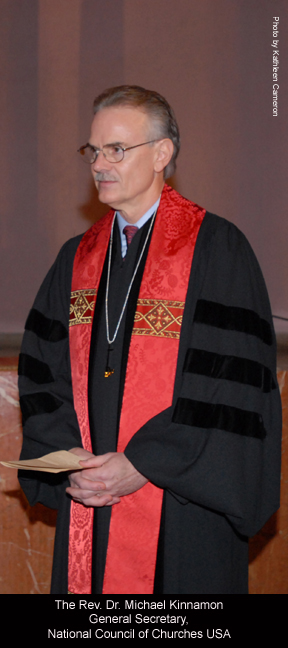
Rev. Dr. Michael Kinnamon
In terms of ecumenism and lay ministry, there have been some exciting personnel moves:
In Summer 2011, Dr. Michael Reid Trice was hired at Seattle University as the associate dean of the School of Theology and Ministry. Michael and I have known each other for several years, and he is one of the most active young ecumenists in the country, having served since the age of 35 as the associate director of the ELCA’s ecumenical and interreligious office.
Shortly thereafter, it was announced that Dr. Rick McChord was retiring after 25 years in the USCCB office for laity, marriage and family – and picking up a consulting contract with Seattle-based (and Domer-founded) Reid Group, which specializes in leadership development, strategic planning and mediation for religious groups.
The latest came in April while i was in Assisi, with the retirement of Rev. Dr. Michael Kinnamon as General Secretary of the National Council of Churches, and his own move to a three-year contract at Seattle University, starting this fall.
Finally, the biggest spotlight to hit Seattle in recent years, ecclesially speaking, is the appointment of the relatively new metropolitan, Archbishop J. Peter Sartain, to lead the five-year overhaul of the Leadership Conference of Women Religious. Striking every note of consultation, careful listening, and collaboration a person in his position possibly could during the press conference and interviews later with John Allen in Rome, it seems like the best has been made of an unpleasant situation.
These are exciting times to be in the church-world in Seattle. Almost a pity I am in Rome!
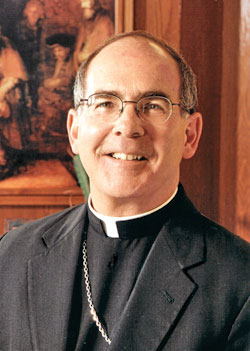
Most Rev. J. Peter Sartain
 The Ecumenism Blog