
Home » Posts tagged 'Catholic Church' (Page 11)
Tag Archives: Catholic Church
Il Potere e la Grazia: I Santi Patroni d’Europa
Power and Grace: Patron Saints of Europe
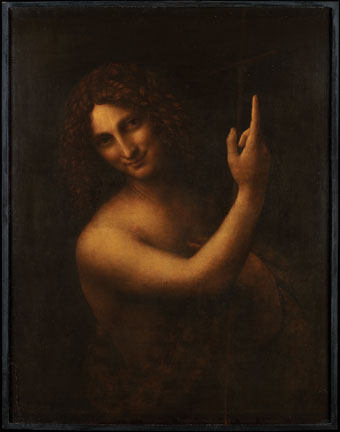
Leonardo's John the Baptist
The Palazzo Venezia has had an art exhibit running this month displaying various art forms depicting various saints of Europe, including on loan from the Louvre Leonardo da Vinci’s John the Baptist. A small group of us from the Lay Centre decided to go on the penultimate night of the exhibit, which was free and open until midnight.
The display was organized into rooms depicting the progression of sainthood around the needs of the times and the kind of saints honored, starting with biblical figures, then martyrs, monastics, confessors, theologian-bishops, founders of orders, the ‘military saints’ (George, Michael, etc), royalty, and those martyred in the struggles of church (grace) and state (power), such as Jean d’Arc or Thomas More.
The art chosen focused on those who were patron saints of the nations of Europe, and from a variety of media: icons, stained glass, sculpture, carving, oil on canvas, illuminated manuscripts, even old black and white films.
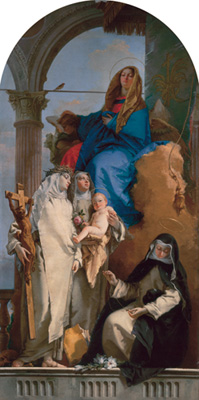
Madonna with Catherine of Siena, Rose of Lima, and Agnes of Montepulciano (Giambattista Tiepolo)
Did you know that Europe, as a continent, has six patron saints? Three male and three female, three from the first millennium and three from the second: Benedict of Norcia, Cyril and Methodius of Thessalonica, Birgitta of Sweden, Caterina of Siena, and Teresa Benedicta of the Cross (Edith Stein). Each nation then has its own patron saint(s) – some with as many as 10!
Dimitrios and I finished some time before the others, so we had a chance to discuss the exhibit, the nature of Greece’s concerns with the name chosen by the Former Yugoslav Republic of Macedonia, and apophatic gelato – which prompted a debate about the distinction between that and kataphatic gelato, scholastic gelato, and postmodern gelato. Needless to say we took a detour to La Palma when Kassim, Greg and Karina joined us!
As it turns out, we were not the only ones who waited till the last weekend to go: Pope Sneaks Out of Vatican to Visit Exhibit
St. Thomas Aquinas
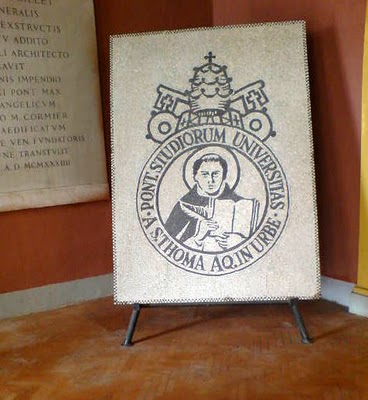
Seal of the Pontifical University of St. Thomas Aquinas in Rome
Today is the feast of San Tommaso d’Aquino, patron of my current university, of academics and theologians everywhere. Unfortunately, as I was trying to beat a cold, I was unable to get to the celebration of our Patronal Feast at the Angelicum this morning, with Archbishop Agustin DiNoia, OP, but a friar friend has put some photos up on the university blog, so check them out!
I have never claimed to be a Thomist per se, for as one of my first university philosophy professors said, “If you are going to be a Thomist, you have to be a damn good one.” I am fascinated by the Angelic Doctor, but I see him as one (important) contributor to the Catholic, Christian theological tradition, rather than devoting all of my studies to him and his works, which is what it would take to be a “damn good” Thomist.
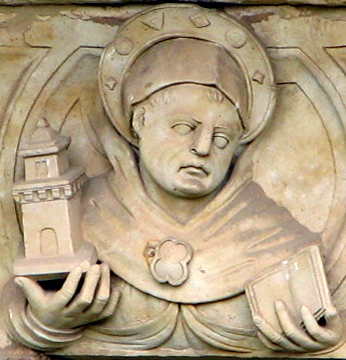 Truth be told, though, even that would not be enough – I am not convinced Thomas would approve of such narrowed focus! He was, after all, the Great Synthesizer, and did not hesitate to use a variety of Christian sources, as well as Jewish, Muslim and pagan ones.
When I was an undergraduate, I had a friend who was studying medieval philosophy, almost exclusively with the late Ralph McInerny – who is a Thomist. He and I would have many long debates some of which revolved around the maxim of the Papal Theologian: “Never mix philosophy and theology, because philosophy always wins!” My friend felt that, as a medieval philosophy with a particular focus, he was therefore an adept theologian. As a theologian with a much broader view of Tradition, I often had to remind him that this was not the case! No matter how profound and how great the tradition, no one theologian encompasses the whole of Catholic theology, much less the attendant pastoral, liturgical, historical and other issues that interact with theology in the lived experience of the Church.
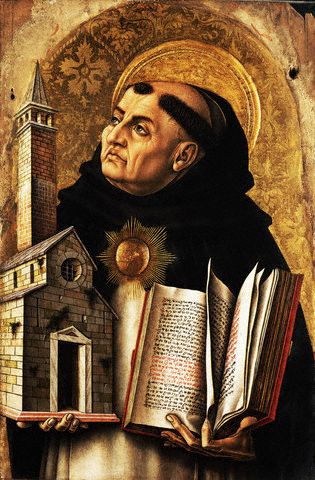 I have always had a great affinity for Thomas, first as a theologian, and in more recent years as a patron for “new” vocations, such as lay ecclesial ministry.
As a theologian and student, his peers dubbed him the “Dumb Ox” – dumb as in mute – to which Albertus Magnus supposedly retorted, “That ‘dumb ox’ will one day fill the world with his bellowing!” Thomas was no quick wit. He would not have made it as official Catholic commentator on Fox News or CNN. He was big, slow to move and slow to speak, and as with any good introvert, would fix you with a stare in response to unexpected questions that probably left less astute contemporaries wondering if he really was all that bright. He is an inspiration to any systemitizing introvert who has been caught in the spotlight by “think out loud” extravert peers!
As a candidate for patron of “new” vocations, consider his story:
According to his father, the Count of Aquino, Thomas was going to be groomed as the Abbot of Montecassino, an old, established, and wealthy Benedictine Abbey not too far from Rome. This was the normal sort of ecclesial vocation of his era – monastic life. It was how you served the church successfully. It was expected. It was “just the way things were done”. You want to serve the church? Fine, join the monastery.
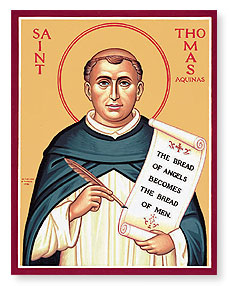 But he would have none of it. At 19 he ran off to join some newfangled wannabes who were kind of like monks, but not really monks – and I doubt the real monastics would have been too happy if you called these mendicant friars “monks”! They had only been around for 40 years. They did not spend their time at the monastery but wandered around the countryside preaching, teaching, and doing God-only-knows what else that was properly the ministry of monks and diocesan clergy.
This was not right!! How dare they? So, his family did the only respectable thing to do – they arranged for him to be rescued from this cult, threw him in a locked room and commenced a serious deprogramming effort.
A year later, he remained committed to his vocation. He was called to serve the church, clearly, just not in the way that his parents and grandparents generations took for granted. It looked a little different. The charism was a little different. New terminology had to be used to explain it. There were bishops who did not support it. People worried about the confusion of identity of traditional monastic life – of monks and nuns – with this itinerant innovation of mendicant life – these friars. Even a few years later, after being ordained in this “new order”, he spent time writing defense of the vocation he was living. Some critics argued that real ministers would be spending their time in prayer and sacramental service, not defending and defining a “new” vocation!
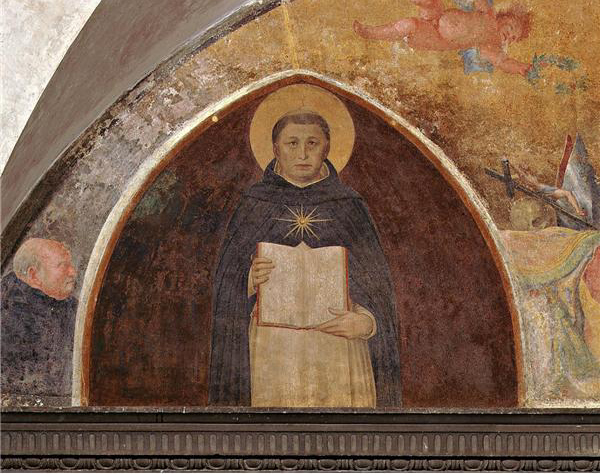 The parallels to the present age, to lay ecclesial ministry and even to the restoration of a real diaconate, are overwhelming! (Though, I admit I am not aware of any pastoral associate being kidnapped by family to consider the diocesan presbyterate or religious life instead.) We are 50 years into the present form of lay ecclesial ministry in the U.S., and it never ceases to amaze me how much suspicion, ignorance, misunderstanding and outright vitriol is out there. I completely understand this minister’s plea, “Don’t dis lay ecclesial ministry!”
St. Thomas Aquinas, patron of “new” vocations, pray for us!
Quote of the Day
Orientale Lumen 20, Pope John Paul II, 1995
[T]he Church of Rome has always felt was an integral part of the mandate entrusted by Jesus Christ to the Apostle Peter: to confirm his brothers in faith and unity (cf. Lk 22:32). Attempts in the past had their limits, deriving from the mentality of the times and the very understanding of the truths about the Church. But here I would like to reassert that this commitment is rooted in the conviction that Peter (cf. Mt 19:17 – 19) intends to place himself at the service of a Church united in charity. “Peter’s task is to search constantly for ways that will help preserve unity. Therefore he must not create obstacles but must open up paths. Nor is this in any way at odds with the duty entrusted to him by Christ: ‘strengthen your brothers in the faith’ (cf. Lk 22:32). It is significant that Christ said these words precisely at the moment when Peter was about to deny him. It was as if the Master himself wanted to tell Peter: ‘Remember that you are weak, that you, too, need endless conversion. You are able to strengthen others only insofar as you are aware of your own weakness. I entrust to you as your responsibility the truth, the great truth of God, meant for man’s salvation, but this truth cannot be preached or put into practice except by loving.’
(Emphasis mine)
Witness through Hope and Trust: WPCU Day #7
From the official material prepared by the Pontifical Council for Promoting Christian Unity and the World Council of Churches:
Scripture
Job 19:23-27, God whom I shall see on my side.
Psalm 63, My soul thirsts for You.
Acts 3:1-10, What I have, I give you.
Luke 24:36-40, The disciples were startled and terrified.
Meditation
During their journey in life and faith, all Christians experience moments of doubt. The challenge faced by Christians is to continue to believe that even when they do not see or feel God, God remains with them. The virtues of faith, hope and trust allow them to give witness that their faith goes beyond their own possibilities.
The character Job gives us an example of someone who faced difficult trials and tribulations and even argued with God. In faith and hope however, he believed that God would remain on his side. This reliance and conviction is also shown by the actions of Peter and John in the account with the lame man as told in Acts. Their belief in the Name of Jesus allows them to witness powerfully to all who were present. Today’s psalm is a prayer reflecting our deep desire for God’s steadfast love.
Our meeting during this Week of Prayer for Christian Unity allows our communities to grow in shared faith, hope and love. We bear witness to God’s steadfast love to all people, and God’s faithfulness to the one church we are called to be. The more we witness together, the stronger our message will be.
Prayer
God of hope, share Your vision of the one church with us, and overcome our doubts. Increase our faith in your presence, that all who profess belief in you may worship together in spirit and in truth. We especially pray for all who are in doubt right now, or whose lives are spent in the shadow of danger and fear. Be with them and give them your consoling presence. Amen.
Reflection Questions
How do you deal with your own fears and doubts?
How might you be a cause of fear and anxiety for others by your behaviour?
When have you faced up to your own fears and doubts and so given witness to your faith in Christ by overcoming these difficulties?
How may Christian communities encourage one another in faith and hope?
Witness through Sharing Stories; WPCU Day #2
From the official material prepared by the World Council of Churches and the Pontifical Council for Poromoting Christian Unity:
Scripture
Jeremiah 1:4-8, Go to all to whom I send you.
Psalm 98, Sing to the Lord a new song.
Acts 14:21-23, They strengthened the souls of the disciples.
Luke 24:13-17a, What are you discussing with each other while you walk along?
Meditation
Sharing our stories is a powerful way in which we give witness to our faith in God. Listening to one another with respect and consideration allows us to encounter God in the very person with whom we are sharing. The reading from Jeremiah offers us a powerful witness of God’s call to the prophet. He is to share what he has received, and so allow God’s Word to be heard and lived out. This call to proclaim God’s Word is also experienced by the disciples in the early Church, as witnessed to in the reading from Acts. Our psalm allows us to sing to God with a spirit of praise and thanksgiving.
Today’s gospel passage presents a Jesus who enlightens our blindness and dispels our disillusionment. He helps us to understand our stories within the one unfolding plan of God. During this Week of Prayer for Christian Unity, we listen to the faith stories of other Christians in order to encounter God in the variety of ways God’s very self is revealed to us. In listening with attentiveness we grow in faith and love. In spite of the diversity of our personal and collective witness, we find ourselves intertwined in the one story of God’s love for us revealed in Jesus Christ.
Prayer
God of history, we thank you for all who have shared their story of faith with us and so have given witness to your presence in their lives. We praise you for the variety of our stories both as individuals and churches. In these stories we see the unfolding of the one story of Jesus Christ. We pray for the courage and the conviction to share our faith with those with whom we come into contact, and so allow the message of your Word to spread to all. Amen.
Reflection Questions
Are you “gossiping the Gospel” or just gossiping?
How open are you or your church to be drawn into the stories of others?
How open are you to share with others your stories of faith, and so give witness to God’s presence in your personal experiences of life and of death?
Are you aware of the enormous potential for good that modern means of communication offer the Church today?
 The Ecumenism Blog