
Home » Uncategorized (Page 3)
Category Archives: Uncategorized
Prayer Vigil schedule & liturgical booklet
From Rome…

VATICAN CITY — Whether you plan on following tomorrow’s Prayer for Peace vigil on TV, online or in person in St. Peter’s Square, a schedule of Saturday’s events will come in handy. As well as the official liturgical booklet.
Here is a breakdown of what will be happening and when:
View original post 205 more words
Apostolic Blessing “Urbi et Orbi”: Pope Francis’ first public words

Brothers and sisters, good evening!
You know that it was the duty of the Conclave to give Rome a Bishop. It seems that my brother Cardinals have gone to the ends of the earth to get one… but here we are… I thank you for your welcome. The diocesan community of Rome now has its Bishop. Thank you! And first of all, I would like to offer a prayer for our Bishop Emeritus, Benedict XVI. Let us pray together for him, that the Lord may bless him and that Our Lady may keep him.
Our Father…
Hail Mary…
Glory Be…
And now, we take up this journey: Bishop and People. This journey of the Church of Rome which presides in charity over all the Churches. A journey of fraternity, of love, of trust among us. Let us always pray for one another. Let us pray for the whole world, that there may be a great spirit of fraternity. It is my hope for you that this journey of the Church, which we start today, and in which my Cardinal Vicar, here present, will assist me, will be fruitful for the evangelization of this most beautiful city.
And now I would like to give the blessing, but first – first I ask a favour of you: before the Bishop blesses his people, I ask you to pray to the Lord that he will bless me: the prayer of the people asking the blessing for their Bishop. Let us make, in silence, this prayer: your prayer over me.
[…]
Now I will give the Blessing to you and to the whole world, to all men and women of good will.
[Blessing]
Brothers and sisters, I leave you now. Thank you for your welcome. Pray for me and until we meet again. We will see each other soon. Tomorrow I wish to go and pray to Our Lady, that she may watch over all of Rome. Good night and sleep well!
Capo d’anno – Looking back, looking ahead
Every year I find that I had many more ideas for my blog than I actually had time to post. The irony, of course, is that the busier and more interesting life gets, the less time to chronicle it.
Perhaps the biggest ‘distraction’ was a push to finish my License in Sacred Theology. I submitted my thesis in mid-September, at twice its intended length, and passed my oral comprehensive exams in early October, being awarded an S.T.L. in Ecumenism and Dialogue magna cum laude. I am now dedicated to finishing the doctorate – with the dubiously honorific postnominal initials of S.T.D. – in the next 18 months or so. (“Or so” indicating about a half year of flexibility for editing, revising, and Roman beaurocracy).
On paper, the S.T.L. seems to require only 20 lecture courses, 4 seminars, a thesis and oral comprehensive exams, and could be completed normally in two years. In fact, owing to extra requirements of my particular discipline, I completed 31 courses for credit and audited three others (including one with Cardinal Walter Kasper). … and that was with credit for seven courses walking in the door, owing to previous academic and pastoral work.
Translating American and Pontifical degrees is tricky, because each system inherently thinks itself superior to the other. Roughly, the STL is equivalent to being ABD in the U.S. PhD system, though certain elements simply do not translate: There are no teaching assistants or lecture opportunities for anyone without a doctorate in hand, in the Roman system, for example. It is still a good indicator of where I am in my studies.
Certainly the biggest encounter, and one of the nicest surprises of the year, was a little one on one time with His Grace, The Most Rev. Dr. Rowan Williams, now retired Archbishop of Canterbury. On the day of his address to the Synod of Bishops in October, he came to the Caelian hill for a short tour, and I was invited to be his local guide and ecumenical host for the encounter. As we walked through the basilica of Ss. Giovanni e Paolo, the ruins of the Temple of Claudius, and onto the grounds the Lay Centre shares with the Passionists, we were able to talk briefly about the state of the church and the churches, and his upcoming remarks. Seeing his ‘entourage’ it was like a reunion of friends and respected colleagues, people I admire for their dedicated service to the Church and ecumenism from both communions.
The year began on an ecumenical note, as I traveled in January to Norway to celebrate the ordination of a friend and former housemate of mine as a pastor in the (Lutheran) Church of Norway, which took place in Nidaros Cathedral, in Trondheim, just a couple degrees south of the arctic circle.
January of course also sees the Week of Prayer for Christian Unity, always a busy time in Rome. This year included, in January and February, a course at the Angelicum taught by Cardinal Walter Kasper on ecclesiological ecumenical themes.
During the spring semester, President Mary McAleese of Ireland, recently retired, moved to Rome to finish a License in Canon Law, and spent the spring semester in residence at the Lay Centre. She brought a wealth of knowledge of the church, experience in politics, and stories told with the kind of skill and humor that made the Irish famous as bards. She has been a great gift to the community.
March witnessed the first of two visits this year by Archbishop Rowan Williams, including a joint vespers service with Pope Benedict, on the occasion of the Camaldoli celebrating their millennial anniversary, at the Church of St. Gregory the Great, our next door neighbors on the Caelian hill, and the installation of an Anglican priest as the Catholic prior of the order’s chapter in Rome. (He was received into Catholic orders after his election as prior.)
In April, I was able to head up to Assisi for a conference sponsored by the Ecclesiological Investigations Network, and included several U.S. graduate students and theologians. Cardinal Koch gave a significant lecture on fifty years of Jewish-Catholic dialogue as this year’s annual John Paul II Lecture on Interreligious Understanding, sponsored by the office I work for, the John Paul Center for Interreligious Dialogue.
In June, I was invited by the Holy See’s Commission for Religious Relations with the Jews to be a plenary speaker from the Catholic side at a Jewish-Catholic dialogue in New York, with a focus on emerging leadership in this oldest and closest interreligious dialogue.
I spent the summer in Rome, practicing Italian and learning first-hand why anyone who can, leaves. It is impossible to think in that kind of heat and humidity, the universities and libraries close, and there is virtually nowhere in the city with air conditioning. I did get a trip to Germany and the Netherlands at the end of the summer to cool down a little. September included a working visit to Budapest.
October was a busy month, with the synod for bishops, the 50th anniversary of Vatican II opening, visits by the Archbishop of Canterbury and the Patriarch of Constantinople, an international conference at the Lay Centre, the orientation of a new cohort of Russell Berrie Fellows, and of course the comprehensive exams for my license.
November took an eastern focus, with conferences on Eastern Catholicism, and Middle Eastern Christianity. December was about wrapping up the year and getting ready to head home for my first Christmas holiday in the States since 2008.
2012 in review
The WordPress.com stats helper monkeys prepared a 2012 annual report for this blog.

Here’s an excerpt:
4,329 films were submitted to the 2012 Cannes Film Festival. This blog had 22,000 views in 2012. If each view were a film, this blog would power 5 Film Festivals
Dolan on Romney
To our group visiting last week, and quoting himself at another engagement:
There might be many reasons not to vote for Mitt Romney in the coming election, but the fact that he’s Mormon is not one of them. We [Jews and Catholics] know better.
Cardinal Timothy Dolan of New York
(once, New Amsterdam)
Assisi 2012 – Where we Dwell in Common.
So, I have had a bit of a break from blogging, mostly to focus on other writing, and owing to other distractions. Rome can do that.
However, I find myself now with about 30 pages of back-notes for blogs, and sitting in Assisi for a conference of the Ecclesiological Investigations Network, so it seemed opportune to begin again with some observations from the first day. The theme is Assisi 2012: Where we Dwell in Common – Pathway sofr Dialogue in the 21st Century. The three thematic tracks are intra/inter ecclesial issues (ecumenism/ecclesiology), interfaith/interreligious issues, and Faith and World/Culture.
We arrived yesterday and started with an opening plenary prayer in the Basilica of Santa Maria degli Angeli, home of the Porzincula, and greeted by Assisi Archbishop Domenic Sorrentino and Friar Fabrizio Migliasso, Custodian of the basilica.
There are a few familiar faces (Peter Phan, Rick Gillardetz, Dennis Doyle, Michael Kinnamon), and a few names I finally get to put faces to (Paul Murray from Durham, the other Viggo Mortensen). But I confess I am a little surprised how few I knew or knew of – one more reminder of how insulated pontifical academia can get.
Participants number over 200, from 55 countries, and several different churches and faiths. The opening panel offered insights into the theological situation in Italy for the participants, and the opening keynote was offered by Paul Arthur of North Ireland, offering lessons from the peace process there for dialogue initiatives. Peter Phan offered a humorous evening toast, and Dennis Doyle delivered a deadpan response. This morning began with a plenary panel composed of Brad Hinze (US), Mary Getui (Kenya), and Eleni Kasselour Hatzivassiliadi (Greece) and a response from Deivit Montealegre (Argentina).
The late morning, we had parallel plenaries, with mine focused on interchurch issues, such as:
- The Burdens of History: Must Tribalism Always Prevail?
- Hierarchy or Network of Truths? Hermenutical Principles and Challenges of Dialogue about Doctrinal Issues
- Does a Doctrinal Teaching Office have an Ecumenical Future? (Which focused on a recent report of the Group des Dombes)
The afternoon held smaller breakout sessions with panels of smaller papers, and more direct discussion. I chose one with a Chilean and Tanzanian students from Louven, and Michael Walsh, the British church historian. He offered a look into an as-yet unpublished encyclical of Pius XI, Ecclesia Christi – On the True Church of Christ. It is one of two released in the archives of his pontificate.
It is so healthy, and people are so approachable. It is like a retreat, except that daily life in Rome is like a retreat, so I guess having a packed schedule is the retreat from the retreat. Having the daily intellectual stimulation with world class scholars is a nice break though. It is such a culture clash from the daily pontifical experience though, nobody is here speaking in official capacity, and everyone is quite open. No holds barred in critiquing the narrowing hermeneutic of the Council, calling to task shoddy scholarship, or directly challenging other churches for inconsistencies or unusual doctrinal stances.
I present on Friday, offering some observations on non-priestly ministries as opportunities for ecumenical convergence. Diaconate and lay ecclesial ministry anyone?
2011 Stats from WordPress
The WordPress.com stats helper monkeys prepared a 2011 annual report for this blog.
Here’s an excerpt:
The concert hall at the Syndey Opera House holds 2,700 people. This blog was viewed about 26,000 times in 2011. If it were a concert at Sydney Opera House, it would take about 10 sold-out performances for that many people to see it.
The Golden Ring
The Gospel reading of the day reminded me of a column i had written as a college senior for our campus newspaper, The Observer, as part of what was called the “Inside Column” – a chance for the editorial staff to say whatever they wanted. It is interesting to read something i wrote over a decade ago and see how my style has changed… and where it has not.
It has also come up on occasion here in Rome, since so many people have commented on my Notre Dame ring. The class ring is not a common practice over here, and several of my classmates have admitted wondering if i was a bishop incognito when they first saw it! I have been promising a rediscovery of this article for some time:
We take pride in no symbol of our status as Notre Dame students and alumni than our class rings. No other school in the country has alumni as fanatic about proving their school pride so blatantly as our fellow Domers, and rightly so, for ours is a tradition of unparalleled family and excellence. But, as with all symbols, its meaning is polyvalent and there is much more to my class ring than simply showing off my bachelor of arts.
First, it is a sign that, at some point in my life, I had around $600* to shell out on a piece of jewelry. For myself; not as a gift or as a donation to someone who needed the money for food or clothing, but for a pretty piece of gold to sit on my finger.
It is a sign that I have literally bought into the very disease that I railed against when I first saw it permeating the ostensibly Catholic character of this institution. It is a malign corruption of life known as materialism, the cure for which is harder to find than “for a camel to pass through the eye of a needle.”
There are times when I feel the weight of my ring on my right hand and am forced to think of the chains that Marley wears in his visit to Ebeneezer Scrooge. It seems I have forged the first link in my own chains of eternal bondage, and I fear it is larger than most. Worse, I find no comfort in the idea that comes from a fundamental reading of Matthew 25:29 that reads: “For to one who has, more will be given and he will grow rich; but from the one who has not, even what he has will be taken away.” It is an idea that seems to be incorporated into the mission statement of both financial aid and development offices.
Although I have only had my ring since July, I have already noticed several dings and imperfections. At first I was overwhelmed with what people would think when they saw how ugly my ring had become. I worried that I had not been able to keep it aesthetically perfect. Then I realized that its condition was a perfect allegory of Notre Dame itself.
When you’re here long enough to learn to care for the place and the people here, you pay attention to everything and you begin to see the dings and imperfections. For people of a good heart and a righteous soul, it is easy to become obsessed with these, discouraged that they exist and cynical that anyone could see beauty in something so horribly flawed.
But then you realize that despite a discoloration here or a small dent there, the whole of the ring is still gold, and to anyone who meets you and doesn’t inspect it with an overcritical eye, it may as well be unblemished.
Much the same can be said of the Notre Dame experience. Despite what corruption or frustrations you may find, in time (though usually not until after you graduate), you will learn to see again the gold of the whole and not just the damage of one small area.
Finally, it is a symbol of the office of Notre Dame Alumnus (or Alumna), which carries a unique power and responsibility. It is a sign of our education and our commitment to service. It is a sign that we can accomplish great things against formidable odds. It is a sign that will allow us unhindered passage into positions at any number of corporations, firms and grad schools. It is above all a reminder that “Much will be required of the person entrusted with much, and still more will be demanded of the person entrusted with more!” (Luke 12.48)
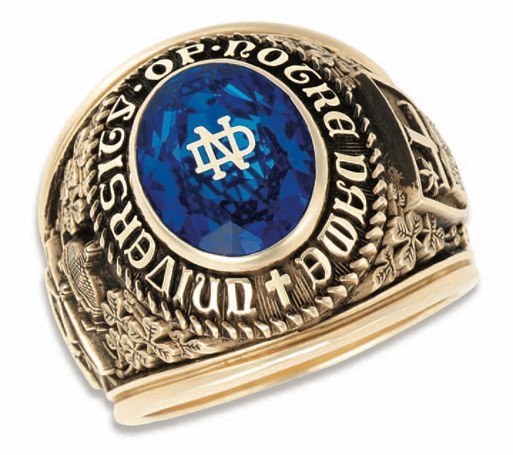
*That was in 1999. Inflation and rising gold costs have nearly doubled the cost for today’s students and alumni.
Original publication: http://www.nd.edu/~observer/02032000/Inside/0.html
ND Class Ring website: http://web.me.com/edobal488/Notre_Dame_Rings/Welcome.html
2010 in review
The stats helper monkeys at WordPress.com mulled over how this blog did in 2010, and here’s a high level summary of its overall blog health:

The Blog-Health-o-Meter™ reads This blog is on fire!.
Crunchy numbers
The average container ship can carry about 4,500 containers. This blog was viewed about 19,000 times in 2010. If each view were a shipping container, your blog would have filled about 4 fully loaded ships.
In 2010, there were 110 new posts, growing the total archive of this blog to 177 posts. There were 195 pictures uploaded, taking up a total of 102mb. That’s about 4 pictures per week.
The busiest day of the year was December 6th with 219 views. The most popular post that day was Sinterklaas came early this year….
Where did they come from?
The top referring sites in 2010 were facebook.com, catholicblogs.com, en.wordpress.com, twinsabroad.blogspot.com, and search.aol.com.
Some visitors came searching, mostly for piazza navona, sinterklaas, santa susanna, befana, and father christmas.
Attractions in 2010
These are the posts and pages that got the most views in 2010.
Sinterklaas came early this year… November 2009
Centro Pro Unione November 2009
Santa Susanna: the American parish in Rome November 2009
Roman Forum, Palatine Hill, and il Colosseo February 2010
Mar Bawai Soro March 2010
Happy Birthday, Zandyr
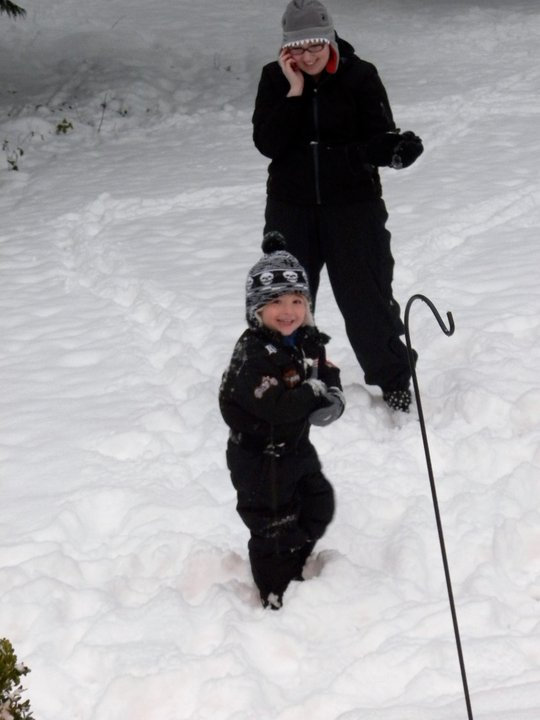
Zandyr and mom enjoying the first snow of the season
 The Ecumenism Blog