
This is Vocaris Media, and you are listening to Thinking with the Church. In this edition: the second part of a conversation with a man who has dedicated his life to studying, praying, and working to achieve Christian unity.
Andrew J. Boyd – “A.J.” to his friends – is Adjunct Professor of Theology in the Rome program of the Catholic University of America, as well as in the Rome programs of Providence College and Assumption College.
In the first part of our conversation, we talked about the evolution – so to speak – of the modern ecumenical movement: the prayerful, patient, painstaking search for full, visible unity in doctrine, life, and worship, of all Christ’s faithful.
This search for unity arises out of Christ’s own high priestly prayer at the Last Supper, when Jesus prayed:
Father, the hour is come, glorify thy Son, that thy Son may glorify thee. As thou hast given him power over all flesh, that he may give eternal life to all whom thou hast given him. Now this is eternal life: That they may know thee, the only true God, and Jesus Christ, whom thou hast sent. I have glorified thee on the earth; I have finished the work which thou gavest me to do. And now glorify thou me, O Father, with thyself, with the glory which I had, before the world was, with thee.
I have manifested thy name to the men whom thou hast given me out of the world. Thine they were, and to me thou gavest them; and they have kept thy word. Now they have known, that all things which thou hast given me, are from thee: Because the words which thou gavest me, I have given to them; and they have received them, and have known in very deed that I came out from thee, and they have believed that thou didst send me. I pray for them: I pray not for the world, but for them whom thou hast given me: because they are thine: And all my things are thine, and thine are mine; and I am glorified in them.
And now I am not in the world, and these are in the world, and I come to thee. Holy Father, keep them in thy name whom thou has given me; that they may be one, as we also are. While I was with them, I kept them in thy name. Those whom thou gavest me have I kept; and none of them is lost, but the son of perdition, that the scripture may be fulfilled. And now I come to thee; and these things I speak in the world, that they may have my joy filled in themselves. I have given them thy word, and the world hath hated them, because they are not of the world; as I also am not of the world. I pray not that thou shouldst take them out of the world, but that thou shouldst keep them from evil.
They are not of the world, as I also am not of the world. Sanctify them in truth. Thy word is truth. As thou hast sent me into the world, I also have sent them into the world. And for them do I sanctify myself, that they also may be sanctified in truth. And not for them only do I pray, but for them also who through their word shall believe in me;
That they all may be one, as thou, Father, in me, and I in thee; that they also may be one in us; that the world may believe that thou hast sent me. And the glory which thou hast given me, I have given to them; that they may be one, as we also are one: I in them, and thou in me; that they may be made perfect in one: and the world may know that thou hast sent me, and hast loved them, as thou hast also loved me. Father, I will that where I am, they also whom thou hast given me may be with me; that they may see my glory which thou hast given me, because thou hast loved me before the creation of the world. Just Father, the world hath not known thee; but I have known thee: and these have known that thou hast sent me.
And I have made known thy name to them, and will make it known; that the love wherewith thou hast loved me, may be in them, and I in them. – Holy Gospel according to St. John, Ch 17
That desire, which comes from Christ Our Lord in the climactic moment of His earthly ministry – at the institution of the Eucharist – is not therefore an adjunct, nor is it an ancillary element of the Faith: it is of the essence.
Toward the end of Part 1, I said something about the surprise I experienced when I first began to encounter Christians of different confessions and discovered how fervently they believe in the so-called “four marks” of the Church: Oneness, Holiness, Catholicity, and Apostolicity.
This week, in the second part of our conversation, A.J. and I explore some of the concrete possibilities for achieving a further and substantial measure of unity, especially as regards the Lutheran community.
We also address what Pope Francis has called, “the ecumenism of blood”: the unity of Christians in suffering and dying for faith in Jesus Christ – and our duty to make the most of the opportunities they have won for us by their heroic witness.
It happens that the second anniversary of one of the most starkly brutal episodes of Christian martyrdom in the early years of the 21st century fell just a few days ago – right in the middle of the week between the two editions presenting our conversation with Prof. Boyd.
I refer to the murder of 21 Coptic Orthodox Christians in Libya (I say 22 in the recording), a video recording of which traveled around the world.
Pope Francis condemned the act as soon as he heard of it.
On February 16th – the day after the video emerged – in remarks during a scheduled meeting with an ecumenical delegation from the Church of Scotland, the Holy Father departed from his prepared text to say, in his native Spanish:
I read about the execution of those twenty-one or twenty-two Coptic Christians. Their only words were: “Jesus, help me!”. They were killed simply for the fact that they were Christians. You, my brother, in your words referred to what is happening in the land of Jesus. The blood of our Christian brothers and sisters is a testimony which cries out to be heard. It makes no difference whether they be Catholics, Orthodox, Copts or Protestants. They are Christians! Their blood is one and the same. Their blood confesses Christ. As we recall these brothers who died only because they confessed Christ, I ask that we encourage each another to go forward with this ecumenism which is giving us strength, the ecumenism of blood. The martyrs belong to all Christians.
The spokesman for the Coptic Catholic Church, Fr. Rafic Greiche, gave an interview to Vatican Radio in which Fr. Greiche spoke of the early reception of the martyrdom of these men, whom he described as, “very poor people, but very near to God,” men who, “were not theologians, they were not people who even read the Bible or can read…but [had] the faith, and were brave.”
One of the martyred men was a convert – a man who received a baptism of blood – who came from Chad, and, seeing the faithful courage of his fellows, desired to be counted among their number on earth and in heaven. “He found his faith when he saw the [faith] of the other Egyptian Christians, he didn’t want to leave,” Fr. Greiche told Vatican Radio. “He wanted to be a martyr like them.”
21 Martys of Libya – icon by Tony Rezk
The reason I bring all this up – aside from the obvious and already mentioned 2ndanniversary of their martyrdom this past week – is to emphasize the urgency of the ecumenical project: an urgency palpable in A.J.’s remarks as he begins this segment, discussing a different specific area of ecumenical effort, namely, the work that Catholics and Lutherans have been doing together – work that has some surprising elements of “out-of-the-box” thinking.
That was A.J. Boyd, Adjunct Professor of Theology in the Rome Program of the Catholic University of America.
You can find Part 1 of our conversation in Episode 6 of Thinking with the Church.
**********
Friends, the podcasting arm of Vocaris Media is listener-supported, so, your donations really are what makes this possible. $1 / show is what we ask – though we’re always happy to receive more.
You can make your donation by going to the blog – www.thinkingwiththechurch.wordpress.com – and click on the “support TwtC” tab in the menu at the top, or by going to www.vocarismedia.com and looking for the “donate” button in the top-right corner of the page.
You can participate in discussions by going to the blog: again, that’s at www.thinkingwiththechurch.wordpress.com and leaving your thoughts in the comboxes.
Follow us on Twitter: @TWTC_Rome
You can write me directly on the emails: the address is craltieri@vocarismedia.com
Subscribe and leave us a review on iTunes, or use the RSS feed to subscribe through your favorite podcast manager.
“Thanks!” as always to Executive Producer Ester Rita.
Our web guru is Christopher Bauer Anderson – “Topher” Anderson of www.lifesiteministries.org.
Sean Beeson composed our theme. Hear more of his musical stylings at www.seanbeeson.com.
St. Gabriel Archangel, pray for us!
Praised be Jesus Christ, now and forever!
Home » Uncategorized (Page 2)
Category Archives: Uncategorized
Interview on “Thinking with the Church”, Part II
Part two of a conversation on Christian Unity with Christopher Altieri at “Thinking with the Church”.
Episode 7: ut credat mundus – Part 2 of an ecumenical conversation with A.J. Boyd


Interview on “Thinking with the Church”
I was interviewed recently by Christopher Altieri, host of “Thinking with the Church”, a podcast series started by the philosopher/Vatican Radio reporter earlier this year. The conversation ranges over a variety of ecumenical questions for just under an hour. Please check out the rest of the series, too, if you enjoyed our conversation.
https://thinkingwiththechurch.wordpress.com/
THINKING WITH THE CHURCH
sentire cum ecclesia
Episode 6: Ut unum sint – Part 1 of an ecumenical conversation with Prof. A.J. Boyd
This is Vocaris Media, and you are listening to Thinking with the Church. In this edition: Part 1 of a conversation with a man who has dedicated his life to studying, praying, and working to achieve Christian unity.
Andrew J. Boyd – “A.J.” to his friends – is Adjunct Professor of Theology in the Rome program of the Catholic University of America, as well as in the Rome programs of Providence College and Assumption College.
He has taught short term courses through the Lay Centre at Foyer Unitas – the Rome center founded in 1986 and dedicated to the formation of the laity and to the promotion of the lay vocation in the Church and in the world, which also works to promote Christian unity and to create opportunities for genuine encounter and sincere dialogue with people of other religions.
AJ has also worked with the sabbatical program of the Pontifical North American College.
We’d known of each other for some time before we met “in real life” at the inauguration of the KAICIID dialogue foundation in Vienna in 2015.
He is an extraordinarily thoughtful interlocutor – only, don’t let his soft-spoken demeanor fool you – he is capable of giving as good as he gets in any discussion.
Don’t take my word for it, though. Let AJ get us rolling with his take on what the ecumenical project is.
“Last Supper” by Vicente Juan Masip [Public domain], c. 1562, via Wikimedia Commons
That was Part 1 of a two-part conversation with ecumenist AJ Boyd.
We’ll bring you Part II next week.
There’s a story told among analytical philosophers – not that I traffic very much in such circles – about a theologian or divine who, one night at dinner in the college, pronounced, “The Church is One!” only to have one of his companions archly ask, “One what?”
Well, the Catholic Church has always thought – believed and taught – that there exists a single Church of Jesus Christ, which subsists in the Catholic Church, governed by the Successor of Peter and by the Bishops in communion with him (cf. Dominus Iesus 17):
Just as there is one Christ, so there exists a single body of Christ, a single Bride of Christ: “a single Catholic and apostolic Church”. Furthermore, the promises of the Lord that he would not abandon his Church (cf. Mt 16:18; 28:20) and that he would guide her by his Spirit (cf. Jn 16:13) mean, according to Catholic faith, that the unicity and the unity of the Church — like everything that belongs to the Church’s integrity — will never be lacking. (ibid.)
Indeed, one of the surprising things for me has been the discovery of how fervently Christians of other confessions also believe in the Four Marks: that the Church is indeed “One, Holy, Catholic, and Apostolic” – however different their understanding of what the marks indicate and what it means to profess them – because – I must confess – I cannot understand caring about the Marks at all and not being instantly and therefore Catholic. So this fellow, who grew up in CatholicTown, USA, and has spent almost the whole of his adult life in Rome, is on a pretty steep learning curve.
I am sure of one thing, though: it is for us, the baptized faithful of every confession and of every state of life in the Church, to live, pray, and work for the unity desired and promised by Christ Our Lord:
In treating the question of the true religion, the Fathers of the Second Vatican Council taught: “We believe that this one true religion continues to exist in the Catholic and Apostolic Church, to which the Lord Jesus entrusted the task of spreading it among all people. Thus, he said to the Apostles: ‘Go therefore and make disciples of all nations baptizing them in the name of the Father and of the Son and of the Holy Spirit, teaching them to observe all that I have commanded you’ (Mt 28: 19-20). Especially in those things that concern God and his Church, all persons are required to seek the truth, and when they come to know it, to embrace it and hold fast to it”. (Ibid., 23, DH, 1)
In all this, “The revelation of Christ will continue to be ‘the true lodestar’ in history for all humanity. (Ibid.)” Dominus Iesus – a much maligned and deeply misunderstood document, supposedly one-sided and heavy-handed, ends with an almost mystical vision taken from the Fathers of the II Vatican Council.
“The truth, which is Christ,” writes Pope St. John Paul II in his Encyclical Letter Fides et ratio, “imposes itself as an all-embracing authority.” He goes on to say:
The Christian mystery, in fact, overcomes all barriers of time and space, and accomplishes the unity of the human family: ‘From their different locations and traditions all are called in Christ to share in the unity of the family of God’s children… Jesus destroys the walls of division and creates unity in a new and unsurpassed way through our sharing in his mystery. This unity is so deep that the Church can say with Saint Paul: ‘You are no longer strangers and sojourners, but you are saints and members of the household of God’ (Eph 2:19). – Ibid.
It’s not by accident, I think, that Joseph Cardinal Ratzinger concluded his doctrinal note on the relation of the Catholic Church to other Christian Churches and ecclesial communities and other religions, with just these quotations from the then-recently-published Fides et ratio. It is as if he were recalling us to the task set for us by Peter in his first letter: to give a reason for the hope that is in us.
I’ve told the story before on this podcast, about how a friend once asked me why I am Catholic – or why, after all, I am still Catholic?
I answered:
I am Catholic because the Catholic Church is true. The Catholic Church is the One Church founded by our Divine Savior, Jesus Christ, as the vehicle by which humanity is redeemed from sin and death, and restored to friendship with God. The Church is the efficacious sign of that friendship. I am Catholic because I would be reconciled to God, and to all my fellows, and at peace with all and every one, and the Catholic Church promises this. For now, I see this through a glass, darkly, in a darkness the brightest spots of which are often but the dimmest glimmers of hope – though I am told this is a hope, which does not disappoint. Why am I Catholic? Let me answer with Peter: where else shall I go?
**********
Friends, the podcasting arm of Vocaris Media is listener-supported, so, your donations really are what makes this possible. $1 / show is what we ask – though we’re always happy to receive more.
You can make your donation by going to the blog – www.thinkingwiththechurch.wordpress.com – and click on the “support TwtC” tab in the menu at the top, or by going to www.vocarismedia.com and looking for the “donate” button in the top-right corner of the page.
You can participate in discussions by going to the blog: again, that’s at www.thinkingwiththechurch.wordpress.com and leaving your thoughts in the comboxes.
Follow us on Twitter: @TWTC_Rome
You can write me directly on the emails: the address is craltieri@vocarismedia.com
Subscribe and leave us a review on iTunes, or use the RSS feed to subscribe through your favorite podcast manager.
“Thanks!” as always to Executive Producer Ester Rita.
Our web guru is Christopher Bauer Anderson – “Topher” Anderson of www.lifesiteministries.org.
Sean Beeson composed our theme. Hear more of his musical stylings at www.seanbeeson.com.
St. Gabriel Archangel, pray for us!
Praised be Jesus Christ, now and forever!
*********** Show Notes ***********
For the Common Declaration of the Catholic Church and the Assyrian Church of the East, click here
The Assyrian Church of the East grew out of the Nestorian tradition, which affirms that Christ existed as two persons – one human and the other Divine, to which one of the exaggerated responses was Monophysitism – the idea that Christ had only one Divine nature, either because His human nature had been subsumed by His Divine nature, or because the Divine mind somehow replaced or supplied Christ’s human reason in the Incarnation.
Both Nestorianism and Monophysitism were condemned by Church Councils at Chalcedon et passim.
For more on Nestorianism, click here
For more on Monophysitism, click here
At 24:05, A.J. refers to the “Ravenna Document” – the framework agreement among the Catholic Church and several Orthodox Churches regarding – among other things – the taxis of the 1st millennium, according to which, “Rome, as the Church that ‘presides in love’ according to the phrase of St Ignatius of Antioch (To the Romans, Prologue), occupied the first place in the taxis, and that the bishop of Rome was therefore the protos among the patriarchs.”
For a brief history of the modern ecumenical movement – especially the Catholic Church’s commitment to the movement in the wake of the II Vatican Council – see the summary from the US Catholic Bishops, here
Pope Francis’ prayer, “O Cross of Christ”
Thanks to Cindy Wooden over at Catholic News Service, here is the Vatican’s English translations of Pope Francis’ prayer last night at the conclusion of the Via Crucis service at Rome’s Colosseum:
Holy Week in Rome 2016
Holy Week in Rome: There are so many opportunities in Rome during Holy Week, I have highlighted just a few in Italian and English, including the normal Roman Rite, and a few exemplars from the “Extraordinary Form”, Byzantine Rite, and Anglican rites. All of the Station Churches and Papal Liturgies are noted.
I would welcome input from anyone who is aware of others of particular interest, especially where good liturgy can be found – including good music, good preaching, good aesthetic, etc.
Palm Sunday of the Lord’s Passion
- Station Church: San Giovanni in Laterano – 0700 (English); 1730 (Italian)
- Papal Liturgy: Piazza San Pietro – 0930
Monday
- Station Church: Santa Prassede all’Esquilino – 0700 (English); 1800 (Italian)
- Byzantine Vespers of the Presanctified Gifts – Russicum/Sant’Antonio Abate – 1800
Tuesday
- Station Church: Santa Prisca all Aventino – 0700 (English); 1800 (Italian)
- Anglican Centre 50th Anniversary Eucharist/Chrism Mass – 1245 (English)
- Byzantine Vespers of the Presanctified Gifts – Russicum/Sant’Antonio Abate – 1800
- Evening Prayer with Sant’Egidio Community – Santa Maria in Trastevere 20:30
Wednesday
- Station Church: Santa Maria Maggiore – 0700 (English); 1730 (Italian)
- Seven Churches Pilgrimage of St. Filippo Neri (a devotional tradition since 1559)
- Join the seminarians of the Pontifical North American College in a tour of the Seven Churches, starting with the morning station mass at Santa Maria Maggiore. It is about 22km walking total and will take all day. Pack a lunch or plan to stop along the route:
- Santa Maria Maggiore
- San Lorenzo Fuori le Mura
- Santa Croce in Gerusalemme
- San Giovanni in Laterano
- San Sebastiano
- San Paolo fuori le Mura
- San Pietro al Vaticano
- Join the seminarians of the Pontifical North American College in a tour of the Seven Churches, starting with the morning station mass at Santa Maria Maggiore. It is about 22km walking total and will take all day. Pack a lunch or plan to stop along the route:
- Byzantine Vespers of the Presanctified Gifts – Russicum/Sant’Antonio Abate – 1800
- Office of Tenebrae
- Paul’s Within the Walls (Episcopalian) – 1830 (English)
- Santissima Trinita’ dei Pellegrini (extraordinary form) – 2030 (Latin)
Holy Thursday
- Papal Liturgy: Chrism Mass – Basilica San Pietro – 0930
- Mass of the Lord’s Supper (Beginning of the Paschal Triduum Liturgy)
- San Giovanni in Laterano – 1730 (Italian) – Station Church
- Santa Maria in Trastevere – 1730 (Italian)
- Oratory of San Francesco Saverio al Caravita – 1800 (English)
- Altars of Repose pilgrimage – Roman devotional tradition is to walk around the city after the liturgy ends for the evening, visiting the beautifully decorated altars of repose in (at least seven) different churches.
Good Friday
Solemn Liturgy of the Lord’s Passion with Veneration of the Cross:
- Station Church: Basilica Santa Croce in Gerusaleme – 1500 (Italian)
- Oratory of San Francesco Saverio al Caravita – 1500 (English)
- Papal Liturgy: Basilica San Pietro – 1700 (Italian)
- Santissima Trinita’ dei Monti – 1800 (French)
Stations of the Cross devotion, with Pope Francis at the Colosseum, 2115
Holy Saturday
The Great Vigil of Easter
- Oratory of San Francesco Saverio del Caravita – 2000 (English)
- Papal Liturgy: Basilica San Pietro – 2030 (Italian)
- Station Church: San Giovanni in Laterano – 2100 (Italian)
- Venerable English College – 2130 (English)
Easter Sunday
Mass of the Lord’s Resurrection
- Byzantine Divine Liturgy – Russicum/Sant’Antonio Abate – Midnight
- Papal Liturgy: Piazza San Pietro – 1000 (Italian)
- Oratory of San Francesco Saverio del Caravita – 1100 (English)
- Station Church: Santa Maria Maggiore – 1800 (Italian)
Pope Francis Urbi et Orbi Blessing – Piazza San Pietro – 1200 (Multilingual)
Solemn Vespers (concluding the Paschal Triduum)
- Chiesa di Sant’Anselmo al Aventino – 1700 (Italian)
- Byzantine – Russicum/Sant’Antonio Abate – 1800
Easter Week Station Churches (Italian):
- Monday – San Pietro – 1700
- Tuesday – San Paolo fuori le Mura – 1730
- Wednesday – San Lorenzo fuori le Mura – 1800
- Thursday – XII Apostoli al Foro Traiano – 1830
- Friday – Santa Maria ad Martyres (Pantheon) – 1700
- Saturday – San Giovanni in Laterano – 1630
- Divine Mercy Sunday – San Pancrazio – 1600
- Conclusion of the Station Churches pilgrimage
Catholic-Lutheran Dialogue: Pope Francis, the Eucharist, and Reception
In recent weeks, two significant events highlighted the significant progress made in Catholic-Lutheran dialogue over the last fifty years.
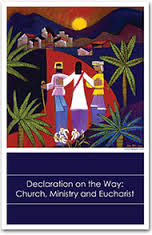 On 31 October, Reformation Day, the U.S. Catholic-Lutheran dialogue published a consensus statement, Declaration on the Way: Church, Ministry, and Eucharist. The Declaration draws on the fifty years of official dialogues to produce a litany of 32 consensus statements – a list of doctrinal agreements on the related topics of the Church, ministry, and the Eucharist – that are the direct results of dialogue, and which are no longer church-dividing issues.
The Conference of Bishops of the Evangelical Lutheran Church in America (ELCA) has unanimously affirmed the document and has forwarded it to the 2016 Churchwide Assembly and the Lutheran World Federation for consideration. On the Catholic side, the Committee on Ecumenical and Interreligious Affairs of the United States Conference of Catholic Bishops (USCCB) also affirmed the consensus unanimously. They have sent it on to the Pontifical Council for Promoting Christian Unity for consideration.
Two key points from the conclusion of From Conflict to Communion guided the work. [Called to Communion is the 2013 document published by the international Catholic-Lutheran dialogue, in preparation for the 500th anniversary of the beginning of the Reformations, in 2017]:
1) Catholics and Lutherans should always begin from the perspective of unity and not from the point of view of division in order to strengthen what is held in common even though the differences are more easily seen and experienced.
2) Lutherans and Catholics must let themselves continuously be transformed by the encounter with each other and by mutual witness of faith.
Too frequently, we hear the complaint, “What has been achieved with all this dialogue?” as if to expect that the answer is nothing. It is easier for those of us too young to remember the time before the Council to think this way, growing up in an age when it was taken for granted that we should be ecumenically engaged, and little seems to have changed since the 1980s. The purpose of this document is to respond to the question, and to lay the groundwork for the next steps in the dialogue.
With the Joint Declaration on the Doctrine of Justification (1999) the days when one could simplistically summarize the disparity on Catholic and Lutheran teaching on justification as “Protestants believe you are saved by faith alone, and Catholics that you are saved by faith and works” are thankfully long gone. The Declaration on the Way offers a longer list of doctrines that we clearly share in common.
The summary form makes it easy for preachers to integrate into their preaching, and catechists to integrate into their teaching. While wading through volumes of dialogue statements and notes might make a daunting task for the typical parish pastoral minister or Sunday school teacher, this entire document is about 100 pages and easily navigated.
This concern is “Ecumenical Reception”. It is one thing for the Churches, through their official dialogues, to agree on an article of faith, but it is quite another for that to really sink in at the grassroots level. It has to be adopted, and adapted, at the local level – both in terms of local culture and pastoral practice, and at the level of individual faith and the understanding. What good is an agreement on justification or ecclesiology if the Sunday school teachers, the pulpit preachers, and the popular bloggers are still using outdated information and spreading stereotypes based on the misunderstandings and attitudes of the past, as if no dialogue had ever happened?
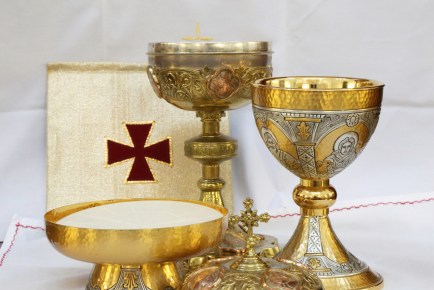
Catholics and Lutherans agree on the Church’s foundation in God’s saving work, in Scripture and the means of Grace, the Church as communion (koinonia) with visible and invisible elements, the communion of saints and the eschatological nature of the Church and its mission. We agree on ordained ministry as an essential element of the Church, the universal priesthood, the divine origin of ministry, the nature of ministerial authority, much of the nature of ordination, the unity of the orders of ministry, and the need for a ministry of worldwide unity. So too are there agreements on the Trinitarian and Christological dimension of the Eucharist, the Eucharist as a sacrificial memorial, the eschatological and ecclesiological dimensions of the Eucharist, and even on the Real Presence in the Eucharist.
Where work remains to be done is on some aspects of the nature of ordination and who may be ordained, and the question of what intermediate sacramental steps might be taken to help lead to reconciliation an full communion among the separated Christian communities. Before offering ‘next steps on the way’ the document suggests that “The possibility of occasional admission of members of our churches to Eucharistic communion with the other side (communicatio in sacris) could be offered more clearly and regulated more compassionately.”
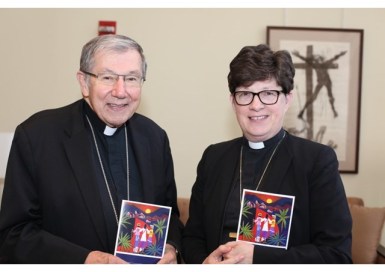
Bishop Dennis Madden, USCCB and Presiding Bishop Elizabeth A. Eaton, ELCA
Almost as if in response to the document, Pope Francis visited Rome’s Evangelical Lutheran Church just a couple weeks later, on 15 November, and responded to a question about Eucharistic hospitality that suggested that Lutherans might receive communion as a matter of conscience. We take it as a given that this assumes the normal conditions being met and in appropriate circumstances.
At first blush, this seems little more than an affirmation of the long-standing practice of the Church articulated in the 1983 Code of Canon Law, which was virtually unchanged from the pre-Vatican II conditions.
According to the Code, for members of the churches and ecclesial communions born out of the Reformation (i.e., Anglicans and Protestants) to receive communion during a Catholic Eucharist, they must:
- Be baptized
- Be properly disposed
- Manifest Catholic faith in the sacrament (=Real Presence)
- Not have access to a minister of their own church or communion
- Approach the sacrament on their own accord
- Be motivated by “grave pastoral need”, such as danger of death; other situations to be determined (generally, not case-by-case) by the episcopal conference or diocesan bishop. (CIC §844.4)
[Eastern Orthodox, Oriental Orthodox, Assyrian Church of the East, and Old Catholic Christians are allowed to participate in Catholic sacramental life at any time, with respect to the rules of their own traditions, essentially only needing baptism, disposition, and belief in the Real Presence, which are all assumed in these cases as well. This is dealt with in CIC §844.3]
In application, Lutherans always fulfill condition 1: we have long recognized their baptism as valid. Whenever a communicant approaches during the communion procession, it is assumed they fulfill conditions 2 and 5, unless there is some grave public reason to know otherwise. This is, even for Catholics, generally a matter of conscience (guided by their spiritual advisor, confessor, etc.).
As the consensus statement above highlights, Catholics and Lutherans have long articulated agreement on the Real Presence, so being Lutheran is enough to fulfill condition 3.
This condition does not mean, as some have suggested, that only those in full communion with the Catholic Church can receive communion; it means you must agree with the Catholic theology of the Real Presence; most Christians do. Neither does it mean that you must use the word “transubstantiation” – even within the Catholic communion, many of the Eastern Churches do not. In Mysterium Fidei (1965), and Paul VI reminded us that it is helpful, even necessary, to find “fresh ways of expressing [the Real Presence], even by using new words” – it is the meaning of the doctrine, not its formulation, which is always imperfect and in need of reform, that is essential.
Where there is remains some discussion, and frequent confusion, are the following two questions:
- what does it mean not to have access to a minister of their own church?
- and what constitutes a grave pastoral need?
The 1993 Directory on the Application of Principals and Norms on Ecumenism offers an interpretive lens and some clarifications, noting that, “in certain circumstances, by way of exception, and under certain conditions, access to these sacraments may be permitted, or even commended, for Christians of other Churches and ecclesial Communities.” (§130)
Pope John Paul II similarly softened the language of condition 6 from “danger of death or other grave necessity” to simply “grave spiritual need”. He reduced the requirements to this spiritual need and baptism, proper disposition, and who freely approach the sacrament – eliminating the “lack of access to a minister of their own faith” as a condition. (Ecclesia de Eucharistia §34-46, esp. 45). Where bishops and bishops conferences have attended to their duty in this regard, ‘mixed’ marriage and family life is the most common example of a situation that meets these conditions.
Unfortunately, as with a great many of the Polish pope’s great achievements, he lead by example and larger-than-life theatrical symbols, and never changed the law itself to correspond with his actions or apparent intentions. One could hope that among the myriad reforms that the Church needs would be an updating of the Code to account for the developments in ecumenical dialogue over the last five decades.
Both John Paul II and the Directory take care to point out that this concerns individuals, not interim concelebration or general table fellowship, and that the purpose is always for the spiritual care of the individual and the motivation for full communion, with care that it not lead to indifferentism. Triumphalism about Catholic Eucharistic theology or practice – that is, to suggest erroneously that only Catholics celebrate the Eucharist or “have the Real Presence” – is not part of the equation. In fact, it could be argued that if that is your attitude, you are not properly disposed to receive, owing to a sin of pride!
In other words, it is not possible for any informed Catholic to say, “Non-Catholics may never receive communion at a Catholic Eucharist”. This truth has been encased in law since at least 1983. This is a “dumbing-down” of a complex discipline of the faith to the point of error.
Understanding of the conditions under which access to the sacrament is allowed has developed even in the thirty years since the Code was 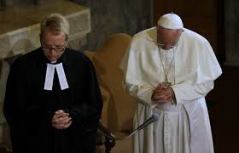 published. These legitimate developments have to be considered as well, not just the Code itself. It is already Church teaching and practice, explicitly in many jurisdictions and implicitly in others, that the Lutheran spouse of a Catholic could receive communion during the Catholic Eucharist, at least in some situations.
Pope Francis is merely reiterating this. What he does, and has every right to do, as supreme pontiff and universal pastor, in light of real progress made by the Lutheran-Catholic dialogue on the Eucharist, is to frame it in a more positive way. He could, in fact, change the Code itself to allow more frequent opportunities, or to spell out more clearly a longer list of situations, like an interchurch marriage, where the exceptions apply. He is, after all, the supreme legislator.
We already know that there are certain circumstances that a Lutheran can receive; Pope Francis is suggesting that it is a matter of conscience by the individual to determine when those conditions are fulfilled. This is, practically, just acknowledging the current practice of the Church: it is the conscience of the person that determines if they are properly disposed, whether there is spiritual need (and what constitutes ‘grave’), and motivates them to approach the sacrament.
The bishop of Rome also reminds us, as did Vatican II, that communion is not only the goal and sign of ecclesial communion achieved, but also a viaticum (food for the journey) for walking together on the way to that unity. If witness to the unity of the Church generally restricts Eucharistic sharing, the grace to be had from it sometimes commends the practice. (UR §8). Under the right, carefully proscribed circumstances, the Church has taught for fifty years, certain occasions of Eucharistic hospitality is good for the soul, and for the ultimate goal of full communion.
The real progress made by dialogue necessitates a real change in discipline and practice, and we can see this in the (rather conservative) shifts from the Code to the Directory to John Paul II to Francis.
Anyone “confused” by the pope’s comments has probably not kept up with the development of Church teaching in and since the Council, and is unaware of the even previously existing conditions (e.g., danger of death) that allowed a non-Catholic to receive communion from a Catholic minister.
What has changed with Pope Francis is that the ‘norm’ is now to take a more generous reading of the law – one in which the hermeneutic is mercy and the care of souls – rather than a rigorously constrained reading or a hermeneutic of triumphalism. This is possible without even offering a change in the law itself.
Little ways to be ecumenical: Saints
From PrayTell: Worship, Wit, and Wisdom:
The Pope has halted the canonization process for Aloysius Stepinac, the Croation Catholic Archbishop of Zagreb from 1937 until his death in 1960. Pope John Paul II had beatified the fiercely anti-communist archbishop, who spent many years in prison and under house arrest in Communist Yugoslavia, in 1998. The archbishop’s actions during World War II, however, especially his ties to the Nazi-aligned, murderous Ustaše regime, have raised criticism not only from the Serbian Orthodox Church but also from other victim groups.
Pope Francis has now halted the all-but-complete process of canonization for Stepinac and established a commission of Catholic and Serbian Orthodox experts instead, which will look more closely into the archbishop’s actions during World War II. The Pope’s decision was described as an “unexpected ecumenical step, without any historical precedent,” according to the German-language website Oekuemenisches Heiligenlexikon (https://www.heiligenlexikon.de/).
I wonder if it is really without historical precedent, though…
Declaration on the Way: Catholic-Lutheran consensus on the Church, Ministry, and Eucharist
The Catholic-Lutheran consensus document, Declaration on the Way, lists 32 agreements that have been reached over the last 50 years of dialogue between the two communions. The following excerpt is the list of doctrinal agreements, made easy for reception and incorporation into parish preaching and catechetical teaching. Each is explored more fully in the document itself.
It can also serve as an examination of conscience: Have i ever promoted a stereotype of the other, thereby perpetuating a sinful division on what is not actually a church-dividing issue?

Bishop Dennis Madden, USCCB Committee on Ecumenical and Interreligious Affairs; Bishop Elizabeth Eaton, ELCA Presiding Bishop
Agreements on the Church
The Church’s Foundation in God’s Saving Work
(1) Catholics and Lutherans agree that the church on earth has been assembled by the triune God, who grants to its members their sharing in the triune divine life as God’s own people, as the body of the risen Christ, and as the temple of the Holy Spirit, while they are also called to give witness to these gifts so that others may come to share in them.
(2) They agree as well that the church on earth arose from the whole event of Jesus Christ, who remains its sole foundation (1 Corinthians 3:11).
(3) Further, they hold in common that the church on earth is gathered by the proclamation of the gospel of God’s saving mercy in Christ, so that the gospel, proclaimed in the Holy Spirit by the apostles, remains the church’s normative origin and abiding foundation.
(4) An agreement follows that the church on earth is in every age apostolic, because it is founded upon the apostles’ witness to the gospel and it continuously professes the apostolic and evangelical faith while living by mandated practices handed on from the apostles. Thus, Lutherans and Catholics recognize in both their ecclesial communities the attribute of apostolicity grounded in their ongoing continuity in apostolic faith, teaching and practices.
The Word, Scripture and Means of Grace
(5) Lutherans and Catholics agree that the church on earth lives from and is ruled by the Word of God, which it encounters in Christ, in the living word of the gospel, and in the inspired and canonical Scriptures. (6) They are one in holding that the church on earth participates in Christ’s benefits through the historical and perceptible actions of proclaiming the gospel and celebrating the sacraments, as initiated by Christ and handed on by his apostles.
Communion, Visibility and Hiddenness
(7) Catholics and Lutherans agree that the church on earth is a communion (koinonia). It shares in God’s gifts offered for us by Christ, which, by being held in common, bring believers into unity and fellowship with each other.
(8) Consequently, they agree that the church on earth combines audible and visible elements with profound spiritual realities that remain hidden from empirical investigation and perception. Preservation of the Church and Union with the Saints
(9) Catholics and Lutherans agree that the church on earth is indefectible, because it is and will be preserved by the Holy Spirit in all its aspects essential for salvation. They share the certainty of Christian hope that the church, established by Christ and led by his Spirit, will always remain in the truth fulfilling its mission to humanity for the sake of the gospel.
(10) They furthermore agree that the church on earth is united with the community of the saints in glory.
Eschatology and Mission
(11) This perspective gives rise to agreement that the church on earth is an anticipatory reality, on pilgrimage and expectant of reaching its final destination in God’s ultimate gathering of his people in their entirety, when Christ returns, and when the Holy Spirit completes the work of sanctification.
(12) But Catholics and Lutherans agree as well that the church on earth is mandated to carry out a mission in which it participates in God’s activity in the world by evangelization, worship, service of humanity and care for creation.
Agreements on Ordained Ministry
In “Agreements on the Church,” Catholics and Lutherans affirm the ecclesial character of one another’s communities. This affirmation is an essential first step toward a mutual recognition of ordained ministry, for mutual recognition of one another’s ecclesial character is intertwined with the mutual recognition of one another’s ministry.
Ministry in the Church
(13) Lutherans and Catholics agree that the ordained ministry belongs to the essential elements that express the church’s apostolic character and that it also contributes, through the power of the Holy Spirit, to the church’s continuing apostolic faithfulness.
(14) Catholics and Lutherans agree that all the baptized who believe in Christ share in the priesthood of Christ. For both Catholics and Lutherans, the common priesthood of all the baptized and the special, ordained ministry enhance one another.
Divine Origin of Ministry
(15) Lutherans and Catholics affirm together that ordained ministry is of divine origin and that it is necessary for the being of the church. Ministry is not simply a delegation “from below,” but is instituted by Jesus Christ.
(16) We both affirm that all ministry is subordinated to Christ, who in the Holy Spirit is acting in the preaching of the Word of God, in the administration of the sacraments, and in pastoral service.
(17) Lutherans and Catholics agree that the proclamation of the gospel is foremost among the various tasks of the ordained ministry.
(18) They declare in common that the essential and specific function of the ordained minister is to assemble and build up the Christian community by proclaiming the word of God, celebrating the sacraments, and presiding over the liturgical, missionary and diaconal life of the community.
Authority of Ministry
(19) The authority of the ministry is not to be understood as an individual possession of the minister, but it is rather an authority with the commission to serve in the community and for the community.
(20) Catholics and Lutherans also agree that the office of ministry stands over against (gegenüber) the community as well as within it and thus is called to exercise authority over the community.
Ordination
(21) Catholics and Lutherans agree that entry into this apostolic and God-given ministry is not by baptism but by ordination. They agree that ministers cannot ordain themselves or claim this office as a matter of right but are called by God and designated in and through the church.
(22) Catholics and Lutherans both ordain through prayer invoking the Holy Spirit and with the laying on of hands by another ordained person. Both affirm that the ordinand receives an anointing of the Holy Spirit, who equips that person for ordained ministry.
(23) Both Lutherans and Catholics regard ordination as unrepeatable.
One Ministerial Office
(24) Both consider that there is one ordained ministerial office, while also distinguishing a special ministry of episkope over presbyters/pastors.
(25) They agree that the ministry is exercised both locally in the congregation and regionally. Both accept that the distinction between local and regional offices in the churches is more than the result of purely historical and human developments, or a matter of sociological necessity, but is the action of the Spirit. Furthermore, the differentiation of the ministry into a more local and a more regional office arises of necessity out of the intention and task of ministry to be a ministry of unity in faith.
Ministry Serving Worldwide Unity
(26) Catholics and Lutherans affirm together that all ministry, to the degree that it serves the koinonia of salvation, also serves the unity of the worldwide church and that together we long for a more complete realization of this unity.
Agreements on the Eucharist
High Esteem for Eucharistic Union with Christ in Holy Communion
(27) Lutherans and Catholics agree in esteeming highly the spiritual benefits of union with the risen Christ given to them as they receive his body and blood in Holy Communion. Trinitarian Dimension of Eucharist
(28) Catholics and Lutherans agree that in Eucharistic worship the church participates in a unique way in the life of the Trinity: In the power of the Holy Spirit, called down upon the gifts and the worshiping community, believers have access to the glorified flesh and blood of Christ the Son as our food, and are brought in union with him and with each other to the Father. Eucharist as Reconciling Sacrifice of Christ and as Sacrifice of the Church’s Praise and Thanksgiving
(29) Catholics and Lutherans agree that Eucharistic worship is the memorial (anamnesis) of Jesus Christ, present as the one crucified for us and risen, that is, in his sacrificial self-giving for us in his death and in his resurrection (Romans 4:25), to which the church responds with its sacrifice of praise and thanksgiving.
Eucharistic Presence
(30) Lutherans and Catholics agree that in the sacrament of the Lord’s Supper, Jesus Christ himself is present: He is present truly, substantially, as a person, and he is present in his entirety, as Son of God and a human being.
Eschatological Dimension of Eucharist
(31) Catholics and Lutherans agree that Eucharistic Communion, as sacramental participation in the glorified body and blood of Christ, is a pledge that our life in Christ will be eternal, our bodies will rise, and the present world is destined for transformation, in the hope of uniting us in communion with the saints of all ages now with Christ in heaven.
Eucharist and Church
(32) Lutherans and Catholics agree that sharing in the celebration of the Eucharist is an essential sign of the unity of the church, and that the reality of the church as a community is realized and furthered sacramentally in the Eucharistic celebration. The Eucharist both mirrors and builds the church in its unity

An Israeli Arab and a Palestinian Jew walk into a bar…
(…if I had included this entry in the previous post as originally intended, the setup would have included a Russian nun.)
First, a disclaimer: I am an amateur in observing the processes for peace and justice in the Middle East. As an American I have an affinity for and support of Israel, as a Christian a sense of solidarity with many Palestinians, as a Catholic adamantly against anti-Semitism or any form of religious discrimination, and as an educator and practitioner of dialogue a commitment to non-violence and the truth. My limitations are such – neither speaking Hebrew nor Arabic, not being a native or a professional diplomat or peacemaker – that I have always known there were others who would understand the situation better. But I hope to learn more in these months. It sometimes, probably naively, seems like it would actually take little effort – it simply must be willed. The majority of people I meet could live with one another without problem, given the chance. I will offer further reflections on the current situation and overall concerns at a later time.
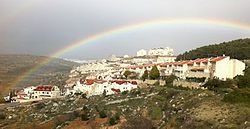
Efrat, Israeli settlement/disputed development, south of Bethlehem.
In the last week, I have tagged along with the sabbatical students of Tantur’s continuing education program – mostly priests, with a couple of religious – for a “dual-narrative” tour and conversations. I understand this set up was something of an experiment for Tantur, and I personally think it worked very well.
Two experienced guides, one Israeli, one Palestinian, traded off presentations designed to introduce participants into the overriding narratives in the region regarding the current situation. And, unsurprisingly, to suggest that it is black and white, and only two-sided, is erroneous. Yet, many of us were only familiar with one or the other. (I have had an excellent introduction to Judaism and Israel, through the Shalom Hartmann Institute and the Russell Berrie Fellowship, but, while I have a good grasp of Islam generally, the specific Palestinian story was less firm in my mind; others had the opposite experience).
The most impressive feature was probably the positive dynamic between our two guides, and their openness to learn from one another, even as we learned from them. AS much as was possible, we had them both together, though occasionally separately.
We started with a presentation on the history of Zionism and its various movements. Then a presentation on Palestinian nationalism, and the shift from Arab to pan-Islam identity. We drove from Jerusalem to Jaffa-Tel Aviv along Route One, getting an interwoven dialogue of the history of the Israeli War of Independence; the displacement of Palestinians (mostly Muslim) from Israel and of Jews from the Arab countries (in roughly equal numbers); the stories of villages destroyed and of those survived. We visited the old city of Jaffa, the first Jewish neighborhood outside the old city, Neve Tzedek, and ended at Rabin Square, visiting the site of the former Prime Minister’s 1995 assassination.
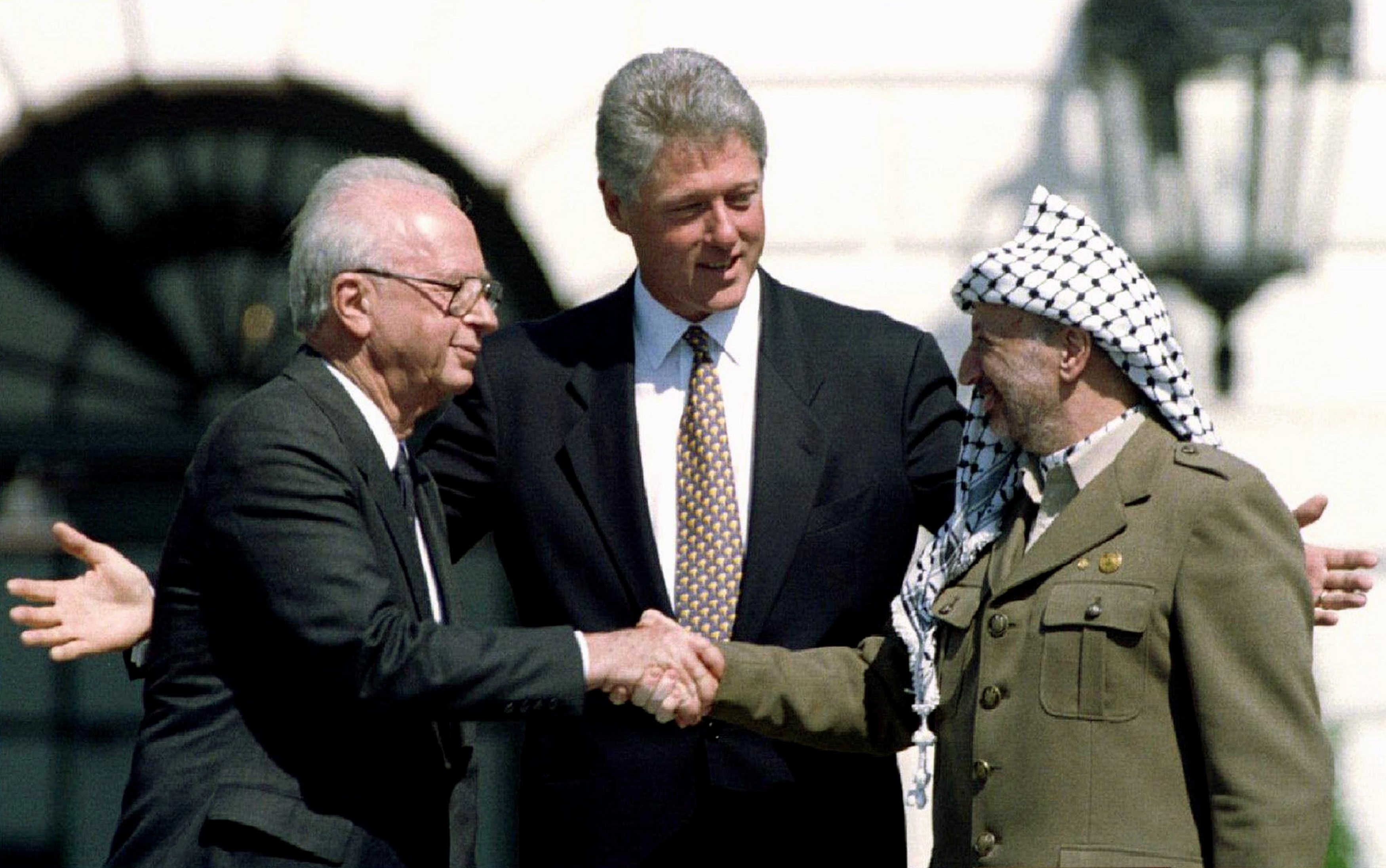
The iconic image of peace in the Middle East from my youth.
Oh, and we saw a couple gazelle along the road, too.
Our second day included a presentation by a couple of young workers involved in the Christian Peacemaker Teams based in Hebron, detailing their role as observers of the relationship between the Palestinian locals, Israeli settlers, the IDF and Border Patrol. Lunch at a famous restaurant above Shepherd’s Field, The Tent, was delicious and enlightening,conversation lead as it was by the regional director of the Alliance for Middle East Peace, a “network of organizations that conduct civil society work in conflict transformation, development, coexistence and cooperative activities…among Israelis, Palestinians, Arabs, and Jews.” In the afternoon we visited with a Christian Palestinian and an Israeli Jew, a former Seattleite turned settler, involved in an organization called Roots, which “draws Israelis and Palestinians who, despite living next to each other, are separated by walls of fear- not just fear of each other, but even of the price of peace.” We rounded out the day at the disputed Israeli development at Efrat, located in Judea/West Bank. A current population of about 10,000 is split into roughly 20% secular, 20% Haredi (“ultra-Orthodox”), and 60% Orthodox/Observant Jews, it was founded in 1983.
At the end of the day as we gathered for evening prayer, we found Tantur overrun by children. Turns out the seasonal gathering of Kids4Peace had been bumped out of their scheduled location and had had some trouble finding a place – some locations made some members uncomfortable, and unbelievably, some places did not want them. Who could object to kids wanting peace, getting to know each other? It was a beautiful benediction wrapping up a couple of intensive days, and a compelling reminder of what is at stake here in the land called holy.
While still processing much of the information and experience, i am a small step closer to understanding each of the narratives that often seem impossible to come from the same situation. And there are, as in every situation, exceptions and variations. It is also amazing how people living in such a small area,in such close proximity to one another can have so little contact with each other. This is one of the dangers of the current situation. As a couple people have noted, at least the older residents remember living side by side with someone who was “other”. Now, for the millennials, this sort of thing has never been part of their experience. How much easier is it, then, to establish increasingly divergent narratives?
Reason #5,354 to love Rome – Pope Joan
When i lived in Celio, at the Lay Centre at Foyer Unitas, this was one of my favorite quirky little places. Marian shrines cover the city at nearly every corner, often small and easy to miss. This one is said to mark the spot of the legendary Pope Joan’s labor. I came across this other bloggers pictures and account of the story, and it seemed worth sharing, just for a little something fun!
There is also one of the best pizzerias of Rome just across the street, if you happen to come by…

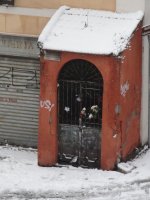 I live close to this little shrine and I love that people always leave flowers here. In summer, winter, rain or shine… and a couple of times, even in snow! … people come to this little portico to leave their floral offerings.
My children like to pass by and count how many flowers have been left on that particular day for Papessa Giovanna – or Pope Joan.
For that’s the over-one-thousand-year-old legend that keeps the offerings coming to this little spot in Rome’s Celio neighbourhood. And how can you not love a city that keeps its medieval legends alive and well in our modern world?
 According to the legend, in the 9th century a young English woman disguised herself as a man, taking the name Johannes Anglicus, and became a monk. In July 853 A.D, this female monk succeeded Pope Leone IV, becoming Pope Giovanni VII (Johannes Septimus
View original post 258 more words
How Will You Pray for Peace on Saturday?
Resources from a friend…

Rome Vigil and Prayer Booklet
Prayer adapted from Catholics Confront Global Poverty by USCCB
http://www.usccb.org/prayer-and-worship/prayers/prayer-for-peace-in-syria.cfm
Almighty eternal God, source of all compassion,
the promise of your mercy and saving help fills our hearts with hope.
Hear the cries of the people of Syria;
bring healing to those suffering from the violence,
and comfort to those mourning the dead.
Empower and encourage Syria’s neighbors
in their care and welcome for refugees.
Convert the hearts of those who have taken up arms,
and strengthen the resolve of those committed to peace.
O God of hope and Father of mercy,
your Holy Spirit inspires us to look beyond ourselves and our own needs.
Inspire leaders to choose peace over violence
and to seek reconciliation with enemies.
Inspire the Church around the world with compassion for the people of Syria,
and fill us with hope for a future of peace built on justice for…
View original post 412 more words
 The Ecumenism Blog

