Home » Theology and Ecumenism (Page 8)
Category Archives: Theology and Ecumenism
Final Statement
Final Statement
Fundamentalist or Responsible Citizen?
The Contribution of Religious Communities to the Formation of European Citizens.
28 November to 5 December 2010 Sarajevo, Bosnia and Herzegovina.
Our God has called us here all together, Jews, Christians and Muslims, motivated to encourage young religious people to take a more active role in public life within Europe. In light of the changing religious composition of European societies, increased xenophobia, and a trend towards excluding religion from civil discourse, our aim was to propose ways in which young religious European citizens can take a more active role in fulfilling their duties towards society as a whole.
We are concerned over the rise of extremist attitudes, sometimes identified with fundamentalism, whether religious or secular. We believe that religions, cultures and civil systems can work together towards common objectives.
We assert that religious identity should not be excluded from the public sphere, and that in order to achieve a fairer society, people of all backgrounds and beliefs must take an equal part in civil activities.
To achieve this, we recommend:
Formal, informal and non-formal educational initiatives:
- to raise awareness about the role of religious communities within
society;- to raise awareness of civil duties within religious communities;
- to increase understanding of different religions and perspectives;
- to help all people to see beyond stereotypes;
Dialogue and collaboration:
- on an individual level: getting to know each other, listening, and
sharing life experiences;- between religions and secular authorities;
- to build networks involving different religious and secular communities
and policy influencing organisations;Engagement:
- by young religious citizens in politics, media and NGO work;
- in setting an example, becoming involved in voluntary services.
These are activities that will need to be continued by all members of European society on a long-term basis. We must persevere towards a more committed, more responsible and more inclusive society, all together.
Sarajevo, 4th December 2010
Conflict and Dialogue: Contemporary Bosnia i Herzegovina
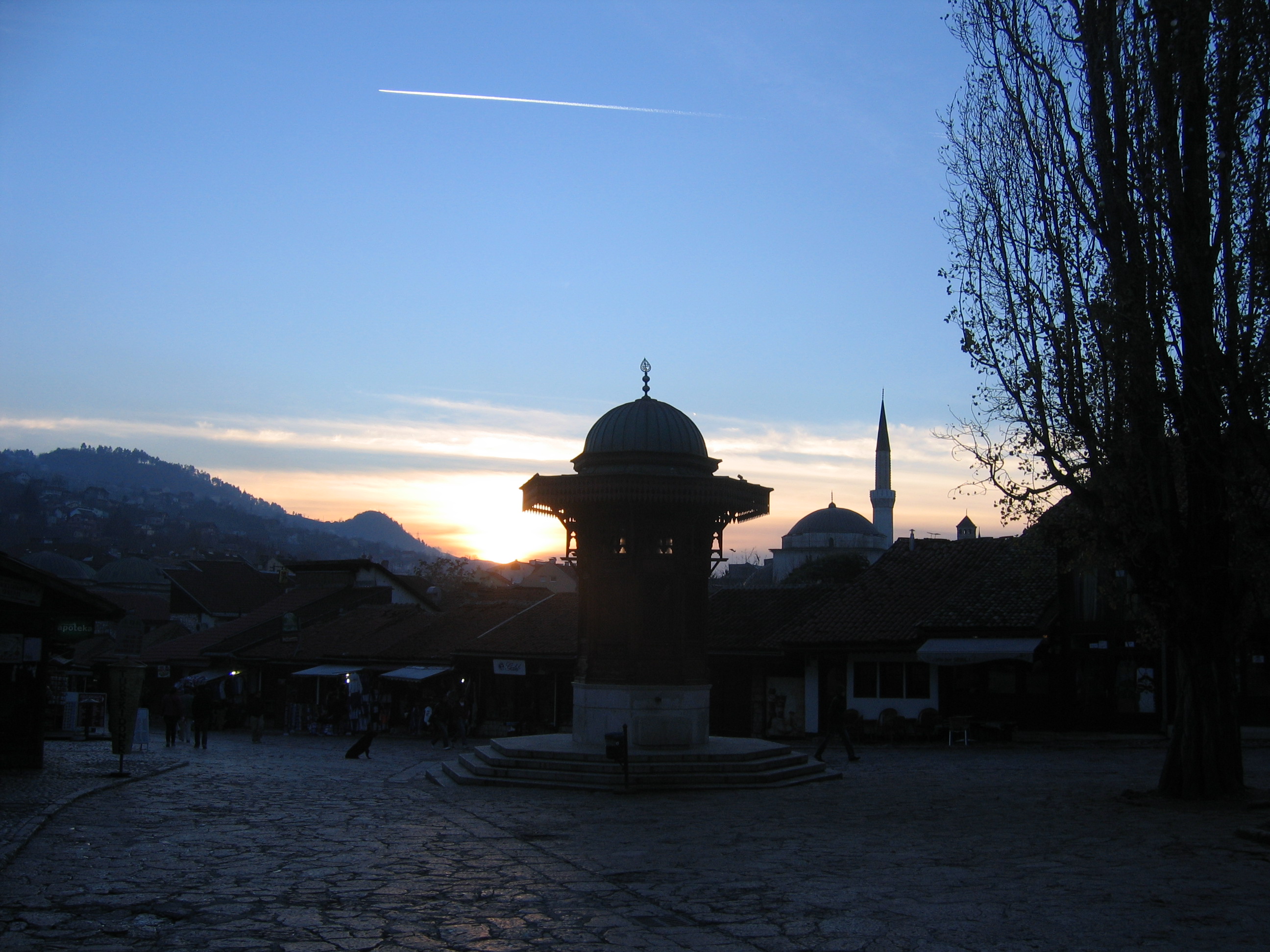
Sarajevo at sunset
The siege of Sarajevo was contemporary with my four years in high school, 1992-96. Now, nearly fifteen years later, the city is in good shape and relations seem markedly better, but just as there are some signs of the previous destruction – a few buildings with bullet holes or shrapnel damage, some still gutted, an abandoned and burned out pickup truck, and a few Sarajevo Roses still to be seen – so too is there still some evidence of the ethnic and national tensions.
The airport is small, with a relatively short runway surrounded by residential neighborhoods, in a valley that usually includes a turbulent and foggy approach. As if this is not enough, pilots must approach in radio silence, apparently because there are still pockets of resistance whom authorities fear would take advantage of an incoming jet, intercept voice communications and give incorrect information in order to cause a crash. Outside the capital city, there are still places where you can see nationalist expression, even while within Bosnia, for example, you can see neighborhoods divided by flying Croatian and Serbian flags respectively.
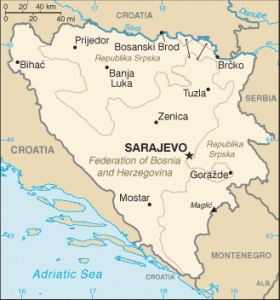 The government is complicated. There are three (ethnic) constituent peoples in Bosnia and Herzegovina (BiH): the Bosniaks (mostly Muslim), Serbs (Orthodox) and Croats (Catholic). In the wake of the Dayton Accords which established the current peace (but did not set up a constitution or long term plan), the country of Bosnia and Herzegovina has a rotating national presidency of three people, one from each of the constituent peoples. The three presidents serve a four year term (elected) and rotate chairmanship of the presidency every eight months. The locals joked with us that if you walk down the street, nobody knows who the current president is, but they surely all know the UN High Representative (currently Austrian Valentin Inzko) who is responsible for overseeing the ongoing implementation of the Dayton Accords.
Further, the country is divided into three political entities: The Federation of Bosnia and Herzegovina, Republika Srpska, and the small Federal District of Brčko which is formally part of both the other entities but governed by neither. Further, the Federation is subdivided into ten cantons; each has its own government. Finally, the regions of Bosnia and Herzegovina, respectively, are distinct but not defined – Herzegovina covering the southern part of the country, the eastern half in Republika Srpska and the western half in the Federation of Bosnia and Herzegovina.
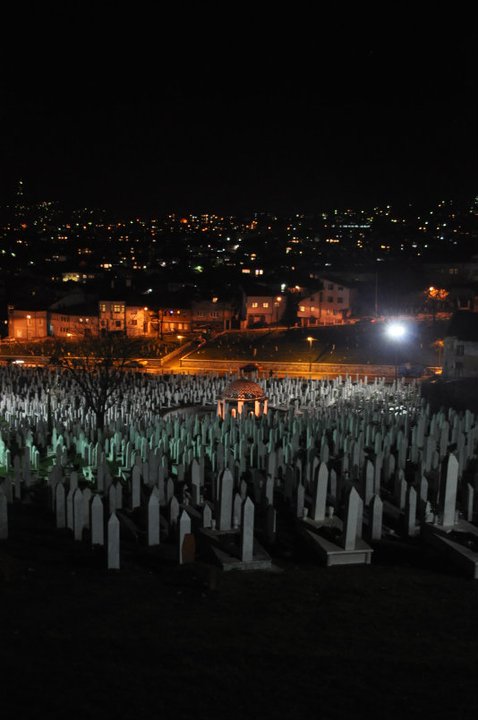
Sarajevo Martyrs Cemetary, courtesy Khaoula Amouri
At one point during the week, we had an evening presentation on the country and its culture, given by our local hosts and members of the planning committee, three Bosnians in their twenties. They had deliberately decided not to present on the war. As part of the younger generation, only children at the time, there is an understandable interest in moving on and focusing on the good that has come since, and also to show that the war is not the only thing to know about the country. (Our friend from Northern Ireland voiced his understanding for this approach from his own experience of having been constantly asked about the troubles there). In part, the decision had been made because there had already been some tense side discussion about one of the more horrific aspects of the conflict, which was the Srebrenica massacre, which was ruled as genocide by the International Criminal Tribunal for Yugoslavia in 2004 and confirmed as such by the International Court of Justice in 2007. Other participants had been waiting for a discussion precisely on the topic, though, and the anxiety boiled over during discussion, when it seemed as though it might not be addressed at all during the week.
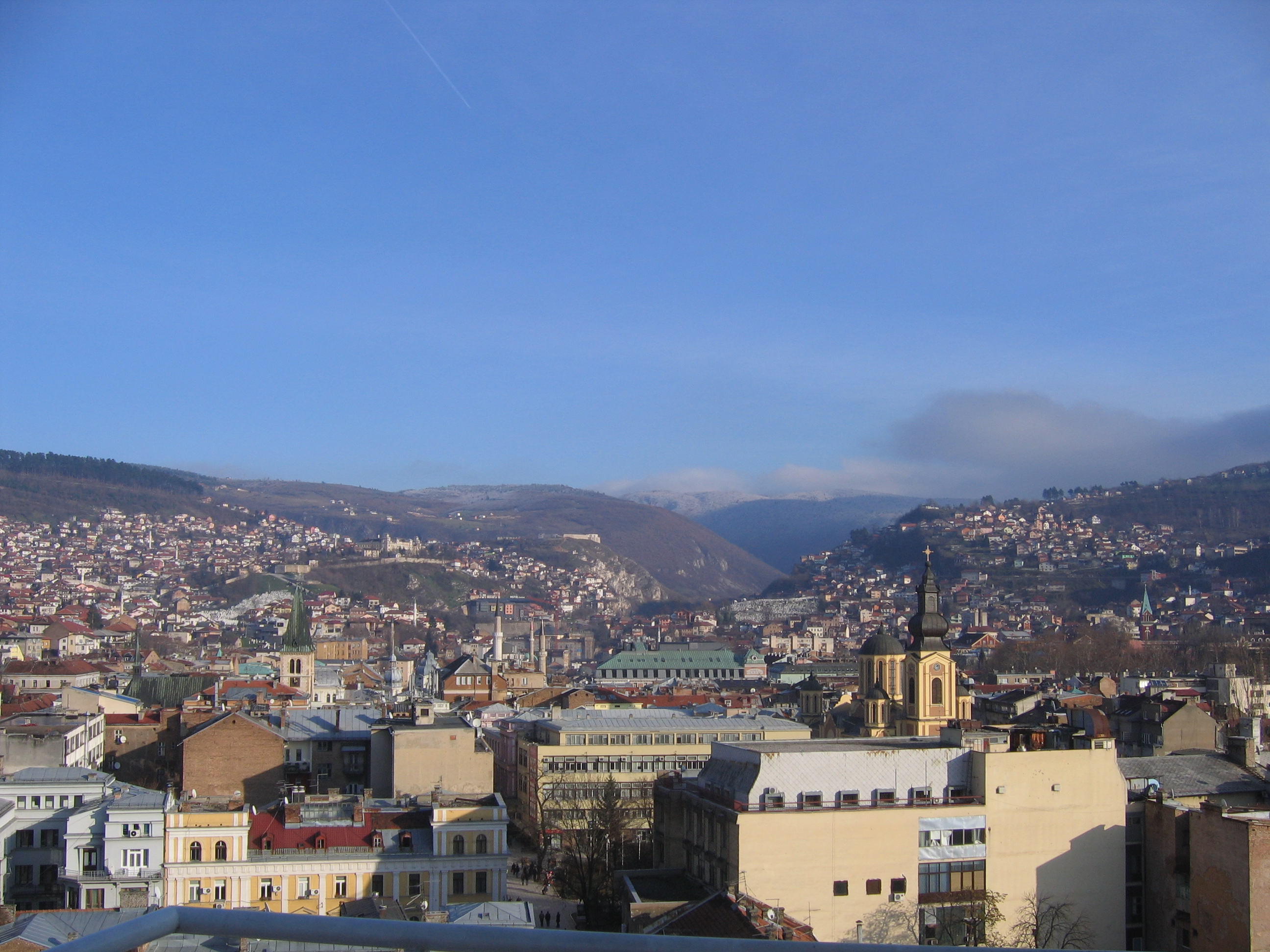
Sarajevo
It got very emotional. Had the planning committee overlooked including a discussion about the war, which would have been irresponsible, or were they trying to move on too quickly, which could appear as a false irenicism? Was Srebrenica genocide as the ICJ declared, or is that a matter of opinion – with each of the three factions in BiH having its own take in addition to the “outsider” international judgment? Is even asking that question genocide denial? One of our participants pointedly asked whether killing 6 million Chinese would count as genocide, suggesting that several historians disagree with the ICJ determination (based on the idea that genocide cannot be confined to a locality, but must target an entire ethnic group or nation), while another held that even questioning the term genocide in this case was tantamount to denying the act itself. Someone else asked whether it mattered at all what we called it, massacre or genocide, war crime or atrocity, so many deliberate killings is wrong no matter the motivation. Others were voicing shock that this could happen on European soil so recently as to be in our lifetime, after the Shoah and “never again”, even while UN peacekeepers stood by and did nothing (or could do nothing). For that matter how could a siege have lasted for so long in the modern era without direct international intervention?
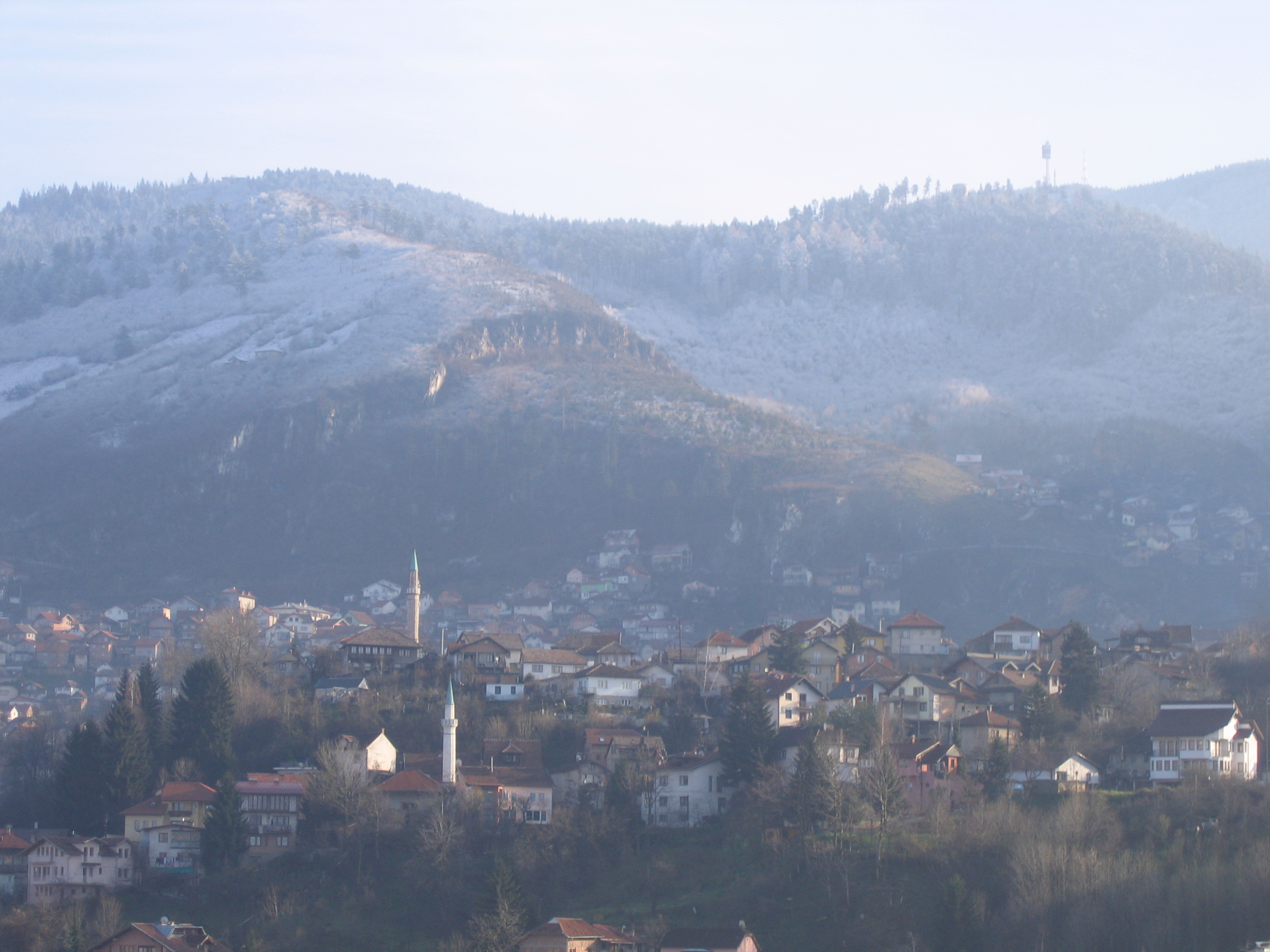 I would not have wanted to be in the place of our presenters, a couple of young Bosnians in unprepared for the barrage of questions and not expert in the topic other than having lived here – but they handled it remarkably well. Some of the planning committee worried that the entire rest of the conference would be derailed by the topic, rather than focusing on the purpose that brought us together. I have rarely felt so inadequate for a discussion: I had not studied the war in depth, and am not an expert in genocide (its definition or its denial). I spent the rest of the night wandering from group to group, doing what I could just to listen to everyone, or to as many as I could. I was humbled, inspired, and moved in turn – at times I have felt that my work in dialogue can get too academic and we need to bridge the gap with the pastoral. Here, that was no problem, and my only wish was that I could have offered more.
This is what interreligious dialogue is about. The group gelled well in the first part of the week. People were open and available for conversation and challenge. It was not planned this way, but the organizers and the next morning’s presenter responded well, addressing the concerns but bringing it into the context of our work, doing so first in thespirit of prayer and then in the greater question of fundamentalism and dialogue. I know not everyone was perfectly happy, some still felt as if their voice was not heard enough, or not enough attention was given to the subject of the war and the ongoing healing, but the larger sense seemed to be that at a moment which could have tipped the rest of the week into uncomfortable irrelevance, instead we were able to bring it back together and deal with difficult questions. In the end, we were better for it.
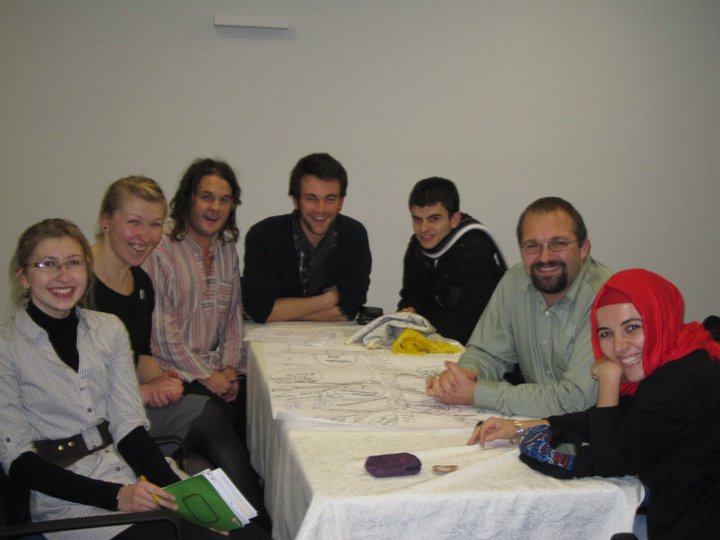
Home group at the end of the week, courtesy Amjad Agil
Sarajevo 2010: Fundamentalist or Responsible Citizen?

Karin Kops (Estonia) addressing the conference
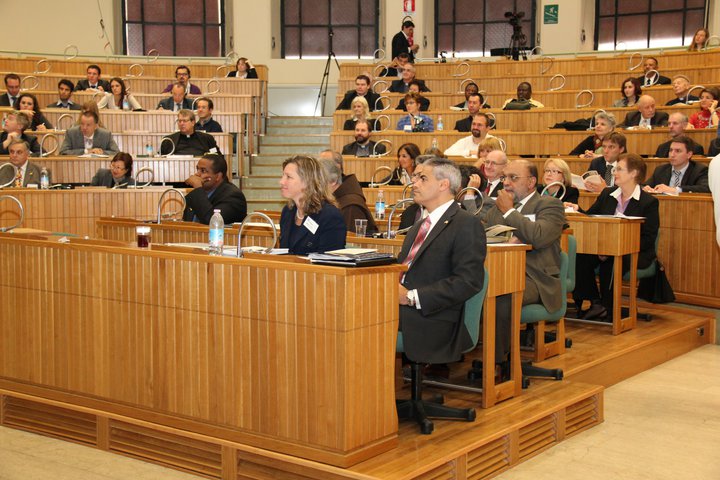
For the last week, I have been blessed with the opportunity to be in Sarajevo with a great group of young people from all over Europe. We gathered for a conference entitled Fundamentalist or Responsible Citizen? The Contribution of Religious Communities to the Formation of European Citizens. The sponsoring agencies included the Ecumenical Youth Council in Europe (EYCE, affiliated with the WCC), the Forum of European Muslim Youth and Student Organizations (FEMYSO), and the Council of Europe. This summit marked the culmination of a three-year Campaign to Overcome Fundamentalism spearheaded by EYCE.
I should note that “youth” means something different here than in the U.S., as anyone involved in World Youth Day would be aware. At home, especially when speaking of “youth ministry”, we are talking of teens in middle school and high school, age 12-18 or so. Over here, “youth” means university age, in its broadest implications, so the participants ranged from 20 to 35. After almost a decade of involvement in National Workshops on Christian Unity and some NCC events in the States, it was striking to be one of the older people in the room rather than one of the youngest.
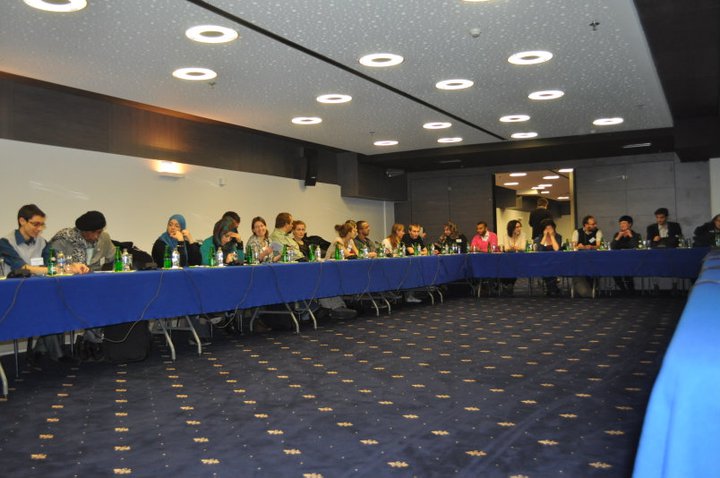 About 45 people were gathered, roughly twenty each were Christian or Muslim, and only four or five were Jewish. I think only four of us were Catholic, with Orthodox, Protestant and even pre-protestant communities represented (i.e., Moravians, Czech Brethren, and Waldensians). Most European states were represented, with the Iberian countries being the only noticeable absence. I was the only non-European, but for my European credentials I was ‘representing’ the Vatican as a pontifical university student – that is, quite unofficially.
The highlight of the week was the other participants. My roommate was a student from Lithuania. I spent time at a British pub called “Cheers” with a theologian-staffer to the Icelandic bishops’ national office, a protestant pastor’s kid from Northern Ireland living in the Republic, and a Romanian seminarian friend who lead the planning of the whole event (and just turned 22). One of my first conversations was with a Palestinian Briton about the situation in the Holy Land, and my experiences there with the Russell Berrie Fellowship. I shared shisha with a Turkish Muslim woman living in Cairo, and burek with two Albanians from Macedonia and a Latvian who has seen more of the world than I likely ever will! And the list goes on.

Hasan Patel, photo courtesy of Khaoula Amouri
Despite having studied in Rome for the last year, this was the first time to really talk about Europe per se with Europeans – really to listen and observe as they discussed it themselves – especially on such a relevant issue as the role of religion and secularity in nation, state, and European society. (Most of my classmates are African, Asian, and some from the Americas and what Europeans there are mostly from the east, and a minority.)
While not an academic conference exactly, the presentations were on topic and promoted good discussion. We had a welcome from the Mufti of Sarajevo and President of the Interreligious Council (IRC), a panel with Muslim, Orthodox, and Catholic representatives of the Bosnian IRC, and presentations from Bashy Quarishy of Denmark, Hasan Patel and Imam Ajmal Masroor of the UK, and Dirk Thesenvitz of Germany. At the end of the week, a subcommittee of participants collated the week’s comments and discussion and drafted a Final Statement, which was signed by all the participants. As part of that committee, I wish we had had more time, as there were a few areas that we felt could have been better phrased, but considering the actual drafting was done in about three hours, by committee for approval by the whole, it seemed to come together rather well.
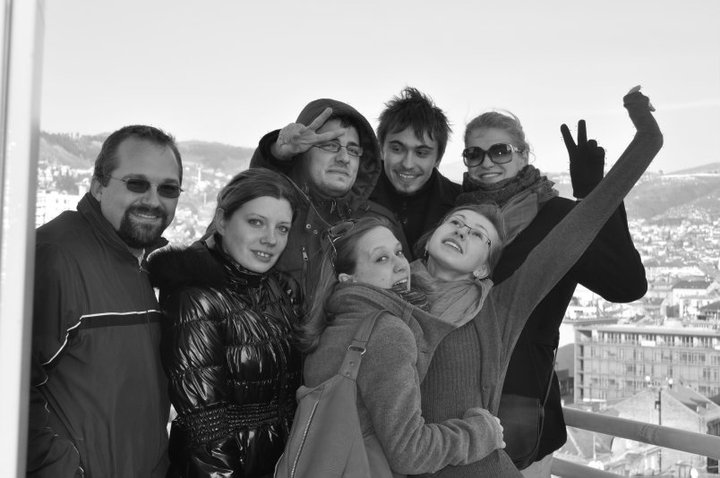
Baltic and Balkan friends, photo courtesy Kristina Jureviciute
John Allen, Jr. on Pope Benedict and Islam
Appropos of conversation this week during the conference in Sarajevo, Fundamentalist or Responsible Citizen? The Contribution of Religious Communities to the Formation of European Citizens, here is an exceprt of Jon Allen, Jr.’s blog All Things Catholic today concerning the pope’s take on Islam. The entire post can be read here.
In the political argot of our time, Pope Benedict XVI is unquestionably a “conservative.” A core aim of his papacy is to revive a strong sense of traditional Catholic identity over against radical secularism, a classically conservative agenda.
Precisely because of those credentials, however, the old American axiom that “only Nixon could go to China” fits Benedict XVI like a glove. Because of who Benedict is and what he represents, every once in a while he can do things a more “liberal” pontiff either wouldn’t dare or couldn’t pull off without splitting the church apart.
That point has been brought home anew due to Benedict’s new book-length interview with German journalist Peter Seewald, titled in English Light of the World, which featured some surprising comments on condoms.
Consider the following defining traits of cultural conservatives these days:
- A hawkish line on Islam
- Eco-skepticism
- Unyielding pro-life advocacy
Here’s the irony, one which is often underappreciated: While Benedict XVI is obviously sympathetic with all three concerns, in some ways he’s also taken the legs out from under the extremists in each camp.
Islam
On any list of improbable recent papal moments, the site of Benedict standing alongside a mufti in Istanbul’s Blue Mosque in 2006, facing the mihrab in a moment of silent prayer, would have to figure near the top.
As a theologian, Benedict expressed doubts about the very possibility of inter-religious prayer. The fact that he stepped outside his own skin, so to speak, on such a high-profile occasion, offered a clear signal of his commitment to reconciliation with the Muslim world.
When Benedict was elected, many observers prophesied he would be the pope of Samuel Huntington’s “Clash of Civilizations,” rallying the Christian West against an Islamic threat. His Regensburg lecture in September 2006 seemed to cut in that direction, igniting protest across the Islamic world by appearing to link Muhammad with violence. (In his new book, Benedict admits he failed to realize that people would take his academic address as a political statement.)
Yet since Regensburg, Benedict instead has emerged as a great friend of Islam, albeit without pulling any punches on terrorism and religious freedom. He’s met with Muslims on scores of occasions, opened up new dialogues, and pulled off highly successful trips to Muslim nations. Today, it’s abundantly clear that détente with Islam is the top inter-faith priority of this papacy.
At the core of Benedict’s vision is what he described during a May 2009 journey to Jordan as an “Alliance of Civilizations” – a phrase obviously crafted as an alternative to the “Clash of Civilizations.” The idea is that Christians and Muslims should stand shoulder-to-shoulder in defense of shared values such as the right to life, care of the poor, opposition to war and corruption, and a robust role for religion in public life. (The pope calls that “inter-cultural,” as opposed to “inter-religious,” dialogue.)
In Light of the World, Benedict is asked if he has abandoned the medieval notion that popes are supposed to save the West from Islamization.
“Today we are living in a completely different world, in which the battle lines are drawn differently,” Benedict says. “In this world, radical secularism stands on one side, and the question of God, in its various forms, stands on the other.”
In that struggle, Benedict sees Christians and Muslims as natural allies.
Bottom line: The only crusade Benedict is interested in leading is against a “dictatorship of relativism,” not against Islam. If only Nixon could go to China, maybe only Benedict XVI can go to Mecca.
Oy, Advent! quote of the day…
Attributed to Rabbi Hayyim of Volozhin (d.1821) founder of the Lithuanian yeshivot:
“Thus will be the advent of the Messiah: you will be sitting in your room alone studying, and your wife will suddenly enter and say, ‘Oy, Hayyim! You are sitting here studying? Don’t you know the Messiah has come?’ Startled, you will sputter three times and say to her, ‘Who told you?’ and she will say to you, ‘Go outside and see for yourself: not a soul is left in the city, not even the babes in their cradles, for everyone has gone out to greet [him].’”
Aviezer Ravitzky, Messianism, Zionism, and Orthodoxy: Historical and Conceptual Background, p. 22
Building Bridges of Hope: Success Stories and Strategies for Interfaith Action
Past the Ambassador and Dr. Diaz, in the white...
On October 12, 2010, the U.S. Embassy to the Holy See and the Pontifical Gregorian University sponsored a conference entitled “Building Bridges of Hope: Success Stories and Strategies for Interfaith Action.” The purpose of the conference was to discuss how people of different faiths could work together to address global problems. Nine panelists from different faiths spoke on the topics of environmental protection, equitable development, and conflict resolution, sharing their religion’s perspective on their panel theme plus concrete examples of interreligious cooperation in that field. The White House sent a keynote speaker, Dr. Joshua DuBois, to the event to emphasize the U.S. Government’s senior-level support for the initiative.
[Taken from the conferences wikisite, which includes full transcripts of presentations: http://bridgebuilders.wikispaces.com/]
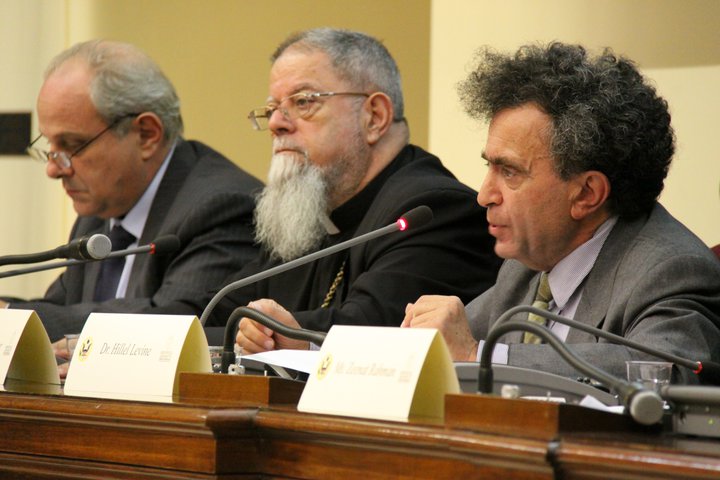
Foclare Representative; Melkite Archbishop Elias Chacour; Dr. Hillel Levine
The Environment, Ethical Development, and Conflict Prevention were the three panel themes of the conference, each addressed by three panellists from each of the three Abrahamic faiths: Judaism, Christianity, and Islam. Not all were academics. Business and NGO leaders, clergy and politicians were among the presenters, providing for an even greater variety of approaches to the questions of interfaith dialogue and action.
Take a few minutes to peruse the conference on the link above!
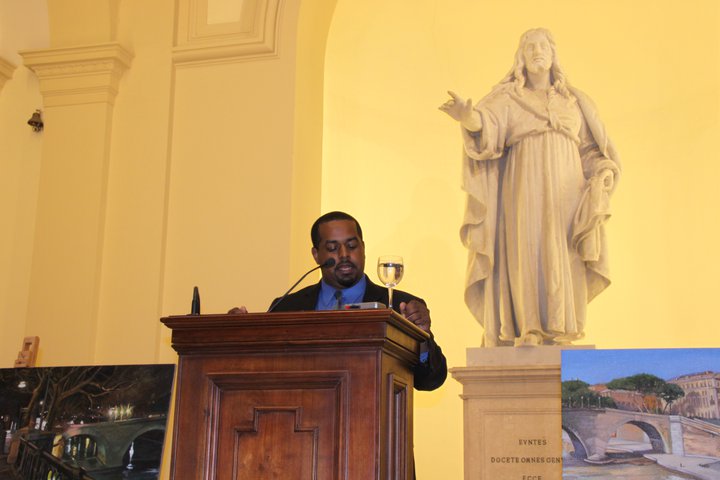
Dr. Joshua DuBois, Director, White House Office of Faith-Based and Neighborhood Partnerships
Caravita Community Celebrates 10 Years
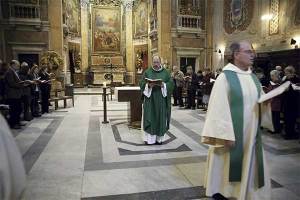
Eucharist in the Caravita Community
I have mentioned it before, but the Caravita Community is a quasi-parish that meets at the Oratory of Saint Francis Xavier “del Caravita”. It is comprised of an international assortment of Anglophones, with members from about 20 different countries, and is staffed by priests from four different religious orders. Most of its membership travel frequently, and it is a particularly welcoming place for English-speaking pilgrims to Rome. Several people I have meet are in Rome regularly as general officers for their religious community, students or faculty at the pontifical universities, on diplomatic assignment, or staff in the Roman curia. While i try to worship at a variety of churches on Sunday to get a truly catholic experience of the Church, the Caravita Community is always and already familiar.
This weekend they celebrated their 10th anniversary, though even this recent endeavour reflects the longer tradition of the place. Prior to October 2000, however, it had not been used as a place of regular worship since 1925.
Named after the Jesuit Pietro Gravita who was responsible for its construction, the oratory was built between 1618 and 1633 on the site of an existing church, San Nicola de Forbitoribus, and then completely rebuilt between 1670 and 1677 (Baroque, anyone?) The Oratory was constructed to house the nine different lay “congregations” (which would later become to Sodality movement) linked with the work of the Jesuits and served as a centre for lay formation and social outreach in the 17th and 18th centuries. The first women’s lay “congregation” was housed here.
The importance of lay ministry and formation, the dedication to the social mission of the church, and active ecumenical participation remain a part of the community’s identity. Similarly, a rich artistic heritage rests in the place, from 17th century frescoes to the 18th century performance of the teenage Wolfgang Amadeus Mozart, his debut in the Roman court. In honor of a new organ installed into the oratory, part of the weekend’s events included a concert dedicated “Mostly Mozart”.
 A symposium entitled “How Firma Foundation: The Role of the laity and the Church’s Mission in the Third Millennium” included presentations from John Padberg, SJ on the history of Lay Confraternities, a report from Kerry Robinson of the National Leadership Roundtable, and an analysis of last year’s African Synod by Cardinal Peter Turkson of the Pontifical Council for Justice and Peace.
(The symposium and concert occurred while I was at the day of Reflection at Tre Fontane, and no one seems to have recorded the talks. I am trying to track down the speakers’ papers or notes, if they are available…)
The conclusion of the weekend was Ecumenical Evensong, with participation from the membership of Churches Together in Rome, the ecumenical organization for English-language churches in the City. Canon David Richardson, the Archbishop of Canterbury’s Representative to the Holy See, presiding and Donald LaSalle, SMM of the Caravita Community staff preaching.
“The Reception of Guests”, Rule of Benedict §53
Let all guests who arrive be received like Christ,
for He is going to say,
“I came as a guest, and you received Me” (Matt. 25:35).
And to all let due honor be shown,
especially to the domestics of the faith and to pilgrims.
As soon as a guest is announced, therefore,
let the Superior or the brethren meet him
with all charitable service.
And first of all let them pray together,
and then exchange the kiss of peace.
For the kiss of peace should not be offered
until after the prayers have been said,
on account of the devil’s deceptions.
In the salutation of all guests, whether arriving or departing,
let all humility be shown.
Let the head be bowed
or the whole body prostrated on the ground
in adoration of Christ, who indeed is received in their persons.
After the guests have been received and taken to prayer,
let the Superior or someone appointed by him sit with them.
Let the divine law be read before the guest for his edification,
and then let all kindness be shown him.
The Superior shall break his fast for the sake of a guest,
unless it happens to be a principal fast day
which may not be violated.
The brethren, however, shall observe the customary fasts.
Let the Abbot give the guests water for their hands;
and let both Abbot and community wash the feet of all guests.
After the washing of the feet let them say this verse:
“We have received Your mercy, O God,
in the midst of Your temple” (Ps.47[48]:10).
In the reception of the poor and of pilgrims
the greatest care and solicitude should be shown,
because it is especially in them that Christ is received;
for as far as the rich are concerned,
the very fear which they inspire
wins respect for them.
Let there be a separate kitchen for the Abbot and guests,
that the brethren may not be disturbed when guests,
who are never lacking in a monastery,
arrive at irregular hours.
Let two brethren capable of filling the office well
be appointed for a year to have charge of this kitchen.
Let them be given such help as they need,
that they may serve without murmuring.
And on the other hand,
when they have less to occupy them,
let them go out to whatever work is assigned them.
And not only in their case
but in all the offices of the monastery
let this arrangement be observed,
that when help is needed it be supplied,
and again when the workers are unoccupied
they do whatever they are bidden.
The guest house also shall be assigned to a brother
whose soul is possessed by the fear of God.
Let there be a sufficient number of beds made up in it;
and let the house of God be managed by prudent men
and in a prudent manner.
On no account shall anyone who is not so ordered
associate or converse with guests.
But if he should meet them or see them,
let him greet them humbly, as we have said,
ask their blessing and pass on,
saying that he is not allowed to converse with a guest.
Official Catholic Dialogue with Judaism and Islam
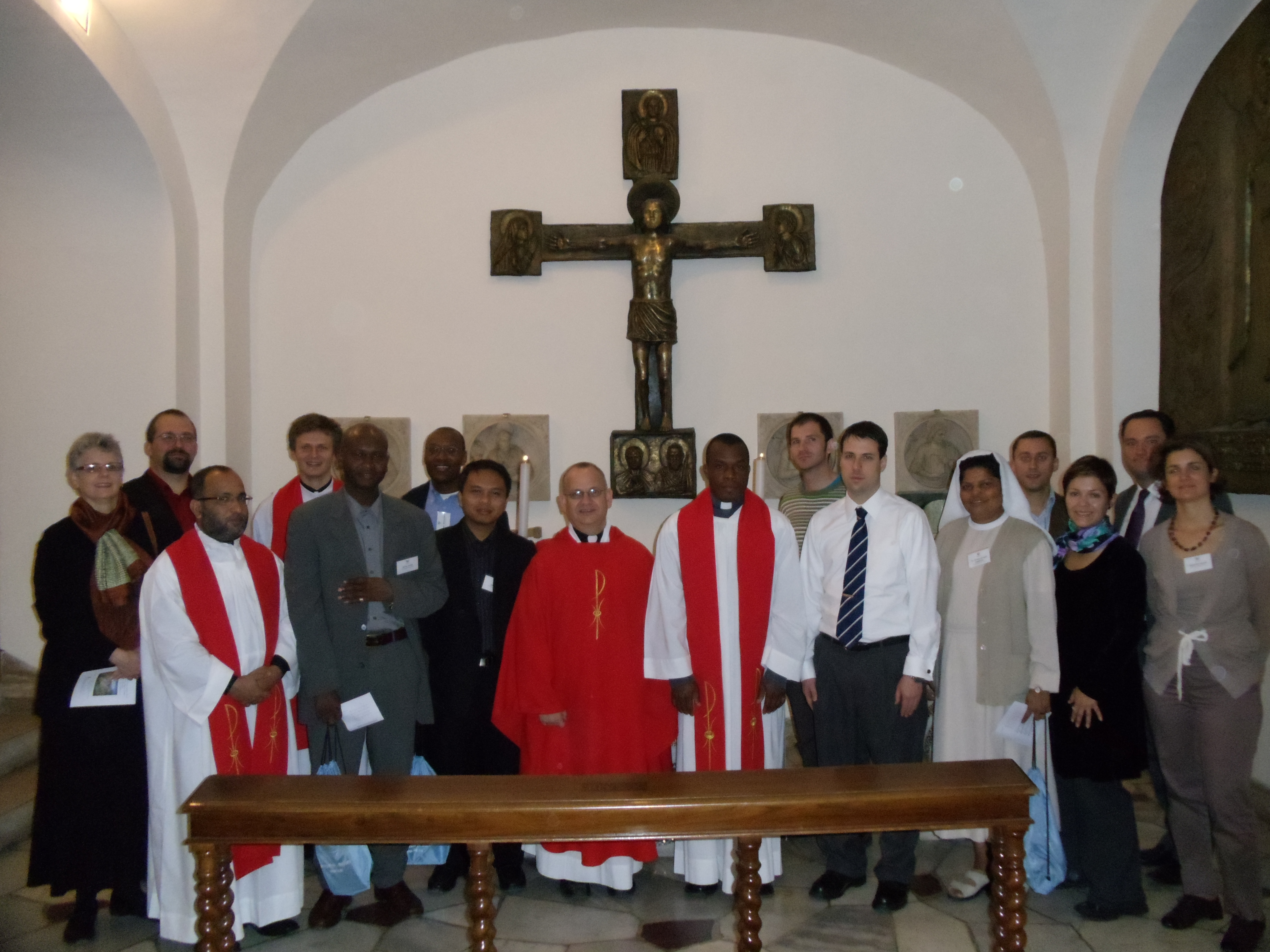
Russell Berrie Fellows at Chapel of the Patrons of Europe, Vatican Basilica
The second full day of our orientation began with a celebration of the Eucharist at the Vatican Basilica, in the Chapel of the Patrons of Europe just a few yards from the heart of the basilica, underneath the high altar. It was dedicated by Pope John Paul II in 1981 to the three first-millennium co-patrons of Europe: St. Benedict of Norcia and Sts. Cyril and Methodius of Thessaloniki. (The three second-millennium co-patrons, all women, were named in 1999.) The presider of our liturgy was Father Jess Rodriguez of the Jesuit curia, newly arrived in Rome to serve the English Secretariat of the Church’s largest religious order.
Noted art historian Elizabeth Lev joined us after the liturgy to give us a brief, but informative, insider’s tour of the basilica of St. Peter. Even for those who have been in Rome for years, something new was gleaned from her rich presentation. For me, it was the answer to one of the Eternal City’s eternal questions: “Hey Bernini, what’s with the twisted columns on the baldacchino???”
A short walk down Via della Conciliazione brought us to the offices of the Pontifical Council for Promoting Christian Unity, which for largely historical reasons, also houses the Pontifical Commission for Religious Relations with the Jews and a presentation from German Salesian Norbert Hofmann on the “Official Catholic Dialogue with Judaism”.
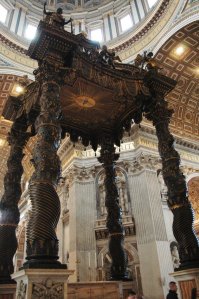
Bernini's Baldacchino
An afternoon of technical details broke for two more presentations: “Analysis of Nostra Aetate: Doctrine and History” by Thomas Casey, SJ and “The Official Dialogue of the Catholic Church with Islam” with German Jesuit Felix Körner of the Gregorian University’s ISIRC. The final discussion of the evening was a dinner dialogue with U.S. Ambassador to the Holy See, theologian Miguel Diaz, his wife and fellow theologian Marian Diaz, and the Canadian Ambassador to the Holy See, Anne Leahy. Their topic, understandingly, was “Diplomacy and Interreligious Dialogue”. We were joined by Drs. Armando and Adalberta Bernardini, president and vice-president of the International Foundation for Interreligious and Intercultural Education – and Fellow Paola’s parents.
Commitment of the Catholic Church to Dialogue
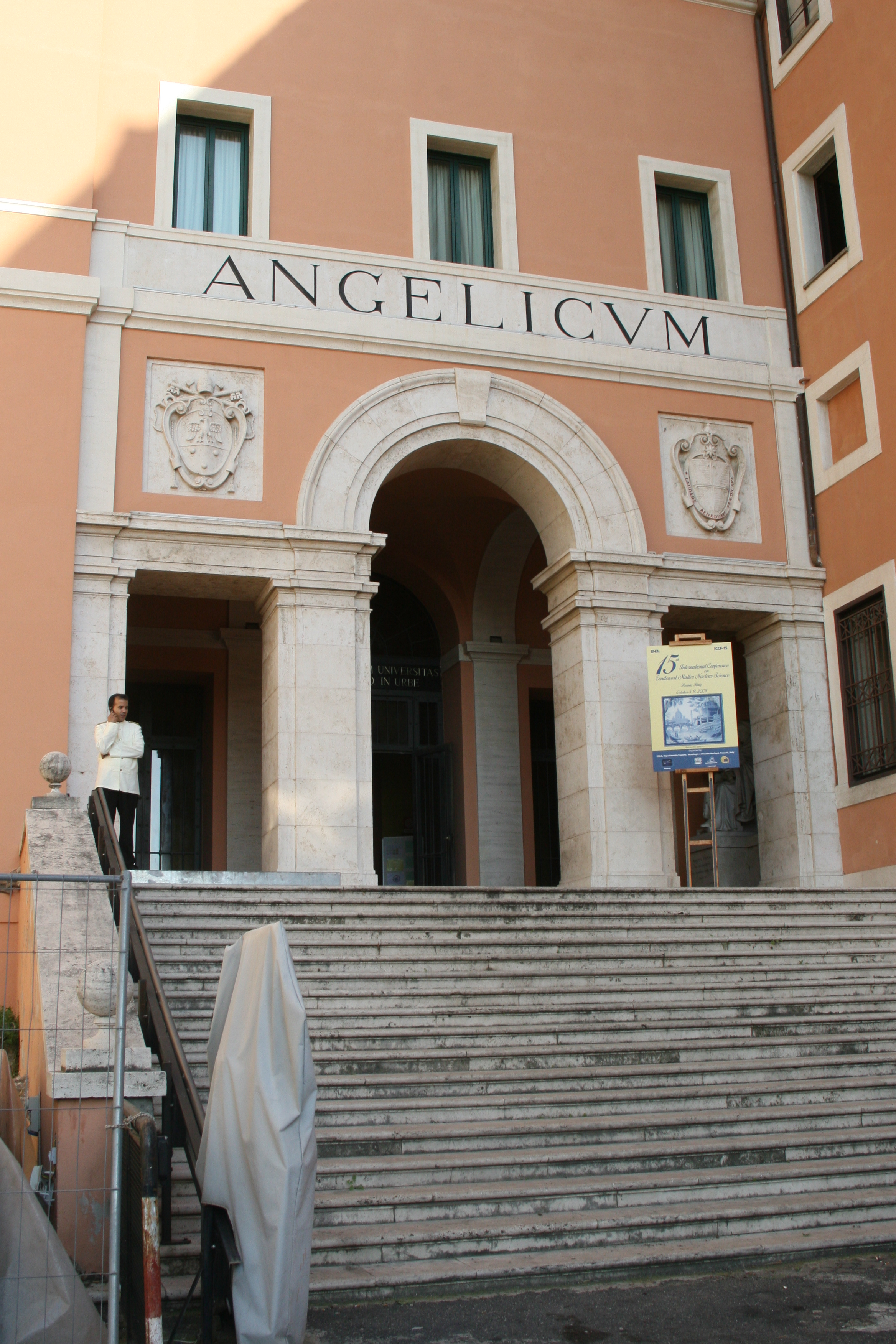 Monday brought us to the Angelicum with a welcome from Irish Dominican Michael Carragher, Vice-Rector and Canon Law Professor, and a brief tour from the new dean of the Theology faculty, Maltese Dominican Joseph Aguis. I learned more about the University in these 20 minutes than my time spent in its classrooms the last year. The university itself is the third oldest in rome, after Sapienza and the Gregorian, but its original location was next to the Pantheon in Santa Maria Sopra Minerva. The building that currently houses the university was originally a convent, repurchased from the government sometime after both sites had been taken in 1870. In what had been the chapter room, and serves now as the Sala de Senato, the full-body relic of an unnamed saint rests in the armor of an imperial roman soldier under the altar, unbeknownst to even some of the faculty who had joined us on our tour.
Fr. James Puglisi, SA, who serves as director of the ecumenical section and the Centro Pro Unione lead our first academic discussion on the “Commitment of the Catholic Church to Ecumenical and Interreligious Dialogue”. Like many of the presentations throughout the week, the content was review, but would certainly be helpful for those arriving without previous background in ecumenism and interreligious dialogue. We lunched at the Gregorian university bar, which is substantially larger than its Angelicum counterpart.

Thomas Casey, SJ pictured with NYU Professor Lawrence Schiffman
Following lunch, we ran into former Lay Centre resident Dimitrios Keramidas in his new role as secretary of the Missiology faculty at the Gregorian. He gave us an impromptu tour of his office and that of the Institute for the Interdisciplinary Study of Religion and Culture, as well as the Cardinal Bea Centre for Judaic Studies. We were joined there by Irish Jesuit Father Thomas Casey, director of the Bea centre, who introduced us to the research and work of the center, which includes 6000 volumes on Judaism in the Gregorian university library. This was followed by a 90-moinute introduction to the library there, which is the largest in Rome. At this point I calculated that if all the pontifical universities in Rome combined their libraries into a single collection, or at least a single system to which all pontifical students had access, it would be almost as large as the Hesburgh Memorial Library at Notre Dame.
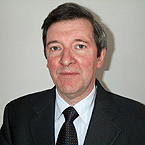
Gerard O'Connell, Rome Correspondent for UCANews
We returned to the Lay Centre for celebration of the Eucharist with the Theologian of the Papal Household, Polish Dominican Wojciech Giertych. This was followed by a dual-presentation and discussion over dinner with Fr. Giertych and Gerard O’Connell, Rome correspondent for the Union of Catholic Asia News service and author of God’s Invisible Hand, a biography of Cardinal Francis Arinze. The topic of their presentations was, “Issues that Matter to the Holy See: Seeing Interreligious Dialogue in its Broader Context”.
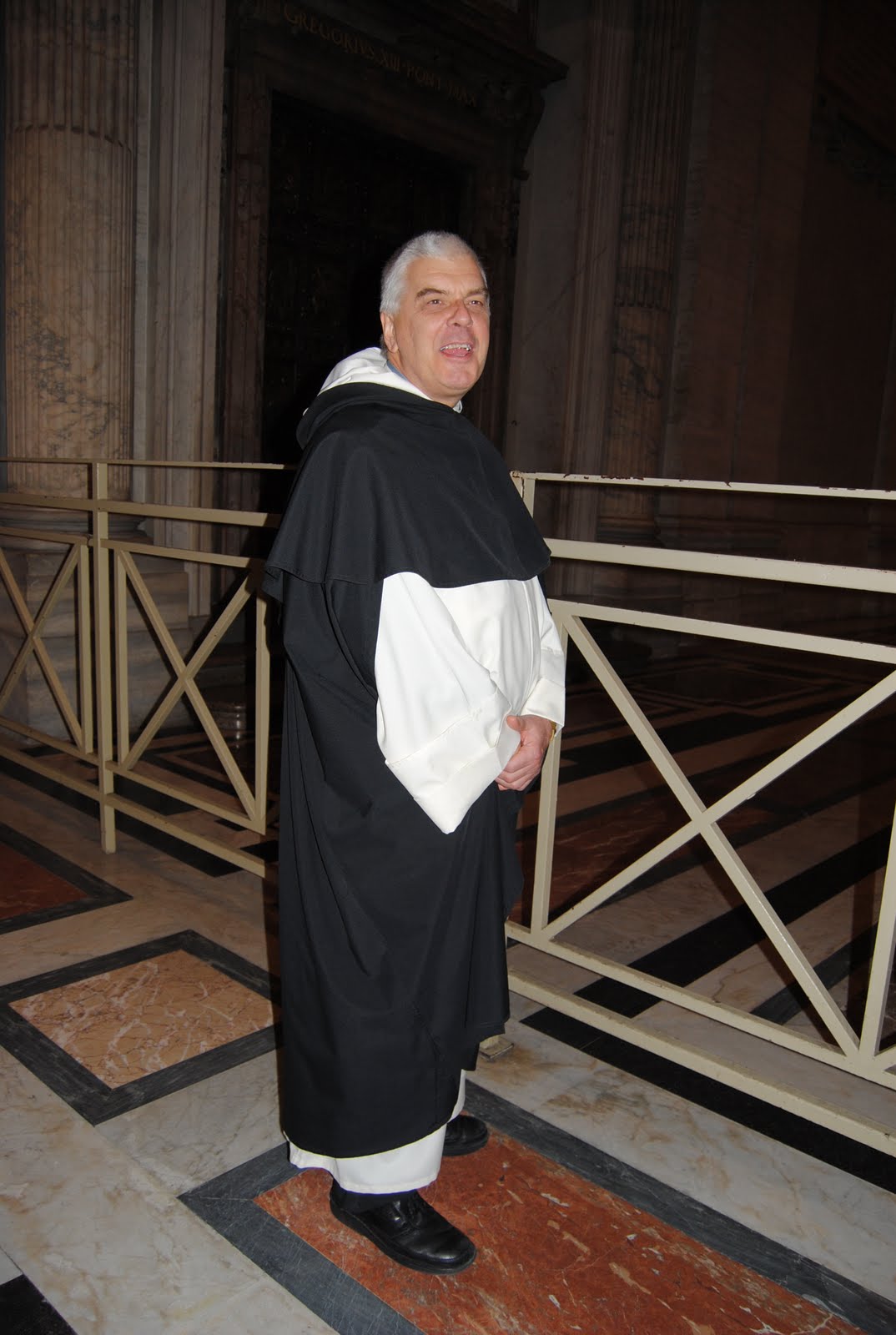
Wojciech Giertych, OP
The views were decidedly different, but not necessarily in opposition. Clearly a journalist and a theologian have different constituencies, frames of reference, and sensitivities when observing the Holy See; both men have had several years of doing so. Fr. Giertych raised a few hackles among some fellows with comments that grace comes through Christ and not through Buddha or Muhammad, but others countered that this is simply classical Christocentricism, inclusivist though it may be and in contrast to a more pluralistic view that is popularly construed as the most popular approach. (Whether it is or not is another discussion). At the least, it is helpful to be reminded that even in the administration of a papacy that is clearly pro-dialogue, there exist different methodologies and approaches to dialogue.
One of the burning questions of the evening revolved around whether Jews and Muslisms, at least, worship the same God as Christians. The Catholic Church has authoritatively taught that they do, and this has been cited from Gregory VII in the eleventh century to Nostra Aetate in the twentieth. Still, the thesis is challenged even within the church, and this fact lead to some pretty interesting conversation the rest of the evening. That, and another debate which started with one of the European fellows noting, “There is nothing new in Nostra Aetate. It is fifty years old, and it shows. We should be much further along than this!”
 The Ecumenism Blog