
Home » Theology and Ecumenism (Page 4)
Category Archives: Theology and Ecumenism
Summer Stage II: English and Ecumenism in Eastern Romania
Providence provides again. After three weeks in Cyprus, the choice of destination was determined by one and only one question: what was the cheapest flight out of Larnaca? Wherever it went, that is where my next stop would be.
As it happened, the answer was Bucharest. I missed my mother’s trip to Romania by just under a week, too, but the timing worked in my favor. After having booked the tickets, a Georgian friend sent a facebook message about a ‘summer camp’ for students from central and eastern Europe interested in ecumenism and improving their English. The target age seemed to be university students in their twenties, or late teens – “youth” by the European definition. A little past the upper limit, I wrote the organizers to see if they were interested in having a native-English speaking ecumenist join them, and offer a lesson or two.
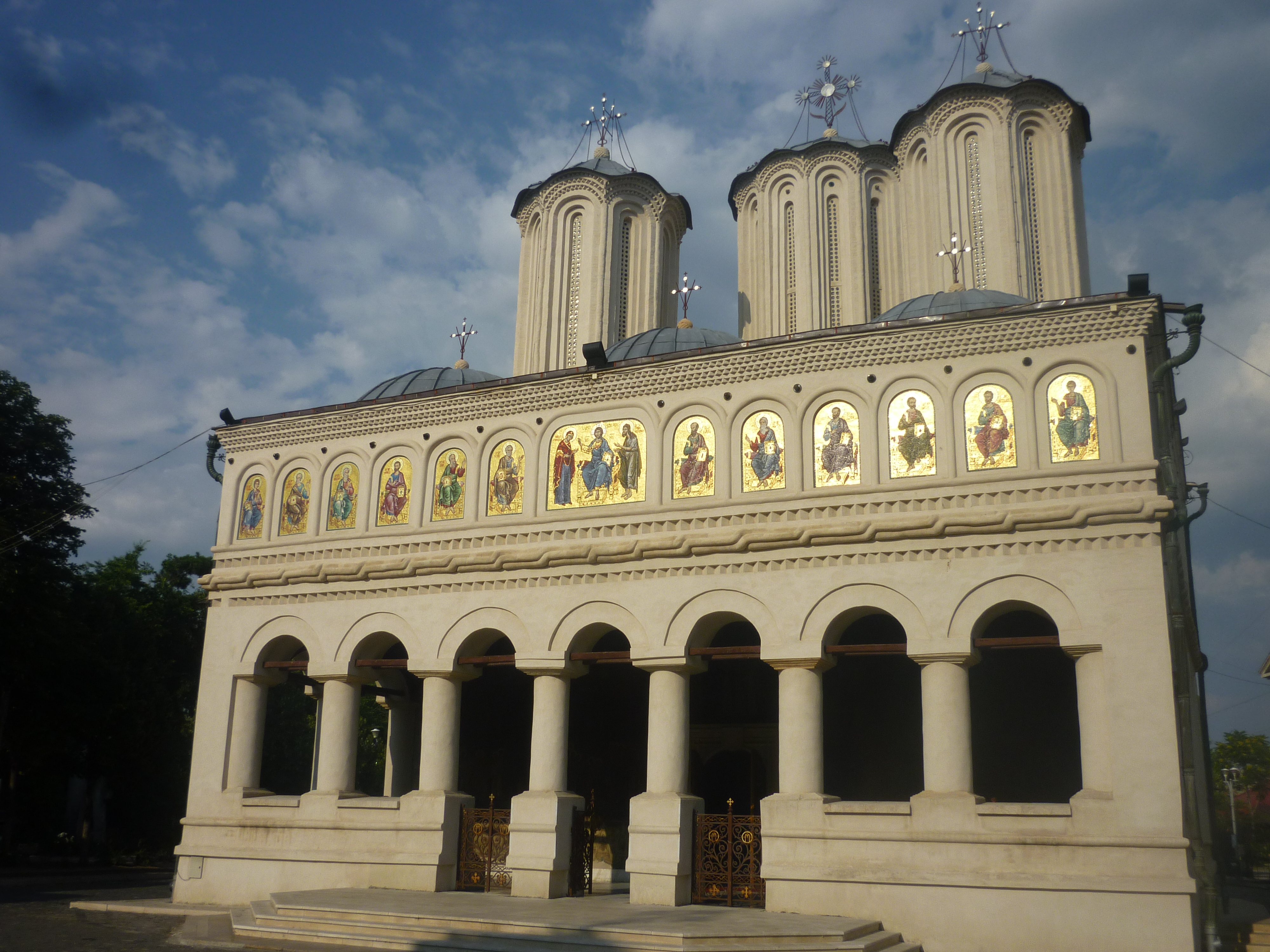
Patriarchal Cathedral of Sts. Constantine and Helen, Bucharest
The idea of spending ten days in a castle in northeastern Romania for no more than the cost of getting there was appealing, too, I admit. A few hours in Bucharest gave us time to visit the patriarchate (where we got parking only because our host told security that I was a theologian visiting from the Vatican), and a walking tour of the city. Then it was a night train to Roman.
The Lingua Franca Summer Camp was organized by the European Region of the World Student Christian Federation, an organization i had somehow not encountered before. It started originally in the early nineties at the collapse of the Soviet Union as a way to promote Christian leadership and provide English-language training for young Christians from behind the Iron Curtain. The length of the program has reduced dramatically in the last 20 years, from three months to ten days, but still serves many of the same countries. All the participants already had some mastery of English, and some involvement in ecumenical student movements. I was privileged to lead a small discussion group of advanced English speakers from Armenia, Georgia, Ukraine, and Finland during language training, and participate in the program the rest of the week. The other participants or staff came from Armenia, Bulgaria, Georgia, Germany, Finland, Ireland, Italy, Lithuania, Moldova, Poland, Romania, Slovakia, UK, Ukraine, and US.
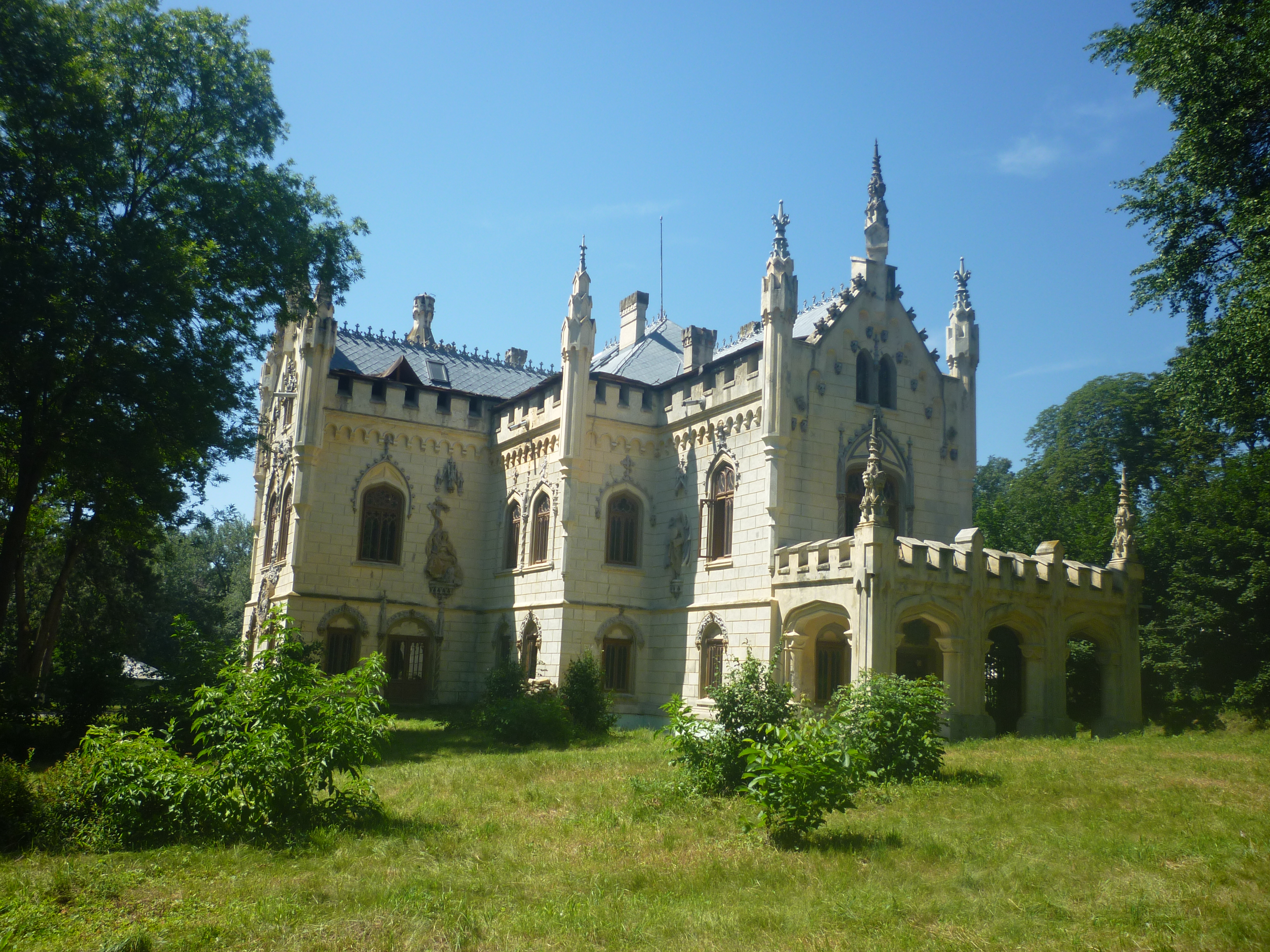
Studza Castle, Miclăuşeni
The setting is the almost surreal nineteenth century neo-gothic Sturdza Castle, near the village of Miclăuşeni. Built on the site of a fifteenth century manor estate, the castle once boasted a library of 60,000, including several rare first editions. Most of these were lost during the second world war, burned as fuel or stolen either by Nazi or Soviet soldiers. In 1947 the heiress donated the property to the Romanian Orthodox Metropolitanate of Iasi, and established a monastic community there. Only six years later, however, Communist authorities seized the land, and used the castle successively as a munitions depot, museum of military metallurgy, and hospital for children with severe mental disabilities. Villagers looted some of the original furniture, and other pieces were lost in two fires over the decades. As late as 2002, the place was still in complete disrepair. Recent work to restore it seems to have done a great job, but there is still a lot to be done – many of the original frescoes and decorations are so ruined, it seems more a question of renovation than restoration. A retreat center has been started, and the metropolitanate hopes to make a museum of part of the place. An iconography workshop already takes part of the space in the monastery complex, and the community of sisters numbers about forty.
The educational piece was organized in cooperation with the metropolitanate, under the guidance of the vicar for education, Archimandtrate Hrisostom Radasanu, a graduate of the Orientale in Rome. An articulate and erudite young cleric, his presentation to the group was apparently his first ever teaching occasion in English, and it was nearly flawless. I imagine the ecumenical world will be hearing his name a lot more in the years and decades to come, and I look forward to it.

Traditional Armenian dance demonstration
The best part of the experience was, naturally, the people who participated. I met some amazing young ecumenists and future leaders. I learned a great deal from them, about everything from the specter of Russian imperialism, perceptions of American politics and the degree to which we don’t always appreciate our country, to ecclesiastical reality in different countries and experience with Islam, to the situation for gay rights in Georgia (In May, a demonstration of about four dozen in support of gay rights was overwhelmed when something like 35,000 counter-protesters turned out). I also learned a bit about Romanian Orthodox Ecclesiology in practice, like the fact that they will not ordain someone without a pastoral office (ie, a parish or chancery role) that is open and requires a deacon or presbyter. I have to go read Fr. Ron Roberson’s doctoral dissertation now…
Two familiar faces from a great youth conference I attended in Sarajevo three years ago (!) were there too: Pip, an implacably irenic North Irish Anglican PK, now father of a beautiful daughter himself, who brought no less than six bodhráin with him; and Paweł, the Polish editor-in-chief of the WSCF-E publication Mozaik, whose English is more British than most Englishmen I know.
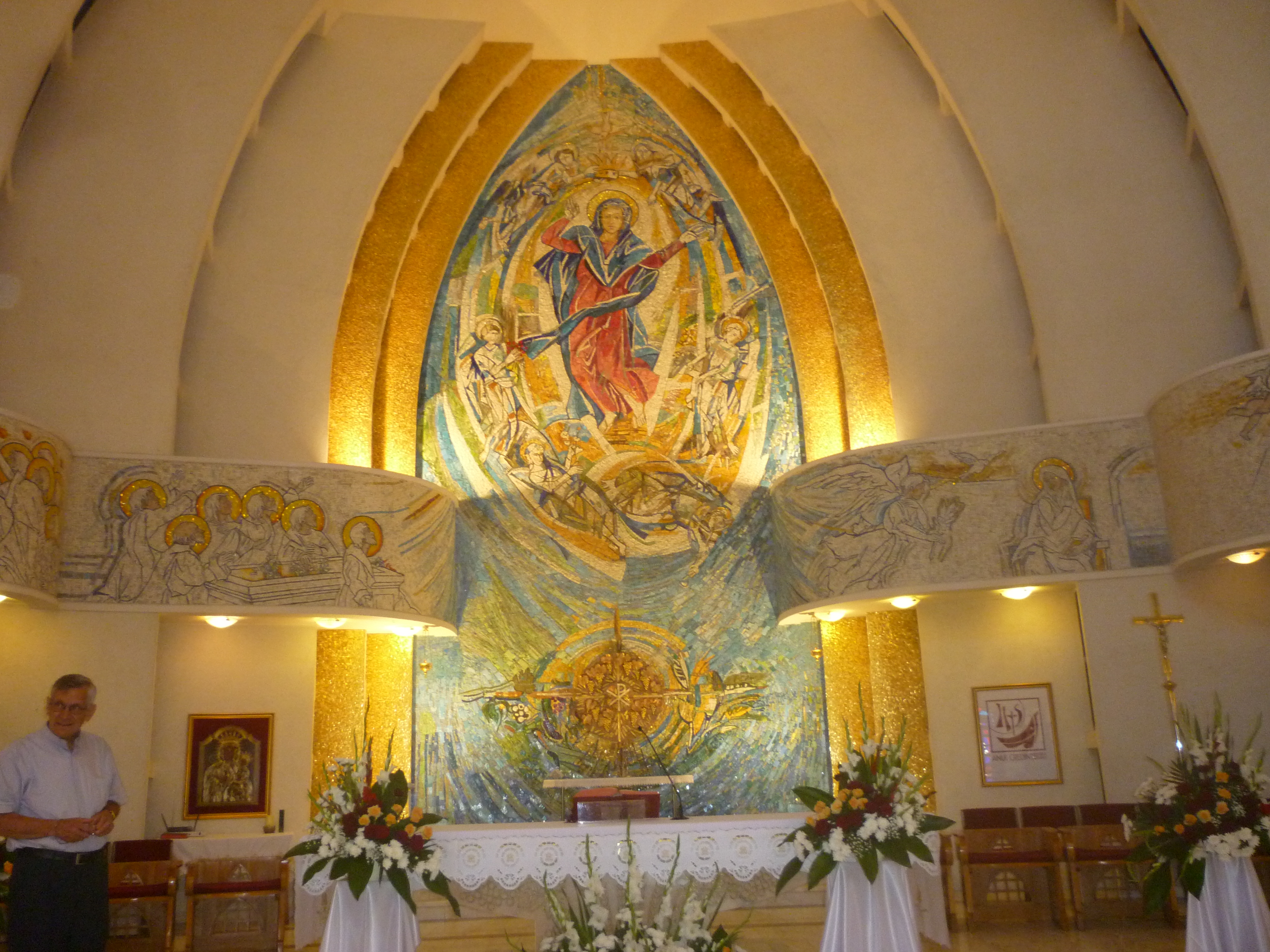
Catholic Cathedral of Mary, Queen of Heaven, in Iasi. Bishop Petru Gherghel’s motto is ‘ut unum sint’.
I met a Georgian who could be a Republican from the Peach State, an inquisitive Ukrainian with a passion for learning, Romanian teens whose Byzantine chant was angelic, a fey Finn of Russian roots with a compelling story, and an awesome Armenian foursome. My new Slovak friend is the very image of a central European intellectual, with a cigarette in one hand and a book on existentialism in the other, slightly unkempt beard and untucked dress shirt completing the ensemble. A Bulgarian duo were inseparable, indefatigable, and inspiring. The German regional secretary proved a kindred ecumenical spirit.
I could go on, and in more depth. I was impressed by the quality of each, and by the opportunity they had here. I had support from some key ecumenists in my years post-college around the US, but there was nothing like this for us to tap into, to network with ecumenists our own age. Europe may struggle with its Christian identity, but at least religion is still recognized as enough a part of culture that its diversity is something to be addressed, rather than ignored. Western Europe may be increasingly secular and unprepared to comfortably address religious questions, but there is a light in the East.
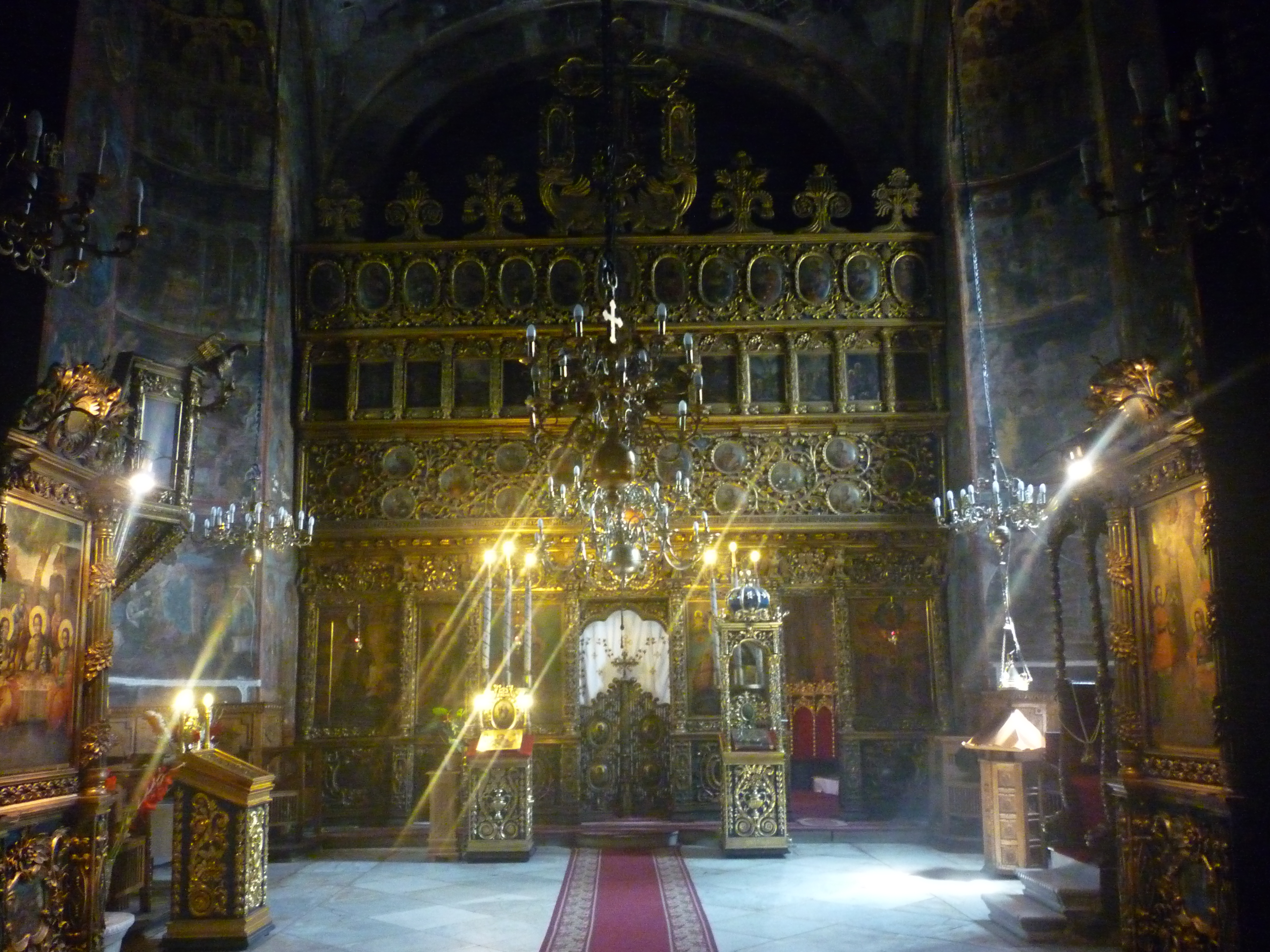
Golia Monastery, Iasi
Malines Conversations Group – Communiqué
From March 17 to 20, a group of Anglican and Catholic theologians gathered at the Monastery of Chevetogne in Belgium to initiate a new ecumenical exploration under the title ‘Malines Conversations Group’. Desiring to stand in the tradition of the Malines Conversations, which were convened by Cardinal Mercier of Mechelen (Malines) in the 1920’s, the Group’s first meeting included reflection on socio-cultural, liturgical and ecclesial developments from the time of the Malines Conversations to the present, and on the anthropological dimension of liturgical experience in our two communions.
During the meeting, the Conversation participants joined the monks of Chevetogne for their worship, both in the Byzantine and Latin rite traditions. They also went on pilgrimage to Mechelen and joined in prayer at the tomb of Cardinal Mercier.
Like the Malines Conversations of the 1920’s, the current dialogue is informal and not officially sponsored by Anglican and Catholic Churches, though it has been organized in consultation with and has received the blessing of Church authorities. Archbishop Rowan Williams and Cardinal Godfried Danneels have agreed to serve as Patrons of the Conversations. At the recommendation of those responsible for coordinating ecumenical relations in the Catholic Church and the Anglican Communion, the Malines Conversations Group will remain in communication with both the Anglican-Roman Catholic International Commission (ARCIC) and the International Anglican-Roman Catholic Commission for Unity and Mission (IARCCUM).
Though not intentionally planned this way, the meeting was held during the same historic week as the inauguration of the Petrine Ministry of Pope Francis and the enthronement of Archbishop of Canterbury Justin Welby, and was imbued with the hope which those events carried for the life of our two communions, and the future of our relations.
Anglican participants:
- Rev. Dr. Jennifer Cooper, College of the Resurrection, Mirfield, UK
- Rev. Dr. James Hawkey, Westminster Abbey, London, UK
- Rev. Dr. Simon Jones, Chaplain of Merton College, Oxford, UK
- Rev. Dr. Jeremy Morris, Dean of King’s College, Cambridge, UK
- Rev. Dr. Michael Nai-Chiu Poon, member of ARCIC III, Singapore
- Canon Dr. Nicholas Sagovsky, member of ARCIC III, London, UK
Catholic participants:
- Most Rev. Donald Bolen, Catholic Co-Chair of IARCCUM, Saskatoon, Canada
- Dr. Joris Geldhof, Catholic University of Leuven, Belgium
- Dr. Maryana Hnyp, Catholic University of Leuven, Belgium
- Rev. Dr. Keith Pecklers, S.J., Gregorian University, Rome
- Rev. Dr. Thomas Pott o.s.b., Monk of Chevetogne, University of Sant’Anselmo, Rome
- Rev. Cyrille Vael o.s.b., Monk of Chevetogne
The Malines Conversations Group members expressed their heartfelt thanks to Abbot Philippe Vanderheyden and the monks of Chevetogne for the extraordinary welcome extended to them. Their aim is to meet again next March at a location in the United Kingdom.
Pope Francis greets ecumenical and interreligious delegates
Audience with representatives of
Churches and Ecclesial Communities
and of other Religions
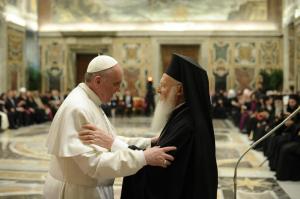
(Reposted from Vatican Radio) On Wednesday, March 20 2013, Pope Francis received several dozen representatives of the various Christian Churches and other world religions, who attended the Pope’s inauguration.
Among them were several leaders from the Orthodox Church, Orthodox Oriental Churches, the Anglican Communion, and various Protestant churches, including the Lutheran, Baptist and Methodist churches. Representatives from the Jewish and Muslim faiths were also present.
Please find below Vatican Radio’s translation of the Pope’s discourse:
Dear Brothers and Sisters,
First of all, heartfelt thanks for what my Brother Andrew* told us. Thank you so much! Thank you so much!
It is a source of particular joy to meet you today, delegates of the Orthodox Churches, the Oriental Orthodox Churches and Ecclesial Communities of the West. Thank you for wanting to take part in the celebration that marked the beginning of my ministry as Bishop of Rome and Successor of Peter.
Yesterday morning, during the Mass, through you , I recognized the communities you represent. In this manifestation of faith, I had the feeling of taking part in an even more urgent fashion the prayer for the unity of all believers in Christ, and together to see somehow prefigured the full realization of full unity which depends on God’s plan and on our own loyal collaboration.
I begin my Apostolic Ministry in this year during which my venerable Predecessor, Benedict XVI, with true inspiration, proclaimed the Year of Faith for the Catholic Church. With this initiative, that I wish to continue and which I hope will be an inspiration for every one’s journey of faith, he wished to mark the 50th anniversary of the Second Vatican Council, thus proposing a sort of pilgrimage towards what for every Christian represents the essential: the personal and transforming relationship with Jesus Christ, Son of God, who died and rose for our salvation. This effort to proclaim this eternal treasure of faith to the people of our time, lies at the heart of the Council’s message.
Together with you I cannot forget how much the council has meaning for the ecumenical journey. I like to remember the words that Blessed John XXIII, of whom we will soon mark 50 years since his death, when he gave his memorable inauguration speech: “The Catholic Church therefore considers it her duty to work actively so that there may be fulfilled the great mystery of that unity, which Christ Jesus invoked with fervent prayer from His heavenly Father on the eve of His sacrifice. She rejoices in peace, knowing well that she is intimately associated with that prayer “.
Yes, dear brothers and sisters in Christ, let us all be intimately united to our Saviour’s prayer at the Last Supper, to his invocation: ut unum sint. We call merciful Father to be able to fully live the faith that we have received as a gift on the day of our Baptism, and to be able to it free, joyful and courageous testimony. The more we are faithful to his will, in thoughts, in words and in deeds, the more we will truly and substantially walk towards unity.
For my part, I wish to assure, in the wake of my predecessors, the firm wish to continue on the path of ecumenical dialogue, and I thank you, the Pontifical Council for the Promotion of Christian Unity, for the help it continues to offer in my name, for this noble cause. I ask you, dear brothers and sisters, to bring my cordial greetings to the Churches and Christian communities who are represented here. And I ask you for a special prayer for me so that I can be a pastor according to the heart of Christ.
And now I turn to you, distinguished representatives of the Jewish people, to whom we are bound by a very special spiritual bond, from the moment that, as the Second Vatican Council said, “thus the Church of Christ acknowledges that according to God’s saving design, the beginnings of her faith and her election are found already among the Patriarchs, Moses and the prophets”.(Decree Nostra Aetate, 4). I thank you for your presence and trust that with the help of the Almighty, we can continue that fruitful fraternal dialogue that the Council wished for. And that it is actually achieved, bringing many fruits, especially during the last decades .
I greet and thank cordially all of you, dear friends belonging to other religious traditions; firstly the Muslims, who worship the one living and merciful God, and call upon Him in prayer. I really appreciate your presence, and in it I see a tangible sign of the wish to grow in recipricol trust and in cooperation for the common good of humanity.
The Catholic Church is aware of the importance of the promotion of friendship and respect between men and women of different religious traditions – this I wish to repeat this: the promotion of friendship and respect between men and women of different religious traditions – this is attested evident also in the valuable work undertaken by the Pontifical Council for Interreligious Dialogue. The Church is equally aware of the responsibility that each of us bring towards our world, abd to the whole of creation, that we must love and protect. And we can do a lot for the good of the less fortunate, for those who are weak and suffering, to promote justice, to promote reconciliation, to build peace.. But above all, we must keep alive in our world the thirst for the absolute, and must not allow the vision of the human person with a single dimension to prevail, according to which man is reduced to what he produces and to what he consumes: this is one most dangerous threats of our times.
We know how much violence has been provoked in recent history by the attempt to eliminate God and the divine from the horizon of humanity, and we feel the need to witness in our societies the original openness to transcendence that is inherent in the human heart. In this we feel the closeness also of those men and women who, while not belonging to any religious tradition, feel, however the need to search for the truth, the goodness and the beauty of God, and who are our precious allies in efforts to defend the dignity of man, in the building of a peaceful coexistence between peoples and in the careful protection of creation.
Dear friends, thank you for your presence. To all, I offer my cordial and fraternal greetings.
*My Brother Andrew – that is, Bartholomew I, Patriarch of Constantinople, Successor of Andrew, the brother of Peter.
Catholic or catholic?
If you do not know the blog Get Religion, you should, especially if you have any interest in reporting on religion in secular media, or any interest in how religions present themselves to the world through the secular media.
There was a recent post discussing the terms Catholic and catholic, and what they mean. While doing a good job of looking at catholic as universal versus Catholic as referring to the Catholic Church, it left a few vagaries intact, that I have always struggled with, especially in secular reporting on the Catholic Church.
Briefly, the most misunderstood aspect of secular reporting on these terms is to always conflate ‘Roman Catholic Church’ and Catholic Church.
I have mentioned it before, but, simply put, the Catholic Church is the Catholic Church. It is not the only church that is catholic, nor is it the entire church catholic, but there is only one church called, officially, the Catholic Church., and it is the 1.1 billion member church in communion with Rome.
Roman Catholic, at most, indicates only a part of the Catholic Church – one of the 23 sui iuris churches that make up the Catholic Church. Roman Catholic and Latin Catholic are basically synonymous. However, Roman Catholic Church and Catholic Church are not synonymous. A Ukranian-Greek Catholic, a Chaldean Catholic, or a Maronite Catholic are all Catholic, but none are Roman Catholic.
More strictly, as I write from Rome, Roman Catholic means those Catholics who belong to the Church of Rome – that is, the Diocese of Rome. There are less than 3 million. Neither should the entire Catholic Church be referred to as the Roman Church – that would be like referring to the Anglican Communion as the Church of Canterbury, or to the Lutheran World Federation as the Augsburgian Church.
Yet, the AP style manual still insists on using ‘Roman Catholic’ instead of simply Catholic. In the end, admitting that the Catholic Church is properly called Catholic and not Roman Catholic does not mean it is, or thinks it is, the only catholic church, nor that it is the entire church catholic, but it is ecumenically appropriate to call a Church what it calls itself. The Catholic Church is the Catholic Church, and no high-church Anglicans were harmed in the making of this statement.
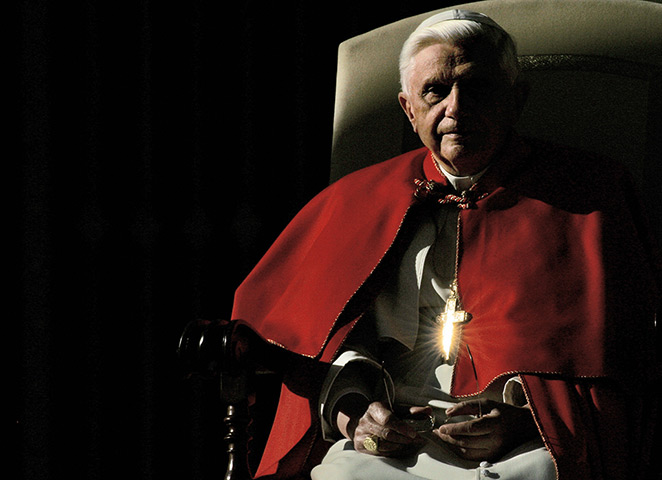
Benedict Resigns – Retired Pope Q & A
[Updates since the writing of this Q & A, usually confirmation of my speculations, are included below in blue.]
The Italians have squelched the discussion of papal resignation in the past by brushing the idea aside with comments like “you cannot have a pope emeritus,” or, “what would you even do with a retired pope?”
Several question, some serious and some mere curiosities have arisen in recent discussions, both virtually and in person here in Rome: Does the pope abdicate, resign, or retire? How does this compare to Pope John Paul II? When will the conclave be? Which cardinals can participate? What will Benedict’s new title be? What is the protocol and prerogatives for a retired pope? What role does he have in the Vatican, the college of Cardinals, or the Church? Does he retain his infallibility? Does he still wear white?
Official plans of the conclave will be publicized shortly, perhaps even today. It should not be difficult, even in the slow-moving Vatican, when many of the cardinals are already gathered for consistory. Though, at the same time, they may need a couple days to deal with the shock of the announcement. It seems only the dean of the college and a very small handful of others had notice even a day or two in advance of Monday’s announcement.
The following includes official answers where available, and speculation or suggestions where indicated.
Abdication, Resignation, or Retirement?
CIC 332§2 Si contingat ut Romanus Pontifex muneri suo renuntiet, ad validitatem requiritur ut renuntiatio libere fiat et rite manifestetur, non vero ut a quopiam acceptetur.
CIC 332§2 If it happens that the Roman Pontiff resigns his office, it is required for validity that the resignation is made freely and properly manifested but not that it is accepted by anyone.
Though “abdication” is the term used when a monarch leaves, the term has not been used officially since the loss of the papal state, for the resignation of the popes. Though technically still an absolute monarch, as sovereign of the Vatican City-State, the pope is the bishop of Rome above all else, and therefore he “resigns.” Though, in this case, “retires” certainly seems a valid description.
[On 18 February, Bishop Thomas Paprocki, bishop of Springfield and serves on the USCCB Committee on Canonical Affairs and Church Governance, with both a JD and an STD, confirmed the correct translation is ‘resignation’ rather than ‘abdication.’]
How does this compare to Pope John Paul II?
We really should not compare the two. John Paul II showed us suffering and ageing in dignity, Benedict XVI teaches us genuine kenosis and leadership with integrity and humility. It is hard to continue a ministry that it seems the Holy Spirit has called you to when your body fails you, it is harder to let go of power so absolute.
Voices that have criticized the Holy Father for resigning, saying things like “a father does not abandon his family,” or, “Wojtyla stayed until the end because one does not come down from the cross” seem to have missed the point.
Being pope is not about suffering, but about serving. A bishop emeritus can give witness to dignified suffering and the value of the elderly, but an impeded pope cannot serve. Benedict has reminded us to separate the office from the person, putting the emphasis on the Petrine ministry, where it belongs.
When will the conclave be held?
The apostolic constitution Universi Dominici Gregis, published by Bl. John Paul II and adapted slightly by Pope Benedict XVI, governs the Conclave, the process for the election of a new pope. According to the constitution, §37,
…from the moment when the Apostolic See is lawfully vacant, the Cardinal electors who are present must wait fifteen full days for those who are absent; the College of Cardinals is also granted the faculty to defer, for serious reasons, the beginning of the election for a few days more. But when a maximum of twenty days have elapsed from the beginning of the vacancy of the See, all the Cardinal electors present are obliged to proceed to the election.
This would seem to put the earliest starting date for the conclave on 15 March, and the latest starting date on 20 March. [This was confirmed by the Vatican Press office on 13 February].
However, since the purpose of this is to allow the cardinals not in Rome to get here, and because they have been given 17 days notice from the announcement to the time the retirement takes effect, perhaps it will be decided that this interregnum could be dispensed with. [A motu proprio to this effect is being considered, as of 22 February.]
Certainly, all hope that there will be a new bishop of Rome by Holy Week, which starts 24 March.
Which cardinals will participate?
The right to elect the Roman Pontiff belongs exclusively to the Cardinals of Holy Roman Church, with the exception of those who have reached their eightieth birthday before the day of the Roman Pontiff’s death or the day when the Apostolic See becomes vacant. (UDG §33)
One cardinal turns 80 on 26 February, and that is Lubomyr Husar, the retired Major Archbishop (de facto patriarch) of the Ukranian Catholic Church. According to the text, he would be excluded from the election, for being too old by less than 48 hours. Two others turn 80 in early March, Walter Kasper (March 5) and Severino Poletto (March 18), but even if the Conclave begins after their birthdays, they would still be admitted.
What is the protocol and prerogatives for a retired pope?
There is nothing in canon law or the apostolic constitution relating this. There are some ancient canons, and the precedent of retired bishops, that will be helpful. We know just a few things at this point, and the rest is speculation. We do know that Benedict XVI will not be involved in the election of his successor, and that he will retire first to Castel Gandolfo, and then to the monastery of cloistered nuns inside the Vatican for a time.
What will Benedict’s new title be?
The pope is the bishop of Rome. That is his title, his office, and the font of all other titles and offices, from Vicar of Christ to Servant of the Servants of God. Therefore the obvious choice would seem to be “bishop emeritus of Rome” just as any other retired bishop. But that is simply this ecclesiologist’s suggestion.
[On 22 February, Cardinal Francesco Coccopalmerio, president of the pontifical council for legislative texts, confirmed that after his retirement, he will be known as “His Holiness, Benedict XVI, bishop emeritus of Rome”.]
What role will he have in the Vatican, the college of Cardinals, or the Church?
Effectively none. In terms of protocol and precedence, one can imagine that he will be “ranked” below only the serving pope. Traditionally, popes have been forbidden from participating in the selection of their successors, and we already know he will be excluded from the coming conclave.
When a powerful leader resigns, it always seems the best practice that he or she basically disappear from the public eye for about a year, at least, to allow his or her successor to settle into the role. When the last Jesuit general retired – another office that was until recently ‘for life’ – he became a librarian in the Holy Land, and kept out of even provincial politics. When Fr. Ted Hesburgh retired as president of Notre Dame after 35 years, he took a year-long road trip and tour, staying away from campus. Mary McAleese, after 14 years as president of Ireland came to Rome and moved into the Lay Centre at Foyer Unitas to return to her studies of canon law.
Does he retain his infallibility?
The pope is not infallible. Not personally, anyway: Infallibility is not a possession or power of the pope, but a divine gift attributed to the Church as a whole, and derivatively to the college of bishops as a whole. The bishop of Rome, in communion with and head of the college of bishops, may exercise that authority in some very limited, very precise conditions, but it goes with the office, not the individual.
Will he still wear white?
I have no idea; I would expect not, but it will be curious to see what is deemed appropriate. Perhaps a black cassock or simar with white trim?
[John Allen, Jr., adds his own Q & A after today’s lengthy press briefing here.]
Benedict Resigns – Not exactly ‘unprecedented’
Popes have resigned in the past, and more than once, despite popular mythology to the contrary, at least including:
- Pope St. Pontian in 235
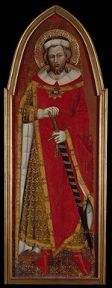
Pope St. Pontian, resigned in 235 AD
- Pope Silverius in 537
- Pope John XVIII in 1009
- Pope Benedict IX in 1045
- Pope Gregory VI in 1046
- Pope Celestine V in 1294
- Pope Gregory XII in 1415

Several others are not entirely clear whether it was resignation or deposition, including at least Pope Marcellinus in 308 and Pope Liberius in 366.
Plus there were others who are now considered antipopes who resigned, but at the time may not have been so clear who was the legitimate bishop of Rome. Some popes were deposed, others excommunicated. What I remember from history courses was that about 10% did not serve until death (and not all who did died of natural causes).
Modern popes have considered resignation as an option, most famously:
- Pius VII in 1804 prepared a letter of resignation, to be put into effect if he was captured and imprisoned
- Pius XII in 1943, for the same reason
- Paul VI considered retiring at the age of 75, in 1972, to conform to the law that asked the same of all other bishops
- John Paul II said in 1979 that he was open to the same idea, and it is said that he had a conditional document prepared as early as 1989, and again in 2000.
- Benedict XVI told the cardinals in the days after he was elected that he would resign if necessary, and addressed it again in 2010 in his interview with Peter Seewald, Light of the World
Back in 2000, ecclesiologist Fr. Richard McBrien penned an article for the Tablet, asking the question of resignation with respect to the pontificate of John Paul II. His book, Lives of the Popes: The Pontiffs from St. Peter to Benedict XVI, is one of a handful of good, contemporary resources on the topic.
We need to think more broadly than the bishop of Rome. We have seen other patriarchs and heads of churches resign, both within the Catholic Church, and in broader Christendom. All of them in positions that, in virtually all cases, were also considered normally held until death.
Consider just recently:
- The Catholic Coptic Patriarch Antonios I Naguib resigned in January 2013, at age 77.
- The Catholic Chaldean Patriarch Emmanuel III Delly resigned in December 2012, at age 85.
- The Catholic Maronite Patrairch Nasrallah P. Sfeir resigned in March 2011, at age 90.
- Archbishop Rowan Williams of Canterbury resigned, effective December 2012, at age 62.
- Metropolitan Jonah of the Orthodox Church in America resigned in July 2012, at age 53.
So, while it has been almost 600 years since the last bishop of Rome willingly retired, we can and will get used to the idea. It takes remarkable integrity to lead by such strong example.

Retired professors retire for second time
Benedict Resigns – Press office update
Some helpful reminders from the Vatican Press Office:
- Pope Benedict XVI has given his resignation freely, in accordance with Canon 332 §2 of the Code of Canon Law.
- Pope Benedict XVI will not take part in the Conclave for the election of his successor.
- Pope Benedict XVI will move to the Papal residence in Castel Gandolfo when his resignation shall become effective.
- When renovation work on the monastery of cloistered nuns inside the Vatican is complete, the Holy Father will move there for a period of prayer and reflection.
Week of Prayer for Christian Unity 2013 – Rome
[From the archives, published for record only]
A list of events in Rome for the WPCU 2013:
Thursday, 17 January: Giornata di Riflessione Ebraico-Cristiana
17:30 – Pontificia Università Lateranense, Aula Pio XI –
Non commettere adulterio
– Rabbino capo della Comunità ebraica di Roma, Riccardo Di Segni;
– Padre Reinhard Neudecker sj., professore emerito del Pontificio Istituto Biblico;
– Rettore Magnifico dell’Università Lateranense, S.E. Monsignor Enrico Dal Covolo.
Friday, 18 January
07:45 – Pont. Univ. Gregoriana, Cappella Comunitaria –
Santa Messa Presiede: P. Adrien Lentiampa
17:30 – Cappella di Santa Brigida –
Celebrazione ecumenica dei Vespri
- S.E. Cardinal Kurt Koch
- S.E. Kari Mäkinen, Arcivescovo della Chiesa evangelico-luterana di Finlandia
19:00 – Chiesa Valdese di Via IV Novembre 107 –
celebrazione ecumenica in apertura della settimana di preghiera
organizzata dalla consulta delle chiese evangeliche di Roma
19:00 – Parrocchia di S. Gioacchino in Prati, Piazza dei Quiriti, 17 –
celebrazione ecumenica di preghiera e inaugurazione della mostra biblica ecumenica
19:30 – Lay Centre at Foyer Unitas –
Vespers with Rev. Milan Žust, SJ,
Pontifical Council for Promoting Christian Unity
Presentation on the Week of Prayer by Prof. Teresa Francesca Rossi, Centro Pro Unione
And students of The Catholic University of America (Washington, DC)
Saturday, 19 January
16:00 – Basilica di Santa Maria sopra Minerva –
Celebrazione ecumenica finlandese della festa di S. Enrico di Finlandia
– Sua Eccelenza Kari Mäkinen, arcivescovo della chiesa evangelica-luterana di Finlandia
– S.E.R. Mons. Teemu Sippo, SCI, vescovo della diocesi cattolica di Helsinki
– Sua Eminenza Leo, arcivescovo della chiesa ortodossa in Finlandia
I canti saranno eseguiti dai cori giovanili della Cattedrale di Turku.
Dopo la celebrazione ci sarà un rinfresco nella casa di Santa Brigida, piazza Farnese 96.
18:00 – Pontificio Collegio Beda, Viale San Paolo 18 –
Celebrazione per la Settimana di preghiera per l’unità
Sunday, 20 January
10:00 – Christus Kirche, Chiesa evangelica luterana, Via Toscana –
Eucaristia presieduta dall’Arcivescovo Kari Mäkinen (Turku, Finlandia),
11:00 – Caravita Community at Oratorio San Francesco Saverio, Via del Caravita –
Sunday Eucharist with Ecumenical Guest Preacher
Very Rev. Canon David Richardson, ChStJ, Preaching
16:30 – Chiesa battista, Via della Bella Villa, 31 (Centocelle) –
pomeriggio ecumenico di fraternità e preghiera, organizzato dal gruppo romano del SAE e dalla Chiesa battista di Centocelle presso i locali della
18:00 – Chiesa metodista, Via Firenze 38 –
celebrazione per la Settimana di preghiera per l’unità
Churches Together in Rome
Monday, 21 January
12.25 – Cappella Universitaria, Pont. Univ. Gregoriana –
Momenti di Preghiera Ecumenica (Ortodossa): Ivan Plavsic
Tuesday, 22 January
11:00 – Parrocchia della Trasfigurazione, Piazza della Trasfigurazione (Monteverde Nuovo) –
Incontro e Agape fraterna con la Chiesa copto-ortodossa,
12.25 – Cappella Universitaria, Pont. Univ. Gregoriana –
Momenti di Preghiera Ecumenica (Protestante): Taneli Ala-Opas
12:45 – Anglican Centre of Rome –
Eucharist for the Week of Prayer for Christian Unity, Lunch following
18:30 – Parrocchia di San Barnaba –
Veglia Ecumenica Diocesana
Preside: Cardinale Agostino Vallini, Vicario Generale di Roma
Wednesday, 23 January
12.25 – Cappella Universitaria, Pont. Univ. Gregoriana –
Momenti di Preghiera Ecumenica (Cattolica): Michel e Deema
19:00 – Lay Centre at Foyer Unitas –
Community Evening and Eucharist with Rev. Prof. Frederick Bliss, SM,
Professor of Ecumenism and Dialogue, Pontifical University of St. Thomas Aquinas
(residents only)
Thursday, 24 January
12:30 – Pont. Univ. Gregoriana, Aula Magna
Film sull’ecumenismo “Bells of Europe”
16:30 – Centro Pro Unione –
Cosponsored by the Centro Pro Unione and the Lay Centre at Foyer Unitas
Dignitatis Humanae: What has it given to the Church and the World?
Lecture by Rev. Prof. Ladislas Orsy, SJ
Visiting Professor of Law, Georgetown University
Followed by an Ecumenical Celebration of the Word
Presider: Very Rev. Canon David Richardson, ChStJ, Archbishop of Canterbury’s Representative to the Holy See
Preacher: Rev. Austin K. Rios, Rector of St. Paul within the Walls
Friday, 25 January
07:45 – Pont. Univ. Gregoriana, Cappella Universitaria –
Santa Messa conclusiva, presiede: P. JÁN ĎAČOK
17:30 – Basilica of St. Paul outside the Walls –
Solemn Vespers with Pope Benedict XVI
Closing of the Week of Prayer for Christian Unity and the Feast of the Conversion of Paul
18.30 – Oratorio San Francesco Saverio del Caravita –
Free Organ recital and dedication of newly restored 1790 Priori Organ,
RSVP
19:00 – Pontifical Gregorian University, Aula F007 –
Dialogue and Reconciliation Today: The Irish Process
Mary McAleese, President emeritus of the Republic of Ireland
Sunday, 27 January
10:00 – Parrocchia della Trasfigurazione, Piazza della Trasfigurazione (Monteverde Nuovo) –
Santa Messa presieduta dal Cardinale Walter Kasper, Presidente emerito del Pontificio Consiglio per la promozione dell’unità dei cristiani, con la partecipazione dell’Istituto Ecumenico di Bossey (Svizzera),
Divina Liturgia nei vari riti cattolici
dei giorni di Settimana di Preghiera per l’unita dei Cristiani
– Basilica Di Santa Maria in Via Lata –
alle ore 20:00
– Venerdì, 18 Rito Armeno Pont. Collegio Armeno
– Sabato, 19 Rito Siro-maronita Ordine Maronita della B.M.V.
– Domenica, 20 Rito Romano Presiede: Mons. Matteo Zuppi
– Lunedì, 21 Rito Siro-malabarese Pont. Collegio Damasceno Venerdì
– Martedì, 22 Rito Bizantino-romeno Pont. Collegio Romeno
– Mercoledì, 23 Rito Bizantino-greco Pont. Collegio Greco
– Giovedì, 24 Rito Bizantino-ucraino Padri Basiliani di S. Giosafat
– Venerdì, 25 Rito Etiopico Pont. Collegio Etiopico
Eastern Catholics explain tradition, value of married priests
Tuesday, November 13, 2012
By Cindy Wooden Catholic News Service
ROME (CNS) — In Eastern Christianity — among both Catholics and Orthodox — a dual vocation to marriage and priesthood are seen as a call “to love more” and to broaden the boundaries of what a priest considers to be his family, said Russian Catholic Father Lawrence Cross.
Father Cross, a professor at the Australian Catholic University in Melbourne, was one of the speakers at the Chrysostom Seminar in Rome Nov. 13, a seminar focused on the history and present practice of married priests in the Eastern churches.
The Code of Canons of the Eastern (Catholic) Churches insist that “in the way they lead their family life and educate their children, married clergy are to show an outstanding example to other Christian faithful.”
Speakers at the Rome conference — sponsored by the Australian Catholic University and the Sheptytsky Institute of Eastern Christian Studies at St. Paul University in Ottawa — insisted the vocation of married priests in the Eastern churches cannot be understood apart from an understanding of the sacramental vocation of married couples.
“Those who are called to the married priesthood are, in reality, called to a spiritual path that in the first place is characterized by a conjugal, family form of life,” he said, and priestly ordination builds on the vocation they have as married men.
Father Cross and other speakers at the conference urged participants to understand the dignity of the vocation of marriage in the way Blessed John Paul II did: as a sacramental expression of God’s love and as a path to holiness made up of daily acts of self-giving and sacrifices made for the good of the other.
“Married life and family life are not in contradiction with the priestly ministry,” Father Cross said. A married man who is ordained is called “to love more, to widen his capacity to love, and the boundaries of his family are widened, his paternity is widened as he acquires more sons and daughters; the community becomes his family.”
Father Basilio Petra, an expert in Eastern Christianity and professor of theology in Florence, told the conference, “God does not give one person two competing calls.”
If the church teaches — as it does — that marriage is more than a natural institution aimed at procreation because it is “a sign and continuation of God’s love in the world,” then the vocations of marriage and priesthood “have an internal harmony,” he said.
Father Petra, who is a celibate priest, told the conference that in the last 30 or 40 years some theologians and researchers have been making a big push to “elaborate the idea that celibacy is the only way to fully configure oneself to Christ,” but such a position denies the tradition of married priests, configured to Christ, who have served the church since the time of the apostles.
Father Thomas J. Loya, a Byzantine Catholic priest and member of the Tabor Life Institute in Chicago, told the conference it would be a betrayal of Eastern tradition and spirituality to support the married priesthood simply as a practical solution to a priest shortage or to try to expand the married priesthood without, at the same time, trying to strengthen Eastern monasticism, which traditionally was the source of the celibate clergy.
He called for a renewed look at what the creation of human beings as male and female and their vocations says about God to the world.
Father Peter Galadza of the Sheptytsky Institute told conference participants that the problem of “cafeteria Catholics” who pick and choose which church teachings they accept is found not just among Catholics who reject the authority of the church’s leaders; “those who believe they are faithful to the magisterium” also seem to pick and choose when it comes to the church’s official recognition of and respect for the Eastern tradition of married priests.
“We know we are only 1 percent of the world’s Catholics, but Eastern Catholics have a right to be themselves,” he said.
“As we celebrate the 50th anniversary of the opening of the Second Vatican Council, we hope the same Holy Spirit who guided the authors of its decrees would guide us in implementing them,” he said, referring specifically to Vatican II’s affirmation of the equality of the Latin and Eastern churches and its call that Eastern churches recover their traditions.
“There has been a long history of confusing ‘Latin’ and ‘Catholic,'” he said, and that confusion has extended to an assumption that the Latin church’s general discipline of having celibate priests is better or holier than the Eastern tradition of having both married and celibate priests.
The speakers unanimously called for the universal revocation of a 1929 Vatican directive that banned the ordination and ministry of married Eastern Catholic priests outside the traditional territories of their churches. The directive, still technically in force, generally is upheld only when requested by local Latin-rite bishops.
Copyright (c) 2012 Catholic News Service/U.S. Conference of Catholic Bishops
http://www.uscatholic.org/news/2012/11/eastern-catholics-explain-tradition-value-married-priests
Married Priests: Optional Celibacy among Eastern Catholics – Past and Present
Report on the Chrysostom Seminar at the Domus Australia, Rome
November 2012

Presentation Panelists with their host
Did you know that there are now more married Roman Catholic priests in the U.S. than Eastern Catholic priests?
I do not actually remember a time when I did not know that there were married Catholic presbyters, so it has always been amusing to encounter people who find this a scandal in some way. The real scandal is that Catholic Churches with a right (and a rite!) to ordain married men are not allowed to do so, basically because of 19th and 20th century anti-immigrant sentiment, in the U.S.
That was not a main theme of the conference this morning, but it was certainly an interesting fact that was new to me.
Of the varied and lively discussion, probably the main take-away theme was this: The Gospel does not coerce, but offers conversion.
In other words, conversion is a response of the heart, whereas coercion is an exercise of power. Any relationship of supposedly sister churches, say, of Rome and of Constantinople – or of New York and Parma, for that matter – which is experienced as a relationship of coercion, becomes a church-dividing issue. This came up repeatedly regarding the imposition of a Latin discipline – mandatory celibacy for diocesan presbyterate – on non-Latin churches.
Speakers for the day included:
- Archpriest Lawrence Cross, Archpriest, Centre for Early Christian Studies, Australian Catholic University
- Rev. Prof. Basilio Petrà, Facoltà Teologica dell’Italia Centrale (Firenze)
- Rev. Thomas Loya, Tabor Life Institute, Chicago:
- Protopresbyter James Dutko, Emeritus Dean of the Orthodox Seminary of Christ the Savior, PA
- Archpriest Peter Galazda, Sheptytsky Institute, Saint Paul University, Ottawa
Archpriest Dr. Lawrence Cross spoke on “Married Clergy: At the Heart of Tradition.” Father Cross opened by stating for the record that the conference here was not a critique on the Latin practice, internally, but a protest against what he described as ‘bullying’ in some parts of the Latin Church against Eastern sister churches in communion with Rome: namely, the requirements in some places (such as the U.S.) that Eastern Catholic churches not allow married clergy because of pressure from the Latin (Roman) Catholic bishops.
Both married and celibate clergy belong to the deep tradition of the church. Though some try to point to the origins of mandatory celibacy as far back as the Council of Trullo in Spain, it is really from the 11th century Gregorian reforms – based on monasticism and coincident with a resurgence of manichaeism in the Church.
One of the results of this, much later, is the novelty, he says, of speaking of an ontological change in ordination, or an ontological configuration to Christ, as in Pastores Dabo Vobis 20, which sees married priesthood as secondary. One US Cardinal, he did not name, has referred to the ontological change of priesthood as analogous to the Incarnation or transubstantiation. The problem with the analogy is that the humanity of Christ is unchanged! Trying to assert an essential link between priesthood and celibacy, something which has been relatively recent in its effort, is problematic.
Indeed, there is no celibacy per se, in the Eastern tradition, just married or monastic life. Both require community, and vows to commit one to that community. The Code of Canons of the Eastern Church 374-5 highlights to mutual blessing that marriage and ordination offer to each other. He wonder why Pope John Paul II, who seemed to have such a high respect for the “primordial sacrament” did not see fit to apply it to the presbyterate.
Professor Basilio Petrà of the Theological Faculty of Central Italy (in Firenze), spoke on the topic of “Married Priests: A Divine Vocation.” Two immediate thoughts he shared were that the Catholic Church has always, officially at least, affirmed married priesthood, and to consider that vocation is always a call of the community and not of the individual. Marriage and priesthood are two separate callings, but both sacraments and therefore complementary not competitive.
Fr. Petrà drew attention to the recent apostolic exhortation, Ecclesia in Medio Oriente, which included this paragraph:
48. Priestly celibacy is a priceless gift of God to his Church, one which ought to be received with appreciation in East and West alike, for it represents an ever timely prophetic sign. Mention must also be made of the ministry of married priests, who are an ancient part of the Eastern tradition. I would like to encourage those priests who, along with their families, are called to holiness in the faithful exercise of their ministry and in sometimes difficult living conditions. To all I repeat that the excellence of your priestly life will doubtless raise up new vocations which you are called to cultivate.
While he emphasized the positive nature of the bishop of Rome including the married priesthood as a respected and ancient tradition in the east, it is interesting to note that while celibacy is a priceless gift of God” which “ought to be received in East and West alike,” married priesthood is not categorized as a gift of god but “a part of the tradition” and only in “the East.”
Father Thomas Loya of the Tabor Life Institute in Chicago, and a regular part of EWTN programming, presented on the topic, “Celibacy and the Married Priesthood: Rediscovering the Spousal Mystery.” Married priesthood witnesses to the Catholic tradition of a life that is ‘both-and’ rather than ‘either-or.’ We need a more integrated approach to monasticism and marriage, and relocating celibacy in its proper monastic context. But the continued practice of requiring eastern Catholic churches to defer to the Latin church hierarchy with respect to married clergy is to act as though the Latin Church is the real Catholic Church and the eastern churches are add-ons – fodder for accusations of uniatism if ever there was.
One of the clear problems of this was that when, in 1929, celibacy was imposed upon eastern churches in the US and elsewhere, married priesthood was part of the strength of these churches. Since then vocations have disappeared, evangelization has all but ceased, and the general life of the churches has withered. After “kicking this pillar of ecclesial life out from under the churches” it offered nothing to hold them up in its place, and the Church is still suffering.
Can you imagine a better seedbed for presbyteral vocations than a presbyteral family? What better way for a woman to know what it would be like to marry a priest than to be the daughter of a priest?
Married priesthood is part of the structure of the Church, but celibacy always belonged to the monasteries. Without a monastic connection, a celibate priest is in a dangerous situation, lacking the vowed relationship of either marriage or monastic life to balance the call to work. Every celibate must be connected to a monastery in some way.
Just as a celibate monastic must be a good husband to the church and community, so too must a married couple be good monastics. The relationship of monasticism and marriage ought to be two sides of the same coin and mutually enriching. The call to service in ordained ministry comes from these two relationships to serve. This would be a sign of an integrated and healthy church.
Protopresbyter James Dutko is retired academic dean and rector of the Orthodox Seminary of Christ the Savior in Johnstown, PA. His topic was “Mandatory Celibacy among Eastern Catholics: A Church-Dividing Issue.” Father Dutko was the only Orthodox presenter on the panel (and the only one without a beard, incidentally…) The bottom line? As long as the Latin Church (that is the Roman Catholic Church) imposes its particular practice on other Churches even within its own communion, there will be no ecumenical unity. Stop the Latinization, and the Eastern Orthodox may be more inclined to restore full communion.
 The Ecumenism Blog