
Home » Theology and Ecumenism (Page 12)
Category Archives: Theology and Ecumenism
Jan Cardinal Willebrands, 1909-2006
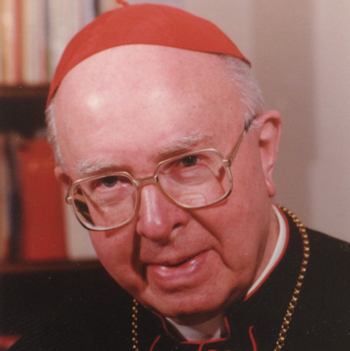
Jan Cardinal Willebrands
Johannes Cardinal Willebrands would have celebrated his 100th birthday this fall, and Rome honored this great ecumenist, bishop, and Council father with a day-long Colloquium hosted by the Pontifical Gregorian University.
Cardinal Willebrands was bishop of Utrecht in his native Netherlands, and served for twenty years as the second president of the Pontifical Council for Promoting Christian Unity, from 1969-1989, succeeding Cardinal Agustin Bea with whom he had worked closely during the Council.
Seven lectures traced the contributions of Cardinal Willebrands to the Church and the churches, each about half an hour, interspersed with Q & A time and the obligatory pausa for caffè and pranzo:
- William Henn, OFM: Cardinal Willebrands and the relations between Rome and the Ecumenical Council of the Church
- Michel Van Parys, OSB: Cardinal Willebrands and ecumenical relations with the Churches of the East
- James Puglisi, SA: Cardinal Willebrands and ecumenical relations with the Churches and Ecclesial Communities of the West
- Msgr. Pier Francesco Fumagalli: Cardinal Willebrands and the Jews
- Archbishop Rowan Williams of Canterbury: An Ecumenical Testimony
- Jared Wicks, SJ: Cardinal Willebrands and the development of Catholic ecumenical theology
- Cardinal Walter Kasper: The heritage of Cardinal Willebrands and the future of ecumenism
Unfortunately, the Holy Father’s general audience for the students of the Roman universities was scheduled during the morning, so several students opted for that instead, but the ecumenical section of the Angelicum was here almost in full!
While the morning helped paint a vivid picture of the life and many contributions of Willebrands to the Catholic Church and its commitment to ecumenism, the afternoon focused as much on the current and future situations, and made several references to Cardinal Kasper’s new book, Harvesting the Fruits: Basic Aspects of Christian Faith in Ecumenical Dialogue.
When some people lament the apparent ‘slowing’ of ecumenical progress in the last twenty years, as compared to the previous thirty, the golden age remembered is the period in which Willebrands was either President or Secretary of the Council for Promoting Christian Unity (named the Secretariat for Christian Unity when first established).
Cardinal Kasper has described him this way:
“He had many qualities: sensitivity and discernment in judging people and situations; great capacity to communicate; the gift of nurturing true friendships. All this is fundamental for ecumenical dialogue since ecumenism means overcoming suspicion, building trust and creating friendships. In Willebrands we find the right balance between a passionate eagerness for unity and that patience which does not try to force things but lets them grow and mature. Not least, Willebrands had an exceptionally fine sense of humour, humour being often the only way to face small-minded and sheepish attitudes.”
Before the Council, when Catholics could not attend ecumenical meetings or participate in ecumenical prayer, Willebrands and others would faithfully observe the letter of the law, then accept invitations to tea with a group of sisters who would also, coincidentally, invite the members of whatever commission or meeting was going on in ecumenical circles. In this way early Catholic contributions were not lost to the ecumenical conversations, and the beginnings of a network of friendships was being developed. It was a way of being “obedient to the Church, and more obedient to the will of Christ”.
Willebrands established a “Catholic Conference for Ecumenical Questions” in 1951, to discuss Catholic issues ‘in response to’ some ecumenical initiatives. This was done while maintaining open contact with Cardinal Ottaviani in the Holy Office (the Congregation for the Doctrine of the Faith). He was instrumental in arranging the meeting between Pope Paul VI and Patriarch Athenagoras in which the mutual excommunications of 1054 were renounced. He helped establish the Joint Working Group of the World Council of Churches and the Pontifical Council for Promoting Christian Unity, and was the primary point of contact between the WCC and the Catholic Church for decades.
During the Council, Willebrands was able to use the previous decade of personal relationships to draw up a list of ecumenical observers to be invited, and was their host throughout the Council. These observers and staff of the secretariat would meet weekly at the Centro Pro Unione on Thursdays, to get a debriefing of the week’s interventions (which were in Latin) in English and other more common languages. Often there would be a presentation by one or more of the peritii of the council. As the bishops themselves heard about these gatherings more and more would attend, at the least to hear in an understandable language what had been discussed in front of them the week previous!
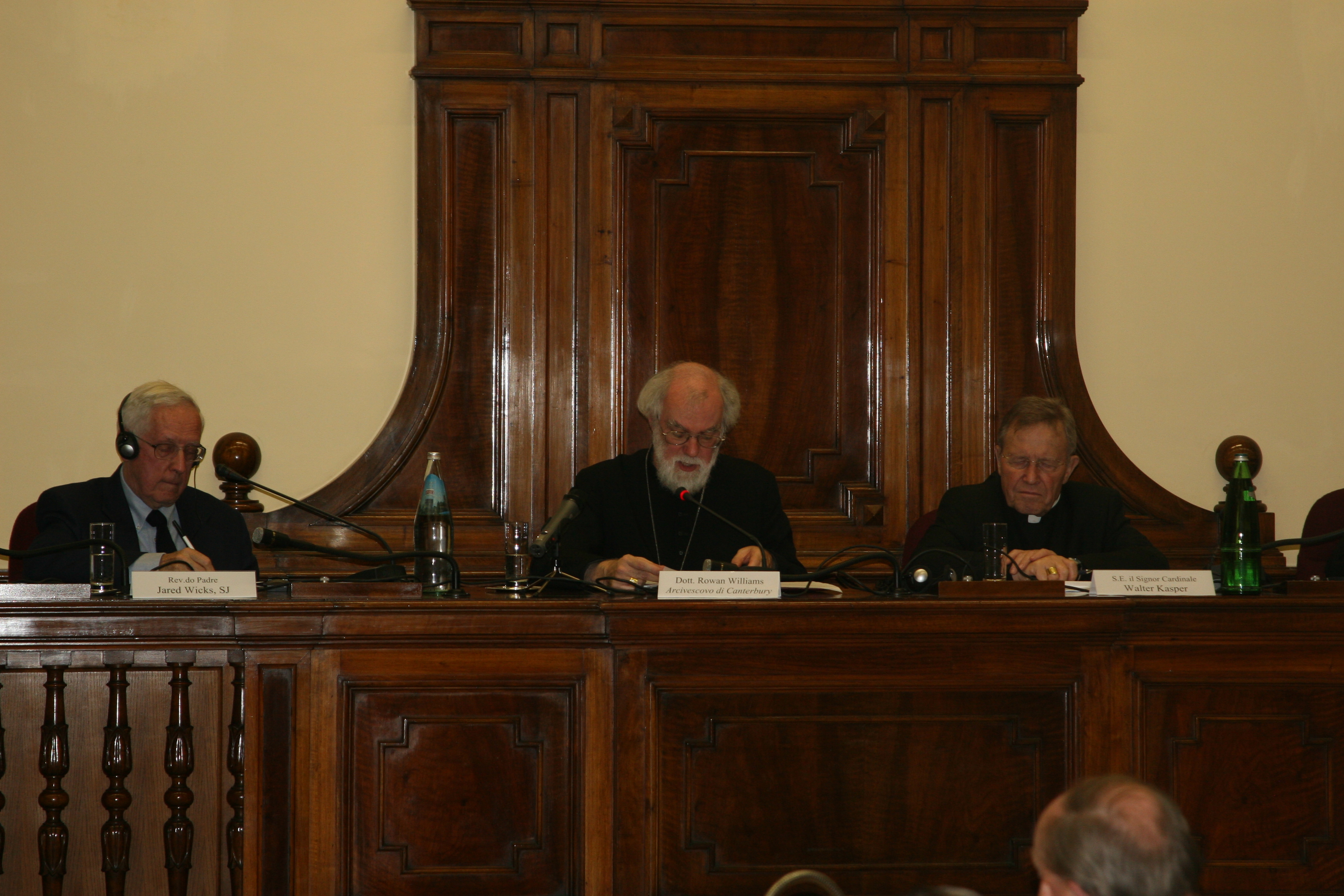
Jared Wicks, SJ; Archbishop Rowan Williams; Cardinal Walter Kasper
Near retirement, Willebrands noted that the best ecumenists have been theologians, but also that “ecumenism is first a way of being Christian, before it is a theological or pastoral competence.” He published, in 1987, an article titled “Subsistit in”, Vatican’s Ecclesiology of Communion, which is one of the most authoritative interpretations of the nature of the church in Lumen Gentium 8, along with the work of Joseph Ratzinger and Walter Kasper.
One of the last reflections he gave in Rome before retiring to the Netherlands was at the invitation of the Lay Centre at Foyer Unitas, and delivered in the Centro Pro Unione, “Why I Am a Man of Hope” – a summation of all his experience and why he maintained hope for the future of the Church and ecumenism.
Archbishop Rowan Williams of Canterbury
In reading some of the headlines the next day, you might have thought that the entire colloquium was just a platform from which the Archbishop of Canterbury could fling the gauntlet at Benedict’s feet on the issue of the ordination of women. This was not the case, and the issue of ordination was raised as an case in the broader question of the relationship between local and universal church, and the theological weight of divisive issues. (His entire address is here.)
Rather, it was a time for him to assert that he too, was a man of hope for the future of the ecumenical imperative, while acknowledging some hard questions that need to be asked, the central question being,
“…whether and how we can properly tell the difference between ‘second order’ and ‘first order’ issues. When so very much agreement has been firmly established in first-order matters about the identity and mission of the Church, is it really justifiable to treat other issues as equally vital for its health and integrity?”
In other words, given the depth of our agreement on the nature and mission of the church, on Baptism and Eucharist, et cetera, do the remaining issues of division – such as the understanding of authority, primacy and the relationship of local to universal church – carry the same weight as the issues that unite us? These are questions pertaining to the hierarchy of truths, and asked by our fellow Christians who desire unity:
“All I have been attempting to say here is that the ecumenical glass is genuinely half-full – and then to ask about the character of the unfinished business between us. For many of us who are not Roman Catholics, the question we want to put, in a grateful and fraternal spirit, is whether this unfinished business is as fundamentally church-dividing as our Roman Catholic friends generally assume and maintain. And if it isn’t, can we all allow ourselves to be challenged to address the outstanding issues with the same methodological assumptions and the same overall spiritual and sacramental vision that has brought us thus far?”
Translating Roman and American degrees
So, I am studying for a License in Sacred Theology (STL). What is that? How does it compare to the MA in Theology that almost/never was? How do the American and Roman degrees correlate?
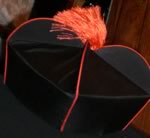
Academic Biretta, worn by a Doctor of Sacred Theology
Rome has answered a frustration I had at CUA, which was shared by several of my classmates: the graduate courses there seemed to be really geared at a more basic, undergraduate level. Some blamed the overwhelming presence of seminarians, for whom classes had to be “dumbed down”. Others attributed it to “the lack of academic freedom” at the only U.S. University officially run by the Catholic Church (as opposed to a religious congregation or non-profit). I believe this to be primarily the result of the difference between the Roman and secular/American degree systems, and a less-than-efficient blending of the two.
Europe has a host of different practices, i find out, and for the last decade they have been in the process of synchronizing the systems. Some graduate secondary (high school) at 17, then have a 3-year bachelors program. Others graduate secondary at 19. Italy currently has what they are calling a 3+2 program for college studies, the three years for a bachelors, and the 2 for a masters – or what we might call a masters. But Italy is different than the Pontifical system.
In the pontifical system, you earn the Baccalaureate first, then a License, and then a Doctorate. If you are studying theology, however, you need at least two years of Philosophy first, then a Bachelors in theology, before doing the License and Doctorate. So, the STB really is an undergraduate degree, and it makes little sense to compare it to an M.Div., though these are respectively the basic ministry degrees required by each system.
So, if one were to go straight through in each of the systems it would look something like this:
| HS + yrs | Pontifical | American |
| +1 | ||
| +2 | Philosophy (no degree) | Associate (AA) |
| +3 | ||
| +4 | Bachelor (BA/BS) | |
| +5 | Baccalaureate (STB) | |
| +6 | Master (MA), or | |
| +7 | License (STL) | Professional (M.Div.) |
| +8 | ||
| +9 | Doctorate (STD) | Pastoral Doctorate (D.Min) |
| +10 | Research Doctorate (Ph.D.) |
Thus, my License is both the completion of the work i began at CUA for the MA in Theology, and the begining of my doctoral work.
Grand(father) Inquisitor at the Lay Centre
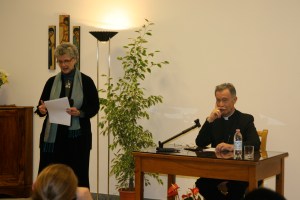
Dr. Donna Orsuto, Most Rev. Luis Ladaria Ferrer, SJ
When meeting with the second-ranking official of the dicastery known for most of its history as the Holy Office of the Inquisition (now the Congregation for the Doctrine of the Faith, CDF), one might not expect a relaxed and cheerful pastor.
One certainly does not expect to hear such pearls as, “We are not here to judge who is ‘really’ Catholic and who is not. We are all striving for holiness, but none of us has reached it. We offer people formation in the Catholic ideal, but everyone struggles with the real application of this in their life” or “Let him who is without sin cast the first stone!”
Yet, this is exactly what we got in the “grandfatherly” Jesuit Spaniard, Archbishop Luis Ladaria Ferrer, Secretary of the CDF at Tuesday night’s inaugural Oasis in the City at the new location of the Lay Centre.
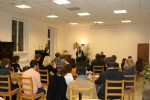
Oasis in the City event at the Lay Centre
Equally reassuring of the man’s Christian heart was his reaction to the fact that the car service that had been arranged to get him to the Lay Centre was 45 minutes late, having left the Archbishop waiting for his ride, without any notice. Any normal person could reasonably expect to be irritated or upset. A typical “VIP” might have just given up and given up on us. More than a couple U.S. hierarchs I have encountered might have thrown a royal fit at such inconvenience. But when the archbishop finally arrived, he got out of the car laughing and waving away Donna’s profuse apologies as if they were not even needed: “These things happen all the time”, he says.

Archbishop Ladaria, Secretary of the Congregation for the Doctrine of the Faith
The bulk of his lecture was on the unsurprising CDF 2008 instruction Dignitas Personae, dealing with a range of bioethical issues including IVF, stem cells, and cloning. It was the questions afterword that brought some of the most interesting comments, including the two quotes above, the first being in response to a question about where to draw the line when someone (such as a politician) does not act or profess a view entirely commensurate with Catholic moral teaching on these complicated issues. Others challenged the Church’s insistence that “human life/personhood begins at conception” from a Thomistic framework which allows for a later development.
My Italian is not good enough to have followed the lecture in its entirety, but the conversation afterword was just as lively. Now if only all of our American hierarchy were as pastoral as this CDF honcho! (Yes, you read that correctly!!)
UPDATE: Didn’t realize the press was here too: http://www.catholic.org/international/international_story.php?id=34844&cb300=vocations
The Roman Classroom, or, Reflections on Methodology and Pedagogy in the Pontifical Roman Universities from an American Catholic Paradigm Typified by L’Universite de Notre Dame du Lac
What is it like studying in Rome? Are the courses challenging? Are the students on par with peers in the U.S.? Is the university academically rigorous? Are the faculty orthodox? How does it compare to [Notre Dame/Seattle University/Catholic University]?
These are the kinds of questions I have had from a number of friends and colleagues, and I thought I would address them together once I had had some time to get a sense of the pedagogy here.
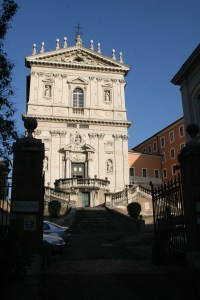
Church of Dominic and Sixtus at the Angelicum University
It is a different system, no question. The first thing to note is the nature of the university. The Universities are really just buildings with classrooms, and very minimal administrative staff. The entirety of the Angelicum – classrooms, offices, chapel, faculty residences, library and bookstore – is about the same size as Hunthausen Hall at SU, Caldwell at CUA, or O’Shaughnessy at ND. This is because the university really only offers the classes, mostly lectures and a small number of seminars. It is assumed that the bulk of your formation actually happens elsewhere, specifically, independent research, formation in community, and the experience of being in Rome.
My specialization does not even use the university library, for example. Instead, we have access to the Centro Pro Unione, run by the Society of the Atonement; that is our library. Sure, it is about a 25 minute walk from the Angelicum, but it’s a walk that passes by the Trevi fountain, the Pantheon, Piazza Navona and some of the most famous gellateria in the city, so one cannot complain. Moreover, there is a lot of time for research, so once I settle on an idea, I will not be bogged down by unwanted topics in order to pursue it.
The presumption of the university is that its students live in a house of formation, one of the “colleges” around Rome – and these are operated entirely separately from the universities. The problem is, of course, that only about 70% of students have access to one of these colleges as they are usually established either by national bishops’ conferences exclusively for priests and seminarians, or by religious communities for their own members. That leaves a significant number of students – deacons, lay ecclesial ministers, non-ecclesial lay students and non-Catholics – without an essential part of their education in Rome. The Lay Centre is the only such college trying to meet this need, and it is a private venture. It is also limited in space, with only room for about 20 residents out of the hundreds needing such a place. (Though get the impression the quality of life and of formation here exceeds what can be found in many of the national colleges for seminarians and priests!)
Further, I think the course load is intentionally light, though it does not appear this way at first. It is normal to be registered for about 8 or 9 courses a semester, one of which is a seminar. Whereas the typical 3-credit course in the States meets for 3 hours in two or three classes a week, here we get 90 minutes, once a week – about half as much time. The reading load is considerably less, too, if you just look at the syllabi. Two of my courses have only one required text of about 200 pages each, for the entire semester. The rest rely entirely on lecture notes. I have a total of 30 pages of writing due this semester, and most final exams are oral rather than written. (I am remembering my first semester sophomore year at ND, over 100 pages on 60 different topics, not counting finals!)
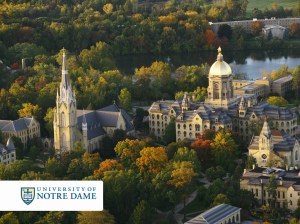
Sacred Heart Basilica and Main Building, University of Notre Dame
The difference between being located in South Bend, IN and in Roma cannot be overstated, though. It is easy to take on a thousand pages of reading a week at ND when there is nothing to do otherwise anyway. Here, if you want to learn about early Christianity or the history of the papacy, go for a walk. San Giovanni in Laterano is ten minutes from here. San Clemente is even closer. The Vatican is a few metro stops away. Just in the last week, we have had dinner with two of the three Catholic representatives on the reconciliation talks with the Lefebvrite schismatics (Archbishop Ladaria and Charles Morerod, OP). The week after the press release about the Anglican personal Ordinariates, we got to talk with two different members of the Pontifical Council for Christian Unity. Then, of course, the discussions had over dinner and caffé more than make up for the pedantic lecture style in some of the classrooms.
It is important to note the international character here too. Granted, ND and CUA were both pretty international, but I think this is the most mixed place I have ever been. I am frequently the only native English speaker in a class, or one of two. It seems to be a good representation of the Church in general: lots of representation from Africa, southeast Asia, India, and Eastern Europe. (Some from Latin and South America, but most of them seem to go to the Gregorianum rather than the Angelicum). This probably makes lecture rather than group discussion in class more feasible, and accounts for what seems like a slow pace.
We had elections? (We have a government??)
Today I was blessed with a lesson in Italian culture that I could not have asked for. I witnessed a genuine Italian election. At least, it was supposed to be an election. And I think I was supposed to vote, too.
As a Catholic and an American, I feel it is more than civil duty to be a well-informed citizen and to participate in elections. It is a moral imperative.
So, when Karina, one of my housemates, mentioned at breakfast this morning that our second class of the day was cancelled due to student elections, I was intrigued. In fact, last night was the first time anyone had mentioned the fact that we even had student representatives, or a government of some kind… though no one was really clear on what they did, who they were, or when the elections were. No mention of this is made in the 300 page, mostly bilingual Ordine degli Studi except in the Italian language calendar which indicates only, “Elezioni Studentesce (10.30-12.15)” on this day.
Today, when we arrived at the Angelicum, there were a few copies of an “avviso” pinned to some classroom doors, apparently informing people (in Italian) that elections were being held today but without explaining much else.
At the appointed hour, our professor seemed mildly surprised to learn that his class was cancelled due to elections, and did not really know where we were supposed to go, or who was coordinating them.
The Angelicum is not really that big. One can peek into every classroom in about 15 minutes, and that is about how long it took me to find no one gathering to elect anyone, anywhere.
A fellow Anglophone student who has been here a few years, Kim, found me and decided he would introduce me to Italian-government-inaction, so together we continued the scavenger hunt for clues. After another search we found canon lawyers getting ready to elect someone from their faculty, some first cycle (Baccalaureate) students who had had elections in their classes, and finally we found a Canadian Anglican priest who had been the License representative last year, but who was equally unaware of where we were supposed to be doing elections this year.
At that point, in true Roman fashion, we decided nothing could be done and headed to the student bar for a cappuccino. Naturally, it was after caffé that someone walking by mentioned that the elections for student president were going to be held in a few minutes in the John Paul II Aula Magna (the giant lecture hall which seast several hundred).
Gathered there were less than 50 people (out of about 1400 registered students), almost all of whom seemed to be Italians (probably the entire Italian student population). The proceedings were held entirely in Italian, and when they started calling for votes, our request for a translation gained only a few brief comments in English.
Apparently, the sitting president was pointing out that with the absence of either the Rector of the university or the General Secretary precluded us from moving forward with the election. Moreover, only one candidate had met the (unpublished) deadline for submitting his name. So the discussion was to either take a non-binding vote to recommend another general assembly, to refer to the rector the current candidate, or to just ask him to appoint somebody.
At that point, people just started to leave. As far as I can tell, we did not really vote on anything, or decide anything. But at least I got to see a genuine Italian electoral process in action!
Dutch Katholieke Kerk and All Saints Anglican
I had two great experiences of church today. This morning, i had the priveledge to join my friend Eveline at the Dutch church in Rome for the Sunday Eucharist, and this evening we joined our friend Stian at an Anglican celebration of Evensong (Vespers) at All Saints.
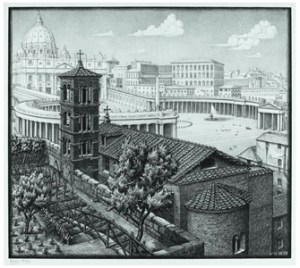
Saint Michele dei Frisoni, National Church of the Netherlands in Rome
The Dutch church, San Michele dei Frisoni, is located just over the international border at Piazza San Pietro, on the Italy side – litteraly right out from the piazza, hang right and up the stairs. Voila! You are I the Kerk van de Friezen. The Friezen, apparently, are one of the regional cultural groups in the Netherlands, like Holland. (If that link does not work, or, more likely, if you cannot read Dutch, try this one.)
It is a beautiful language, especially when sung. I have the sense always of being just on the edge of comprehension. The common Germanic root of English and Dutch makes it as if listening to a conversation in another room, so that you feel like you can almost make out what is being said, but not quite.
After the liturgy, I was asked about differences with my experience of the mass in America and in Rome. Obviously, the language, and some small details (for example, almost no one made the small sign of the cross at the gospel). But, the mass is the mass, and coffee hour, apparently, is coffee hour.
More noticeably, though, was a real quality of the congregational singing; there was only a small choir yet every song was richly done. That and the assembly filled the church, but was on average noticeably older than what I am familiar with. They did announce a pilgrimage from the diocese of Tilburg coming next week, though, so it will be interesting to see if it is young people or older.
Speaking of pilgrimages, one of the members present was called forth for a special blessing and recognition. He had walked from the Netherlands to Rome, a journey that took him a little over three months, and about 2000 km/1400mi. I wish I knew more about his experience to share, but it was all in Dutch. Though Eveline was kind enough to translate the highlights of the homily, we decided the announcements were fine left in the original!
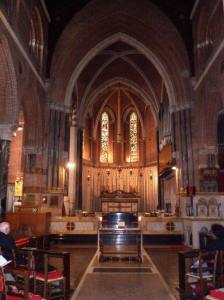
All Saints Anglican Church, the Church of England parish in Rome
In the evening Stian, Eveline and I trekked to All Saints for Festal Evensong (Vespers), one of two Anglican churches in Rome. All Saints is the Church of England parish, while St. Pauls-within-the-Walls is the (American) Episcopalian parish. The church was celebrating the feast of their dedication, so there was a choir from Hexam Abbey and the guest preacher was British Monsignor Mark Langham who is the person responsible for relations with Anglicans in Rome, from the Pontifical Council for Promoting Christian Unity.
Father Mark opened his homily by admitting that, as he sat to begin writing his remarks this week, he found himself wishing that he had been invited to preach last week – before the press conference that has made such an impression on Anglican-Catholic relations. Without ignoring the challenges posed by the announcement, the reflections genuinely focused on the community of All Saints and on the community as one of the many expressions of the unity to which we are all called.
Whether this is an aspect of British culture I am not familiar with, I do not know, but several times he employed some very good humor, and it seemed as though the three of us were the only ones appreciating it. (At the beginning he said something about the news of the week causing ripples in the “normally tranquil waters of ecumenical dialogue.” Tranquil waters indeed!)
It was enough that we were wondering how much was perhaps some latent tension surrounding the presence of a guest preacher form the Holy See in such proximity to the announcement of the Personal Ordinariates. To his great credit, Father Langham neither sidestepped the question, nor did he dwell on it, focusing on the cause for celebration, the dedication feast of All Saints parish in Rome.
The prayers of the faithful were also interesting, “Let ecumenical dialogue be honest… and charitable,” being the most memorable among a list of prayers for unity.
As beautiful as the service was, it was difficult to fully participate. The songs were choral, rather than congregational, and often in unfamiliar settings. Though my internal liturgist recoils at the thought, I suppose there can be times to sit back and appreciate the beauty of liturgy without engaging more than the receptive senses!
Anglican-Catholic Personal Ordinariates
Two days ago, Rome announced a forthcoming Apostolic Constitution establishing Personal Ordinariates for former Anglicans seeking full communion with the Catholic Church.
As the Constitution itself has not been actually published, there’s a great deal more speculation on the blogs and newswires that real information, but a few things were made clear in the news conference.
Unfortunately, my presence on Vatican property and proximity to the halls of power has not really increased my access to information about the decisions made there. We did have dinner tonight with an official from the Pontifical Council for Promoting Christian Unity, however, which probably would not have been possible in Seattle – so there are some advantages!
So, some immediate observations:
The “note” and press conference was delivered by two of the highest ranking Americans in the Holy See, Cardinal William Levada, prefect of the Congregation for the Doctrine of the Faith, and Archbishop Augustin DiNoia, secretary (#2) in the Congregation for Divine Worship and the Discipline of the Sacraments. Why two Americans? Why no Brits? Probably because of the offices they hold, but Romans seem to be skeptical of coincidences. I’m merely curious.
Conspicuous by absence is any representative of the Pontifical Council for Promoting Christian Unity. Indeed, Cardinal Kasper, president of the council, is not even in Rome, but in Cyprus for the 11th meeting of the Joint International Commission for Theological Dialogue between the Catholic Church and the Orthodox Church.
Personal Ordinariates are not exactly like a Personal Prelature (which is what Opus Dei is), but are basically what the Military Ordinariates are – essentially a diocese serving people of a certain characteristic rather than a geographic structure. Instead of members of the armed forces, the membership will be former Anglicans.
Something like this, or the establishment of a new Church sui iuris with its own patriarch or major archbishop, has been discussed as a structural option for the future full communion between the Anglican Communion and the Catholic Church. I think that may still be seen as an eventual option, because the Personal Ordinariates are not fully autonomous churches in that sense, but particular churches like a diocese, still within the context of the Roman church and its national conferences.
Nevertheless, the specter of “uniatism” will no doubt be raised again in the Eastern Orthodox world, and possibly, in the Anglican and Protestant world too. This move could be seen from those corners as proof that Rome really is just interested in co-opting non-Roman liturgical and theological patrimony just for the sake of proselytism. While such an accusation has some historical bases, especially concerning the Latinization of Eastern Catholic Churches, it is clearly not the reality of the current Eastern Catholic Churches, and I do not think it is the reality for these Personal Ordinariates, either. Still, the perception itself could be damaging to the ongoing reception of ecumenical advances with the apostolic chuches in the East.
There is one line that I found particularly interesting, even though it seemed to be made almost off-hand: When explaining that the ordinary of these Ordinariates (read: diocesan bishop) may be either a (celibate) bishop or a (celibate or married) priest, the note states, “Historical and ecumenical reasons preclude the ordination of married men as bishops in both the Catholic and Orthodox Churches.”
Really? that’s new…
Historically, the Latin Church has had married bishops, at least when we also had married presbyters and deacons as a rule (that is, most of the first 1200 years). If we do not have a requirement of celibacy for either deacons or presbyters, as would be the case in these Ordinariates, there is no historical reason for requiring it of bishops (in Western practice).
Ecumenically, as far as I am aware, to restore this discipline would not pose a challenge to the Orthodox, as they see no objection to the Western Church having married bishops even while the Eastern Church does not. The difference in custom is based on the practice of selecting bishops from the diocesan clergy (as in the West) rather than from the monastic clergy (as is most common in the East). So while there is historic precedent for a celibate episcopate in the Eastern Catholic and Orthodox churches, it does not hold for the Western churches, except inasmuch as we currently have a (mostly) celibate presbyterate and have discontinued the ancient practice of selecting bishops from the diaconate.
I would really like to see the ecumenical and historical rationale behind this piece of the note; presumably it is in the forthcoming Apostolic Constitution. Either way, it has got my curiosity piqued; I’ll look into it and follow up!
Life Together
My spiritual reading this Sunday was Dietrich Bonhoeffer’s Life Together: A Discussion of Christian Fellowship. It was mentioned by our Augustinian guest last week, Father Bob Guessetto, as the source of the famous quote that “the person who loves his dream of community more than the Christian community itself becomes a destroyer of the latter, even though his personal intentions may be ever so honest and earnest and sacrificial.”
Bonhoeffer, a Lutheran pastor and theologian, was a martyr of the Nazis at Flossenburg in April 1945, only a couple months before Allied victory in Europe. Prior to his capture in 1943, he was active in the Confessing Church and the German resistance, teaching in an underground seminary (like the one Karol Wojtyla attended in Poland) and ministering to the Germans who fought against Hitler’s regime.
His discussion is only about 120 pages, touching on the themes of the community itself, the day with others, the day alone, ministry in the community, confession and communion. Leave it to a Lutheran to give one of the most eloquent descriptions and defenses of confession I have ever read! (Luther, as you probably know, was a devoted participant in the sacrament of Reconciliation, originally keeping it along with Baptism and Eucharist as truly sacraments).
He highlights the aspects/gifts of ministry in community as The Ministry of Holding One’s Tongue, The Ministry of Meekness, The Ministry of Listening, The Ministry of Helpfulness, The Ministry of Bearing, The Ministry of Proclaiming, and the Ministry of Authority.
The book is definitely worth a read, for anyone living in Christian community (including family life!) or serving in ministry. I thought I’d share a few nuggets worth expropriating:
“First, Christian community is not an ideal, but a divine reality. Second, Christian community is a spiritual and not a psychic reality.”
“Life together under the Word will remain sound and healthy only where it does not form itself intoa movement, and order, a society, but rather where it understands itself as being a part of the one, holy, catholic, Christian Church, where it shares actively and passively in the sufferings and struggles and promise of the whole church”
“It is not the experience of Christian community, but solid and certain faith in community that holds us together. … We are bound together by faith, not by experience. … for Jesus Christ alone is our unity”
“Listening can be a greater service than speaking. He who can no longer listen to his brother will soon be no longer listening to God either; he will be doing nothing but prattle in the presence of God too.”
“The day of the Lord’s Supper is an occasion of joy for the Christian community. Reconciled in their hearts with God and the brethren, the congregation receives the gift of the body and blood of Jesus Christ, and receiving that, received forgiveness, new life and salvation. … The fellowship of the Lord’s Supper is the superlative fulfillment of Christian fellowship. … Here the community has reached its goal. Here joy in Christ and his community is complete. The life of Christians together under the Word has reached its perfection in the sacrament.”
Philo of Alexandria
Today, I completed my first course at the Angelicum, exam and all. Granted, it’s only a credit and a half, but not bad for the first week of classes.
It has been 12 years since David Burrell’s survey of Ancient and Medieval Philosophy, so I’m a bit rusty when it comes to middle-Platonist Jewish philosophers. Thankfully, there’s really only one.
Philo of Alexandria is a fascinating person. In attempting to synthesize his Jewish faith with the Greek philosophy in which he was proficient, he had a remarkable influence on the early Church Fathers – and virtually none on Judaism until the late medieval era. He was a Hellenized Jew in Alexandria, of nearly the last generation of Ancient Judaism, before the destruction of the Temple and the birth of both Christianity and Rabbinical Judaism from the ashes.
Twenty-five years older than Jesus, and dying just a few years after Christ, his work probably even influenced some of the Gospels. John’s prologue owes at least a little to the concept of the Word (the Logos) present in Philo. He even has a type of Trinity – though not completely – of God, Logos, and Powers. With Philo, the transcendent, inscrutable God is knowable only through the Son (the Logos), and the dynamies/powers of mercy and justice. “You can only come to the Father through the Son” sound familiar?
He’s also known for his allegorical interpretation of scripture, especially Genesis and the creation story, wherein man=our mental capacity and spiritual self, and woman=our sensory capacity and physical self, so that when man and woman cleave together to become one flesh, it really does mean one person – combining our intellect and sense-perception, our spiritual and our material aspects, to be the human-kind we know.
Probably one of his biggest contributions is in the uniting of the religious side of Platonism with Biblical faith, bringing the idea of a totally transcendent “unmoved mover” into the same conversation as the very personal and immanent God of the Hebrew Scriptures. Totaliter aliter and Emmanuel, all in one divine bundle.
No wonder it feels like all the great ideas have already been thought!
 The Ecumenism Blog