
Home » Theology and Ecumenism (Page 10)
Category Archives: Theology and Ecumenism
Mar Bawai Soro
One of my intensive courses this semester is “The History of Aramaic Christianity”, taught by Mar Bawai Soro, a bishop of the Chaldean Catholic Church whose name is probably familiar to anyone who has been involved in ecumenism the last few years. He was also our guest for dinner at the Lay Centre this evening. (And though he did not share this, he was the person who, during the Jubilee Year 2000, recieved from Pope John Paul II the cross carried at the Stations of the Cross at the Colosseum. The pope carried it to the first two stations, handed off to Bishop Bawai for the second two, who then handed it off again.)
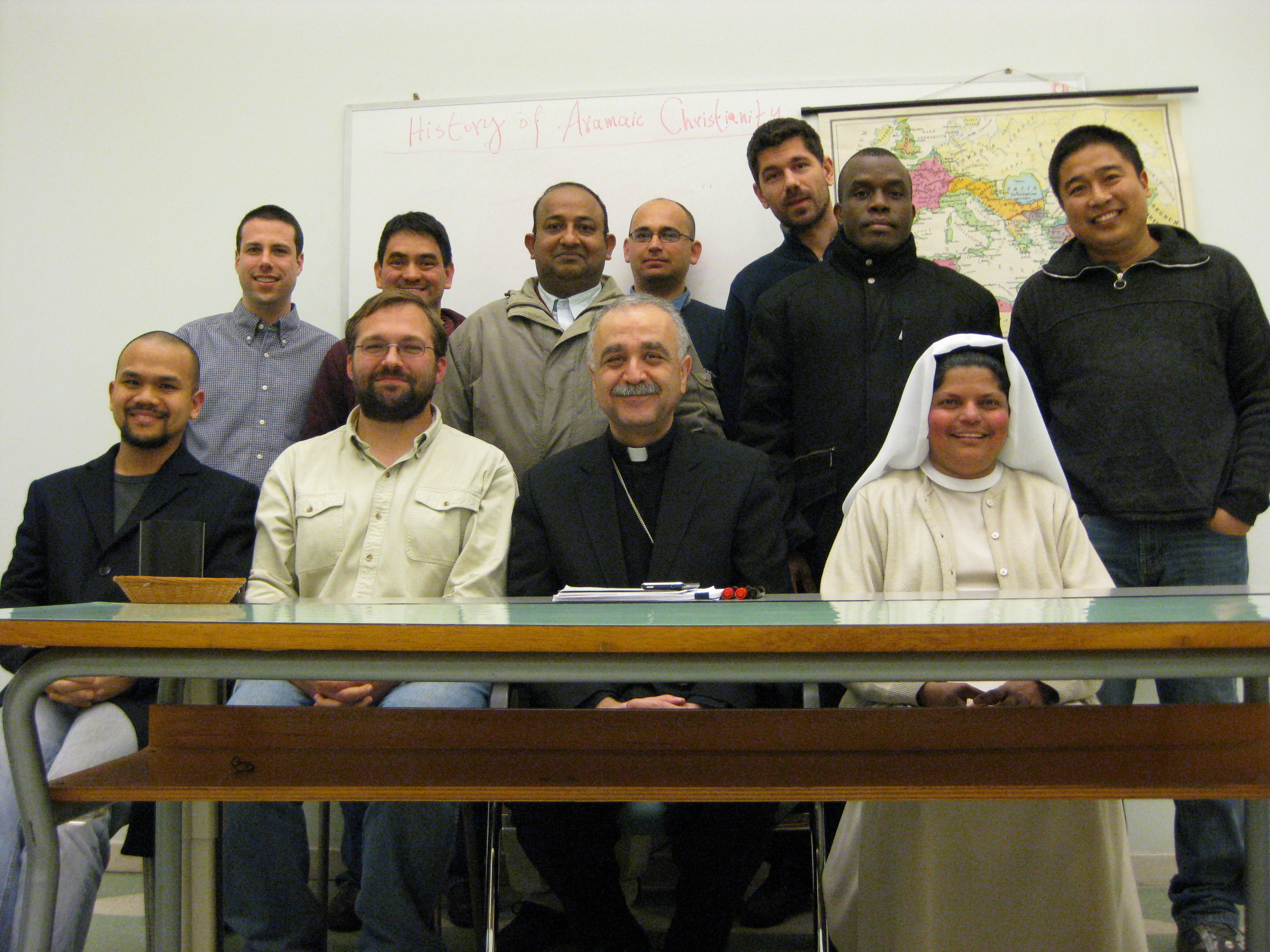
History of Aramaic Christianity, Angelicum, 2010
In most church history classes I have taken or taught, the focus is usually on the history of the Church within the Roman empire, and subsequently the nations were in direct succession from that Empire. Sometimes it gets even more eclipsed if the focus is purely on the Latin Church, the churches directly associated with the ritual and patriarchal patrimony of the church of Rome itself (ie, the Roman Catholic Church). It is sometimes news enough for people to realize there were four other apostolic sees within the Roman empire besides Rome! But we have often forgotten entirely the church in Asia, beyond the borders of the ancient Roman Empire.
The focus of our studies for this course have been on that Church of the East – not the Eastern or Oriental Orthodox Churches, but further east, in Mesopotamia and what was part of the Persian Empire at the time of Constantine. This church never enjoyed the status of being an official religion of the empire, as did the church in the empire of Rome and Constantinople. In fact, persecution only increased after Christianity became associated with the enemy to the west. To this day, being Christian in this area makes you suspect of collaboration with the “West” – whether that is Emperor Constantine or President Bush, and whether the dominant religion is Persian Zoroastrianism or Shi’a Islam.
This was the church of refuge for the Nestorians and the theological School of Antioch, driven across the border in the aftermath of the Council of Ephesus in 431, and a place where the theological battle between Monophysites and Nestorians was waged for centuries. The first stopping point for the missionary activity of the Apostle Thomas, the Mesopotamian church was the mother church of the earliest Christians in India, still known as Mar Thoma (St. Thomas) Christians. Missionaries of this church had reached Mongolia and China by the sixth century, and some scholars have suggested communities as far as Japan.
The current heirs to this tradition include:
- The Assyrian Church of the East, with about 250,000 members, traditionally centered in Iraq
- The Chaldean Catholic Church, with about 750,000 members, centered in Iraq
- The Syro-Malabar Catholic Church, with about 4 million members centered in the state of Kerala, India

Mar Bawai Soro
Much of the Church of the East’s history has been marked by political and ecclesial isolation – first by being the Christians outside the Roman empire, then ecclesially, and throughout by being more or less constantly a persecuted minority in Zoroastrian Persia, or Muslim Arab and Mongol rule. Several times in the last six centuries dioceses and other groups of the faithful would resume full communion with Rome. The first, in 1445 was the archbishop of Cyprus and his diocese, who after a couple generations were unfortunately Latinized and assimilated into the Latin (Roman) Catholic Church. A couple others only lasted for a century or so, eventually leaving communion again. Finally, the Patriarch (one of two rivals, anyway) and his cohort came in to full communion in 1830, giving us the current Chaldean Catholic Church. The rival patriarchal line and those in communion with it remain today as the Assyrian Church of the East, though they were the line which had been in Catholic communion for a century or so during the 16th and 17th centuries.
For 20 years, Bishop Bawai served this church as a bishop and as their top theologian and ecumenical officer (a sort of Ratzinger-Kasper combo, if you will), and participated in the Assyrian-Catholic dialogue from its inception, through the Common Christological Declaration of 1994 and the preparation of the Common Sacramental Declaration that was to follow.
For those who wonder about the products of ecumenism, it only took 8 years of dialogue to resolve the Christological issue that split the church 1500 years ago, and confess together that :
Our Lord Jesus Christ is true God and true man, perfect in his divinity and perfect in his humanity, consubstantial with the Father and consubstantial with us in all things but sin. His divinity and his humanity are united in one person, without confusion or change, without division or separation. In him has been preserved the difference of the natures of divinity and humanity, with all their properties, faculties and operations. But far from constituting “one and another”, the divinity and humanity are united in the person of the same and unique Son of God and Lord Jesus Christ, who is the object of a single adoration.
This is why there is always hope!
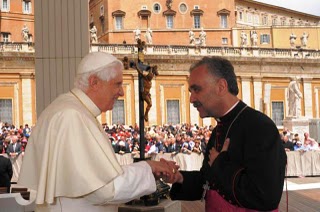 Of course, that hope is always needed. The reality of the impending full communion with the Catholic Church provoked some nervousness. Understandably, I suppose: Comparatively, we are beyond huge (4400 Catholics for every one Assyrian Christian), and the prospect of the Patriarch becoming a mere cardinal, as some bloggers have put it, was uninviting. Their decision was to suspend the dialogue, and to suspend the bishop.
After finding no appeal, Mar Bawai and about 5000 faithful, including 30 deacons and a half dozen priests, came into full communion with the Chaldean Catholic Church in 2008.
Quote of the Day
The advice of Pope Saint Gregory the Great (590-604) to Augustine of Canterbury, as a model of communion for the contemporary (postmodern?) ecclesial scene:
Agustine’s Second Question: Even though the faith is one, are there varying customs in the churches? And is there one form of Mass in the Holy Roman Church and another in Gaulish churches?
Pope Gregory answered: My brother, you know the customs of the Roman Church in which, of course, you were brought up. But it is my wish that if you have found any customs in the Roman or the Gaulish church or any other church which may be more pleasing to Almighty God, you should make a careful selection of them and sedulously teach the Church of the English, which is still new in the faith, what you have been able to gather from other churches. For things are not to be loved for the sake of a place, but places are to be loved for the sake of their good things. Therefore choose from every individual Church whatever things are devout, religious, and right. And when you have collected these as it were into one bundle, see that the minds of the English grow accustomed to it.
From The Venerable Bede, Ecclesiastical History of the English People, as quoted in Frederick M. Bliss, Catholic and Ecumenical: History and Hope – Why the Catholic Church is Ecumenical and What She is Doing About It, p9.
[emphasis mine]
St. Thomas Aquinas
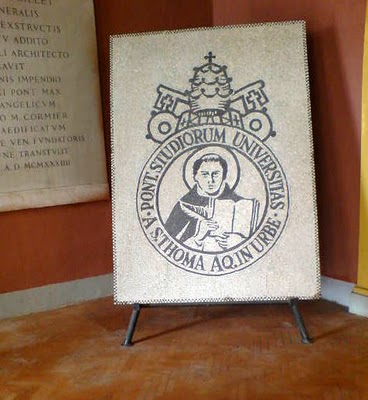
Seal of the Pontifical University of St. Thomas Aquinas in Rome
Today is the feast of San Tommaso d’Aquino, patron of my current university, of academics and theologians everywhere. Unfortunately, as I was trying to beat a cold, I was unable to get to the celebration of our Patronal Feast at the Angelicum this morning, with Archbishop Agustin DiNoia, OP, but a friar friend has put some photos up on the university blog, so check them out!
I have never claimed to be a Thomist per se, for as one of my first university philosophy professors said, “If you are going to be a Thomist, you have to be a damn good one.” I am fascinated by the Angelic Doctor, but I see him as one (important) contributor to the Catholic, Christian theological tradition, rather than devoting all of my studies to him and his works, which is what it would take to be a “damn good” Thomist.
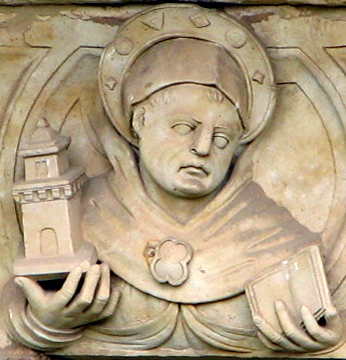 Truth be told, though, even that would not be enough – I am not convinced Thomas would approve of such narrowed focus! He was, after all, the Great Synthesizer, and did not hesitate to use a variety of Christian sources, as well as Jewish, Muslim and pagan ones.
When I was an undergraduate, I had a friend who was studying medieval philosophy, almost exclusively with the late Ralph McInerny – who is a Thomist. He and I would have many long debates some of which revolved around the maxim of the Papal Theologian: “Never mix philosophy and theology, because philosophy always wins!” My friend felt that, as a medieval philosophy with a particular focus, he was therefore an adept theologian. As a theologian with a much broader view of Tradition, I often had to remind him that this was not the case! No matter how profound and how great the tradition, no one theologian encompasses the whole of Catholic theology, much less the attendant pastoral, liturgical, historical and other issues that interact with theology in the lived experience of the Church.
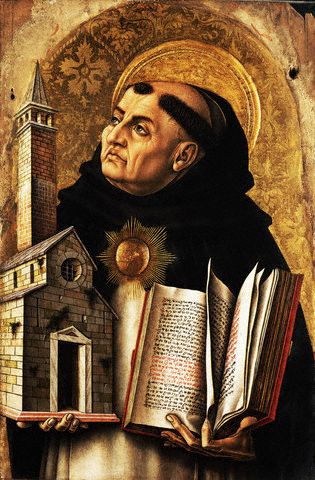 I have always had a great affinity for Thomas, first as a theologian, and in more recent years as a patron for “new” vocations, such as lay ecclesial ministry.
As a theologian and student, his peers dubbed him the “Dumb Ox” – dumb as in mute – to which Albertus Magnus supposedly retorted, “That ‘dumb ox’ will one day fill the world with his bellowing!” Thomas was no quick wit. He would not have made it as official Catholic commentator on Fox News or CNN. He was big, slow to move and slow to speak, and as with any good introvert, would fix you with a stare in response to unexpected questions that probably left less astute contemporaries wondering if he really was all that bright. He is an inspiration to any systemitizing introvert who has been caught in the spotlight by “think out loud” extravert peers!
As a candidate for patron of “new” vocations, consider his story:
According to his father, the Count of Aquino, Thomas was going to be groomed as the Abbot of Montecassino, an old, established, and wealthy Benedictine Abbey not too far from Rome. This was the normal sort of ecclesial vocation of his era – monastic life. It was how you served the church successfully. It was expected. It was “just the way things were done”. You want to serve the church? Fine, join the monastery.
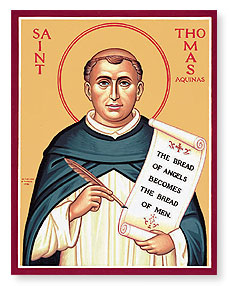 But he would have none of it. At 19 he ran off to join some newfangled wannabes who were kind of like monks, but not really monks – and I doubt the real monastics would have been too happy if you called these mendicant friars “monks”! They had only been around for 40 years. They did not spend their time at the monastery but wandered around the countryside preaching, teaching, and doing God-only-knows what else that was properly the ministry of monks and diocesan clergy.
This was not right!! How dare they? So, his family did the only respectable thing to do – they arranged for him to be rescued from this cult, threw him in a locked room and commenced a serious deprogramming effort.
A year later, he remained committed to his vocation. He was called to serve the church, clearly, just not in the way that his parents and grandparents generations took for granted. It looked a little different. The charism was a little different. New terminology had to be used to explain it. There were bishops who did not support it. People worried about the confusion of identity of traditional monastic life – of monks and nuns – with this itinerant innovation of mendicant life – these friars. Even a few years later, after being ordained in this “new order”, he spent time writing defense of the vocation he was living. Some critics argued that real ministers would be spending their time in prayer and sacramental service, not defending and defining a “new” vocation!
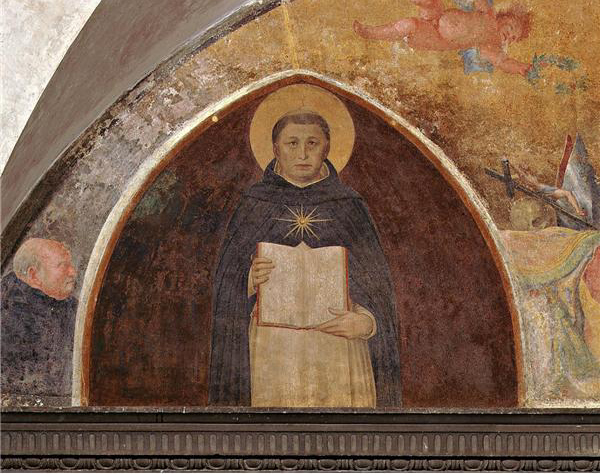 The parallels to the present age, to lay ecclesial ministry and even to the restoration of a real diaconate, are overwhelming! (Though, I admit I am not aware of any pastoral associate being kidnapped by family to consider the diocesan presbyterate or religious life instead.) We are 50 years into the present form of lay ecclesial ministry in the U.S., and it never ceases to amaze me how much suspicion, ignorance, misunderstanding and outright vitriol is out there. I completely understand this minister’s plea, “Don’t dis lay ecclesial ministry!”
St. Thomas Aquinas, patron of “new” vocations, pray for us!
Quote of the Day
Orientale Lumen 20, Pope John Paul II, 1995
[T]he Church of Rome has always felt was an integral part of the mandate entrusted by Jesus Christ to the Apostle Peter: to confirm his brothers in faith and unity (cf. Lk 22:32). Attempts in the past had their limits, deriving from the mentality of the times and the very understanding of the truths about the Church. But here I would like to reassert that this commitment is rooted in the conviction that Peter (cf. Mt 19:17 – 19) intends to place himself at the service of a Church united in charity. “Peter’s task is to search constantly for ways that will help preserve unity. Therefore he must not create obstacles but must open up paths. Nor is this in any way at odds with the duty entrusted to him by Christ: ‘strengthen your brothers in the faith’ (cf. Lk 22:32). It is significant that Christ said these words precisely at the moment when Peter was about to deny him. It was as if the Master himself wanted to tell Peter: ‘Remember that you are weak, that you, too, need endless conversion. You are able to strengthen others only insofar as you are aware of your own weakness. I entrust to you as your responsibility the truth, the great truth of God, meant for man’s salvation, but this truth cannot be preached or put into practice except by loving.’
(Emphasis mine)
Papal Ecumenical Vespers on the Conversion of St. Paul
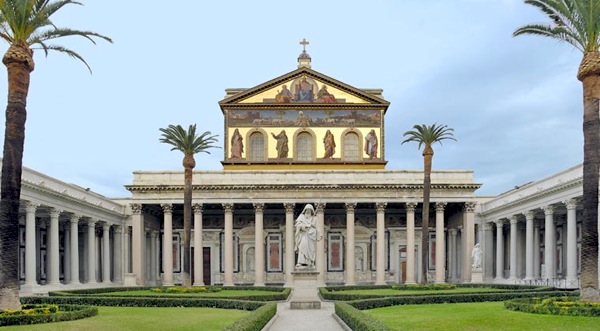
Papal Basilica of St. Paul Outside the Walls
The closing of the very busy Week of Prayer for Christian Unity every year in Rome is the Papal Ecumenical Vespers (Evening Prayer) at the Patriarchal Basilica of St. Paul Outside the Walls. Built over the tomb of St. Paul, re-confirmed by tests revealed at the end of the Year of Paul last summer, and administered by Abbot Edmund Power and the Benedictine Abbey there, the basilica is known for its ecumenical significance.
In fact, it was at the end of this very service on 25 January 1959, closing the Week of Prayer for Christian Unity, that Pope John XIII announced his intention to convene the Second Vatican Council, making very clear that ecumenism was to be one of the major themes of the council, along with the aggiornamento of the Church and a reconciled engagement with the modern world.
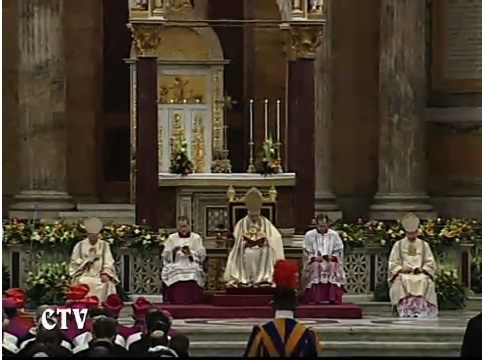
Pope Benedict XVI presiding at Ecumenical Vespers for the Week of Prayer for Christian Unity
This year, probably Cardinal Walter Kasper’s last as President of the Pontifical Council for Promoting Christian Unity, Pope Benedict XVI made special note of the 100th anniversary of the 1910 World Missionary Conference in Edinburgh, which marks the beginning of the modern ecumenical movement.
The basilica is outside the walls of the historic city centre, but only a few stops away by metro. Between exams and bad weather, and limited tickets, only a few of us from the Lay Centre were able to attend: Andrea, an Italian canon law student; Anna, our New Zealand liturgy student, and myself in one section; with our three Orthodox housemates Theodosius, Dimitrios, and Radmilo, escorted to the front as scholars of the Pontifical Council for Christian Unity.
The readings and prayers of intercession were all offered by ecumenical guests and leadership, including the Archbishop of Canterbury’s permanent representative to the Holy See, Very Rev. David Richardson of the Anglican Centre in Rome.
The Holy Father’s homily is included in full below.
****
Dear Brothers and Sisters,
Gathered together in this fraternal liturgical assembly, on the Feast of the Conversion of St Paul, today we conclude the annual Week of Prayer for Christian Unity. I greet all of you warmly, in particular Cardinal Walter Kasper, President of the Pontifical Council for Promoting Christian Unity, and the Archpriest of this Basilica, Archbishop Francesco Monterisi, along with the Abbot and the Community of monks whose guests we are. I also extend my cordial thoughts to the Cardinals here present, to the Bishops and to all who represent the Churches and ecclesial Communities of this City who are here today.
Only a few months have passed since the conclusion of the Year dedicated to St Paul, which gave us an opportunity to deepen our awareness of his extraordinary work as a preacher of the Gospel and also of our call to be missionaries of the Gospel, as the theme of the Week of Prayer for Christian Unity reminds us “You are witnesses of these things” (Lk 24: 48).
Paul, although he retained an intense memory of his own past as a persecutor of Christians, did not hesitate to call himself an Apostle. For him, the basis of that title lay in his encounter with the Risen One on the road to Damascus, which also became the beginning of his tireless missionary activity. In this he was to spend every ounce of his energy, proclaiming to all the peoples the Christ whom he had met personally.
Thus Paul, from being a persecutor of the Church, was in his turn to become a victim of persecution for the sake of the Gospel to which he witnessed: “Five times I have received at the hands of the Jews the forty lashes less one. Three times I have been beaten with rods; once I was stoned…. On frequent journeys, in danger from rivers, danger from robbers, danger from my own people, danger from Gentiles, danger in the city, danger in the wilderness, danger at sea, danger from false brethren; in toil and hardship, through many a sleepless night, in hunger and thirst, often without food, in cold and exposure. And, apart from other things, there is the daily pressure upon me of my anxiety for all the churches” (2 Cor 11: 24-25, 26-28). Paul’s witness reached its culmination in his martyrdom when, not so far from here, he was to give proof of his faith in Christ who conquers death.
The dynamic of Paul’s experience is clearly expressed in the pages of the Gospel that we have just heard. The disciples of Emmaus, after having recognized the Risen Lord, return to Jerusalem and find the Eleven gathered together with the others. The Risen Christ appears to them, comforts them, overcomes their fear and doubts, and eats with them. Thus he opens their hearts to the intelligence of the Scriptures, recalling what had to happen, which would constitute the nucleus of the Christian proclamation. Jesus affirms: “Thus it is written, that the Christ should suffer and on the third day rise from the dead, and that repentance and forgiveness of sins should be preached in his name to all nations, beginning from Jerusalem” (Lk 24: 46-47). These are the events to which the disciples of the first hour were to bear witness, followed by believers in Christ of all times and places. It is important, however, to emphasize that this witness, then just as now, is born from the encounter with the Risen One, is fed by a constant relationship with him and animated by a profound love for him. One can only be his witness if one has had the experience of feeling Christ alive and present “See my hands and my feet, that it is I myself” (Lk 24: 39) of sitting at table with him, of listening as he sets one’s heart aflame! For this, Jesus promises his disciples and each of us a powerful aid from on high, a new presence, that of the Holy Spirit, gift of the Risen Christ, who guides us to the whole truth: “And behold, I send the promise of my Father upon you” (Lk 24: 49). The Eleven were to spend their whole lives proclaiming the Good News of the death and Resurrection of the Lord. Almost all of them were to seal their witness with the blood of martyrdom, a fertile seed that has produced an abundant harvest.
The choice of the theme of this year’s Week of Prayer for Christian Unity the invitation, that is, to a common witness of the Risen Christ in accordance with the mandate he entrusted to his disciples is linked to the memory of the 100th anniversary of the Edinburgh Missionary Conference, in Scotland, widely considered a crucial event in the birth of the modern ecumenical movement.
In the summer of 1910, in the Scottish capital, over 1,000 missionaries from diverse branches of Protestantism and Anglicanism, who were joined by one Orthodox guest, met to reflect together on the necessity of achieving unity in order to be credible in preaching the Gospel of Jesus Christ. In fact, it is precisely this desire to proclaim Christ to others and to carry his message of reconciliation throughout the world that makes one realize the contradiction posed by division among Christians.
Indeed, how can non-believers accept the Gospel proclamation if Christians even if they all call on the same Christ are divided among themselves? Moreover, as we know, the same Teacher, at the end of the Last Supper, had prayed to the Father for his disciples: “That they may all be one… so that the world may believe” (Jn 17: 21). The communion and unity of Christ’s disciples is therefore a particularly important condition to enhance the credibility and efficacy of their witness.
Now a century after the Edinburgh event, the intuition of those courageous precursors is still very timely. In a world marked by religious indifference, and even by a growing aversion to the Christian faith, it is necessary to discover a new, intense method of evangelization, not only among the peoples who have never known the Gospel but also among those where Christianity has spread and is part of their history. Unfortunately, the issues that separate us from each other are many, and we hope that they can be resolved through prayer and dialogue. There is, however, a core of the Christian message that we can all proclaim together: the fatherhood of God, the victory of Christ over sin and death with his Cross and Resurrection, and faith in the transforming action of the Spirit.
While we journey toward full communion, we are called to offer a common witness in the face of the ever increasingly complex challenges of our time, such as secularization and indifference, relativism and hedonism, the delicate ethical issues concerning the beginning and end of life, the limits of science and technology, the dialogue with other religious traditions. There are also other areas in which we must from now on give a common witness: the safeguard of Creation, the promotion of the common good and of peace, the defense of the centrality of the human person, the commitment to overcome the shortcomings of our time, such as hunger, poverty, illiteracy, and the unequal distribution of goods.
The commitment to unity among Christians is not the work of a few only, nor is it an incidental undertaking for the life of the Church. Each one of us is called to make his or her contribution towards the completion of those steps that lead to full communion among the disciples of Christ, without ever forgetting that this unity is above all a gift from God to be constantly invoked. In fact, the force that supports both unity and the mission flows from the fruitful encounter with the Risen One, just as was the case for St Paul on the road to Damascus, and for the Eleven and the other disciples gathered at Jerusalem.
May the Virgin Mary, Mother of the Church, grant that her Son’s desire may be fulfilled as soon as possible: “That they may all be one… so that the world may believe” (Jn 17: 21).
© Copyright 2010 — Libreria Editrice Vaticana
Witness through Hospitality: WPCU Day #8
From the official material prepared by the World Council of Churches and the Pontifical Council for Promoting Christian Unity
Scripture
Genesis 18:1-8, Let me bring a little bread, that you may refresh yourselves.
Psalm 146, He who gives justice to the oppressed and gives food to the hungry.
Romans 14:17-19, Pursue what makes for peace and mutual edification.
Luke 24:41-48, Then he opened their minds to understand the scriptures.
Meditation
Today, electronic communication has made us neighbors in one small and overloaded planet. As in the time of Luke, many peoples and communities have had to leave their homes, wandering and journeying to strange lands. People of the world’s great faiths have arrived bringing new beliefs and cultures to our communities.
In the Week of Prayer for Christian Unity we recognize in our shared journey towards unity the hospitality and companionship of Christians of all churches. Christ also calls us to both offer and to receive the hospitality of the stranger who has become our neighbor. Surely, if we cannot see Christ in the other, then we cannot see Christ at all.
The story in Genesis describes how Abraham receives God in opening his house and offering hospitality to strangers. The God of all creation also stands with the prisoner, the blind, the stranger. Our psalm is an offering of praise for God’s everlasting faithfulness and all that God has done for us.
The text from Romans reminds us that the kingdom of God comes about through justice and peace and joy in the Holy Spirit.
The resurrected Christ brings his disciples together, eats with them and they recognize him again. He reminds them of what the scriptures said about him and explains what they did not understand before. Thus, he frees them from their doubts and fears and sends them out to become witnesses of these things. In creating this space for encounter with him he enables them to receive his peace, that implies justice for the oppressed, care for the hungry and the mutual up-building as the gifts of the new world of the resurrection. Christians throughout history have found the risen Lord as they have served others and been served by others in faith, so we too can encounter Christ when we share our lives and our gifts.
Prayer
God of love, You have shown us your hospitality in Christ. We acknowledge that through sharing our gifts with all, we meet you. Give us the grace that we may become one on our journey together and recognize you in one another. In welcoming the stranger in your name may we become witnesses to your hospitality and your justice. Amen.
Reflection Questions
To what extent is the country in which you live hospitable to the stranger?
How in your own neighborhood can the stranger find hospitality and a space to live?
How might you show gratitude for those who have shown you hospitality by being available?
How does the cross show us that God’s hospitality is a hospitality lived out in total self-giving?
Witness through Hope and Trust: WPCU Day #7
From the official material prepared by the Pontifical Council for Promoting Christian Unity and the World Council of Churches:
Scripture
Job 19:23-27, God whom I shall see on my side.
Psalm 63, My soul thirsts for You.
Acts 3:1-10, What I have, I give you.
Luke 24:36-40, The disciples were startled and terrified.
Meditation
During their journey in life and faith, all Christians experience moments of doubt. The challenge faced by Christians is to continue to believe that even when they do not see or feel God, God remains with them. The virtues of faith, hope and trust allow them to give witness that their faith goes beyond their own possibilities.
The character Job gives us an example of someone who faced difficult trials and tribulations and even argued with God. In faith and hope however, he believed that God would remain on his side. This reliance and conviction is also shown by the actions of Peter and John in the account with the lame man as told in Acts. Their belief in the Name of Jesus allows them to witness powerfully to all who were present. Today’s psalm is a prayer reflecting our deep desire for God’s steadfast love.
Our meeting during this Week of Prayer for Christian Unity allows our communities to grow in shared faith, hope and love. We bear witness to God’s steadfast love to all people, and God’s faithfulness to the one church we are called to be. The more we witness together, the stronger our message will be.
Prayer
God of hope, share Your vision of the one church with us, and overcome our doubts. Increase our faith in your presence, that all who profess belief in you may worship together in spirit and in truth. We especially pray for all who are in doubt right now, or whose lives are spent in the shadow of danger and fear. Be with them and give them your consoling presence. Amen.
Reflection Questions
How do you deal with your own fears and doubts?
How might you be a cause of fear and anxiety for others by your behaviour?
When have you faced up to your own fears and doubts and so given witness to your faith in Christ by overcoming these difficulties?
How may Christian communities encourage one another in faith and hope?
Witness through Faithfulness to the Scriptures: WPCU Day #6
From the official material prepared by the Pontifical Council for Promoting Christian Unity and the World Council of Churches:
Scripture
Isaiah 55:10-11, The word that goes forth from my mouth does not return to me empty.
Psalm 119:17-40, Open my eyes that I may see the wonders of your Law.
2 Timothy 3:14-17, All scripture is inspired by God.
Luke 24:28-35, Jesus opens the Scriptures to His disciples.
Meditation
Christians encounter God’s Word in a privileged way through reading the Sacred
Scriptures and celebrating the sacraments. In faithfully listening to the proclamation of Holy Scripture, and by prayerfully reading the various books of the Bible, they open their hearts and minds to receive the very Word of God. Jesus promised His disciples that He would send the Holy Spirit to make them understand the Word of God, and to guide them in all truth.
Historically, Christians have been divided in reading and understanding the Word of God. Fortunately, in recent times, in their search for unity, Sacred Scripture has brought Christians closer to one another. Shared Bible study has become a major means of growing together among them. The Christian journey that we celebrate during this Week of Prayer for Christian Unity is one that is firmly rooted in our shared listening to God’s Word, trying together to understand and to live it.The prophet Isaiah reminds us that God’s Word powerfully proclaimed is indeed effective and operative. It does not return to God empty but succeeds in the purpose for which He sent it.
This message is repeated in the words addressed to Timothy, as he is directed to believe in the efficacy of the Scriptures by which the faithful are equipped for every good work. Our psalm gives praise for God’s words and statutes and implores God to give understanding, that we may keep the Holy Law with our whole heart.
During this Week of Prayer for Christian Unity we pray that all Christians may enter more deeply into the mystery of God’s wonderful revelation as it comes to us in Holy Scripture. We ask the Holy Spirit to help us better comprehend the Word of God and to direct us on our common journey of faith until we will all be gathered again around the one table of the Lord.
Prayer
God, we praise and thank you for your saving Word as it reaches out to us through the Sacred Scriptures. We thank you too for the brothers and sisters with whom we share your Word and discover together the abundance of Your love. We pray for the light of the Holy Spirit, so that Your Word may lead and direct us in our quest for greater unity. Amen.
Reflection Questions
What are the passages of Scripture that mean most to you?
Who or what in your life makes your heart burn with a passion for the gospel and a desire to give witness to Christ?
Which passages from the Scriptures have helped you to better understand the witness of other Christians?
How may our churches use the Scripture more effectively in their daily life and prayer?
Witness through suffering: WPCU Day #5
From the official material prepared by the Pontifical Council for Promoting Christian Unity and the World Council of Churches:
Scripture
Isaiah 50:5-9, The one who vindicates me is near.
Psalm 124, Our help is in the name of the Lord.
Romans 8:35-39, God’s love shown forth in Jesus Christ.
Luke 24:25-27, He interpreted to them the things about himself.
Meditation
The reality of suffering is something that the Prophet Isaiah speaks about forcefully in today’s text, in which he reminds us that God is never resigned to seeing humanity suffer. In response the Psalm proclaims the trust that believers must maintain in their Savior.
The letter to the Romans proclaims the certainty that love is always strongest and that suffering and sorrow will never prevail. For before offering the resurrection to the world, Christ entered into a terrible death and into the dark depths of the tomb so as to be completely with us at our very lowest ebb.
In the Lord’s footsteps, Christians who seek full unity show their solidarity to those amongst them who are confronted in their lives with tragic situations of suffering, by confessing that love is stronger than death. And that it was from the extreme humiliation of the tomb that resurrection came like a new sun for humanity; a clamoring annunciation of life, forgiveness and immortality.
Prayer
God our Father, look with compassion on our situations of poverty, suffering, sin and death, we ask you for forgiveness, healing, comfort and support in our ordeals. We give you thanks for all who manage to see light in their affliction. May your divine Spirit teach us the greatness of your compassion and help us stand alongside our sisters and brothers in difficulty. Filled with its blessings, may we in unity proclaim and share with the world the victory of your Son who lives for ever. Amen.
Reflection Questions
How can you show empathy to those who suffer and are in difficulties?
What wisdom and deeper understanding have you gained through suffering you have known in your own life?
How do you live out solidarity with the suffering and oppression that so many people living in poverty in our world experience, and what is your own experience of it?
How would you bear witness to the mercy of God and to the hope you find in the light of the cross of Christ?
 The Ecumenism Blog