
Home » La vita Roma (Page 8)
Category Archives: La vita Roma
Bishop-elect Charles Morereod, OP
The first priest I knew to be made a bishop was my look-alike Daniel Jenky, CSC from Notre Dame (now Bishop Daniel of Peoria). My first professor to become a bishop was Bishop Donald Bolen of Saskatoon. But this is the first time a Facebook friend has been named a bishop.
Fr. Charles Morerod was instructor of a course I took in my first year on the “Philosophical Elements in the Catholic-Protestant Dialogue”, and has been Rector Magnificus of the Angelicum University for a little over two years. He has doctorates in both philosophy and theology, and serves as the secretary general of the International Theological Commission, as well as teaching at three universities.
News of his appointment leaked via Swiss news radio on 2 November, though the official VIS announcement was made the following day on 3 November.
Though it has since been retracted, it is interesting to note that on the same day, the Society of St. Pius X seemed to indicate its rejection of the doctrinal preamble offered by the Congregation for the Doctrine of the Faith as a requisite for the restoration of full communion of the schismatic sect with the Catholic Church.
Interesting to note, I say, because Bishop-elect Charles was one of three theologians appointed by the CDF two years ago to engage the SSPX in dialogue in an effort to close the only formal schism that resulted from Vatican II, along with Archbishop Luis Ladaria, Secretary of the CDF and Msgr. Fernando Ocariz, vicar general of Opus Dei. Moreover, his new diocese is the home of the SPPX seminary and the place of its short-lived status as a legitimate Catholic organization (SSPX was a diocesan ‘pius union’, what would now be called an ‘association of the faithful’, from 1970-1975).
But back to the good bishop-to-be. I keep running into him these days at the Angelicum, and he leaves this weekend for his home diocese, where he will be ordained and installed on 11 December. The following seems to portray his humility rather well:

Cari [fratelli e sorelle],
…Io pensavo d’essere nella nostra cara Università fino alla pensione (o alla morte). La lascio con grande tristezza, e timore per quel che trovo davanti a me. Ma non ho pensato di poter dire di no, perché non avevo motivi gravi d’andare contro una richiesta diretta del Santo Padre. “Quando il Papa ha visto i nomi, ha detto che doveva essere Lei. Perché la conosce.”
… Cosa rispondere, lo prendo come ho sempre preso la mia vocazione: umanamente ho paura, ma mi fido della volontà divina che non delude. E vedo bene qualche urgenza pastorale in Svizzera: da questo punto di vista sono felice di poter aiutare un po’.
Sono davvero triste di dover rinunciare al nostro lavoro comune… Cercherò di trovare qualche modo d’aiutare l’Angelicum a distanza. Preghiamo gli uni per gli altri.
fr. Charles
My translation, with some help from Google:
Dear brothers and sisters
… I thought to be in our beloved University until retirement (or death). I leave with great sadness, and fear of what I find before me. But I did not think I could say ‘no’, because I had no serious reasons to go against a direct request of the Holy Father. “When the Pope saw the names, he said it had to be you. Because he knows.”
… With that answer, I take it as I have always taken my vocation: As a human, I am afraid, but I trust God will not disappoint. And I can see some pastoral urgency in Switzerland: From this point of view I am happy to help a little. ‘
I am really sad to have to give up our joint work … I will try to find some way of helping the Angelicum from a distance. Let us pray for one another.
Fr. Charles has been a guest at the Lay Centre each year, and one of the main supporters of the the new John Paul II Center for Interreligious Dialogue at the Angelicum in the past year, and of the Russell Berrie Fellowship. He will certainly be missed!
The Angelicum community bids Bishop-elect Charles a fond farewell on Friday, 11 November, with a reception at 12:15.
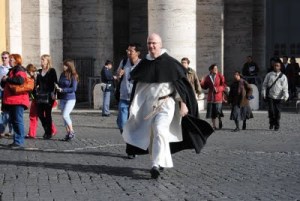
The official bio:
The Rev.do P. Charles Morerod, OP, was born in Riaz (diocese of Lausanne, Genève et Fribourg) October 28, 1961. He studied philosophy and theology at the Faculty of Theology, University of Fribourg, concluding with a degree in Theology. In 1983 he entered the novitiate of the Order of Friars Preachers Swiss province and has made his vows in 1987.
He was ordained April 30, 1988 in Geneva.
From 1987 to 1989 he served in pastoral ministry, first as a deacon and then as viassociate pastor of the parish of St. Paul in Geneva. From 1989 to 1992 he was Assistant at the Faculty of Theology, University of Fribourg from 1991 to 1994 and chaplain of the University of Fribourg. In 1993 he received his doctorate in theology and a licentiate in philosophy in 1996.
From 1994 to 1999 he was adjunct professor of Fundamental Theology at the University of Fribourg and since 1996 professor at the Pontifical University of St.Thomas Aquinas. Since 1997 he is editor of the edition in French of Nova et Vetera Magazine.
In 1999 he became full-time professor at the Pontifical University of St. Thomas Aquinas. From 1999 to 2002 he also taught at the Faculty of Theology of Lugano. He was Vice-Dean of the Faculty of Theology from 2003 to 2009 and Dean of the Faculty of Philosophy at the Pontifical University of St. Thomas Aquinas. In 2004 he obtained his doctorate in philosophy at the Catholic Institute of Toulouse. Since 2008 he is also Director of the Roman Catholic Studies Program at the University of St. Thomas (St. Paul, Minn.).
In April 2009 he was appointed Secretary General of the International Theological Commission and Consultant of the Congregation for the Doctrine of the Faith and in September 2009, also Rector of the Pontifical University of St. Thomas Aquinas.
Return to Rome
Time Flies. Two years on the Russell Berrie Fellowship in Interreligious Studies have come and gone. For those who know me well, it is unsurprising that my two major goals here – learn Italian and write my thesis – are still works in progress, despite a number of other accomplishments.
I am returning for a third year to the Lay Centre at Foyer Unitas, Rome’s pre-eminent collegio for the tired, the poor, the huddled masses yearning to breathe free lay students. Which is, basically, anyone who cannot play on a pontifical university football (soccer) team for the annual Clericus Cup – but I digress.
Only two of us, aside from director Donna Orsuto and assistant Robert White, are back for a third consecutive year: the other being my newly-wed friend and next-door neighbor from Morelia, Mexico, David. Others who were here last year, or at least part of the year, include Muhamed (Bosnia), Marija (Croatia), and Julia (Hong Kong).
In total, we have citizens of 16 countries this year:
Belarus, Bosnia, Canada, Croatia, Czech Republic, Egypt, Georgia, Germany, Hong Kong, Indonesia, Israel, Mexico, the Netherlands, Romania, Serbia, and the U.S.A.
Religiously we are:
- 1 Secular Jew
- 3 Muslims (2 Sunni, 1 Shi’a)
- 4 Orthodox Christians (Belarusian, Georgian, Romanian, and Serbian Churches)
- 13 Catholic Christians (12 Latin, 1 Syro-Malabar)
This year I also start a new role continuing the relationship with the Russell Berrie Foundation, through the Institute for International Education, in the form of a graduate assistantship at the new John Paul II Center for Interreligious Dialogue, housed at the Angelicum.
The first month back in Italy consisted of jet lag, a severe cold, orientation week for new Lay Centre residents, and then orientation week for new Russell Berrie Fellows. The tesina awaits. There are a few highlights I will be, ah, highlighting shortly.
Shi’a Muslim – Monastic Catholic Dialogue
Barely recovered from jet lag, the first event of my third year in Rome was a presentation on Muslim-Monastic dialogue at the Primatial Abbey of Sant’Anselmo on the Aventine hill.
For years, the monastic interfaith dialogue focused on the Buddhists, particularly in its Japanese Zen form, and one can remember easily the relationship of Thomas Merton and Tich Nacht Hanh. In the last decade though, there has been a general realization that we need not look so far from home, so to speak, and the Benedictines decided to initiate a dialogue with Islam… in this case, with Shi’a scholars from Qom, the study center for the Shi’a in Iran.
The public lecture was part of the schedule of the official dialogue, and our host was the Abbot Primate of the Benedictine Confederation, the Rt. Rev. Notker Wolf… also known for being a rock star. Literally. It was organized and introduced by Fr. William Skudlarek, the Secretary General of Monastic Interreligious Dialogue.
The lecturer was Abbot Timothy Wright, OSB, Delegate for Monastic-Muslim Relations, and the respondent was Dr. Mohammad Ali Shomali, Director of the new International Institute for Islamic Studies in Qom – a center which focuses on brining in western students to study Shi’a theology and jurisprudence in Iran.
Abbot Timothy highlighted the common core values of monastic spirituality and Shi’a Islam, though, to be honest, there was little that seemed to me to be particularly monastic about the spirituality he mentioned:
- Affirmation of God revealed in Word
- Day and night punctuated by prayer
- Exercise of opened word – lectio divina, e.g.
Though, the shared lectio divina he described sounded not unlike the scriptural reasoning programme in Cambridge and elsewhere. Yet, with the rule of Benedict as a guide, it certainly does not hurt to have monastic engagement.
Dr. Shomali responded with an affirmation that the key to good dialogue is the building up of good relationships first, in which dialogue can happen. Relationships rather than events, should drive our encounter with the other… though obviously events can provide for the beginnings and deepening of relationships with people we might not otherwise encounter.
“Dialogue is not a formality or fashion but a part of my religious obligation. Neither is it dependent on reciprocation or appreciation. In this it is like prayer and fasting. If no one appreciates my prayer and fasting, I do not stop!”
His advice to those interested in dialogue was simply to be a good listener, and shared the story of Moses and Pharaoh from the Quran, in which Moses objects to God sending him to waste his time trying to dialogue with someone not interested in dialogue: Pharaoh.
“Go and speak softly”, instructs the Almighty, “ for even in him there is a chance of his heart being softened.”
Consider this then. The most difficult dialogue is with the person who does not think he/she needs to dialogue with anyone – the person with a hard heart. But if there is even a chance of the heart of pharaoh being turned by soft-spoken dialogue, then there remains hope for everyone. In Dr. Shomali’s words, dialogue requires you to master being a good listener and gentle, soft and wise speaker.
Summer hiatus
Friends,
I am spending a lot of time in front of the computer, writing, this summer, and have just let the blogging go by the wayside for a few weeks. I will catch up with a number of things about the time i get back to Rome, if all goes well. In the mean time, enjoy fair august and the rest of summer!
A Tridentine wedding and “How not to” homiletics

Two friends of mine were recently married, according to the “extraordinary form” of the Roman Rite, better known as the Tridentine Rite. It was the first nuptial mass of its kind in Rome since Pope Benedict XVI published Summorum Pontificum and established a personal parish in the Eternal City for the followers of the pre-Vatican II liturgies.
This is one of the unanticipated gifts of being in Rome, being able to time travel and see what the various sacraments and rites were like for the four centuries before Vatican II went digging around the scriptural and patristic sources to bring back the older traditions while simultaneously brining everything “up to date”.
It was a beautiful day. The weather was perfect, the liturgical chant was beautifully sung, the bride was radiant, the bridesmaids beautiful, and the reception was a masterpiece of hospitality and conviviality. The liturgy was observed at church of Santissima Trinita dei Peligrini, and the reception was hosted in the gardens of the Passionist Retreat of John and Paul, home of the Lay Centre at Foyer Unitas. About 70 guests were present, some from as far as Vancouver, BC or Johannesburg, South Africa.
The people I met were wonderful, and though I did not get as much time to get to know the wedding party – between their hard work preparing for the wedding, and their deserved socializing afterwards – I had some great conversations and met some fascinating people.
It was, overall, one of the most beautiful wedding weekends to which I have been invited.
It is therefore all the more to the credit of the bride and groom, and their assembled guests, that they did not let the one black mark on the day ruin the rest: It was the worst wedding homily I have ever heard. I can honestly say it nearly had me in tears.
(I debated whether to write about this or not – hopefully my choice to do so is not interpreted as disrespect to my friends who were married, but serves as a lesson for those of us in preaching ministries!)
The priest began by comparing marriage to investing in the stock market – risks and rewards. I do not find financial analogies to personal relationships generally helpful, but he might have been able to move on to something meaningful. Instead, the meandering sermon – decidedly not a genuine homily – stumbled from one faux pas to another.
The proper epistle for the nuptial mass in the Tridentine form is the passage from Ephesians that admonishes “wives be submissive to your husbands, husband love your wife.” This was the starting point for an anecdote that seemed to be titled “how not to preach on this passage”. He made his point, but probably not the way he intended:
“Let me tell you about the wrong way to read this passage. I was at a parish in the diocese of Rochester [New York] when this was the reading of the day. Now for those of you not from the U.S., or not in the ecclesiastical scene, Rochester is one of the five worst dioceses in the country. …”
Anybody want to bet he was thinking of Seattle among the other four? Rochester’s bishop usually gets critiqued for, among other ‘liberal tendencies’, his support of lay people in ministry. Hmm… strike one against a crowd of lay students at pontifical universities preparing for ministry.
“… the priest could have talked about the proper attitude of husbands and wives, but instead started talking about the ‘context’ and ‘historical criticism’ of the text! As if what scripture said then and what it says now are ‘historically conditioned’ and must be understood differently! Of course, this priest was a Jesuit, and you cannot expect anything orthodox from them!”
So… actual scripture study and the Jesuits in one blow. Poor Biblicum students.
“… Now, I am not saying that wives should be slaves to their husbands, like the Muslims believe….”
And our resident imam, friend and housemate of the bride, sitting right in front of me. Ouch.
“… there is something the Muslims get right. Their women wear a veil. Here too, we see a veil. It marks what is set aside, what is restricted. The tabernacle is veiled, to show that only the priest can enter it, just like the bride is veiled …”
Thankfully, he did not explicitly complete that thought, but the parallel was not lost. A little uncomfortable, but not quite offensive like the previous statements.
Then the meandering somehow landed on Thomas Jefferson and the Declaration of Independence, on which it stayed for a while. I honestly cannot remember what the point of that was, I was trying too hard to keep a straight face by focusing on the image of the Holy Trinity above the altar. The whole thing went on for about 20 minutes, though i felt like an eternity.
As someone intimately connected with the wedding mentioned afterwards, “there was nothing about love, nothing really about marriage… what the hell was he thinking!?”
At least the pastor, during the “admonishment on the responsibilities of the married state” at the exchange of vows before the mass, spoke of “procreation and the upbringing of offspring”. Maybe not how I would have put it, but more apropos than purely partisan preaching!
Imposed (Ir)reverence?
Can you force someone to be more reverent? Is it possible to compel reverence from someone by demanding a particular prayer, position, or facial expression?
We can cultivate reverence. We can create environments that aid people in prayer. We can counsel others, offer spiritual companionship and direction, and inspire liturgical involvement and devotional piety in a way that encourages reverence. But I do not think it is possible to make people more reverent by making them do something which they are not ready to do. In fact, trying to do so would more often have the effect opposite of the intent, and instead impose irreverence.
Yet it is precisely in the language of “increasing reverence” during the Eucharist that there has been discussion in recent years of imposing particular postures – including how one receives communion. It has always been my position – as someone who has spent a decade instructing Eucharistic ministers and prepared adults and children to receive their first communion – that you should receive communion reverently.
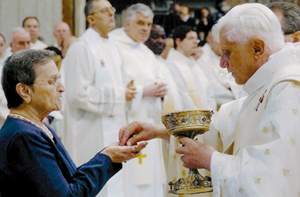
"...make with the left a throne for the right hand, which recieves the King" -Cyril of Jerusalem, c. 313-386 AD
The Latin church itself prescribes two forms for this, in the hands and on the tongue. Dioceses and bishops’ conferences may add or stress elements of the General Instruction on the Roman Missal, such that in some places we are asked to bow before receiving, as we proclaim ‘Amen’; others suggest a sign of the cross immediately after; in the Archdiocese of Seattle we remain standing throughout the communion procession as a sign of reverence, honoring the presence of Christ and the assembly’s act of communion with Him (and the Church), and honoring the liturgical integrity of the procession itself.
The Holy Father has himself weighed in on this, especially since he has been seen to prefer to administer communion in a particular fashion, and some commentators interpreted this to mean he was indicating a change. This is not entirely the case, however:
I am not opposed in principle to Communion in the hand; I have both administered and received Communion in this way myself.
The idea behind my current practice of having people kneel to receive Communion on the tongue was to send a signal and to underscore the Real Presence with an exclamation point. One important reason is that there is a great danger of superficiality precisely in the kinds of Mass events we hold at Saint Peter’s, both in the Basilica and in the Square. I have heard of people who, after receiving Communion, stick the Host in their wallet to take home as a kind of souvenir.
In recent months, it seems this last, unique concern has trumped general liturgical principle, and since the beginning of Advent 2010, at St. Peter’s Basilica during papal masses (and only at papal liturgies, as far as I have seen) communicants are refused communion unless they receive on the tongue.
The first time this happened to me, it was quite jarring. There has been no announcement that I have found, it was just a change. In fact, it seemed that many of the Eucharistic ministers (who are always priests during the papal liturgies, though not necessarily so at other liturgies there) had not been informed. I thought, actually, that it was just the priest at my station “imposing reverence” as he saw fit. He even looked a bit smug. Looking up and down the aisle, some priests were still serving the host according to the communicant’s desire, and others were refusing ‘in the hand’.
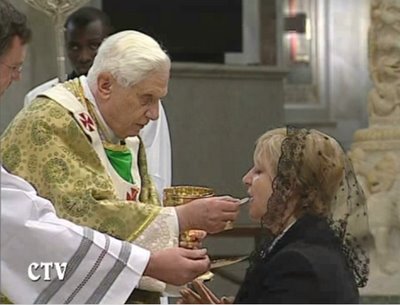 Clearly, this did not instill reverence, but rather robbed the moment of its usual spiritual peace. As I watched people’s reactions, from tourists to young Italians, to one elderly nun in full habit, more than three-quarters went to receive on the hand and when they were refused, responded in surprise, confusion, or even disgust (the septuagenarian sister looked ready to ‘have words’ with the young priest, but then decided against it).
The second time I went to a papal mass with this new practice, the priest at my communion station was a friend and classmate. I was prepared, and this time noticed every minister serving in the hand only, and this time it was the ushers who were gesticulating to everyone to make it clear that communion was only available orally. My friend looked apologetic, and the priest next to him was confused, clearly not having been informed of this new rule, either. Again, though some people would have received this way in any case and others had been recently enough to know what to expect, others looked disconcerted, distracted, or dissatisfied. None appeared more reverent.
Then again, reverence is an interior orientation, not an exterior expression, so maybe they were.
Beatification debriefing in brief

New image of the newly Blessed
This morning I have already begun to hear stories of people’s experience here in Rome for the beatification, from one being interviewed by CNN in the middle of Piazza San Pietro, to others who gave up trying to get within a kilometer of the Vatican, and still others who deliberately skipped town to avoid the chaos and the crowd.
The Beatification Mass began at 10:00am Sunday, with an hour-long rosary and divine mercy chaplet planed ahead of time.
Vatican security had cleared the Piazza at 7:00pm Saturday night, though people had already staked places and laid out sleeping pads on the cobblestones around the square. They were moved back beyond a large perimeter. We saw nearly every law enforcement agency available in the city – Policia Municipale, Guarda di Finanza, Carabinieri, Corpo Forestale, Polizia di Stato, et al.
One friend was at the perimeter by 1:00am Sunday, and she made it no closer to the altar than the obelisk in the centre of the piazza. Others arrived at 4:00am and were never able to get into the square. The gates officially opened at 5:30am, allowing people into Piazza San Pietro and Via della Conciliazione. By 6:15am, people were packed up to Castel Sant’Angelo. We followed a group of bishops into the crowd, only to be turned back on the close side of the castle – even the bishops could not get through.
Even in lateral directions the area around the Vatican was packed – I have not yet seen an aerial photo that was able to capture the whole scene of people-packed streets, I do not know if any of the helicopters were high enough to get that wide a view.
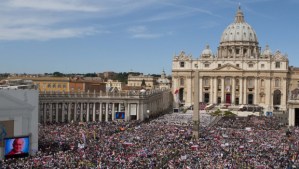
The 5.7 acres of Piazza San Pietro hold only a fraction of the people who came to Rome for the beatification
Some people decided to bail, and go somewhere they could be less crowded and watch it on a jumbotron – the city had a dozen such locations set up, including the Cathedral of San Giovanni in Laterano and the Circo Massimo. Others continued to push in, but never made it close. We found shade and refreshment under the umbrellas of a café’s outdoor seating area, with an oblique view of a jumbotron at Piazza Risorgimento, with no audio but a pilgrims radio tuned to a station translating the whole thing into Polish.
We spent almost two hours in a line to get a cappuccino and cornetto, and then go to the bathroom, once it was decided there was no where better to go unless we wanted to bail and watch at one of the other centers around the city. We got out just in time for mass to start, and stood (thankfully in the shade with tables to put our things on), for the entire 3 hour liturgy and angelus address. Even the English reading was translated into polish on the radio, so I could only relay the parts of the mass as I saw from the partial view of the screen and from the singing in Latin.
I am glad I was here for an historic event, grateful to be in a place with shade and with a friend, but sorry that, given the exhaustion of staying up all night after the vigil that we did not get closer than we did. But, I never thought I would get as close as we did, either. For his canonization, which I expect this time next year, I think the view from San Giovanni in Laterano sounds pretty good – especially for a pope who repeatedly said his role as bishop of Rome, along with Servant of the Servants of God, was the most important responsibility of the pope.
Christ is Risen, Alleluia!
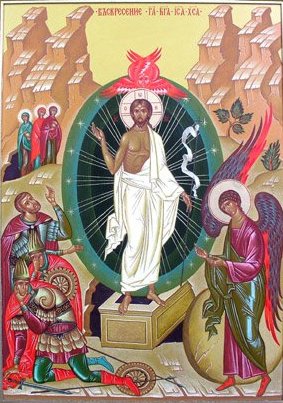
Is there anyone who is devout and a lover of God?
Let them enjoy this beautiful and radiant festival.Is there anyone who is a grateful servant?
Let them rejoice and enter into the joy of their Lord!Is there anyone who is weary with fasting?
Let them now receive their wages!If anyone has labored from the first hour,
let them today be justly rewarded!If anyone has come at the third hour,
let them with thanksgiving join the feast!If anyone has arrived at the sixth hour,
let them have no doubt; for they shall suffer no loss.If anyone has delayed until the ninth hour,
let them come without hesitation.If anyone has arrived even at the eleventh hour,
let them not fear on account of their delay!For the Master is gracious and receives the last even as the first;
He gives rest to him that comes at the eleventh hour,
just as to him who has labored from the first.He has mercy upon the last and cares for the first;
to the one He gives, and to the other He is gracious.
He both honors the work and praises the intention.Enter all of you, therefore, into the joy of our Lord!
Whether first or last, receive your reward.
O rich and poor, one with another, dance for joy!
O you ascetics (sober) and you negligent (slothful), celebrate the day!
You that have kept the fast and you that have not, rejoice today!
The table is rich-laden: feast royally, all of you!
The calf is fatted: let no one go away hungry!
Let all partake of the cup of faith.
Let all receive the riches of His goodness!Let no one lament their poverty,
for the universal kingdom has been revealed.
Let no one mourn that they have fallen again and again,
for forgiveness has risen from the grave.
Let no one fear death, for the Savior’s death has set us free.He that was taken by death has annihilated it!
He descended into Hades and took Hades captive!
He embittered it when it tasted His flesh!
Anticipating this, Isaiah exclaimed:
“The nether world is all astir, embittered as it prepares for your coming!”Hell was embittered, for it was abolished!
It was embittered, for it was mocked!
It was embittered, for it was purged!
It was embittered, for it was despoiled!
It was embittered, for it was bound in chains!Hell took a man, and came upon God!
It took earth, and encountered Ηeaven!
It took what it saw, but crumbled before what it could not see!O Death, where is thy sting?
O Hades, where is thy victory?Christ is Risen, and you are overthrown!
Christ is Risen, and the demons are fallen!
Christ is Risen, and the angels rejoice!
Christ is Risen, and life reigns free!
Christ is Risen, and the tomb is emptied of its dead!For Christ, being raised from the dead, has become the first-fruits of those who have fallen asleep. To Him be glory and power forever and ever. Amen!
[Paschal Homily of St. John Chrysostom of Constantinople, Trans. Deacon Mark Baker, Andre Levergne, et al. Edited by A.J. Boyd]
Holy Thursday in Rome
The Paschal Triduum in Rome this year sees even more than its usual number of pilgrims and visitors. In part this is because of the lateness of the season – in two centuries, it will be this late or later only thrice – and in part because of early arrivals for the beatification of John Paul II next Sunday, May 1.
Given a shortage of tickets to papal events, a group of friends – from the Lay Centre, students in Rome and visitors from the States – opted for the neighboring parish basilica of Santa Maria in Domnica, alias the Navicella, for the Mass of the Lord’s Supper after an early dinner.
Our local parish, animated by the Communione e Liberazione movement, the church is beautifully mosaiced, based on an ancient site, and normal Sunday liturgy includes a full choir of young voices, so our expectations were a little high. We did want something shorter than the papal liturgy down the street at the Cathedral, but none of us were quite prepared for what felt more like a daily mass with a couple extra bits added on – the entire liturgy, including a period of adoration at the altar of repose, was finished in 55 minutes.
There was no choir, no psalmist – even the Gloria was merely recited. The washing of the feet (of a dozen teen and preteen boys) barely took five minutes. The only minister of the mass was the presiding priest – even for the procession to the altar of repose the thurifer and crucifer were pulled form the assembly and dressed in ‘civvies’, rather than an alb (or cassock and surplice).
On one hand, there is something nice about not having to wait for three hours to get into a three hour liturgy. On the other hand, the liturgy looses something when, as one visitor said, it seems as if the presider has more important things to do afterwards!
Still, the altar of repose was tastefully prepared, with a simple and elegant wooden tabernacle. The abbreviated liturgy left us four hours to visit and pray at as many churches as desired before midnight; the goal was the traditional seven, culminating at the Pantheon, which was reputed to have one of the most beautiful altars prepared in the city.
(Some friends just reported on their evening at Trinità dei Monti at the top of the Spanish Steps, as one of the most beautiful liturgies ever experienced – something to keep in mind next year!)
Pictures pending – but here’s a schedule of our mini-pilgrimage:
+ Santa Maria in Cosmedin – closed
+ San Giorgio in Valabro – closed
+ San Nicola in Carcere – open
+ Santa Maria in Campitelli – open
+ Santa Maria in Ara Coeli – open
+ San Marco – closed
+ Cappella della Madonnella – open
+ Chiesa del Gesù – closed
+ Santa Maria Sopra Minerva – open
+ Sant’Ignazio – closed
+ Santa Maria ad Martyres (Pantheon) – closed
+ San Luigi dei Francese – open
+ Sant’Agnese in Agone – closed
+ Sant’Andrea della Valle – open
The intended grand finale of the Pantheon was closed, as was the Jesuit headquarters of the Gesù!
The French national church of San Luigi probably was the most evocative – you enter a completely dark church, only a small light in a distant chapel visible. As you stumble your way to its source, you see a single light illuminating a simple altar reserving the Blessed Sacrament under both species, tucked into the Contarelli Chapel, famous as each of sides is adorned with masterpieces of Caravaggio: the Calling of St. Matthew, the Inspiration of St. Matthew, and the Martyrdom of St. Matthew. With an entire church in black, and this small corner in light, it was as if Caravaggio himself had planned the entire experience.
San Nicola’s altar of repose was surrounded by about fifty candles, and attended by a solitary monk. Santa Maria in Compitelli was a church I had never visited before, and beheld there an 11th century icon and one of the rare baroque altars that actually looks good. Santa Maria in Ara Coeli had candles along the stairs leading up the Capitoline hill to the entrance and an altar of repose filled with flowers. Madonella is almost Reformed in its whitewashed and modern simplicity, and Sopra Minerva offered no surprises. At Sant’Andrea some very modern, interpretive paintings of the Stations of the Cross almost distracted before one could get to the altar of repose, but offered a welcome end to our evening’s sojourn in any case.
 The Ecumenism Blog