
Home » La vita Roma (Page 20)
Category Archives: La vita Roma
San Giovanni in Laterano
The Cathedral of Rome, the first Christian church in the city, the ecumenical mother church*, dedicated on 9 November 324 by Sylvester I, Bishop of Rome. We did not make it over for the dedication celebration because of heavy rain and homework… next year!
*referring to church as the building, rather than the people of God. In the later case, the mother church would be the local church of Jerusalem and the universal church catholic!
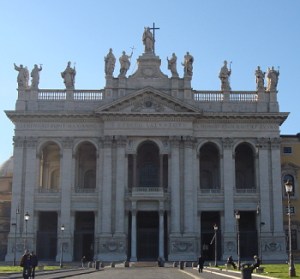
St. Giovanni in Laterano, Cathedral and Major Basilica of Rome
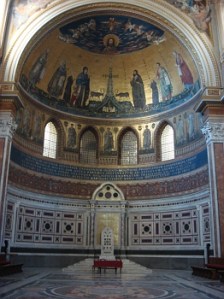
Cathedra Romana, the Chair of the Bishop of Rome
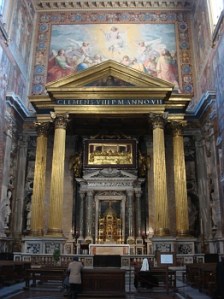
Adoration chapel, with golden pillars from the Temple of Jupiter (Zeus)
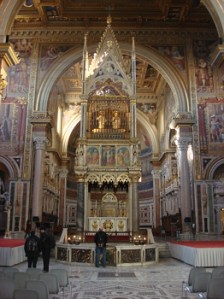
High altar and baldacchino, with relics of Peter and Paul in the golden statue/reliquaries
Student Pilgrimage to the Sanctuary of St. Gabriele, C.P.
Before coming to Italy, I had never met a Passionist and really did not know much about the order. I think the only one I had even heard of was New Testament scholar Donald Senior, president of Catholic Theological Union in Chicago.
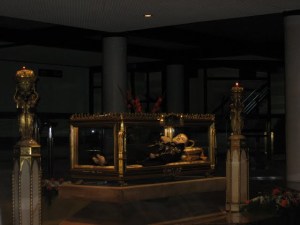
St. Gabriele of Our Lady of Sorrows, 1838-1862
In the nearly 300 year history of the order, however, they have clearly made an impact on Italy and other parts of the world. The monastery where the Lay Centre finds its home is certainly one of the largest in Rome. And one of the Passionist saints, the young St. Gabriele of Our Lady of Sorrows, is one of the most popular in Italy. It was to the shrine and pilgrimage center of St. Gabriele that the students of Rome were invited on Saturday.
This is the seventh annual pilgrimage of the students of Rome at the beginning of the academic year, and the first to go to the Santuario San Gabriele at Isola del Gran Sasso d’Italia, in the Abruzzo region – about two hours bus ride from Rome, and not far from L’Acquila, epicenter of the 5.8 tremor in April.
Of the 308 deaths in the earthquake, 50 were university students, who were remembered at the liturgy and throughout the day at the retreat.

Basilica Antica S. Gabriele
This serious note was mixed with the World Youth Day style music and liturgy that seemed to mark the tradition for the weekend – it reminded me, in fact, of our Archdiocesan Youth Convention for high school students, which was celebrated the same weekend in Seattle. Except that there were a couple hundred priests (mostly graduate students) – so many, in fact, that the communion procession for the presbyterate took longer than for the rest of the assembly, which I do not think I have seen any other time.
The Roman Classroom, or, Reflections on Methodology and Pedagogy in the Pontifical Roman Universities from an American Catholic Paradigm Typified by L’Universite de Notre Dame du Lac
What is it like studying in Rome? Are the courses challenging? Are the students on par with peers in the U.S.? Is the university academically rigorous? Are the faculty orthodox? How does it compare to [Notre Dame/Seattle University/Catholic University]?
These are the kinds of questions I have had from a number of friends and colleagues, and I thought I would address them together once I had had some time to get a sense of the pedagogy here.
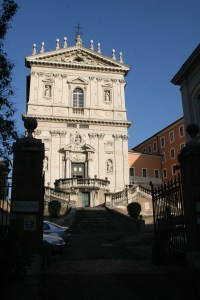
Church of Dominic and Sixtus at the Angelicum University
It is a different system, no question. The first thing to note is the nature of the university. The Universities are really just buildings with classrooms, and very minimal administrative staff. The entirety of the Angelicum – classrooms, offices, chapel, faculty residences, library and bookstore – is about the same size as Hunthausen Hall at SU, Caldwell at CUA, or O’Shaughnessy at ND. This is because the university really only offers the classes, mostly lectures and a small number of seminars. It is assumed that the bulk of your formation actually happens elsewhere, specifically, independent research, formation in community, and the experience of being in Rome.
My specialization does not even use the university library, for example. Instead, we have access to the Centro Pro Unione, run by the Society of the Atonement; that is our library. Sure, it is about a 25 minute walk from the Angelicum, but it’s a walk that passes by the Trevi fountain, the Pantheon, Piazza Navona and some of the most famous gellateria in the city, so one cannot complain. Moreover, there is a lot of time for research, so once I settle on an idea, I will not be bogged down by unwanted topics in order to pursue it.
The presumption of the university is that its students live in a house of formation, one of the “colleges” around Rome – and these are operated entirely separately from the universities. The problem is, of course, that only about 70% of students have access to one of these colleges as they are usually established either by national bishops’ conferences exclusively for priests and seminarians, or by religious communities for their own members. That leaves a significant number of students – deacons, lay ecclesial ministers, non-ecclesial lay students and non-Catholics – without an essential part of their education in Rome. The Lay Centre is the only such college trying to meet this need, and it is a private venture. It is also limited in space, with only room for about 20 residents out of the hundreds needing such a place. (Though get the impression the quality of life and of formation here exceeds what can be found in many of the national colleges for seminarians and priests!)
Further, I think the course load is intentionally light, though it does not appear this way at first. It is normal to be registered for about 8 or 9 courses a semester, one of which is a seminar. Whereas the typical 3-credit course in the States meets for 3 hours in two or three classes a week, here we get 90 minutes, once a week – about half as much time. The reading load is considerably less, too, if you just look at the syllabi. Two of my courses have only one required text of about 200 pages each, for the entire semester. The rest rely entirely on lecture notes. I have a total of 30 pages of writing due this semester, and most final exams are oral rather than written. (I am remembering my first semester sophomore year at ND, over 100 pages on 60 different topics, not counting finals!)
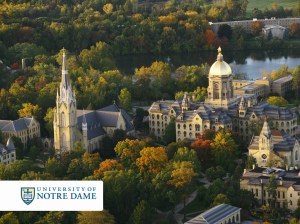
Sacred Heart Basilica and Main Building, University of Notre Dame
The difference between being located in South Bend, IN and in Roma cannot be overstated, though. It is easy to take on a thousand pages of reading a week at ND when there is nothing to do otherwise anyway. Here, if you want to learn about early Christianity or the history of the papacy, go for a walk. San Giovanni in Laterano is ten minutes from here. San Clemente is even closer. The Vatican is a few metro stops away. Just in the last week, we have had dinner with two of the three Catholic representatives on the reconciliation talks with the Lefebvrite schismatics (Archbishop Ladaria and Charles Morerod, OP). The week after the press release about the Anglican personal Ordinariates, we got to talk with two different members of the Pontifical Council for Christian Unity. Then, of course, the discussions had over dinner and caffé more than make up for the pedantic lecture style in some of the classrooms.
It is important to note the international character here too. Granted, ND and CUA were both pretty international, but I think this is the most mixed place I have ever been. I am frequently the only native English speaker in a class, or one of two. It seems to be a good representation of the Church in general: lots of representation from Africa, southeast Asia, India, and Eastern Europe. (Some from Latin and South America, but most of them seem to go to the Gregorianum rather than the Angelicum). This probably makes lecture rather than group discussion in class more feasible, and accounts for what seems like a slow pace.
Ius et Pax Romana
When the Compendium on the Social Doctrine of the Church was published in the year before Pope John Paul II died, some of those who most welcomed it also noted that it should have been affixed with the cautionary sticker, “for external use only!” – The Church has this great tradition, this profound gift, of Catholic Social Teaching to offer to the world, but how is it going about applying these principles to its internal life?
This and a variety of other questions were posed to Father Anthony after dinner and his introduction to the work of the Pontifical Council for Justice and Peace.
Our guest presider and speaker this evening was a presbyter of the diocese of Manchester, NH who has served the last four years with the PCJP, and four years previously as part of the Holy See’s delegation to the United Nations.
He was able to share a few personal observations of the new president of the Council, Cardinal Peter Turkson of Ghana, a “soft-spoken” and “highly intelligent” man who seemed to have hit it off well with the staff that he will lead in the coming years. The Cardinal has currently returned to his home diocese to set things in order before leaving for Rome.
The question of secularism and religion, democracy and Europe came into the conversation from questions, and allowed Fr. Frontiero to relate experiences from his days with at the U.N. and from his doctoral work. At a meeting in Warsaw on human rights, he was compelled to respond to the European Humanist Federation who, while at a meeting on tolerance and non-discrimination, suggested that religion and religious people have no role in public sphere, and no rights of protection against hate-speech:
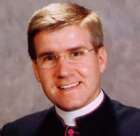
Monsignor Anthony Frontiero, Pontifical Council for Justice and Peace
“Demonizing Christianity, or deliberately mocking and undermining central tenets of the Christian faith as a means to promoting the rights of other groups is a clear and flagrant contradiction to the religious freedom and mutual respect that all people should enjoy, not to mention the work of building a more just and peaceful community. Such practices and must be seen for what they are: a subversive attempt to dismantle the progress made thus far in the promotion of tolerance and non-discrimination.” (Monsignor Anthony R. Frontiero, representative of the Holy See, HDIM 2007, session 2)
We peppered him with questions about AIDS in Africa, about the Euro-centric focus of the “secular culture” and battle with modernism/relativism, about post-modernism, and the internal ecclesiological applications of the Church’s social principles. (Unfortunately, I forgot to ask: What’s the deal with the Church and unions? There is this historical symbiosis between the two on one hand, and an unspoken allergy to even asking if there could/should be unions of church ministers or other employees…)
To Father Anthony’s credit, he gave honest answers to all questions, including the challenges of reception of the Church’s teaching within her own life – a situation as familiar to ecumenists as to peace and justice advocates, and probably, every office in the Roman curia!
The birds, cont.
Starlings, it seems, are what i was seeing. I guess if you search Rome starlings on YouTube you can get some video, but here’s a NY Times photo gallery and story about them: http://www.nytimes.com/packages/html/magazine/20070422_BIRDS_FEATURE/index.html
and the BBC – estimates up to 5 million starlings…
Hallowe’en in Rome, St. Paul Outside the Walls, and All Saints
I nearly forgot it was Halloween yesterday without all the candy and pumpkins in the stores; barely any orange or brown to be found in the city.
Apparently, it has not been a big holiday for Romans, or Italians in general. The big costume holidays are Epiphany, where they tend to dress up as La Befana, a gift-delivering witch who visits on January 6, and Carneval.
A small group of us went out for an evening passagata around the Pantheon and Piazza Navona, stopping for gelato en route, and finishing with a nice bottle of wine at a little wine bar/café. We saw a few Befana hats out early, but really it was only as we were heading home for the night, about midnight, that we saw more people in costume.
For the morning of All Saints, I opted for the Basilica San Paolo fuori la mura (St. Paul Outside the Walls). Rezart, one of my Muslim housemates, is working on a paper about the Eucharist, and he decided to join me so he could compare his first mass experience from Wednesday night here in the Lay Centre to a more formal experience at the Basilica. An added bonus is that Abbot Edmund was presiding at both liturgies, so the difference in personal presider styles could be taken out of the equation. Matthew joined us on location, in exchange for a visit to his parish next week, to which I am looking forward.
St. Paul’s is the huge basilica built over the tomb of St. Paul, outside the old city walls (hence the name), one of the four major basilicas. Until the new St. Peter’s was built (1506-1625), St. Paul’s was the largest church in the world. Along the walls are the images of the bishops of Rome going back to Peter – the source for those posters one finds all over the place.
St. Paul’s has also become significant in Rome’s ecumenical efforts, including being the location of the culminating liturgy for the Week of Prayer for Christian Unity each year. In fact, it was from the steps of St. Paul’s that John XIII announced Vatican II at the end of the celebration for Christian Unity 50 years ago.
Afterwards, Abbot Edmund was generous enough to meet with Rezart and me to answer questions and show us around a little. It is a gift to share the liturgy with someone experiencing it for the first time, especially someone so interested in learning about our worship. The questions remind us of the theology and symbolism we take for granted, and push for better understanding of what we might do out of habit. His first question was like this, he wanted to know why, if the Eucharist itself was a sacrifice made for the forgiveness of sins, why we had a penitential rite just a little while before celebrating the once-and-for-all penitential act! From there we ventured into the symbolism of serving only one species or both, the meaning of incense, and expansion from the homily and so on. It was a blessing for me to just listen!
After returning to the Lay Centre for lunch and a little homework, we ventured out again to All Saints Anglican, to celebrate their patronal feast, and to cheer on Stian who had his acolyting debut. Nine of us in total joined the small English community fro Evensong, then ventured to a pizzeria founded in 1753 (according to the waitress’ t-shirt anyway) and located just down the road, near San Clemente. Donna assured us in advance it was the best pizza in Rome, and we were not disappointed!
Ladri di biciclette
There are bicycle thieves in Rome. Sixty years ago, one of the great classic movies of Italian cinema said it was so. But unfortunately the descendents of these ladri di biciclette live on.
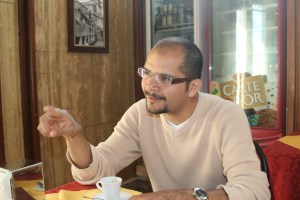
David Garnica, MD; Lay Centre Resident
My housemate, David, is from Mexico. He has already got an M.D., and is here to do a degree in theology, but because his medical background lacks the basic philosophical underpinning required to study theology in the Roman system, his university has him starting all over at the beginning – baccalaureate, year one. (David’s own philosophical grounding probably surpasses the STB program here, however!) In other words, he is going to be here for a while. So his decision to invest in a durable, quality bicycle (€150) while at the Porta Portese market on our second weekend in Rome was a bit of an investment, but for three years it is a lot cheaper than riding the metro or bus every day.
Apparently, Rome’s bicycle-thieving crime syndicate thought so too. Only four days after the classes began, someone took a little too much notice of David’s bike, locked up in front of the Gregorianum. (There are no bike racks here, so everyone locks their bikes to the chains protecting the piazza from the omnipresent motorini and smart cars).
As it happened, David saw the thieves in action and gave a chase worthy of a classic adventure film. Coming down the stairs between classes, he glanced out a window in the direction fo the bikes and saw a few people gathered around his bicycle, paying a little too much attention, so he headed for the door. As he came out the entrance, he saw the lock on the ground – cut by bolt cutters – and one of the ragazzi riding off with his bike in the direction of Piazza Venezia.
David dropped his bag, books, and laptop and sped off in hot pursuit. Somehow hailing a Roman motorist sympathetic to the victim of a dishonorable theft, David jumped on the back of the citizen’s motorini, and together they continued the chase through the narrow streets of Rome.
Despite this valiant effort, though, the thief got away. Thankfully, another student saw the chase and was watching over David’s computer and backpack, or it would have been a total loss.
Remember this was only about 10 days or a couple weeks into our stay together at the Lay Centre; David was a little reticent to share the tale at first, but we are grateful he did – it gave the community an opportunity to show him what community is really about. Last Sunday, we were able to present him with a new bike – and a tougher lock – all organized by students in the house almost from the day we heard about the theft (thanks to Dimitrios for organizing!).
David’s response is worth sharing:
I am so many others. JB What a joyful surprise! I know that my first reaction was just to babble,– I was overwhelmed and felt a little bit shy and silly… therefore I now want to give my “acuse de recibo” I want to share with you what you have done and just how much this means to me, I want to thank you for it – it has made my heart thud – this sign of your friendship, in which is revealed the face of the good God; thank you – all of you – for being a spark (scintilla) with your smiles and your deep tenderness… Not only a coin I have found, a fiets, but also something even better. Thanks and rejoice with me!
Why you should always use plastic
Cash in U.S. Dollars: $30.00
Exchange rate: $1.56774 = €1
Exchange amount: €19.15
Service fee 19.7% = €4.90
Final Cash in hand: €10.45
Trying to argue the math in Italian? Priceless Hopeless
The birds
One more than one occasion, I have been reminded of Alfred Hitchcock’s movie. There are no phone booths in Rome anymore, though, so it seems I’m safe for a while yet.
First, there are peacocks on the grounds, five or six, including an albino. Then there’s a flock of some kind of parakeet, about eighteen or twenty.
Monday, as I was exploring the Basilica Santa Prassede with a couple friends, we were flocked by pigeons on the piazza Maria Maggiore nearby (though, these were aided by a grizzled gypsy throwing seeds). Then, yesterday, as i was sitting on the terrace, reading about reception, i was listening to what sounded like a small army of birds in a nearby umbrella pine. Then, as though on cue, they went silent. A moment later the began leaving the tree, perhaps a couple hundred, headed in the general direction of the Vittorio Emmanuele monument. I could see three other flocks of about the same size from different origins headed in the same direction. Then, i looked west.
It took a moment to realize what i was seeing, because they were just on the edge of sight in the fading light of the setting sun -Thousands, probably tens of thousands of these birds. The flock covered the entire western horizon in a 120 degree arc; it had to have been more than a mile long. I’ve never seen anything like it. And they were all moving in the same direction. Somewhere between Pizza Venezia and San Pietro, they began to coalesce and dance – for lack of a better term. Like a swarm, they moved in and out, coalescing and separating, sometimes translucent in the colors of the setting sun. Absolutely breathtaking.
And my camera’s batteries were dead.
On monkishness
“Two monks were walking along in the woods one day, some time ago. As they approached a stream swollen with spring rains, they came across a woman clearly wanting to cross, but afraid to do so because of the strength of the flooded river.
“According to the rule of the order, these monks were prohibited from speaking to women – and certainly from touching a woman. After a brief pause, one monk looked at the other and said, “Ah well”. He then asked the woman if she needed assistance across the river. She eagerly accepted, and he carried her across, with his brother monk following behind. On the other bank, the first monk let the woman down, and she went on her way, in a different direction than the two brothers.
“The monks travelled on in silence for about half an hour. Suddenly, the second monk whipped around to face the first: ‘How could you?! You know the rule! You should not have spoken to that woman, and yet you even picked her up! What were you thinking?’
“’It is true’, replied the first monk, ‘In helping her cross the stream, I carried her for four minutes. But, Brother, you have been carrying her ever since.’”
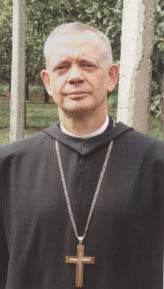
Rt. Rev. Edmund Power, O.S.B., Abbot of St. Paul Outside the Walls
The guest presider and speaker for our community evening tonight was the Right Reverend Edmund Power, Abbot of the Benedictine Abbey at the Major Basilica of St. Paul Outside the Walls. And it was with this story that he opened a discussion on what it means to be a monk.
A monk is a man (as a nun is a woman) who stands in the night with arms outstretched waiting for the dawn – and of course the dawn in Christ. Unlike some of these “modern” orders – like the Franciscans (founded c. 1210) or the Jesuits (founded c.1534) the primary charism of a monastic order like the Order of Saint Benedict (founded c.529) is not a particular work or ministry, but the interior life of prayer and purification of the soul.
This is not to label one order as contemplative, so as to insist that others are not, or to suggest that activity is not involved in the life of a monastic. For of course, monks need work to support their life, but each monastery does whatever work is suitable to it – some farm, others make wine or chocolates, and the Abbey of St. Paul Outside the Walls serves the needs of the Basilica, mostly the pastoral and practical needs of pilgrims.
Each of the major basilicas has a Cardinal Archpriest who is, at least nominally, responsible to be patron of the basilica and an advocate for its upkeep and other needs. The most (in)famous is of course the Cardinal Archpriest of St. Mary Major, Bernard Law.
What was news to me is that until four years ago, St. Paul Outside the Walls did not have a Cardinal Archpriest. The reason being that, historically, the archpriest position was created only after the religious order at each basilica closed or withdrew from service, the last being St. John Lateran several hundred years ago.
During that time, there has remained a Benedictine abbey at St. Paul outside the Walls, and the Abbot has been the equivalent of the Archpriest. With the election of Pope Benedict, however, an archpriest has also been named to St. Paul. (It was the first cardinal archpriest who commissioned the minor excavations that were announced at the close of the Pauline year this summer confirming the presence of first-century remains in the sarcophagus believed to be St. Paul.
And speaking of sarcophagi, as one is wont to do, did you know that the most beautiful of those found underneath St. Paul, the famous Dogmatic Sarcophagus was, ah, “borrowed” in the 19th century? Yes indeed. By Pope Pius IX, for display at the Vatican Museum…
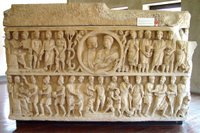
Dogmatic Sarcophagus, 4th century, first known artistic depiction of the Trinity
 The Ecumenism Blog