
Home » La vita Roma (Page 11)
Category Archives: La vita Roma
Dignitatis Humanae and an aside
The final full day of our Russell Berrie Fellowship Orientation program began with a trip to the Centro Pro Unione, the historic library and ecumenical center that sits above the Piazza Navona. Director Fr. James Puglisi, who also serves as director of the ecumenical section at the Angelicum and Minister General of the Franciscan Friars of the Atonement, lead a presentation on the academic responsibilities and processes of the section in addition to an introduction to the Centro.
This was followed by a roundtable discussion on Dignitatis Humane with our previous guests Thomas Casey, SJ and Miguel Ayuso Guixot, MCCJ and introducing Maltese Dominican Joseph Ellul, who is an expert on Islamic thought and its encounter with eastern Christianity. The rest of the day was spent in administrative issues and a group discussion around the praxis of interreligious dialogue, and a closing celebration of the Eucharist.
***
One of the interesting aspects of the week was the number of priests living in the house. Obviously, the Lay Centre only has one or two priests for Eucharist, whoever has been invited to preside. It is always a little strange to have as many concelebrants as other members of the assembly! This provided an interesting side discussion with one of my cohort, a presbyter. If a priest is celebrating the Eucharist, must he do so as presider or concelebrant, or may he do so as a member of the assembly – “in choir” in other words. And if so, does it “count” if the priest feels an obligation to celebrate mass daily?
There is clearly a movement that seems recent which indicates a priest should vest and actively concelebrate every time he is at mass. At the same time, one need look no further than papal liturgies at St. Peters to see that often, most priests and bishops are attending in choir only, not concelebrating. As at home, it seems some are asked to concelebrate for certain occasions, but it should not be assumed – and it certainly does not necessitate a private mass to be celebrated later!
I know it is not about interreligious dialogue, but, thoughts, anyone?
The Great Mosque of Rome and the Little Community of Sant’Egidio
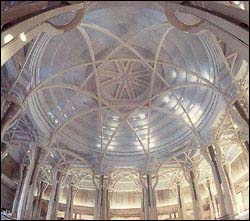
Rome Mosque, interior
American Dominican Robert Christian joined us to begin the day with the Eucharist. One of my professors at the Angelicum, Fr. Christian and I share a ministry in common – for a few months at the beginning of our service to the church, we each served as campus ministers in the Archdiocese of Seattle. He, at the Newman Center at University of Washington for a few months in 1985 and me at the Shalom Center at Western Washington university for a few months in 2003. His specialty is St. Thomas and sacramental theology, and is an excellent preacher.
We spent the morning at the Great Mosque of Rome, lead by former Lay Centre resident Mustafa Cenap Aydin of Turkey, and co-founder of the Istituto Tevere Centre for Dialogue. Unlike the synagogue and the many churches of Rome, the mosque is well outside of the historic centre and difficult to get to without a car. The design incorporates colors of classical Rome, familiar Arabic elements, and modern adaptations, including pillars in five parts to recall the five pillars of the Islamic faith and call to mind palm trees that might be found in Mecca. Various nations contributed parts of the mosque, from the careful mosaic to the suras encircling the worship area. The use of hidden natural light and the local colors mix with the exotic elements to provide a meditative space that can handle 2500 worshipers.
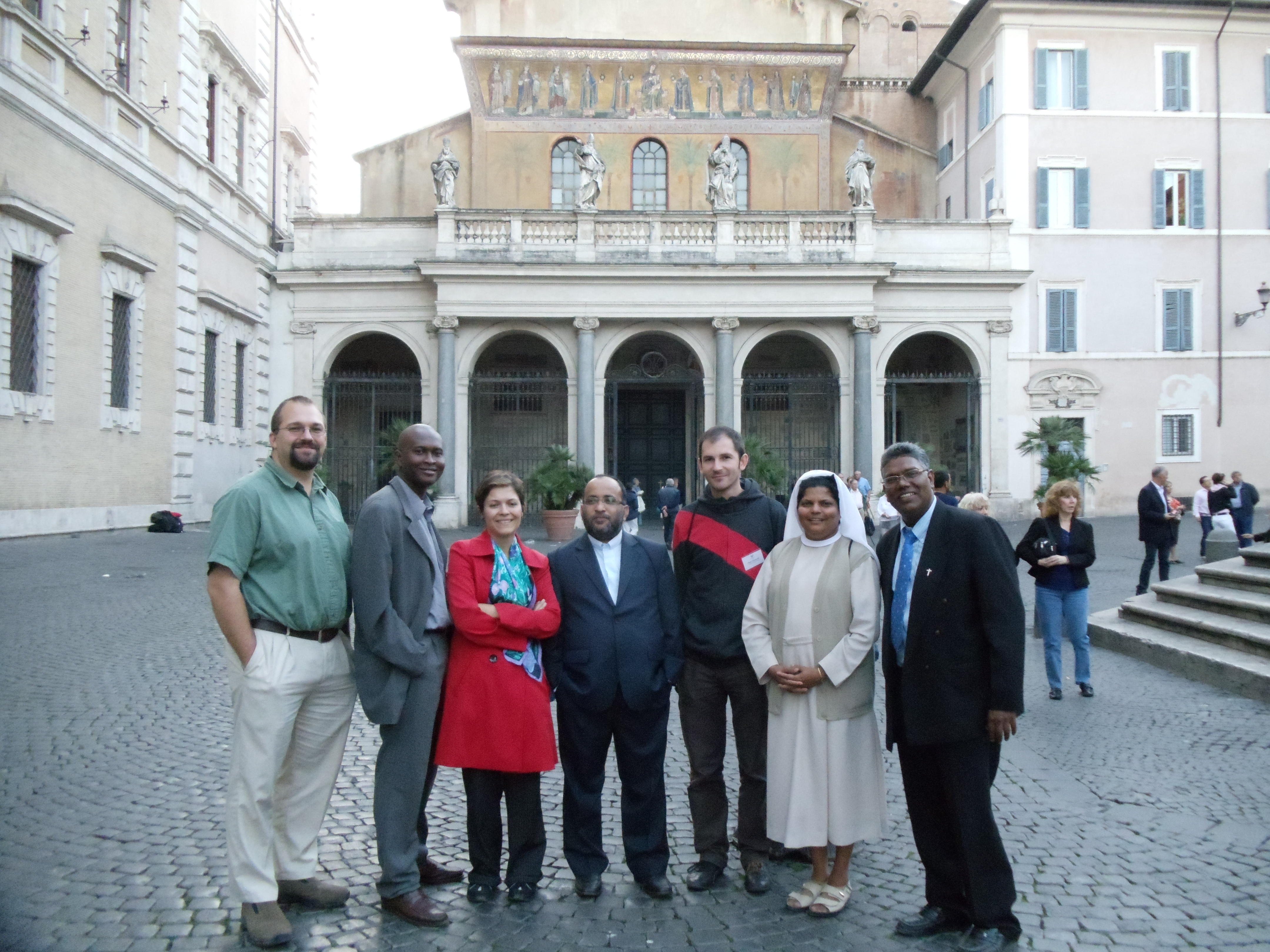
Piazza Santa Maria in Trastevere: AJ, Omar, Claudia, Bovas, Peter, Gracey, Michael
Our afternoon brought us back to the centre and across the river to PISAI – the Pontifical Institute for the Study of Arabic and Islam, where president Fr. Miguel Ayuso-Guixot, a Spanish Comboni Missionary of the Heart of Jesus gave an historical and theological overview of the encounter between Christianity and Islam. One of the oft-repeated metaphors of the week was one that Padre Miguel spent a few moments on – we are not looking for a “melting-pot” so much as a “mixed salad” when it comes to interreligious dialogue.
After a meander through the streets of trastevere, we met with Dr. Paolo Mancinelli of the Sant’Egidio community, one of Church’s best known lay movements, whose focus areas are direct work with the poor, peace and justice, dialogue and prayer. Paolo introduced us a little more to the work of the community, including Pope Benedict’s recent lunch with the community at their soup kitchen near Sant’Egidio.
We concluded the evening with evening prayer with the community at the church of Santa Maria in Trastevere, a 12th century church built atop the foundations of its 4th century former self. Around the corner was diner at Trattoria degli Amici, a now-familiar restaurant run by Sant’Egidio community and disabled friends. Good food and good company always make for an excellent discussion!
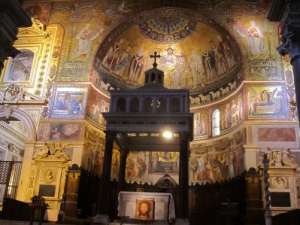
Santa Maria in Trastevere, interior
Official Catholic Dialogue with Judaism and Islam
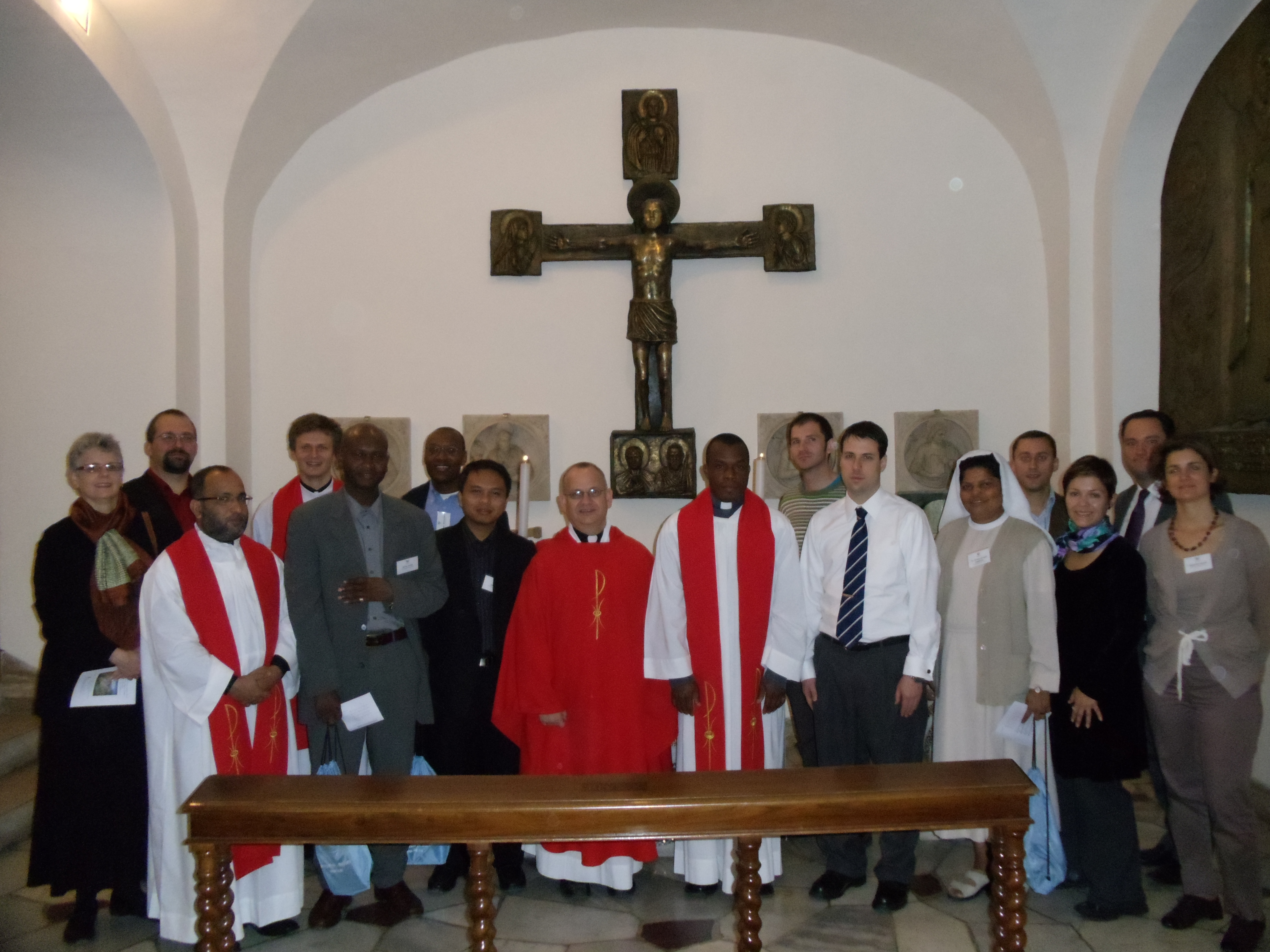
Russell Berrie Fellows at Chapel of the Patrons of Europe, Vatican Basilica
The second full day of our orientation began with a celebration of the Eucharist at the Vatican Basilica, in the Chapel of the Patrons of Europe just a few yards from the heart of the basilica, underneath the high altar. It was dedicated by Pope John Paul II in 1981 to the three first-millennium co-patrons of Europe: St. Benedict of Norcia and Sts. Cyril and Methodius of Thessaloniki. (The three second-millennium co-patrons, all women, were named in 1999.) The presider of our liturgy was Father Jess Rodriguez of the Jesuit curia, newly arrived in Rome to serve the English Secretariat of the Church’s largest religious order.
Noted art historian Elizabeth Lev joined us after the liturgy to give us a brief, but informative, insider’s tour of the basilica of St. Peter. Even for those who have been in Rome for years, something new was gleaned from her rich presentation. For me, it was the answer to one of the Eternal City’s eternal questions: “Hey Bernini, what’s with the twisted columns on the baldacchino???”
A short walk down Via della Conciliazione brought us to the offices of the Pontifical Council for Promoting Christian Unity, which for largely historical reasons, also houses the Pontifical Commission for Religious Relations with the Jews and a presentation from German Salesian Norbert Hofmann on the “Official Catholic Dialogue with Judaism”.
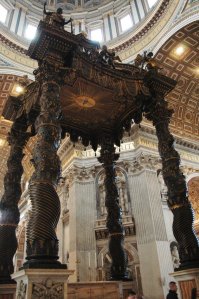
Bernini's Baldacchino
An afternoon of technical details broke for two more presentations: “Analysis of Nostra Aetate: Doctrine and History” by Thomas Casey, SJ and “The Official Dialogue of the Catholic Church with Islam” with German Jesuit Felix Körner of the Gregorian University’s ISIRC. The final discussion of the evening was a dinner dialogue with U.S. Ambassador to the Holy See, theologian Miguel Diaz, his wife and fellow theologian Marian Diaz, and the Canadian Ambassador to the Holy See, Anne Leahy. Their topic, understandingly, was “Diplomacy and Interreligious Dialogue”. We were joined by Drs. Armando and Adalberta Bernardini, president and vice-president of the International Foundation for Interreligious and Intercultural Education – and Fellow Paola’s parents.
Commitment of the Catholic Church to Dialogue
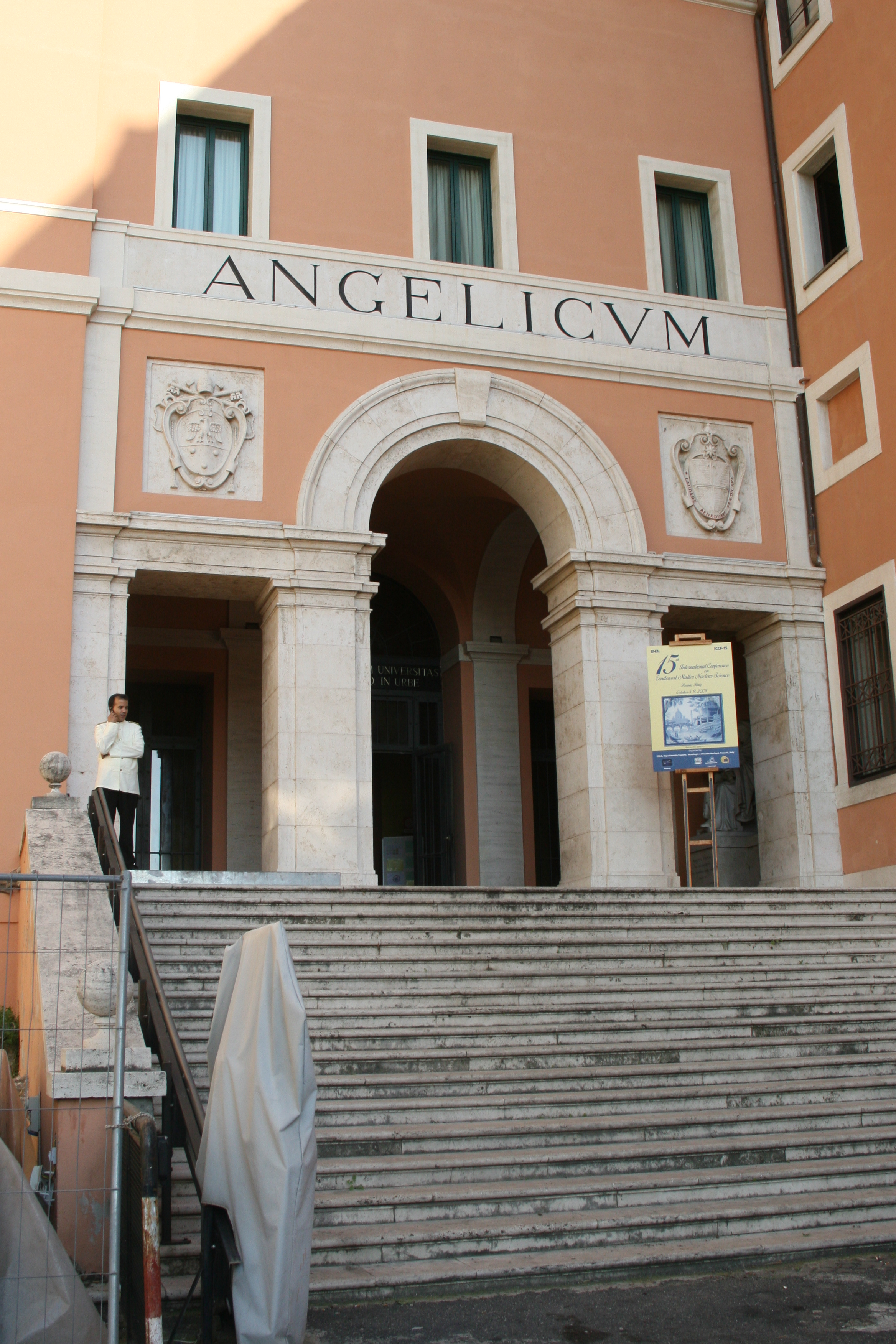 Monday brought us to the Angelicum with a welcome from Irish Dominican Michael Carragher, Vice-Rector and Canon Law Professor, and a brief tour from the new dean of the Theology faculty, Maltese Dominican Joseph Aguis. I learned more about the University in these 20 minutes than my time spent in its classrooms the last year. The university itself is the third oldest in rome, after Sapienza and the Gregorian, but its original location was next to the Pantheon in Santa Maria Sopra Minerva. The building that currently houses the university was originally a convent, repurchased from the government sometime after both sites had been taken in 1870. In what had been the chapter room, and serves now as the Sala de Senato, the full-body relic of an unnamed saint rests in the armor of an imperial roman soldier under the altar, unbeknownst to even some of the faculty who had joined us on our tour.
Fr. James Puglisi, SA, who serves as director of the ecumenical section and the Centro Pro Unione lead our first academic discussion on the “Commitment of the Catholic Church to Ecumenical and Interreligious Dialogue”. Like many of the presentations throughout the week, the content was review, but would certainly be helpful for those arriving without previous background in ecumenism and interreligious dialogue. We lunched at the Gregorian university bar, which is substantially larger than its Angelicum counterpart.

Thomas Casey, SJ pictured with NYU Professor Lawrence Schiffman
Following lunch, we ran into former Lay Centre resident Dimitrios Keramidas in his new role as secretary of the Missiology faculty at the Gregorian. He gave us an impromptu tour of his office and that of the Institute for the Interdisciplinary Study of Religion and Culture, as well as the Cardinal Bea Centre for Judaic Studies. We were joined there by Irish Jesuit Father Thomas Casey, director of the Bea centre, who introduced us to the research and work of the center, which includes 6000 volumes on Judaism in the Gregorian university library. This was followed by a 90-moinute introduction to the library there, which is the largest in Rome. At this point I calculated that if all the pontifical universities in Rome combined their libraries into a single collection, or at least a single system to which all pontifical students had access, it would be almost as large as the Hesburgh Memorial Library at Notre Dame.
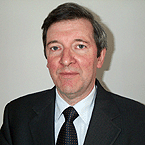
Gerard O'Connell, Rome Correspondent for UCANews
We returned to the Lay Centre for celebration of the Eucharist with the Theologian of the Papal Household, Polish Dominican Wojciech Giertych. This was followed by a dual-presentation and discussion over dinner with Fr. Giertych and Gerard O’Connell, Rome correspondent for the Union of Catholic Asia News service and author of God’s Invisible Hand, a biography of Cardinal Francis Arinze. The topic of their presentations was, “Issues that Matter to the Holy See: Seeing Interreligious Dialogue in its Broader Context”.
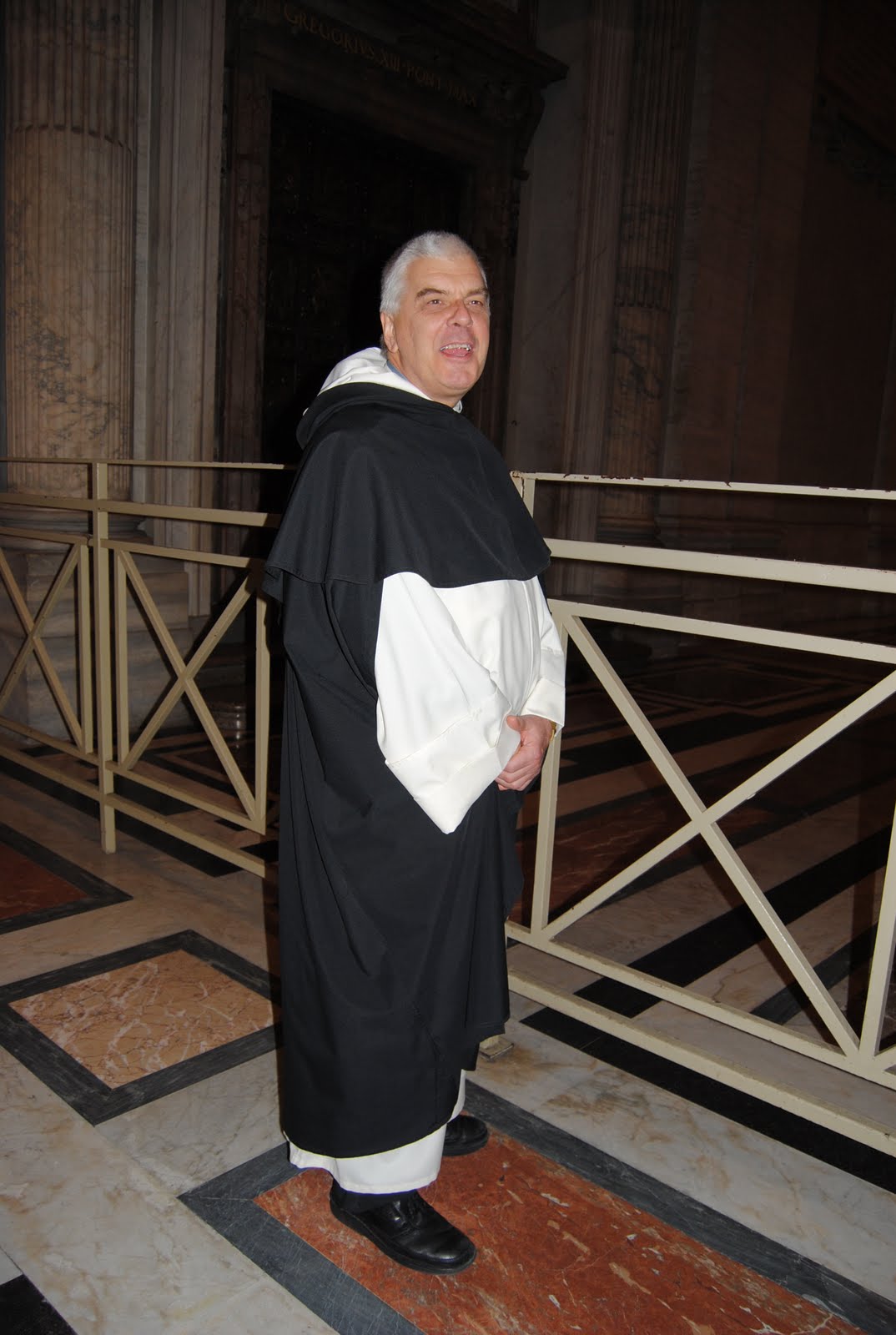
Wojciech Giertych, OP
The views were decidedly different, but not necessarily in opposition. Clearly a journalist and a theologian have different constituencies, frames of reference, and sensitivities when observing the Holy See; both men have had several years of doing so. Fr. Giertych raised a few hackles among some fellows with comments that grace comes through Christ and not through Buddha or Muhammad, but others countered that this is simply classical Christocentricism, inclusivist though it may be and in contrast to a more pluralistic view that is popularly construed as the most popular approach. (Whether it is or not is another discussion). At the least, it is helpful to be reminded that even in the administration of a papacy that is clearly pro-dialogue, there exist different methodologies and approaches to dialogue.
One of the burning questions of the evening revolved around whether Jews and Muslisms, at least, worship the same God as Christians. The Catholic Church has authoritatively taught that they do, and this has been cited from Gregory VII in the eleventh century to Nostra Aetate in the twentieth. Still, the thesis is challenged even within the church, and this fact lead to some pretty interesting conversation the rest of the evening. That, and another debate which started with one of the European fellows noting, “There is nothing new in Nostra Aetate. It is fifty years old, and it shows. We should be much further along than this!”
Back home in Rome
What a week! I returned to Rome on Sunday, 26 September with time enough for lunch and a nap before beginning an intensive orientation week for the Russell Berrie Fellowship. Though I started the program last year, the orientation and several other aspects are new this year, and we welcome the third cohort, as the first has finished their course of study (I am in the second).
The new Fellows include priests from Poland, Ruanda, Nigeria and India and lay scholars from Chile, Ukraine, Gambia, India and the U.S. (including one seminarian, one religious sister, and one Muslim). In addition to the Latin Church (“Roman Catholic”), three of the Catholics are Eastern: the Ukrainian Greek, Syro-Malabar, and Syro-Malankara Catholic Churches are represented. More had studied in Rome previously than with my class, and I was reminded how little my Italian has advanced in the last year.
The Lay Centre served as the ‘base camp’ for our orientation, and there is something about sharing my home in Rome with friends and fellow Fellows that gives a special joy. This truly is a place of hospitality and dialogue, of retreat and study, and it is only a pity that more of the Fellows are not also residents the rest of the year! Insha’Allah…
It was an impressive schedule. Our first evening’s introductory remarks were from Dr. Donna Orsuto (Lay Centre Director, Pontifical University Gregoriana) and Dr. Adam Afterman (Shalom Hartman Institute, Tel Aviv University).
Owing to the schedule, I am back-filling some of my notes, but dating them as though they were real time. I hope it makes sense!
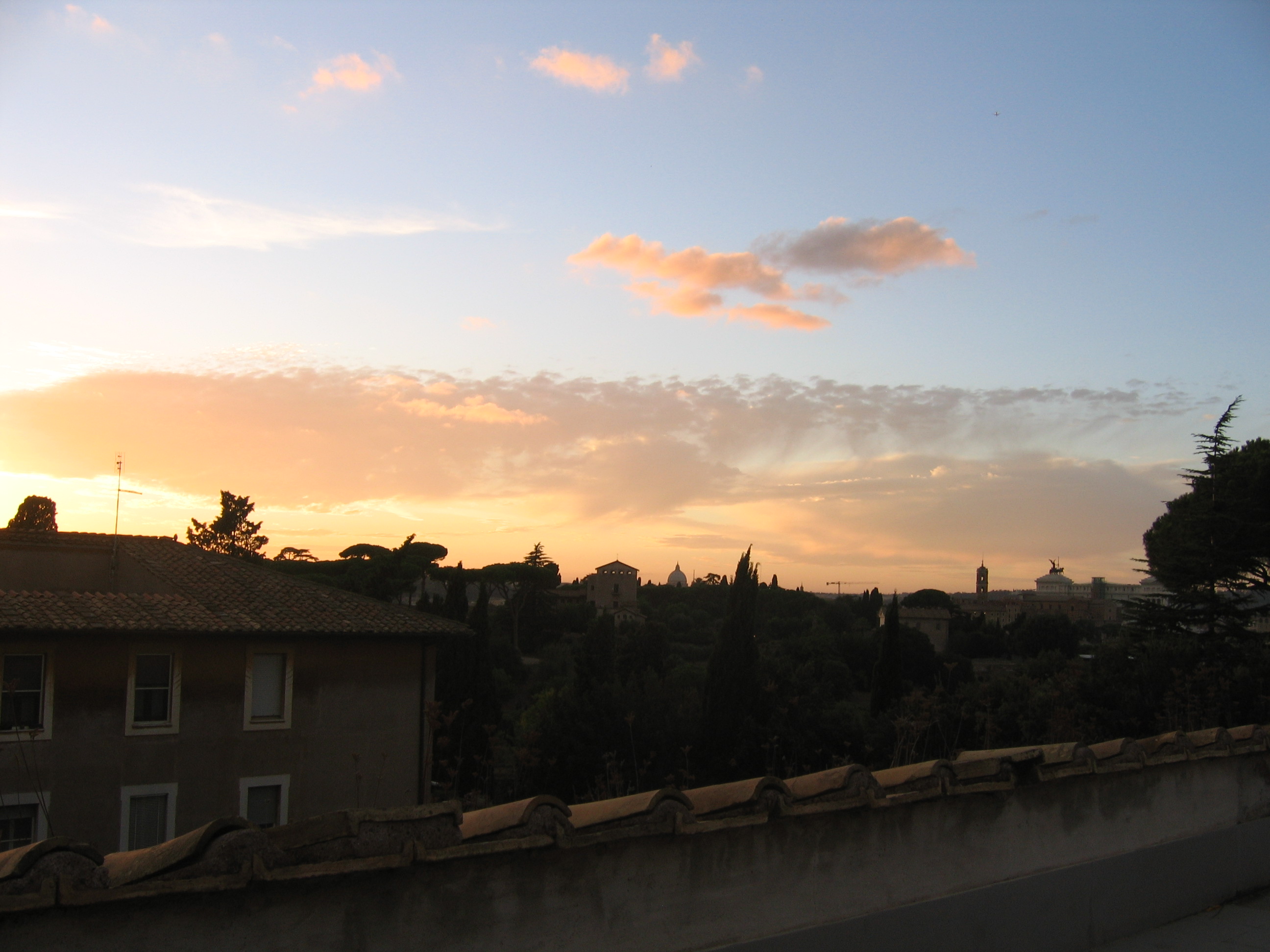
Nice to be back on the terrace
Father Dominic of the Mother of God

Blessed Dominic of the Mother of God
Much is being made of today’s centenary birthday of Blessed Teresa of Calcutta, known in life as Mother Teresa, and rightly so. As the first, and so far only, pastoral associate of the first parish dedicated to her after her beatification, I had already developed something of a devotion to this latest holy Teresa. Living within a stone’s throw of the Missionaries of Charity Roman HQ helps too!
The Lay Centre is of course in a section of the Passionist Retreat of John and Paul, their international general house, where today is already tomorrow and one of their own is honored on the calendar. Blessed Dominic Barberi is likely best known for his missionary work on the British Isles and for being the priest who received Bl. John Henry Newman into full communion with the Catholic Church.
Our director, Dr. Donna Orsuto, is on an around-the-globe lecture tour this summer, and discovered a timely quote from one of Newman’s letters that describes my home in Rome and the case of canonization for the Passionists’ founder, St. Paul of the Cross:
On November 15, 1846 to his friend Dalgairns, Newman writes:
“What do you think of Mr. Spencer having joined the Passionists? I am very glad for Father Dominic’s sake. We went to their House here [Rome] with Cardinal Acton. It is very clean and beautifully situated. We saw the various remains (dress etc) of Venerable Paul—They expect he will be canonized by the end of three years. Suppose we all become Passionists.”
From The Letters and Diary of John Henry Newman, volume XI, p. 274.
The world just keeps getting smaller!
Not to be confused with the Netherworld
I have said this before, but it is hard to believe it has been an entire year already. One year ago, I was wrapping up at St. Brendan, still trying to work out visa issues and wondering if I would in fact get to Rome at all!
This morning, as I took my leave of the Eternal City for the summer it was already 30°C (85°F) by 10:00am. By all accounts it has been a relatively mild June, but it is already toasty enough for me. Arriving in Amsterdam a couple hours’ flight north of Rome, it was a much more reasonable 22°C (72°F).
The first thing I saw out the airplane window as we approached the airport was a windmill. Not one of the iconic Don Quixote sort, though, but a modern, white, high tech electricity producer. As for wooden clogs, I did not even have to leave the airport before I encountered a few!
Eveline, a good friend and Dutch theology student who had spent the year at the Lay Centre, was there to greet me and show me around Amsterdam before we left for her university town of Tilburg. This much further north, the days are noticeably longer – more like home. I knew to expect it, but you really cannot prepare for how many bicycles there are in this city! Everyone is on two wheels – kids, parents, professionals in suits/dresses, elderly folk out for a stroll. I can understand why fiets is basically the first Dutch word anyone would learn!
Before Amanda asks, yes, I got to the Van Gogh Museum, but it was closed. Saw the palace, the “new church” (from 1410), various canals, the flower market, Rembrant’s square, ate pannekochen (pancakes) for lunch and Irish pub fare for dinner. Also smelled marijuana wafting through the air at several points on our walk, I got hit on by a guy on a bike, and we overheard a tour guide address his group as they emerged from the red light district: “OK, let’s count everybody. I always lose one of the guys by this point… Hey, where’s Mike? Oh, Hi Mike! Your daughter told me I had to keep an eye on you since she could not come along today!”
Den Haag, Delft, Rotterdam, Maasdam, Tilburg and Den Bosch (with the just-retired Cardinal Kasper) are all on the agenda before heading for home.
Feast of Sts. Peter and Paul
It is appropriate that my last full day in Rome for this year should be the patronal feast of the city.
The idea of tourists coming to Rome to see the Pope is a modern phenomenon. For centuries, pilgrims came to Rome primarily to pray at the tombs of the two great martyr-saints who are honored as the “co-founders” of the Church of Rome, even though Christians were certainly present in the city before either Apostle arrived: Sts. Peter and Paul.
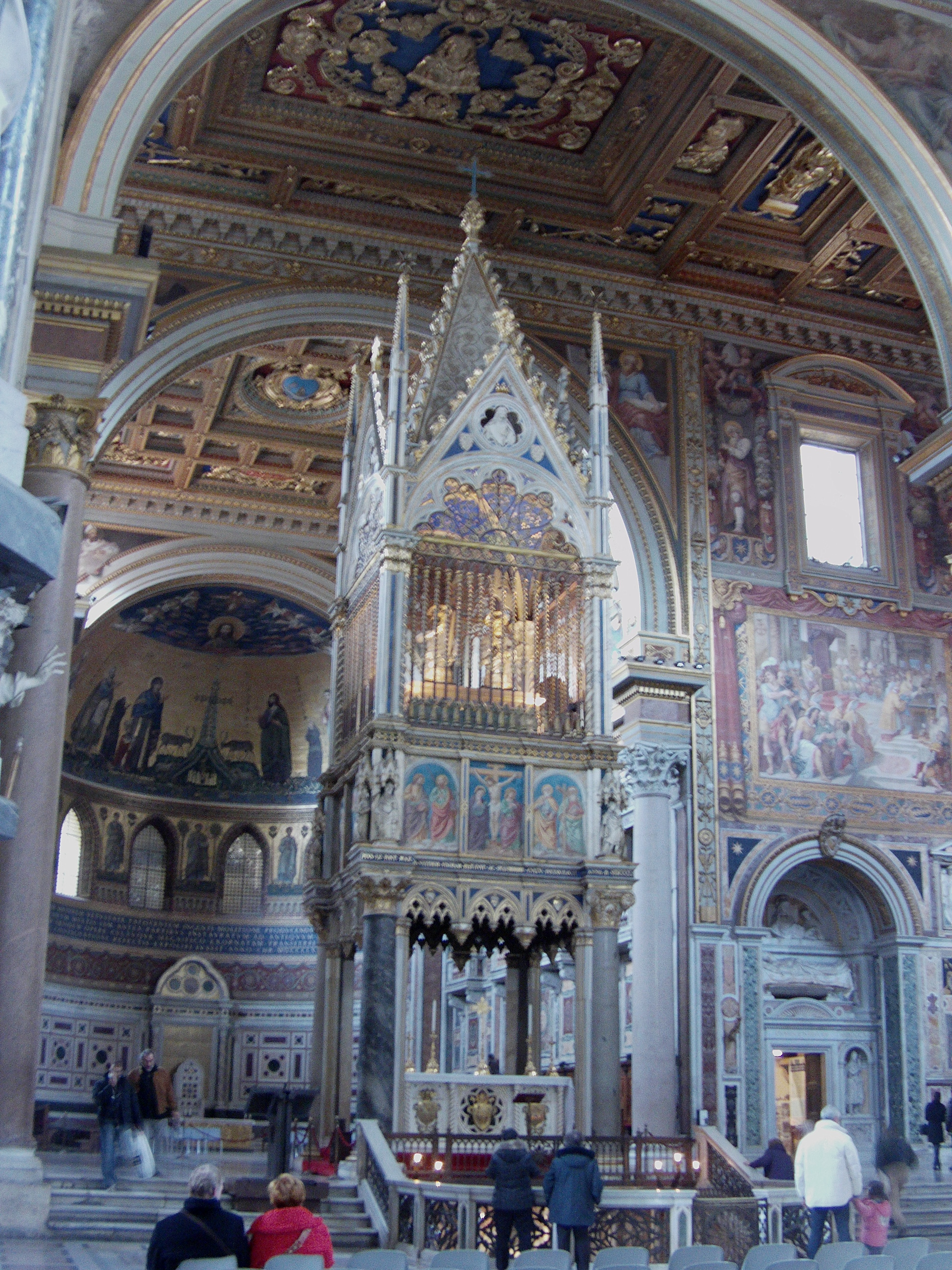
Relics of Sts. Peter and Paul above Papal Altar at San Giovanni Laterano
Throughout the Eternal City, you will see both saints together. On the Piazza in front of St. Peter’s Basilica, you see two giant statues, Peter on the left and Paul on the right. Atop the baldachino over the papal altar in Rome’s Cathedral-Basilica, St. John Lateran, two gold reliquaries house purported relics of each of the saints. The oldest known depiction of either saint is a depiction of both, at the catacombs of St. Thecla.
If you want to see the famous mosaics of the bishops of Rome, from Peter to Benedict, you go not to the Vatican Basilica, but to St. Paul’s Outside the Walls, which from the 4th to the 16th centuries was the largest church in Rome, until the new St. Peter’s was built. The “Successors of Peter” were honored at the Tomb of Paul. No wonder ecclesiologists point out the pope is better named “Successor of Peter and Paul” – if they are not too busy pointing out that neither Peter nor Paul were bishops of the city in the modern sense, but that is another debate.
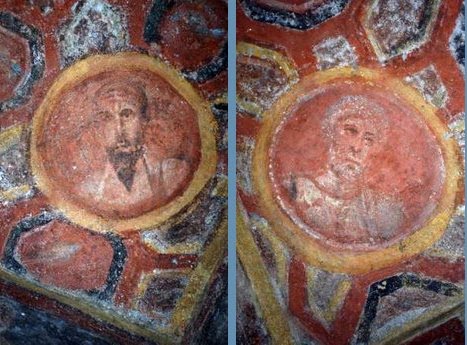
Recently discovered images of Paul (left) and Peter (right), oldest known
Since the beginning of the dialogue between Orthodox and Catholic, one of the traditional signs of fraternity is the exchange of delegations on the feast days of the two Apostolic Sees. Rome sends a delegation to Constantinople on the Feast of St. Andrew, November 30, and Constantinople returns the delegation on the Feast of Sts. Peter and Paul. Metropolitan Gennadios of Sassima lead the group this year, and was the only person to receive the Sign of Peace from the Pope during the morning’s liturgy. In addressing the delegation, Pope Benedict spoke strongly and favorable of the progress toward unity being made in Catholic-Orthodox dialogue, and praised the Patriarch’s recent encyclical on ecumenism (a short read I strongly recommend to all). http://www.patriarchate.org/documents/sunday-orthodoxy-2010
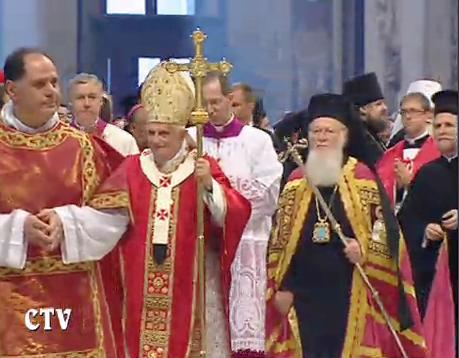
Pallium Mass 2008 - Patriarch Bartholomew and Pope Benedict, the later wearing an adaptation of the pallium
This celebration also serves as the “Pallium Mass” when the (Catholic) Metropolitan Archbishops appointed within the last year come to Rome to receive the symbol of their office. Made from wool shorn of sheep blessed on the Feast of St. Agnes, the pallium is one of the oldest liturgical vestments, having changed size and function over the centuries but remaining in use throughout. The tradition of metropolitans coming to Rome to receive the pallium is recent, however, dating only from 1984. Prior to this they were vested in their own cathedral at the time of their installation as Metropolitan. However, it serves as a powerful symbol of the communion of the bishop of Rome with the archbishops throughout the world.

Metropolitan Gennaidos of Sassima, 2010 delegate of the Patriarch of Constantinople to Rome on the occassion of the Patronal Feast of Sts. Peter and Paul
The unity of the Church is the clear theme of the day– the pallium celebrating the existing full communion between Rome and the churches represented by the new metropolitan Archbishops, and the kiss of peace and exchange with the Orthodox delegation celebrating the impaired communion with the Orthodox Church in hope for full communion in the near future. Appropriate that the city that sees itself at the centre of this union is guided, not by a solitary figure, but the “dynamic duo” of two very different Apostles. May the church continued to be blessed by their common patronage and the balance that they represent!
Over the summer months I will be travelling a little, teaching a little, and spending a lot of time with family and friends near Seattle. My blogging will slow (and indeed I am writing some of these rather post-facto) but I will also have some time for more meaty reflection on some of the themes and events raised during this incredible year in Rome.
Roman June
It is hot, and it is certainly humid. It could be worse, I am told, and there are definitely some redeeming qualities of Roman June. One of which is that it is not Roman August, and I know I will be home for that!
The academic year of the Angelicum was more or less set in the time of St. Thomas Aquinas, though the university’s origins are with the 16th century House of Formation for the Dominican Order. Class begins mid-October and end in May; the entire month of June is set aside for exams. By university statute, they happen in June, the whole of June, and no month but June. Naturally this means that most are scheduled between late May and early June – I was in finals mode for a month, but I have a couple of weeks of freedom to enjoy the City. Two experiences illustrate how to spend these Roman summer days.
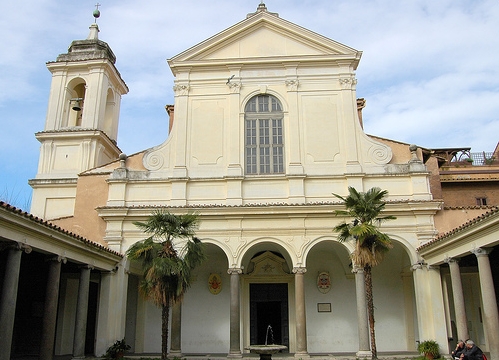
Basilica San Clemente
Sunday, June 13 – An American friend and I decided to head to St. Peter’s for mass. Rather than rushing across town for the 10am, however, we opted for leisurly morning starting with cappuccino and cornetto (croissant with Nutella filling) at my favorite local bar, Café San Celemente – literally across the street from the Basilica San Clemente. We ventured over to San Pietro just in time for the Sunday Angelus, a brief prayer and address by the pope. While there we encountered no less than three different people or groups known to one or the other of us, including one from the states just in Rome for the week! We made it inside for an early afternoon liturgy at the St. Joseph chapel.

Tiber Riverwalk
We spent the next couple of hours touring the basilica and piazza, tourist shopping on the Via della Concilizione, eating pizza by the slice, and then a holy hour devotion at the San Lorenzo youth pilgrimage centre nearby. What could have then been a 30 minute bus ride home turned into a four hour walk along the Tiber with generous time spent at a riverside bar set up for the summer, complete with comfortable lounging couches along the riverwalk. 14 hours out and about, with the only plan for the day being the Eucharist!

Cafe della Pace
Saturday, June 19 – A Danish friend and I decided to get together for coffee and some conversation about mid morning. This time we met near the famous and picturesque Café della Pace, which is the quintessential Roman café – cobblestone street, outside seating, low traffic and a church nearby, all within a couple blocks of Piazza Navona. It comes with quintessential pricing too, so we opted for a humbler, and homier, bookstore/coffee house across the street that charges no more to sit down than to take your coffee at the bar. Two hours later we wander to the Pantheon for lunch on the steps, taken from a pizzeria popular with the municipale – the Roman city cops.  A meander through the city north takes us to the Piazza del Poplo and up to the edge of the Villa Borghese overlooking the piazza for some excellent people watching and a view of the city. From there we part ways and I wander back along the Viale Gabriele D’Annunzio to Chiesa Treinita dei Monti – famous as the church a the top of the Spanish Steps – and the Via Sistina to Maria Maggiore before heading back home.

Trinita dei Monti and Spanish Steps
The Year of the Priest: Corresponsibility of Priests and Laity
The Lay Centre has three major aspects to its ministry of hospitality and formation. The first is the one most familiar to anyone reading my blog or following my studies, which is the community of students and scholars who live in the house of formation throughout the academic year (Oct-June) and who eat, pray and learn together in an ongoing dialogue of life. The second is the ongoing adult formation offered (mostly) to the English-speaking population of Rome. Theology, spirituality, church history, liturgy, art, and architecture offered by faculty of the pontifical universities and visiting scholars every Thursday morning as part of the Vincent Pallotti Institute.
The third piece of the mission is the summer seminars and retreats offered by the lay centre. During June, July, and September groups come in from around the world to spend a week in Rome. Some have their own agenda and primarily enjoy the hospitality of the Lay Centre, while others are sponsored by the Centre directly and open to anyone from around the world.
A few years ago I remember hearing about Rome’s first-ever symposium on Lay Ecclesial Ministry, and recall thinking to myself, “First? This has been going on 50 years and they are only now talking about it???” Little did I know. (One can hear about how slowly time moves in the Eternal City, but you really have to be there to appreciate it, soak it in, and start wondering what all the fuss was about back when you cared about things like deadlines, traffic laws, and absolute concepts of any kind…)
One of the programs offered this summer was the latest in the series touching on lay ecclesial ministry, but with a timely twist. In honor of the Year of the Priest, and timed to coincide with the closing festivities of the year, the theme was taken from Pope Benedict’s address to the annual convention of the diocese of Rome (given at St. John Lateran on May 26, 2009) and again later to the presbytery of Rome at the beginning of the year: “Corresponsibility of Priests and Laity”.
The unique opportunities for a program like this in Rome include access to so much of the Church’s history within walking distance, access to curia officials, access to representatives of the Church from all over the world, and of course the hospitality of the Lay Centre.
The program progressed through the centuries day by day, with an examination of key saints and their experience of “corresponsibility”. We studied St. Paul and his collaborators with Abbot Edmund Power of the Benedictine Abbey of St. Paul Outside the Walls – guardians of the tomb of the great missionary and co-patron of Rome. St. Justin Martyr, a layman, buried at St. Lawrence Outside the Walls. Pope St. Gregory the Great, with his oratory of St. Andrew is literally just over the wall from my Roman home. St. Vincent Pallotti was an early modern pioneer of lay formation.
Contemporary organizations and developments we looked at included the Emmanuel Community, Sant’Egidio, the Pontifical Council for the Laity, and the Union of the Catholic Apostolate. Presenters included Dr. Marian Diaz, Fr. William Henn of the Gregorian, Ms. Ana Crisitina Villa-Betancourt of the PCL, Fr. Jean Baptiste Edart of the Emmanuel Community, and John Breen of the Beda College in Rome. The participants were mostly students and (both lay and ordained) ministers from the U.S., but included one Dutch pastoral life director.
[Further Reflection to Follow]
 The Ecumenism Blog