Home » La vita Roma (Page 10)
Category Archives: La vita Roma
Week of Prayer for Christian Unity 2011
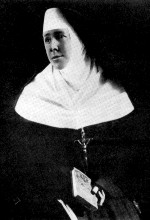
Mother Lurana White, SA
The Week of Prayer for Christian Unity has its origins in the Church Unity Octave, started in 1908 by the founders of an Anglican religious order, the Franciscan Society of the Atonement. The dates were chosen to run the week from the Feast of the Chair of Peter (18 January) to the Feast of the Conversion of Paul (25 January).
18 January was in fact one of two Feasts of the Chair of Peter on the Tridentine calendar, the other being 22 February. Some distinguished these as the Chair of Peter in Rome and the Chair of Peter in Antioch, though it is not clear that that was the original intent of the two dates. Since 1960, only the later date has been celebrated in the Roman calendar as the feast of the Chair of Peter, but the dates for the Week of Prayer remain the same.
(As an interesting aside, with the resurgence of interest in the extraordinary form of the Roman Rite, since Pope Benedict’s 2007 motu proprio Summorum Pontificum allowing more widespread use of the 1962 missal, some liturgical traditionalists observe the January feast date. However, this appears to be incorrect, as the 1962 missal was produced after the change to the calendar mentioned above.)

Fr. Paul Wattson, SA
The original octave focused on Anglican-Catholic reunion, and the themes as approved by Pope Pius X were a great example of what is now known as the “ecumenism of return” – which was common in the post-Vatican I period at the beginning of the last century (and which some fear is making a resurgence in these days… but more on that in a later post).
In fact, even before the Church Unity Octave was established by Father Paul Watson, SA, and Mother Lurana White, SA, there were calls for a time of prayer for Christian Unity. The Lambeth Conference, the decennial synod of the world’s Anglican bishops, in 1878 called for a period of prayer for unity around the feast of the Ascension. In 1895 Pope Leo XIII agreed, establishing a novena for Christian Unity from Ascension to Pentecost.
Since 1935, the Church Unity Octave began to expand to a more comprehensive Week of Prayer for Christian Unity, including prayer for the unity of all Christians. By 1957, there was quasi-official participation in the planning for the worldwide celebrations by a Catholic organization from Lyons, and in 1966 the Week of Prayer for Christian Unity officially became a joint project of the Catholic Church and the World Council of Churches. The materials used throughout the world have been prepared each year by a Joint Working Group of the Faith and Order Commission of the WCC and the Pontifical Council for Promoting Christian Unity.
Additionally, a local ecumenical community prepares the theme and symbols for the Week of Prayer, and this year’s local planners were the churches of Jerusalem. The theme chosen for 2011 is: “One in the apostles’ teaching, fellowship, breaking of bread and prayer” (cf. Acts 2:42).
Each day of the Week has a different theme:
- 18 January: The Church in Jerusalem.
- 19 January: Many Members in One Body.
- 20 January: Devotion to the Apostles’ Teaching Unites Us.
- 21 January: Sharing, an Expression of Our Unity.
- 22 January: Breaking the Bread in Hope.
- 23 January: Empowered to Action in Prayer.
- 24 January: Living in Resurrection Faith.
- 25 January: Called for the Service of Reconciliation.
Compare that to the themes of the original Church Unity Octave, as approved by Pope Pius X just one century ago, to see “development in continuity” in practice for the Catholic Church’s teaching on the ecumenical movement. Unity is still the goal, in obedience to Christ and for the sake of the Church’s mission, but our understanding of this constant truth has clearly matured!
Note, not only the the marked difference in tone, but also the inclusion of prayer for the Jews both then and today, except that now it is on a day preceding the Week of Prayer for Christian Unity. Note also the distinction between European Protestants and American Christians.
Church Unity Octave daily themes (c.1911)
- 18 January: The Union of all Christians in the one true faith and in the Church
- 19 January: The Return of separated Eastern Christians to communion with the Holy See
- 20 January: The Reconciliation of Anglicans with the Holy See
- 21 January: The Reconciliation of European Protestants with the Holy See
- 22 January: That American Christians become one in union with the Chair of Peter
- 23 January: The Restoration of lapsed Catholics to the sacramental life of the Church
- 24 January: That the Jewish people come into their inheritance in Jesus Christ
- 25 January: The missionary extension of Christ’s kingdom throughout the world
On the way through the forum today…
 How well do you know your history? I suspected something was up yesterday when a single fighter jet kept making passes over the Foro Romano. Today confirmed it, as the Via Fori Imperialli was barricaded this morning as I walked to university for an exam. Just as I was getting to Trajan’s forum, Italian military jets do a low fly-over trailing smoke in the Italian national tricolore.
Still, there was little beyond that, and I moved on to my exam, after which I enjoyed a well earned siesta for the first time in weeks. After napping, I decided to try for a passagata and found my way to the Spanish steps to sit in the rays of the setting sun as I people-watched and pretended to study. Just as the sun dipped beneath the buildings, a military band marched up, cleared the first level of steps, and began a free concert that lasted for an hour.
The occasion? Surely you have guessed it by now. On this day in 1918, Italy defeated the Austro-Hungarian Empire in the battle of Vittorio Veneto, effectively ending World War I – a week later the armistice with Germany was signed. According to some commentators, just as the civil war was the last battle of the American revolution, some saw Vittorio Veneto/WWI as the last battle for Italian Risorgimento which had officially been completed with the 1870 conquest of papal Rome.
St. André Bessette and company
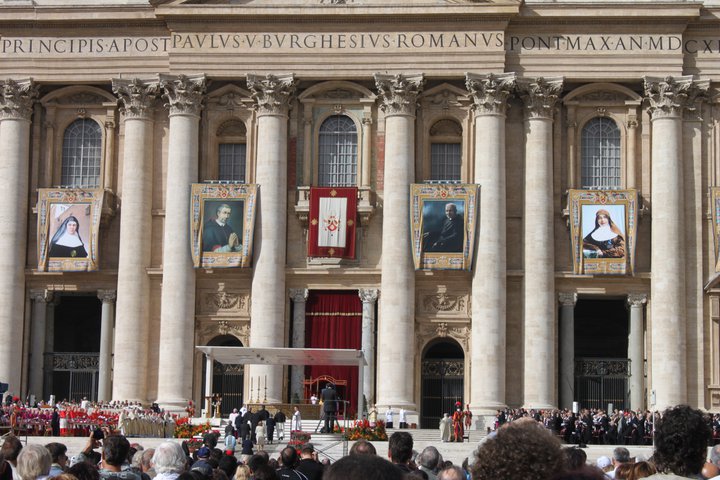
Saints banners on St. Peter's
Six new saints were declared by Pope Benedict XVI during the weekend of 17 October, but one in particular stands out. Brother Andre Bessetté, CSC has been a familiar name to me since Notre Dame, and his story I had known something about even before then. In fact, throughout my four years of service on the altar at the Basilica of the Sacred Heart, the Litany of Saints always concluded with a robust “Blessed Brother André… Pray for Us!”
Those years of prayer are ‘paid off’ today, in the official recognition of the Congregation of Holy Cross’ first saint – though rumour is the cause of CSC founder, Father Basil Moreau may be ready as early as 2012. Brother Andre is also the first native-born male saint of North America, having been born and raised in Canada.
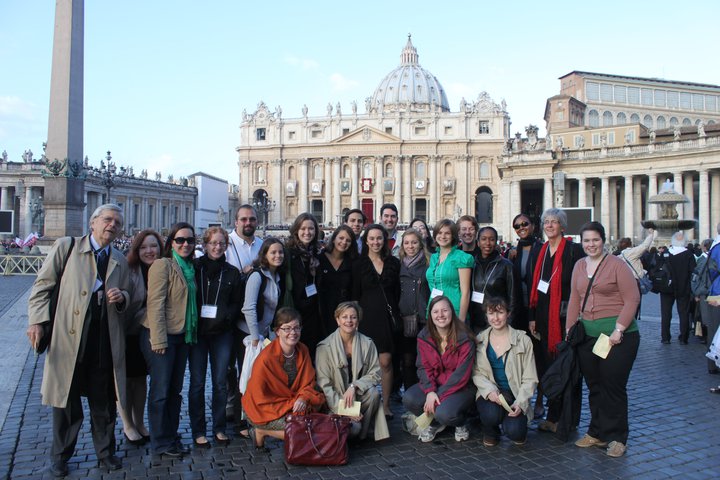
Notre Dame pilgrims for canonizations
He was a simple porter, a door-keeper, not educated enough for presbyteral ordination, but a man gifted with healing and a particular devotion to St. Joseph in a time when Marian piety defined Catholic spirituality. One man’s simple prayer to see a small shrine to Our Lord’s earthly father near the school where he served lead eventually to the impressive St. Joseph Oratory of Mount Royal, in Montreal, Quebec. The oratory offers a biography of the new saint here.
A delegation of Holy Cross brothers and priests, Notre Dame students, alumni, and faculty converged on Rome along with thousands of Canadians and others devoted to Brother André. About two dozen of us participated in a program offered by ND’s Center for Social Concerns. On the eve of the canonization day, these pilgrims filled the church of St. Andrea della Valle to standing-room capacity, about five thousand by estimates I have seen.
One of the Domer alumns from the states was my friend and classmate Julie Fritsch, who i literally picked up from Leonardo DaVinci airport as i dropped off Simone. From pro-life marches in D.C. to canonizations in Rome, it is nice to know you can share the journey with friends over the course of decades!
We got to participate in the vigil at Sant’Andrea della Valle, the canonization mass at St. Peter’s, the premier of Salt and Light’s documentary of his life, “God’s Doorkeeper”, and a presentation by ND Professor Kathleen Sprows Cummings on the process of canonization.
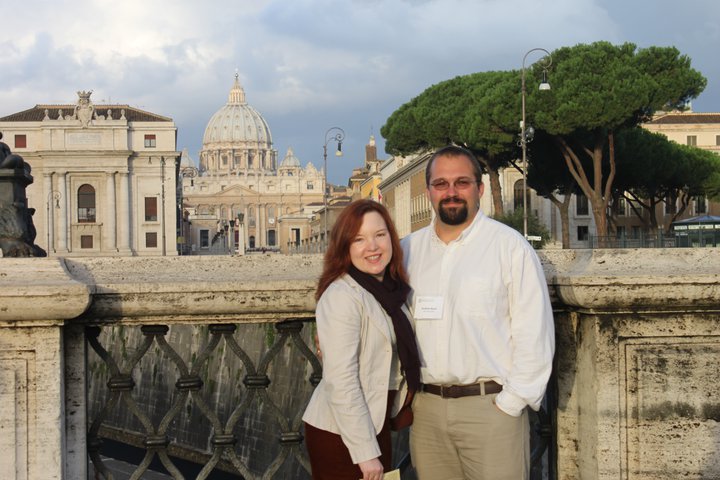
Julie and I on Ponte Sant'Angelo
Leading up to the weekend, the only names of the soon-to-be saints i knew were Brother André and Australia’s first saint, Sr. Mary MacKillop, founder of an order of women religious and contemporary of St. André. The program on the morning of the liturgy described the six thus: One priest (Stanisław Kazimierczyk, Polish, 15th cent.), one religious (Br. Andre), and four “virgins”. IN addition to Mary MacKillop, there were two Italian sisters Giulia Salzano and Camilla Battista da Varano and Spanish nun Candida Maria of Jesus.
Why the four women were not identified as religious, as sisters, or even the three as founders of orders, i do not know. While chaste virginity can be holy (as can chaste marriage or celibacy) it seems to mischaracterize their vocations. After all, none were consecrated virgins, so much as religious and founders. Giulia and Candida were educators and catechists, Camilla was a princess turned nun, an example of the wealthy giving up materialism for service to the poor. Mary has been championed by some as an example for those persecuted by ecclesiastical authority for remaining true to the Gospel rather than “obedience” to abusive leaders.
Four of the six were all born in the 1840’s: André, Mary, Giulia and Candida. The other two were born mid-15th century.
Robert DeNiro and Monica Bellucci filming on campus
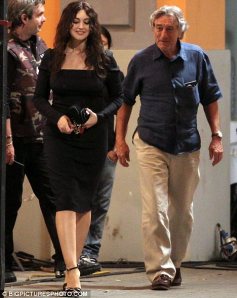
Monica Bellucci and Robert DeNiro in Rome
So, I ran into Robert DeNiro today. Not literally, mind you, what with the security and stage hands and boom operators and thirty other people that go into shooting a short scene, it would have taken a deliberate effort and probably not have been received well to do so literally. Nevertheless, he and Monica Bellucci were at the Angelicum today shooting for their new movie, Manuale d’amore 3.
Unlike my late spring encounter with the hordes of Italian teens outside Castel Sant’Angelo for the stars of the latest Twighlight movie, I might have actually made an effort to get DeNiro’s signature, if it were not so apparent that he was working and that I was supposed to be getting to class. It would have been, as they say, simply brutto. Ah well. Next time!
Very Rev. David Neuhaus, SJ
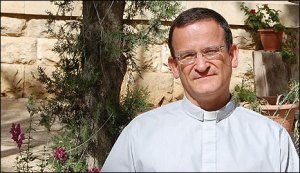
Very Rev. David Neuhaus, SJ
The Synod of Bishops is meeting in extraordinary session for the Middle East for the first time in church history, and one of the few synod fathers who is not a bishop is our guest presider and presenter this evening, Jesuit David Neuhaus, Patriarchal Vicar for the Hebrew-Speaking Catholics in the Latin Patriarchate of Jerusalem.
The Patriarchate is the diocese covering Israel, Palestine, Jordan and Lebanon serving the 70,000 Latin Catholics living in this area. In Israel, only 2% of the population is Christian, and the majority of these (about 90%) are Arab. There is a small but significant number of Hebrew-speaking Catholics, however, that requires special attention and holds a unique place in the Church.
Like migrant workers anywhere, these families are made of the first-generation workers, many now parents, who came to Israel looking for work, but maintaining their primary identity with their country of origin. Many of these are Filipino. Now, their children, who have been born and raised in Israel, are “culturally” Jewish – they speak Hebrew, go to school in Hebrew, know the popular religious imagery and stories of Judaism as a child in the States or the UK would know basic “cultural” Christian stories and images even if not a Christian (Christmas itself being a great example). The vicariate then ministers, primarily in catechesis, to these children who are Israeli, ‘culturally’ Jewish, but religiously Christian. Like Jews in a secularly Christian culture, the biggest threat to these Christians in a secularly Jewish culture is assimilation.
It was one of the first places in the world granted blanket approval for the liturgy and sacraments to be celebrated in the vernacular, as early as 1955. At the time, the liturgy had to be in one of the three sacred languages: Latin, Greek, or Hebrew. If one of those three happened also to be the vernacular, in this case Hebrew, you were set. Eleven priests serve the 500 members of the vicariate.
Fr. David is one of a rarer sort, a convert from Judaism. Born in South Africa the son of German Jews, he migrated to Israel at the age of 15, less than two weeks after the assassination of Stephen Biko. There his first encounter with Christianity was with an 89-year old Russian Orthodox babushka whose principal character marker was joy. He met with her regularly until her death at 93. When he told his parents, as a teen, that he intended to become Christian, I can imagine there was a little scepticism mixed in with the expected disappointment. They told him to wait a decade, and if he still wanted to convert then, he could. Ten years later he began the formal catechumenate process.
Conversant in Hebrew, Arabic, Italian, English, and French, Fr. David was drawn to the Melkite liturgy, but also to the Jesuit community, where he eventually applied to be part of the province serving the Holy Land, based in Lebanon. He is the only Israeli citizen in the Church’s flagship religious order.
He shared with the community about the church in the Holy Land, his vicariate, and about the Synod on the Middle East. The purpose of this special assembly of the Synod was
“…to confirm and strengthen Christians in their identity, through the Word of God and the sacraments; and to deepen ecclesial communion among the particular Churches, so that they can bear witness to the Christian life in an authentic, joyful and winsome manner. Essential elements in this witness in our lives are ecumenism, interreligious dialogue and the missionary effort.”
This gathering of the Synod is remarkable for several reasons. For the purpose of this Assembly, the Middle East indicates 18 states, a region with a total population of approximately 356,174,000 people, of whom only 5.7 million are Catholic, representing 1.6% of the total population. The region is home to seven of the 23 Churches sui iuris that comprise the Catholic Church.
It is perhaps the first time that the Catholic bishops of the Middle East have met as a group. The Assembly itself is predominately representative of the Eastern Catholic Churches: of the 185 Synod Fathers, 140 are Eastern Catholic. In addition to the regular participants, there are 36 experts and 34 auditors, plus three special guests: an Israeli Rabbi, a Lebanese Mufti (Sunni), and an Iranian Ayatollah (Shi’ite). This marks only the second time that a Jewish leader has spoken at a Synod assembly, and the first that Muslim leaders have done so.
Working languages of this Assembly are Arabic, English, French and Italian; scheduled for only 14 days, it is the shortest gathering of the Synod in its history.
Despite streamlining in the meetings since Pope Benedict’s election, there still are some organizational challenges. There is no real order to the speakers’ interventions, for example: Fr. David gave his five-minute speech between the Maronite bishop of Sydney and the Chaldean bishop of Kirkuk, Iraq.
The main concern is the coherence of Catholic presence in the Middle East, the question of dialogue is most pressing in terms of Islam and religious freedom. With Judaism, our dialogue flourishes in the west, where Judaism is a minority, but in Israel where Christianity is the minority it is harder to ‘get on the radar’. Many Israeli’s can go most of their lives never having met a Christian, as a Christian, and those who encounter the work of the vicariate are often surprised to find Christianity taught in Hebrew, rather than an imported western language and culture. The challenge of dialogue can be partially in the overlap of culture and religion, ethnicity and identity in the region, a challenge to separate the religious from the political, at least to an extent. A the same time there is unique opportunity for bridge building in a place where most Christians are Arab, east can meet west and Arab can meet Israeli, all under the roof of the Catholic Church.
In terms of ecumenism in the Holy Land, Fr. David shared an anecdote from the visit of some (western, Anglophone) pilgrims. He took them to a particular holy site, which is administered by an Orthodox monastery. After knocking for several minutes, an irritated monk opened the door and demanded to know what they wanted. At first he refused entry, but eventually allowed them to look around, “but no praying!!” He proceeded to follow them around, suspicious that they might commit the apparent sacrilidge of Catholic prayer in an Orthodox holy space.
“Some of you may be wondering about the reception we have just had,” our Jesuit starts. “Consider the first arrival of Latin Christians, the crusades – the sacking of Jerusalem and the wholesale slaughter of men, weomen and children – Muslim, Jew and Christian alike. Then consider the controversy of the erection of the Lutheran/Anglican diocese, and even of the Latin patriarchate in the last century. We (Latins) have not always been the most Christian when coming to these places.” He continues with the history and information about the site as the monk, who had been listening all along, slips out the back. Just before they get ready to leave, he asks them to wait, “I have prepared something for you” and offers refreshment. Before they finish, he invites them to pray.
The healing of memories was one of the key themes of John Paul II’s approach to ecumenism, and it starts with us and an honest look at our common heritage. Some debts may be too great to pay, but cannot be ignored. Some small acts of honesty can go a long way in a place so sensitive to such memories.
Building Bridges of Hope: Success Stories and Strategies for Interfaith Action
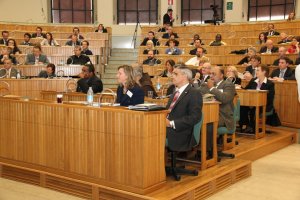
Past the Ambassador and Dr. Diaz, in the white...
On October 12, 2010, the U.S. Embassy to the Holy See and the Pontifical Gregorian University sponsored a conference entitled “Building Bridges of Hope: Success Stories and Strategies for Interfaith Action.” The purpose of the conference was to discuss how people of different faiths could work together to address global problems. Nine panelists from different faiths spoke on the topics of environmental protection, equitable development, and conflict resolution, sharing their religion’s perspective on their panel theme plus concrete examples of interreligious cooperation in that field. The White House sent a keynote speaker, Dr. Joshua DuBois, to the event to emphasize the U.S. Government’s senior-level support for the initiative.
[Taken from the conferences wikisite, which includes full transcripts of presentations: http://bridgebuilders.wikispaces.com/]
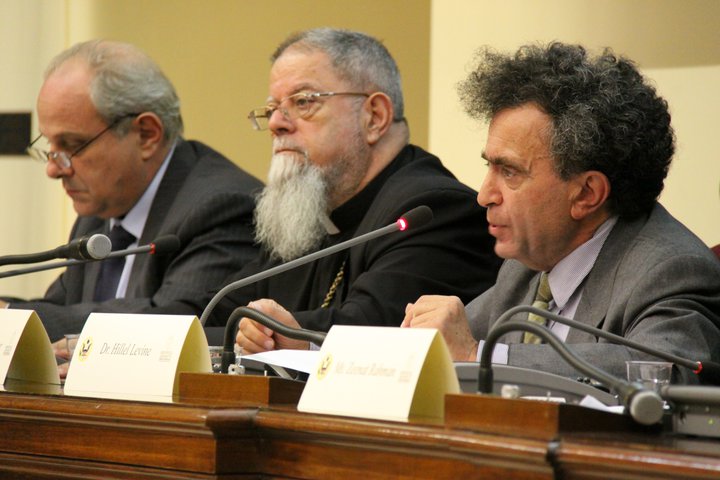
Foclare Representative; Melkite Archbishop Elias Chacour; Dr. Hillel Levine
The Environment, Ethical Development, and Conflict Prevention were the three panel themes of the conference, each addressed by three panellists from each of the three Abrahamic faiths: Judaism, Christianity, and Islam. Not all were academics. Business and NGO leaders, clergy and politicians were among the presenters, providing for an even greater variety of approaches to the questions of interfaith dialogue and action.
Take a few minutes to peruse the conference on the link above!
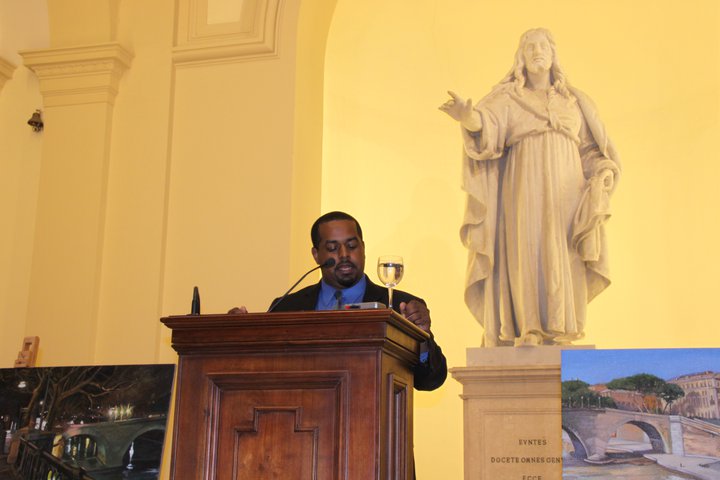
Dr. Joshua DuBois, Director, White House Office of Faith-Based and Neighborhood Partnerships
Russell Berrie Foundation Board of Trustees
For three days this week, the Angelicum, the Lay Centre, and the Russell Berrie Fellows hosted the board of trustees of the Russell Berrie Foundation, which grants the funding and direction for our Fellowship. It was the first time the full board had come to Rome to see first-hand how the program was progressing.
In addition to the 20 Fellows (Ten each year for two years) funded, the Foundation also provides for the John Paul II Center for Interreligious Dialogue at the Angelicum, supplies visiting faculty for six intensive courses this year, and the annual lecture in Interfaith Dialogue featuring a world-renowned speaker.
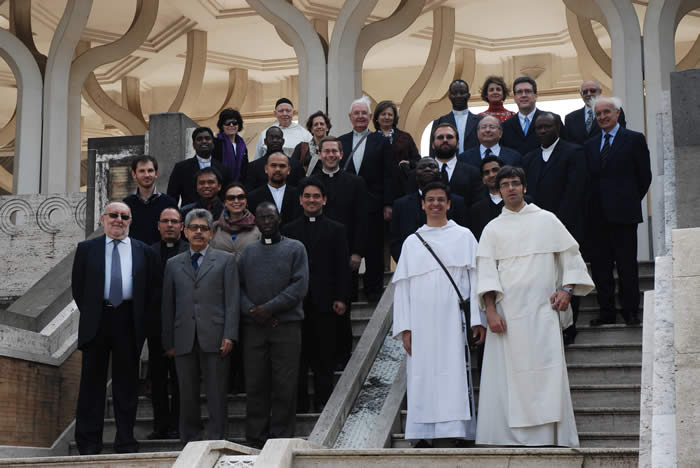
Russell Berrie Fellows with Angelica Berrie, Rome Islamic Leadership and Angelicum staff
The six trustees were friends, family, and colleagues of Russ Berrie, the successful New Jersey entrepreneur with interests ranging from Catholic-Jewish relations, to business leadership development, medical diabetes research, and fostering a Jewish renaissance. Angelica Berrie, his widow, is chair of the board.
Three of the trustees had come to Rome in early 2005 to meet with John Paul II, and at that time met with some of Rabbi Jack Bemporad’s students. This encounter sparked the idea that became the Russell Berrie Fellowship in Interreligious Studies. Over lunch, one of the trustees told me that, as the son of two Holocaust survivors, he was completely surprised by his welcome in Rome on that visit and the attitude of these post-Vatican II Catholics. Not what he expected or had experienced in the past; he became a convert to the cause of dialogue.
I had shared with him and then with the entire group that, being raised not only post-Vatican II but by parents formed mostly after the Council themselves, nothing could be more antithetical to Catholicism than anti-Semitism. It was in fact fairly late, in college, that I first encountered a history of the Church with the Jews that was anything other than the very positive relations we now largely enjoy, and it was a shock. For the man with whom I was speaking, his surprise had been at discovering my generation’s positive disposition.
Several events gave the Fellows and the trustees time to meet and mingle, along with officers of the Angelicum and then at the Lay Centre. A more formal presentation was offered by four of us representing the two cohorts of current Fellows: Myself, Paola Bernardini (Italy), John Bakeni (Nigeria), and Taras Dzyubanskyy (Ukraine).
Russell Berrie Foundation Trustees
My remarks focused on three sections: 1) Who am I and what is my background in interreligious dialogue, 2) Why Rome and the Angelicum, instead of somewhere like Boston College or Notre Dame – places with stronger academic reputations and established Jewish-Catholic studies and resources for dialogue? And 3) Where is the future of our dialogue, and my role in it as a Fellow?
Most people have heard my vocation story, or at least the early part of it. I distinctly remember where I was when, at the age of 7, I discovered that not all Christians shared the same Church. I was scandalized, even then, and vowed to spend my life working to heal the divisions. At about the same time I discovered that not everyone was Christian, but this delighted me and I determined to learn as much as I could about the world’s religions.
But the question in the minds of several people is, Why Rome? Why Angelicum? There is the historical opportunity in the form of the personal connections between Russ Berrie, Rabbi Bemporad (who has been visiting professor at the Angelicum for over a decade) and Fr. Fred Bliss (former chair of the ecumenical section). It is not the only place where a Rabbi teaches on a Catholic theology faculty, nor the first. But it is where Karol Wojtyla got his doctorate in philosophy and where, for example, Cardinal-designate Archbishop Wuerl of Washington and Archbishop Dolan of New York did their studies while in Rome.
The Angelicum is the second oldest of the pontifical universities, after the Gregorian, and the only one which offers the specialization in ecumenism or an entire programme in English – making it more accessible to several of the countries where the growth of the church is strongest, in Africa, India, and southeast Asia. The program here offers exposure to a broader cross-section of the church and future episcopate than would be the case at even the best U.S. or northern European university. Just being part of such a diverse fellowship, often being one of only two or three North Americans or native Anglophones in a class offers insight to the dialogue within the church as well as dialogues ecumenical and interreligious. As I noted in my remarks, the Fellows represent the demographics of the Church better than the College of Cardinals does, though we need more from Latin and South America.
One of the most interesting comments for me came from our sole Latina, Claudia, from Chile. Leadership was a theme repeated by the trustees and staff of the Foundation during our orientation and meetings. As a lay person, she says, she had never considered what leadership in the Church would mean, for her. Obviously, she will not be bishop or a religious superior, and this is true of most of us. Even after having studied theology for several years, and having been invited to Trent for an international symposium in her field, she had never been asked by anyone within the Church to think about her leadership role. Remarkable.
Caravita Community Celebrates 10 Years
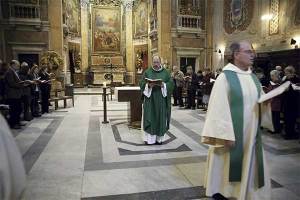
Eucharist in the Caravita Community
I have mentioned it before, but the Caravita Community is a quasi-parish that meets at the Oratory of Saint Francis Xavier “del Caravita”. It is comprised of an international assortment of Anglophones, with members from about 20 different countries, and is staffed by priests from four different religious orders. Most of its membership travel frequently, and it is a particularly welcoming place for English-speaking pilgrims to Rome. Several people I have meet are in Rome regularly as general officers for their religious community, students or faculty at the pontifical universities, on diplomatic assignment, or staff in the Roman curia. While i try to worship at a variety of churches on Sunday to get a truly catholic experience of the Church, the Caravita Community is always and already familiar.
This weekend they celebrated their 10th anniversary, though even this recent endeavour reflects the longer tradition of the place. Prior to October 2000, however, it had not been used as a place of regular worship since 1925.
Named after the Jesuit Pietro Gravita who was responsible for its construction, the oratory was built between 1618 and 1633 on the site of an existing church, San Nicola de Forbitoribus, and then completely rebuilt between 1670 and 1677 (Baroque, anyone?) The Oratory was constructed to house the nine different lay “congregations” (which would later become to Sodality movement) linked with the work of the Jesuits and served as a centre for lay formation and social outreach in the 17th and 18th centuries. The first women’s lay “congregation” was housed here.
The importance of lay ministry and formation, the dedication to the social mission of the church, and active ecumenical participation remain a part of the community’s identity. Similarly, a rich artistic heritage rests in the place, from 17th century frescoes to the 18th century performance of the teenage Wolfgang Amadeus Mozart, his debut in the Roman court. In honor of a new organ installed into the oratory, part of the weekend’s events included a concert dedicated “Mostly Mozart”.
 A symposium entitled “How Firma Foundation: The Role of the laity and the Church’s Mission in the Third Millennium” included presentations from John Padberg, SJ on the history of Lay Confraternities, a report from Kerry Robinson of the National Leadership Roundtable, and an analysis of last year’s African Synod by Cardinal Peter Turkson of the Pontifical Council for Justice and Peace.
(The symposium and concert occurred while I was at the day of Reflection at Tre Fontane, and no one seems to have recorded the talks. I am trying to track down the speakers’ papers or notes, if they are available…)
The conclusion of the weekend was Ecumenical Evensong, with participation from the membership of Churches Together in Rome, the ecumenical organization for English-language churches in the City. Canon David Richardson, the Archbishop of Canterbury’s Representative to the Holy See, presiding and Donald LaSalle, SMM of the Caravita Community staff preaching.
Tre Fontane and Abbot Edmund – A Day of Reflection

Right Rev. Edmund Power, OSB, Abbot of St. Paul Outside the Walls
The year officially started with a week of orientation activities at the Lay Centre, with the community half comprised of returning residents and half of new members. Robert White, our assistant director and patristic scholar, lead a couple of guided walks around the city and the neighbourhood. House meetings included topics ranging from the sharing of life and responsibilities, prayer in community to living with diverse faith traditions and the psychology of building healthy community life. Felix Körner, SJ and Tim Costello, SM of the Gregorian joined us on different nights to add their wisdom to the discussions.
The week culminated with a day of reflection spent at the Casa San Bernardo at Tre Fontane and lead by Abbot Edmund of the Benedictine Abbey at St. Paul Outside the Walls. Tre Fontane is the site where Paul was martyred and where, according to pious legend, after he was decapitated his head bounced three times. At each place where his head hit the ground, a spring welled up. One of the churches on the site was constructed over the three springs, which are each commemorated with their own altar featuring a relief of the Apostle’s head. Nevermind the fact that pre-Christian pagans had already built shrines on the site of the three fountains…
The church, it is interesting to note, has two main altars on the axis, over which are depictions of the martyrdom of St. Peter on one end and St. Paul on the other. Even here in this place of the martyrdom of Paul, his co-patron of Rome seems to have gained the upper hand as all the chairs are oriented to the altar of Peter rather than Paul!
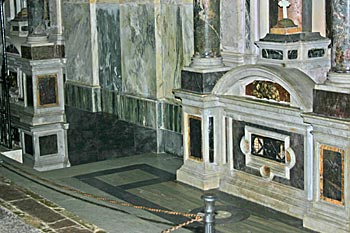
Fountains (under altars) at Chiesa San Paolo alle Tre Fontane
Three churches and a retreat centre share the grounds with the Cistercian abbey. In addition to the Church of San Paul of the Three Fountains are the abbey church of Sts. Anastasias and Vincent, and the church of Santa Maria Scala Coeli. The Benedictines and the Trappists are both involved in various ways with the site, which includes among its various activities the raising of the sheep which are shorn on St. Agnes’ Day to prepare the pallia presented to Metropolitans on the Feast of Sts. Peter and Paul by the bishop of Rome.
Abbot Edmund Power, OSB, lead our day of prayer and reflection around the theme of Hospitality as Spirituality according to St. Paul and to St. Benedict.
Hospitality is reciprocal, not just social but sacred. This can be missed in the host-guest relationship in English, but in Italian the same word is used for both: Ostpite. Recieving hospitality is as sacred a duty as offering it. Paul’s observations that “All is Grace” indicates that following the law is insufficient, we must rely on one another. Little wonder the semitic cultures put such emphasis on hospitality.
Genesis 18 gives the famous account of Abraham receiving the three figures at his tent under the Oak of Mamre. (Interestingly, today is the Feast of the Patriarch Abraham, according to the Roman Martyrology). Paul treats the topic in three places we examined:
Romans 14.1-4 –
Welcome anyone who is weak in faith, but not for disputes over opinions. One person believes that one may eat anything, while the weak person eats only vegetables. The one who eats must not despise the one who abstains, and the one who abstains must not pass judgment on the one who eats; for God has welcomed him. Who are you to pass judgment on someone else’s servant? Before his own master he stands or falls. And he will be upheld, for the Lord is able to make him stand.
2 Cor 6.11-13 –
We have spoken frankly to you, Corinthians; our heart is open wide. You are not constrained by us; you are constrained by your own affections. As recompense in kind (I speak as to my children), be open yourselves.
Phil 4.14-20 –
Still, it was kind of you to share in my distress. You Philippians indeed know that at the beginning of the gospel, when I left Macedonia, not a single church shared with me in an account of giving and receiving, except you alone. For even when I was at Thessalonica you sent me something for my needs, not only once but more than once. It is not that I am eager for the gift; rather, I am eager for the profit that accrues to your account. I have received full payment and I abound. I am very well supplied because of what I received from you through Epaphroditus, “a fragrant aroma,” an acceptable sacrifice, pleasing to God. My God will fully supply whatever you need, in accord with his glorious riches in Christ Jesus. To our God and Father, glory forever and ever. Amen.
We concluded with a reading and observations on the Rule of Benedict, chapter 53, which deals with the “Reception of Guests”. Benedict describes a formal, sacramental act of welcoming a guest and describes the balance between keeping the life of the community going yet making exceptions to fasting and other norms in order to make the guest be welcome. The priority he gives is clear: First the poor and pilgrims, with whom Christ is particularly received, then brothers in the faith, and others.
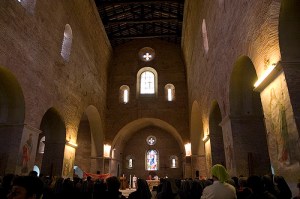
Past and Present in Rome – una bella ospita
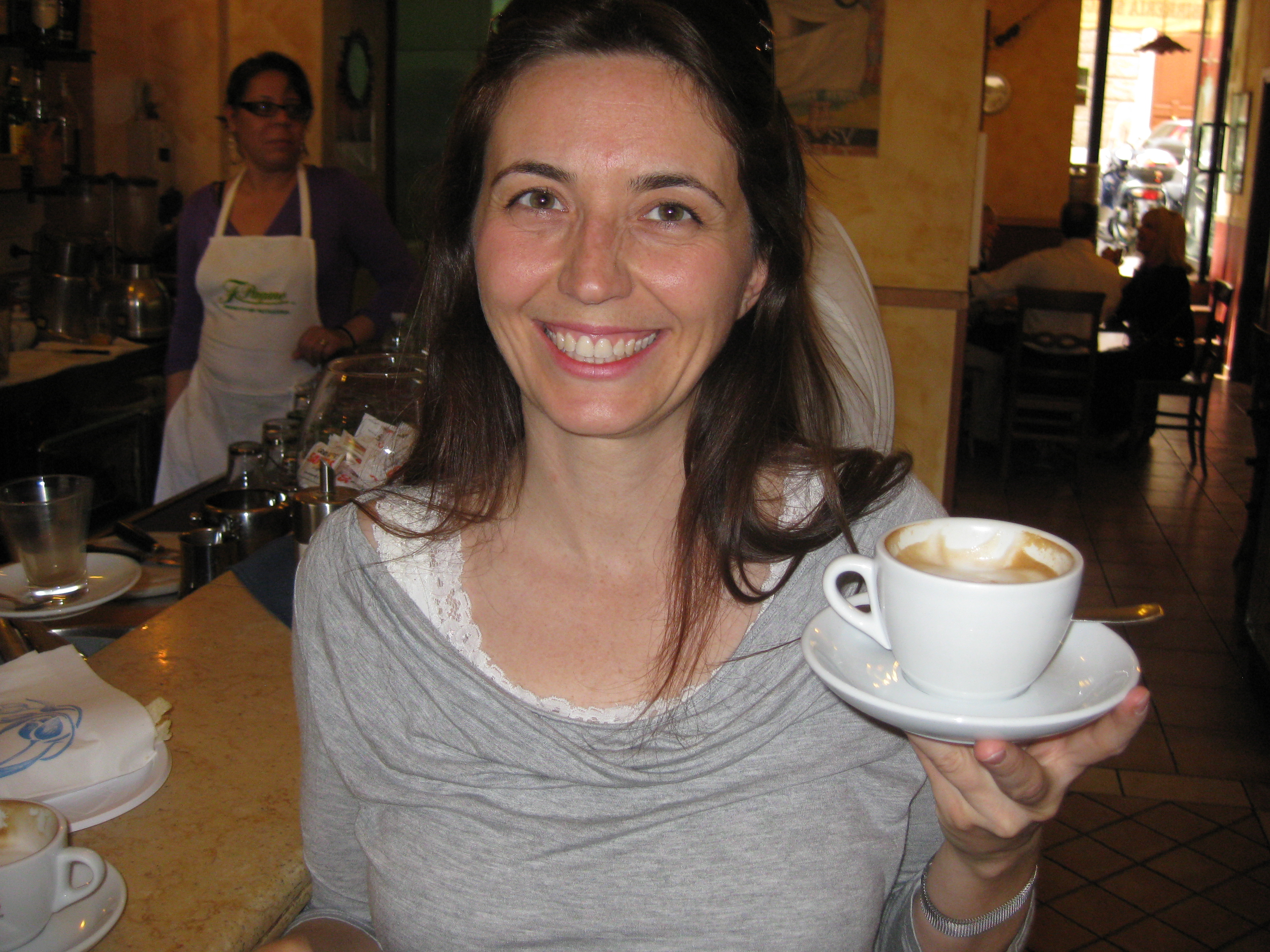
Simone’s first cappuccino
Almost exactly 14 years ago, in my freshman year at Notre Dame, I met a spunky grad student in the medieval institute while serving at the altar of the Basilica of the Sacred Heart. In the decade since my graduation, I have not seen Simone until she arrived in Rome on October 1. In fact, there was a period of several years where I had lost complete contact with her (I am sad to say a common situation with some of my best friends from those days). It was no surprise then that one of her first observations was along the lines of, “Well, AJ, you are not 18 anymore!”
Dr. Simone Brosig received her PhD from the medieval institute at Notre Dame and now serves as Director of Liturgy for the Diocese of Calgary, Alberta. As blessed as I was to have almost two weeks to reconnect with a good friend, I think I can safely say she was a blessing to the whole Lay Centre community while she was with us – and certainly our Oasis in the City provided her a welcome refuge from the chaos of Rome.
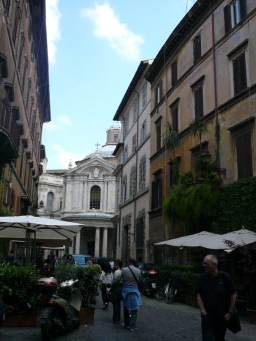
Via della Pace
Over the next 12 days I made sure we visited all the familiar sites in the historic center: the four major basilicas, the fori imperiali, the pantheon, piazza navona, trevi fountain, the Gregorian and the Angelicum, and others. Given her Byzantine interests, we made a point to spend time in Santa Maria in Domnica, Santa Maria in Trastevere, San Clemente and Santa Praessede. We also managed a decent amount of gelato and genuine Roman pizza dinner on the Via della Pace, a classic Roman outdoor street scene if ever there was one.
Among a few new places for me were a day trip to Ostia Antica, a sizeable town in ruins that was the ancient seaport and military outpost for the Roman Republic and later Empire. We visited the Musei Borghese within the vast Villa Borghese at the north end of Rome – an elaborate estate once home to Scipione Borghese, the cardinal nephew of Pius V who precisely embodies the ecclesiastical nepotism of the period. (The word for nephew in Italian is in fact, nepote).
We also spent a day in Trastevere, discovering parts of the neighborhood I had not before, including Santa Cecelia and the little church home of the Heralds of the Gospel in Rome, San Benedetto in Piscinula, which houses a cell said to have been occupied by St. Benedict of Norcia when he came to Rome.
On a Sunday after introducing Simone to one of the best gellateria in Rome, the Gelateria del Teatro, we sat on the steps of a nearby church to eat the creative indulgence. San Salvatore in Lauro, as it turns out, was just about to celebrate the Eucharist with the auxiliary bishop responsible for the centro storico, Most Rev. Ernesto Mandara, presiding. It was one of the most authentically, local Roman liturgies I have been to, and concluded with the opportunity to be blessed with a second-class relic of Padre Pio (his habit). Not something I would have sought out, but truly Italian!
Also thanks to her visit I discovered that there are guided tours of the Vatican Gardens (which I will have to try), plenty of places to go dress and shoe shopping in Rome (which I will not be trying), and that one of her former professors is given a stately burial in the crypt of San Clemente, under the 4th century basilica.
The highlight of Simone’s visit was herself, of course, but a close second was Divine Liturgy on the 10th with the Melkite Catholics at Santa Maria in Cosmedin. Celebrating the Eucharist in Arabic, Greek, and Italian the small community follows the Liturgy of St. John Chrysostom like most of the Byzantine rite churches, but somewhat simplified compared to the Slavic iterations. With the Synod of Bishops for the Middle East, the following week would see the Patriarch and most of the bishops worshiping with the small community – ‘unfortunately’ I was to be at the canonizations at St. Peter’s instead.
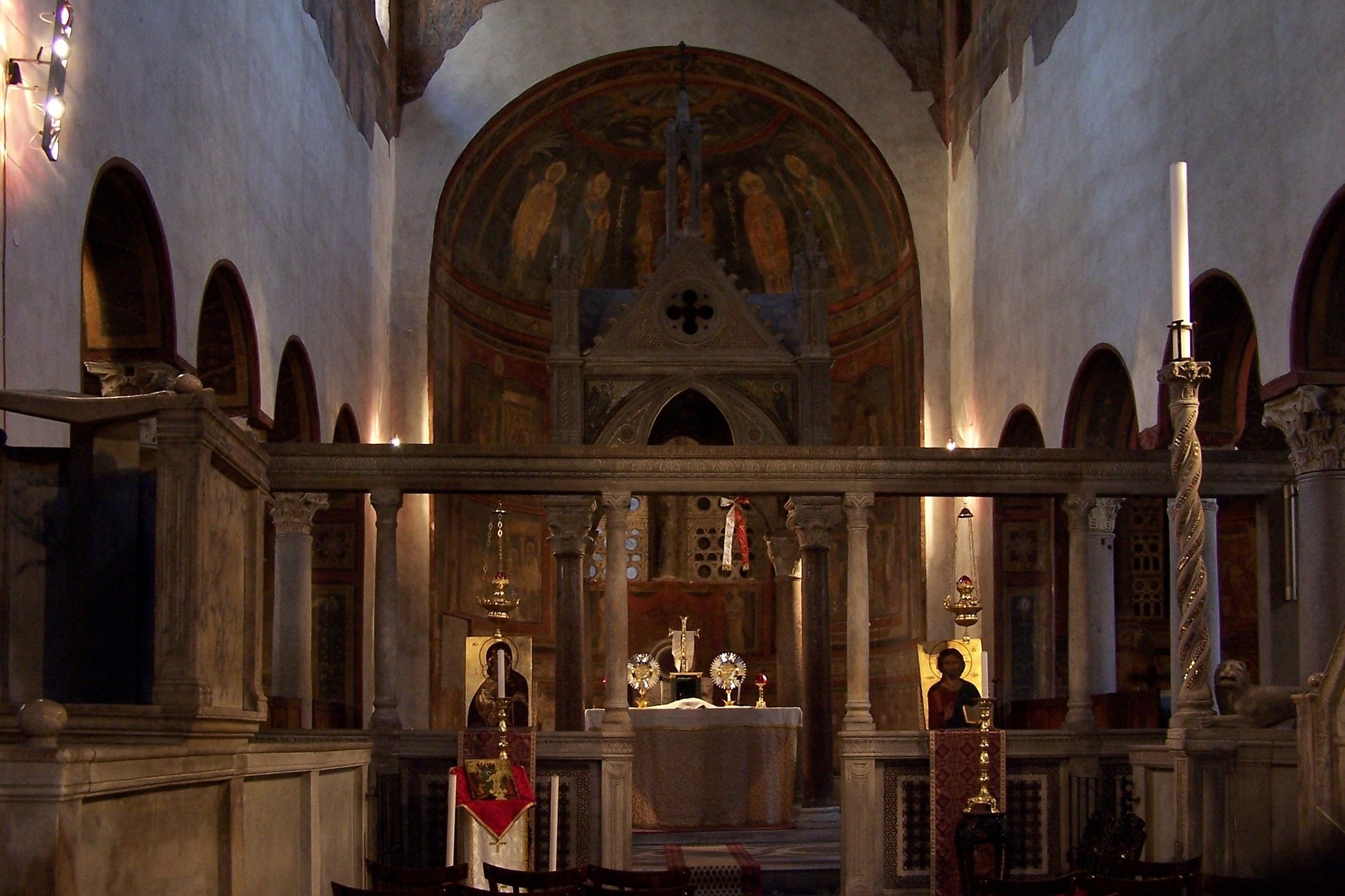
Santa Maria in Cosmedin
 The Ecumenism Blog