
Home » Church and World (Page 9)
Category Archives: Church and World
Beatification debriefing in brief

New image of the newly Blessed
This morning I have already begun to hear stories of people’s experience here in Rome for the beatification, from one being interviewed by CNN in the middle of Piazza San Pietro, to others who gave up trying to get within a kilometer of the Vatican, and still others who deliberately skipped town to avoid the chaos and the crowd.
The Beatification Mass began at 10:00am Sunday, with an hour-long rosary and divine mercy chaplet planed ahead of time.
Vatican security had cleared the Piazza at 7:00pm Saturday night, though people had already staked places and laid out sleeping pads on the cobblestones around the square. They were moved back beyond a large perimeter. We saw nearly every law enforcement agency available in the city – Policia Municipale, Guarda di Finanza, Carabinieri, Corpo Forestale, Polizia di Stato, et al.
One friend was at the perimeter by 1:00am Sunday, and she made it no closer to the altar than the obelisk in the centre of the piazza. Others arrived at 4:00am and were never able to get into the square. The gates officially opened at 5:30am, allowing people into Piazza San Pietro and Via della Conciliazione. By 6:15am, people were packed up to Castel Sant’Angelo. We followed a group of bishops into the crowd, only to be turned back on the close side of the castle – even the bishops could not get through.
Even in lateral directions the area around the Vatican was packed – I have not yet seen an aerial photo that was able to capture the whole scene of people-packed streets, I do not know if any of the helicopters were high enough to get that wide a view.
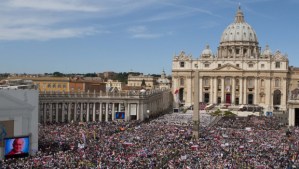
The 5.7 acres of Piazza San Pietro hold only a fraction of the people who came to Rome for the beatification
Some people decided to bail, and go somewhere they could be less crowded and watch it on a jumbotron – the city had a dozen such locations set up, including the Cathedral of San Giovanni in Laterano and the Circo Massimo. Others continued to push in, but never made it close. We found shade and refreshment under the umbrellas of a café’s outdoor seating area, with an oblique view of a jumbotron at Piazza Risorgimento, with no audio but a pilgrims radio tuned to a station translating the whole thing into Polish.
We spent almost two hours in a line to get a cappuccino and cornetto, and then go to the bathroom, once it was decided there was no where better to go unless we wanted to bail and watch at one of the other centers around the city. We got out just in time for mass to start, and stood (thankfully in the shade with tables to put our things on), for the entire 3 hour liturgy and angelus address. Even the English reading was translated into polish on the radio, so I could only relay the parts of the mass as I saw from the partial view of the screen and from the singing in Latin.
I am glad I was here for an historic event, grateful to be in a place with shade and with a friend, but sorry that, given the exhaustion of staying up all night after the vigil that we did not get closer than we did. But, I never thought I would get as close as we did, either. For his canonization, which I expect this time next year, I think the view from San Giovanni in Laterano sounds pretty good – especially for a pope who repeatedly said his role as bishop of Rome, along with Servant of the Servants of God, was the most important responsibility of the pope.
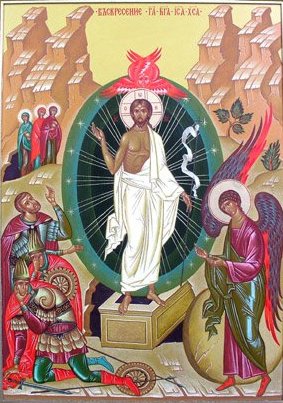
Christ is Risen, Alleluia!
Is there anyone who is devout and a lover of God?
Let them enjoy this beautiful and radiant festival.Is there anyone who is a grateful servant?
Let them rejoice and enter into the joy of their Lord!Is there anyone who is weary with fasting?
Let them now receive their wages!If anyone has labored from the first hour,
let them today be justly rewarded!If anyone has come at the third hour,
let them with thanksgiving join the feast!If anyone has arrived at the sixth hour,
let them have no doubt; for they shall suffer no loss.If anyone has delayed until the ninth hour,
let them come without hesitation.If anyone has arrived even at the eleventh hour,
let them not fear on account of their delay!For the Master is gracious and receives the last even as the first;
He gives rest to him that comes at the eleventh hour,
just as to him who has labored from the first.He has mercy upon the last and cares for the first;
to the one He gives, and to the other He is gracious.
He both honors the work and praises the intention.Enter all of you, therefore, into the joy of our Lord!
Whether first or last, receive your reward.
O rich and poor, one with another, dance for joy!
O you ascetics (sober) and you negligent (slothful), celebrate the day!
You that have kept the fast and you that have not, rejoice today!
The table is rich-laden: feast royally, all of you!
The calf is fatted: let no one go away hungry!
Let all partake of the cup of faith.
Let all receive the riches of His goodness!Let no one lament their poverty,
for the universal kingdom has been revealed.
Let no one mourn that they have fallen again and again,
for forgiveness has risen from the grave.
Let no one fear death, for the Savior’s death has set us free.He that was taken by death has annihilated it!
He descended into Hades and took Hades captive!
He embittered it when it tasted His flesh!
Anticipating this, Isaiah exclaimed:
“The nether world is all astir, embittered as it prepares for your coming!”Hell was embittered, for it was abolished!
It was embittered, for it was mocked!
It was embittered, for it was purged!
It was embittered, for it was despoiled!
It was embittered, for it was bound in chains!Hell took a man, and came upon God!
It took earth, and encountered Ηeaven!
It took what it saw, but crumbled before what it could not see!O Death, where is thy sting?
O Hades, where is thy victory?Christ is Risen, and you are overthrown!
Christ is Risen, and the demons are fallen!
Christ is Risen, and the angels rejoice!
Christ is Risen, and life reigns free!
Christ is Risen, and the tomb is emptied of its dead!For Christ, being raised from the dead, has become the first-fruits of those who have fallen asleep. To Him be glory and power forever and ever. Amen!
[Paschal Homily of St. John Chrysostom of Constantinople, Trans. Deacon Mark Baker, Andre Levergne, et al. Edited by A.J. Boyd]
Colloquium on Anglican Patrimony in light of the Apostolic Constitution: A Canon Law Perspective
After class on Friday, my professor and I walked down the hill from the Angelicum to the Anglican Centre in Rome to join a group of canon lawyers from the Anglican Communion and the Catholic Church engage in a presentation and a conversation on the nature of Anglican Patrimony in light of the Apostolic Constitution Anglicanorum Coetibus.
In the wake of the 2009 apostolic constitution making provision for the establishment of personal ordinariates, questions have been raised about the exact nature of the “Anglican Patrimony” which is named in the text of the constitution and its appended general norms. Cardinal Levada’s answer to the inquiring Anglicans was, “we are hoping you can tell us!” To begin answering that question, the Anglican Centre in Rome is coordinating a series of meetings this year on the theme Anglican Patrimony in light of Anglicanorum Coetibus.
There were 22 participants in the workshop: Three lay women, four lay men, and fifteen priests – Most of the participants were members of the standing colloquium of Anglican and Catholic canonists, who chose to have their annual meeting in conjunction with this workshop.
Questions raised and observations made included the following:
What exactly is “patrimony”? Canonically the term is used in the Latin code only in reference to the charism of religious orders and the particular customs of local churches in the formation of priests. In the Code of Canons for the Eastern Churches, it more clearly refers to the liturgy, theology, spirituality, and discipline of a particular church (CCEO 28, 39, 405). If the model of religious order charism is an example, it was noted by a Franciscan friar present that it took Clare 40 years to get the rule she wanted approved by Rome, a constant give and take, debate and discussion between the founder’s vision and the hierarchy’s presumptions – and we are only 16 months from the announcement of the Apostolic Constitution and six weeks from the establishment of the first actual Ordinariate. We may not know for some time what this received Anglican Patrimony will actually be.
There was some discussion that the ordinariates are apparently not limited to Anglicans and former Anglicans. [Though, in rereading the text, it does seem to be limited] Indeed, many of the traditionalist Anglicans attracted to it are former Catholics – canonically still considered Catholic by the Latin code. But does this mean that Lutherans, Baptists, et al. can join the Catholic Church as part of the Ordinariate? What/who defines an “Anglican group” that can corporately join the Ordinariate? Four of the provinces of the Anglican Communion are in fact united churches, local ecumenical unions between Anglicans, Reformed, and other denominations. Could a Presbyterian elder of one of these united churches join and become an Anglican Ordinariate priest? Many of these members of united churches are part of the Anglican Communion but do not think of themselves as Anglican.
Why was the model of the pastoral provision not simply adopted more widely? (Where personal parishes would be set up allowing for use of Anglican rites and lead by former Anglican clergy) In this case it was thought that the patrimony would not be sufficiently preserved, and Pope Benedict finds the Anglican patrimony to be worthy of preservation within the Catholics Church, not just by the Anglican Communion. (This observation lead to an entire conversation about the locus and determiners of Anglican patrimony).
What would be the approved liturgical use in the Ordinariate, and would this be up to each Ordinariate individually? Someone had heard the 1928 Book of Common Prayer, which had been approved for use by the Episcopal Church in the US but rejected by Parliament for use by the Church of England, would be the model. This was unconfirmed, and others noted that most Anglo-Catholics, in England especially, are already using the Roman rite anyway and would likely continue to do so.
This lead to the speculation that there could be an Anglican Ordinariate in which no particularly Anglican Eucharistic rite was celebrated, somewhat ironic when one considers that most people probably think of Anglican patrimony in primarily liturgical terms.
Why not establish an Anglican Catholic Church sui iuris, like the Eastern Catholic Churches? The thought here was the mention in the constitution of seeing the Anglican Church as a particular expression of the Latin Church, its rites as variation of the Roman rite – as well as not wanting to do any more to appear to be bringing back uniatism as a form of ecumenism, something which has been rejected by the Catholic Church in its agreements with the Orthodox.
Since the Anglican Communion officially recognizes two sacraments, how will the other five be celebrated in an Anglican Ordinariate, since the Catholics Church accepts seven? This question was ‘corrected’ as someone else noted that the Anglicans do, in fact, recognize all seven sacraments and both churches, as agreed in ARCIC I, recognize a hierarchy of sacraments – the two dominical sacraments of Baptism and Eucharist holding a pride of place among the seven sacramental acts, for both churches, though this is expressed differently in parts of the Anglican Communion than others.
Candidacy for ordination, in the personal ordinariates, will be determined by the Governing Council – but this is neither Catholic nor Anglican, for both communions currently put this decision in the hands of the ordaining bishop, though with appropriate consultation.
Some noted that there had been popular speculation that the exception to celibacy would only be granted pro tempore, however, this would have been made clear in the text if that was the intent. Each will be appealed on a case by case basis, as celibacy remains the ideal for those who were not already ordained in the Anglican church, but it remains a real, practical possibility.
Married bishops are a part of Anglican Patrimony, based on scripture, yet the Official Commentary on the Apostolic Constitution, written by Jesuit Father Gianfranco Ghirlanda, Rector emeritus of the Gregorian, has “absolutely excluded” the possibility of married bishops “given the entire Catholic Latin tradition and the tradition of the Oriental Catholic Churches, including the Orthodox tradition…” The VIS communiqué on 15 January announcing the erection of the first Personal Ordinariate of Our Lady of Walsingham for England and Wales, went so far as to say, “For doctrinal reasons the Church does not, in any circumstances, allow the ordination of married men as bishops.”
Given all of that, the question was asked, how much a part of the Anglican patrimony are married bishops, and what reasons could there be to exclude them? It was noted that despite the VIS announcement, there are no doctrinal reasons for not ordaining married men to the episcopate, only disciplinary reasons. It is suspected, given the wording of Fr. Ghirlanda’s commentary, that this could be out of ecumenical concern for our relations with the East – but also noted that the traditions of Latin and Eastern and Oriental churches have always differed, and the Orthodox would likely not be concerned whether we had a different discipline in the West vis a vis married bishops or not. Strangest of all, some noted, was that though the married former Anglican bishops would only be ordained to the presbyterate, especially those serving as ordinary are still allowed the use of pontificals, the symbols of episcopal office such as the pectoral cross and ring.
What will the role of priest’s wives be in the Ordinariate, if any? What role do Anglican clergy spouses have now? This varies in the Anglican Communion, depending on the cultural context, and would likely vary as well in the Ordinariates. In some places the priests wife is treated as the ‘first lady’ of the parish, and the bishops wife even called “mama bishop” and treated as the first among these. In others, they have no role unless they are also a theologian or minister in the church, or volunteer like any other parishioner.
Final comments came from two Anglicans. The first shared that he had initially thought this “pastoral response” was anything but ecumenical, but as he reflected on it, the idea formed that the Anglican patrimony to be received by the Catholic Church in the Ordinariates was the people themselves. In this way, by receiving them, we are receiving some part of Anglicanism, and this may eventually turn out to be one more way in which the ground was prepared for the full-scale reception of each other in full communion down the road.
The other, who also stated considerable concern, shared that he was afraid that this would in fact have some rather negative ecumenical results, again by reason of the people received through the Ordinariate – the Anglicans may be all to happy to see them go, and he fears we Catholics may not be all that happy to receive them, once we get to know them!
On that note, we broke for drinks.
Guest response to ‘Liberal’ and ‘Conservative’ in the Church
My blog posts appear on my Facebook wall, and sometimes get comments there. A friend and former parishioner of mine, Colleen Walsh, shared this reply to my quote from Fr. Ladislas Orsy on ‘Liberal’ and ‘Conservative’ in the Church. I would like to see continued conversation on this idea, and will add some of my own thoughts soon, but I asked Colleen if she would allow me to repost her comments here on the blog so a broader audience could take up the theme, and she kindly agreed. [I have made some minor copy and formatting edits, but not edited content]
As always, replies, comments and critiques are welcome, but only respectful contributions will be approved!
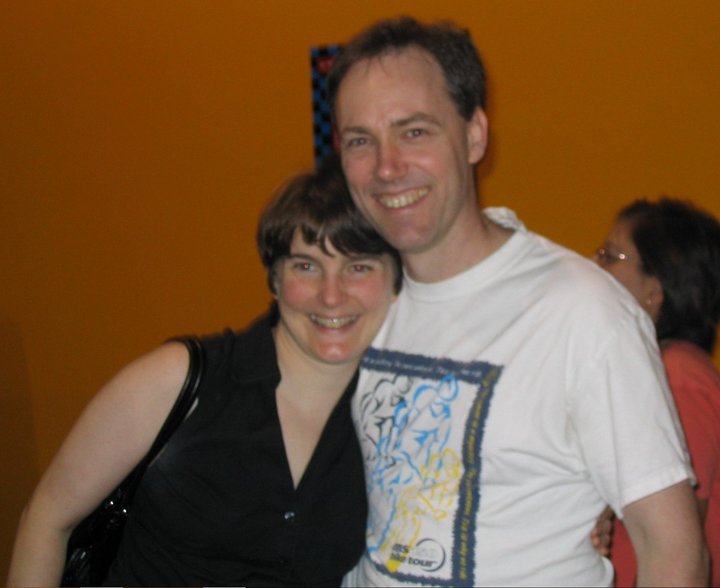
Colleen and her husband, Pat
A.J., I think there is actually a post-Vatican II split, some would call a schism of sorts, that is not being considered in this article.
I would have to ask this: If the people who like the Tridentine Mass would be considered the conservatives, and my group could be considered the faithful liberals, due to being post Vatican II, then what would you call the folks that seem to be more liberal than me? There are many examples of this, but I will only mention two for illustrative purposes. One example would be the people in the church that want women priests. Another group of people would be those who seem to actually embrace integrating eastern religious ideas and rituals into the Catholic church. I have had contact with many people of both these beliefs, neither of which, I would wish to be grouped with, if a line is being drawn.
The latter of these groups baffle me. I mean, If Jesus is the real thing, and our church is the One True Church, then it appears that one who believes in the integration of Eastern religion is implying that God somehow goofed and left something out when He started our church. How can that be if we are the One True Church? Last I checked, God doesn’t make mistakes. He picked males to lead his church from the beginning and He also chose His Son to be our saviour, who could bring us to His Father, God. God didn’t expect us to go through some guru to in order to have a relationship with God. If Jesus is the way and no one can come to His Father but by Him, then why do these people feel all paths lead to God? God is a loving God, so why would He ask His only begotten Son to die for us, a horrible painful death, if there were going to be other paths to Him anyway? God would not do it if He thought there was another way. God, in His infinite wisdom, is way smarter than us, and knows the weight of our sin, and it is very, very, heavy! Just look at abortion, for example.
Many folks think I am conservative because I like taking communion on the tongue and am glad that they put kneelers back the churches around here. I am opposed to the idea of inclusive language, don’t agree with the idea of women priests and am against using female altar servers. (I think female altar servers helped contribute to our dwindling number of vocations to the priesthood) I also really like that Mother Angelica and Fr. Corapi and Priests for Life are not afraid to stand up for the sanctity of life in this culture of death. I believe nuns should be happy to wear the habit, and should not be hiding their light under the bushel basket of street clothing. They shouldn’t be afraid to show their Catholic identity! I also do not like round churches as I believe we should be focused on the miracle of the Mass, the Eucharist, not the people across the room from us. That is a distraction. I believe the tabernacle belongs behind the alter, not in a separate room adjacent to the sanctuary like it’s some sort of a side show in a circus. The Eucharist is central to our faith and should not be kicked to the side of the building somewhere. I think a crucifix belongs inside the sanctuary at all times, not these statues of the risen Christ, because as Catholics, not only is it part of our identity, but it is an important reminder that we should see often. (Jesus loves us THIS MUCH, and suffered for us THIS MUCH) We are only human and need that reminder! The devil wants us to forget this. Seeing Jesus crucified helps to form a good sense of Catholic guilt. Contrary to popular belief, Catholic guilt can be a good thing. 🙂 It should be an integrated part of every conscience. It helps us to make the right choice. It helps us make a good examination of conscience. I think the risen Christ status are beautiful and would be a fine, even welcome addition, to today’s church, as long as they are not being used to replace the crucifix. They could be set up at the end of the stations of the cross to finish the story. 🙂 As for stained glass windows, I think it is a shame my first parish, sold their beautiful building in the 80’s to build a new round, visually plain, modernized church without kneelers. The old building had previously been a seminary and the stained glass and mosaics told stories of Saints and the Bible along with a beautiful stations of the cross. This beauty, along with the presence of the Eucharist in the tabernacle behind the altar, and the crucifix in front of the congregation which was a constant reminder of the ultimate sacrifice, created a beautiful setting for Mass, even with the folky guitar music I so enjoyed at the time. It was the perfect mix of old and new, in my opinion.
On the other hand, I have friends who think I am way too liberal because I do not want to go backwards to a complete Latin Mass. I think it’s important to hear the Word and understand it in ones own native language. (on a side note, I have to say, I dislike the bilingual masses our archdiocese is into doing. It seems there is always something lost for those who don’t speak both languages fluently, since they flip flop between the readings and songs. The only REAL bilingual part is the fact that the homily is said in both languages.) I attended a Latin Easter Vigil Mass once and although we could read along in English with every reading, the only part in a English was the homily. Even though the music was pretty, I wanted to sing along and was frustrated that it was mostly only the schola choir allowed to sing during the Mass. I think the part that got me most is that I felt a need to go back home and read the readings all over again in English because I still felt hungry for the Word! I have heard that I picked an extreme Mass to go to for my first Latin Mass, and that it was not typical to do every reading in Latin during many Masses, but I felt it really was not my worship style.
I very much enjoy Lifeteen Mass music, and am not opposed to clapping during songs in Mass. I have even sung with some of the “modern” music groups at different parishes and was even part of a Catholic handbell choir at a local parish before I moved up north. I listen to the local a Christian music station, and I even let my kids watch some secular TV shows, which would be considered taboo for some of my Tridentine friends, many of which don’t believe in even having a TV in the house at all. I am not opposed to holding hands during the “Our Father” and have been known to cross aisles and even give hugs during the sign of peace. Although, I try to wear my Sunday best, but I have to confess that on some occasions I find myself having to wear jeans to Mass. When this happens, I try to at least wear ones that are not too faded and can be sort of dressed up with a nice shirt and some shoes other than tennis shoes, after all it IS the King we are going to see! (Bishop Eusebio reminded me of that when he was our pastor at St. Elizabeth prior to becoming a bishop. It was kinda funny cuz I was so pregnant my feet wouldn’t fit my dress shoes, so I wore my fake birkenstocks the next week so as not to get reprimanded by Father. LOL) My Tridentine friends are almost never seen without a skirt, even on the playground and would never go to Mass without a veil. I do have to say that I am appalled at the fact that so many altar servers in our diocese that wear jeans and tennis shoes under their albs. I think it is not only tacky and distracting, but disrespectful to serve like this. Waiters at restaurant dress nicer than most of these boys!
I have been to charismatic gatherings over the years and have been baptized in the Holy Spirit and very much see the need to reach out to our protestant brothers and sisters and those of other traditions, though I do not believe we should be hiding our Catholic identity by trying to look like protestant churches. I believe music is a great place to find some common ground, both biblically and culturally in our liturgy without losing our Catholic identity in today’s world.
Believe it or not, there is a very large group that is often stereotyped as ultra-conservative, pre-Vatican II, but to the contrary, actually embraces the liberating aspect of hearing God’s Word spoken in a way that is meaningful to them in their own language. It is a group that appreciates the ability to sing praise to God with all the zeal given to us by the Holy Spirit, even, if it means clapping, and using guitars and drums! Yes, there is actually quite a large group of us conservative, yet modern (or as this article seems to call us, ‘faithful liberals’) post -Vatican II folks who are out there. We enjoy the ability to participate in Mass with a more modern worship style. The problem is that some people would like to throw us all into one category with the pre-Vatican II crowd just because we appreciate some of the beauty the old church had to offer, some of the same beauty you get to experience every day while you are in Rome. While we embrace the changes in liturgy given to us by Vatican II, we cling to whatever beauty and traditions we still have in today’s church, sometimes due to a deep understanding of the meaning behind the tradition and other times due to fear that before too long, the Church will be purged of all that identifies Her: throwing the baby out with the bathwater in an attempt to make Her more inviting to non-believers. It would be a sad day if they renovated Rome, yanked out all the crucifixes and kneelers, stripped the buildings of all the stained glass and mosaics in the name of Vatican II.
Quote of the Day – ‘Liberal’ and ‘Conservative’ in the Church
We hear much about the imaginary case of Conservatives v. Liberals in the church… The labels are misconceived, misplaced, and misleading.
Today’s “conservatives” are mostly clinging to convictions and habits developed mainly after the Council of Trent; rare among them are those familiar with the church of the first millennium, and even rarer those who wish to return to its practices.
They who in common parlance are called “liberals” hardly form a cohesive group. Many of them are simply searching honestly for the correct practical implementation of the conciliar vision. Others are “free thinkers” of sorts; they want to propagate the Council’s vision but do not have enough knowledge to do so within the balancing parameters of the Tradition; they easily fall into unacceptable excesses.
With some simplification it is fair to say, though, that the contemporary fight between the conservatives and the (faithful) liberals is between the “Tridentines” and the followers of Vatican II.
Ladislas Orsy, Receiving the Council: Theological and Canonical Insights and Debates. Liturgical Press: 2009. p.87, footnote 22
(Responses welcome, as always! What do you think?)
Almost Reverend
I originally posted this a couple of years ago on a different blog. I came accross it recently, and given where i am now (that is, Rome), it still seems funny, and i hope you can appreciate the humor. [Disclaimer: No clerics were harmed in the making of this post.]
**Original Post: August 15, 2008**
At an ecumenical meeting not long ago, i found myself again trying to explain lay ecclesial ministry to a Lutheran pastor. While many non-Catholics (and even some Catholics) often think the only ministers in the Catholic Church are priests, at least this one had been ecumenically involved long enough to know different. He just was not sure how to address me.
“As a member of the Board,” he said, “you deserve to be addressed with appropriate formality in correspondence, and appropriate respect during meetings. So, what do we call you?”
I told him the name given me at my birth and baptism was Andrew, and that was fine – or A.J., as I have been known since birth: “No adornments necessary.”
Pressed, however, I shared how evangelical Christians i meet with invariably address me as “Pastor Boyd”, since anyone who does professional pastoral ministry is, ipso facto, a pastor, and therefore called “pastor”. I noted how, every time i got something from Hilel or the local synagogue, it was addressed to “Rev. Boyd”, because, again, the logic is, clergy are professional ministers, and I am a professional minister, so i must be clergy. Even when filling out legal forms, i often have to select “clergy” as my occupation, because for the uninitiated, clergy is defined by Webster, and not the Codex Iuris Canonicis, as “a group of church officials doing official church ministry”.
After all this, i was informed it just was not acceptable. We had to find something appropriate to my position as not-ordained but vocational, “professional” minister of the Church while respecting the internal distinction between clerical and lay ministers. So we began an exploration.
“Virtually Reverend”, “Not-Quite-Reverend”, and “Sort-of-Reverend” were all suggested before we alighted on “The Almost Reverend”.
After my colleague observed that a personal style was needed, too, I remembered a line from a great book and movie about a pope, Saving Grace, and we decided the only possible ecclesiastical style for someone of such standing as myself was “Your Mediocreness…”
Therefore I can now fit in at the next clerical cocktail party as “His Mediocreness, The Almost Reverend A. J. Boyd”.
I am thinking of petitioning the Pontifical Council for the Laity for making this a universal norm…
John Allen, Jr. on Pope Benedict and Islam
Appropos of conversation this week during the conference in Sarajevo, Fundamentalist or Responsible Citizen? The Contribution of Religious Communities to the Formation of European Citizens, here is an exceprt of Jon Allen, Jr.’s blog All Things Catholic today concerning the pope’s take on Islam. The entire post can be read here.
In the political argot of our time, Pope Benedict XVI is unquestionably a “conservative.” A core aim of his papacy is to revive a strong sense of traditional Catholic identity over against radical secularism, a classically conservative agenda.
Precisely because of those credentials, however, the old American axiom that “only Nixon could go to China” fits Benedict XVI like a glove. Because of who Benedict is and what he represents, every once in a while he can do things a more “liberal” pontiff either wouldn’t dare or couldn’t pull off without splitting the church apart.
That point has been brought home anew due to Benedict’s new book-length interview with German journalist Peter Seewald, titled in English Light of the World, which featured some surprising comments on condoms.
Consider the following defining traits of cultural conservatives these days:
- A hawkish line on Islam
- Eco-skepticism
- Unyielding pro-life advocacy
Here’s the irony, one which is often underappreciated: While Benedict XVI is obviously sympathetic with all three concerns, in some ways he’s also taken the legs out from under the extremists in each camp.
Islam
On any list of improbable recent papal moments, the site of Benedict standing alongside a mufti in Istanbul’s Blue Mosque in 2006, facing the mihrab in a moment of silent prayer, would have to figure near the top.
As a theologian, Benedict expressed doubts about the very possibility of inter-religious prayer. The fact that he stepped outside his own skin, so to speak, on such a high-profile occasion, offered a clear signal of his commitment to reconciliation with the Muslim world.
When Benedict was elected, many observers prophesied he would be the pope of Samuel Huntington’s “Clash of Civilizations,” rallying the Christian West against an Islamic threat. His Regensburg lecture in September 2006 seemed to cut in that direction, igniting protest across the Islamic world by appearing to link Muhammad with violence. (In his new book, Benedict admits he failed to realize that people would take his academic address as a political statement.)
Yet since Regensburg, Benedict instead has emerged as a great friend of Islam, albeit without pulling any punches on terrorism and religious freedom. He’s met with Muslims on scores of occasions, opened up new dialogues, and pulled off highly successful trips to Muslim nations. Today, it’s abundantly clear that détente with Islam is the top inter-faith priority of this papacy.
At the core of Benedict’s vision is what he described during a May 2009 journey to Jordan as an “Alliance of Civilizations” – a phrase obviously crafted as an alternative to the “Clash of Civilizations.” The idea is that Christians and Muslims should stand shoulder-to-shoulder in defense of shared values such as the right to life, care of the poor, opposition to war and corruption, and a robust role for religion in public life. (The pope calls that “inter-cultural,” as opposed to “inter-religious,” dialogue.)
In Light of the World, Benedict is asked if he has abandoned the medieval notion that popes are supposed to save the West from Islamization.
“Today we are living in a completely different world, in which the battle lines are drawn differently,” Benedict says. “In this world, radical secularism stands on one side, and the question of God, in its various forms, stands on the other.”
In that struggle, Benedict sees Christians and Muslims as natural allies.
Bottom line: The only crusade Benedict is interested in leading is against a “dictatorship of relativism,” not against Islam. If only Nixon could go to China, maybe only Benedict XVI can go to Mecca.
Notre Dame student dies in accident during football practice
This morning, the first email i read was the following from my friend and former dorm-mate, Michael McAllister, in what i thought was going to be his usual pre-game breifing. Please keep Declan, his family, and the entire Notre Dame community in your prayers.
Yesterday, the Notre Dame community was stunned and grief-stricken at the death of 20-year-old junior Declan Sullivan. Sullivan, a native of the Chicago area, served as a video coordinator for the athletic department. During the football team’s outdoor practice yesterday, held in winds that gusted above 50 miles per hour, Sullivan was killed when the tower he stood on was blown over by the wind.
This weekend, several traditional aspects of the football weekend will be suspended in honor of Sullivan. Some discussion in the hours following the student’s death centered on the university potentially postponing or canceling this weekend’s game. ND last postponed a game the weekend immediately following the terrorist attacks of September 11, 2001, when the Purdue game was moved to the end of the season. ND has not canceled a game outright since its November 23, 1963 game at Iowa was canceled in the wake of the assassination of President John Kennedy.
Declan Sullivan, 20, Notre Dame Junior
Sviluppo (Update): On 21 November, Fr. Richard Warner, new Father General of the Congregation of Holy Cross presided at a memorial mass for Declan in Rome, at Santa Maria in Monterone with about 30 ND students and alumni celebrating.
St. André Bessette and company
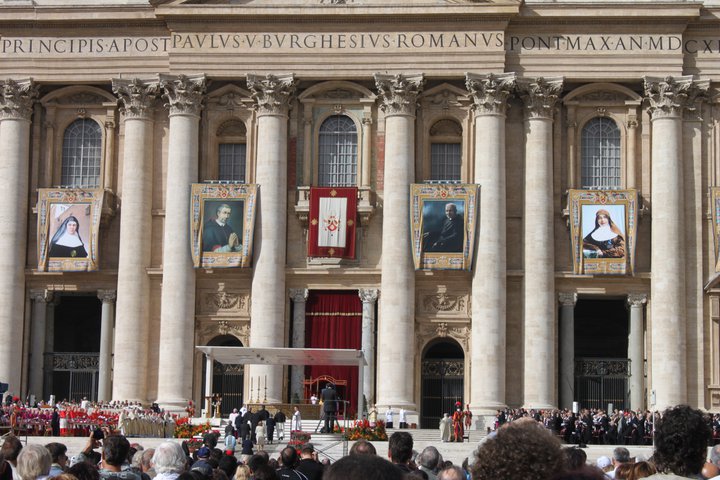
Saints banners on St. Peter's
Six new saints were declared by Pope Benedict XVI during the weekend of 17 October, but one in particular stands out. Brother Andre Bessetté, CSC has been a familiar name to me since Notre Dame, and his story I had known something about even before then. In fact, throughout my four years of service on the altar at the Basilica of the Sacred Heart, the Litany of Saints always concluded with a robust “Blessed Brother André… Pray for Us!”
Those years of prayer are ‘paid off’ today, in the official recognition of the Congregation of Holy Cross’ first saint – though rumour is the cause of CSC founder, Father Basil Moreau may be ready as early as 2012. Brother Andre is also the first native-born male saint of North America, having been born and raised in Canada.
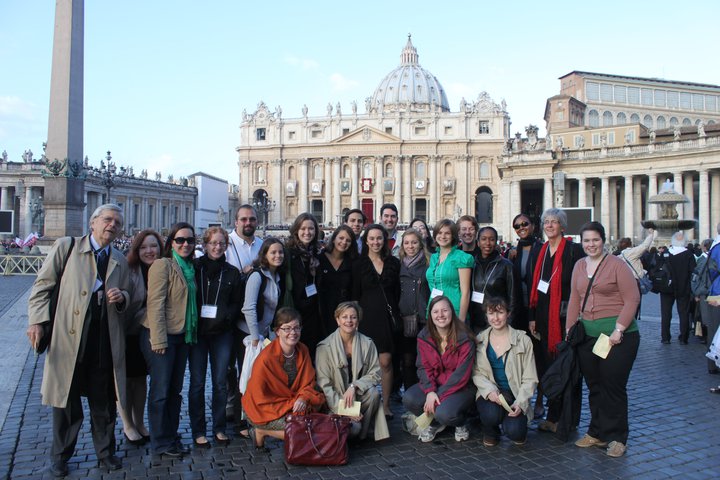
Notre Dame pilgrims for canonizations
He was a simple porter, a door-keeper, not educated enough for presbyteral ordination, but a man gifted with healing and a particular devotion to St. Joseph in a time when Marian piety defined Catholic spirituality. One man’s simple prayer to see a small shrine to Our Lord’s earthly father near the school where he served lead eventually to the impressive St. Joseph Oratory of Mount Royal, in Montreal, Quebec. The oratory offers a biography of the new saint here.
A delegation of Holy Cross brothers and priests, Notre Dame students, alumni, and faculty converged on Rome along with thousands of Canadians and others devoted to Brother André. About two dozen of us participated in a program offered by ND’s Center for Social Concerns. On the eve of the canonization day, these pilgrims filled the church of St. Andrea della Valle to standing-room capacity, about five thousand by estimates I have seen.
One of the Domer alumns from the states was my friend and classmate Julie Fritsch, who i literally picked up from Leonardo DaVinci airport as i dropped off Simone. From pro-life marches in D.C. to canonizations in Rome, it is nice to know you can share the journey with friends over the course of decades!
We got to participate in the vigil at Sant’Andrea della Valle, the canonization mass at St. Peter’s, the premier of Salt and Light’s documentary of his life, “God’s Doorkeeper”, and a presentation by ND Professor Kathleen Sprows Cummings on the process of canonization.
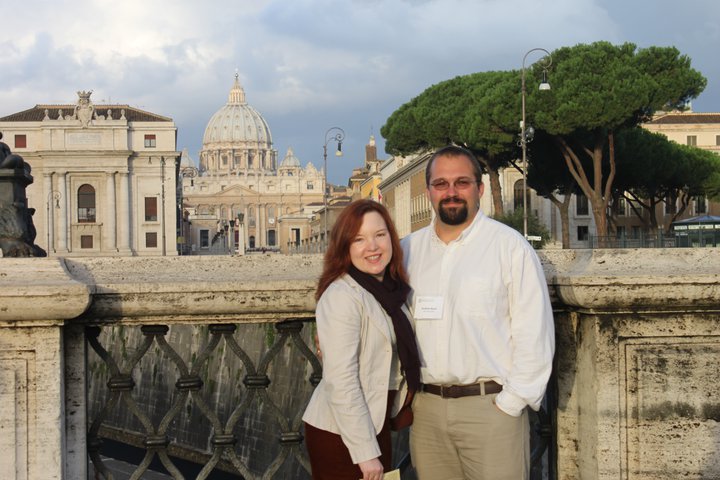
Julie and I on Ponte Sant'Angelo
Leading up to the weekend, the only names of the soon-to-be saints i knew were Brother André and Australia’s first saint, Sr. Mary MacKillop, founder of an order of women religious and contemporary of St. André. The program on the morning of the liturgy described the six thus: One priest (Stanisław Kazimierczyk, Polish, 15th cent.), one religious (Br. Andre), and four “virgins”. IN addition to Mary MacKillop, there were two Italian sisters Giulia Salzano and Camilla Battista da Varano and Spanish nun Candida Maria of Jesus.
Why the four women were not identified as religious, as sisters, or even the three as founders of orders, i do not know. While chaste virginity can be holy (as can chaste marriage or celibacy) it seems to mischaracterize their vocations. After all, none were consecrated virgins, so much as religious and founders. Giulia and Candida were educators and catechists, Camilla was a princess turned nun, an example of the wealthy giving up materialism for service to the poor. Mary has been championed by some as an example for those persecuted by ecclesiastical authority for remaining true to the Gospel rather than “obedience” to abusive leaders.
Four of the six were all born in the 1840’s: André, Mary, Giulia and Candida. The other two were born mid-15th century.
 The Ecumenism Blog