
Home » Church and World (Page 3)
Category Archives: Church and World
US Embassy to the Holy See: no closure, downgrade, or presidential plot…

Ambassador Hackett presents his credentials to the Holy Father
As always, the busier and more interesting things get, the less time I have to write about them.
But sometimes something comes up that here, you do not even think will be a thing, only to find it exploding the internet on the other side of the Atlantic.
A week ago, the National Catholic Reporter ran a story detailing how five of the former US Ambassadors to the Holy See were upset that the Embassy was being moved. That was the first I had heard of it, and I thought some fo the reactions seemed a bit over the top… but then you cannot expect much from partisan political appointees on either side of the aisle.
Naively, I suppose, I still expect people to read more than headlines. Especially absurd headlines like the following:
- Obama’s call to close Vatican embassy is ‘slap in the face’ to Roman …(Washington Times)
- Obama administration plans to close Vatican embassy in shock move (Irish Central)
- Obama Administration Snubs Catholic Church With Vatican Embassy Downgrade… (LifeNews.com)
- U.S. Pulls Out of the Vatican (Daily Beast)
- Obama to close diplomatic ties with the Vatican (US Finance Post)
- Obama ‘insults’ Catholics in Vatican–embassy shutdown: ‘Massive downgrade’ in relationship with the Holy See (WND.com)
Notice how only one of these misleading leads did not start by blaming President Obama by name?
The facts are simple, and were clear even from the first reports:
- The US is not closing the Embassy to the Holy See
- The US is not pulling out of its diplomatic relationships with the Holy See
- The US is not downgrading the diplomatic status of its relationship with the Holy See (e.g., from Ambassador to Special Envoy, or something)
- The US is not combining the Embassy to the Holy See with the Embassy to Italy
- The US Ambassador is not moving his residence, only the offices.
This was confirmed by the current and immediate past US Ambassadors to the Holy See, and the State Department again in a conference call today.
The US has four places (Rome, Vienna, Brussels, and Paris) with multiple missions in the same city, and in each case there have been moves to bring the separate embassies together physically, while maintaining separate missions, staffs, budgets, and space.

Current US Embassy to the Holy See
The current US Embassy to the Holy See is in a converted private home near the Circo Massimo, and while I daresay it is a better view than to be had by its big sister on Via Veneto, it is hard to have a larger meeting there than about a dozen people. It would probably make the support staff, the local staff and interns, feel a little less isolated, considering they are a much smaller crew than at US Embassy Italy.
While I can certainly see arguments for the separate location in terms of keeping a clear identity, it seems this has already been a consideration and will be seriously maintained. Rome has three, not two, US embassies: One to Italy and San Marino, one to the UN Food Agencies, and one to the Holy See. The first two are already on the same property, but in different buildings. Adding the third does make sense economically, even if it is a drop in the bucket compared to overall waste… every little bit helps.
It is worth noting that the US Embassy to Italy does double duty to the other micro-state completely surrounded by the Italian Republic, that of San Marino. A pretty obvious contrast between that situation and the proposal for that of the Holy See should put to rest any concerns about this being a move to combine or downgrade the Embassy to the Holy See.
What is interesting, yet unsurprising, to me is the narrative of President Obama being rabidly anti-Catholic, and that this is just one more example of his ‘war on religion/the Catholic Church’. While i certainly find several areas of disagreement, which should be rather obvious, I find this assertion as convincing as the narrative of Pope Benedict being a mean-spirited old man who was only interested in rules and regalia while actively covering up the clergy sex abuse scandal. Both have a powerful hold on the imaginations of large portions of the American population; both are false.
The current and former US Ambassador to the Holy See have the most ‘Catholic’ credentials of any persons to hold the office – not in terms of holiness, spirituality, or personal faith, to which I cannot speak – but in terms of ecclesiastical vocation and formation. Both Ambassador Ken Hackett and Miguel Diaz have given their life in service to the Church rather than to partisan politics: Diaz as a theologian, Hackett in Catholic Relief Services. That sets them out from the pack.
The rest were all partisan political appointees, and whether left or right does not matter. Glendon is a law professor; Rooney an investment banker; Nicholson was Republican Party Chairman; Boggs a democrat congresswoman; Flynn was mayor of Boston; Melady was a career diplomat; Shakespeare was president of CBS; and Wilson was a cattle ranching oil magnate.

US Embassy to Italy and San Marino
This is not to say they were not good Catholics (those who were) or good Ambassadors. I am sure they were. Rather, it is simply that no president until Barack Obama had picked ‘church’ people for the post. People who were chosen specifically because of their devotion to the Catholic Church first, and country second, rather than the other way around.
So, while any change will ruffle feathers, of all the Ambassadors in the post, the most qualified to speak to the real situation of this move, as far as the Holy See and the Church are concerned, are precisely the two supporting the move: Hackett and Diaz.
Bottom line: fear not. The US and the Holy See are as engaged as they ever have been, and signs show the relationship is stronger than ever. Moving to a new building next door to two other US Embassies will not change that.
The Pacific Northwest Presence in Rome

St. James Cathedral, Seattle
The last month has confirmed that there is a greater presence of the pacific northwest in Rome (Churchy Rome, that is) than there has been for a very long time.
Earlier this month, Archbishop Sartain of Seattle passed through Rome, mostly on business with the LCWR, it seems. Though there was no time on his busy schedule to meet with us all, it gave an opportunity to reflect on the presence of people from the Emerald City and environs here in the Eternal City. An almost overlapping visit from the Laughlin sisters of St. James Cathedral fame made for a more enjoyable Northwest night out.
We have a record number of students from the Archdiocese, two seminarians and two graduate students. Then, there are a couple of professionals at work around the Vatican.
Michael Dion is a second-year seminarian and from Sacred Heart Parish, Enumclaw. He is studying for a bachelor of sacred theology at the Pontifical Gregorian University.
Kyle Mangloña is another second-year seminarian from Our Lady, Queen of Heaven, Tacoma. He is likewise studying for a bachelor of sacred theology at the Pontifical Gregorian University.
Derek Farmer is a US Navy veteran and former Seattle city hall employee who just finished his MA in Pastoral Studies at Seattle University and was accepted for the Russell Berrie Fellowship in Interreligious Studies. His Certificate program is equivalent to the first year of the license in sacred theology, at the Angelicum. He is from Christ our Hope Parish in Belltown, Seattle, and married to his wife Katy for just over a year.
Cindy Wooden is the senior correspondent of the Catholic News Service Rome Bureau, and she has been here about 20 years. Her previous employer? The Catholic Northwest Progress, the newspaper of the Archdiocese of Seattle. And she’s a Seattle U. grad whose roommate was a parishioner of mine at St. Brendan.
Fr. Steve Bossi, CSP, is the new vice-rector of Santa Susanna, the American parish in Rome, and a Seattle native and still has family in the area. He too is a Seattle U. alumnus.
Msgr. John Cihak from Portland, OR, is a Notre Dame grad, working for the Congregation for Bishops, and the only diocesan priest from the northwest anywhere in the curia, as far as we can tell.
Finally, A.J. Boyd (your humble scribe), a doctoral student in ecumenism at the Angelicum, adjunct theology professor, and graduate assistant at the John Paul II Center for Interreligious Dialogue. A native of North Bend, WA, and former lay ecclesial minister for the Archdiocese of Seattle, I also spent a year in a post-grad program at Seattle U, after studies at Notre Dame and CUA.
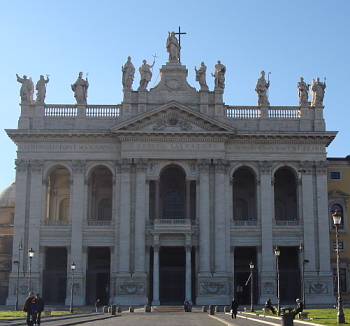
Cathedral of Christ the Savior, Sts. John the Baptist and the Evangelist, Rome
Feeling more Catholic than the pope? I find your lack of faith disturbing
By now, most have read that last week’s “interview” between La Repubblica’s Eugenio Scalfari, 89, and Pope Francis, was really more of the former’s recollection of a friendly conversation between the two.
It was obvious from day one that this interview, and its translation, was not on the same par as that published by the Jesuit journals of the world less than two weeks before. That fact has just been underlined, and the gulf of quality widened, by recent revelations. Both remain important, illustrative of the Holy Father’s basic ecclesiological paradigm, his personality, and his vision for the mission of the Church, but not in the same degree. As you would expect.
Scalfari used neither a notepad or a recorder, and while I am sure that any one-on-one with the pope will be memorable enough that you are not likely to forget that much of it, even at such a venerable age, it seems like a journalistic mortal sin to publish conversation as if these are recorded quotes during a professional interview.
Given that, I do not find it surprising that a couple of the details get mixed up. Scalfari is not a theologian, in fact, not even a practicing Catholic. So, the fact that he misremembers whether Pope Francis had his mystical moment before or after accepting the office, or whether he or the translator captured all the nuance of the primacy of conscience is neither surprising nor shocking.
The Vatican confirmed that the basic tone and tenor of the interview was accurate and trustworthy. The thoughts expressed are the pope’s thoughts, technical and translation glitches aside. It is a “reconstruction and not a transcript” and “should be considered faithful on the whole to the mind of the pope, but not necessarily in its particular words and the accuracy of its details.”
One merely needs to read the interview with a basic understanding of Christian teaching and knowledge of the fact that not only is the pope Catholic but that he is, in fact, a bishop of the Church, and there are no theological or doctrinal problems to be found. A little benefit of the doubt is sufficient, to say nothing of thinking with the Church here.
By far, then, the most disturbing news of the week is the vitriolic and unabashed criticism of the bishop of Rome from some voices on what is often called the far right – though there are many self-described conservative Catholics who find this reaction appalling. And well they should.
(Some other rebuttals to this hysteria, and conservative clarifications to calm the nerves, can be found on The Dish, The Deacon’s Bench, National Catholic Register, and even the godfather of ‘far right’ Catholic bloggers, Fr. Z!)
–I suspect there would not have been so much confusion if we had not had such a recent long streak of obsessing with literal translations and verbatim fidelity of words themselves, rather than focusing on the message being conveyed by the words. But I digress —
To be clear, I have no problem with the criticism of any religious leader, including the bishop of Rome. In fact, a healthy Church, one committed to the principle on ongoing reform, is made evident by those that love the Church are the first willing to openly recommend improvements. A culture of fear and thought-control, wherein everyone simply has to toe the party line, is detrimental to the overall wellbeing of any institution, especially the Body of Christ.
But criticism demands responsibility. It is one thing to not like the color of the pope’s shoes as a matter of personal taste, and anyone can express such an opinion. It is something else to claim the pope is a heretic, a relativist, a modernist, or confused about the role of the bishop of Rome without some kind of theological legwork to back up your claim. And when the attack is made ad hominem, it just loses all respectability.
Since the moment he appeared on the balcony in March, I have heard complaints and an unceasing stream of vitriol from either the radical traditionalist set, or the plain old neo-con clericalist set.
Not all who respect tradition are traditionalists, and not all who claim the title traditionalist are “radical” traditionalists. The former may have greeted this latest interview with a raised eyebrow or two, but then immediately began looking through the Italian for translation errors (and there were a few) or intuitively read the pope’s words with the docility of will and humility of intellect required of all faithful , and realized what was being said.
Likewise, not all who identify with the label conservative – whether politically, morally, socially, or theologically – fall into the particular subset of neo-conservative, and not all of these somehow substitute the dogmas of unrestrained capitalism for the Christian gospel. But there are certainly those who do, and they tend also to adhere precisely to these sins of clericalism, careerism, materialism and triumphalism that Pope Francis has been warning us about. No wonder they are upset.
I am happy to be in a Church with traditionalists and conservatives, innovators and liberals, even if (as a reform-minded, ecumenically devoted centrist), we do not agree on everything, because that is the nature of a universal Church. All I expect from all sides is that you think with the Church, you at least give your local bishop or that of Rome the benefit of the doubt, and when that is not sufficient, try harder to employ a hermeneutic of charity.
For my entire lifetime, we have had two popes who were considered conservative even by general Catholic standards, at least concerning matters ad intra. Pope Benedict bent over backwards to accommodate the traditionalist wing, like the Good Shepherd, giving disproportionate attention to a very small minority in the Church that had wandered far from the flock. He was the bishop of Rome, the successor of Peter, and tasked with making hard choices for the sake of unity; this is what he did.
Now we have a pope who nobody could seriously describe as liberal: He will not be changing Church doctrine on abortion, euthanasia, capital punishment, or war anytime soon. Neither is the question of women in the presbyterate, nor gay marriage, suddenly on the fore of the Church’s agenda. Relieved or disappointed, you can take that to the bank.
Call him a reformer, a moderate, a centrist, creative orthodox or just plain Catholic: He will bring change, but only the change that the gospel demands and that which only hubris and fear have withheld. Some will find it too much too fast, others will find it too little too late.
He may not cater to the particular agenda of the parties that have been in ascendancy for an entire generation, if you want to think in those terms, but is instead fixated on the timeless Gospel of Jesus Christ, and willing to free the Church from self-imposed bondage where necessary, to promote that central message and mission. It is about time someone did.

…
NB to the liberal and progressive set: “This is the Church. If you don’t like it, leave!” is exactly the kind of thinking that such über-conservative dissidents have had for the last 35 years for everyone that did not agree with them. Now we come, perhaps, to the turn of the tide, and there is temptation in some quarters to respond in kind. Don’t. The Church needs them, and what they need is conversion and healing, which is unlikely to be found in the outer darkness. Treat them as you wish they had treated you over these last decades: with charity.
What a week! From Francis to Francis with Francis…
I was privileged to spend yesterday, the Feast of St. Francis of Assisi, in Assisi with Pope Francis. With him came the Council of Cardinals, or group of eight, which held their first meeting this week. It was an overcast, pleasant day, the predicted thunderstorms holding off until last night.
His entire itinerary is here, and text of speeches and addresses. There is also a good commentary by a friar i met last year in Assisi at a conference, Daniel Horan, at America Magazine.

The last papal event I attended in Assisi was the 25th anniversary of the first interreligious day of prayer for peace with Pope Benedict XVI, which was dubbed ”Pilgrims of Truth, Pilgrims of Peace.” Two cornerstone pieces of the original event were missing however – prayer, and the Sant’Egidio community who organize the annual prayers for peace in the spirit of Assisi. Subsequently, perhaps, attendance was surprisingly low.
Yesterday was a different story. The Eucharistic celebration in the lower piazza of San Francesco was witnessed not only by a full piazza there, but also in the upper piazza, all the side streets, and in the other major piazzas of Assisi (Santa Chiara, San Rufino, Piazza del Commune) where jumbotron screens were set up. It was an almost all-Italian gathering, and there is no question of the broad appeal of this reforming pontiff.
It came at the end of an amazing week in terms of Church news – especially with regard to Church reform. I commented already on some of them, but there has been so much, it has been hard to keep up. Thankfully, there are professionals to do that for us: John Allen summarizes this week in Vatican and Church news, in what he contends to be the biggest week outside of a conclave in his nearly 20 years of Vatican reporting.
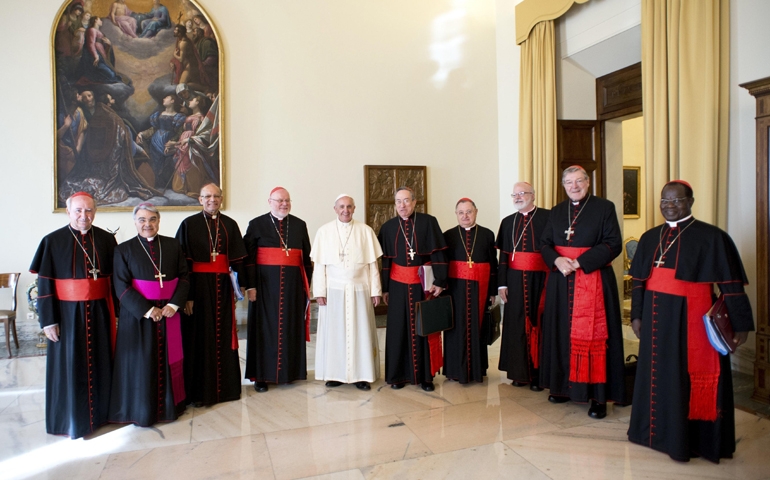
The biggest news is probably the meeting this week of the Council of Cardinals, dubbed in some circles the G-8. They have discussed the ecclesiology of Vatican II, the reform of the Synod of Bishops into a more permanent exercise of synodality and collegiality, the reform of the Roman curia to such an extent as to require a new constitution emphasizing decentralization and service to the local churches, changes to the Secretariat of State that might remove it from its current role as über-dicastery, and serious questions on the role of the laity in the church, including the role of the laity inside the curia itself. Their second meeting is set for just two months from now. They seem to really be addressing the half-finished business of Vatican II, or at least getting started on it.
When my students asked me last week why no pope or bishop has ever talked about the Church in the way that Francis has, and why there’s never been so much energy in the church, I was reminded of my own experience as a university sophomore, in my own 200-level theology class (on Vatican II) asking a similar question, “why are we still waiting for the changes promised by the Council? How can 35 years have passed and we are still waiting [on things like decentralization, synodality and collegiality, the role of the laity, the full restoration of the diaconate, overcoming clericalism, etc]?” – I had no idea 15 years later I would be the one trying to answer these questions, and under what different circumstances!
Two highlights of John Allen’s highlights, aside from the meeting of the Council of Cardinals, worth particular notice:
Allen reports that
“Von Freyberg told me recently it’s his ambition to put gossipy newspaper reports out of business by making it so easy to get information directly from him that journalists don’t have to rely on whispers in Roman bars.”
If that is not argument enough for getting more lay people in positions of responsibility of the Roman Curia, i do not know what is. When was the last time you heard any cleric tackle communication and transparency issues so directly? Well, before this one…
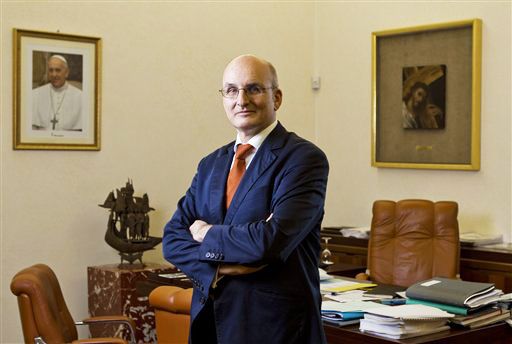
Ernst Von Fryberg, cleaning up the Vatican Bank. He really should be a deacon!
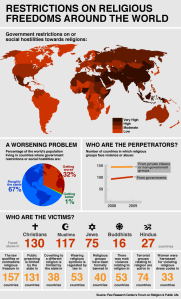
The second point is less about this week in particular, but about Allen’s comments about his own book on religious persecution around the world, after talking about the killing of about 500 Christians in India during 2008 riots:
Not to put too fine a point on it, but that’s what a real “war on religion” looks like. One aim of the book is to reframe the conversation over religious freedom among Western Christians so we don’t allow our metaphorical battles at home to obscure the literal, and often lethal, war on Christians being waged in other parts of the world.
In the view from Rome, there was a bit of discomfiture last year with the whole tone and tenor of the ‘fortnight for freedom’ in the U.S., because it seemed to ignore the real problems of religious freedom. Officially, of course, the Vatican backs its bishops, but, unofficially (and remember this was still under Pope Benedict) there seemed to be a current of thought around the Vatican and in Rome that there was a little too much partisan politicking, and not enough focus on the fact that there are more Christian martyrs around the world today than at any point in history. It is hard to be quite so concerned about contraceptive funding when there are Christians dying at the hands of radical elements in Buddhism, Hinduism, Islam, and secular Atheism – especially when it is part of a universal health care plan that the Church supports in principle, if not in every detail.
This is, of course, not to say to ignore the small problems before they become big ones, but to keep everything in perspective. That is something we Americans have a hard enough time doing when it comes to global events, but for which membership in a Church so universally oriented that it is called Catholic ought to be a corrective.
****
For the full run-down of the week, read Allen’s article here.
In brief, what happened this week:
- Monday:
- Canonization of Popes John XXIII and John Paul II set for April 27
- Discussion of regional tribunals to adjudicate clerical sex abuse cases
- G-8 formal established as a permanent Council of Cardinals
- Tuesday:
- A “stunning Q&A with the pope” published in La Repubblica
- The Vatican Bank (IOR) released its first-ever annual report and its lay president demonstrates the kind of transparency attitude needed all over the Church
- The Vatican Bank announced the closure of 900 accounts for dubious activity
- The Council of Cardinals began its first meeting, as mentioned above
- Thursday
- 50th anniversary of Pacem in Terris, organized by Sant’Egidio Community
- “Monsignor 500” (as in Fortune 500), Nunzio Scarano, under investigation for embezzlement and money laundering, airs some dirty laundry about further financial scandals (alluded to last week)
- Friday
- Feast of Francis of Assisi . Francis took aim at the ‘right’ by calling on the Church to “strip itself of the cancer of worldliness”, and took aim at the ‘left’ by asserting that the peace of Francis is not a ‘kind of pantheistic harmony with the forces of the cosmos’, but a Christ-centered peace.
How come Pope Francis doesn’t talk about deacons?
The only thing i find objectionable about Deacon Greg’s blog is that he is constantly stealing my ideas, and worse, beating me to publication! Seriously, it has happened at least three times in the last two weeks that i had an idea for a blog, and then later that day get a notice that he has just posted about the same question. I guess we have a common muse or something. Here is one that i also wondered about lately:
Church Reform Wishlist: Open Letter of Introduction
Oscar Cardinal Rodríguez Maradiaga of Tegucigalpa;
Giuseppe Cardinal Bertello, governor of Vatican City;
Francisco Javier Cardinal Errázuriz Ossa of Santiago;
Oswald Cardinal Gracias of Mumbai;
Reinhard Cardinal Marx of Munich;
Laurent Cardinal Monsengwo Pasinya of Kinshasa;
Sean Cardinal O’Malley of Boston;
George Cardinal Pell of Sydney.
Your Eminences,
Know that the Church is with you in prayer during these first days of dialogue, discussion and deliberation on how the people of God can be best served by the college of Bishops and its structures of universal governance, including those particular to the bishop of Rome.
[Know also that the Beards for Bishops Campaign applauds Pope Francis for including two of our most beloved members, Cardinals Marx and O’Malley, in your number. Clearly, His Holiness knows bearded men are wise men!]
It seems that you have consulted broadly among your episcopal peers in your respective regions. It is not clear to what extent, if any, consultation was extended to deacons, presbyters, lay ecclesial ministers, theologians, religious and the lay faithful. Perhaps you devoted a day to reading Catholic blogs from around the world – and if you did, you simultaneously have my gratitude and my pity.
It seems as if everyone is working on their reform wishlist! Some that I found interesting including John Allen, and the interview with Cardinal Maradiaga on Salt and Light was encouraging. I found Tom Reese to be a little skeptical when he warns that
if the press release says that [you] had a wonderful discussion with the pope and [you] agreed that collegiality and subsidiarity should be the guiding principles for curial reform, you can be assured no one has a plan and they wasted six months.
Personally, I expect your work to take some time. However, after a generation of waiting on some questions, it would be reassuring to see some indication of movement. I trust in the Holy Spirit and in your good will, but as a theologian, a minister, and a member of Christ’s church, have the duty to share my hopes and concerns (cf. CIC 212).
I admit, it does seem a little like sending a Christmas wish list to Santa Claus. I would need a book to spell out the rationale behind each of these suggestions. In many cases there are incompatible alternatives, but either choice would be an improvement. Most of these are small things, tinkering with structures even, that need only to reflect the more important principles and ought to serve the conversion of heart and change of mind. Some are obvious to me based on my study, that i forget they are not so obvious to the public, or even to theologians not studied in ecclesiology or ecumenism. These are, in fact, some of the effects of change, the signs that reform in the more important areas is trickling down to the practical, nitty-gritty. It is also just a list! But before i get to it, I can assert that this list intends to adhere to the following ideals and principles, and is not exhaustive:
Each change is rooted in the tradition of the church – historically, and/or ecumenically (or, apostolic and catholic tradition). We do not really need brand new structures, so much as looking to our past and to the current practice of other apostolic and catholic churches, and adapting those practices for our current needs.
Neither I nor most people I know are much interested in reforms of dogma and doctrine, though the development of doctrine, of the articulation and understanding of unchangeable truth, is always welcome; the focus is on discipline, custom, culture, and administrative practice.
Ecumenically, we should formally commit to the Lund Principle: “churches should act together in all matters except those in which deep differences of conviction compel them to act separately.” In other words, that which can be done together should be done together. Too often we only seem to do the minimum, not all that is allowed or encouraged, but only what is required.
Let him be anathema who says, “Tinkering with structures is not sufficient, all we need is prayer, or holier priests.” Whatever virtue there may have once been present in such pietism is usually overshadowed by this being used as a cop out by people afraid of change, transparency, and the light of day. I agree it is not enough to merely tinker with some structures; they must be overhauled from the ground up. However, prayer without action is merely words, like the letter without the spirit, or the dead kind of faith James warns us about. Pray and Act, rather than Pray not Act, should be your watchword.
Any changes which have been approved in principle, or recommended by various authorities in the church, including official ecumenical dialogues, should be enacted – most have been delayed too long already (e.g., Paul VI and married Eastern presbyters in the US; or the Synod of Bishops on women as instituted readers).
Likewise, some policies already on the books should be more clearly enforced (e.g., only clerics should wear clerical clothing – not seminarians; or the requirement that everyone engaged in formation for pastoral work take a required course in ecumenism and interreligious dialogue).
A healing of memories should take place, perhaps the establishment of a truth and reconciliation commission at various levels. There have been many wrongs, some lesser and some greater, committed because of the wrong attitudes of clericalism, careerism, triumphalism. this has happened at the parish level and at the highest levels of the curia. I know pastoral associates and former presidents of pontifical councils treated poorly or fired just for being ‘too pastoral’ and not buying in to the system of clericalism.
Finally, take to heart Pope Francis’ admonishment that all of these are secondary to the need for a conversion of heart, a change of attitude – always the first step in both ecclesial reform and ecumenical reconciliation, two goals which are inseparable from the Gospel.
His Holiness is right, of course, “the people of God want pastors, not clergy acting like bureaucrats or government officials.” Presbyters especially have a vocation to parish ministry and to advising the bishop in the care of the diocese; it is deacons who have a particular vocation to assisting the bishop in his ministry of governance and administration at the deanery, diocesan, and supra-diocesan levels.
Thank you for your prayer, your humility, your leadership, and your dedication to the Church. Accept these suggestions from a loyal son of the Church in the spirit in which they are given, out of love for the Church and frustration in its failings and imperfections. And of course, out of humility: this is a work in progress, and the work of many is better than that of one, so I hope friends and colleagues will add their voices to mine, even in disagreement.
I am, as ever, your servant…

Jump to:
- Church Reform Wishlist: Open Letter and Introduction
- Church Reform Wishlist: The Eastern Catholic Churches
- Church Reform Wishlist: The College of Bishops
- Church Reform Wishlist: The College of Cardinals
- Church Reform Wishlist: The Roman Curia
- Church Reform Wishlist: Ministry and Holy Orders
- Church Reform Wishlist: Precedence and Papal Honors
- Church Reform Wishlist: Catholic Education
- Church Reform Wishlist: Liturgy
Church Reform Wishlist: The Eastern Catholic Churches
The Eastern Catholic Churches
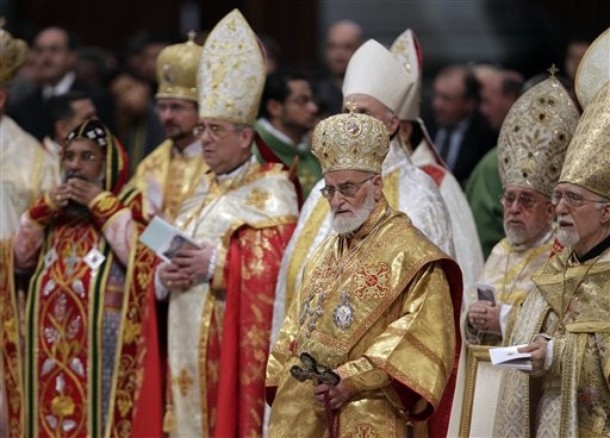
- The notion of national or proper ritual territory is archaic. Most churches have a diaspora larger than members living in their original countries. Eliminate any discrepancies between the authority of the synod and heads of the churches for their members worldwide (e.g., in the selection of bishops).
- Eastern Catholic presbyters have not been allowed to be married in the U.S. since the late 19th century because of certain overanxious (celibate) Latin bishops at the time. This caused schism and scandal, and has lead to the current situation where there are now more married Roman Catholic priests than Eastern Catholic priests in the U.S. That ought to be corrected. [Done!: 14 November 2014]
- All other rights of the Eastern Churches that have been impinged upon by the Latin Church should be fully restored.
- A clarifying directive and definition from the competent ecclesial authority that the name of our communion is The Catholic Church and not the Roman Catholic Church should help in a number of confusing venues. It is already in fact the practice[1], but needs to be clearly articulated.
[1] Search the Vatican website: “Roman Catholic Church” gets 125 hits, “Catholic Church” gets over 4400. And most of the uses of “Roman Catholic” are concessions to ecumenical partners, which could be done away with now after years of growth in understanding.
Jump to:
- Church Reform Wishlist: Open Letter and Introduction
- Church Reform Wishlist: The Eastern Catholic Churches
- Church Reform Wishlist: The College of Bishops
- Church Reform Wishlist: The College of Cardinals
- Church Reform Wishlist: The Roman Curia
- Church Reform Wishlist: Ministry and Holy Orders
- Church Reform Wishlist: Precedence and Papal Honors
- Church Reform Wishlist: Catholic Education
- Church Reform Wishlist: Liturgy
Church Reform Wishlist: The College of Bishops
The College of Bishops:
- Zero tolerance for bishops who covered up sex abuse. Remove them.
- Bishops are diocesan ordinaries. No more titular bishops for dicasteries. Even the practice of auxiliary bishops should be reconsidered. Ordaining a personal secretary or a bureaucrat as a bishop diminishes the office of bishop, even if the individual is worthy of the office.
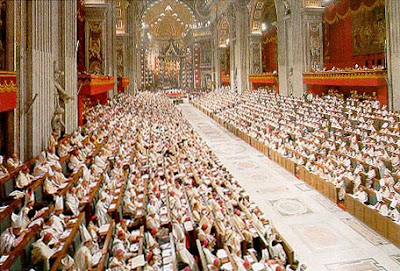
- Smaller dioceses: Dioceses in Italy are about the same geography and population of a deanery/vicariate in the US. The ratio of Eastern (Catholic and Orthodox) bishops to faithful seems to hover at around 1:10,000. In the Latin church it is about 1:250,000.
- Restore the ancient practice of elected bishops. “Election” need not mean simple democracy, but a clear participation of the clergy (both diaconate and presbyterate), the lay ecclesial ministry, any resident theologians, and the leadership of the laity.
- Only after the above reform, restore the ancient practice of bishops being ‘wed’ to a single diocese – no more moving on up and out. This makes no sense if a bishop is appointed, but an election makes it possible.
- We need to make better use of the archbishops/metropolitans, including an increased role in the election of bishops from their province. If there were smaller dioceses, and more bishops, the metropolitan would take on some of the load currently at the diocesan level.
- Titular patriarchates (Venice, Lisbon, East Indies) should be eliminated. Despite their historical origin, they only serve to confuse.
- The synod of bishops and the conferences of bishops need to be strengthened. There needs to be a regular standing structure in place to balance the primacy of the papacy. Primacy and synodality belong together, neither one without the other, at every level of the church.
Jump to:
- Church Reform Wishlist: Open Letter and Introduction
- Church Reform Wishlist: The Eastern Catholic Churches
- Church Reform Wishlist: The College of Bishops
- Church Reform Wishlist: The College of Cardinals
- Church Reform Wishlist: The Roman Curia
- Church Reform Wishlist: Ministry and Holy Orders
- Church Reform Wishlist: Precedence and Papal Honors
- Church Reform Wishlist: Catholic Education
- Church Reform Wishlist: Liturgy
Church Reform Wishlist: The College of Cardinals
The College of Cardinals
[Alternative to many of these ideas, of course, is that the college could be disbanded entirely, and certain offices designated electors ex officio. There is a certain appeal in this, but perhaps it is not prudent at this time.]
- Zero tolerance for cardinals found to be implicated in the cover up of sex abuse cases. They should be removed from the college of cardinals, not just from ministry.
- Patriarchs and major archbishops should not be created cardinal, which is proper to the Latin Church (indeed, to the Roman clergy!), though they should be included in conclave, ex officio.
- The heads of a number of the largest religious orders, male and female, as well as the largest ecclesial lay movements should be either made cardinals, or at least included in the conclave, ex officio.
- The presidents of the bishops’ conferences could be made cardinals, ex officio.
- Cardinals should not be ordained bishops unless they are going to serve as bishops (diocesan ordinaries).
- Cardinal-deacons should not be “promoted” to cardinal-presbyters after 10 years, but retain the dignity of their diaconal office – which ought to be considered equal to that of the cardinal-presbyters.
- Cardinal-deacons should be deacons, chosen from the ranks of deacons, who serve in diaconal posts such as the dicasteries of the Roman curia, the diplomatic corps, etc.
- As a sign of gratitude for their leadership in the last half-century, all the surviving Council Fathers (about 19 in number*) should be named cardinal. The only exception being if they have been found complicit in the sex abuse crisis, or left communion with the church. [*63 at the time of original publication]
- Lay men or women, whether theologians, religious, or lay ecclesial ministers, who are appointed to top offices in the curia could be made cardinals. Preferably after being ordained to the diaconate.
- Women cardinals? If women deacons, or deaconesses, then yes. Maybe better not to make it about being cardinal, but by virtue of the office being given the same rights and responsibilities, same access, and same dignity – and taken as seriously.
- Lay cardinals? The pope could do it, though with the historical connection of the cardinals to the clergy of Rome, perhaps that would take a more monumental shift – like eliminating the college, or eliminating the canonical distinction between cleric and lay states (NOT eliminating the ministries, holy orders, priesthood, etc!)
Jump to:
- Church Reform Wishlist: Open Letter and Introduction
- Church Reform Wishlist: The Eastern Catholic Churches
- Church Reform Wishlist: The College of Bishops
- Church Reform Wishlist: The College of Cardinals
- Church Reform Wishlist: The Roman Curia
- Church Reform Wishlist: Ministry and Holy Orders
- Church Reform Wishlist: Precedence and Papal Honors
- Church Reform Wishlist: Catholic Education
- Church Reform Wishlist: Liturgy
Church Reform Wishlist: The Roman Curia
The Roman Curia:
- Get the most qualified people. This means, at least:
- Some kind of open hiring process that allows anyone qualified to be considered. The Anglicans even advertise their top openings on their website. We could have something similar. Jobs.va? Why not?
- A doctorate and experience in the particular field is a must. No more non-liturgists running liturgy, diplomats running theology, etc.
- If anything, the ordinary minister of any curia should be a deacon.
- If a presbyter is not theologically or canonically required for a position, it should not normally be given to a presbyter.
- Lay ecclesial ministers, theologians, other lay persons, religious, and some priests or bishops may also be called upon, but they should ordinarily then be ordained to the diaconate (if appropriate).
- This could be a good example of a place where the return of the deaconess, or of women in the diaconate, would be appropriate.
- The diplomatic corps should be reformed
- The same considerations as for the curia, though perhaps a doctorate is not necessary.
- The ordinary ministers of the diplomatic corps should be deacons
- The ecclesiastical academy should be open to all qualified, fully initiated Catholics
- Candidates should not be drawn from seminary, but should either be a separate track or have proven field experience first
- The nuncio should not be a bishop, but a deacon (perhaps an archdeacon, or protodeacon), unless they have already been ordained a bishop before being called to diplomatic service.
- Communication – one apparatus to rule them all. There are what, seven different offices for communication in the Vatican? Things have improved a little, but this really needs to be coordinated. Also, people, even cardinals, whose competence is in a specific area should not be publicly speaking on the record about other areas (e.g., the President of the PCPCU should not be talking about liturgical changes, and the Prefect of the CDW should not be making ecumenical judgments.)
- The councils and congregations should be made up of committees of the synod – or from the episcopal conferences. The staff should really be staff to these committees, not the driving force.
- All dicasteries are equal, according to Pastor Bonus, but some dicasteries appear more equal than others. Change that. The Council for Christian Unity should be able to promulgate policy with the same authority as the Congregation for the Doctrine fo the Faith
- Ecumenical review of doctrinal, liturgical, and canonical decisions – the PCPCU should be involved in the vetting process of decisions made by the CDF, CDW, etc. to help formulate the best policy that is both orthodox and ecumenically helpful. The reverse is already true and should continue.
- The Secretariat of State should focus on diplomacy, not act as moderator of the curia or, generally, mediator on local ecclesiastical issues. Let there be a separate office to organize the work of the curia.
- Most theologians are laity, true? Certainly in the western world, but I think now also universally. This should be reflected in the staff of the dicasteries, the pontifical academies, and in the pontifical universities. Though, in the case of the curia, they could be ordained to the diaconate once selected for office.
- The support staff in many offices is quasi-hereditary, and almost exclusively Italian. If only there were a bunch of universities nearby with graduate students from all over the world looking for internships, assistantships, and part time work, we could tap into some of the greatest young talent the church has to offer… oh well…
Jump to:
- Church Reform Wishlist: Open Letter and Introduction
- Church Reform Wishlist: The Eastern Catholic Churches
- Church Reform Wishlist: The College of Bishops
- Church Reform Wishlist: The College of Cardinals
- Church Reform Wishlist: The Roman Curia
- Church Reform Wishlist: Ministry and Holy Orders
- Church Reform Wishlist: Precedence and Papal Honors
- Church Reform Wishlist: Catholic Education
- Church Reform Wishlist: Liturgy
 The Ecumenism Blog