
Theologian of the Papal Household
His study has a view of a small courtyard where the papal guillotine once stood, and where a pillar likely used for the flogging of heretics and criminals can still be seen. The corridor leading from his office is lined with Roman tombstones, and the Swiss Guard are omnipresent with full regalia and halberds. Once known as the Master of the Sacred Palace, the Theologian of the Papal Household has four large paintings in his room each depicting miniature portraits of his nearly 100 predecessors (all Dominicans), starting with St. Dominic himself.

Fr. Wojciech Giertych, OP, Theologian of the Papal Household
Fr. Wojciech Giertych, OP was appointed in December of 2005 by Pope Benedict XVI, and is just beginning his fifth of a five-year term of office. A Polish Dominican born and raised in London, he describes himself as a true “prisoner of the Vatican”, albeit in a gilded cage. Outspoken, jovial, and unafraid to tell it how it is, Fr. Giertych shared with the lay centre residents his thoughts on Thomas, on theology and philosophy, the vocation of the laity, the challenge of contemporary religious life, contemporary challenges arising from the “crisis of 1968” (not Vatican II, note) including relativism, and the practical life of a Vatican officer.
One might be inclined to ask, “Why does the pope need a theologian?” especially a pope like Benedict, the first theologian to be elected pope in a couple centuries. Traditionally, there were three duties ascribed to the office: Offering theological instruction to the papal court (back when most of the court were not monsignori with doctorates in theology, philosophy, or canon law), reviewing any theological books published in Rome, and vetting the papal addresses (especially important at a time when most popes were politicians, warriors, or, worse, nobility).
Now, this means reviewing the drafts of papal allocutions drafted by the staff of Vatican speech writers, though he is neither the first nor the last word on the matter. And, Fr. Wojtech points out, his role is to examine theological content and look for phrases that could be misunderstood, especially by mass media – not to judge the prudence of an address (questions around Regensburg were raised). The most interesting papal addresses are the ones he does not see – those that the pope prepares personally: in Benedict’s case, his encyclicals, major homilies, and annual advent address to the Roman Curia. Given how much is written for the pope, it is like having a graduate seminar with Professor Ratzinger almost every day – even if the personal meetings are less often.
Occasionally the various dicasteries in the curia ask him for theological input on a document, and he serves as consultor to the Congregation for the Doctrine of the Faith. In one of the oldest continuously operating bureaucracies on the planet, he’s one man serving in an office consisting of only himself. It can be hard to tell what effect his work is having without the constant interaction of peers. This touches on one of the challenges for a friar used to life in community, used to working and living in constant contact and consultation with other people, now working in a more solitary position.
He did get invited to lunch with the pope, once. It is fairly common knowledge that Pope Benedict normally prefers to eat alone or with the sisters who prepare his meals – understandable for an introvert in an intensely public office! However, when a film crew came in to film a “day in the life of the pope” for international TV consumption, it happened that the Holy Father would be seen having a ‘working lunch’ with three members of the papal family, including, as it happens, Fr. Giertych. (“A great, open conversation. We three had wine, while the pope had juice”) As it was viewed around the world, some cardinals expressed how lucky our Friar Preacher was – even they had never had lunch with the pope!
“Never mix theology and philosophy, because philosophy always wins.” Despite the irony of such a statement from a Thomist, or perhaps because of it, this comment alone sparked a conversation that continued with some of us well after Fr. Wojciech left for the evening. While philosophy – in the broad sense of all the ‘sciences’ and other disciplines – can serve the church and our study of theology, they should never be confused as if they are theology, or as if the revelation of the Word should be judged according to the criterion of philosophy, politics, or social sciences. When this happens you end up getting the problems that, for him, have stemmed especially from 1968, and include the identification of the faith with one political party (‘as a good Catholic you must vote for candidate X or party Y’), the revision of the life of faith to fit in with what people expect from other fields, and end up with relativism (‘there may be a Truth, but we can’t know the Truth, so you have your truth and I have my truth’).
The conversation got really interesting as we delved into the vocation, identity, and relationships of the laity, clergy, and religious. Religious should be visible in the world, and laity should be “discreet” (leaven in the world, to use another phrase) – and we have had trouble with religious being more like laity and laity being more like religious. Specifcally, he noted some religious orders without habits of any kind (“it doesn’t matter what kind: a modern habit or a medieval habit or a 19th century habit”) living in apartments where you can hardly find them, or some of the lay movements whose first order of business seems to be deciding what kind of habit to design – and the more medieval the better!
When I asked about lay people serving in ministry positions, his response was about people wanting to be the lector all the time, or spend all their time helping at the church because something is amiss in their real life or they do not understand that the primary lay ministry is in the world, not collecting money at mass or something, “don’t spend your life holding on to the sacristy door”. But what about lay people serving the church in a paid, full time manner? Even the Roman curia has lay ministers in its employ?
“Well, of course the church will always need administrative personnel, computer technicians, finance experts, people to manage the facilities – especially in places where the church is burdened with such institutions as schools and hospitals”. Pastors should not be “running the plant”, but should be engaged in sacramental and pastoral ministry. But even this was more about ‘secular’ jobs that one could do for the church or for another entity, not so much ecclesial vocations; we tried a different track: We are here in Rome, studying at pontifical universities, to get ecclesiastical degrees – what would he expect for us to do with them?
“We have a saying in Poland: man cannot live on theology alone!” As a lay person you should be thinking of making a living, to support a family, you cannot do this with a theology degree. You cannot come from a degree and demand a job from the bishop – he may not have the money. [Can you imagine anyone demanding a job from a bishop???] We need the people (mentioned above) to be theologically trained, but it should be a secondary to your primary education. He shared his experience fromPoland, where a degree is a civil, legal contract – maybe in that system there is a “demand” to be employed in the field. But he wondered most people studying in Poland for theology degrees should have instead been studying harder subjects like medicine or law, but admitted that each country is different: “We have 100 friars living at the monastery in Krakow, 14 masses a day, confessions with two-hour waiting lines” and no experience of a non-ordained person devoting their life to the church outside of a religious community.
“I’d rather see thirty ‘normal’ people give one hour a week, than to pay one person for thirty hours a week, if that person does not have the best formation…” But, he admits he may be wrong as he quoted the Dominican Cardinal Yves Congar, who wrote after being dragged to Rome to be questioned in the 1950’s, wrote in his journals “I may be getting the answers wrong, but these are real questions – and that’s what enervates these people here in Rome!” He was asking questions about the laity and ministry and looking to scripture and the patristic sources for answers. We have to keep asking these real questions, even if it takes time to get the right answers; that is better than ignoring the problems!
Bearing witness through celebrating the faith we have received: WPCU Day #4
From the official material prepared by the World Council of Churches and the Pontifical Council for Promoting Christian Unity:
Scripture
Deuteronomy 6:3-9, The Lord is our God, the Lord alone.
Psalm 34, I will bless the Lord at all times.
Acts 4:32-35, Of one heart and soul.
Luke 24:17-21, But we had hoped…
Meditation
We have an enormous debt of gratitude to those whose faith has provided the foundation for our Christian lives today. Numerous men and women through their prayer, witness and worship have ensured that the faith is handed down to the next generations.
Today’s readings affirm the importance of supporting the community of faith in order to ensure the dissemination of the Word of God. The passage from Deuteronomy gives us the beautiful prayer of our Jewish sisters and brothers who every day use these words to praise God. The Psalm invites us to bear witness through praise for what we have received as believers, so that our faith may be shown through glorifying and thanksgiving. The extract from Acts reveals a community united in faith and charity. The gospel passage shows us Jesus as the center of what we have received in faith.
As we unite with our Christian brothers and sisters in praying for unity during this week, we welcome the rich variety of our Christian heritage. We pray that awareness of our common heritage may unite us more closely as we progress in faith.
Prayer
Lord God, we give you thanks for all the people and communities who have communicated the message of the Good News to us, and thus given us a solid foundation for our faith today. We pray that we too may together bear witness to our faith, so that others may know you and place their trust in the truth of salvation offered in Jesus Christ for the life of the world. Amen.
Reflection questions
Who inspired you in your faith?
What are the aspects of faith which inspire you in your everyday life?
What do you feel were the most important teachings which were passed on to you?
How can you recognize God at work with you in the transmission of faith the future generations?
Witness through Awareness: WPCU Day #3
From the official material prepared by the World Council of Churches and the Pontifical Council for Promoting Christian Unity:
Scripture
1 Samuel 3:1-10, Speak, Lord, your servant is listening.
Psalm 23, The Lord is my Shepherd.
Acts 8:26-40, Philip proclaimed to him the Good News about Jesus.
Luke 24:13-19a, …their eyes were kept from recognizing him.
Meditation
Growing in faith is a complex journey. It is easy to miss God’s revealing love to us in our everyday life and experiences. The more pressure and activity we surround ourselves with, then the greater the possibility of overlooking what is in fact before our very eyes. Like the two disciples in the gospel, we sometimes think we know what is real, and try to explain our view to others, yet we are not aware of the full truth. In our world today we are invited to be aware of God in the surprising and unlikely events of life.
In our Old Testament reading, we hear how God calls and invites Samuel to bear witness. Samuel first of all has to hear this word. Hearing requires an open disposition and a willingness to listen to God.
This desire to hear God’s Word is also experienced by both Philip and the Ethiopian in the reading from Acts. They witness to their faith by responding to what is asked of them at that precise moment in time. They listen attentively and respond accordingly. The psalm of the Good Shepherd reflects the quiet trust of the one who is aware of the tender care of God, who gathers the flock and leads them to green pastures.
During this Week of Prayer for Christian Unity, we seek to be aware of God in our everyday events and experiences. We meet people who are familiar and others who are strangers. In these encounters we learn from each other’s spiritual experiences and so get a new view of God’s reality. This awareness of God’s presence challenges us to work for Christian unity.
Prayer
Lord Jesus, Good Shepherd, You encounter us and remain with us in everyday life. We pray for the grace to be aware of all you do for us. We ask that you prepare us to be open to all you offer us and bring us together in one flock. Amen.
Reflection Questions
When have you been aware of God’s presence in your life? Are you aware of global celebrations and tragedies, and how might our churches together respond to these? Is being aware enough, or is there something more that you might do in order to give witness to your faith? How do you make yourself aware of God when the reality of God’s presence does not correspond to your expectations?
Witness through Sharing Stories; WPCU Day #2
From the official material prepared by the World Council of Churches and the Pontifical Council for Poromoting Christian Unity:
Scripture
Jeremiah 1:4-8, Go to all to whom I send you.
Psalm 98, Sing to the Lord a new song.
Acts 14:21-23, They strengthened the souls of the disciples.
Luke 24:13-17a, What are you discussing with each other while you walk along?
Meditation
Sharing our stories is a powerful way in which we give witness to our faith in God. Listening to one another with respect and consideration allows us to encounter God in the very person with whom we are sharing. The reading from Jeremiah offers us a powerful witness of God’s call to the prophet. He is to share what he has received, and so allow God’s Word to be heard and lived out. This call to proclaim God’s Word is also experienced by the disciples in the early Church, as witnessed to in the reading from Acts. Our psalm allows us to sing to God with a spirit of praise and thanksgiving.
Today’s gospel passage presents a Jesus who enlightens our blindness and dispels our disillusionment. He helps us to understand our stories within the one unfolding plan of God. During this Week of Prayer for Christian Unity, we listen to the faith stories of other Christians in order to encounter God in the variety of ways God’s very self is revealed to us. In listening with attentiveness we grow in faith and love. In spite of the diversity of our personal and collective witness, we find ourselves intertwined in the one story of God’s love for us revealed in Jesus Christ.
Prayer
God of history, we thank you for all who have shared their story of faith with us and so have given witness to your presence in their lives. We praise you for the variety of our stories both as individuals and churches. In these stories we see the unfolding of the one story of Jesus Christ. We pray for the courage and the conviction to share our faith with those with whom we come into contact, and so allow the message of your Word to spread to all. Amen.
Reflection Questions
Are you “gossiping the Gospel” or just gossiping?
How open are you or your church to be drawn into the stories of others?
How open are you to share with others your stories of faith, and so give witness to God’s presence in your personal experiences of life and of death?
Are you aware of the enormous potential for good that modern means of communication offer the Church today?
Witness through Celebrating Life; Week of Prayer for Christian Unity, Day #1
From the official material prepared by the Pontifical Council for Promoting Christian Unity and the World Council of Churches:
Scripture
Genesis 1:26-31, God saw all that he had made, and indeed, it was very good.
Psalm 104:1-24, O Lord, how manifold are your works.
Corinthians 15:12-20, If the dead are not raised, then Christ has not been raised.
Luke 24:1-5, Why do you look for the living among the dead?
Meditation
Our journey of Christian unity is firmly rooted in our common belief that in the resurrection of Jesus Christ, – we celebrate not only the life God has given us but the offer of new life through Jesus’ conquering death once and for all. As we meet together during this Week of Prayer for Christian Unity, we witness to our shared faith by our concern for the life of all.
The reading from the book of Genesis reminds us of the creative power and energy of God. It is this power and energy that St. Paul encounters in experiencing Jesus’ resurrection. He challenges the people of Corinth to put their total trust in the Risen Lord and his offer of new life. The psalm continues this theme as it proclaims the glory of God’s creation.
Our gospel passage challenges us to look for new life in the face of a culture of death that our world frequently presents to us. It encourages us to trust in Jesus’ power, and so to experience life and healing.
Today, we thank God for all that shows God’s love for us: for all of creation; for brothers and sisters in all parts of the world; for communion in love, for forgiveness and healing and for life eternal.
Prayer
God our creator, we praise you for all who give witness to their faith by their words and actions. In living life to the full we encounter your loving presence in the many experiences you offer us. May our common witness of celebrating life unite us in blessing you, the author of all life. Amen.
Reflection Questions
To what extent do your own witness and the witness of your church celebrate life? Will others know from your witness that Christ has been raised from the dead? What do you see as the areas of growth in your life? Are there things of the past that the churches cling to which ought to be laid to rest because of a new ecumenical consciousness?
Mario López Barrio, SJ and Ignatian Spirituality
Former Jesuit provincial in Mexico, Padre Mario López Barrio, SJ and a small contingent of Mexican Jesuits from the Pontifical Gregorian university joined us tonight for mass and community evening. Though it may seem that the reason for their visit was the personal serenade for David and his visiting girlfriend, the real point of Fr. Lopez Barrio’s conversation was about St. Ignatius and the Spiritual Exercises.
It’s a Small (Catholic) World After All
I think John Allen, Jr. said that if you stand in the same place in Rome long enough, you will meet every Catholic you have ever known, or at least someone who knows them.
Nancy left for home on Thursday after three weeks here in Italy, and I spent the next day sleeping to recover from vicarious jetlag! As Sunday approached I had not yet decided where I would be worshipping in my quest to pray in as many of Rome’s different churches as possible (without becoming just a liturgical tourist). So when Donna asked me to deliver some propaganda for Lay Centre events to the “Caravita”, the oratory of St. Francis that Nancy and I had been to a couple weeks ago, I agreed, still thinking I should be going somewhere new.
The Spirit works in little ways too.
When I arrived at del Caravita, I looked around for someone to ask about the material – where to put it, if we could announce the events, etc. As I watched two people seemed to be the “go-to” folk, one was a woman clearly preparing to serve as lector, and the other a tall, thin, bald guy who seemed to know everyone. So, i approached him with, “you seem to know whats going on around here, who would I talk to about this?” He offers to introduce me to the lector, “Cindy”, who would know. Here’s a transcript:
Me: Hi, my name is AJ Boyd, and I’m from…
Cindy: Oh my God! You’re AJ! I’m Cindy… Me: [Shocked expression] Cindy: …Woodin!
Me: Oh that Cindy!
Cindy: So you’re at the Angelicum right? Are you in Don’s class [indicating tall, thin, bald guy]?
Me: No, I just met him.
Cindy: He’s teaching a course on Methodism, and he’s just been named bishop of Saskatoon…
Me: That’s Don Bolen?! I didn’t recognize him! I am taking his class… it starts tomorrow.
Ok, so it was more comical in real life. Cindy is a college friend of one of my parishioners from St. Brendan, and when I decided to come to Rome, she decided to put the two of us in touch. Cindy and I had been exchanging sporadic emails since July, and just had not yet met in person. She has lived in Rome for 20 years as part of the Catholic News Service Vatican Bureau.
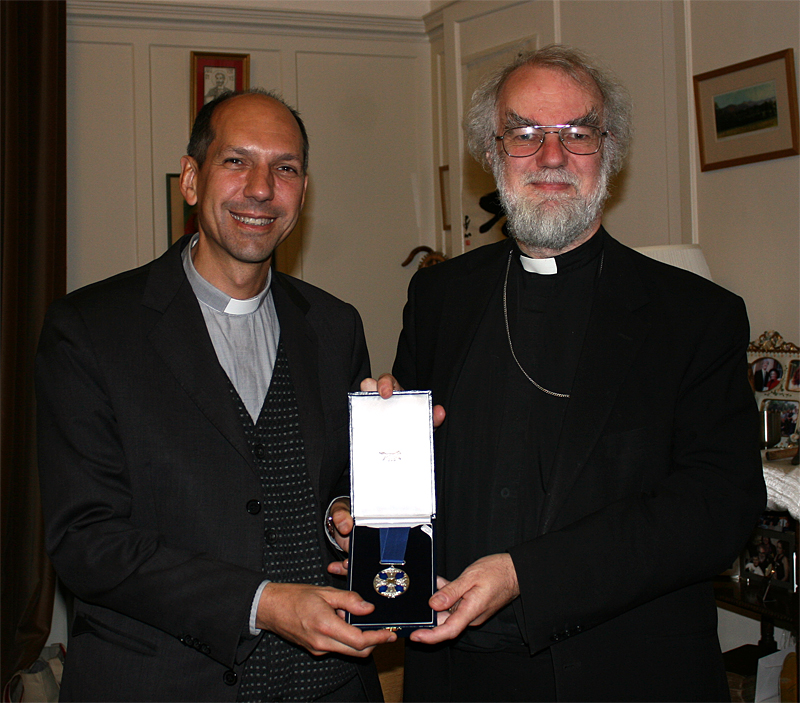
Monsignor Don Bolen recieving the Cross of St. Augustin from Archbishop Rowan Williams
Monsignor Don Bolen is the vicar general of the Archdiocese of Regina, Saskatchewan, Canada, and former staff of the Anglican/Methodist desk at the Pontifical Council for Promoting Christian Unity. Over Christmas break his election as bishop was announced, which I followed and even posted on Facebook. He’s teaching the second half of our course, Methodism and its Dialogue with the Catholic Church. He was the presider and homilist for the Sunday Eucharist, and was clearly loved by the people who had known him there from his time in Rome.
First impressions – after one mass and one class – is that the people of Saskatoon are blessed among Canadians. Home of the Prairie Centre for Ecumenism, it seems like a great fit, and any diocese would welcome a bishop who is so genuine, humble, intelligent and obviously a gifted ecumenist. A good preacher and teacher too!
Leaving Assisi
Disclaimer: You may have noticed some incongruity between posts and pictures. In the rush between returning to Rome from Assisi on Epiphany, and Nancy leaving for the states the next day, I did not have time to download our pics and videos from that part of the trip! So, I have had to make use of others’ photos. This is why the “Rainy Assisi” pics have blue skies!
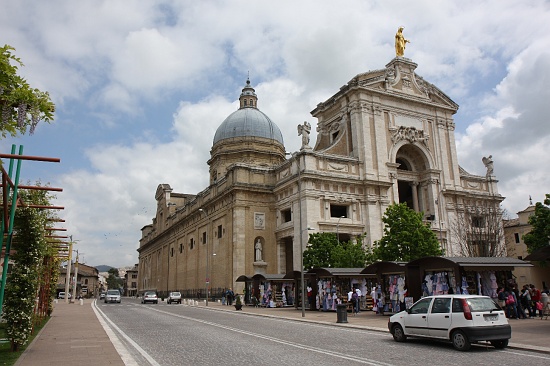
Basilica Santa Maria degli Angeli, Assisi
The train station for Assisi is on the valley floor, in the “new” town called Santa Maria degli Angeli, after the church there – though still in the municipal limits of Assisi.
The Basilica of Santa Maria degli Angeli (St. Mary, [Queen] of the Angels) is constructed over the small chapel that Francis rebuilt in response to his vision of the San Damiano crucifix which told him to repair the Lords house which was falling into ruin. He thought it meant the small deteriorating chapel below the town, on some unused property of one of the local monasteries. Only later did he realize the Lord was probably not being so literal, and meant to reform the Church itself. It is easy to forget that the Reformations really started about 300 years before Luther!
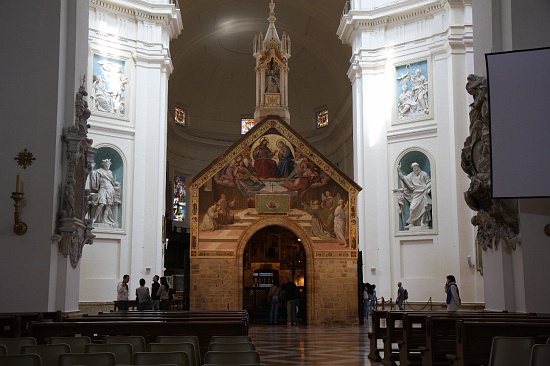
Porzincola inside Santa Maria degli Angeli
Here in Rome there is a statue outside of the Lateran of St. Francis and companions pleading their case before Pope Innocent III, who, according to pious legend, had a dream of Francis supporting a tilting church and interpreted it to mean he would help sustain the Church from collapse.
The small chapel that he rebuilt, and the portion of land it is on, are known as the Porzincola – the small portion. After his death, they literally built the new basilica over his little chapel, which is still intact in the centre of the new church. It is not hard to imagine what he would say of this huge “memorial” to his humble little house of the people of God!
For those of us from the States, especially on the west coast, it is important to remember the history of Franciscan missionaries who brought their Assisi roots to California’s shores. Three of their many missions were named after churches here in Assisi: Santa Chiara inspired Santa Clara, San Francesco inspired San Francisco, and Francis’ Porzincola inspired the name of a little place – El Pueblo de Nuestra Señora la Reina de los Angeles del Río de Porciúncula – more commonly known as L.A.
Rainy Assisi

Rocca Maggiore Fortress, Assisi
The day we decided to hike to the very top, to the Rocca Maggiore fortress, it was raining. Yet, the view was worth it, especially as a heavy fog rolled in from the valley devouring the town. Watching one big church after another disappear in a mist so thick as to be tangible, I was reminded of the old tales of Brigadoon (that, and of a Stephen King novel, the Mist). In this spiritual retreat centre of central Italy, three days with three very different characters served once again to remind me of the mystery and awe of God’s handiwork!

Piazza Communale, Santa Maria Sopra Minerva, Assisi
We spent the afternoon revisiting the shops to pick up souvenirs, and drying off in a Café just across form San Rufino Cathedral (also recommended by Rick Steves’). Unfortunately for me (or for my family, I guess), my memory of where I saw the gifts I wanted to get for some of my family did not serve, so I had to leave some places empty handed. We did find a place selling a local cheese made with black and white truffles, and fresh pasta, which we put together for dinner. Delicious! Such a pity Nancy left the cheese here when she left for home!
Only 3500 people live within the walls of the historic town, though 25,000 within the city limits which mostly sprawl on the valley below. For this small number, there are almost 100 churches. Ok so some of these have been deconsecrated, but still, for that number of Catholics in the U.S., one church the size of any of the basilicas would be more than sufficient! This could explain why you see sparse numbers at mass sometimes, is that there are too many options!

My favorite Franciscan, Dr. Lorelei Fuchs of the Franciscan Sisters of the Atonement, taken at the National Workshop on Christian Unity
However, sparse numbers was not a problem in Assisi’s cathedral on a Tuesday afternoon. We had about half an hour to kill before the shuttle picked us up, and as I may have mentioned, it was raining. So we ducked inside the Cathedral thinking we could sit and pray or look at the artwork in relative comfort. The place was packed! But not a car in the piazza, which had been full on Sunday! Imagine a few hundred teens, a dozen Franciscan friars, and a Charismatic praise and worship service. And they say there is no life in the church here!
Snowy Assisi
The only snow I have had in Italy! We woke up to a thin blanket of the white stuff, and got to spend the day under a very gentle snowfall. We completed our tour of the town, which is more or less a stroll through the major churches, and stopping for another Umbrian five-course meal.
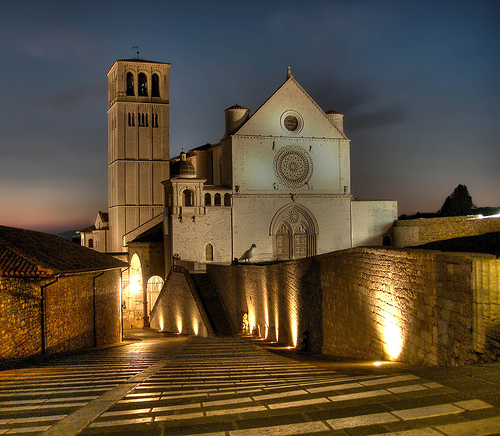
Basilica of St. Francis
On the way down from the higher end of town where we start the day to the big Basilica of San Francesco, we stopped by the small, old church of San Stefano whose bells are said to have rung miraculously by themselves at the moment St. Francis died. In itself, the church is a testament to the simple style of the age, created without an architect, just the stonemasons putting together a basic design that would serve its purpose: a house for the church.
The Basilica San Francesco is massive, three stories from the crypt to the lower basilica to the upper, with two huge piazzas, one off of the upper and lower basilicas respectively. It was at this site that Pope John Paul II called his World Day of Prayer for Peace in 1986 and again in 2003, gathering leaders of every major Christian communion and of virtually every religion on the planet, from the Dalai Lama to First Nations peoples from the Pacific Northwest.
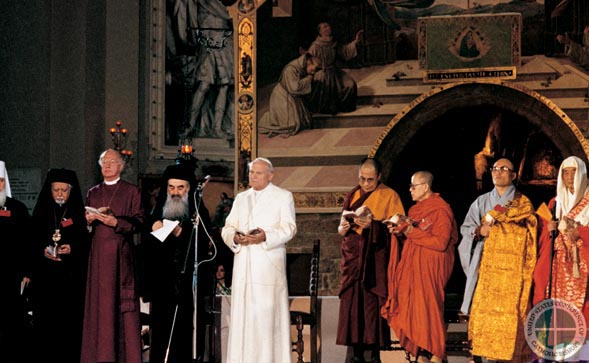
First World Day of Prayer for Peace, 1986
It is said that Francis was the first to use a presepe, a nativity scene or crèche, in commemoration of Christmas, and Italian churches go all out, especially in Assisi. An entire stable is converted for a life-size display near the Roman Amphitheatre, and the Piazza San Francesco also has a life-size display. Within every church we stopped at were scenes with sometimes hundreds of figures, rolling hills, light and water effects, sometimes music. In the Benedictine Abbey church of San Pietro, the lighting and sound effects were timed to give a full rotation of the day and night, with corresponding village sounds, birds, etc.
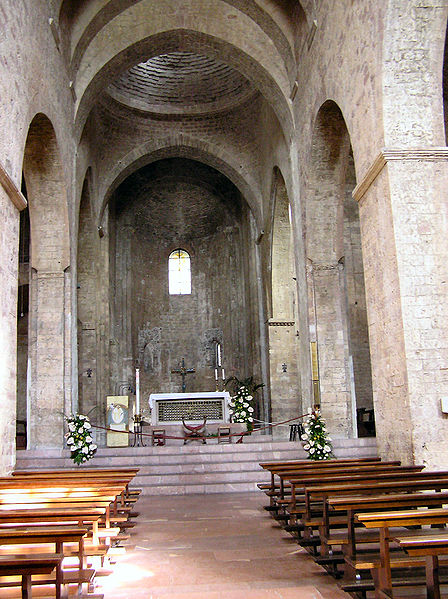
Abbey Church of San Pietro, Assisi, Built 970 AD
 The Ecumenism Blog