
Summer hiatus
Friends,
I am spending a lot of time in front of the computer, writing, this summer, and have just let the blogging go by the wayside for a few weeks. I will catch up with a number of things about the time i get back to Rome, if all goes well. In the mean time, enjoy fair august and the rest of summer!
Cascade Covenant Church

I had reason when I was home last summer [2011] to visit Cascade Covenant Church, a short walk from my mother’s house, where she, though a lifelong Catholic, helps with the Snoqualmie Valley’s only Sunday school for children with special needs. The pastor’s wife is also a colleague of hers in special education at the public schools, and they worked together to develop the ministry.
Given how little encounter with, and regularly innacurate assumptions about, Protestants and protestant worship that many of my Catholic colleagues have in Rome, especially regarding the small denominations and the nondenominational movements, it was interesting to reflect on a few of the liturgical and pastoral or administrative aspects of this community.
Many Catholic parishes are named for a patron saint. Cascade Covenant has instead a patronal verse:
“I have come to give you life – life in all its fullness.” -John 10:10
The elements, if not the order, of worship should be quite familiar for the liturgically oriented:
- Worship music
- Opening prayer by the music leader/associate pastor
- More music
- Announcements (with a video clip)
- Communion
- Served from three tables with bread, juice, and water.
- Preaching in breakout sessions
- Digging into the Bible
- Understanding the Facts of Christianity (apologetics)
- Spiritual Formation 101: Reflections on authentic growth and transformation
- A Time for Prayer
The music included not only popular Christian worship songs, but also the Sanctus and the Gloria. During Communion, people processed up to the tables, and were invited to use the water to bless themselves in some way, such as a sign of the cross on the forehead, in remembrance of their baptisms.
The community was celebrating baptisms later that day, and was the cause for this additional element at the communion table. While describing Baptism, it was referred to as a sacrament, but not as conversion which is said to be separate. Baptism was a sign of new life in Christ, and would take place at the river that afternoon.
Instead of a single sermon or homily, people were invited into breakout sessions for preaching, and from these concluded separately. I got the impression this was an experimental approach being used over the summer to see how it worked.
Compared to many Catholic churches, both ancient and modern, the facility was better suited to the many needs of a parish community. They had a fireside room/library ideal for a medium group of adults, a multipurpose worship center, classrooms and meeting rooms that were used by Sunday school and others. There were classrooms for all ages from preschool to adult, including space for a dedicated program to children with special needs, and it was clear these could be used for a day school program, but not dominated by it.
A welcome center described on the front of the bulletin invited people to receive a free gift, arrange to meet one on one with one of the pastoral staff. There was also additional ministry information, and several of the staff were circulating regularly through both of their morning services. It was clear throughout that there was a great emphasis on mission and service to the greater community, both local and international.
On the negative side, though, the sanctuary was really a multipurpose room that could easily have served as a banquet hall or conference room as it could a worship space. The center of focus seemed to be the band, rather than altar or pulpit – just a modernized version of churches dominated by the old pipe organs. Despite being in an ideal location, they had not made use of the spectacular view of the local mountain with large windows, which may have been structurally necessary, but was aesthetically disappointing.
The annual budget for the parish was $800,000. The pastoral staff included a Lead Pastor, an Associate Pastor/Worship Director, a Welcoming Ministry Leader, Children’s Ministry Director, and Ministry Leaders for High School, Middle School, Elementary, and Pre-K. Support staff included a Facilities Director and an Administrative Assistant.
Cascade Covenant is part of a communion called the Evangelical Covenant Church, founded in 1885 by Swedish Lutheran immigrants, and now has 800 congregations in the United States and reports 180,000 Sunday worshipers (but only 125,000 members!). This makes their average parish congregation one with 225 people on Sunday, and just over 150 of which are members. The denominational headquarters are in Chicago, IL.
By comparison, the Catholic Church in the U.S. has about 68 million members in 18,992 parishes, of whom about 31 million attend Sunday liturgies. This makes the average parish congregation one with 1640 worshippers on Sunday, but about 3580 members.
The parish tagline was “No Perfect People Allowed! Come as you are and grow in new ways!” with a motto or theme of “Fully Alive”.
 The Evangelical Covenant Church describes itself as
- Evangelical, but not exclusive
- Biblical, but not doctrinaire
- Traditional, but not rigid
- Congregational, but not independent
Dear Father Facebook: You are not married
 Dear Father Facebook,
We have been friends for a while, possibly in real life, but certainly on this social networking site, which is far more important at the moment.
You are a priest of the Catholic Church. I am pretty good at ecclesiology, and having studied and discerned ordained and non-ordained ecclesial ministry my whole life, and I am quite sure that the norm of celibacy is still in force for the Latin Church. I have a deep respect and love of Eastern Catholic Churches, which generally allow their diocesan clergy to wed, but I happen to know that you are thoroughly Latin.
That being the case, unless you are an Anglican priest or Lutheran pastor who has come into full communion since your ordination, you are not married.
Please change your relationship status.
Yes, I know you are not alone, and it is not a clear cut choice. There is no “celibate” option on the relationship status list, last time I checked, so you and your brother presbyters have to choose between “single”, “in a relationship”, or “it’s complicated”, etc. Several of you have opted to present yourself as “married”, but I suggest this is not a good idea. Primarily because, well, you are not married.
You could say you are single, which is the most obvious true choice. The problem is that it might imply that you are available, and if you are chaste in your celibacy, as I am sure you are, then you are not available and I can understand that you do not want to give that impression.
You could say you are in a relationship, or that it is complicated, indicating you are not available, but neither are you engaged or married. These might be better, because, again, they are honest descriptions, though hopefully your commitment to your orders is not really that complicated. And it never says what kind of relationship you are in, so this could work.
But the one thing you are not is “married” (nor “engaged”, for you seminarians reading this). These very clearly indicate a vowed, committed lifelong relationship between two people that is a sign of love and union, and open to children. If you are religious you are in a vowed relationship as well, but it is not marriage. If you are diocesan (secular, for you old-school types), you are not even in vows, but an oath of fealty to your bishop.
Sure, back in the day when local churches elected their own bishops for life, it was spoken of as “being married to the church” – but when princes and popes took the power of placement away from the people, and when bishops began to move from see to shining see with impunity, the analogy began to break down.
And, sure, we can joke about people being “married to the job” because of their commitment and dedication, but these parallels and analogies are not the real thing. As Catholic Christians we view holy marriage as a sacrament – Pope John Paul II called it the “primordial sacrament” – and we should not treat it lightly.
For that reason too, as well as respecting the human person, it is probably not a good idea to refer to your breviary, your calendar, or your bishop even jokingly as your “wife”.
While we are on the topic of mixed messages – please do not wear a wedding band. You are not married.
Symbols are powerful. Consider if all the baptized and confirmed began wearing a stole as a symbol of their priesthood. Even though based on a true doctrinal reality – that by Christian Initiation all share in the priesthood of Christ – we reserve that particular symbol for a particular participation in His priesthood: that of the ordained bishop, presbyter or deacon. Similarly, the wedding band is reserved for those who actually participate in the sacrament of marriage, not a parallel image, no matter how sincere the intent or worthy the service.
If you want to begin a petition for Facebook to offer a “celibate” or “vowed religious” or even “consecrated virgin” relationship status, I will “like” it. I hope you can post an honest descriptor on your page, showing to the socially networked world the sacrifice you have made “for the sake of the kingdom”.
Until that time, however, please help me in supporting the traditional definition of marriage… by removing it from your profile.
Sincerely,
your (unmarried) brother in Christ.
A Tridentine wedding and “How not to” homiletics

Two friends of mine were recently married, according to the “extraordinary form” of the Roman Rite, better known as the Tridentine Rite. It was the first nuptial mass of its kind in Rome since Pope Benedict XVI published Summorum Pontificum and established a personal parish in the Eternal City for the followers of the pre-Vatican II liturgies.
This is one of the unanticipated gifts of being in Rome, being able to time travel and see what the various sacraments and rites were like for the four centuries before Vatican II went digging around the scriptural and patristic sources to bring back the older traditions while simultaneously brining everything “up to date”.
It was a beautiful day. The weather was perfect, the liturgical chant was beautifully sung, the bride was radiant, the bridesmaids beautiful, and the reception was a masterpiece of hospitality and conviviality. The liturgy was observed at church of Santissima Trinita dei Peligrini, and the reception was hosted in the gardens of the Passionist Retreat of John and Paul, home of the Lay Centre at Foyer Unitas. About 70 guests were present, some from as far as Vancouver, BC or Johannesburg, South Africa.
The people I met were wonderful, and though I did not get as much time to get to know the wedding party – between their hard work preparing for the wedding, and their deserved socializing afterwards – I had some great conversations and met some fascinating people.
It was, overall, one of the most beautiful wedding weekends to which I have been invited.
It is therefore all the more to the credit of the bride and groom, and their assembled guests, that they did not let the one black mark on the day ruin the rest: It was the worst wedding homily I have ever heard. I can honestly say it nearly had me in tears.
(I debated whether to write about this or not – hopefully my choice to do so is not interpreted as disrespect to my friends who were married, but serves as a lesson for those of us in preaching ministries!)
The priest began by comparing marriage to investing in the stock market – risks and rewards. I do not find financial analogies to personal relationships generally helpful, but he might have been able to move on to something meaningful. Instead, the meandering sermon – decidedly not a genuine homily – stumbled from one faux pas to another.
The proper epistle for the nuptial mass in the Tridentine form is the passage from Ephesians that admonishes “wives be submissive to your husbands, husband love your wife.” This was the starting point for an anecdote that seemed to be titled “how not to preach on this passage”. He made his point, but probably not the way he intended:
“Let me tell you about the wrong way to read this passage. I was at a parish in the diocese of Rochester [New York] when this was the reading of the day. Now for those of you not from the U.S., or not in the ecclesiastical scene, Rochester is one of the five worst dioceses in the country. …”
Anybody want to bet he was thinking of Seattle among the other four? Rochester’s bishop usually gets critiqued for, among other ‘liberal tendencies’, his support of lay people in ministry. Hmm… strike one against a crowd of lay students at pontifical universities preparing for ministry.
“… the priest could have talked about the proper attitude of husbands and wives, but instead started talking about the ‘context’ and ‘historical criticism’ of the text! As if what scripture said then and what it says now are ‘historically conditioned’ and must be understood differently! Of course, this priest was a Jesuit, and you cannot expect anything orthodox from them!”
So… actual scripture study and the Jesuits in one blow. Poor Biblicum students.
“… Now, I am not saying that wives should be slaves to their husbands, like the Muslims believe….”
And our resident imam, friend and housemate of the bride, sitting right in front of me. Ouch.
“… there is something the Muslims get right. Their women wear a veil. Here too, we see a veil. It marks what is set aside, what is restricted. The tabernacle is veiled, to show that only the priest can enter it, just like the bride is veiled …”
Thankfully, he did not explicitly complete that thought, but the parallel was not lost. A little uncomfortable, but not quite offensive like the previous statements.
Then the meandering somehow landed on Thomas Jefferson and the Declaration of Independence, on which it stayed for a while. I honestly cannot remember what the point of that was, I was trying too hard to keep a straight face by focusing on the image of the Holy Trinity above the altar. The whole thing went on for about 20 minutes, though i felt like an eternity.
As someone intimately connected with the wedding mentioned afterwards, “there was nothing about love, nothing really about marriage… what the hell was he thinking!?”
At least the pastor, during the “admonishment on the responsibilities of the married state” at the exchange of vows before the mass, spoke of “procreation and the upbringing of offspring”. Maybe not how I would have put it, but more apropos than purely partisan preaching!
Liberalism (and Conservativism) Today
My friend and colleague, Dr. Matthew Tan, has his own blog, the Divine Wedgie, which lately has been more active than mine. Probably because he has finished his license and i am still procrastinating toiling away.
Recently, he posted this little bit about “Liberalism today” and prompted my thoughts, below. This continues a thread loosely connected on the topic of partisan labeling, in the Church especially, started with a quote from the famous canonist Ladislas Orsy, and followed by a former parishioner’s response.
First, Matthew’s remarks:
The American radical social activist Saul Alinsky has been dubbed as one of the “great American leaders of the non-socialist left”. He once said that a Liberal was someone that left the room before an argument began.
That was the 20th century, now that Liberalism has established itself as the dominant institutional paradigm in the 21st century (even when articulated through some ostensibly postmodern voices), we find the Liberal being the only one in the room and who bars entry into it before an argument begins.
One should not be surprised, since Liberalism, in its attempt to provide a space for all to behave however they want regardless of communal telos, paradoxically enjoins a particular pattern of behaviour that seeks to undercut and displace any pattern of virtue it claims it wants to include. To the extent it seeks to do this, Liberalism becomes not the opposite to but equates to a form of totalitarianism.
[Warning, liberal use of dry wit below. Or is it conservative use?]
My immediate response:
This sounds rather like late 20th century liberalism, not the contemporary kind. At least in the States, the 80s and 90s were the days of overly uptight political correctness, and you could be sued for sexual harassment for opening a door for a woman. Only the intolerant could not be tolerated. Totalitarian and liberal, in the contemporary sense, are anything but synonymous. Today’s “liberals” really do just want to listen, and be welcoming, which is what gets them labeled as such….
Unless you really do mean Liberalism with a capital L. Because we do not call them Liberals anymore, in the classical sense, probably because they would get confused with the liberals, so they are now called neo-conservatives for some reason. And your description fits well, since they do not care much for dialogue. Or people.
Thankfully in the Church things are much clearer.
Church liberals are the people who are trying to maintain the status quo, or at least the status quo of the last generation or two. They may find themselves fighting fiercely to maintain the serenity and balance of the way things are, lest they be destroyed by these young radicals. Their concern is with tradition as they received it, and protecting the Church from the damage done by irresponsible change.
Church conservatives are radical change agents, dissatisfied with the current state and confused as to why everyone else does not see the obvious need for “reform” (or the abandonment of all that is good and holy, if you are on the other side). They are trying to look back beyond the last couple generations to a previous period, and bring back a ‘purer age’ unencumbered by the historical accretions that are represented in the ‘golden age’ that the reactionaries (above) idealize.
… Does anyone else miss the good old days? You know, back when men were men, roses were red, conservatives were sticks-in-the-mud, and liberals were singing kumbayah?
*sigh*
Imposed (Ir)reverence?
Can you force someone to be more reverent? Is it possible to compel reverence from someone by demanding a particular prayer, position, or facial expression?
We can cultivate reverence. We can create environments that aid people in prayer. We can counsel others, offer spiritual companionship and direction, and inspire liturgical involvement and devotional piety in a way that encourages reverence. But I do not think it is possible to make people more reverent by making them do something which they are not ready to do. In fact, trying to do so would more often have the effect opposite of the intent, and instead impose irreverence.
Yet it is precisely in the language of “increasing reverence” during the Eucharist that there has been discussion in recent years of imposing particular postures – including how one receives communion. It has always been my position – as someone who has spent a decade instructing Eucharistic ministers and prepared adults and children to receive their first communion – that you should receive communion reverently.
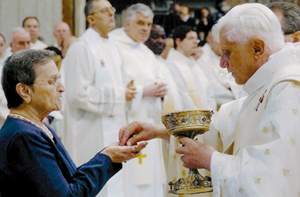
"...make with the left a throne for the right hand, which recieves the King" -Cyril of Jerusalem, c. 313-386 AD
The Latin church itself prescribes two forms for this, in the hands and on the tongue. Dioceses and bishops’ conferences may add or stress elements of the General Instruction on the Roman Missal, such that in some places we are asked to bow before receiving, as we proclaim ‘Amen’; others suggest a sign of the cross immediately after; in the Archdiocese of Seattle we remain standing throughout the communion procession as a sign of reverence, honoring the presence of Christ and the assembly’s act of communion with Him (and the Church), and honoring the liturgical integrity of the procession itself.
The Holy Father has himself weighed in on this, especially since he has been seen to prefer to administer communion in a particular fashion, and some commentators interpreted this to mean he was indicating a change. This is not entirely the case, however:
I am not opposed in principle to Communion in the hand; I have both administered and received Communion in this way myself.
The idea behind my current practice of having people kneel to receive Communion on the tongue was to send a signal and to underscore the Real Presence with an exclamation point. One important reason is that there is a great danger of superficiality precisely in the kinds of Mass events we hold at Saint Peter’s, both in the Basilica and in the Square. I have heard of people who, after receiving Communion, stick the Host in their wallet to take home as a kind of souvenir.
In recent months, it seems this last, unique concern has trumped general liturgical principle, and since the beginning of Advent 2010, at St. Peter’s Basilica during papal masses (and only at papal liturgies, as far as I have seen) communicants are refused communion unless they receive on the tongue.
The first time this happened to me, it was quite jarring. There has been no announcement that I have found, it was just a change. In fact, it seemed that many of the Eucharistic ministers (who are always priests during the papal liturgies, though not necessarily so at other liturgies there) had not been informed. I thought, actually, that it was just the priest at my station “imposing reverence” as he saw fit. He even looked a bit smug. Looking up and down the aisle, some priests were still serving the host according to the communicant’s desire, and others were refusing ‘in the hand’.
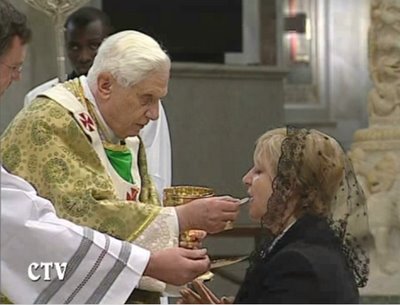 Clearly, this did not instill reverence, but rather robbed the moment of its usual spiritual peace. As I watched people’s reactions, from tourists to young Italians, to one elderly nun in full habit, more than three-quarters went to receive on the hand and when they were refused, responded in surprise, confusion, or even disgust (the septuagenarian sister looked ready to ‘have words’ with the young priest, but then decided against it).
The second time I went to a papal mass with this new practice, the priest at my communion station was a friend and classmate. I was prepared, and this time noticed every minister serving in the hand only, and this time it was the ushers who were gesticulating to everyone to make it clear that communion was only available orally. My friend looked apologetic, and the priest next to him was confused, clearly not having been informed of this new rule, either. Again, though some people would have received this way in any case and others had been recently enough to know what to expect, others looked disconcerted, distracted, or dissatisfied. None appeared more reverent.
Then again, reverence is an interior orientation, not an exterior expression, so maybe they were.
The decaffeinated Other
However, a closer look reveals how [progressive liberal] multicultural tolerance and respect of differences share with those who oppose immigration the need to keep others at a proper distance. “The others are OK, I respect them,” the liberals say, “but they must not intrude too much on my own space. The moment they do, they harass me – I fully support affirmative action, but I am in no way ready to listen to loud rap music.” What is increasingly emerging as the central human right in late-capitalist societies is the right not to be harassed, which is the right to be kept at a safe distance from others. A terrorist whose deadly plans should be prevented belongs in Guantánamo, the empty zone exempted from the rule of law; a fundamentalist ideologist should be silenced because he spreads hatred. Such people are toxic subjects who disturb my peace.
On today’s market, we find a whole series of products deprived of their malignant property: coffee without caffeine, cream without fat, beer without alcohol. And the list goes on: what about virtual sex as sex without sex? The Colin Powell doctrine of warfare with no casualties (on our side, of course) as warfare without warfare? The contemporary redefinition of politics as the art of expert administration as politics without politics? This leads us to today’s tolerant liberal multiculturalism as an experience of the Other deprived of its Otherness – the decaffeinated Other.
Slavoj Zizek, if you are not familiar, is a rather atypical thinker.
I would add school Christmas concerts without Christmas songs to his list. Christmas without Christ? I am sure there are others.
An interesting quote i thought i would pass on, referenced during a presentation last week on interreligious dialogue. I am not sure it is fair to progressive liberals as it sounds more like libertarian liberals, and then there are plenty of people self-describing as liberal who would not fit either… but it does highlight the problem of tolerance if seen as a sufficient goal, and the idea of a whitewashed, bland, decaffeinated neutral zone in which no one is allowed religious or cultural expression under the guise of allowing all a safe place to be together.
A truly safe place is one in which we can be ourselves while respecting the other, not the place where we all have to give up who we are so as not to ‘inflict our religion/politics/personality’ on the other. The challenge is to be true to ourselves while being true to the other. It is not (as the right extreme would have it) that by allowing the other to be truly present we are short-changing our own self and therefore should not or cannot enter into dialogue and encounter, nor is it (as the left extreme would have it) that we must all refrain from being our true selves so that all can be present together in an empty nothingness of secular space.
On the removal of bishops
Twice in the last three months, Vatican Information Service has announced something which, for the last decade, Vatican officials have said was not actually possible: The pope has removed bishops from the pastoral care of their dioceses.
I have mixed feelings on these announcements.
On March 31, VIS reported that the Holy Father had removed his brother bishop Jean-Claude Makaya Loemba from the pastoral care of the diocese of Pointe-Noire, Republic of the Congo. On May 2, it was announced that he had removed Bishop William M. Morris from the pastoral care of the diocese of Toowoomba, Australia. In neither case was the relevant canon cited which would indicate the actual conditions under which the bishop was ‘removed’.
Bishop Bill has been getting lots of press, both supportive and critical. There has been virtually nothing else on Bishop Jean-Claude. This is the first disappointment – a Caucasian Anglophone bishop gets removed and there is all sorts of coverage, but an African bishop gets the same and… nothing? Really? I know there can be lots of reasons for this: access to internet media, maybe it is all being reported in French, maybe there just is not support for Bishop Jean-Claude as there was for Bishop William, etc. But it still looks bad.
The reasons noted in press outlets for Bishop Jean-Claude’s removal include “mismanagement problems (not moral ones) and tensions in his diocese” – by which is apparently meant tensions with his presbyterate. If every bishop with management problems were removed, we would see this kind of thing a lot more often. This is something that commentators on both left and right picked up on: mismanagement alone is not sufficient for the removal of a bishop, according to canon law. In a global corporation, maybe that would be the case, but this is the Church. So maybe it’s the issue of tensions with the presbyterate – we saw in the case of Cardinal Law that he was not asked to go until his priests declared ‘no confidence’ in his leadership, no matter how many protests from the laity and other ministers.
For the last decade of the sexual abuse crisis, amid calls for the Pope to do something more direct, we have constantly heard that he cannot simply remove malfeasant bishops, that a process must be followed. And then this, where he appears to do just that. But I think partially it is that he appears to do that – and probably this is an inaccurate report by VIS. Both EWTN and Ed Peters, both decidedly right-of-center on ecclesiastical issues, comment on this, so put to rest any accusations of this being a ‘liberal’ complaint.
This is an issue from at least two directions. First, a bad process always leads to a bad decision, even if the actual outcome is a good one. This is moral theology 101 – the ends do not justify the means. So, either there was a better process in place (seems likely) and it was just poorly communicated (still part of the process), or it was a bad process from start to finish.
Second, and more importantly, bishops are not middle management, carrying out their tasks vicariously authorized by the pope – at least, in theory (theology) and in law. In practice however, and in popular Catholicism, this is exactly what they are. The problem here is, if this is what they are, then the Holy See is liable for lawsuit on abuse claims based on the idea that the pope is the supervisor of the bishops. The Vatican’s defense in recent cases was precisely based on Catholic ecclesiology that the bishops are not branch-managers of a global conglomerate. However, if they can be appointed and removed at will by the ‘central office’ then, legally, that is exactly what they are – and the Vatican itself becomes liable for their actions while in office.
With the case of Bishop William “Bill” of Toowoomba, which has generally been focused on a 2006 pastoral letter in which the bishop mused on creative alternatives to the priest shortage in his diocese:
Given our deeply held belief in the primacy of Eucharist for the identity, continuity and life of each parish community, we may well need to be much more open towards other options for ensuring that Eucharist may be celebrated. As has been discussed internationally, nationally and locally the ideas of:
- ordaining married, single or widowed men who are chosen and endorsed by their local parish community;
- welcoming former priests, married or single, back to active ministry;
- ordaining women, married or single;
- recognising Anglican, Lutheran and Uniting Church Orders.
We remain committed to actively promoting vocations to the current celibate male priesthood and open to inviting priests from overseas.
The obvious problem point is “ordaining women, married or single”. At least, it should be obvious. Since 1994 and the publication of Ordinatio Sacerdotalis, the popular understanding is that “we cannot talk about ordaining women anymore”. This is not exactly accurate, as the possibility of ordaining women to the diaconate, or as deaconesses, is not excluded and is still very much debated. (I am currently reading an interesting book by Bishop Gerhard Müller who argues that this document meant to exclude the diaconate as well, however).
Many people are not aware that the CDF, under Joseph Ratzinger, a year later issued a Responsum ad Dubium stating, “This teaching… has been set forth infallibly by the ordinary and universal Magisterium” – probably because this claim was repudiated by various theologians expert in the infallible magisterium of the papacy as “not fitting the criterion” to make it such. Some of this was confusion between ex cathedra teaching (which this clearly is not) and the more ambiguous claim to infallibility because it is an exercise of the ordinary and universal magisterium. Much however is based on the argument that the exclusion of women from ordination is not a matter of faith or morals, but of ecclesiastical discipline, and therefore not eligible for “infallible status”.
The rest are valid and viable ideas, to differing degrees. Canon 277.1 obliges all clerics to “observe perfect and perpetual continence … and therefore are bound to celibacy”, but the same canon (277.3) allows the diocesan bishop to establish more specific norms or dispense with this requirement. This is used regularly for deacons, and for priests who are former Orthodox or Anglican priests or Lutheran pastors. Clearly, as a discipline, clerical celibacy is not part of the deposit of faith, is neither irreformable nor infallible, and a (theologically and pastorally, if not politically or prudently) reasonable option for discussion.
Ecumenical dialogue has as one of its goals the recognition of orders and ministries – we can certainly pray for the day when either we can honestly recognize in the orders of these other churches the full understanding of ordained ministry we see in our own, as we already do with the Orthodox and other ancient eastern Churches. And we hope for the day when those ministries are exercised together in full communion with the Catholic Church.
Fundamentally, though, the question comes down to this: If the Holy Father can “remove from the pastoral care of a diocese” bishops whose fault is less serious than shielding pedophile priests, why can we not do the same for those who do?
Beatification debriefing in brief

New image of the newly Blessed
This morning I have already begun to hear stories of people’s experience here in Rome for the beatification, from one being interviewed by CNN in the middle of Piazza San Pietro, to others who gave up trying to get within a kilometer of the Vatican, and still others who deliberately skipped town to avoid the chaos and the crowd.
The Beatification Mass began at 10:00am Sunday, with an hour-long rosary and divine mercy chaplet planed ahead of time.
Vatican security had cleared the Piazza at 7:00pm Saturday night, though people had already staked places and laid out sleeping pads on the cobblestones around the square. They were moved back beyond a large perimeter. We saw nearly every law enforcement agency available in the city – Policia Municipale, Guarda di Finanza, Carabinieri, Corpo Forestale, Polizia di Stato, et al.
One friend was at the perimeter by 1:00am Sunday, and she made it no closer to the altar than the obelisk in the centre of the piazza. Others arrived at 4:00am and were never able to get into the square. The gates officially opened at 5:30am, allowing people into Piazza San Pietro and Via della Conciliazione. By 6:15am, people were packed up to Castel Sant’Angelo. We followed a group of bishops into the crowd, only to be turned back on the close side of the castle – even the bishops could not get through.
Even in lateral directions the area around the Vatican was packed – I have not yet seen an aerial photo that was able to capture the whole scene of people-packed streets, I do not know if any of the helicopters were high enough to get that wide a view.
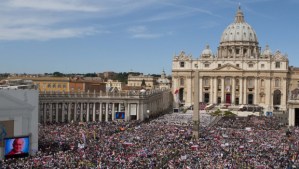
The 5.7 acres of Piazza San Pietro hold only a fraction of the people who came to Rome for the beatification
Some people decided to bail, and go somewhere they could be less crowded and watch it on a jumbotron – the city had a dozen such locations set up, including the Cathedral of San Giovanni in Laterano and the Circo Massimo. Others continued to push in, but never made it close. We found shade and refreshment under the umbrellas of a café’s outdoor seating area, with an oblique view of a jumbotron at Piazza Risorgimento, with no audio but a pilgrims radio tuned to a station translating the whole thing into Polish.
We spent almost two hours in a line to get a cappuccino and cornetto, and then go to the bathroom, once it was decided there was no where better to go unless we wanted to bail and watch at one of the other centers around the city. We got out just in time for mass to start, and stood (thankfully in the shade with tables to put our things on), for the entire 3 hour liturgy and angelus address. Even the English reading was translated into polish on the radio, so I could only relay the parts of the mass as I saw from the partial view of the screen and from the singing in Latin.
I am glad I was here for an historic event, grateful to be in a place with shade and with a friend, but sorry that, given the exhaustion of staying up all night after the vigil that we did not get closer than we did. But, I never thought I would get as close as we did, either. For his canonization, which I expect this time next year, I think the view from San Giovanni in Laterano sounds pretty good – especially for a pope who repeatedly said his role as bishop of Rome, along with Servant of the Servants of God, was the most important responsibility of the pope.
 The Ecumenism Blog