The Ecumenism Blog

Home » Articles posted by A.J. Boyd (Page 18)

Author Archives: A.J. Boyd

Pope Benedict General Audience for the WPCU

“The Unity for Which We Pray Requires Interior Conversion, Both Communal and Personal”

VATICAN CITY, JAN. 18, 2012 (Zenit.org).- Here is a translation of the Italian-language catechesis Benedict XVI gave today during the general audience held in Paul VI Hall. The Pope reflected on the Week of Prayer for Christian Unity, which begins today.

* * *

Dear brothers and sisters,

Today marks the beginning of the Week of Prayer for Christian Unity, which for more than a century has been celebrated by Christians of all Churches and ecclesial Communities, in order to invoke that extraordinary gift for which the Lord Jesus Himself prayed during the Last Supper, before His Passion: “that they may all be one; even as thou, Father, art in me, and I in thee, that they also may be in us, so that the world may believe that thou hast sent me” (John 17:21). The practice of the Week of Prayer for Christian Unity was introduced in 1908 by Father Paul Wattson, founder of an Anglican religious community that subsequently entered the Catholic Church. The initiative received the blessing of Pope St. Pius X and was then promoted by Pope Benedict XV, who encouraged its celebration throughout the Church with the Brief, Romanorum Pontificum, promulgated Feb. 25, 1916.

The octave of prayer was developed and perfected in the 1930s by Abbé Paul Couturier of Lyon, who promoted prayer “for the unity of the Church as Christ wills, and in accordance with the instruments He wills.” In his later writings, Abbé Couturier sees this Week as a way of allowing the prayer of Christ to “enter into and penetrate the entire Christian Body”; it must grow until it becomes “an immense, unanimous cry of the whole People of God” who ask God for this great gift. And it is precisely during the Week of Christian Unity that the impetus given by the Second Vatican Council toward seeking full communion among all of Christ’s disciples each year finds one of its most forceful expressions. This spiritual gathering, which unites Christians of all traditions, increases our awareness of the fact that the unity to which we tend will not be the result of our efforts alone, but will rather be a gift received from above, a gift for which we must constantly pray.

Each year, the booklets for the Week of Prayer are prepared by an ecumenical group from a different region of the world. I would like to pause to consider this point. This year, the texts were proposed by a mixed group comprised of representatives of the Catholic Church and of the Polish Ecumenical Council, which includes the country’s various Churches and ecclesial Communities. The documentation was then reviewed by a committee made up of members of the Pontifical Council for the Promotion of Christian Unity and of the Faith and Order Commission of the Council of Churches.  This work, carried out together in two stages, is also a sign of the desire for unity that animates Christians, and of the awareness that prayer is the primary way of attaining full communion, since it is in being united with the Lord that we move toward unity.

The theme of the Week this year — as we heard — is taken from the First Letter to the Corinthians: “We Will All Be Changed By the Victory of Our Lord Jesus Christ” — His victory will transform us. And this theme was suggested by the large ecumenical Polish group I just mentioned, which — in reflecting on their own experience as a nation — wanted to underscore how strong a support the Christian faith is in the midst of trial and upheaval, like those that have characterized Poland’s history. After ample discussion, a theme was chosen that focuses on the transforming power of faith in Christ, particularly in light of the importance it has for our prayer for the visible unity of Christ’s Body, the Church. This reflection was inspired by the words of St. Paul who, addressing himself to the Church of Corinth, speaks about the perishable nature of what belongs to our present life — which is also marked by the experience of the “defeat” that comes from sin and death — compared to what brings us Christ’s victory over sin and death in His paschal mystery.

The particular history of the Polish nation, which knew times of democratic coexistence and of religious liberty — as in the 16th century — has been marked in recent centuries by invasions and defeat, but also by the constant struggle against oppression and by the thirst for freedom. All of this led the ecumenical group to reflect more deeply on the true meaning of “victory” — what victory is — and “defeat.” Compared with “victory” understood in triumphalistic terms, Christ suggests to us a very different path that does not pass by way of force and power. In fact, He affirms: “If anyone would be first, he must be last of all and servant of all” (Mark 9:35). Christ speaks of a victory through suffering love, through mutual service, help, new hope and concrete comfort given to the least, to the forgotten, to those who are rejected. For all Christians, the highest expression of this humble service is Jesus Christ Himself — the total gift He makes of Himself, the victory of His love over death on the Cross, which shines resplendent in the light of Easter morning.

We can take part in this transforming “victory” if we allow ourselves to be transformed by God — but only if we work for the conversion of our lives, and if this transformation leads to conversion. This is the reason why the Polish ecumenical group considered particularly fitting for their own reflection the words of St. Paul: “We will all be changed by the victory of Christ, Our Lord” (cf. 1 Corinthians 15:51-58).

The full and visible unity of Christians for which we long demands that we allow ourselves to be ever more perfectly transformed and conformed to the image of Christ. The unity for which we pray requires interior conversion, both communal and personal. It is not simply a matter of kindness and cooperation; above all, we must strengthen our faith in God, in the God of Jesus Christ, who has spoken to us and who made Himself one of us; we must enter into new life in Christ, which is our true and definitive victory; we must open ourselves to one another, cultivating all the elements of that unity that God has preserved for us and gives to us ever anew; we must feel the urgency of bearing witness before the men of our times to the living God, who made Himself known in Christ.

The Second Vatican Council put the ecumenical pursuit at the center of the Church’s life and work: “The Sacred Council exhorts all the Catholic faithful to recognize the signs of the times and to take an active and intelligent part in the work of ecumenism” (Unitatis redintegratio, 4). Blessed John Paul II stressed the essential nature of this commitment, saying: “This unity, which the Lord has bestowed on his Church and in which he wishes to embrace all people, is not something added on, but stands at the very heart of Christ’s mission. Nor is it some secondary attribute of the community of his disciples. Rather, it belongs to the very essence of this community (Ut unum sint, 9). The ecumenical task is therefore a responsibility of the whole Church and of all the baptized, who must make the partial, already existing communion between Christians grow into full communion in truth and charity. Therefore, prayer for unity is not limited to this Week of Prayer but rather must become an integral part of our prayer, of the life of prayer of all Christians, in every place and in every time, especially when people of different traditions meet and work together for the victory, in Christ, over all that is sin, evil, injustice, and that violates human dignity.

From the time the modern ecumenical movement was born over a century ago, there has always been a clear recognition of the fact that the lack of unity among Christians prevents the Gospel from being proclaimed more effectively, because it jeopardizes our credibility. How can we give a convincing witness if we are divided? Certainly, as regards the fundamental truths of the faith, much more unites us than divides us. But divisions remain, and they concern even various practical and ethical questions — causing confusion and distrust, and weakening our ability to hand on Christ’s saving Word. In this regard, we do well to remember the words of Blessed John Paul II, who in the Encyclical Ut unum sint, speaks of the damage caused to Christian witness and to the proclamation of the Gospel by the lack of unity (cf. no. 98,99). This is a great challenge for the new evangelization, which can be more fruitful if all Christians together announce the truth of the Gospel of Jesus Christ and give a common response to the spiritual thirst of our times.

The Church’s journey, like that of all peoples, is in the hands of the Risen Christ, who is victorious over the death and injustice that He bore and suffered on behalf of all mankind. He makes us sharers in His victory. Only He is capable of transforming us and changing us — from being weak and hesitant — to being strong and courageous in working for good. Only He can save us from the negative consequences of our divisions. Dear brothers and sisters, I invite everyone to be more intensely united in prayer during this Week for Unity, so that common witness, solidarity and collaboration may grow among Christians, as we await the glorious day when together we may profess the faith handed down by the Apostles, and together celebrate the Sacraments of our transformation in Christ. Thank you.

[Translation by Diane Montagna]
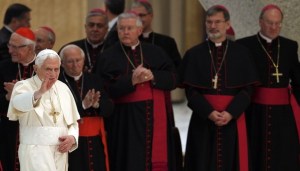
[In English, he said:]

Dear Brothers and Sisters,

The Week of Prayer for Christian Unity which begins today invites all the Lord’s followers to implore the gift of unity. This year’s theme – We Will All Be Changed By The Victory Of Our Lord Jesus Christ – was chosen by representatives of the Catholic Church and the Polish Ecumenical Council. Poland’s experience of oppression and persecution prompts a deeper reflection on the meaning of Christ’s victory over sin and death, a victory in which we share through faith. By his teaching, his example and his paschal mystery, the Lord has shown us the way to a victory obtained not by power, but by love and concern for those in need. Faith in Christ and interior conversion, both individual and communal, must constantly accompany our prayer for Christian unity. During this Week of Prayer, let us ask the Lord in a particular way to strengthen the faith of all Christians, to change our hearts and to enable us to bear united witness to the Gospel. In this way we will contribute to the new evangelization and respond ever more fully to the spiritual hunger of the men and women of our time.

* * *

I offer a cordial welcome to all the English-speaking pilgrims and visitors present at today’s Audience. My special greeting goes to the Lutheran pilgrims from Finland. I also greet the group of sailors and marines from the United States. Upon all of you and your families I cordially invoke God’s abundant blessings!

© Copyright 2012 – Libreria Editrice Vaticana
Zenit original: http://www.zenit.org/article-34139?l=english
Vatican original with video: http://www.vatican.va/holy_father/benedict_xvi/audiences/2012/documents/hf_ben-xvi_aud_20120118_en.html
Prayer for Christian Unity?

One of the most well advertised annual events during the Week of Prayer for Christian Unity in Rome has nothing to do with ecumenism.

At least, not explicitly.

Every night at 8:00pm during the WPCU, there is a liturgy at Santa Maria in Via Lata, just off the Via del Corso. Instead of inviting in the Orthodox, Anglican, and Protestant communities in Rome to lead worship in rotation, every one of these liturgies is Catholic. The unique aspect of the series, however, is that each is celebrated according to a different liturgical rite, sponsored by different of the Churches sui iuris that make up the Catholic communion.

It is a great idea, but the question is whether it is appropriate for the week of prayer that is meant to focus on the restoration of unity with other Christians. Is it a celebration of the unity-in-diversity that already exists in a real but imperfect way in the Catholic Church? Does it smack of uniatism, or of Catholic imperialism? Is it enough to remind Roman Catholics that not all Catholics are Roman, that we do not all do things the same way, and therefore demonstrate a fundamental principle of ecumenism – that unity does not mean uniformity?

This year’s schedule includes most of the major liturgical traditions – though the East Syrian, or Assyrian/Chaldean rite is notably absent for some reason:

  • January 18: Byzantine Rite, Greek Catholic Church
    (organized by the Pontifical Greek College)
  • January 19: Byzantine Rite, Ukrainian Catholic Church
    (organized by the Basilian Fathers of St. Giosafat)
  • January 20: Byzantine Rite, Romanian Catholic Church
    (organized by the Pontifical Romanian College)
  • January 21: Maronite Rite, Maronite Catholic Church
    (organized by the Maronite Order of the Blessed Virgin Mary)
  • January 22: Latin Rite, Roman Catholic Church
    (presided by Archbishop Piero Marini)
  • January 23: West-Syrian Rite, Syro-Malankara Catholic Church
    (organized by the Pontifical Damascene College)
  • January 24: Armenian Rite, Armenian Catholic Church
    (organized by the Pontifical Armenian College)
  • January 25: Ge’ez Rite, Ethiopian Catholic Church
    (organized by the Pontifical Ethiopian College)

First, I have to say it is a great opportunity to celebrate the liturgical diversity of the Catholic Church. In a way it recalls Bl. John XXIII’s decision to open Vatican II in the Ambrosian Rite rather than in the Roman – a reminder that there is always more than one way to be Catholic.

It is also helpful for us Latins to remember that the Catholic Church is actually catholic, and not simply an extension of Latin-Roman/Western culture. All Roman Catholics are Catholic, but not all Catholics are Roman Catholic.

(It should go without saying the ecumenically obvious statement that not all catholics are Catholic, either, but that does not merit calling all Catholics ‘Roman Catholic’. Capisce?)

One caveat is that it can reduce the respective churches of the Catholic communion merely to their liturgical patrimony, as if the Catholic Church simply enjoys liturgical diversity in a single monolithic ecclesial entity, rather than in fact being a communion of churches.

Another is that such a celebration during the Week of Prayer for Christian Unity could communicate an unintended model of unity, some kind of liturgical uniatism – or, as one my first ecumenical dialogue partners, an avid Trekkie, would put it, this model makes the Catholic Church out to be the Borg, with a simple message: “Your patrimony will be absorbed and added to our own. Resistance is futile.”

Certainly, that is not ecumenism according to the Catholic Church. (Though there is at least a hint of receptivity!)

Nevertheless, it is a celebration of Christian Unity – to be precise, of Catholic unity – to be able to celebrate the same Eucharistic mystery in such varied and ancient liturgical traditions, all of which are found within the Catholic Church. It just is not the kind of Christian Unity, or not the whole scope of the kind of unity, envisioned by the Week of Prayer.

It might be more fitting, however, if the week included Anglican, Protestant, and Orthodox Eucharistic liturgies, in which it is precisely our inability to share communion that compels us to strive for the unity for which Christ himself prays. Or let us celebrate the rich diversity of the Catholic communion in the same manner, but in a different week: perhaps the Pentecost octave. Then at least we would have time to participate in both!


Settimana di Preghiera per l’unità dei Cristiani 2012 in Roma

If you ever thought that Rome was not interested in ecumenism, you should think again. The calendar below is an unofficial list of everything going on during these days that has been advertised in connection to the Week of Prayer for Christian Unity, or the preceding Day of Reflection on Jewish-Christian Dialogue.

WEEK OF PRAYER FOR CHRISTIAN UNITY
SETTIMANA DI PREGHIERA PER L’UNITÀ DEI CRISTIANI
ROMA + 18 – 25 JANUARY 2012

Tutti Saremo Trasformati dalla Vittoria di Gesu Cristo, Nostro Signore”
“We will all be transformed by the victory of our Lord Jesus Christ”

Tuesday, 17 January

1730     Giornata di Riflessione Ebraico-Cristiana: La Sesta Parola: «NON UCCIDERAI»
S. E. Mons. Benedetto Tuzia Commissione diocesana per l’Ecumenismo e il Dialogo
Ecc.mo Rav Riccardo Di Segni Rabbino Capo della Comunità Ebraica di Roma
Prof. Mauro Cozzoli Professore Ordinario di Teologia Morale, Pont. Università Lateranense
Pontificia Universitá Lateranense, Aula Pio XI

Wednesday, 18 January

1730      The Encounter of the African Traditional Religions, Islam and Christianity in Northeastern Nigeria:
Toward a Contextual Theology of Interreligious Dialogue
Doctoral Defense of Rev. John Bogna Bakeni, Russell Berrie Alumnus
Pontificia Universitá San Tommaso, Aula X

1830       The Venerable English College – Celebration of the Week of Prayer for Christian Unity

1900      Celebrazione, Consulta delle Chiese Evangeliche Romane
Pastore Herbert Anders, Chiesa Luterana
S. E. Mons. Benedetto Tuzia Commissione diocesana per l’Ecumenismo e il Dialogo
Chiesa luterana, via Toscana 7

Thursday, 19 January

1600     Celebrazione ecumenica finlandese, festa di S. Enrico di Finlandia
S.E.R. Mons. Teemu Sippo, vescovo della diocesi cattolica di Helsinki.
Rev.mo Seppo Hakkinen, vescovo della diocesi evangelico-luterana di Mikkeli.
Basilica di Santa Maria Sopra Minerva

1630      Impulses of the Spirit: Promotion of Human Rights, Justice, and Peace since Vatican II
Rev. Drew Christiansen, SJ, editor-in-chief of America Magazine
Ecumenical Celebration of the Word
Canon David Richardson, ChStJ, Archbishop of Canterbury’s Representative to the Holy See
Monsignor Mark Langham, Pontifical Council for Promoting Christian Unity
Centro Pro Unione, Via del Anima 30 (Piazza Navona)

1830       Veglia Ecumenica Diocesana di Preghiera
Basilica Santa Maria in Trastevere

Friday, 20 January

1730      Vespri ecumenica
Rev.mo Seppo Hakkinen, vescovo della diocesi evangelico-luterana di Mikkeli
S.E. Teemu Sippo, vescovo della diocesi cattolica di Helsinki
S.E. Mons. Brian Farrell e Mons. Mathias  Türk.
Chiesa di S. Brigida, Piazza Farnese 96

Saturday, 21 January

1000      Abdullahi An-Na’im Human Rights Theory and Jacques Maritain’s Natural Law: A Comparative Study
Doctoral Defense of Dott.ssa. Paola Bernardini, Russell Berrie Alumna
Pontificia Universitá San Tommaso

Sunday, 22 January

1100      Catholic Eucharist with guest preacher,
Canon David Richardson, ChStJ, Archbishop of Canterbury’s Representative to the Holy See

Oratorio di San Francesco Saverio del Caravita

1830       Ecumenical Prayer Service/Churches Together in Rome
Prof.ssa Donna Orsuto, DSG, Preaching
Ponte Sant’Angelo Methodist Church, Piazza di Ponte Sant’Angelo

Tuesday, 24 January

1245      Anglican Eucharist with guest preacher
Rev. Kenneth Howcraft, Methodist Representative to the Holy See
Anglican Center in Rome, Piazza del Collegio Romano 2

1830       Dialogo Interreligioso in Chiara Lubich e nel Movimento dei Focolari
Dott. Roberto Catalano, Centro Dialogo Interreligioso
Istituto Tevere – Centro pro Dialogo, Via di Monte Brianzo 82

Wednesday, 25 January

1730      Vespers at the Papal Basilica of San Paolo fuori le Mura
Pope Benedict XVI Solemn Closing of the Week of Prayer for Christian Unity

2000     Veglia di preghiera ecumenica
Mons. Charles Scicluna
Chiesa Santa Brigida, Piazza Farnese 96

Thursday, 26 January

1800      Chiesa Cattolica: Essenza – Realtà – Missione
Presentazione: Dott. Rosino Gibellini
Intervento: S.E.R. Cardinal Walter Kasper
Responso: S.E.R. Cardinal Kurt Koch
Centro Pro Unione, Via Santa Maria dell’Anima 30

The Lay Centre at Foyer Unitas: Catholic, Ecumenical, and Interreligious

I wrote the following for Koinonia, the newsletter of the Paulist Office for Ecumenical and Interfaith Relations. It was published in the winter 2012 issue:

For Avner, an Israeli Jew, Yom Kippur this year meant spending the day at a Benedictine retreat center with his new housemates and attending his first Catholic mass. It inspired him to fast for the Day of Atonement for the first time in years.

For Kassim, a Muslim father of three from Ghana, his first Sunday in Rome was marked by the celebration of the Eucharist as well – at St. Peter’s Basilica with Pope Benedict XVI and all the bishops of Africa, including Cardinal Peter Turkson of Ghana. Matthew, a Christian born in Singapore and living in Australia, experienced for the first time a Shabbat meal with a rabbi; Muhamed, a Sunni imam from Bosnia studied the liturgy of the hours in the Latin tradition alongside a Belarusian Orthodox scripture scholar and a Syro-Malabar Catholic liturgist.

When a rabbi, an imam, and a minister sit down together, it sounds like the beginning of a joke. Mention that they are housemates, too, and you suspect there is a punch line coming. Add that this is in the heart of Rome, in a Catholic residence for students of the Pontifical Universities in the Eternal City, and your skepticism is almost justified.

For twenty-five years, however, the Lay Centre at Foyer Unitas has been just that: a Catholic collegio [1]committed to the formation of future theologians and church leaders in their Catholic identity – and precisely by virtue of that commitment, also a house of hospitality to ecumenical and interreligious scholars in Rome.

The Lay Centre was founded by Dr. Donna Orsuto, of Ohio, and Ms. Riekie van Velzen, of the Netherlands, in 1986 – a time when, surprisingly, there were still very few lay students in the pontifical universities, and when no Roman collegio was open to people who were not priests, seminarians, or religious. It was born out of the Foyer Unitas (literally, Hearth of Unity) of the Ladies of Bethany, which they had operated since 1952 as an information and hospitality center for non-Catholic pilgrims to Rome, including some of the ecumenical observers at Vatican II.

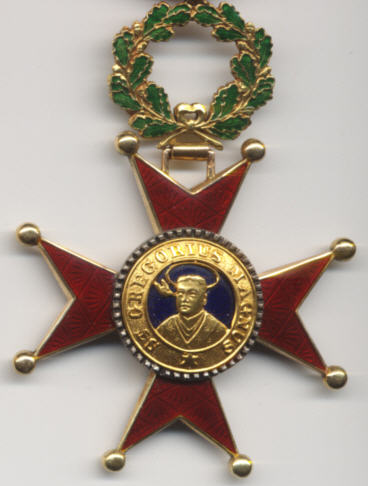
During the recent twenty-fifth anniversary celebrations, the co-founders, Dr. Orsuto and Ms. van Velzen were honored by Pope Benedict XVI as Dame of the Order of St. Gregory the Great, and Dame of the Order of Pope St. Sylvester, respectively.

Three-fold Mission

The Lay Centre’s mission is threefold:

  • To provide a formation program for the resident student community based on the four pillars of Christian formation identified by the Holy See: spiritual, intellectual, human and pastoral.
  • To provide ongoing adult faith formation to the expatriate Anglophone communities of Rome.
  • To provide a series of international programs giving church leaders from around the world a unique opportunity to explore the history and theology of Rome.

There are currently twenty-two residents of sixteen nationalities and from five continents. They are agnostic and Jewish, Shi’a and Sunni, Orthodox and Catholic (even Latin and Eastern!). In such a milieu, there is ample opportunity for a dialogue of life and hands-on learning from a cross-cultural context.

Food and mealtimes always provide such occasions: One student is vegetarian, the three Muslims have three different approaches to halal, and during advent the Orthodox have gone temporarily vegan. As an Italian dinner is never complete without wine on the table, the Sicilian blood-orange juice was redubbed “Muslim red wine” by those not permitted to partake of the Christian variety. Dinnertime conversation can range from the World Cup to circumcision practices in Judaism, Christianity, and Islam. A trip to the kitchen for a midnight snack can turn into a two-hour conversation about different religions’ perspectives on agnosticism and secularity.

The Prayer Life of the House

As a lay Catholic Christian community, the prayer life of the house is decidedly in that tradition; members of other churches are welcome to participate, and members of other faiths are welcome to observe, as appropriate. Before the main community meal of the day, all who choose to do so pray either midday prayer or vespers in common, and every day ends with a form of night prayer. A weekly community night includes the celebration of the Eucharist with a guest bishop or priest, dinner, and a formation session. Meal prayers might come from any tradition and be in any language.

Prayer also presents the opportunities for respectful presence and observation at the prayer of another religion, like the Jewish and Muslim encounters with the Mass mentioned above. Prayer can be a time for hospitality: During a recent evening event, one of the Muslim guests asked his Lay Centre hosts for a quiet place to pray maghrib. One Catholic resident immediately went to his room to retrieve a prayer mat he kept for just such occasions, as the other resident volunteered to wait during her friends’ prayer to make sure he was not disturbed.

In October, the Lay Centre organized [2] a pilgrimage to Assisi to join Pope Benedict XVI and other leaders of the world’s religions for the Pilgrimage of Peace, Pilgrimage of Truth,marking the 25th anniversary of the historic first interreligious gathering in Assisi with Pope John Paul II. Though the official agenda included several speeches and declarations of commitment to peace, no form of common prayer was scheduled.

Prayer, pilgrimage, and community are separated only with difficulty, however. As the group wandered around the ancient town for half an hour before dinner, some found their way to San Stefano, a simple 12th century church. Instinctively, Christians made their way to the front benches to quietly pray, while in the vestibule, an imam and a dervish began their own prayers. Our agnostic housemate took time to reflect outside with a cigarette.

Like the medieval church in which we found ourselves – simple, quiet, and peaceful – the prayer and reflection expressed our unity and our diversity. It is precisely this community without communion which marks life in the Lay Centre at Foyer Unitas and makes it an oasis of hospitality and dialogue in the heart of Rome.

A.J. Boyd is a graduate student in ecumenism at Rome’s Angelicum University, and graduate assistant at the Pope John Paul II Center for Interreligious Dialogue. Before returning to studies full-time, he was a lay ecclesial minister for the Archdiocese of Seattle and active in ecumenical and interreligious work in the United States. This is his third year at the Lay Centre at Foyer Unitas.


1 In the Pontifical Roman system, Universities are the accredited institutions of post-secondary education. Colleges, which are generally seminaries, are the residences and houses of formation where most university students are presumed to live and receive the balance of their formation.

2 In collaboration with the Pope John Paul II Center for Interreligious Dialogue (Rome)


Testing the Porvoo Agreement: An Ordination in Norway

Stian Heggedal was an Anglican seminarian when he lived at the Lay Centre for his semester as a student in Rome in 2009. Today he is a priest of the Lutheran Church of Norway, ordained at Nidarosdomen, the Cathedral Church of Trondheim. Yet, he will have the faculties of an Anglican priest as well, and be able to serve in either church. His first pastoral assignment is with the Military Ordinariate of Norway, where he will begin as a chaplain lieutenant stationed near Lillehammer.

The ecumenical achievement that makes this possible is the Porvoo Communion, which was established by the signing of the Porvoo Common Statement, twenty years ago in the very same cathedral where Stian received his presbyteral ordination.

As early as 1938, work began towards a closer union between the established churches of northern Europe, which are variously Anglican or Lutheran. The church of Norway was one of the first handful of signatories in 1992, with the Church of Denmark being the latest to join, in 2010. It includes 14 member churches and some observers, consisting of the Anglican and Lutheran churches in the British Isles, Scandinavia, the Baltic states and the Iberian peninsula.

The churches are all episcopal in structure, rather than congregational or presbyterian, and most are established state churches. An ordained priest or pastor in one can serve in another, and in theory at least, it does not matter anymore which church you are ordained into. An Anglican seminarian can be ordained by a Lutheran bishop, and still be validly Anglican.

Yet in practice, it did not quite work that way. Stian had to officially join the Lutheran Church of Norway about two weeks before his ordination. Finance, personnel, and administration seem to delay what theology and sacramental practice have already allowed to happen!

As for the ordination itself, i am sorry to report that my camera died, which was only discovered at the end of the weekend. However, i will note that i was surprised at how small the attendance was. Family members and friends, and a few church officials, but for two ordinands, there were about 50 people present, including three of us who had studied with Stian in Rome – myself, Eveline from the Netherlands and Cosima from Germany. The presiding bishop of the Church of Norway was present, but served as neither the presider at Eucharist nor the principal minister of ordination. In fact, one ordinand offered the homily and the other offered the Eucharist.

On a personal note, i have to say that i liked Norway for the fact that it was the first time in my life i was up before the crack of dawn every day. Granted, dawn cracked at about 10:00am, and sunset was at 2:00pm, but still… It was a very good trip!


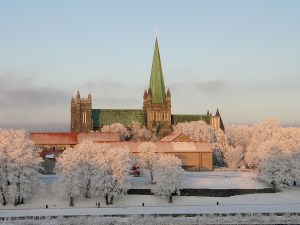
Nidaros Cathedral, Trondheim

In January, i was in Trondheim, Norway for the ordination of a friend of mine as a pastor in the (Lutheran) Church of Norway. More about that in another post, but here’s something about the Cathedral, which was for centuries the northernmost cathedral in the world.

Located at about the same latitude as Fairbanks, Alaska, the city that is now called Trondheim was founded as Nidaros by King Olaf I Tryggvason, in AD 997 – that would be the same King Olaf who received Leif Eriksson and introduced him to Chrstianity, just before the latter made his famous voyage to establish “Vinland” – modern-day Newfoundland, Canada.

The diocese was erected by St. Olav (King Olaf II Haraldsson) in about AD 1030 and elevated to metropolitan see in 1153 with suffragan sees in Norway, Iceland, Greenland, and the Kingdom of Mann and the Isles. The cathedral was constructed during the later part of the 11th century and the entirety of the 12th. In the mid-1530s the Church of Norway came under the influence of the Lutheran reformation, and, like the Church of England, broke communion with Rome, and became an established church. For four centuries there was no official Catholic presence there, until a mission was re-established in the 1930s; now the de-facto Catholic cathedral of the Territorial Prelature of Trondheim sits just across the road from Nidarosdomen, in a squat temporary building. (A capital campaign is underway to build a new Catholic church there.)

Nidaros Cathedral houses the remains of St. Olav, patron of Norway – though the exact whereabouts have been unknown since a 16th century iconoclasm. The only known relic of St. Olav is his arm, which is located in the (Catholic) Cathedral of Oslo.

Next to the Cathedral one can still find the archbishop’s palace, though there is no longer an archbishop. The (Lutheran) Bishop of Nidaros has his offices there, and hosted us for an intimate reception after the ordination. The presiding bishop of the Church of Norway also officially has some offices there, as Nidaros is the primatial see of Norway, though she spends most of her time in Oslo, the national capital.

2011 Stats from WordPress

The WordPress.com stats helper monkeys prepared a 2011 annual report for this blog.

Here’s an excerpt:

The concert hall at the Syndey Opera House holds 2,700 people. This blog was viewed about 26,000 times in 2011. If it were a concert at Sydney Opera House, it would take about 10 sold-out performances for that many people to see it.

Click here to see the complete report.

Year in Review

As the Year of Grace 2011 ended, I reviewed my “to write” file for the blog, and found no less than 22 pages of notes on events and ideas I had not had time to develop into full posts. Here is a list of some highlights from the last year, with links to posts if I have them and as I develop them!

December:

November:

October:

September:

August:

  • Short visit home in the Pacific Northwest
  • Cascade Covenant Church
  • Helping my sister move: 16 hours on the road, 45 minutes unpacking the truck
  • My brother’s new house

July:

  • Netherlands: visiting Eveline, Clare
  • New York/New Jersey: visiting Courtney, Liam, Rob
  • Lay Centre 25th Anniversary Colloquium: My paper on the laity and ecumenism

June:

  • Archbishop Sartain of Seattle in Rome for Pallium
  • EuroPride in Rome – monastic perspectives from the hill

May

  • Notre Dame Chorale Concert at Sant’Ignazio: Michael and Kerri Castorano
  • Eucharistic Procession with Cardinal Marc Ouellet
  • Notre Dame Glee Club and Fr. Michael Driscoll in Rome
  • Lay Centre alumnus Theodosius Kyriakidis debuts his documentary film on Greek Christians in Asia Minor; another alumnus Mustafa Cenap Aydin of Turkey responds
  • Archbishop Michael Fitzgerald and Leijla Demiri present on Interfaith Dialogue of life
  • Beatification of JPII

April:

  • Fr. Michael Casey, O.Cist. visits Lay Centre
  • Assisi and Florence with Courtney and co.
  • David Ford and Stephen Kepnes: The Future of Theology
  • Annual JPII Lecture David Ford on Scriptural Reasoning
  • Paschal Triduum  in Rome
  • Culture Week in Rome
  • Meeting with Fr. Norbert Hofmann

March:

Earlier unwritten posts:

  • Cardinal Levada visits the Lay Centre
  • Springtime of Faith Summit in Rome – local presenters include two cardinals, two professors, and me!

Ideas, ongoing or upcoming:

  • Liberal and Conservative in the Church (see june 26, Feb 2)
  • Nostra Aetate, Dabru Amet, and Common Word
  • ARCIC III and Personal Ordinariates
  • Clericalism and Anti-clericalism
  • Laïcite, laity, secularism, and secularity
  • Vocations: discernment or recruiting office?
  • Catholic Education beyond parochial schools
  • “Catholic” vs. “Roman Catholic”: What’s in a Name?
  • The Bologna Process and Pontifical Universities
  • Papal honors as ecclesiological indicator
  • Liturgy Wars: Episode V – The New Translation
  • Call for a Common Easter
  • The Big Sort
  • Ecumenical Updates: Where have we got with all this dialogue?
  • Wikipedia as Courtyard of the Gentiles: A call for biographical articles on great ecumenists and other theologians
  • A Parable: The Kingdom of God is like the Electromagnetic Spectrum and it is Easier for a Colorblind Man to Pass Through 400-789 Terrahertz than to Enter it…
  • Upcoming article in Koinonia
  • Upcoming article and presentation for Assisi 2012: Ecclesiological Investigations Network conference

And finally: “The Diaconate in the International Ecumenical Dialogues: Toward an Understanding of the Deacon as Minister of Unity.” a tesina to be submitted for the License in Sacred Theology…

A Tale of Two Dames

At the beginning of this year, a small group of Lay Centre residents and friends started asking the question, “During this anniversary year, how can we appropriately honor all the work that Donna and Riekie have put in over the last 25 years?”

And the answer presented itself: “We cannot… but the pope can!”

On Thursday, December 1, 2011, the co-founders of the Lay Centre at Foyer Unitas were invested with two of the pontifical orders of knighthood:

  • Prof. Donna Orsuto was created a
          Dame of the Order of St. Gregory the Great;
  • Ms. Riekie van Velzen was created a
           Dame of the Order of Pope St. Sylvester.

The investiture took place during a mass celebrated at the Basilica dei Santi Giovanni e Paolo by Archbishop Joseph Tobin, CSsR, Secretary of the Pontifical Congregation for Institutes of Consecrated Life and Societies of Apostolic Life, in front of over 150 residents, guests, and friends of the Lay Centre.

Archbishop Tobin invests Dames Donna and Riekie with the regalia of their orders

Archbishop Tobin invests Dames Donna and Riekie with the insignia of their orders

The Eucharist was part of a week of events celebrating the Lay Centre’s 25th anniversary and a new alliance with the Catholic Theological Union of Chicago, IL, USA. The papal honors were a surprise to nearly everyone present, even the honorees.

“When Donna invited me to celebrate this liturgy tonight, she mentioned that St. Gregory the Great had grown up in the neighborhood and played on the property,” Archbishop Tobin said just before introducing the awards, “she had no idea that her relationship with St. Gregory was about to move to a new level!”

Truth be told, we were a little concerned that if Donna or Riekie found out beforehand, they would be too nervous or too humble to accept!

Nancy Lindsay, chair of the Board of Directors, introduced the nomination at the end of the homily. Archbishop Tobin read the papal briefs officially creating the Church’s two newest Dames, and blessed the insignia of the Orders before presenting them to Professor Orsuto and Ms. van Velzen. I had the great privilege to serve as Master of Ceremonies for the entire liturgy, including preparing the Rite of Investiture (based on resources borrowed from the Association of Papal Orders in Great Britain, who have an excellent website)

Pontifical Order of St. Gregory the Great

Pontifical Order of St. Gregory the Great

The orders carry no obligations, and primarily only ceremonial privileges: Both women are now entitled with the style “Dame” (the female equivalent of “Sir”), post-nominal lettering of the order (Donna Orsuto, DSG; Riekie van Velzen, DSS), a place in processions and seating in the sanctuary during liturgies and church events, etc. They even earn salutes from the Swiss Guard if they are wearing the insignia of the order. But the right attached to the orders that both seemed most interested in was that, as Equestrian Orders, the new Dames have the privilege of riding a horse into St. Peter’s Basilica! (Not that anyone has tried in recent decades…)

The Pontifical Order of St. Gregory the Great was founded in 1831 by Pope Gregory XVI. It is conferred as a reward for services to the Holy See and the Church on gentlemen and ladies who “by reason of their nobility, the renown of their deeds, or the degree of their munificence are deemed worthy to be honored by a public expression of esteem on the part of the Holy See.”

Pontifical Order of Pope St. Sylvester

Pontifical Order of Pope St. Sylvester

The Pontifical Order of Pope St. Sylvester was founded a decade later, in 1841, also by Pope Gregory XVI. It is conferred as an honor for “the laity who are active in the apostolate, in particular in the exercise of their professional duties and masters of the different arts.”

On a personal note, I have to say thank you a thousand times (mille grazie!) to Bishop Brian Farrell of the PCPCU for helping us navigate the process of the nominations, and devoting a great deal of time to the effort on our behalf. It is not as if he has nothing else to do, as secretary of a Pontifical Council and on the team leading the Apostolic Visitation of the Legion of Christ! The demands of his office even meant he could not be there in person, to deliver the awards he had helped obtain, as he was in Constantinople representing Pope Benedict to Patriarch Bartholomew on the patronal feast day of the Holy See of Constantinople (St. Andrew’s Day, 30 November).

Likewise many thanks to Archbishop Michael Fitzgerald for his support and direction in the process, Archbishop Joseph Tobin for presenting the honors on behalf of the Holy Father, to Cardinal Koch for his sponsorship of the nomination, and to Cardinal Bertone for his approval of the same!

Rite of Investiture of Papal Knighthood

Celebration of the Eucharist
Thursday of the First Week of Advent
25th Anniversary of the Lay Centre at Foyer Unitas

Investiture of Papal Orders of Knighthood

At the conclusion of the homily

Archbishop Joseph Tobin, CSsR, and Master of Ceremonies A.J. Boyd stand at the chair

MC Boyd invites Nancy Lindsay, Chair of the Lay Centre Board of Directors, to the podium

Servers bring a table with the Papal Briefs and the insignia of the orders and place in front-center.


Presentation of the Nomination: Nancy Lindsay

Your Excellency,

For twenty-five years, the Lay Centre at Foyer Unitas has contributed to the Church of Rome, and to the entire Catholic Church, through its commitment to community and ecclesial formation of students, to hospitality and dialogue, fidelity to the Church, and outreach to the broader community.

The co-founders of the Lay Centre, Professor Donna Orsuto and Signora Henrica van Velzen have lived in Rome for more than thirty years each, and have lead the growth of the Lay Centre from its modest beginnings within Foyer Unitas in 1986. Their service to the Church has had an impact beyond all expectations. As Fr. Francois-Xavier Dumortier, SJ, Rector of the Pontifical Gregorian University, said during his visit to the Lay Centre in March, “this community has had a significant impact in Rome – on one hand, yes, it is a small community, but it is in fact a big thing!”

It is for their decades of dedicated service to the Church, both individually and in particular for the creation, development and growth of the Lay Centre at Foyer Unitas and its notable contribution to the life of the Church in Rome and the world – and with considerable gratitude to Bishop Brian Farrell, Archbishop Michael Fitzgerald, and Cardinal Kurt Koch, for their support and sponsorship of this nomination – that we propose Professoressa Donna Orsuto for recognition with the Order of St. Gregory the Great, and Signora Henrica van Velzen with the Order of Pope St. Sylvester.


Introduction of the Orders: Archbishop Tobin

The Pontifical Order of St. Gregory the Great was founded in 1831 by Pope Gregory XVI. It is conferred as a reward for services to the Holy See and the Church on gentlemen and ladies who “by reason of their nobility, the renown of their deeds, or the degree of their munificence are deemed worthy to be honored by a public expression of esteem on the part of the Holy See.”

The Pontifical Order of Pope St. Sylvester was founded a decade later, in 1841, also by Pope Gregory XVI. It is conferred as an honor for “the laity who are active in the apostolate, in particular in the exercise of their professional duties and masters of the different arts.”

Becoming a Papal Dame does not merely mean receiving a title of honor – even though it is well deserved – but fighting evil, promoting good and defending the weak and oppressed against injustice.

Archbishop Tobin or MC Boyd invites the candidates to present themselves before the altar.

Archbishop Tobin, with mitre and crozier,
and MC Boyd, process to the front of the altar.

MC Boyd holds the order of investiture for Archbishop Tobin


Reading of the Papal Decree: Archbishop Tobin

Addressed to Donna and Riekie:

The Papal Brief which creates you, Donna Orsuto, a Dame of St. Gregory the Great reads as follows:

Benedict XVI, Supreme Pontiff, gladly acceding to a request made to Us from which we have gathered that you are most deserving for what you have done for the Holy Catholic Church and its affairs, and in order that We might give a clear sign of Our pleasure and appreciation, We choose, make and declare you, Donna Lynn Orsuto, of the diocese of Rome, a Dame of the Order of St. Gregory the Great. We bestow on you the right to use and enjoy all the privileges which go with this high dignity.

Given at St. Peter’s in Rome on 7 October 2011,
Signed and sealed by Cardinal Tarcisio Bertone, Secretary of State.

Likewise, the Papal Brief which creates you, Henrica van Velzen, a Dame of Pope St. Sylvester, reads as follows:

Benedict XVI, Supreme Pontiff, gladly acceding to a request made to Us from which we have gathered that you are most deserving for what you have done for the Holy Catholic Church and its affairs, and in order that We might give a clear sign of Our pleasure and appreciation, We choose, make and declare you, Henrica Filomena Apollonia van Velzen, of the diocese of Rome, a Dame of the Order of Pope St. Sylvester. We bestow on you the right to use and enjoy all the privileges which go with this high dignity.

Given at St. Peter’s in Rome on 7 October 2011,
Signed and sealed by Cardinal Tarcisio Bertone, Secretary of State.


Oath and Blessing of insignia: Archbishop Tobin

I have been delegated by His Holiness Pope Benedict XVI to invest you with the insignia of the Orders to which he has appointed you.

Before performing this solemn task, I must ask you: Do you promise faithfully to maintain unswerving fidelity to God, the Supreme Pontiff, the Holy See and the Holy Church and exercise the office of a Pontifical Dame in accordance with the high ideals and standards expected of you?

Donna and Riekie: I do.

Archbishop Tobin blesses the Brief and Insignia saying:

Almighty and Eternal God,
bless these symbols approved by your Servant, Pope Benedict XVI.
We invoke your omnipotent power to confound all evil spirits
and protect your servants Donna Orsuto and Henrica van Velzen,
who, from this day forward, wear them.
Protect your Dames from all harm
and may they be ever faithful to you all the days of their life.
We ask this through Christ, our Lord.


Investiture of insignia


 Archbishop Tobin to Donna Orsuto:

In the name of the Holy Father I herewith invest you with the insignia of a Dame of St. Gregory the Great and I present to you the Papal Brief.

Archbishop Tobin to Riekie van Velzen:

In the name of the Holy Father I herewith invest you with the insignia of a Dame of Pope St. Sylvester and I present to you the Papal Brief.

MC Boyd or Archbishop Tobin presents the newly invested Dames to the Assembly, before all retire to their respective places.