
On the Spirit of the Council
“The only spirit or ghost of a Council is the one called Holy — exorcising that from the hermeneutic is the problem, not the solution. There is no hermeneutic of reform without the Spirit of the Council; only rupture and the pride of men.”
In other words, if you reject the Spirit of Vatican II, you are rejecting the Holy Spirit. Plain and simple. Now, there are legitamate criticisms of some usages of this phrase, or some actions made on its behalf, particularly way back in the 60s, but that is not the same as throwing out the baby with the bath water.
Put another way, the so-called “hermeneutic of discontinuity” or “hermeneutic of rupture” – the idea that Vatican II created something entirely new- is the error of the traditionalists, schismatics, and sedevacantists who reject the Council, or who seek to undermine its genuine authority. (Usually with some argument that a “pastoral” council is not a “dogmatic” council. As if the Church makes any such distinction.)
The big supporters of Vatican II as a Church-changing event, as a “new pentecost” are best described as “hermeneutic of reform” or of “reform in continuity”.
Then those who say that nothing really happened at all, that really Vatican II intended no changes, are simply exercising a “hermeneutic of continuity”.
That’s my nutshell take; Would appreciate serious discussion.
Bishop Gerhard Müller to CDF
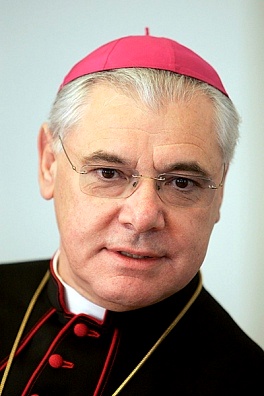 The rumor has been floating around for some months, and this week it was announced that Cardinal Levada has retired as prefect of the Congregation of the Doctrine of the Faith, and the bishop of Regensburg, Gerhard Müller, has been appointed to take his place.
His official biography and extensive information can be found in English at his diocesan website.
The two NCRs cover the story here:
- National Catholic Register (moderately conservative)
- National Catholic Reporter (moderately liberal)
Talking with one of my German colleagues in Rome, she was complaining how the German press has continued to remind people that this was once the office of the Universal Inquisition. That, and that Müller has been widely painted as an archconservative and favoring the current trend towards traditionalism.
I chuckled and pointed out that most of the English-language blogosophere seems to focus on his connection to Liberation Theology, and that if anything, the traditionalists have protested because he is “heretic” and a “modernist” – terms almost inevitably misused, but that is nothing new.
I have read only one of Müller ’s books, and that is his Priesthood and Diaconate, which I have used for my License thesis. He writes to counter the arguments made by some German feminist theologians that women have been and ought to be ordained to the diaconate. The major argument he sets out to counter is that, although the question of ordination to the priesthood – understood as the presbyterate and the episcopate in this case – has been closed since John Paul II’s 1994 Apostolic Letter Ordinatio Sacerdotalis, the question of the ordination of women to the diaconate remains (ostensibly) open.
First, it is interesting to note that in the translation, there are a couple of humorous editorial notes attached to his text. This same German friend keeps remarking that the problem with German theologians, ministers and ecclesiastics is that they all think that “the German Church is the center of the Catholic Church”- or whatever issues are big in the German world must be the main issues for the universal church. Not unlike the American/anglo-phone phenomenon, actually.
At various points in his book, Müller demonstrates this by saying something like “theologians in the whole world are asking this question” or “everyone seems to think this is an inevitability”. But after the translator and editor have their input, it looks like this: “theologians in the whole [German-speaking] world are asking this question” or “everyone [in Germany] seems to think this is an inevitability.”
More substantially, I was struck that he seemed not to address the most fundamental ecclesiological point of the argument he was trying to counter and correct. The argument for the ordination of women to the diaconate, in the current context, is that, if you maintain that within the one sacrament of holy orders there are not only three orders, but two distinct classes of orders – one to the priesthood and one to ministry/diakonia – then you can argue that a prohibition of ordaining women to priesthood does not necessarily dictate a prohibition to the ordination of women to diaconate.
However, if you argue that the three distinct orders within the one sacrament are modeled in a Trinitarian concept, then this argument might collapse, and if women cannot be ordained to one order or another it can be argued that they cannot be ordained to all of them. Müller’s strongest move, it seems, if his intent is to demonstrate that women cannot be ordained even to the diaconate, would have been to argue the unity of the sacrament. Instead, he maintains throughout his text this scholastic division between priesthood and other, the very point that the target of his investigation needs to retain in order to make her argument.
It is also interesting to note is that Bishop Müller was heavily involved in the International Theological Commission’s Report on the Diaconate, From the Diakonia of Christ to the Diakonia of the Apostles, which itself does not close the door on the question of ordaining women to the diaconate.
All in all, he seems an accomplished theologian, interested in ecclesiology and ecumenism, with a healthy ability not to get stuck in some of the old images and models of theology; he is able to judge aspects of liberation theology on its merits, rather than treat it like a bad word, as so many in the anglophone world are sadly wont to do. On the other hand, it seems that the question of women in the diaconate may be closed soon, before the non-German speaking world even had a chance to realize it was open.
I am looking forward to reading more, and seeing what the future brings.
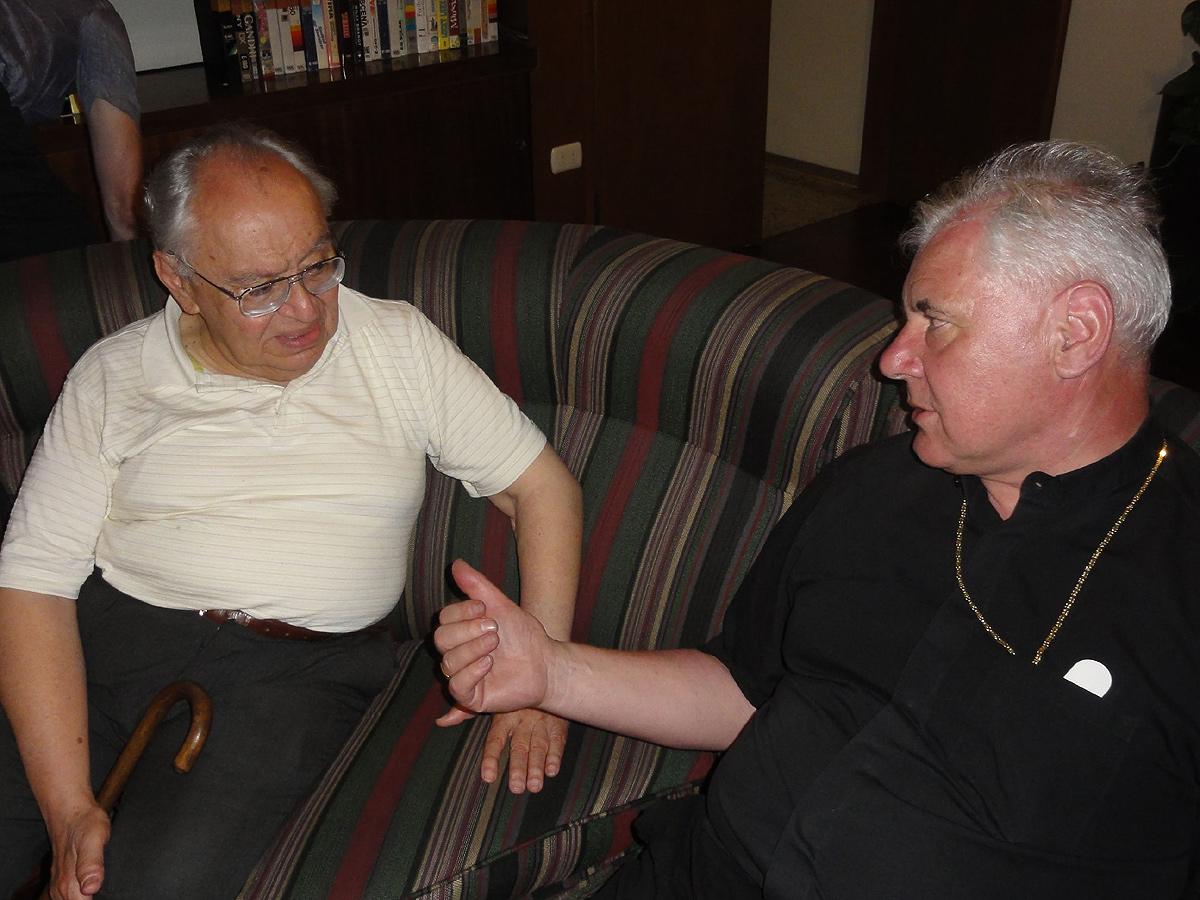
Gustavo Gutierrez, father of liberation theology, and Gerhard Muller, at one of their annual sessions.
Random tidbits from Jewish-Catholic dialogue
Some of this was new, some not, but all quick interesting bits worth sharing…
Who was the first Jew named in recorded history known to have been named at circumcision? John the Baptist.
Who was the first Jew in recorded history to read from the Torah at a synagogue? Jesus of Nazareth.
Rabbis are not ordained, at least not ordained priests, though several will use this terminology of ordination. According to one of my colleagues, the last Jewish ordination took place in 425 AD.
There is a Jewish priesthood, the Kohanim, who do not necessarily have any leadership role in the community; Rabbis are in a way the successors of the Pharisees – learned lay leaders. (I need to find more about this, but I think there may be a parallel suggesting a descriptor of Lay Ecclesial Ministers as something like Christian Rabbis? Something to mull over…)
There is evidence of women in roles basically like Rabbis as early as the 16th and 17th century, called Rabaneet (which could also indicate the wife of a rabbi) and Tanaiit (feminine form of Tanaiim). The discussion, offered by one of the Jewish presenters, made me think of the arguments about Episcopa Theodora, (episcopa meaning bishop’s wife, or a woman with jurisdiction of a bishop) depicted in mosaic at the Basilica of Santa Praessade here in Rome.
One participant asked then, if Rabaneet was the name of a Rabbi’s wife, what do you call the name of a (female) Rabbi’s husband? From the back of the room came the answer: “Lucky!”
Cantors are taking on more and more pastoral roles, it is not just about leading music and chant in worship. Likewise, there is a phenomenon even in some orthodox communities of having a kind of recognized lay ministry outside of the rabbinate – so where rabbis are only men, women can still take a leadership role. (This one also has my gears turning…)
There are 68 different Hebrew translations of the Lord’s Prayer.
If you have not heard of the Cairo Geniza, you should at least go to Wikipedia or read Sacred Trash, which I am told is popularly accessable reading.
Learning about Ourselves while Learning about Each Other: Proposals for Jewish and Catholic Education, by Lawrence Shiffman and Joseph Sievers is something worth reviewing for anyone in catechesis, ministry formation, or dialogue.
Around the edges at the Catholic-Jewish Emerging Leadership Conference
American vs Italian ecclesial approaches reflected
This was the second such emerging leadership conference sponsored by the Holy See’s Commission for Religious Relations with the Jews and the International Jewish Committee on Interreligious Consultations. The first took place in 2009 at Castel Gandolfo.
There were only a few participants from the first event at this one, intentionally. Speaking with a couple of the Catholic participants of both meetings, some observations on the differences (and how they relate to the difference of Italian and American Catholicism) came up.
At that first meeting, virtually all the Catholics invited were members of the Focolare movement. This time, we had much better representation across the board, but it is a ‘tell’ of the Italian approach of the first one and a more American (and German?) approach at the second.
The Italian church is the birthplace of the lay movements, and here, often, the active lay person – the ‘serious’ Catholic – is a member of a movement. But it is like being part of a political party too, people size you up immediately based on which movement you belong to, or pigeonhole you a little too quickly. “Oh, you’re into ecumenism, you should be in Focolare”, “Peace and Justice is your thing? Go to Sant’Egidio”, “You’re wearing a double breasted clerical suit, your hair is parted just so, and you do not read theology published after 1938? You must be a Legionnaire.” And so on.
The American context however, is a much livelier and generally healthier parochial-diocesan Church. While there is certainly too much polarization generally imported from the general culture, American Catholics tend not to belong to lay movements, or if they do, they tend to be extracurricular to their main parochial and diocesan life and activity. Think Knights of Columbus, Cursillo, and even the Charismatic movement. Instead we encourage people to be engaged in parish life, diocesan visioning, and lay volunteer ministries. A healthy diocesan vocations program encourages lay ecclesial ministry alongside its diaconate and presbyterate programs. A US Catholic who is active in a movement but not in a parish is seen, if anything, as a little suspect, rather than as super committed, where in Italy it seems almost the reverse.
Since the Jewish participants were Reform, Conservative, and Orthodox, representing a variety of organizations and movements, it seems much better that the Catholic Church be represented in all its diversity too!
Report on New York: Cardinal Dolan
Cardinal Dolan highlighted five issues where Catholic-Jewish dialogue could concentrate: the human aspect, cultural challenges, theological issues, pastoral issues, and religious freedom/human rights. When asked which of the human rights issues he saw as the most important, he replied, ‘immigration’.
In the five boroughs that make up New York City are about 1.5 million Jews, and nearly twice as many Catholics, out of a total population of just over 8 million.
One of the funniest moments was when the Cardinal admitted that the portrait of Pope Benedict hanging in the room, over the papal chair used during the apostolic visit of 2008, was purchased by Cardinal Egan over ebay a few weeks before the pope’s arrival, because it was discovered they did not have one handy. (Not sure that should be taken too seriously!)
One of the most interesting, for a Catholic ecumenist, was when his diocesan ecumenical officer noted that with the upcoming consolidation of New York area seminary programs, they will finally be requiring courses on ecumenism and interreligious dialogue for all presbyteral and diaconate candidates, as required by the 1993 Directory. Better late than never!
Russell Berrie Foundation
On Friday, for lunch, I traveled out to Teaneck, NJ, to meet with officers of the Russell Berrie Foundation, which so generously supplied my Fellowship in Rome and underwrites the John Paul II Center where I now work. We also were joined by Rabbi Jack Bemporad, director of the center here, and we spent two hours debriefing the week’s program and structure, the experience of the dialogue and the setting, and then turned to the current state of Jewish Catholic relations (and a little U.S. politics, just to catch me up.)
It was nice to make the connections, and see some key people there outside of Rome. I am always impressed, and grateful for their generous involvement in Jewish-Christian dialogue.
Shabbat services at Central Synagogue
On Friday evening a few of us took up the invitation of one of the participants, Andrea, who is studying to become a Cantor, to join her at the synagogue where she would be singing.
The service was breathtakingly beautiful, reverential, and joyfilled. There was no question of the presence of the Spirit in that place. The first impression truly was the happiness, the genuine joy of all involved in worship. Three points in particular stood out.
First, the music. Granted, we may have been biased, knowing our friend was singing, but it was truly outstanding. Andrea also sang the reading from the torah scroll, which was enchanting.
The clergy, rabbis and cantors, throughout the service each had a role and shared as often as not, it never felt as if one person only was leading the service, but the whole team. If lex orandi, lex credendi applies in Judaism as well, the ‘ecclesiology’ expressed here was healthier than many churches I have been to! And they were the first we noticed to seem truly at peace, and filled with joy, to be here welcoming in the Sabbath.
The procession of the Sefer Torah, after being removed from the ark (tabernacle), was a brilliant demonstration of both. With great reverence and joy, lively music, and smiles, the scroll was brought around the sanctuary, giving everyone a chance to touch it with their prayer books, before being brought up to the bimah (altar) for the proclamation. It made such a counterpoint to the Eucharistic processions of Holy Thursday or Corpus Christi, the most obvious comparable ritual, which are so often somber and solemn. Both so reverent, yet so very different in emotive response.
Friends and Fun
Before the conference, some of us coming from Rome stayed at Alma Matthews House, run by the United Methodist Women, serves as a residence and meeting venue for non-profit organizations. Beautifully situated in the West Village, it was a wonderful place to stay that I would highly recommend for anyone staying in Manhattan on Church business. You just have to be there somehow connected to a non-profit.
After the conference, some of us stayed at Leo House, a Catholic guest house in Chelsea I was introduced to last year. The facilities and neighborhood are not quite as nice as those at Alma House, but there is a chapel on site and a good breakfast buffet. They are planning major renovations, however, and I suppose after those it will be of a similar standard. The hospitality at both places was appreciated!
During the week itself, our last night at the Isabella Freedman center, we had a campfire, and I got to instruct David (Mexico), Eveline (Netherlands), and others on proper S’Mores techniques, having finally discovered a truly unique American food.
I had the opportunity to meet up with my college roommate, Liam, as he joined some of the participants for dinner and a night of showing us around the city that never sleeps. Probably our favorite stop of the evening was the inelegantly named “Burp Castle”. Billing itself as a “Temple of Beer Worship” murals inside depict monks and mendicants in various scenes with their brews. A rotating tap of monastic and other import brews is excellent, and the rule of the house is that a certain level of quiet must be maintained to appropriately enjoy the beer, and conversation, without getting drowned out. No music, and the bartender actually shushed people regularly. Not unlike the ambiance of the Sistine chapel, but with beer. Never enough time, but I am so grateful to get an evening with a longtime friend, and introduce him to others who mean so much to me!
On Saturday, another local friend, Courtney, gave a walking tour of southern manhattan, showed us the 9-11 memorial site, and brought us up north for an excellent Mexican dinner and broadway show. Only a pity she left for home before she could join us spend the rest of the evening on a rooftop terrace bar just under the Empire State Building.
Two friends in particular i missed were Sr. Lorelei Fuchs, SA and Rabbi Robbie Harris, for scheduling reasons or my own disorganization and procrastination. Next year in Jerusalem… or New York!
That being said, i established new contacts, discovered energetic your leaders from both religions, i now count several new friends… and not just on Facebook.
A funny thing happened on the way to the Forum today…
OK, I was not anywhere near the forum, but at Villa Richardson, the residence of the U.S. Ambassador to the Holy See, for their annual (anticipatory) Independence Day celebration. But, I have been wanting to use that line since I got to Rome, and never quite worked it in.
So, at Roman noon today, I saw an update from the Vatican’s new-ish news mega-portal, http://www.news.va, officially announcing Cardinal Levada’s retirement and the appointment of Bishop Gerhard Müller to the post of Prefect of the Congregation for the Doctrine of the Faith. So, I reposted it on Facebook.
Tonight, at the Embassy’s Independence Day party, about eight hours later, a curial monsignor mentions to me he heard about the appointment through my Facebook post. “What, there’s no internal memo on these things?” I asked. He just laughed.
Having just celebrated the patronal feast of the city and Church of Rome, it serves as a reminder that, in the Vatican, you can rob Peter to pay the left hand while the right hand does not know what Paul is doing. Or something like that.
Dolan on Romney
To our group visiting last week, and quoting himself at another engagement:
There might be many reasons not to vote for Mitt Romney in the coming election, but the fact that he’s Mormon is not one of them. We [Jews and Catholics] know better.
Cardinal Timothy Dolan of New York
(once, New Amsterdam)
Catholic-Jewish Emerging Leadership Conference
Catholics and Jews: Our Common Values, Our Common Roots
Second Catholic-Jewish Emerging Leadership Conference
My first chance to participate in a national ecumenical conference was almost exactly ten years ago, in May 2002. Five years later, I was invited to present in a plenary session at the 50th Anniversary of Faith and Order in the US, at Oberlin. Last week, I gave my first plenary presentation at an international, Vatican-sponsored interreligious dialogue.
Forty scholars and religious leaders under the age of forty, from a dozen countries, were gathered at the invitation of the Holy See’s Commission on Religious Relations with the Jews and the International Jewish Committee for Interreligious Consultations (IJCIC). The nexus of these two groups is the International Catholic-Jewish Liaison Committee (ILC). The bulk of our meeting took place at the Isabella Freedman Jewish Retreat Center in northwest Connecticut, with a day of meetings in New York City. Before and after, a few of us were able to enjoy the city itself, for some informal sharing and reunions – already, five of the other participants were friends or colleagues from Europe and the States.
As is usually the case with such things, the best dialogue and exchange tended to happen between the official agenda, as good as it was. But the former is always inspired by the latter, and this was a good model for developing leadership in dialogue for the reason that it allowed the ‘emerging leadership’ to actually engage in the conversation. The leaders of the two delegations, Prof. Lawrence Schiffman, president of IJCIC, and Fr. Norbert Hofmann, SDB, secretary of the Holy See’s Commission, were present throughout the conference but aside from their role in introducing the history and context, largely stepped back and served as advisors and guides.
Contrast this to other experiences of academic conferences where the ‘emerging generation’ of ecumenists, religious leaders, et al., are invited to attend and even give a presentation on topic, but the conversation is still largely dominated by established authorities, and may be about the dialogues, but does not allow for an actual dialogue to take place. To put it another way, the agenda of this conference was modeled after an official dialogue at the highest level, in many ways, including the topical presentation of papers on both sides on a given issue, discussion and break out groups.
The schedule also managed very well to provide the necessary background for those who were new to dialogue, as well as keep things interesting for the veterans among us. Some of the Jews present had never heard of Nostra Aetate, and some of the Catholics had not known about Dabru Emet. Others, like the Russell Berrie Fellows in attendance, had made a study of the dialogue and already were familiar with a wide range of thought on the dialogue.
Our first day was basically introductory, with presentations on the Commission, IJCIC, and the ILC and an opening presentation on “The Rise and Development of Rabbinic Judaism and Christianity” by Prof. Schiffman. There were three major elements of the recurring agenda, which were the plenary presentations, the working groups, and the resource sharing workshops.
The plenaries were the official presentations, consisting of two 30-45 minute presentations, one Catholic and one Jewish, followed by between 30 – 60 minutes of questions and discussion, depending on the length of the presentations.
The first plenary was “Catholic-Jewish Relations post-Vatican II” with presentations by Rabbi A. James Rudin and Fr. Lawrence Frizzell. On day two, the second plenary was “Men, Women, and the Family” offered by Dr. Adena Berkowitz and Fr. W. Jerome Bracken, CP. The third plenary explored “Religion in Public Culture”, with yours truly for the Catholics, and Marc Stern, Esq., of the AJC for the Jewish side.
The working groups followed explored pre-determined themes of the conference, and met twice. People could stay with the same group both times, or rotate. These explored the themes of Justice and Charity; Religious Prejudices and Responses to Hate Crimes; Religion and Secular Society; the Role of Religious Leadership. I was asked to facilitate the last, along with a young rabbi serving as university chaplain at Leeds in the UK, though to be honest, there was not a lot of facilitating needed with this group!
The resource sharing workshops were opportunities for participants to raise issues and share from their own experience. As an example, Eveline van der Ham and David Angeles-Garnica, with the help of Andrea Ponzone, led a presentation on their experience at the Lay Centre, “Living in interfaith community” which they summed up with three key points: pray together, play together, and ‘prost’ together.
We spent one long day in Manhattan, dressed in business garb at nearly 100 degrees, I was reminded how much more manageable this is when nearly every building and form of transport is well air conditioned, a luxury not often found in Rome!
Our first appointment was with Cardinal Timothy Dolan, Archbishop of New York, at his residence, and with his ecumenical/interreligious officer. His eminence came in and was literally kissing babies (well, the one baby present), and shaking hands (of literally everyone in the room). “He’s the Bill Clinton of the Catholic Church” was whispered in one corner, so stereotypically the American politician, presented 15 minutes of remarks without notes and with lots of enthusiasm. We were also given a short tour of the cathedral, including a visit to the crypt and the tomb of Ven. Fulton Sheen.
We then travelled to Jewish Theological Seminary, the Conservative movement’s flagship, and met with Chancellor Arnold Eisen, Prof. Burt Visotzky (Midrash), and David Wachtel, the head of the rare books collection, which includes manuscript letters from Maimonides, and part of the Gutenburg bible, among so many other truly rare Hebrew texts. It was encouraging to hear Prof Visotzky even mention this year’s John Paul II Lecture given by Cardinal Koch in Rome.
After this we visited a reform synagogue known for its outreach work, Congregation Rodeph Sholom and north america’s first jewish congregation, the Sephardic orthodox congregation Shearith Israel, better known as the Spanish-Portuguese Synagogue.
That’s just the official program… more to come, from Shabbat services to S’mores-making lessons.
Domers in Rome
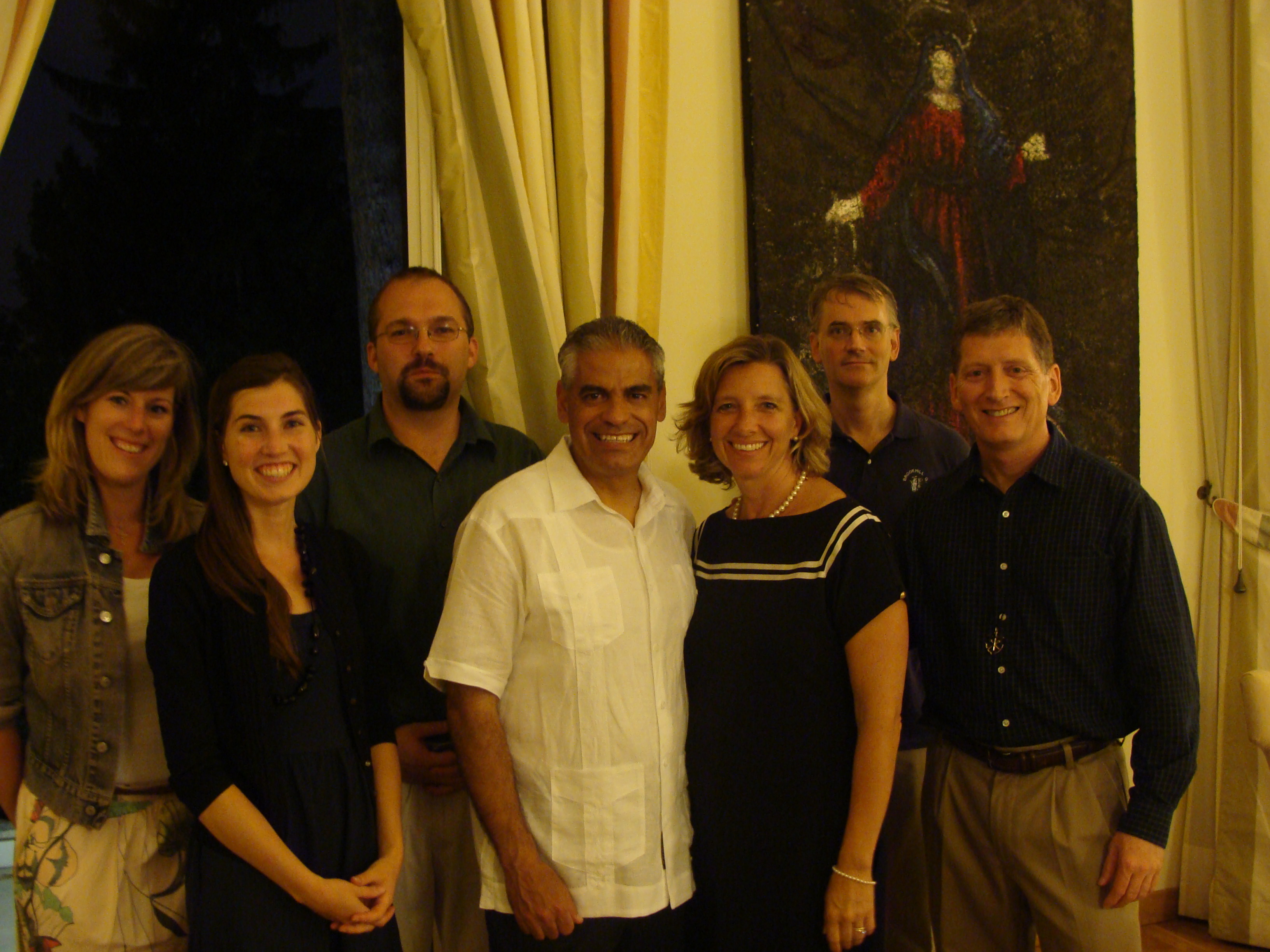
Domers in Rome: Jill, Katie, AJ, Miguel, Marian, TJ, Russ
One of the University of Notre Dame’s greatest strengths is its alumni network. Even here in Italy, there are sons and daughters of Our Lady’s University. We had a gathering of about twenty at Villa Richardson, residence of the U.S. Ambassador to the Holy See, Dr. Miguel Díaz, and his wife, Dr. Marian Díaz, both domers.
It was my first time at the residence, and one of the most striking pieces of art on the beautiful grounds is a large Chihuly, Ducale Tower, on what was once a fountain in the back garden. There’s a short article about it in Slate, with an image.
I have been asked to help form a small leadership group for the alumni club of Italy, to strengthen the club’s activities and in a small way, start paving the road for the new Notre Dame Center of Rome, which will open in a couple of years, we hope. (The building is purchased and being renovated, in Celio not far from the Lay Centre, in fact).

Tempietto di San Pietro, di Bramante
Current ND alumni in Rome include not only the Ambassador and his wife, but Holy Cross priests and brothers, students at pontifical universities, a key staffer at the Pontifical Council for Social Communications, one of Rome’s leading catechetical guides, the director of the University of Mary’s Rome Program, and until recently, Charles Brown, now nuncio to Ireland.
On the way home from the gathering, a few of us were walking by the Spanish Academy, and discovered that the Tempietto di Bramante (San Pietro in Montorio) was open, illuminated, and totally empty. Built as a mausoleum for Ferdinand and Isabel, it was never used for that purpose, but remains quite possibly the smallest church in Rome.
Quote of the Day
Speaking at a meeting of Austrian Catholic newsmen, Cardinal Koenig said:
“Do not wait for the bishop or for a report from Rome, if you have something to say about the Council. Sound a warning whenever you feel that you ought to. Urge, when you feel urging is necessary… Report everything that the people and the Catholics expect concerning the Council.”
Taken from Conciliaria: Fifty Years Ago Today at the Second Vatican Council. If you have not discovered this gem of a blog yet, you ought to.
Can you imagine many people still having that same fearless confidence in the Holy Spirit speaking through the people of God, today? “Don’t wait for us, speak up!” Not exactly the dominant ecclesiastical paradigm half a century later!
John Paul II Center for Interreligious Dialogue

In the midst of last week’s events surrounding the Fifth Annual John Paul II Lecture on Interreligious Understanding, delivered at the Angelicum by Cardinal Kurt Koch, i was asked to stay on another year as the graduate assistant at the John Paul II Center for Interreligious Dialogue at the Angelicum. So, another year in Rome, at least!
Coincident with the big event – that being the lecture not my assistantship renewal – the Center rolled out a new website, that will continue to expand its content: http://jp2center.org/
While my academic focus has remained ecumenical, the interreligious piece, especially with the Abrahamic faiths, has grown ever entwined in every aspect of my life. It is hard to believe how much time has passed in Rome already, but there is always more to see and do. Please check out the website, and also the Center’s Facebook page.
 The Ecumenism Blog