
Ecumenical Responses to Pope Francis’ call to Pray for Peace in Syria
During his Angelus address on Sunday, Pope Francis reiterated the papal battle cry of Paul VI, “War never again! Never again, war!” in response to the ongoing civil war in Syria, the regime’s use of chemical weapons, and the potential international intervention there. Referring to Syria as a martyred country – a country where the language of Jesus, Aramaic, is still spoken in some villages – the bishop of Rome urged in the strongest possible way the cessation of hostilities and the brokering of peace based on dialogue and negotiation.
He then proclaimed today, 7 September, a day of prayer and fasting for the entire Catholic Church, and invited Christians of other communions, members of other religions, and all people of good will to participate in whatever way they can. Here in Rome, we leave shortly to spend the evening in vigil at Piazza San Pietro. [The Icon Salus Populi Romani, pictured below, will be processed through the Piazza as part of the vigil this evening]
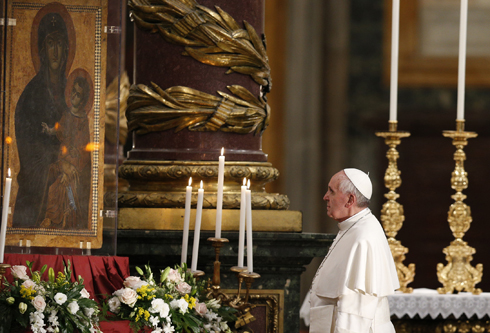
Pope venerates Marian icon “Salus Populi Romani” at Basilica of St. Mary Major in Rome on his first day as bishop of Rome (CNS photo/Paul Haring)
On Monday, two big questions were raised:
1) Would the secular media, who have been so far favorably impressed by this “pope who knows how to pope”, take up the cry and cover the Vigil for Peace in Syria? Or would they consign it to the littering of the editorial room floor, as they do with other pro-life initiatives of the Church (one thinks of the remarkable lack of coverage of the largest annual demonstration in D.C., for example), and
2) Would the other Churches respond? Has the genuine irenicism of the ecumenical movement of the last three generations grown to the point that we can put aside issues about whether the pope speaks for all Christians (or fear that by joining in a day of prayer and fasting would somehow acknowledge a real primacy of the Petrine office) long enough to do what is right, and to do it more convincingly by doing it as one Body of Christ?
The latter interests me more, as an ecumenist. Here is a list of ecumenical responses and endorsements to Pope Francis’ call (more added as I find them):
- His All-Holiness Bartholomew I, Patriarch of Constantinople: “Together with our Brother in Christ, Francis, we shall pray for peace” on Saturday, as we have every day since violence broke out in Damascus.
- His Beatitude Daniel, Patriarch of Romania, declared Sunday, the Nativity of the Theotokos, as a day of prayer.
- Rev. Dr Olav Fykse Tveit, General Secretary, World Council of Churches endorsed Pope Francis’ call for a day of prayer.
- Metropolitan Eustatius Matta Roham of the Syrian Orthodox Church of Antioch for Northern Syria said that the entire Syrian Orthodox Church would adhere strongly to the Pope’s call to pray for peace.
Interreligious Responses:
- Syria’s Sunni Muslim leader, Grand Mufti Ahmed Badreddin Hassoun, called for Syrians to join in the prayers
- Special prayers at the Great Mosque of Paris calling “for the blood to stop flowing” in Syria.
- Chief Rabbi of Rome Riccardo Di Segni said the Jewish community was “in harmony” with the Vatican.
- The Lebanese Shiite Higher Council, Vice-President Sheikh Abdel Amir Qabalan, voiced support: “Islam calls consistently for peace and harmony, and we consistently condemn killings, terrorism and foreign interference.”
- Hindu temples in India took up the call to prayer and fasting, according to Bishop Felix Machado of Visai, President of the Commission for Ecumenical and Interreligious Dialogue of the “Federation of Asian Bishops’ Conferences” .
- Mahmood Amiry-Moghaddam, of Iran Rights Watch, an interreligious NGO in Iran, reports that Shia Muslims, Bahai, and Assyrian and Chaldean Christians who are part of the Iranian diaspora would join the day of prayer.
How Will You Pray for Peace on Saturday?
Resources from a friend…

Rome Vigil and Prayer Booklet
Prayer adapted from Catholics Confront Global Poverty by USCCB
http://www.usccb.org/prayer-and-worship/prayers/prayer-for-peace-in-syria.cfm
Almighty eternal God, source of all compassion,
the promise of your mercy and saving help fills our hearts with hope.
Hear the cries of the people of Syria;
bring healing to those suffering from the violence,
and comfort to those mourning the dead.
Empower and encourage Syria’s neighbors
in their care and welcome for refugees.
Convert the hearts of those who have taken up arms,
and strengthen the resolve of those committed to peace.
O God of hope and Father of mercy,
your Holy Spirit inspires us to look beyond ourselves and our own needs.
Inspire leaders to choose peace over violence
and to seek reconciliation with enemies.
Inspire the Church around the world with compassion for the people of Syria,
and fill us with hope for a future of peace built on justice for…
View original post 412 more words
Prayer Vigil schedule & liturgical booklet
From Rome…

VATICAN CITY — Whether you plan on following tomorrow’s Prayer for Peace vigil on TV, online or in person in St. Peter’s Square, a schedule of Saturday’s events will come in handy. As well as the official liturgical booklet.
Here is a breakdown of what will be happening and when:
View original post 205 more words
Summer Stage III: Backpacking in the Balkans – Bulgaria (by way of Bucharest)
The night bus from Chisinau to Bucharest was a beautiful new small bus, but traveling on potholed country roads, it was not a restful ride. At the border, we had to stop and wait for an hour for no apparent reason – we were the only travelers there. We stayed at the spare apartment of a young Romanian lawyer met through couchsurfing. He was a gracious guide and host, generous to a fault with his time. Having seen much of the city the day we arrived in Romania, we spent the evening with good food and inexpensive beer on the university campus looking at the stars.
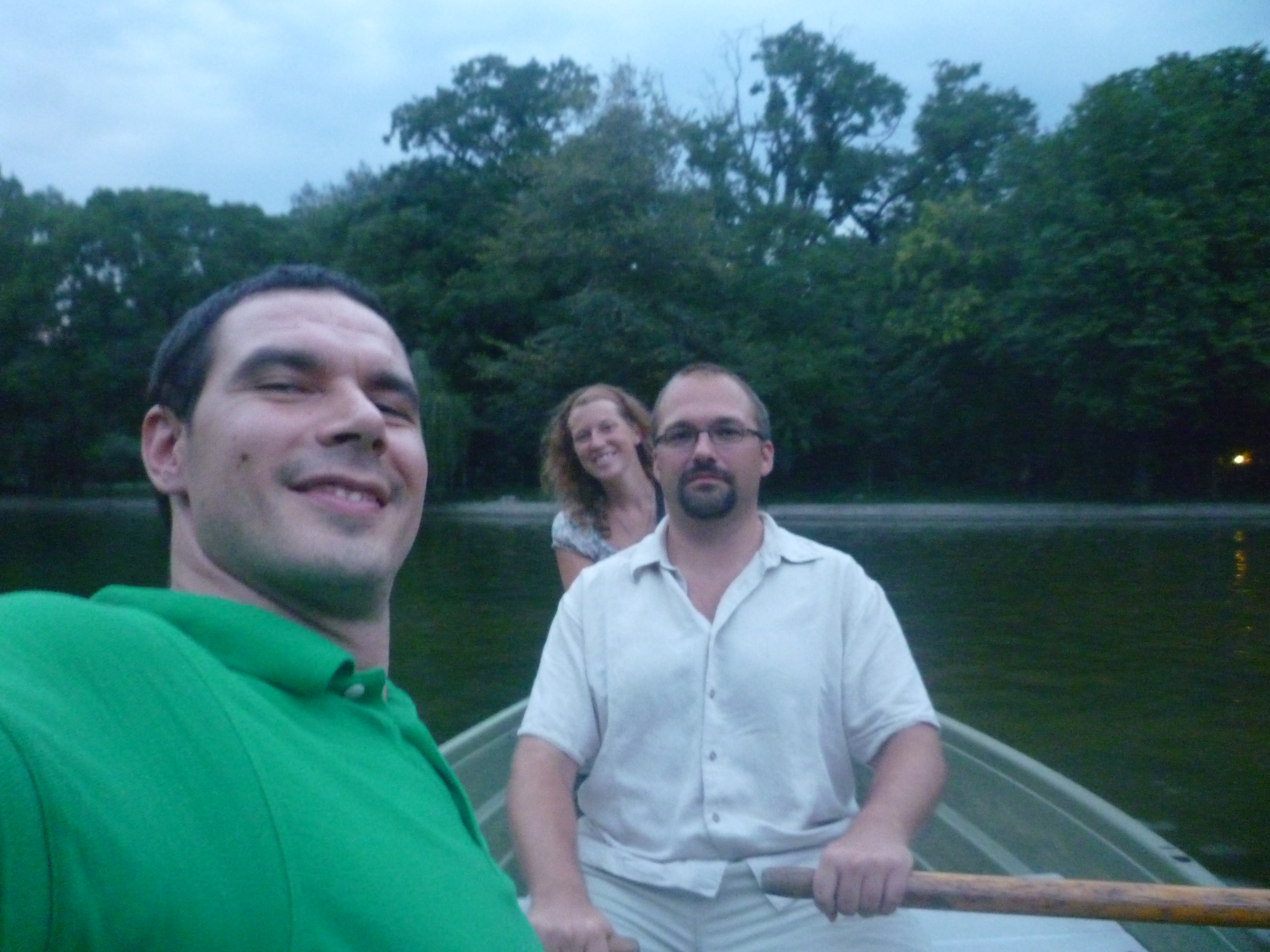
Our Romanian couchsurfer host, Eugen
A slow train took us the next morning to Veliko Tarnovo, a hidden jewel of a town in central Bulgaria. Our hosts there were Anita and Stanislava, the two Bulgarian students who had participated in Lingua Franca in Romania, who were studying at university in Veliko.
“Hidden valley fortress town” is the phrase that came to mind to first describe it. This ‘city of the Tsars’ was the capital of the second Bulgarian Empire (12th-14th century), and the remains of the imperial fortress sit like a crown atop one of the three ridgelines, the patriarchal cathedral of the Nativity of the Theotokos as the crown jewel. We stayed at the most comfortable hostel I have ever encountered, a few minutes walk from the Tsaravets fortress, which, by the way, lights up at night in a (normally) music-synched light and laser show.
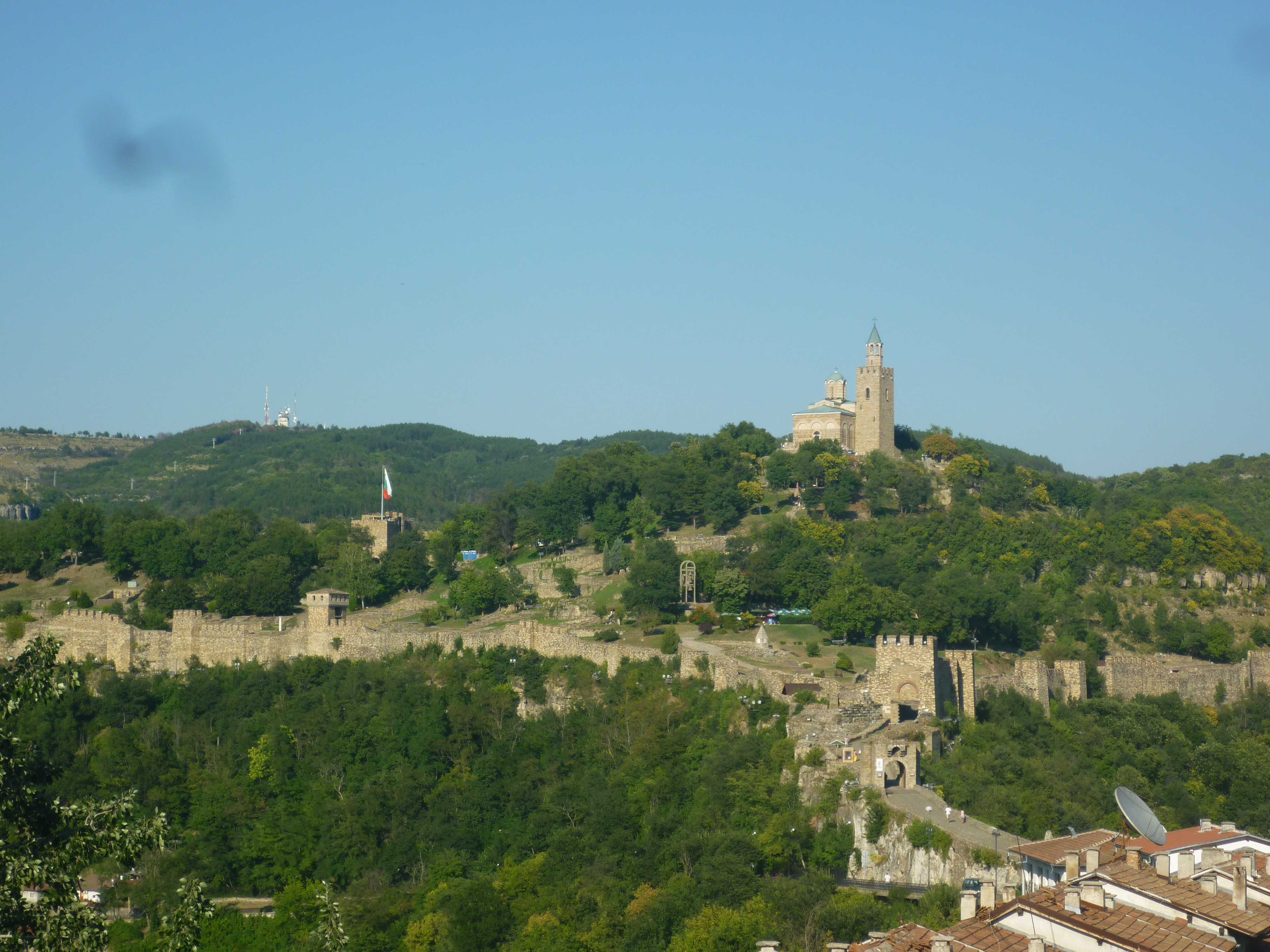
Veliko Tarnovo
Anita and Stanislava outdid themselves as hosts, starting with a massive meat-filled dinner on the first evening (after 10 days of vegetarianism at Lingua Franca). Walking around town and up to the university for a starry overview of the town at night. Visits to Preobrajensky monastery, tucked up on the ridgeline across from its brother monastery – in view but so far away!
When I first came to Europe, Prague was the place to go for cheap beer. Now they tell me the Czechs come to Bulgaria for the same reason. Throw in some shopska salad, cheese-covered French fries, and all manner of grilled treats, and it is hard not to like the fare here.
I would go back to Veliko in a heartbeat, maybe stay a long stretch enjoying the quiet, the greenery, and the monasteries. Having a couple new friends there certainly does not hurt either!
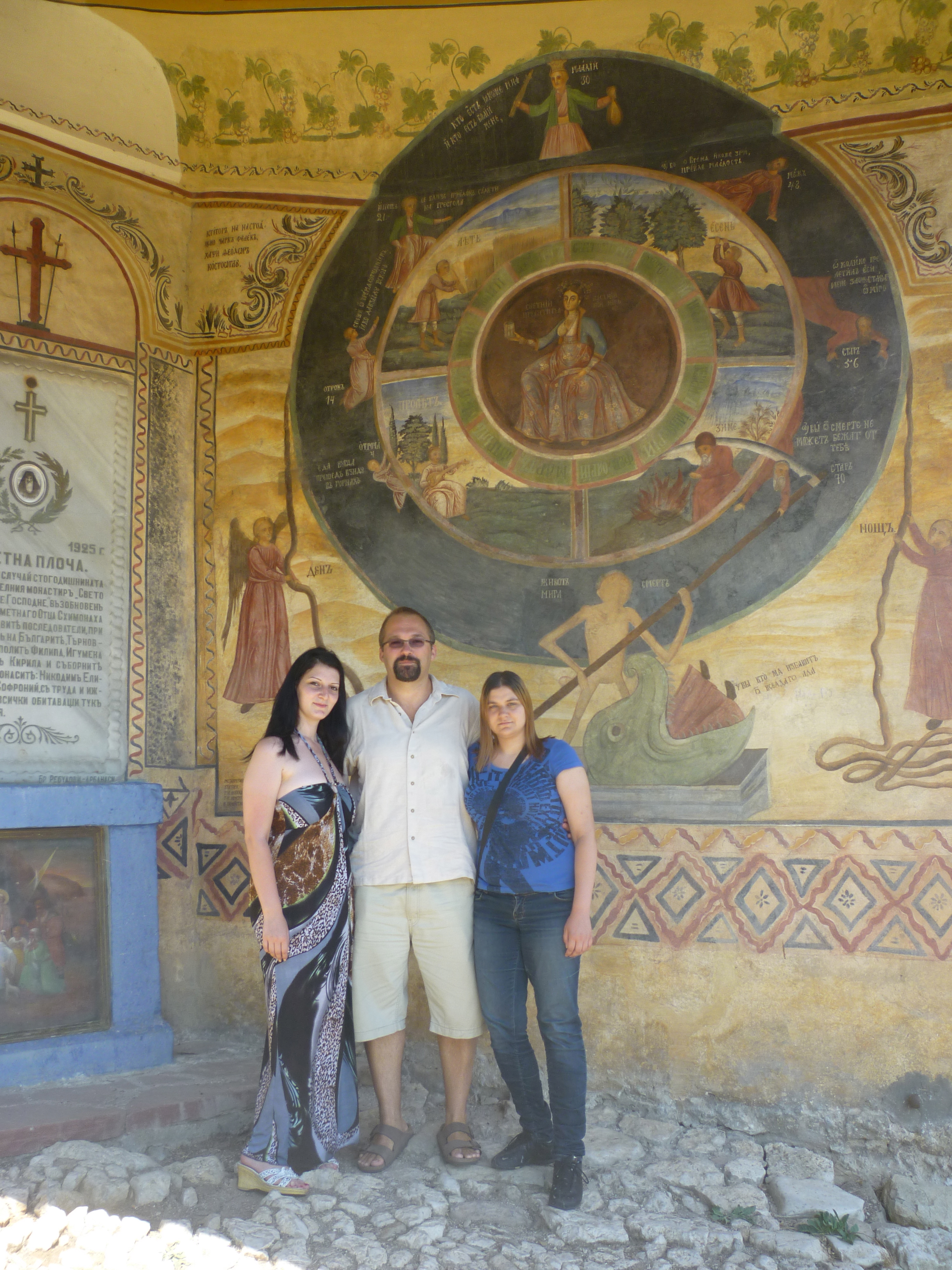
Anita and Stanislava
As the four of us were getting on a train to Burgas and the Black Sea, Anita’s phone was stolen. Sometime in between getting out of the cab and buying the tickets, it disappeared. The police response was impressive, though. Not only did they send officers right away to take a statement, they actually came and looked around, asked questions – I do not think you would see this in Italy or the U.S. for a missing mobile!
While she dealt with the insurance, the remaining three of us plugged on, taking perhaps the slowest train ride I have experienced since a childhood trip on the Snoqualmie-North Bend local line. The buses make the same trip in half the time, we were told! But Burgas is worth it, a port city on the Black Sea (second largest on the Bulgarian coast) with a friendly pedestrian down-town and sprawling sea garden, it is busier than Veliko, but has its own charm. Beach fare included sprat, fries and cheese, local beer and the ubiquitous rekjia (not in that order).
The most luxurious travel of the entire summer was the night train from Burgas to Sofia. I slept as comfortably on that train as I have in any hostel, and better than some. The room was big enough to do morning calisthenics in, even… if I had any such discipline.
Summer Stage III: Backpacking in the Balkans* — Moldova
Meeting two Moldovans during the Lingua Franca summer camp convinced me and the friend I was traveling with that we had to visit this landlocked country between Romania and Ukraine. As one of my friends informed me via facebook while there, some studies list it as the least visited country in Europe. From Iasi, the regional capital of the Romanian state by the same name, we found an antiquated 15-passenger van that was the primary form of public transit. The van had to be pushed or towed every time it stopped; on its last breakdown, the driver just had us all get out on the outskirts of the Moldovan capital. Thankfully, Moldovan taxi drivers are considerably more affordable, and more honest, than some of their Roman counterparts.
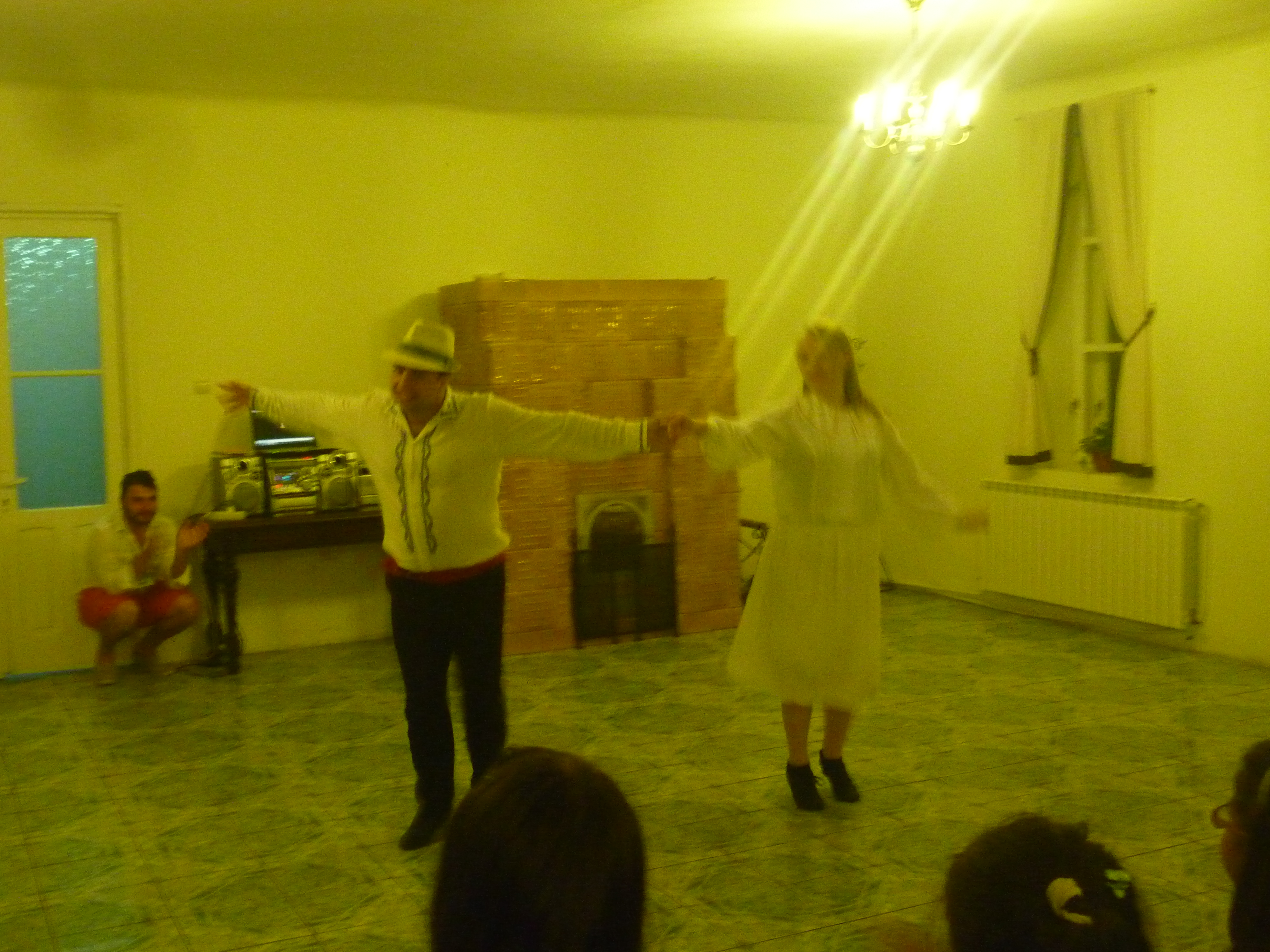
Moldovan confrere Andrei teaches dance
The capital of Moldova is Chisinau (pronounced Kish-ih-now), and we found a new hostel just behind Malldova, the nation’s largest shopping mall, a twenty minute walk from the center. You can see most of the capital core in an afternoon of walking around, including a giant chess set conveniently located between the Metropolitan Cathedral of the Nativity and the National Assembly.
In 2009, after communists won a majority of parliamentary seats, Moldovans joined the ‘Arab Spring’ and there were massive demonstrations, including setting fire to the main federal buildings and even burning the original copy of the national constitution. One of our Friends referred to it as the ‘forgotten revolution’ because of the relative lack of attention they got, despite timing it to join the wave of uprisings that made the western news cycles.
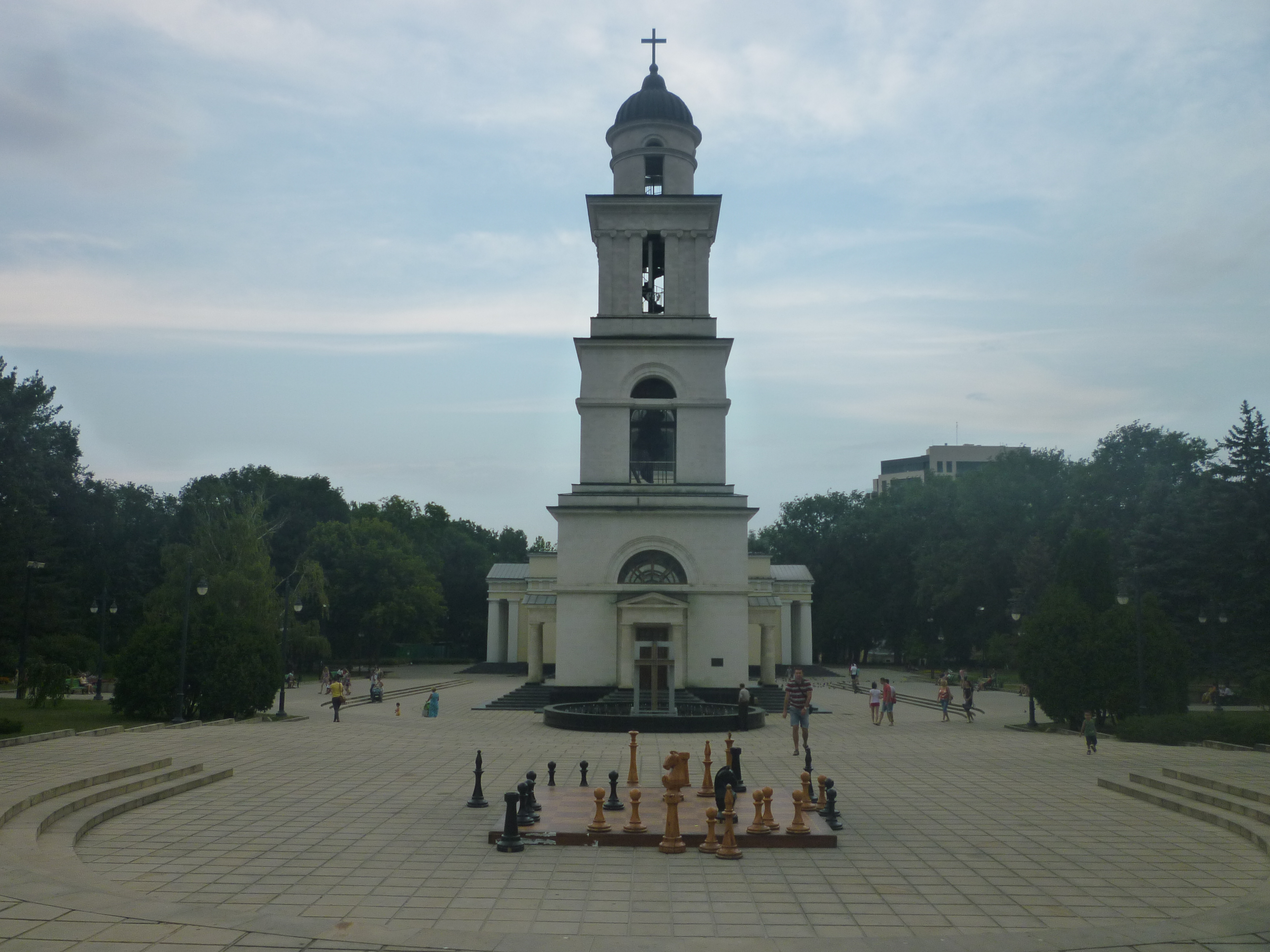
Metropolitan Cathedral of the Nativity, Chisinau
Today, as you walk down the sidewalks, nearly every corner boasts a small bar – basically a keg with a plastic counter built over and around it – where you can buy a pint of Kvas for about fifty cents. Housing was about seven euro a night, and twenty euros was enough to cover a full traditional meal at an upscale restaurant, complete with a bottle of aged cabernet, for two.
While in Chisinau, we took a tour of Milestii Mici, a winery and wine storage facility, with about 200km of underground tunnels, a quarter of which are used to store the world’s largest single wine collection. There are approximately 2 million litres of wine here. It is best to think of it as something like Napa Valley meets Moria (sans balrog). You literally drive into the caverns, following road signs named for the varietals stored in massive oak barrels or in the catacomb-like casas of the Golden Collection. Their prize possessions are a little less than 200 bottles of 1973 vintage – each registered as a part of the national heritage – and which cost upward of 2000 euro apiece. The last one purchased by actor Steven Segal to be given as a gift.
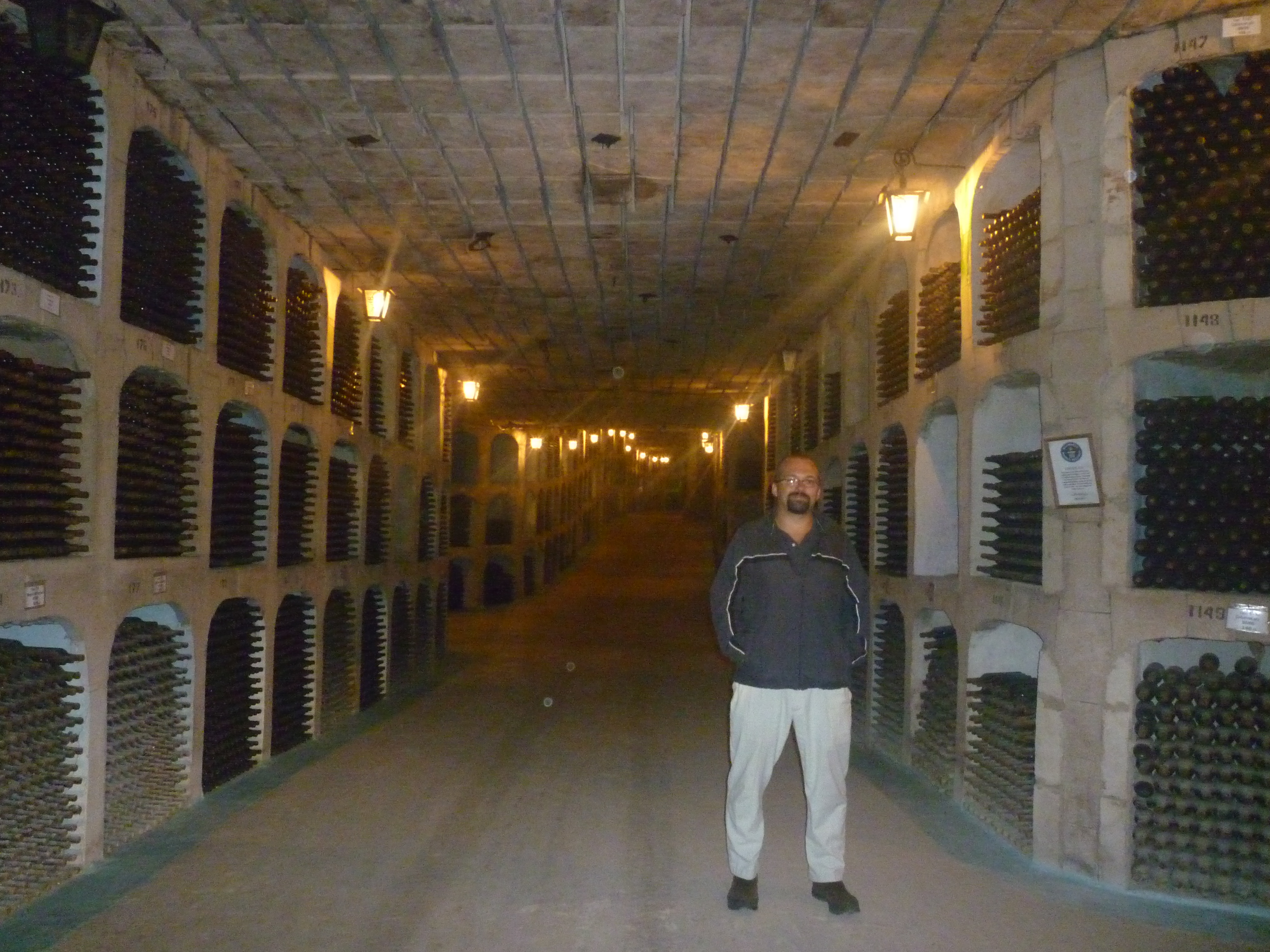
Milestii Mici – World’s Largest Wine Cellar
Our second full day gave us a choice: we could visit a sliver of disputed land called Transnistria, where Soviet Communism still survives, we are told, and half a million people call it home. (Transnistria is not recognized by any other nation, only other unrecognized “frozen-conflict zones” of the former Soviet Union).
Instead, we choose to go to Orhei Vechi, where a series of caves used have been used as a monastery since the 13th century, but with more ancient settlement in the area. The site was clearly once under the sea, as the caves (now hundreds of feet above the riverbed) are almost covered with fossilized shells. Set in the middle of a double bend in the river, which has long since carved out a broad canyon, some guides claim it is the most beautiful place in Moldova. I am inclined to agree.
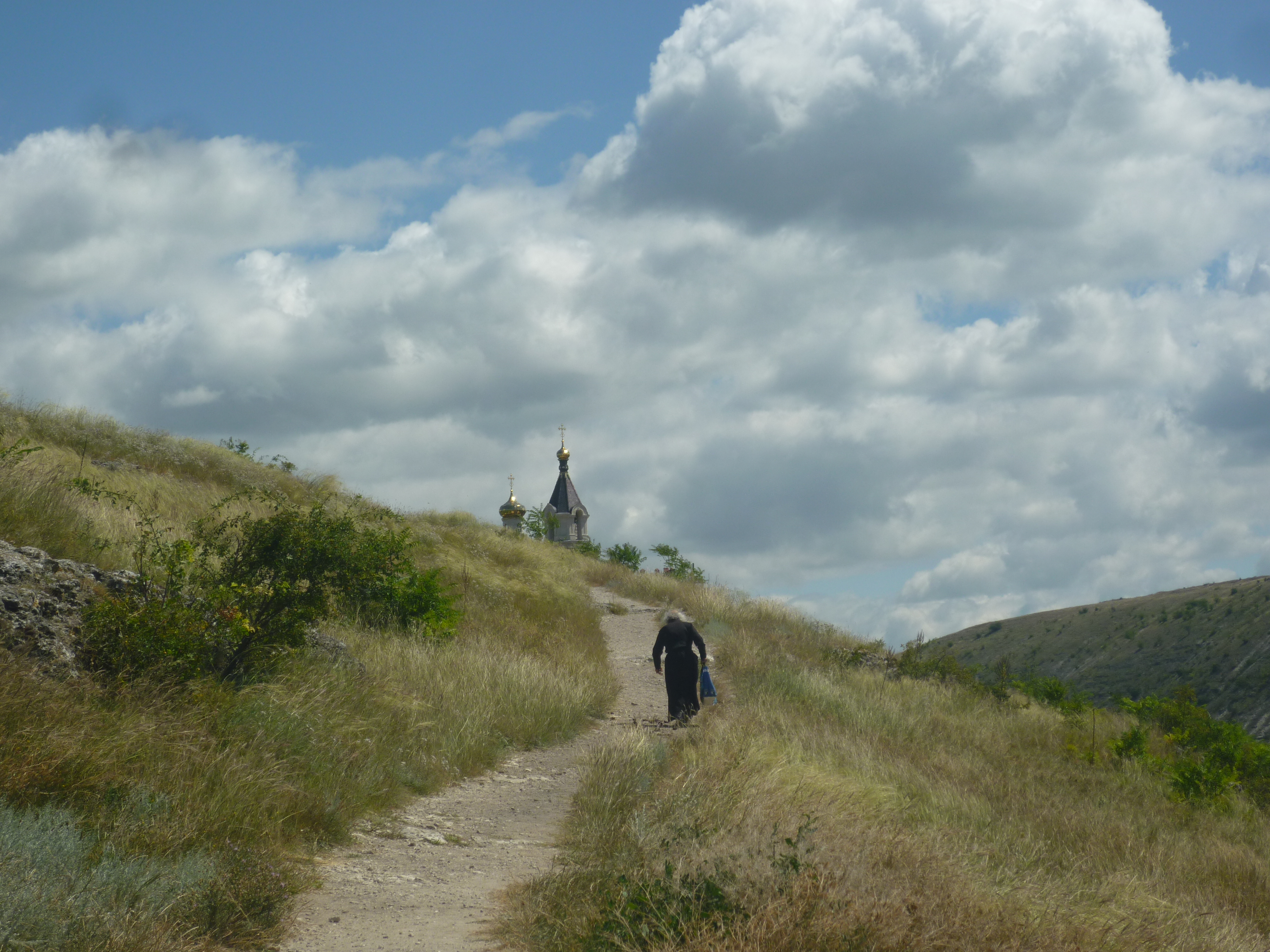
Orhei Vechi
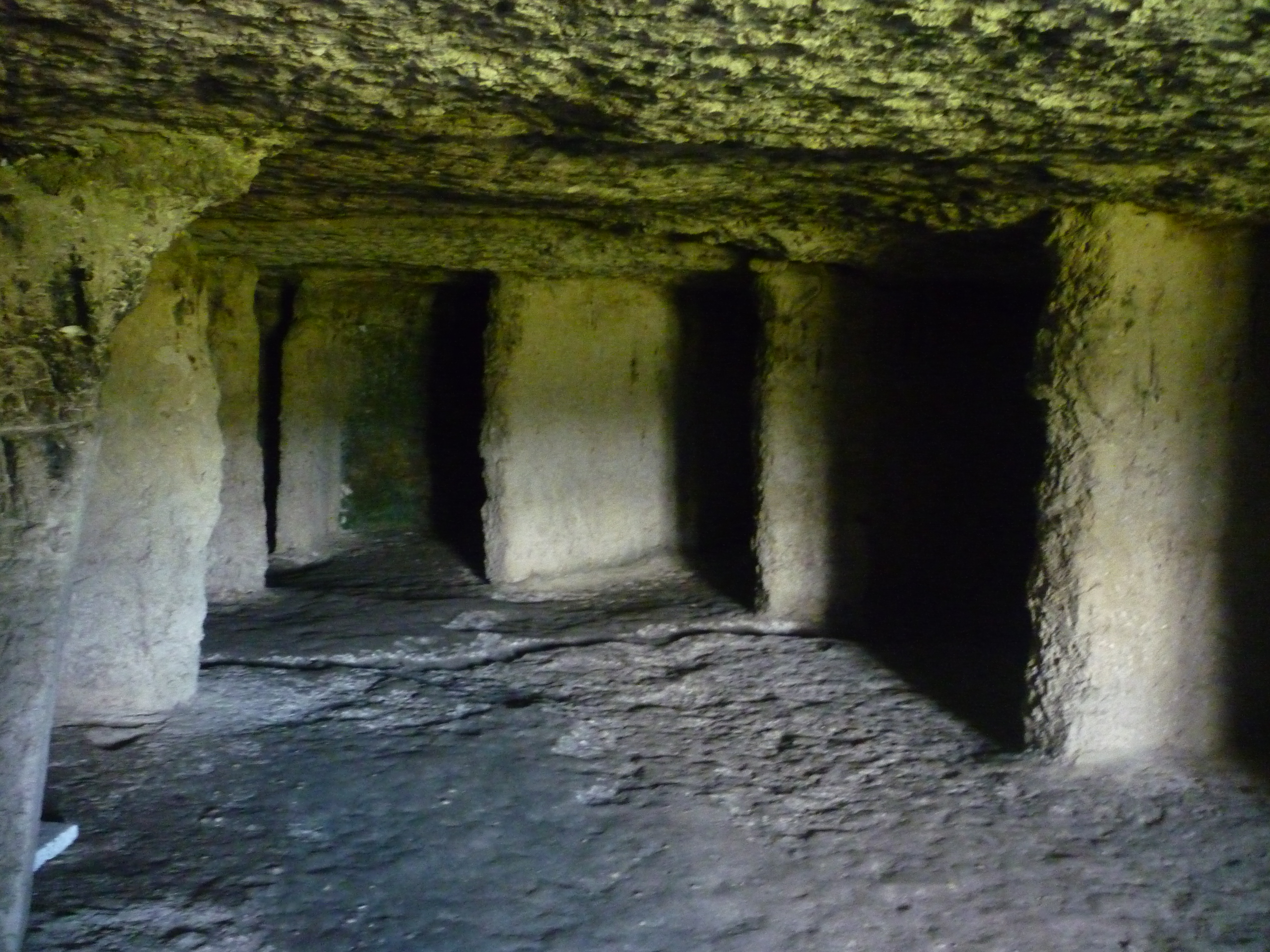
Orhei Vechi – seashell covered cells
*”Backpacking in the Balkans Plus” doesn’t quite have the same ring to it!
Summer Stage II: English and Ecumenism in Eastern Romania
Providence provides again. After three weeks in Cyprus, the choice of destination was determined by one and only one question: what was the cheapest flight out of Larnaca? Wherever it went, that is where my next stop would be.
As it happened, the answer was Bucharest. I missed my mother’s trip to Romania by just under a week, too, but the timing worked in my favor. After having booked the tickets, a Georgian friend sent a facebook message about a ‘summer camp’ for students from central and eastern Europe interested in ecumenism and improving their English. The target age seemed to be university students in their twenties, or late teens – “youth” by the European definition. A little past the upper limit, I wrote the organizers to see if they were interested in having a native-English speaking ecumenist join them, and offer a lesson or two.
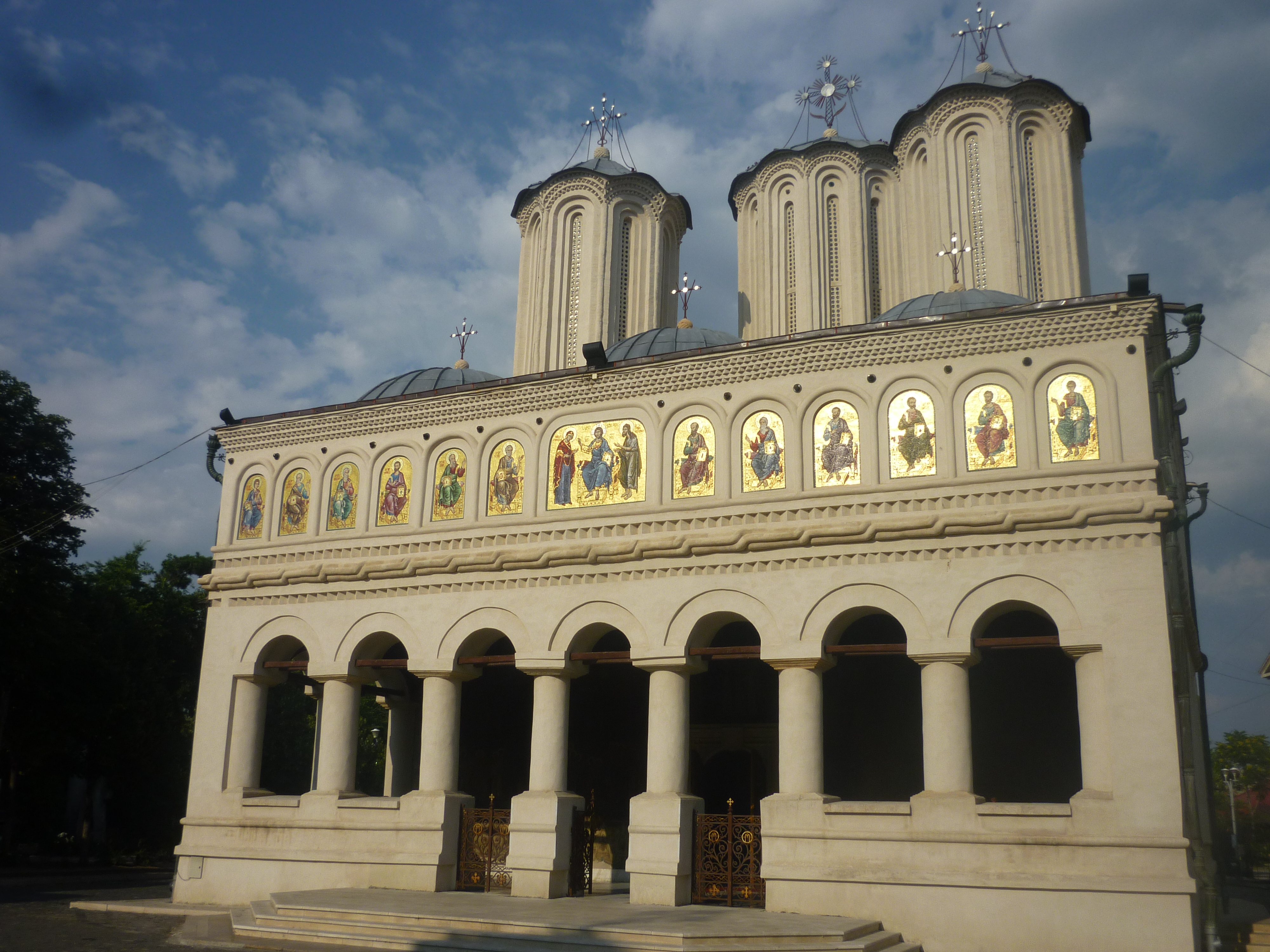
Patriarchal Cathedral of Sts. Constantine and Helen, Bucharest
The idea of spending ten days in a castle in northeastern Romania for no more than the cost of getting there was appealing, too, I admit. A few hours in Bucharest gave us time to visit the patriarchate (where we got parking only because our host told security that I was a theologian visiting from the Vatican), and a walking tour of the city. Then it was a night train to Roman.
The Lingua Franca Summer Camp was organized by the European Region of the World Student Christian Federation, an organization i had somehow not encountered before. It started originally in the early nineties at the collapse of the Soviet Union as a way to promote Christian leadership and provide English-language training for young Christians from behind the Iron Curtain. The length of the program has reduced dramatically in the last 20 years, from three months to ten days, but still serves many of the same countries. All the participants already had some mastery of English, and some involvement in ecumenical student movements. I was privileged to lead a small discussion group of advanced English speakers from Armenia, Georgia, Ukraine, and Finland during language training, and participate in the program the rest of the week. The other participants or staff came from Armenia, Bulgaria, Georgia, Germany, Finland, Ireland, Italy, Lithuania, Moldova, Poland, Romania, Slovakia, UK, Ukraine, and US.
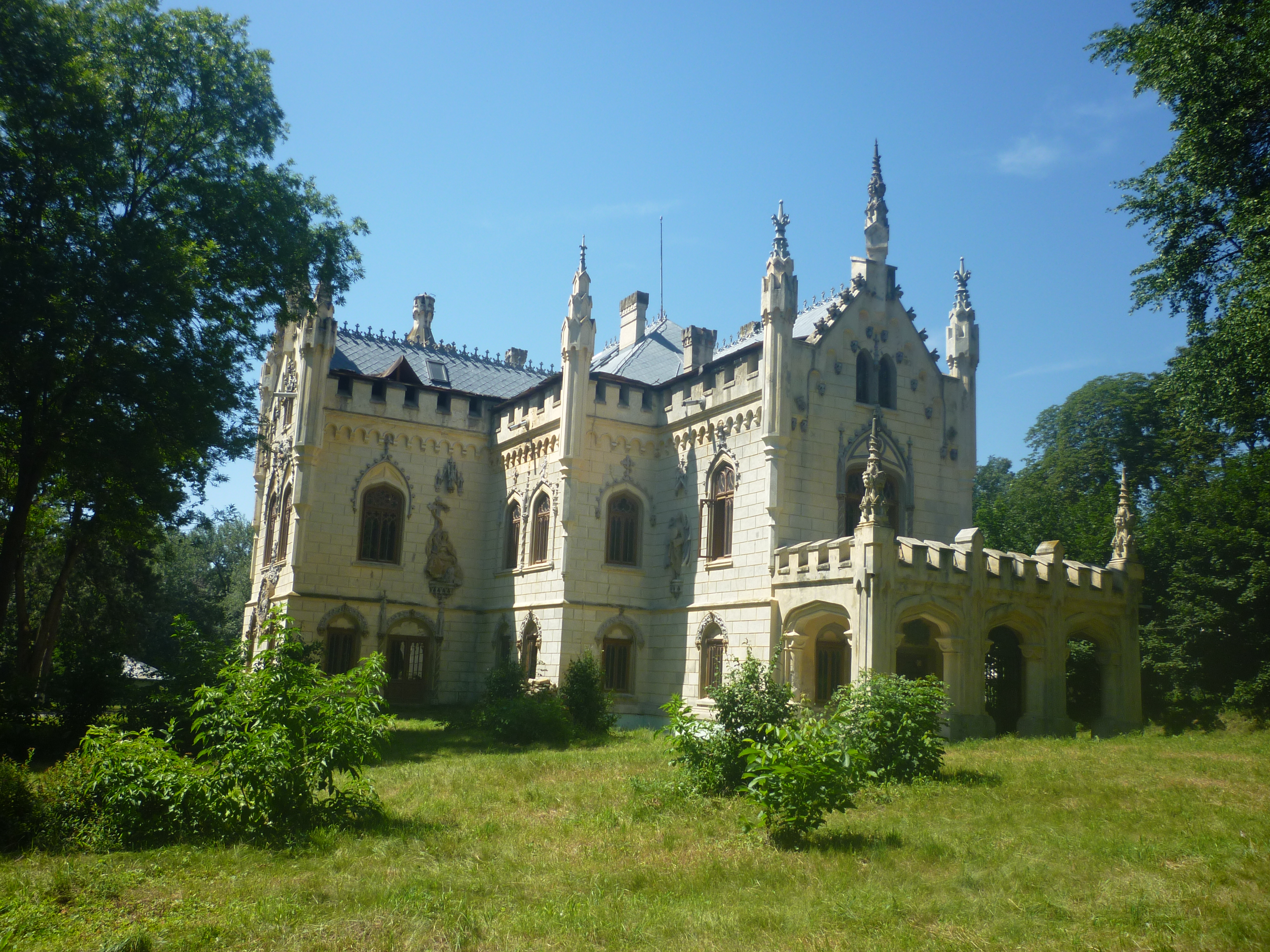
Studza Castle, Miclăuşeni
The setting is the almost surreal nineteenth century neo-gothic Sturdza Castle, near the village of Miclăuşeni. Built on the site of a fifteenth century manor estate, the castle once boasted a library of 60,000, including several rare first editions. Most of these were lost during the second world war, burned as fuel or stolen either by Nazi or Soviet soldiers. In 1947 the heiress donated the property to the Romanian Orthodox Metropolitanate of Iasi, and established a monastic community there. Only six years later, however, Communist authorities seized the land, and used the castle successively as a munitions depot, museum of military metallurgy, and hospital for children with severe mental disabilities. Villagers looted some of the original furniture, and other pieces were lost in two fires over the decades. As late as 2002, the place was still in complete disrepair. Recent work to restore it seems to have done a great job, but there is still a lot to be done – many of the original frescoes and decorations are so ruined, it seems more a question of renovation than restoration. A retreat center has been started, and the metropolitanate hopes to make a museum of part of the place. An iconography workshop already takes part of the space in the monastery complex, and the community of sisters numbers about forty.
The educational piece was organized in cooperation with the metropolitanate, under the guidance of the vicar for education, Archimandtrate Hrisostom Radasanu, a graduate of the Orientale in Rome. An articulate and erudite young cleric, his presentation to the group was apparently his first ever teaching occasion in English, and it was nearly flawless. I imagine the ecumenical world will be hearing his name a lot more in the years and decades to come, and I look forward to it.

Traditional Armenian dance demonstration
The best part of the experience was, naturally, the people who participated. I met some amazing young ecumenists and future leaders. I learned a great deal from them, about everything from the specter of Russian imperialism, perceptions of American politics and the degree to which we don’t always appreciate our country, to ecclesiastical reality in different countries and experience with Islam, to the situation for gay rights in Georgia (In May, a demonstration of about four dozen in support of gay rights was overwhelmed when something like 35,000 counter-protesters turned out). I also learned a bit about Romanian Orthodox Ecclesiology in practice, like the fact that they will not ordain someone without a pastoral office (ie, a parish or chancery role) that is open and requires a deacon or presbyter. I have to go read Fr. Ron Roberson’s doctoral dissertation now…
Two familiar faces from a great youth conference I attended in Sarajevo three years ago (!) were there too: Pip, an implacably irenic North Irish Anglican PK, now father of a beautiful daughter himself, who brought no less than six bodhráin with him; and Paweł, the Polish editor-in-chief of the WSCF-E publication Mozaik, whose English is more British than most Englishmen I know.
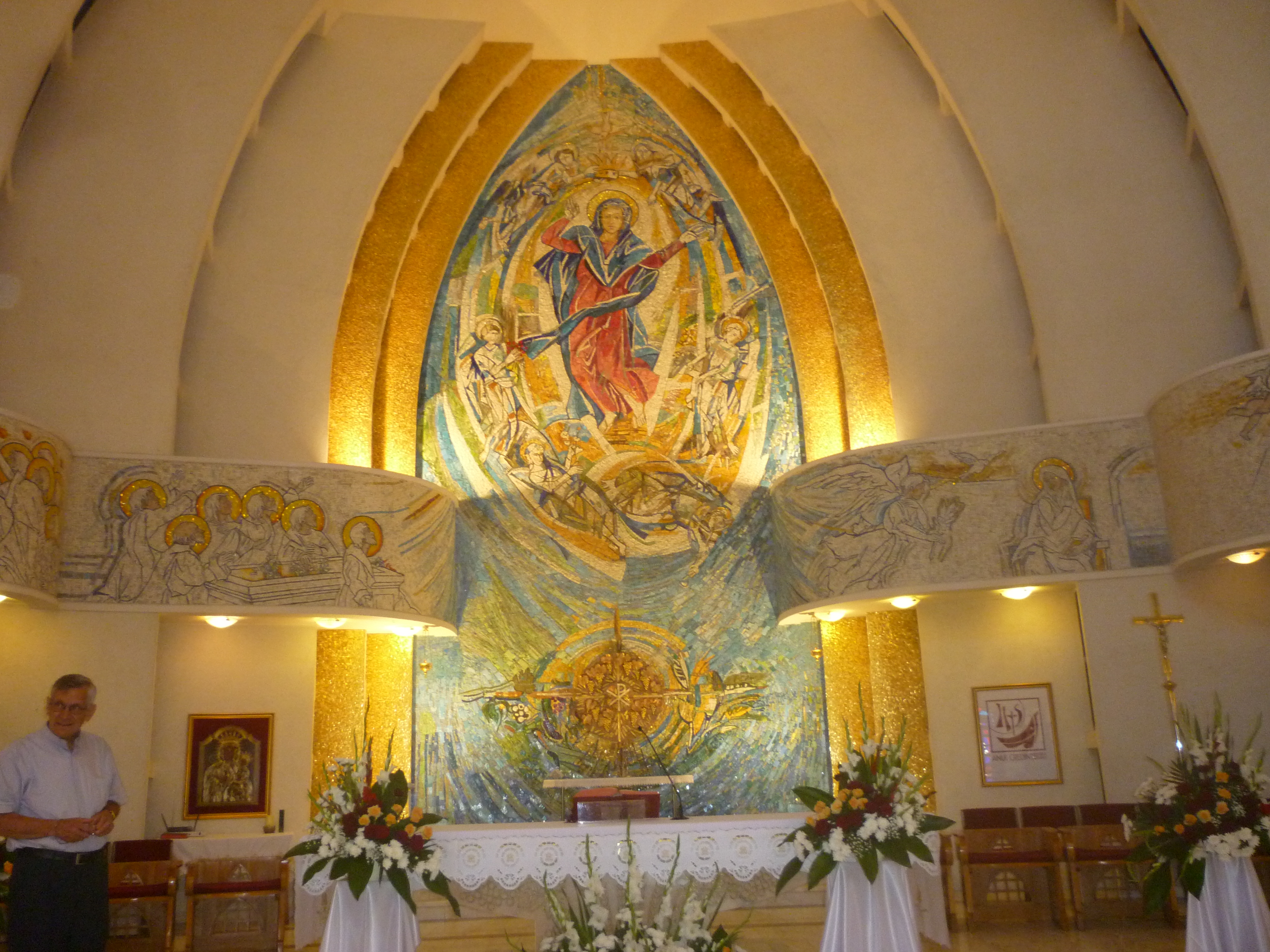
Catholic Cathedral of Mary, Queen of Heaven, in Iasi. Bishop Petru Gherghel’s motto is ‘ut unum sint’.
I met a Georgian who could be a Republican from the Peach State, an inquisitive Ukrainian with a passion for learning, Romanian teens whose Byzantine chant was angelic, a fey Finn of Russian roots with a compelling story, and an awesome Armenian foursome. My new Slovak friend is the very image of a central European intellectual, with a cigarette in one hand and a book on existentialism in the other, slightly unkempt beard and untucked dress shirt completing the ensemble. A Bulgarian duo were inseparable, indefatigable, and inspiring. The German regional secretary proved a kindred ecumenical spirit.
I could go on, and in more depth. I was impressed by the quality of each, and by the opportunity they had here. I had support from some key ecumenists in my years post-college around the US, but there was nothing like this for us to tap into, to network with ecumenists our own age. Europe may struggle with its Christian identity, but at least religion is still recognized as enough a part of culture that its diversity is something to be addressed, rather than ignored. Western Europe may be increasingly secular and unprepared to comfortably address religious questions, but there is a light in the East.
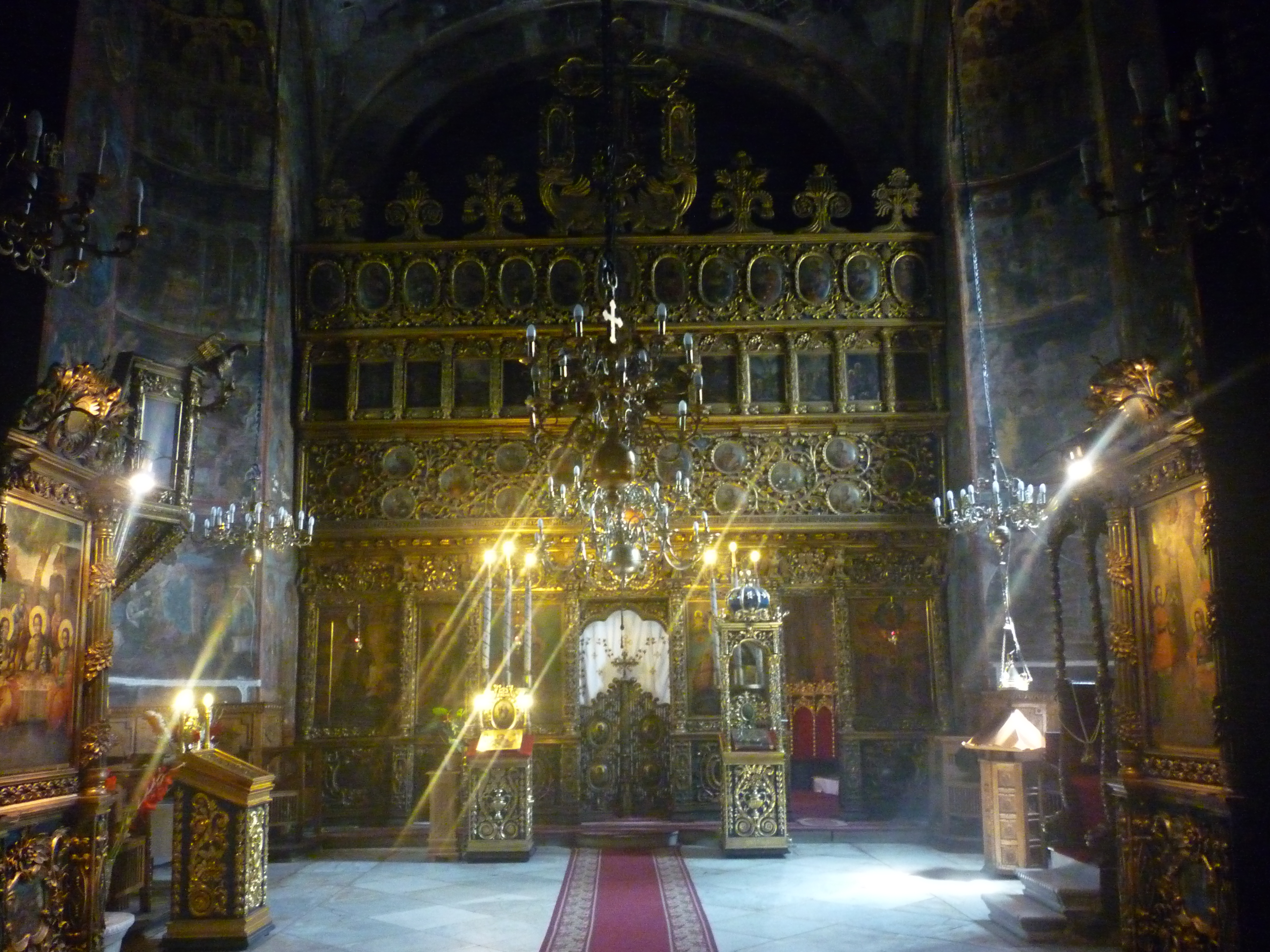
Golia Monastery, Iasi
Summer Stage I: Sun, Syllabus, and Cyprus
For three weeks, I got to call the island of Athena home. St. Paul shipwrecked here. Phonecians, Greeks, Romans, Crusaders, Turks and more Greeks have called this island home before me. I spent the better part of July living in an apartment with a pool, two kilometers from the beach, with an agenda that primarily included visiting orthodox churches and historic sites while preparing my first university syllabus.
Cyprus is an island divided, and I wonder if my Irish friends would find something familiar about it. On the southern side, Greek flags are abundant, but it took a couple days before I saw my first Cypriot flag. On the north side, the flag of Turkey is seen at least as often as that of Northern Cyprus.

Republic of Cyprus

Turkiyё

Greece
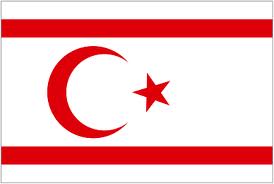
Turkish Cyprus
Most of the world (except Turkey) sees the northern part of the island as occupied territory, with a massive amount of Turkish military and settlers who arrived in response to an attempted coup (by Greek Cypriot nationalists) in 1974. About 200,000 people were displaced, both Turkish and Greek Cypriots, forcing ethnic Greeks to the south, and Turkish Cypriots to the north. The Republic of Cyprus (south) controls a little less than 60% of the island, while the Turkish Republic of Cyprus holds most of the rest. There is a UN buffer zone between, and a couple of British military reservations on the south side.
The total population of the island is about 1.1 million, with about 300,000 living in the north, perhaps half of whom are actually Turkish or the children of Turkish settlers (in contrast to ethnically Turkish Cypriots). The Turkish military maintains about 30,000 troops on the island. One Turkish Cypriot shared this analogy with me:
Imagine the UK invaded the US in response to a crisis (say, an attempted coup by the western states, who wanted to unite with Canada), and left a garrison of 30 million British troops on American soil for the next forty years. Obviously, there’s a shared language, ethnicity, history, and origin… but British soldiers on American soil, numbering 10% of the population in the occupied area? Say, New England? How would that go over at home?
Recently, however, relations seem to have relaxed a little, and some transit across the border is allowed. The capital city of Nicosia (Lefkosa) is divided, not unlike Berlin during the cold war, an image Cypriots of both sides used while I was there. While sipping lemonade in the Buyuk Han, an Ottoman-era inn and market, we got to meet one of the northern Cypriot politicians who was working toward reunification, reflecting a significant minority view, that, it seems, is growing with younger Cypriots there.

Sunset at St. George
The first day in Cyprus saw sunset from the church of Agios Giorgios (St. George). Before that, though, a visit to the ecumenical center of Pahos, Agia Kyriaki Chrysopolitissa – otherwise now known as St. Paul’s Catholic Parish of the Latin Patriarchate of Jerusalem in Paphos, Cyprus (entrusted to them since 1986). The Anglican community of Paphos also accepted an invitation to use the Church for worship (since 1988). The invitation was extended to the Maronite, Lutheran and Finnish communities. The site includes “St. Paul’s Pillar”, where according to local tradition, the apostle was lashed 39 times for preaching Christianity, before managing to convert the local Roman proconsul, Sergius Paulus, the first recorded Roman official to convert. (cf Acts 13)
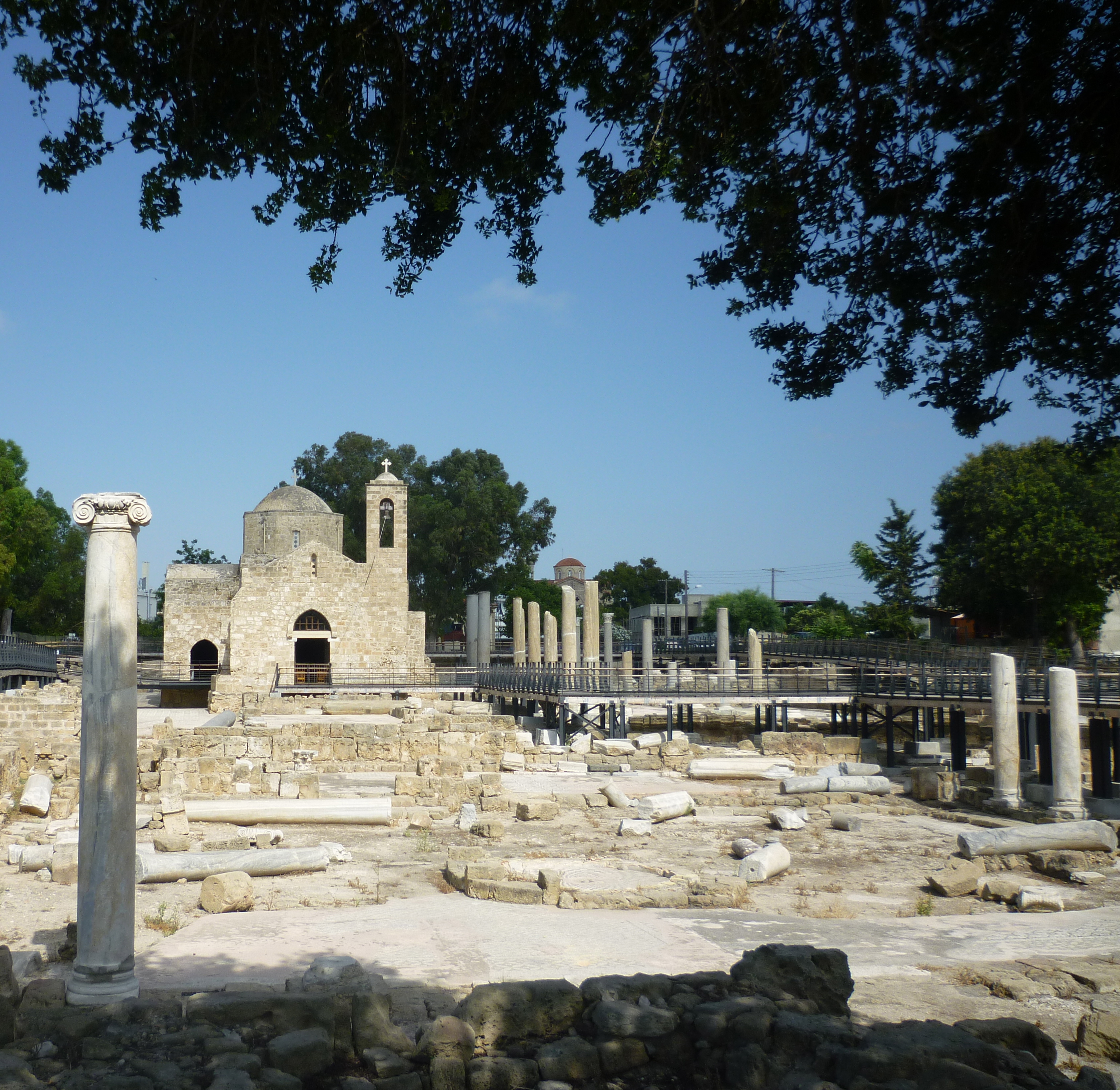
Church at St. Paul’s Pillar
In the south, I spent most of my time near Paralimni, on the southeast corner of the island, with a couple days around Paphos, and a couple days around the local region, such as Agia Napa and Cave Grecko.
It is common for many of the Orthodox churches to have some exterior space where the faithful can light candles or incense, even when the church is closed. Sometimes this is as simple as a converted barbecue, or as elaborate as a completely separate building. In the case of Agia Thekla, it was a sea cave turned grotto, covered in icons. (Never heard of St. Thecla, disciple of Paul? You have, you just don’t know it. The oldest image of Paul in the world is in the catacomb of St. Thecla in Rome, just discovered a couple years ago, under a modern office building!)
With more experience of Byzantine orthodoxy from the Russians and other slavs, I was unprepared for the relatively casual approach to worship here: No heads covered, summer clothes (sundresses rather than beachwear, though) some impromptu recruiting of a very excited young acolyte, and observing the feast day by passing under the icon of the saint. Antidiron (it seemed) and a mix of pomegranate, sesame, and almonds were distributed regularly after vespers.

Lefkosia: The Last Divided Capital
In the north, a local couple showed us around – a Turkish Cypriot high school teacher and his Turkish wife, both generous hosts, showed off a few choice sites. There’s an English village clinging to a cliffside called Karmi, where remnants from the British occupation settled and never left, even after the Turks took over. Bellapais abbey looks out over the port town of Kyrenia, and dates back to the 14th century.
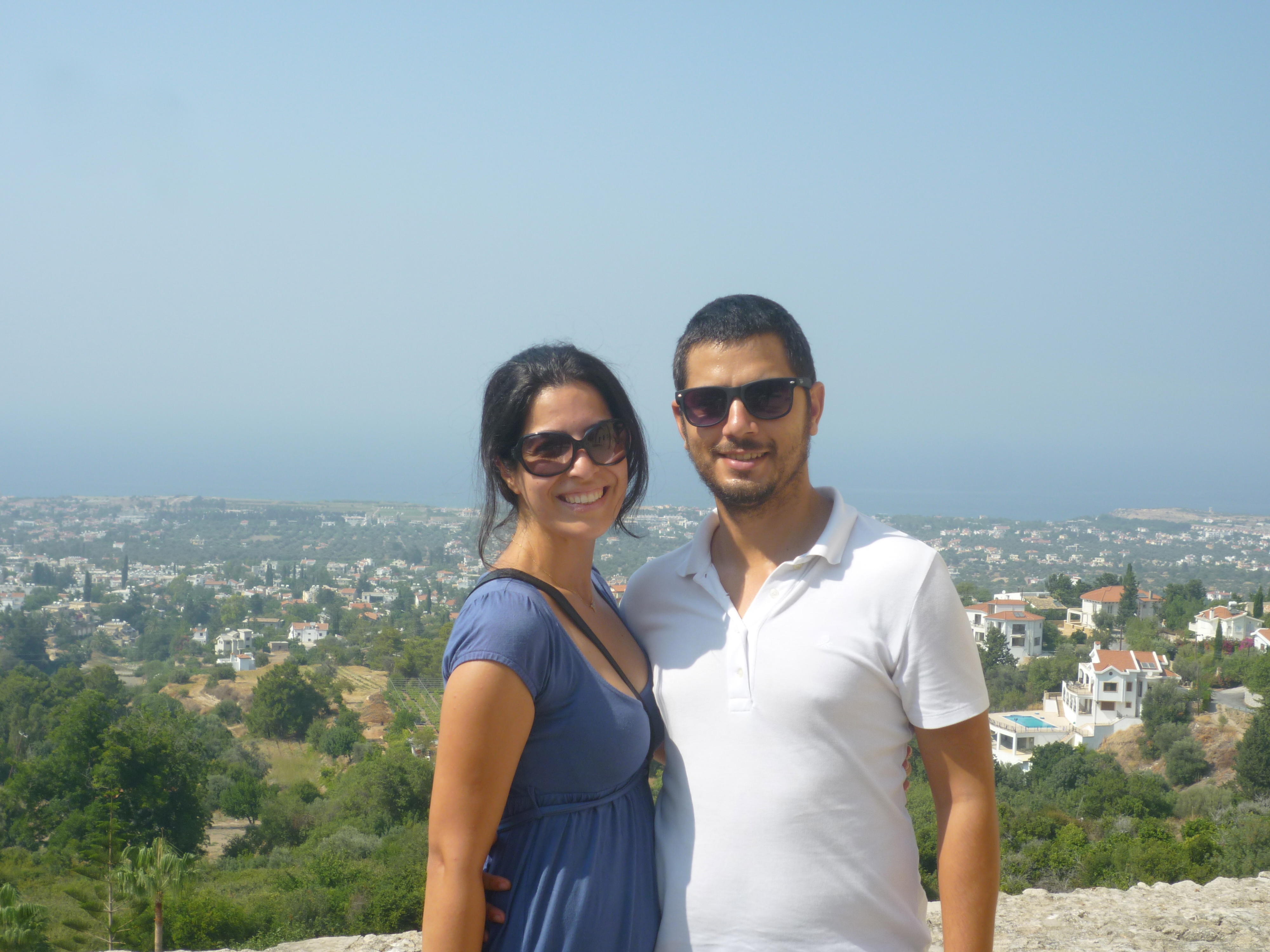
Turkan and Aziz, my hosts in the north
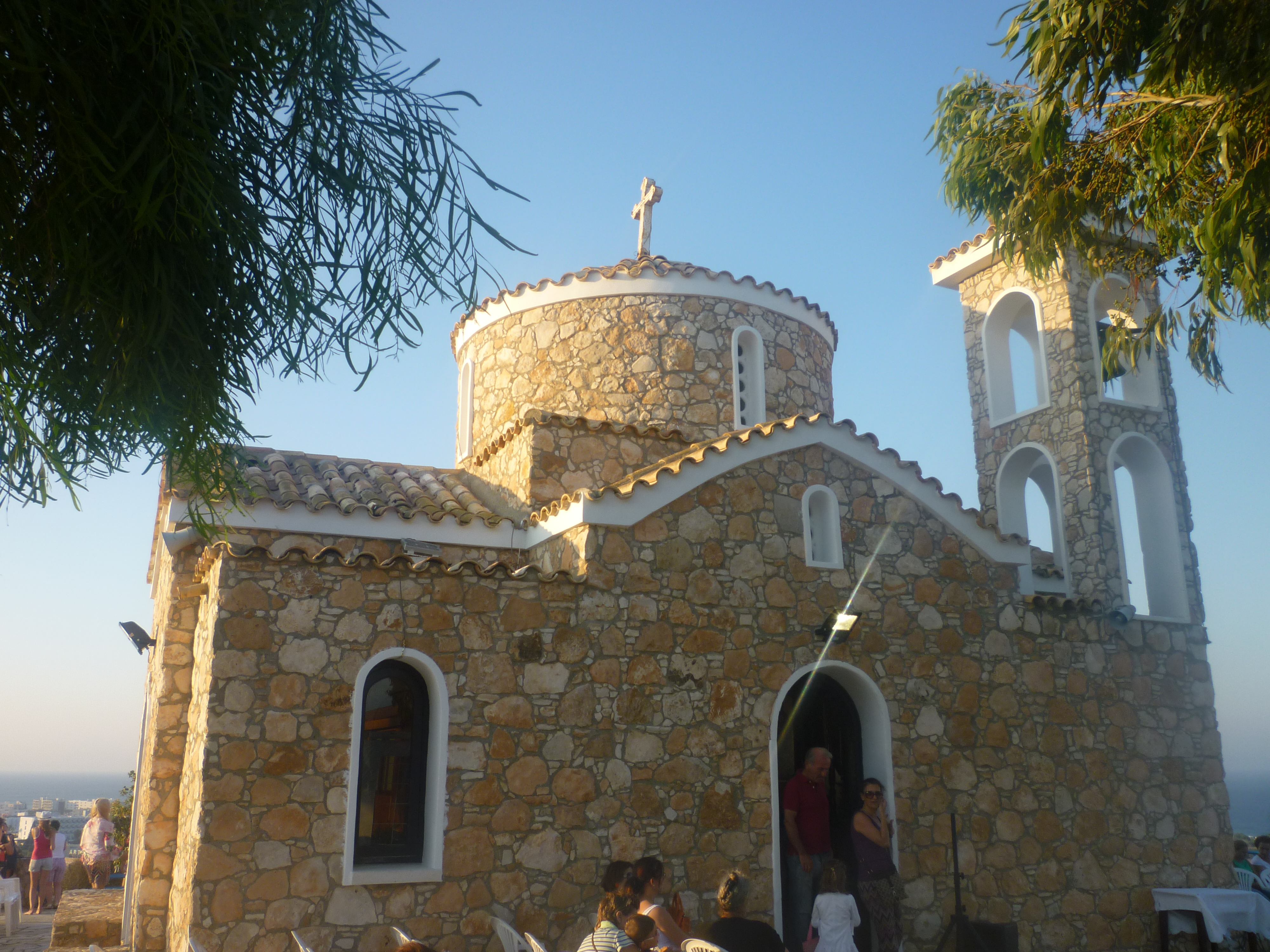
The last, we celebrated vespers on the hilltop church of the Prophet Elijiah, overlooking Protaras, on his feast day. If I had planned it, I might not have made it in time, it just happened that my friend and I decided to climb the hill that day, at that hour, and found ourselves ready to get good seats and join in the liturgy honoring the prophet just after the sun set on my last day in Cyprus.
The next morning, a few hours before I flew to Romania, air raid sirens sounded to commemorate the 39th anniversary of the Turkish invasion. Prior to that, most days were filled with church bells and/or the call of the muezzin, both of which fill me with prayerful peace.
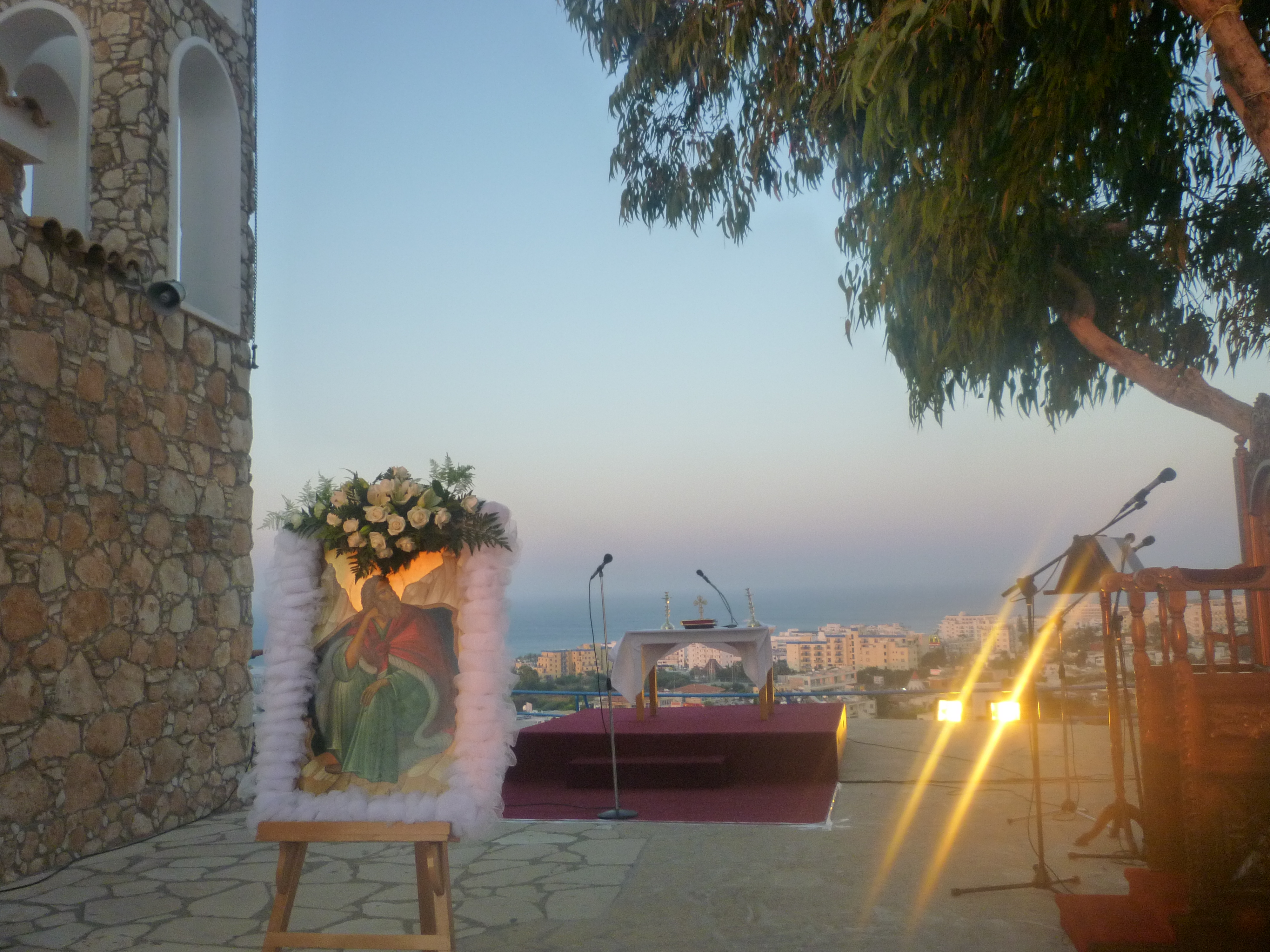
Icon of the Prophet Elijah

- Church of Holy Elijah
Summer 2013
In the last few months, while the world has witnessed the first resignation of the bishop of Rome in six centuries, the election of one with the hopes of the world on his shoulders, renewed violence in Egypt and ongoing horror in Syria, the change in my own life is both far more modest, and more pleasant to share. Of the others, no doubt more will be said.
In May I was informed that my hours at the John Paul II Center for Interreligious Dialogue will be reduced. The Russell Berrie Foundation and the Angelicum– co-operators in the direction of the Center – have been very generous in keeping me on as the Graduate Assistant (and de facto only regular staff person) for the last two years since my fellowship was concluded. I will continue for the coming academic year in the same capacity, and await anxiously news of the next stage of the Center and the Russell Berrie Fellowship in Interreligious Studies at the Angelicum, and whether I may continue to be a part of it.
The reduction in hours, including two summer months without any work, meant three things:
- I would have to find additional work to pay for my studies and living expenses (no doctoral stipends in Rome!);
- I would have to leave the Lay Centre at Foyer Unitas, my home in Rome the last four years;
- I would have an entirely free summer – and even fewer resources with which to enjoy it.
As with my original move to Rome, however, providence provides.
Within a week, three work opportunities presented themselves, which all eventually came to fruition. One even had the advantage of ‘killing two birds with one stone’ and taking care of the accommodation question as well.
- In mid-August, I take on the role of Resident Manager (Domers, read ‘rector’) for The Catholic University of America’s flagship study abroad program, happily joining the staff of my first graduate school, in the city of my latest.
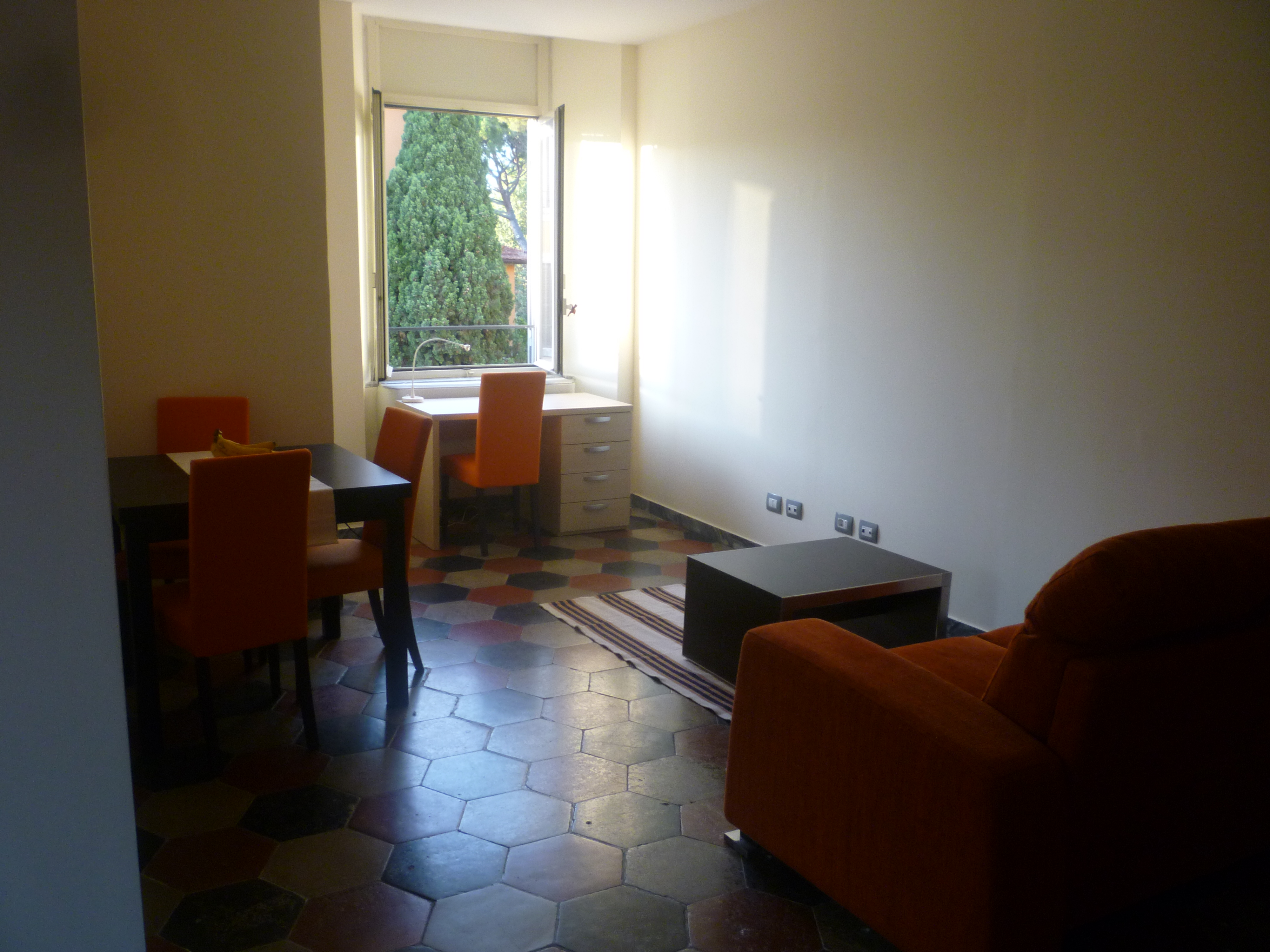
It comes with a spacious corner apartment at the Prati campus – furnished in the colors of Halloween. (I kid you not: Pumpkin-colored couch, dining room chairs, tableware, salad bowl, etc… St. Mary Magdalen folks, Fr. Marquart would have absolutely loved it…).
The 70’s would be proud
- In mid-September, I begin teaching my first university level course as an Adjunct Assistant Professor for Assumption College (Worcester, MA) for their new Rome program. My course is part of the core curriculum, titled “Contemporary Catholicism”. And I get to teach it, in Rome, in the semester that Popes John XXXIII and John Paul II are being canonized. How about them apples, fellow theologians? Preparing the syllabus took the first part of my summer vacation, but has been a great deal of fun.
- In February, I start teaching my first specialized course in Ecumenism and Interreligious Dialogue at the university level, this time at one of the Roman colleges (seminaries), the Pontifical Beda College, where second-career Anglophone seminarians usually find themselves. The course is offered during the fourth year, so all of my students will be transitional deacons – which should make for some fun conversations given my research area!
As for the free summer? Staying in Rome is an expensive proposition… but so is returning home to Seattle.
Suddenly, a little casual research into the interplay of Eastern Orthodoxy and Islam in central and southeastern Europe seemed appealing. It is amazing how far you can get there on a limited budget, a ecumenical network, and whatever else providence can provide…
Hope and Change in the Church
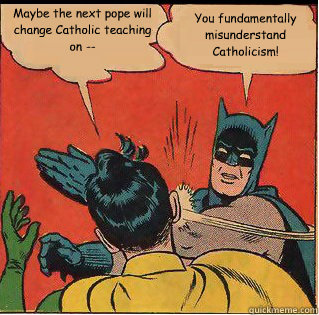
Batman the fundamentalist giving Robin the chance to turn the other cheek
A recent conversation highlights the challenge of talking about “hope” and “change” in the Church.
A few weeks ago I had a quick lunch with an old friend and a new colleague. Eventually my friend (a Notre Dame alumna, “new evangelist” and educator) and I got into a lively discussion about “change” in the Church, given all the hope that has been expressed lately about what changes Pope Francis might bring.
My position is basically this: it is naïve to think that the Church does not change, and it is unhelpful at best and dangerous at worst to suggest that the Church cannot change. The Batman meme above vividly demonstrates a misguided and wrong-headed understanding of the Church.
“The Church should change” does not mean “the truth must/can change”. It is Church discipline – and often really just Church culture – not dogma, which should change in the minds of most. Though there are always exceptions, I suspect most Catholics are not agitating for moral relativism, an end to Trinitarian theology, a return to Arianism, denial of the Resurrection or the Real Presence, promoting abortion or war, that we do away with ordained ministry or that we change the Sunday Eucharist into an hour long drum circle featuring Kumbaya in a dozen different languages.
What most Catholics mean when they say that they hope for change in the Church is ecclesiological, ecumenical, pastoral, and practical. They want a positive gospel message (“God is love” or “Love God and thy neighbor”, and all that radical wishy-washy stuff, you know); they want better preaching, better music, better liturgy; they want transparency and accountability in church decisions, participation in governance, and maybe even more married clergy and less clericalism. They want bishops (and pastors, deacons, DRE’s et al.) to be servant-leaders, not lords of their own fiefdoms. They want ecumenism and interreligious dialogue to work, and to have real effect. They want more effort spent on social justice than on ecclesiastical protocol, more money spent on education and pastoral care than on neo-Baroque bling.
But my experience of most Catholics, admittedly, is based on my experience in parish pastoral ministry and Catholic higher education. My friend has spent several years on the front lines of pre-evangelization, new evangelization, and even good old-fashioned evangelization and catechesis, often in the context of guiding groups of pilgrims and students around Rome’s most sacred sites.
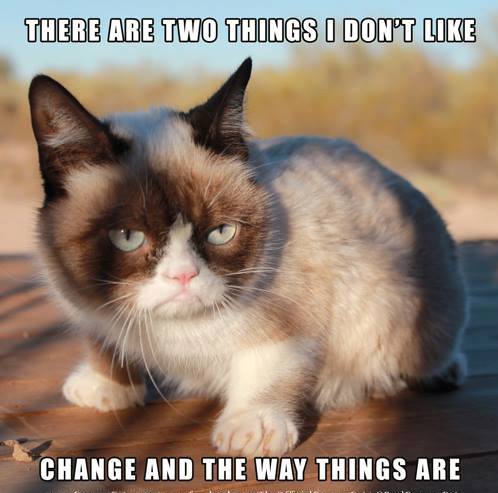
Her position was that “the church should change” is basically code for “the church’s teaching about morals should change to match the social norms of the western world.” When people say change, they mean that the church should get out of its old-fashioned rut, and embrace a woman’s right to choose, gay marriage, equal rights (and rites) for women in the ecclesiastical workforce, and so forth.
That it may be, in some cases, just as in others, “the church should change” means “the church should eliminate the novus ordo, go back to the Tridentine rite, and embrace traditional Catholic culture (circa 1940).”
The problem, though, in assuming that “the church can/must change” is code for a particular agenda is that it stymies the possibility of real conversation and dialogue. The Church is in fact always changing. All we have to do is look at the papacy of Benedict XVI to see a number of examples of change in the church. And no one can accuse Ratzinger of being radical, wishy-washy, or unorthodox.
He changed the liturgy, both in terms of the translations and in terms of the mark his own personal preferences have had. Even just during my four years in Rome, you could see lots of changes to the liturgy at St. Peter’s – longer, less participatory music; rosaries before mass begins; communion no longer offered in the hand; a crucifix and candles dominating the altar; cardinal-deacons vesting in mitre and dalmatic; etc., etc. He changed canon law to exclude deacons from acting “in persona Christi capitis,” making this phrase more about Eucharistic presidency and less about holy orders or leadership in the Church. He innovated in creating ordinariates for disenchanted Anglicans. He pushed forward reforms relating to the sex abuse crisis (at least for priests, if not bishops). He created a personnel office for the Vatican. He called in an outside audit of Vatican finances.
In short, the Church changed a lot under Pope Benedict; why would we not expect it to change with Pope Francis? The Church changes, and survives. Change simply means that things are different than they were before. It is a sign of life, and of fidelity to the principle ecclesia semper purificanda (the church must always be purified). Rather than dismissing the idea of the church changing, embrace it – critically, intelligently, and faithfully.
Remember Dante’s Divine Comedy – God is pure dynamism. The only creature which cannot change is Satan, eternally frozen in the deepest pit of hell.
After 35 Years: A Return to Reform?
My friends can tell you that I have a bad habit. Actually, more than one, but only this one is relevant at the moment. When going through my email inbox, I tend to scan everything, then work from the least important first ‘saving the best for last’, so to speak. Especially after a busy week, I might spend an hour just sorting through quasi-spam and quick reply messages, clearing the space so I can respond to the really important ones. The problem is that I too often run out of time, and messages from my closest friends or strongest ecumenical contacts languish a little too long awaiting attention. The same logic has log-jammed my blog lately.
Since about two weeks after Pope Francis was elected as bishop of Rome, I have sat down several times to start a reflection on his fledgling papacy. The problem is, every time I do this, I get distracted reading about whatever exciting new thing he has done. Often they are little changes, gestures and actions, but they paint a picture of humility and commitment to reform, openness to dialogue and noble simplicity of faith and its expression.
By now the litany of these little things is well known: He appears on the balcony dressed in the simple white simar, like John Paul I, rather than the mozetta and stole of JPII and BXVI. He asks for our blessing before offering his own. He makes personal phone calls. He demonstrates astute ecclesiological acumen by referring to himself as the bishop of Rome, and his predecessor as bishop emeritus of Rome, exclusively. He stops by to pay his hotel bill in person. He moves an entire liturgy out of St. Peter’s and into a juvenile prison. He washes the feet of women and Muslims. He calls the Patriarch of Constantinople ‘my brother Andrew’. He’s formed a representative committee of cardinals to reform the governance of the Catholic Church – or at least the Roman curia. He has unblocked the path to sainthood of one of the 20th century’s great martyrs, Oscar Romero. And so on…
A couple weeks after he was elected, one veteran vaticanist noted that “suddenly, everyone around here is laughing and smiling.” A senior colleague said “I had forgotten what it was like to be so encouraged and inspired.” A fellow student commented that it “felt as if a burden has been removed that I did not know I had been carrying my whole life [c.35 years]”
Although great joy truly has the reaction of the vast majority of people to Francis, not all have been positive. It took the traditionalist fringe all the way until Holy Thursday (15 days after election) to retreat into the old safeholds of disrespect and antagonism. First, they blame the press for creating a false Francis vs. Benedict comparison, and leap on every fan’s expression of praise for Francis as though it were an insult to Benedict. Some immediately decried his humility as false, a kind of stage prop, and held up as a paragon of true humility the faithful master of ceremonies of Benedict XVI, novus Marini, for ‘suffering’ the loss of his lace. They have accused him of being a slob, of undermining the office of the papacy. Basically, they are afraid of change, hurt that the first pope since Pius XII to actually like all the neo-baroque nonsense resigned, and afraid of a return to the days when people were excited about the changes that Vatican II promised. [e.g.]
Everyone else had just long since forgotten what it was like to feel excited about the prospect of change in the church.
Earlier this month a Jesuit friend told me how his confreres have noted that the ‘young people’ do not seem to like Francis very much. The problem, though, here in Rome, is that ‘young people’ are judged as is everything else: clerically. The seminarians under 40, the same ones who were drawn to the priesthood as a power structure, certainly are nervous. But everyone else is giddy. The young, the old, the long-suffering and the fair-weather, everyone is happy but for those who invested in birettas and lace surplices (cf. John Allen, Jr.). But even for them, there remains a place in the Church. How could there not? No one is threatening their particular peculiarities and liturgical peccadilloes. But they simply are no longer being championed as the next big thing.
Yesterday, Pope Francis’ comments to the Conference of Latin American Religious were leaked, in which he seems to suggest not taking the CDF investigation of Religious too seriously, bemoans his own lack of administrative organization, acknowledges the problem of a “gay lobby” in the Vatican, and identifies as two of the most significant concerns today the Pelagianism of restorationist/traditionalist movements, and the Gnosticism of certain spiritualist movements.
One is the Pelagian current that there is in the Church at this moment. There are some restorationist groups. I know some, it fell upon me to receive them in Buenos Aires. And one feels as if one goes back 60 years! Before the Council… One feels in 1940…” The Pope is then said to have illustrated this with a joke: “when I was elected, I received a letter from one of these groups, and they said: “Your Holiness, we offer you this spiritual treasure: 3,525 rosaries.” Why don’t they say, ‘we pray for you, we ask…’, but this thing of counting…
(Though, it strikes me now, what will this mean for all the plenary indulgences I have been able to accrue while living in Rome? I have been saving them up for a rainy day, and now the numbers do not matter? Sheesh…)
Yet, lest you fear (or cheer) His Holiness’ critique of the extreme fringe as a radical departure from his predecessor, Andrea Tornielli reminded us of this commentary on the same topic from then-Cardinal Ratzinger:
…the other face of the same vice is the Pelagianism of the pious. They do not want forgiveness and in general they do not want any real gift from God either. They just want to be in order. They don’t want hope they just want security. Their aim is to gain the right to salvation through a strict practice of religious exercises, through prayers and action. What they lack is humility which is essential in order to love; the humility to receive gifts not just because we deserve it or because of how we act…
Joseph Ratzinger, “Guardare Cristo: esempi di fede, speranza e carità” [Looking at Christ: Examples of faith, hope and charity]. 1986.
The sense now, for most, is that people are hopeful, but hesitate to be too hopeful. More and more, people are reminded of John Paul I, Papa Luciani, who had the same simple, honest way with the Petrine ministry and the hope that he had instilled that the reforms of the Council would continue, only to have those hopes dashed after only 33 days. Three months after Francis’ election, I think some people are still afraid that their hopes will not have the chance to come to fruition. But hope it is.
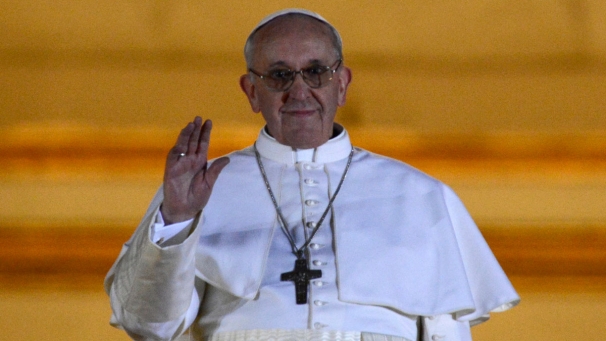
Pope Francis – Jorge Bergoglio
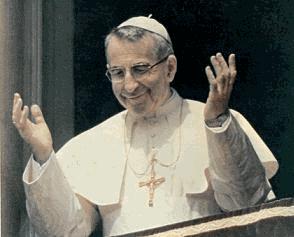
Pope John Paul I – Albino Luciani
 The Ecumenism Blog